

Criminologists have long argued that violence spreads like a contagious disease based on its tendency to cluster in time and space (e.g. Brantingham et al., Reference Brantingham, Carter, MacDonald, Melde and Mohler2021; Fagan et al., Reference Fagan, Wilkinson, Davies, Flannery, Vazsonyi and Waldman2007; Loeffler & Flaxman, Reference Loeffler and Flaxman2018; Loftin, Reference Loftin1986). The contagion of violence hypothesis has grown in popularity in recent years in the academic literature and in policy circles. As more criminologists adopt social network analysis, studies have consistently shown that violence not only clusters in networks but social proximity to victims of violence increases the likelihood of future victimization (Green et al., Reference Green, Horel and Papachristos2017; Papachristos et al., Reference Papachristos, Braga and Hureau2012, Reference Papachristos, Braga, Piza and Grossman2015; Papachristos & Wildeman, Reference Papachristos and Wildeman2013; Roberto et al., Reference Roberto, Braga and Papachristos2018). The popularity of the contagion of violence hypothesis is directly tied to its potential policy implications to reduce gun violence (Abt, Reference Abt2019; Brantingham et al., Reference Brantingham, Carter, MacDonald, Melde and Mohler2021; Fagan et al., Reference Fagan, Wilkinson, Davies, Flannery, Vazsonyi and Waldman2007; Slutkin et al., Reference Slutkin, Ransford and Zvetina2018). Leveraging the social networks that connect violent groups has been at the center of the most promising innovations in policing and violence prevention (Braga et al., Reference Braga, Kennedy, Waring and Piehl2001; Braga & Weisburd, Reference Braga and Weisburd2012; Gravel & Tita, Reference Gravel and Tita2015; Kennedy et al., Reference Kennedy, Piehl and Braga1996; Papachristos & Kirk, Reference Papachristos and Kirk2015; Roman et al., Reference Roman, Link, Hyatt, Bhati and Forney2019; Tita et al., Reference Tita, Riley and Ridgeway2003).
Recently, Brantingham et al. (Reference Brantingham, Yuan and Herz2020) have shown that gang violence is more likely than non-gang violence to exhibit the kind of spatiotemporal clustering scholars typically point to as support for the contagion of violence hypothesis (Huebner et al., Reference Huebner, Martin, Moule, Pyrooz and Decker2016; Zeoli et al., Reference Zeoli, Grady, Pizarro and Melde2015). Street gangs are known to produce a system of norms, opportunity structures, and group processes conducive to violent exchanges (A. K. Cohen, Reference Cohen1955; Klein & Crawford, Reference Klein and Crawford1967; Short & Strodtbeck, Reference Short and Strodtbeck1965). Gangs are particularly effective carriers of subcultural norms and codes of conduct that emphasize violent means to achieve and preserve status, especially when threatened or challenged (Anderson, Reference Anderson1999; Decker, Reference Decker1996; Horowitz & Schwartz, Reference Horowitz and Schwartz1974). In street gangs, retaliation for actual or perceived slights is often the norm (Decker, Reference Decker1996). The status-enhancing nature of violence provides incentives for individual involvement in violence (Gravel et al., Reference Gravel, Allison, West-Fagan, McBride and Tita2018) and dominance contests between groups (Brantingham et al., Reference Brantingham, Valasik and Tita2019; Nakamura et al., Reference Nakamura, Tita and Krackhardt2020; Papachristos, Reference Papachristos2009; Randle & Bichler, Reference Randle, Bichler, LeClerc and Savona2017). Retaliation is often the prototypical example used to demonstrate the self-generating quality of gang violence (Abt, Reference Abt2019; Brantingham et al., Reference Brantingham, Yuan and Herz2020; J. Cohen & Tita, Reference Cohen and Tita1999; Fagan et al., Reference Fagan, Wilkinson, Davies, Flannery, Vazsonyi and Waldman2007; Vilalta et al., Reference Vilalta, Lopez-Ramirez and Fondevila2021).
In this study, we examine the mechanisms through which violence spreads between street gangs in a region of Los Angeles. Our contribution is both theoretical and methodological. While retaliation is undoubtedly a critical mechanism to explain why gang violence often leads to more violence, we argue that additional mechanisms must be at play to explain the diffusion of violence to other groups beyond the retaliation dyad. We build on recent analyses of violent exchanges between gangs revealing the importance of supra-dyadic influences and the directionality of exchanges in explaining the structure and stability of gang violence (Bichler et al., Reference Bichler, Norris and Ibarra2020; Lewis & Papachristos, Reference Lewis and Papachristos2020; Nakamura et al., Reference Nakamura, Tita and Krackhardt2020; Papachristos, Reference Papachristos2009). We improve on those primarily cross-sectional studies by modeling the dynamic nature of inter-gang conflicts as they unfold to study what are fundamentally time-dependent processes. Like other mechanisms of diffusion, retaliation involves a sequence of directed events that unfold over time that can be immediate, delayed, repeated, or interrupted by another conflict. We take advantage of recent advances allowing for the modeling of competing social contagion processes (e.g. Parker et al., Reference Parker, Pallotti and Lomi2022) to produce a more sophisticated understanding of the contagion of gang violence.
In this study, we are exploring potential mechanisms to explain two well-studied features of gang violence: (1) its tendency to replicate and (2) its tendency to spread from one group to another. We take advantage of an underutilized tool to analyze gang violence uniquely suited to our objectives: relational event models (REMs) (Butts, Reference Butts2008). REMs allow us to follow the lead of recent scholars by studying supra-dyadic influences on violence (i.e., third parties) in a dynamic context (Bichler et al., Reference Bichler, Norris and Ibarra2020; Lewis & Papachristos, Reference Lewis and Papachristos2020; Nakamura et al., Reference Nakamura, Tita and Krackhardt2020). In doing so, we position the street gang as an actor whose actions are not solely influenced by their need for status but also react to the actions of others in their social environment, even when those actions do not directly involve them. Building from research on street gangs, intergroup conflict, and network theory, we use REMs to explore plausible mechanisms that may explain why gang violence, at the very least, appears to be contagious.
Th social meaning of gang violence
Some behaviors, especially those that entail some risks, appear to be transmitted between socially close individuals who use one another to evaluate the risk of adopting a behavior. Drawing from the work of Burt (Reference Burt1987) on the social contagion of innovation, Fagan et al., (Reference Fagan, Wilkinson, Davies, Flannery, Vazsonyi and Waldman2007, p.690) argued that violence spreads from one party to another “through a process of mutual influence involving contact, communication, and competition.” Fagan et al. (Reference Fagan, Wilkinson, Davies, Flannery, Vazsonyi and Waldman2007) argued that the social meaning of violence facilitates contagion dynamics in some communities and social networks: “The social meaning, in this case, involves actions (violence) that have both returns (identity, status, avoidance of attack) and expectations that, within tightly packed networks, are unquestioned or normative” (Fagan et al., Reference Fagan, Wilkinson, Davies, Flannery, Vazsonyi and Waldman2007, p.716). This social meaning influences others to consider replicating the behavior, perhaps because it has emerged over time as the fittest response to the challenging environments in communities with high rates of violence (see also Huebner et al., Reference Huebner, Martin, Moule, Pyrooz and Decker2016; Marsden, Reference Marsden1998). Proximity, communication, and competition with others facilitate the replication and diffusion of innovations (Burt, Reference Burt1987) and violence (Fagan et al., Reference Fagan, Wilkinson, Davies, Flannery, Vazsonyi and Waldman2007).
Gangs constantly communicate and compete with others in physical and social proximity. A gang operates in an environment where other groups are constantly challenging its legitimacy and status and engage in behaviors that simultaneously emphasize their group’s superiority in terms of status and violent potential and disparage the reputation of other gangs (Aspholm, Reference Aspholm2020; Decker & Van Winkle, Reference Decker and Van Winkle1996; Densley, Reference Densley2013; Lauger, Reference Lauger2012, Reference Lauger2020). Gangs scholars have long noted such behavioral patterns (Klein, Reference Klein1971; Short & Strodtbeck, Reference Short and Strodtbeck1965; Suttles, Reference Suttles1968; Thrasher, Reference Thrasher1927) These types of posturing behaviors have received renewed attention from scholars studying gang interactions on social media (Densley, Reference Densley, Ireland, Lewis, Lopez and Ireland2020; Leverso & Hsiao, Reference Leverso and Hsiao2021; Patton et al., Reference Patton, Pyrooz, Decker, Frey and Leonard2019; Reid et al., Reference Reid, Valasik and Bagavathi2020; Storrod & Densley, Reference Storrod and Densley2017; Stuart, Reference Stuart2020a, Reference Stuart2020b; Urbanik & Roks, Reference Urbanik and Roks2021). However, most research shows that gang members spend far more time talking about violence than engaging in violence (Bubolz & Lee, Reference Bubolz and Lee2019; Klein, Reference Klein1997; Lauger, Reference Lauger2017; Stuart, Reference Stuart2020a). Still, when gangs decide to be violent, they know to expect a response and that others are taking notes.
Although there is no such thing as a one-gang city (Klein, Reference Klein1997), our understanding of inter-gang interactions as a social system is relatively limited (Descormiers & Morselli, Reference Descormiers and Morselli2011; Lauger, Reference Lauger2012; McGloin, Reference McGloin2005; Papachristos, Reference Papachristos2009; Tita & Radil, Reference Tita and Radil2011; Tremblay et al., Reference Tremblay, Charest, Charette and Tremblay-Faulkner2016). This gap is surprising given the importance of inter-group conflict to the formation and maintenance of street gangs and their internal group processes (Brantingham et al., Reference Brantingham, Tita, Short and Reid2012; Decker, Reference Decker1996; Decker & Van Winkle, Reference Decker and Van Winkle1996; Short & Strodtbeck, Reference Short and Strodtbeck1965; Thrasher, Reference Thrasher1927; Vigil, Reference Vigil1988). As in many other types of informal groups (Festinger et al., Reference Festinger, Schachter and Back1950; Homans, Reference Homans1950; Tajfel & Turner, Reference Tajfel, Turner, Hatch and Schultz1979), the identification of an outgroup plays an essential role in the definition of the boundaries of street gangs (Papachristos, Reference Papachristos2005; Reid & Valasik, Reference Reid and Valasik2020; Short & Strodtbeck, Reference Short and Strodtbeck1965; Tremblay et al., Reference Tremblay, Charest, Charette and Tremblay-Faulkner2016). Without a clear and present threat from other groups, Decker (Reference Decker1996) argued that gangs would struggle to recruit new members to counterbalance the high turnover of gang membership (e.g., Carson et al., Reference Carson, Peterson and Esbensen2013). When faced with an outside threat—real or perceived—gang members become keenly aware of their dependence on one another for safety.
Research suggests that a gang would not survive very long as a group without inter-gang conflict. Despite popular conceptions, gangs rarely exhibit rigid, hierarchical structures that would facilitate coordination in gang “wars.” Instead, most gangs consist of loosely organized and connected subgroups without stable leadership (Bouchard & Spindler, Reference Bouchard and Spindler2010; Decker et al., Reference Decker, Katz and Webb2008; Decker & Curry, Reference Decker and Curry2002; Klein & Maxson, Reference Klein and Maxson2006; Ouellet et al., Reference Ouellet, Bouchard and Charette2019). However, research also shows that external threats are significant but ephemeral drivers of cohesion and solidarity in gangs (Decker & Van Winkle, Reference Decker and Van Winkle1996; Hagedorn & Macon, Reference Hagedorn and Macon1998; Hughes & Short, Reference Hughes and Short2005; Klein, Reference Klein1971; Klein & Crawford, Reference Klein and Crawford1967; Short & Strodtbeck, Reference Short and Strodtbeck1965). Threats from an outside group can lead to a “mobilizing event that pushes a ready and willing group beyond the constraints against violence.” (Decker, Reference Decker1996, p. 262). Even when mobilizing events do not translate into actual violence, they provide a source of excitement and individual members often derive social benefits (e.g., status, reputation, etc.) from their involvement and willingness to participate (Descormiers & Corrado, Reference Descormiers and Corrado2016). The stories of these events often take on a life of their own and contribute to the lasting collective myth of the gang created and maintained by both their members and others (Fleisher, Reference Fleisher1998; Hughes & Short, Reference Hughes and Short2014; Lauger, Reference Lauger2012; Papachristos, Reference Papachristos2009; Vigil, Reference Vigil2020).
Retaliation, reciprocity, and the replication of gang violence
Prior gang scholarship suggests that violence is such a fundamental aspect of gang life that it is doubtful whether these groups would survive (in their current form) if they were deprived of rivals. There are clear incentives for gangs to initiate violence and expectations that such violence will be reciprocated. It is these incentives and expectations that dictates that violence begets violence. Retaliation is the most obvious mechanism for the replication of gang violence.
The popular and scholarly conceptions of violent retaliation imply a directional action in response (i.e., causally related) to a specific action in the opposite direction, typically over a relatively short time. In the context of street culture, where honor and toughness are commodities and cowardice is never an endorsed option, any affront should be reciprocated immediately (Anderson, Reference Anderson1999; Horowitz, Reference Horowitz1983; Wolfgang & Ferracuti, Reference Wolfgang and Ferracuti1967). Gang members often claim that encountering a rival trespassing on their territory, defacing their graffiti, or insulting them is likely to be met with immediate retribution (Aspholm, Reference Aspholm2020; Decker, Reference Decker1996; Decker & Van Winkle, Reference Decker and Van Winkle1996; Fleisher, Reference Fleisher1998; Horowitz & Schwartz, Reference Horowitz and Schwartz1974; Hughes & Short, Reference Hughes and Short2005, Reference Hughes and Short2014). Retaliation of this sort tends to involve a knee-jerk reaction by the aggrieved party, which is often precipitated by the presence of third parties (Cooney, Reference Cooney1998; Fagan et al., Reference Fagan, Wilkinson, Davies, Flannery, Vazsonyi and Waldman2007; Valasik, Reference Valasik2018).
The empirical evidence of the primacy of retaliation in gang conflict is surprisingly more anecdotal than one would imagine. Prior research often depends on accounts of gang members often speaking in generalities about their intentions to retaliate should other groups attack or disrespect them (Hughes et al., Reference Hughes, Schaible and Kephart2022; Matsuda et al., Reference Matsuda, Melde, Taylor, Freng and Esbensen2013; Vecchio & Carson, Reference Vecchio and Carson2022). Given the well-known finding that gang members spend far more time talking about violence than engaging in it, it is worth asking whether retaliation is as essential a mechanism in inter-gang violence as gang members claim.
That is not to say that reciprocity does not play an important role in gang violence. Recent studies have demonstrated that reciprocity is a key structural feature of networks of inter-gang conflicts (Brantingham et al., Reference Brantingham, Valasik and Tita2019; Descormiers & Morselli, Reference Descormiers and Morselli2011; Lewis & Papachristos, Reference Lewis and Papachristos2020; Nakamura et al., Reference Nakamura, Tita and Krackhardt2020; Papachristos, Reference Papachristos2009; Randle & Bichler, Reference Randle, Bichler, LeClerc and Savona2017). However, studies of aggregated networks of gang violence may have obscured differences between reciprocity and retaliation. The use of aggregated networks of violent exchanges is likely to mask important temporal dynamics (see Faust & Tita, Reference Faust and Tita2019 for a critique of this approach). The processes that generate reciprocity in networks can only be identified when considering the temporal sequences of exchanges that lead to aggregated network structures (Bianchi et al., Reference Bianchi, Stivala and Lomi2022; Kitts et al., Reference Kitts, Lomi, Mascia, Pallotti and Quintane2017). For instance, reciprocity in cross-sectional networks of gang violence could arise from processes other than retaliation, such as gangs’ physical and social proximity or institutionalization of gang conflicts (Papachristos, Reference Papachristos2009; Randle & Bichler, Reference Randle, Bichler, LeClerc and Savona2017).
In cities like Chicago or Los Angeles, stable, long-lasting gang rivalry networks become institutionalized as “regular patterns of conflict create an organizational memory shaping a gang’s subsequent violent behavior” (Papachristos et al., Reference Papachristos, Hureau and Braga2013, p. 421). In this context, reciprocity could result from long-standing rivalries where each group builds its status by attacking the same old foe, somewhat independently from the actions this foe directs at them. Indeed, it is not uncommon for gang members to perpetuate deadly feuds with other groups without much of a rationale other than pointing to the historical nature of a rivalry (Decker et al., Reference Decker, Pyrooz and Densley2022; Decker & Van Winkle, Reference Decker and Van Winkle1996; Fleisher, Reference Fleisher1998; Lauger, Reference Lauger2012; Papachristos, Reference Papachristos2009).
Institutionalized conflicts between gangs may lead to “embedding reciprocation”, a process described by Kitts et al. (Reference Kitts, Lomi, Mascia, Pallotti and Quintane2017, p. 858) referring to the “stickiness” of inter-organizational exchanges over time. Organizations with a long history of exchanges become increasingly intertwined such that continued exchanges become optimized and routinized, resulting in inertia in exchanges (embedding inertia) even if other partners become available. Over time, dyadic dependence for resources leads to embedding reciprocation (Kitts et al., Reference Kitts, Lomi, Mascia, Pallotti and Quintane2017). Gangs experiencing significant and frequent membership turnover rely on inter-gang conflicts to maintain group cohesion. The very survival of the gang as a group may depend on their ability to maintain efficient, routinized exchange channels through which they trade violence in exchange for periodic jolts to their group’s internal cohesion. Reciprocity of this nature operates on a longer time scale and could emerge from two groups’ congruence in their need for a villain to justify its existence.
Our study aims to examine how retaliation unfolds over time and the relative importance of recent conflicts and historical rivalries in predicting future violence. Moreover, examining how gang conflicts evolve on a micro scale enables us to differentiate between reciprocity and retaliation. From a policy standpoint, it may be crucial to distinguish patterns of violence driven by the routine of institutionalized conflicts from those more situationally driven and therefore operating at a smaller time scale. From a theoretical standpoint, we may infer different mechanisms of contagion if the dyadic pattern between gangs A and B follows the sequence A→B, A→B, B→A, B→A rather than A→B, B→A, A→B, B→A. While both patterns demonstrate reciprocity in the aggregate, the first may be more indicative of embedding reciprocity based on established rivalries, whereas the second may be more indicative of situationally driven retaliation.
To understand how gang violence leads to more gang violence in the future, the first research question we are answering in this paper is as follows:
RQ1—What is the relative importance of institutionalized conflicts (i.e., rivalries), inertia, reciprocity, and immediate retaliation on the replication of gang violence?
Mechanisms of diffusion of gang violence
Contagion processes—social or otherwise—do not simply explain the reproduction of an entity; they explain the diffusion of this entity beyond the initial host. We know far more about the reproduction of gang violence than we do about its diffusion. Research on group processes and scholarship on retaliation outside the gang context also provide some potential mechanisms that may explain why gang violence spreads beyond the initial violent dyad. Furthermore, while scholars are only beginning to consider supra-dyadic dynamics of gang violence, these studies have produced insightful results.
Research on retaliation offers at least one pathway through which an initial conflict between two groups may spill over to another. While norms of retaliation typically dictate that any affront should receive a response, there are many circumstances where a response may be delayed or inaccurate (Jacobs, Reference Jacobs2004; Jacobs & Wright, Reference Jacobs and Wright2006). Retaliation may be delayed out of necessity—until the violating party can be identified or until competitive advantage can be secured. For instance, gang members may wait until they can gather more people or secure weapons before retaliating (Fleisher, Reference Fleisher1998; Lauger, Reference Lauger2012). More importantly, information on the streets is imperfect or inaccurate, and it may be impossible to identify the violating party accurately. For instance, drive-by shootings—a practice particularly prevalent in Los Angeles in the 1990s (Hutson et al., Reference Hutson, Anglin and Eckstein1996)—may obscure shooter’ identity, making revenge more difficult to exact (see also Valasik & Reid, Reference Valasik and Reid2021). A simple mechanism to explain why violence spreads to third parties may be through cases of mistaken identity. However, such a scenario may simply reinforce prior conflicts rather than start new ones: hasty conclusions may be more likely to lead to the identification of a familiar foe than a new one. Regardless of the obstacles that impede swift retaliation, cultural expectations often dictate that an attack should be met with a response, even if that response is imperfect. Jacobs (Reference Jacobs2004) uses the term “imperfect retaliation” to describe responses displacing violence towards a third party not involved in the original conflict. While not entirely satisfactory, these attacks play an important symbolic role for the party engaging in them. To the extent that others perceive the victim as a worthy adversary, imperfect retaliation allows the party to regain status lost as a result of the initial attack.
Jacobs’ description of imperfect retaliation is consistent with the notion of generalized exchanges (Bearman, Reference Bearman1997), a mechanism that could explain how violence may spread outside the dyad. The concept is rooted in Emerson’s social exchange theory which itself emerged as a response to the overemphasis on dyadic exchanges in traditional work on social exchanges (Cook & Emerson, Reference Cook and Emerson1978; Cook & Whitmeyer, Reference Cook and Whitmeyer1992; Emerson, Reference Emerson1962, Reference Emerson1976; Yamagishi & Cook, Reference Yamagishi and Cook1993), the very problem that seems to plague attempts at explaining the spread of violence.
Generalized exchange is a useful concept to understand the dynamics of inter-gang violence because of the nature of benefits groups acquire when they engage in violent exchanges. It would be easy to assume that the receiver of violence, unlike for positive exchanges like gift-giving, is in fact a loser in the exchange. Gang scholars have implied that an imbalance in incoming and outgoing violence in a dyad or the displacement of violence to a third party indicates hierarchy in social dominance contests between gangs (Bichler et al., Reference Bichler, Norris and Ibarra2020; Brantingham et al., Reference Brantingham, Valasik and Tita2019; Papachristos, Reference Papachristos2009; Randle & Bichler, Reference Randle, Bichler, LeClerc and Savona2017). In a system that places a high premium on a violent reputation, gangs cannot afford to look as though they are unwilling to engage in violence. If they are not able to directly reciprocate an attack, the next best thing may be to attack someone else. The ability to engage in targeted attacks also sends a message to others about their willingness to retaliate, a step in achieving the instrumental goal of deterrence of future attacks by opponents who perceive cowardice and weakness (see Nakamura et al., Reference Nakamura, Tita and Krackhardt2020). This perspective assumes that both the group considering how to respond to an attack and uninvolved third parties observing the conflict behave as rational, utility-maximizing, collective actors and evaluate the exchange similarly. Even when they are objectively on the losing end of a battle (e.g. in terms of causalities), gang members have an uncanny ability to reinterpret the events as a win (Aspholm, Reference Aspholm2020; Decker, Reference Decker1996; Decker & Van Winkle, Reference Decker and Van Winkle1996; Fleisher, Reference Fleisher1998; Lauger, Reference Lauger2012; Short & Strodtbeck, Reference Short and Strodtbeck1965).
An alternative explanation may be that gangs on the receiving end of an attack are not losers at all: the “gift” the group receives is a temporary increase in cohesion that allows for collective behaviors. While the “gift” may be leveraged to retaliate against the giver, increased cohesion may “prime” this group for more conflicts, regardless of the target. By the same logic, considering the weak organization of gangs as collective actors (Decker, Reference Decker1996; Decker & Curry, Reference Decker and Curry2002), a group uninvolved in a prior conflict may actually be at a “cohesive disadvantage” compared to groups actively involved. Therefore, the ability of a group to take advantage of a perceived weakness in another group that was just on the receiving end of an attack may be less likely than the reverse scenario.
The emerging evidence on the structure of inter-gang networks supporting dominance hierarchy is thin and generally relies on non-network measures of dominance such as dyadic imbalance in incoming vs outgoing violence (Descormiers & Morselli, Reference Descormiers and Morselli2011; Nakamura et al., Reference Nakamura, Tita and Krackhardt2020) or cross-sectional aggregated analyses of gang networks (Bichler et al., Reference Bichler, Norris and Ibarra2020; Lewis & Papachristos, Reference Lewis and Papachristos2020; Papachristos, Reference Papachristos2009; Randle & Bichler, Reference Randle, Bichler, LeClerc and Savona2017). Using a series of exponential random graph models of two year “slices” of networks of gang violence in Chicago, Lewis and Papachristos (Reference Lewis and Papachristos2020, p. 1853) conclude that there is very little evidence of hierarchical structuring in gang violence (e.g., lack of transitivity, absence of gangs who are victims only); gangs appear to “resist subordination by others and engage in ongoing, localized struggles to assert superiority.” Notably, the authors report significant inconsistencies across models, finding some evidence of generalized exchanges or transitivity in some periods but not in others. This finding highlights important limitations of aggregating relationships to assess the dynamics of violence and other social networks (Mulder & Leenders, Reference Mulder and Leenders2019).
Regarding the diffusion of gang violence, a key objective of this study is to examine plausible supra-dyadic mechanisms in the spread of gang violence. Broadly, we are interested in examining how third-party gangs become involved in ongoing conflicts. Specifically, we seek to answer the following questions:
RQ2—When do third parties become involved in gang conflicts?
RQ3—What is the relative importance of generalized exchanges (i.e., cyclic closure) and hierarchical patterns of conflicts (i.e., transitive closure) in gang conflicts?
RQ3.1—Do gangs’ position in the rivalry network (i.e., Bonacich power) provide them with a competitive advantage in gang conflicts?
Relational event framework
The relational event framework is a generalized analytical approach that is able to include “a wide assortment of cognitive, behavioral, and social/contextual processes” to forecast future dynamic social behaviors (Butts, Reference Butts2008, p. 158; Butts & Marcum, Reference Butts, Marcum, Pilny and Poole2017). The principal element is the relational event (i.e., gang violence) which is a discrete event performed by one social actor (i.e., gang member), the sender, and directed towards another social actor, the receiver. The social interaction being examined (i.e., the relational event) is the unit of analysis.
A REM requires a series of time ordered events documenting the sequence of actions that transpire between a set of senders and a set of receivers over a delineated time period (Butts, Reference Butts2008; Butts & Marcum, Reference Butts, Marcum, Pilny and Poole2017). REMs rely upon a simplifying assumption that each potential event (i.e., gang violence) is conditionally independent and the potential event’s hazard, the propensity for a particular social action to transpire, remains constant between events while accounting for the prior history of events (Butts, Reference Butts2008, Reference Butts2017). Observing social actions that transpired in addition to social actions that did not transpire, but could have, REMs seek to identify the propensities for all possible events to occur (Butts & Marcum, Reference Butts, Marcum, Pilny and Poole2017).
REMs typically include three groups of covariates: node-level covariates, dyadic covariates, and sequential structural signatures (SSS; Leenders et al., Reference Leenders, Contractor and DeChurch2016). Node-level covariates are characteristics of the actors that might influence their involvement in events. Dyadic covariates refer to characteristics of dyads such as homophily, proximity, or prior relationships. SSS covariates refer to the emergence of structural patterns in relational events as time unfolds and allow researchers to operationalize theoretical mechanisms to explain social exchanges. Common examples of SSS are inertia—the tendency of actors to continue exchanges with the same previous partners, and recency—the tendency of actors to target others they have recently targeted or have recently targeted them. Some SSS also capture supra-dyadic processes such as cyclic and transitive closure. A special kind of SSS allows researcher to specify sequences of events called p-shifts, inspired by shifts in roles during conversations (Gibson, Reference Gibson2005). Of particular importance to the current study is the p-shift PSAB-BA, which indicates a sequence of event where A directs an action toward B followed in the very next event by B directing an action toward A. In the context of gang violence, a positive and significant effect of PSAB-BA would be the best evidence of the likelihood of immediate retaliation between gangs. In this study, we leverage the relational event framework to investigate plausible mechanisms for the replication and diffusion of gang violence proposed in the available literature on street gangs and inter-group conflicts in general.
Methods
Data
This study relies on data maintained by the Los Angeles Police Department’s Hollenbeck Community Policing Area and were originally collected as a part of a project aimed at reducing gang violence (Tita et al., Reference Tita, Riley and Ridgeway2003). The data include all known gang-related violent crimes from November 1999 to October 2002. During the research period Hollenbeck experienced 1,115 gang-related violent crimes, in which the offender, victim, or both were known to be associated with a gang. In 474 of these incidents, gang affiliation was known for both the victim and the offender, and the incidents involved two different gangs. Thirty-two of these events involved gangs whose territory was not in the study area. Thus, the final data used for our analysis are 434 violent interactions between 33 criminally active Hollenbeck gangs. These interactions primarily consist of serious violent crimes such as assaults with a firearm (50.2%), homicides and attempted homicides (22.8%), shots fired (21.0%), and other assaults (4.3%). The remainder of incidents involve different forms of threats (1.7%). On average, gangs directed 15.24 attacks (S.D. = 9.39, median = 13) and were attacked 13.39 times (S.D. = 9.36, median = 13) over the study period.
Gang and dyadic covariates
In addition to information about gang conflicts, we leverage information about gang characteristics, their established rivalries, and the geographic location of their territories. The boundaries and locations of gang territories were identified and mapped through collaborations with detectives and patrol officers in LAPD’s Hollenbeck gang unit and Los Angeles County probation officers, who were assigned to Hollenbeck gang members. From these maps, we extract two control variables we include in our models: distance between gang territories (Distance) and gang territories overlapping with public housing communities (Public housing). Gangs in proximity from one another may be more likely to be involved in conflicts. Regarding public housing, Griffiths and Tita (Reference Griffiths and Tita2009) argue that residents in LA’s public housing communities have historically been socially isolated from other communities, leading to social networks that are rather confined to these communities (see also Barton et al., Reference Barton, Valasik, Brault and Tita2020). Therefore, it is expected that gangs residing in a public housing community may be more likely to be involved in violence. Seven of the 33 Hollenbeck gangs (21.2%) had territories overlapping with public housing communities.
Gang size is measured as the total number of identified members for each gang in the CalGang database as of September 1, 2003. Determining membership size using databases remain a contentious topic for a variety reasons including high turnover rates, failure to remove non-active/deceased members, and the misidentification of associates (Densley & Pyrooz, Reference Densley and Pyrooz2020; Huff & Barrows, Reference Huff, Barrows, Decker and Pyrooz2015). Therefore, the numbers extracted from CalGang are rough estimates of gang size and were used to create a categorical variable based on quartiles of the size estimates. Small gangs (21.2%) refer to groups with less than 60 members; Medium gangs (33.3%) have between 80 and 130 members; Large gangs (18.2%) have between 150 and 250 members; and very large gangs (27.3%) have more than 300 members.
Established rivalries between gangs of Hollenbeck were identified by a survey of LAPD officers and gang members (see further Tita et al., Reference Tita, Riley and Ridgeway2003; Tita & Radil, Reference Tita and Radil2011). All gangs have at least one rival, 5.79 on average (S.D. = 2.45), with the number of rivals ranging from one to ten. Using the rivalry network, we calculated Bonacich power (Bonacich, Reference Bonacich1987) of gangs. Bonacich power is defined a weighted sum of a node’s ties (i.e. degree) where each tie is weighted by the degree centrality of the alter. Bonacich power allows us to specify a parameter beta for the size and direction of the weight given to other nodes’ centralities. We set the value of beta to be the negative reciprocal of the largest eigenvalue of the rivalry adjacency matrix. Gangs with a high Bonacich power have many rivals who have few rivals themselves.
Sequential structural signatures and modeling approach
To test our research questions, we selected SSS statistics based on theoretical and empirical knowledge on gang violence. Table 1 provides an overview of the SSS statistics included in the model and detailed interpretations are described in the results section. For RQ1, we include Target inertia to account for the tendency of gangs to attack gangs they have previously attacked, Recent target persistence captures a gang’s tendency to attack the gangs they have attacked last, Recent reciprocity Footnote 1 captures a gang’s tendency to attack the gang that have attacked them last, and Immediate retaliation which uses the p-shift PSAB-BA to operationalize the tendency for a gang to retaliate for an attack with the very next event. For RQ2, we include two additional p-shift statistics capturing the diffusion of violence beyond the initial dyad: Displaced violence (PSAB-BY) where a gang previously under attack targets with the next event any gang other than the one that previously attacked them; and Violent spree (PSAB-AY) where gangs attack two different gangs in consecutive events. For RQ3, we include SSS statistics that reflect the emergence of triads in a pattern suggestive of generalized exchanges (Cyclical violence) and hierarchical structure (Transitive closure). Both cyclical violence and transitive closure are standardized for each event to be on a comparable metric.
Sequential structural signatures visualization and interpretation

In our REM, the rate of an attack of gang i towards gang j at time t follows a log linear relationship:
 \begin{equation}\log(\lambda _{ij}(t)) = \beta _{0} + \beta _{1}\times x_{ij}^{1}(t)+\beta _{2}\times x_{ij}^{2}(t)+\ldots +\beta _{20}\times x_{ij}^{20}(t)\end{equation}
where
 $x_{ij}^{k}(t)$
denotes the k-th predictor variable (column 1 in Table 2 provides an overview of all 20 predictor variables),
 $\beta _{k}$
denotes the relative importance of the k-th predictor, and
 $\beta _{0}$
denotes the intercept (which captures the average attack rate between gangs over time). The time of the next attack then follows an exponential distribution with rate parameter equal to the sum of the rates of all directional dyads, i.e.,
 $\sum _{i,j}\lambda _{ij}(t)$
, and the dyad that is observed next follows a multinomial distribution where the probability of a dyad is proportional to its rate parameter (DuBois et al., Reference DuBois, Butts, McFarland and Smyth2013). Finally, all model statistics were computed using the R package remstats (v2.0; Tillburg Network Group, 2021) and the model was fit with an exact time REM using maximum likelihood estimation using the relevent R package (v1.1; Butts, Reference Butts2022).
Maximum likelihood estimates of the fitted relational event model

Results
Descriptive results
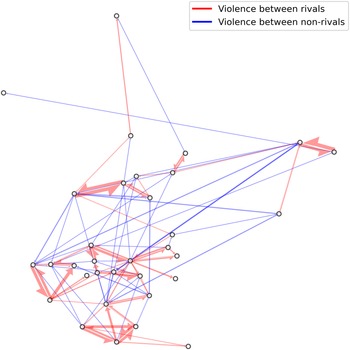
Figure 1 shows the aggregated violence over the study period. The directed edges’ size shows the intensity of violence volume over the study period, and the color indicates whether the violence occurs between rivals (in red) or non-rivals (in blue). The nodes are positioned relative to the geographic position of their territories. Figure 1 shows the importance of proximity for gang violence, as most intense ties tend to occur between gangs. The network also highlights the importance of rivalries. While some violence occurs between non-rivals, such violence is not very frequent, and the most intense violence occurs between rivals. Of all incidents, 86.9% involved rivals. Figure 1 also shows the importance of reciprocity, particularly when conflicts occur between rivals.
Volume of violence (size of arrows) between rivals and nonrivals. Note: Nodes are positioned according to their geographic territories.

Although there are 1056 possible directed dyads (33 × 32), violence is concentrated in only 118 directed dyads (11.2%) involving 87 pairs of gangs. While most pairs of gangs are involved in one-sided conflicts (64.4%), those pairs account for only 21.3% of all conflicts, with each conflict having, on average, 1.7 attacks (S.D. = 1.4, median = 1). Only 10.7% of those one-sided conflicts involve three or more attacks (max = 8), and 37.5% involve rivals. The 31 pairs where both gangs directed at least one attack account for 78.7% of conflicts, with conflicts having, on average, 11.2 attacks (S.D. = 10.5, median = 5). Of reciprocated dyads, 80.6% involve rivals, but those reciprocated dyads between rivals account for 95.7% of conflicts in reciprocated dyads and 75.3% of all conflicts.
Even within conflict dyads exhibiting reciprocity in the aggregate, it is not uncommon for conflicts to be temporarily one-sided. Of the 348 violent incidents in reciprocal conflict dyads, 165 (47.4%) are incidents where the attacker’s identity changes from the previous event, a pattern most closely resembling retaliation. However, it is common for gangs between these exchanges to direct several unreciprocated attacks in a row. Interestingly, even if conflicts appear to be periodically one-sided, each dyad’s overall volume of violence is strikingly balanced. On average, the gang in the dyad with the most attacks accounted for 58% of them (S.D. = 8.3%, median = 55.5%), and only 4 of the 31 reciprocated dyads (12.9%) involved one gang directing more than 70% of attacks (max = 76.9%).
When it does occur, retaliation can be swift: 5.4% of reciprocated incidents occur within a day, 21.2% within a week, and 45.4% within a month. Some reciprocated attacks take a much longer time to occur, which makes it unlikely that this particular attack was a response to the prior act of aggression: 26.7% of reciprocated incidents occur three months or more after the previous attack, and 12.1% occur more than six months after the previous attack.
Results of the REM
The REM results are presented in Table 2, which includes the unstandardized maximum likelihood estimates (MLE), denoted by β, as well as the corresponding standard errors, the Z values, and the p values. A researcher needs to interpret the network coefficients of a REM (and other statistical network models) with great care. Effects in a REM are often embedded in one or more other effects, making the “ceteris paribus” interpretation of traditional regression models problematic in some REMs. Dyads are embedded in triads, triads are embedded in four-cycles, et cetera, which makes it often infeasible to interpret one network effect independently of others. Hence, researchers must exercise caution in drawing conclusions from numerical estimates of parameters in REMs.
Fortunately, in our model, this “effect-embeddedness” is low, which can be seen in the weak correlations between most endogenous effects (see Appendix). When inspecting the correlation matrix between the effects, we can see that the only high correlation occurs between target inertia and recent target persistence: the preference for attacking recent targets increases with the tendency to keep targeting the same gangs. All other correlations are low enough that ceteris paribus interpretations of the effects appear safe.Footnote 2
To assess our model’s goodness of fit, we checked how well it could predict the observed gang attacks. We calculated the estimated rate for each dyad, ordered them from low to high and determined the percentile (from 0 to 1) for each dyad. The least likely dyad has percentile 0 meaning that a conflict between these gangs would be surprising at this point in time. The most likely dyad has percentile 1, meaning that a conflict between these gangs is expected at that particular point in time. For each event, Figure 2 shows the percentiles of realized dyads. The figure shows that our model predicts most realized dyads relatively well (e.g., scores very close to 1), with the median score being 0.980. Realized dyads tend to be among the top 2% of the potential dyads (for that event), as predicted by our model. Considering that 1056 potential dyads can occur at each event, this illustrates a very good model fit. Further, the figure shows that the model’s predictive accuracy is approximately constant over time, without any periods where the model clearly underperforms, implying that the model fit for violence dynamics between gangs is constant over time. The model’s predictive accuracy also extends to the rate of violence of individual gangs. Despite some heterogeneity in the number of attacks gangs are involved in, simulations using the fitted model generally replicated the observed rate of violence for gangs regardless of their level of activity.
Percentiles of realized dyads.

A key property of the REM is the assumption of piecewise constant hazards for all dyads between the observed events. This property follows directly from the fact that waiting times between events follow an exponential distribution. Using the fact that the waiting times are assumed to follow an exponential distribution where the rate parameter is equal to the sum of the rates for all dyads per event, we can normalize the waiting times using the fitted model by multiplying every waiting time with the estimated rate parameter from the fitted model. By inspecting whether the normalized waiting times follow an approximately exponential distribution with a rate parameter of 1, we can check whether the assumed exponential distribution for the waiting times is reasonable and whether the piecewise constant hazard assumption is violated. The histogram of these normalized waiting times for our model is shown in Figure 3.
Normalized waiting times.

Overall, the normalized waiting times match the exponential distribution reasonably well, except for a slightly higher-than-expected concentration of normalized waiting times at either end of the distribution (i.e., short and long normalized waiting times). These deviations are relatively small, however, which suggests that the model provides a good fit to the data.
Public housing, size, and geographic proximity
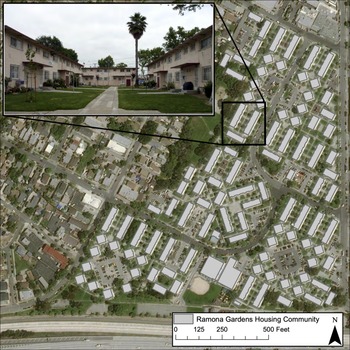
Prior research suggests that public housing communities provide gangs with a competitive advantage in terms of their ability to attack and avoid victimization (Barton et al., Reference Barton, Valasik and Brault2021; Griffiths & Tita, Reference Griffiths and Tita2009). Many public housing projects (see e.g., map of Ramona Gardens, Figure 4) are built as clusters of buildings interconnected by walkways accessed by only one or two streets. Figure 4 shows the physical structure of the streets within these communities and provide a close-up on one of the units within the community. The overall structure of the communities leaves very few entry and exit points into the community, making it easy to identify intruders from gangs who do not reside in the public housing community (Griffiths & Tita, Reference Griffiths and Tita2009; Lasley, Reference Lasley1998). Furthermore, the gathering areas are enclosed inside groups of buildings. A rival member wanting to launch an attack would not be able to drive by but would need to physically enter this enclosed area, where resident gang members may have an advantage.
Map of Ramona Gardens Housing Community.

To account for this potential source of heterogeneity between actors in our model, we included a dummy indicator for gangs in public housing communities as both a sender and receiver covariate. The results suggest that public housing communities may offer gangs a protective advantage over others but do not appear to offer a competitive advantage in attacks. Gangs in public housing communities do not have a statistically significant difference in the rate of violence directed to other gangs (
 $\beta$
= 0.151, p = 0.211), but have a significantly lower rate of victimization than nonpublic housing gangs (
 $\beta$
= –0.283, p < .05).
Another source of heterogeneity between gangs in our model may be linked to the size of the gangs. Larger gangs have more members available to attack other gangs, and other gangs have more members to attack. Gang size may also be a visible indicator of strength and power to other gangs. Using data from Hollenbeck, Brantingham et al. (Reference Brantingham, Valasik and Tita2019) find that the relationship between gang size (measured as territory size) and violence is not necessarily straightforward. Our findings somewhat support their conclusion, but generally, the larger gangs tend to be more often attackers and victims than smaller gangs. Compared to small gangs, large (
 $\beta$
= 0.652, p < 0.01) and very large gangs (
 $\beta$
= 0.519, p < 0.05) are involved in a greater number of attacks, though that is not the case for medium-sized gangs (
 $\beta$
= –0.130, p = 0.522). When it comes to victimization, only very large gangs are significantly more often victimized compared to small gangs (
 $\beta$
= 0.657, p < 0.01). If gang size is a proxy for gang strength or power, it does not appear to be a particularly effective deterrent for other gangs.
Finally, given the territoriality of gangs in Hollenbeck, we expect gangs whose territories are spatially close to have a higher rate of violence. Our model supports this expectation with the rate of violence between groups decreasing with the distance between their territories (
 $\beta$
= –0.913, p < 0.01). We now turn to the results relating to our main research questions.
Replication of gang violence
RQ1—What is the relative importance of institutionalized conflicts (i.e., rivalries), inertia, reciprocity, and immediate retaliation on the replication of gang violence?
To answer RQ1, we compare the effect of established rivalries, target inertia, recent target persistence, recent reciprocity, and immediate retaliation (PSAB-BA). Our model shows the importance of established rivalries (
 $\beta$
= 1.676, p < 0.01) and target inertia (
 $\beta$
= 1.422, p < 0.01) to patterns of gang violence. Established rivalries are similar to Papachristos’ notion of institutionalized conflicts in that they indicate the history of sustained conflicts between groups that predates the violence we observe in our model. Target inertia shows the tendency for gangs to continue attacking the groups they most frequently have attacked during the short history of our model. The fact that both effects are significant in our model suggests that when new conflicts do emerge, they are likely to have a lasting impact, perhaps eventually becoming “institutionalized”. The effect of recent target persistence suggests that a gang’s choice of target is not simply a matter of repeating the history of established conflicts; gangs are more likely to continue attacking the gangs they most recently attacked (
 $\beta$
= 0.944, p < 0.01).
Our model also shows that gangs react to the violence that comes to them above and beyond the effect of institutionalized conflicts and their tendency to continue attacking the same groups. The effect of recent reciprocity shows that gangs are more likely to attack gangs that recently attacked them (
 $\beta$
= 0.715, p < 0.01). Note that recent reciprocity can be seen as a form of delayed retaliation where the rank of the last attack of A to B affects the attack rate of B to A via the reciprocal of the rank (Table 1). Recent reciprocity shows a general tendency for gangs to reciprocate attacks at some point in the future, but our model also shows a tendency for gangs to retaliate immediately after a previous attack. The effect of immediate retaliation (
 $\beta$
= 0.611, p < 0.05) is operationalized using the p-shift AB-BA indicating that an attack from gang A on gang B is followed by gang B’s retaliation before any other attack occurs in the entire system. Absent more qualitative data on inter-gang conflicts, such a rapid response to an initial attack is the clearest evidence of retaliation motivated by a specific attack.
To answer RQ1, it is important to note that the model captures retaliation as a combination of recent reciprocity (0.715) and immediate retaliation (0.611). A consequence is that if gang A attacks gang B, the event rate of B attacking A next is multiplied by exp(0.715 + 0.611) = 3.76. Moreover, if gangs A and B are also rivals, the attack rate of B towards A would be exp(0.715 + 0.611 + 1.676) = 20.13 times larger, and if B only attacked A in the past, then the attack rate of B towards A would become exp(0.715 + 0.611 + 1.676 + 1.422) = 83.43 times larger. Reciprocity is clearly an important norm in gang conflicts, and immediate retaliation is likely, independently from a prior history of conflicts. However, our model suggests that prior history of conflicts or attacks (e.g., rivalries, target inertia, and recent target persistence) is a relatively stronger predictor of future violence.
Diffusion of gang violence
RQ2—When do third parties become involved in gang conflicts?
RQ3—What is the relative importance of generalized exchanges (i.e., cyclic closure) and hierarchical patterns of conflicts (i.e., transitive closure) in gang conflicts?
RQ3.1—Do gangs’ position in the rivalry network (i.e., Bonacich power) provide them with a competitive advantage in gang conflicts?
An important objective of this paper is to examine how gang violence spreads beyond the typical dyadic patterns of rivalries and retaliation. RQ2 and RQ3 examine plausible mechanisms that might explain how conflicts may reach third parties. For RQ2, we considered different p-shift statistics to explore when third parties become involved in a sequence of conflicts.
To answer RQ2, we included two p-shift statistics. First, we included a statistic for displaced violence (PSAB-BY) where gang B, after being attacked by gang A, immediately attacks any other gang besides gang A. Such a pattern may result from different variants of what Jacobs’ called “imperfect retaliation” (2004) whereby gang B either responds to an attack but attacks the wrong party or faces too large a disadvantage against gang A and attacks another gang to salvage their violent reputation. Our model does not find evidence of displaced violence, at least not in such quick succession (
 $\beta$
= 0.379, p = 0.15). Second, we include a statistic we call violent spree (PSAB-AY), where gang A follows an attack on gang B with the very next attack on another gang, which is statistically significant in our model (
 $\beta$
= 0.598, p < 0.05). This effect is consistent with the notion that gangs engaging in violence may galvanize their members into more violence (Decker, Reference Decker1996; Hughes, Reference Hughes2013; Hughes & Short, Reference Hughes and Short2005; Klein & Crawford, Reference Klein and Crawford1967).
Given the limited literature on the role of third parties in gang conflicts, we explored the inclusion of terms that could logically account for third-party involvement, but these terms were ultimately dropped from the model. Specifically, we considered two “turn usurping” (Gibson, Reference Gibson2005) p-shifts where a gang not involved in the attack from gang A to B decides to either immediately attack the victim of the prior conflict (PSAB-XB) or attack the attacker of the prior conflict (PSAB-XA). These effects could be interpreted as reflecting a gang wanting to attack another in their moment of weakness (PSAB-XB) or a gang wanting to either retaliate on behalf of an ally or to police violence by an aggressive gang. In preliminary models, these effects both had large p-values (0.249 and 0.561) and were ultimately dropped in the final model.
In part, the spread of violence to third parties may be collateral damage from the temporary boost to internal group cohesion provided by the excitement of an attack. We find no evidence that third-party gangs actively become involved following conflicts between other gangs. We also did not find evidence that gangs displace their aggression to third parties out of some perception of inferiority or because of the information asymmetry involved in predatory gang attacks at least not in the short term—these processes may still be at play in the long term.
The statistics we include to answer RQ3 do consider the influence of third parties on gang conflict in a less immediate sense. Much of the literature on gang violence argues for a certain hierarchical nature of gang status contests, not unlike pecking orders in the animal kingdom (Chase, Reference Chase1980, Reference Chase1982; Papachristos, Reference Papachristos2009; Randle & Bichler, Reference Randle, Bichler, LeClerc and Savona2017). Others have proposed that gangs are more likely to be involved in localized, generalized exchanges where the pecking order is unclear and constantly challenged (Lewis & Papachristos, Reference Lewis and Papachristos2020). We have already shown that gangs are not likely to immediately pick on weakened opponent or displace their aggression towards targets that perhaps offer a more favorable matchup. To investigate the relative merit of generalized exchanges and hierarchical patterns of conflicts, we examine the tendency of cyclic and transitive closure in gang violence. Our model suggests that while there is no statistically significant tendency for incoming two-paths to be closed (
 $\beta$
= 0.050, p = 0.11), there is evidence of a tendency for transitive closure in gang violence (
 $\beta$
= 0.069, p < 0.05). Transitive closure in this context suggests that whatever status hierarchy exists between gangs, it is not very well defined or steep. If the difference in status between gangs was steep, when gang A attacks gang B and gang B attacks gang C, there should be no need for gang A to attack gang C to establish its superiority. Nevertheless, the positive effect of transitive closure suggests otherwise, even though the effect is relatively small.
Hierarchy in violent exchanges may be encoded in the structure of historical rivalries. We included negatively weighted Bonacich power in the rivalry network as both a sender and receiver effect in the model. Negative Bonacich power reflects a measure of status derived from the lack of alternative paths ego’s alters have in their own network, and these alters’ greater dependence on ego. Bonacich’s (Reference Bonacich1987) motivation for creating this measure was to account for the fact that degree centrality in exchange networks does not necessarily correlate with success. Cook et al. (Reference Cook, Emerson, Gillmore and Yamagishi1983) found that people with many connections to potential trading partners whom themselves had many trading partners reduced that person’s ability to bargain as, in this context, it is advantageous to be connected to people with fewer trading options.
In a rivalry network, an interpretation of the relationship between power and violence potential might be one based on opportunity. Gangs with many rivals whose attention is primarily directed toward them (because they have few other rivals) may be expected to be attacked more often. Given the norms of reciprocity in gang violence and that gangs with high power have many rivals and, therefore, more opportunities to engage in violence, we might expect aggression to be positively related to power. Our model shows that power in the rivalry network is associated with a higher rate of aggression (
 $\beta$
= 0.270, p < .05), but its effect on victimization is negative and not statistically significant (
 $\beta$
= –0.201, p = .07).
It is not surprising that gangs maintaining many rivalries with other groups with few rivals engage in a higher rate of violence because they have many opportunities to do so. However, one would expect gangs with few rivals to be constrained in their opportunities to direct violence, possibly leading to a concentration of attacks on their well-connected rivals. In such a scenario, we should see gangs with many less connected rivals receive substantial violence, but this is not the case. One potential explanation may be that gangs with few rivals are weaker and therefore pose a lower threat, suggesting a certain status hierarchy emerging in the long term. An alternative explanation may be that gangs with fewer rivals are less often attacked by other groups, depriving these groups of the galvanizing effect of an attack on their willingness to engage in violence.
Limitations
While the current study advances research on gang violence dynamics, several limitations must be acknowledged. The data employed from this study relies on police records, and reporting bias may exist as not all violent interactions between gangs may be reported. That said, specialized police units, such as homicide and gang units, dedicate more time and effort to investigating violent or gang-related crimes (Katz & Webb, Reference Katz and Webb2006; Pizarro et al., Reference Pizarro, Terrill and LoFaso2020). Prior studies have affirmed that law enforcement collects reliable gang data (Decker & Pyrooz, Reference Decker and Pyrooz2010; Katz et al., Reference Katz, Webb and Schaefer2000). In this study, the thoroughness of investigating gang-related violence is crucial since the analyses require reliable data on gang affiliations of both the suspect and the victim. This study also focuses on a local jurisdiction within the city of Los Angeles to improve generalizability with other municipalities that are closer in size (approximately 180,000 residents). However, the results may be restricted to urban areas similar to Hollenbeck. Relatedly, Hollenbeck’s gangs are demographically homogeneous, mostly of Mexican American descent, and considered “traditional” in nature, with strong territorial dispositions and intergenerational linkages (Klein & Maxson, Reference Klein and Maxson2006; Tita et al., Reference Tita, Riley and Ridgeway2003; Vigil, Reference Vigil1988). As such, the findings from the current study may be limited to regions where only “traditional” gangs are prevalent.
Similarly, our findings may be limited to the specific period (the early 2000s) we studied. Recent studies have shown how the advent of social media has changed the nature of gang conflicts (Leverso & Hsiao, Reference Leverso and Hsiao2021; Patton et al., Reference Patton, Pyrooz, Decker, Frey and Leonard2019; Stuart, Reference Stuart2020b). In a way, one could argue that the absence of social media or even the widespread use of cell phones during our study period simplifies our interpretation of the model. Most conflicts occurred on the streets and, therefore, could be captured in our data. Modern replications of our analyses may need to combine data on conflicts emerging online and offline. Furthermore, social media might change the dynamics of conflict as more information is available about gang violence, even to the parties not directly involved in them. Social media might allow for a better accounting of gangs’ “pecking order.” These are empirically testable questions using REM.
A major limitation of our study is that we do not include events that do not have named gangs on both sides of a dyad. Thus, many events are known or suspected to be gang-related but cannot be attributed to a specific dyad. The detected statistical patterns might change substantially with additional information to properly place these events. Furthermore, the use of police records necessarily means that we are not capturing the entirety of conflicts between gangs, particularly more minor conflicts that do not come to the attention of police. This limits our ability to examine patterns of escalation of violence between groups. Niezink and Campana (Reference Niezink and Campana2022)—the only other published study we know of to use REM in criminology—show that organized crime members often retaliate against individuals who harassed or threatened them in the past by escalating to more serious forms of violence.
Discussion
This paper is one of the first to introduce REMs to the field of gang research. We show that the combination of network and event history modeling can bring new insights to dynamic processes that have been difficult to study in the past. Gang scholars have long called for approaches that consider micro-level interactions between gangs (Decker et al., Reference Decker, Melde and Pyrooz2013; Short, Reference Short and Meier1985, Reference Short1998) and the relational event framework is well-suited to answer this call.
In this study, we focused on unpacking mechanisms at the core of an idea that has grown in popularity, but not in theoretical sophistication, in recent years: the contagion of violence. Unlike the extensive and sophisticated literature on social contagion processes of various behaviors (e.g., Burt, Reference Burt1987; Christakis & Fowler, Reference Christakis and Fowler2013; Goldberg & Stein, Reference Goldberg and Stein2018; Parker et al., Reference Parker, Pallotti and Lomi2022; Tsvetkova & Macy, Reference Tsvetkova and Macy2014), research on the contagion of violence has been ripe with analogies but weak in empirical analyses of the micro-level mechanisms that explain the clustering in time and social and physical space. Our study moves the needle on our understanding of plausible mechanisms for the contagion of a specific type of violence—gang violence. Much work remains to be done to demonstrate the specific mechanisms that make violence socially contagious. In this study, we focused on two elements of the contagion of gang violence: its replication and diffusion.
How does gang violence replicate
Regarding replication, we show that retaliation is an important mechanism to explain why violence leads to more violence. Gangs are more likely to attack the last gang to attack them, and retaliation is likely to occur rapidly after an initial attack. However, we shed some doubts as to whether retaliation is the most essential mechanism at play. Although gangs clearly react to the violence directed at them, a significant portion of the violence may be self-generated. As Papachristos (Reference Papachristos2009) observed in Chicago, gang violence seems to reproduce established rivalries and involves gangs attacking habitual targets, leading to remarkably stable and perhaps self-sustaining conflicts.
Retaliation is typically thought of as a situationally driven response—revenge for a prior attack. Immediate retaliation is not uncommon but does not appear to be the norm, and in our model, its effect is dwarfed by those of target inertia, rivalries, and recent target persistence. Research shows that retaliation is not always as objective as observing a sequence of directed attacks and that a gang’s claim of retaliatory motives can be rather subjective and self-serving. Gangs do not always respond to actual threats, but to perceived threats that may arise from minor, seemingly innocuous activities of a rival group interpreted as signs of disrespect (Decker, Reference Decker1996; Decker & Van Winkle, Reference Decker and Van Winkle1996). If we were to take gang members interviewed at their words, we could conclude that gangs only reserve their aggression for those who come looking for it, and all gangs are victims of unprovoked attacks (Aspholm, Reference Aspholm2020; Decker & Van Winkle, Reference Decker and Van Winkle1996), which of course is impossible.
We propose that in some communities, long-term reciprocity—not immediate retaliation—is sufficient for conflicts to continue generating more violence. We posit that gangs are typically set in their ways when it comes to their targets, almost to the point that, in the short term, they may not need a tangible reason, such as a previous attack, to continue attacking a particular gang. If these attacks stop being reciprocated, inertia may continue to drive attacks up to a point; eventually, there may be diminishing returns in continuing to beat a dead horse.
The strong effect of rivalries and inertia and the high level of reciprocity we find in gang conflicts (especially among rivals) is reminiscent of Kitts et al.’s (Reference Kitts, Lomi, Mascia, Pallotti and Quintane2017) concepts of embedding inertia and reciprocation. Gangs would most likely cease to exist without a legitimate outside threat, and the most successful and enduring groups may be those who develop stable fighting partners. Since gangs experience significant membership turnover, stable conflicts may be crucial to group solidarity. Conflicts driven by the self-interests of individual members will arise, and violence with other groups may emerge. However, conflicts with historical rivals or a commonly targeted gang may be more likely to be seen by the group as worthy of their involvement—whether on the attacking or receiving end. In a context where a gang’s continued existence may depend on the availability of rivals, long-standing rivalries become encoded in the group’s very identity. These rivalries provide established, group-sanctioned channels through which members can demonstrate their prowess, gain status, or simply alleviate their boredom through the excitement of gang warfare. As for exchanges of resources between competing organizations in Kitts et al.’s (Reference Kitts, Lomi, Mascia, Pallotti and Quintane2017) study, gangs may mutually benefit from established rivalries. Rivals provide routinized targets of violence (embedding inertia) and the dyadic dependence between these gangs’ need for a foe may lead to long-term reciprocity (embedding reciprocity).
It should be noted that our model does not directly model the time to retaliation. Prior research using the relational event framework have shown that different processes operate on different time scales (Amati et al., Reference Amati, Lomi and Mascia2019; Bianchi et al., Reference Bianchi, Stivala and Lomi2022; Mulder & Leenders, Reference Mulder and Leenders2019; Vu et al., Reference Vu, Pattison and Robins2015)—a crucial element for the concepts embedding inertia and reciprocity that is not made explicit in our study (Kitts et al., Reference Kitts, Lomi, Mascia, Pallotti and Quintane2017). Future research could leverage the relational event framework to explore the short-term organizational memory of gangs, a topic that gang scholars have generally ignored.
The finding that gang violence is more driven by historical rivalries and inertia than retaliation may be unique to Los Angeles—Hollenbeck and East Los Angeles in particular—and other cities (e.g., Chicago) with a long, stable history of gangs. It is possible that absent such an established history of gang conflicts, conflicts between gangs may be more influenced by recent history and, therefore, more directly responsive to prior attacks, leading to a greater influence of retaliation. Still, retaliation matters even in Los Angeles or Chicago: retaliation may be less critical in communities with institutionalized conflicts between gangs to sustain gang violence, but reciprocity, even if only periodical, is necessary to reinforce and maintain the rivalry. Future studies could apply the relational event framework to test the relative importance of retaliation in emerging gang cities.
How does gang violence diffuse to other groups
Unlike for the replication of gang violence, we relied on a much more limited body of research to inform our analyses of the diffusion of gang violence. An emerging body of network-based studies has advanced the hypothesis that gangs are involved in dominance contests, leading to a pecking order among gangs (Bichler et al., Reference Bichler, Norris and Ibarra2020; Brantingham et al., Reference Brantingham, Valasik and Tita2019; Nakamura et al., Reference Nakamura, Tita and Krackhardt2020; Papachristos, Reference Papachristos2009). Hierarchy might provide several mechanisms through which dyadic violence may come to include a third party. For instance, hierarchies could lead to the displacement of violence to a weaker target, opportunistic violence against weak gangs by third parties seeking to improve their standing, or attacks designed to reinforce one’s strength over the enemy of one’s enemy (i.e., transitive closure). Alternatively, the absence of a hierarchical structure may indicate that gangs engage in generalized exchanges, another mechanism that could explain the diffusion of violence.
Our findings concur with those of Lewis and Papachristos (Reference Lewis and Papachristos2020), who found that the evidence for strong status hierarchies or generalized exchange is inconsistent and weak. We find a relatively small tendency for transitive closure and no evidence that gangs respond to an attack by attacking a different group. We considered that status hierarchy might be encoded in the rivalry networks given the lengthy history of many of these groups. We find that gangs with high Bonacich power were more likely to attack others. However, their position did not make them more or less at risk of victimization, which could indicate a status hierarchy operating in the long term.
We propose that a more plausible mechanism for the diffusion of violence is one that also drives its replication: internal group processes. The strongest hint of this interpretation comes from the effect of violent sprees—gangs’ tendency to engage in consecutive attacks against different targets. When a member of one’s gang engages in an attack on another group, it may temporarily boost internal group cohesion, priming members for more violence. Considering the extensive literature showing the important role violence play in boosting gang cohesion, solidarity, and overall excitement (Decker, Reference Decker1996; Horowitz & Schwartz, Reference Horowitz and Schwartz1974; Hughes et al., Reference Hughes, Schaible and Kephart2022; Hughes & Short, Reference Hughes and Short2005; Klein & Crawford, Reference Klein and Crawford1967; Papachristos, Reference Papachristos2013; Sánchez-Jankowski, Reference Sánchez-Jankowski1991; Short & Strodtbeck, Reference Short and Strodtbeck1965; Vigil, Reference Vigil1988), we find this explanation more compelling than the notion that gangs are choosing their targets based on opportunities to improve their standing in a pecking order. Gangs are not organizations trading tangible goods in a system of actors aware of one another’s relative standing. What makes gang violence particularly difficult to root out is that no one can truly claim to be the “top dog”; status is an externally defined commodity, and it is doubtful that gangs would show any deference to other groups. From our findings, it does not seem they implicitly show deference to other groups through their actions either.
Future research will need to unpack precisely how an initial attack may lead to more attacks against different groups. One potential mechanism may be through an emboldening effect where gang members caught in the excitement suddenly decide to settle old conflicts they had let go of. Another mechanism may simply be that gang members who do not want to be left out of the excitement actively seek conflicts or are generally more inclined to perceive innocuous actions by other gangs as deserving of “retaliation”.
Policy implications
Our findings have important policy implications. Programs using social workers or violence “interrupters” to prevent inter-gang conflicts before they occur may be more effective in communities with an emerging gang problem than in cities with long-standing conflicts or in preventing conflicts involving less established gangs. Violence interrupters may still be effective in reducing violence between well-established rivals, but their approach with these groups should not be focused only on short-term retaliation. For “younger” rivals, it may be sufficient to stop one act of retaliation to stem a potentially escalating conflict. For more established rivals, even if a group can be convinced to resist retaliating against one attack, the rival gang may persist in attacking the group.
Generally, our findings suggest that interventions—particularly group-level interventions—may be more effective when targeting the perpetrators of an attack rather than the victim. Of course, this is what policing strategies—focused deterrence strategies in particular—are designed to do. Our findings reinforce why the logic behind focused deterrence policing leads to the effective reduction of gang violence (Braga & Weisburd, Reference Braga and Weisburd2012). However, violence interrupters or other actors familiar with and respected by the gangs and the communities they live in may be far more effective in identifying the attacking gang. Law enforcement may be able to identify a victim’s gang membership rapidly, but identifying the perpetrator may be a much lengthier process if it can ever be accomplished. Violence interrupters may be able to identify the perpetrator more quickly and begin to counteract the group processes that may ignite future violence.
Funding statement.
Joris Mulder and Roger Leenders would like to acknowledge financial support from a European Research Council Starting Grant No. 758791. Jason Gravel, Matthew Valasik, Carter Butts, P. Jeffrey Brantingham, and George E. Tita would like to acknowledge financial support from Air Force Office of Scientific Research Award No. FA9550-10-1-0569.
Competing interests.
None.
Correlation matrix