Introduction
Energy is the most important resource for the growth and sustainability of human life and societies. Fossil fuel resources are scarce and will probably be unavailable within a few generations. The world has already witnessed severe pollution and environmental damage from the use of fossil energy. Researchers around the world are racing to explore cleaner energy sources that are affordable as well as renewable and sustainable. Harvesting energy from otherwise wasted resources such as sunlight, wind, industrial heat, magnetic noise, and mechanical vibrations has been rigorously researched as a promising technology enabling the deployment of autonomous wireless sensor networks ([WSNs], sensor arrays for monitoring and recording the physical conditions of the environment and organizing the collected data at a central location) for the Internet of Things ([IoT], the network of physical devices, vehicles, home appliances, and other items embedded with electronics, software, sensors, actuators, and network connectivity that enables these objects to connect and exchange data), which normally need a continuous power supply.Reference Beeby, Tudor and White1–Reference Tan and Panda5
Conventional methods for vibration energy harvesting are based on electromagnetic, electrostatic, piezoelectric, and magnetostrictive energy-conversion mechanisms.Reference Priya2,Reference Hu and Xu6–Reference Eom and Trolier-McKinstry11 Among these, the piezoelectric mechanism based on a cantilever structure seems to be especially promising for WSN technologies because it is a simple structure that can be used directly to harvest vibration energy, and it shows a higher power density compared with electromagnetic, electrostatic, and magnetostrictive energy-conversion mechanisms. However, piezoelectric harvesters have a narrow bandwidth and limited power density.Reference Priya2,Reference Hu and Xu6–Reference Eom and Trolier-McKinstry11 Another attractive energy source ubiquitously available are magnetic fields from various sources. For instance, electric transmission cables, most domestic appliances, transportation systems, and electromagnetic motors all generate low magnetic fields at a fixed frequency of 50/60 Hz. The ubiquitous though small geomagnetic field (<1 Oe) is also always ready for use.
Magnetoelectric (ME) composites, such as a metglas (FeBSiC)/Pb(Mg1/3Nb2/3)O3-Pb(Zr,Ti)O3 single-crystal/metglas (FeBSiC) laminate, which can transfer the strain produced from piezomagnetic materials to piezoelectric phases through interfacial coupling, provide an avenue to realize vibration and magnetic field energy harvesting.Reference Chu, Shi, PourhosseiniAsl, Wu, Shi, Gao, Yuan and Dong12,Reference Chu, Shi, Shi, Liu, Wu, Yang and Dong13 Compared to conventional piezoelectric energy harvesting based on the cantilever structure, a magnetic field coupled with vibration energy harvesting using ME composites can increase the harvesting bandwidth due to the nonlinear interactions between magnets and ME transducers.Reference Erturk, Hoffmann and Inman14,Reference Manna and Simsb15 In addition, the recently proposed magneto-mechano-electric (MME) generator, which combines the magnetic moment effect and the piezoelectric effect, has exhibited good performance for magnetic field energy harvesting with an output power density of 46 mW cm–3 Oe–2 under a weak magnetic field of 1.6 × 10⁻⁴ T at 60 Hz.Reference Liu, Ci and Dong16,Reference Ryu, Kang, Zhou, Choi, Yoon, Park, Choi, Hahn, Ahn, Kim, Kim, Priya, Lee, Jeong and Jeong17
In a bid to further amplify the power density, and therefore strengthen the argument for self-powered devices, energy-harvesting devices with various configurations that combine the electromagnetic and piezoelectric mechanisms have been proposed.Reference Khaligh, Zeng and Zheng18 However, under small magnetic fields, the power generated from an electromagnetic energy harvester is limited; additional pick-up coils inevitably increase the volume and complexity of the harvester.Reference Li, Wen, Chaobo and Xinshen19 In contrast, a single ME energy harvester is able to realize dual-stimulus energy harvesting. We first proposed the concept of a multimode energy harvesting system in 2008; this was especially suitable for undersea conditions where there is always the presence of ocean waves and a stray geomagnetic field.Reference Dong, Zhai, Li, Viehland and Priya20
In this article, we review recent advances in dual-stimulus ME energy harvesting, the concept, mechanism, and equivalent circuit of which is presented in Figure 1. First, we introduce the key materials and requirements for magnetovibration dual-mode energy-harvesting. Second, we highlight several dual-stimulus ME energy harvesting systems. Finally, we discuss the challenges and opportunities for the development and applications of dual-stimulus ME energy harvesters.
The (left) dual energy sources, (middle) schematic concept, and equivalent circuit of dual-stimulus magnetoelectric energy harvesting. Note: H, magnetic field; E, electric field; σ, stress;  ${\rm{\dot{\mu }}}$, mechanical current; Ψm, the electromechanical coupling factor; Ψp, the magnetoelastic coupling factor; H AC, alternating current magnetic field; F, external mechanical force; Z m, the mechanical impedance; V out, output voltage; C 0, the clamped capacitance; I p, a current across the piezoelectric layer; E, electric field; σ, stress; H, magnetic field; I, current.

Key materials for magnetovibration energy harvesting
Magnetoelectric materials are two-phase composites made of piezoelectric and magnetostrictive materials. They are able to realize magneto-to-electric energy coupling as well as mechanical vibration-to-electric energy coupling (thereby implementing electromechanical energy coupling simultaneously). The magnetic, mechanical, and electrical properties of commonly used piezoelectric and magnetostrictive phases for synthesizing ME composites are summarized in Table SI (available online).Reference Zhai, Xing, Dong, Li and Viehland21–Reference Lou, Liu, Reed, Ren and Sun25 Due to their high electromechanical coupling coefficient and good flexibility, piezoelectric Pb(Mg1/3Nb2/3)O3-PbTiO3 (PMN-PT), Pb(Zn1/3Nb2/3)O3-PbTiO3 (PZN-PT), and Pb(Zr,Ti)O3 (PZT) are typical choices for the piezoelectric phase. Tb1−xDyxFe2−y (Terfenol-D) and FeBSiC (metglas) alloys have features such as a high saturated magnetostriction coefficient and good piezomagnetic coefficient; they are widely used as the magnetic phase in ME sensors.Reference Chu, Shi, PourhosseiniAsl, Wu, Shi, Gao, Yuan and Dong12,Reference Chu, Shi, Shi, Liu, Wu, Yang and Dong13,Reference Zhai, Xing, Dong, Li and Viehland21
The situation is different when considering energy harvesting with the cantilever structure for low-frequency operation. The major challenges include (1) increasing the energy density, (2) obtaining good flexibility (nonbrittle), (3) designing magnetic self-bias, and (4) improving broadband response. Multifunction materials and structure design can play a significant role to deal with these problems. For example, replacing PZT with the piezoelectric single-crystal PMN-PT in ME energy harvesters would increase energy density.Reference Ryu, Kang, Zhou, Choi, Yoon, Park, Choi, Hahn, Ahn, Kim, Kim, Priya, Lee, Jeong and Jeong17 The amorphous alloy metglas, as a promising magnetic phase characterized by the highest piezomagnetic coefficient and good flexibility, is often laminated with piezoelectric fibers for ME energy harvesting. However, metglas needs an additional attached magnet for producing the necessary magnetic bias. In order to overcome the self-bias problem, researchers have tried to use alloy nickel (Ni) shims by laminating it with piezoelectric macrofibers for making ME harvesters.Reference Zhou, Apo and Priya26 Although the Ni alloy has a low piezomagnetic coefficient, it features low-field magnetic hysteresis, a nonzero piezomagnetic coefficient, and high mechanical quality factor, which are indispensable for self-biased ME response in ME configurations. In the next section, we will see that the broadband responses of energy harvesters are mainly related to ME configurations.
Recent advances in dual-stimulus magnetoelectric energy harvesting
Simultaneously scavenging different forms of energy sources enables the efficient utilization of waste energies and device miniaturization.Reference Zhou, Apo, Sanghadasa, Bichurin, Petrov, Priya, Srinivasan, Priya and Sun27 Recently, attempts have been made to develop a dual-phase system for simultaneous energy harvesting from stray magnetic fields and mechanical vibrations by combining ME and piezoelectric effects.Reference Dong, Zhai, Li, Viehland and Priya20,Reference Zhou, Apo and Priya26
Static magnetic field and vibration coupled energy harvesting
A conventional piezoelectric vibration energy harvester has a linear vibration structure, and it works effectively only at its electromechanical resonant frequency. When the ambient vibration frequency deviates from the resonant frequency, the power output decreases sharply.Reference Beeby, Tudor and White1–Reference Shaikh and Zeadally4,Reference Hu and Xu6–Reference Eom and Trolier-McKinstry11 Compared to the linear vibration structure, a nonlinear harvesting system is viewed as an effective way to expand the working frequencies.Reference Harne and Wang3,Reference Kim, Priya and Kanno28–Reference Yang, Wen, Li and Dai32 Magnetic force interaction typically shows nonlinear behavior. In 2009, Erturk et al.Reference Erturk, Hoffmann and Inman14 introduced a dual-stimulus piezo-magnetoelastic device using a static magnetic field (produced by a magnet) and its vibration coupling for broadband vibration energy harvesting. The broadband response obtained apparently benefited from nonlinear magnetic buckling, that is, an attractor motion produced by magnetic force.Reference Erturk, Hoffmann and Inman14
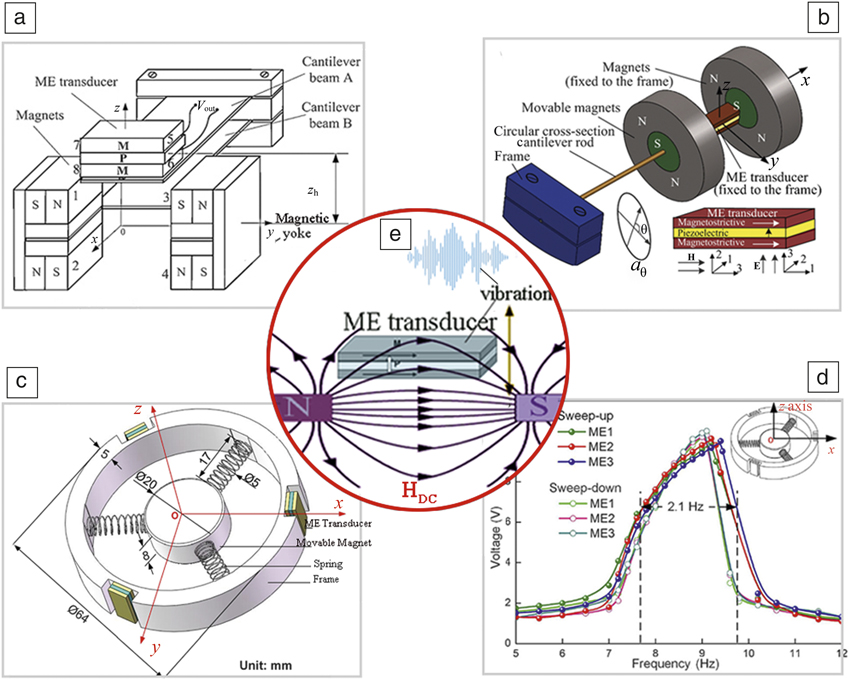
ME composites are able to realize the coupling between the magnetic field and the electric field.Reference Chu, Shi, PourhosseiniAsl, Wu, Shi, Gao, Yuan and Dong12,Reference Chu, Shi, Shi, Liu, Wu, Yang and Dong13 Yang et al.Reference Yang, Wen, Li and Dai32–Reference Bai, Wen, Yang, Li, Qiu and Zhu34 proposed a ME energy harvester taking advantage of multicantilever beams and the nonlinear behavior of the magnetic force to achieve broadband responses in the low-frequency range of 1–12 Hz. As shown in Figure 2a, this harvester consisted of two cantilever beams, a magnetic circuit, and a ME transducer. The magnetic circuit was used to produce a static magnetic field and was placed at the end of cantilever beam B, serving as a proof mass at the same time, which is necessary for producing an inertial force for a cantilever energy harvester.Reference Yang, Wen, Li and Dai32 The ME composite was placed at the end of cantilever beam A, acting as the energy-conversion component and a proof mass. The two cantilever beams were designed with different resonant frequencies, implying that relative motion between the magnetic circuit and the ME composites could occur when the external vibration frequency was close to the resonant frequency of cantilever beam A or B. In this case, the ME composites could undergo magnetic field variations in the air gap and generate electric power output based on the ME effect.
The structure of (a) 1D,Reference Yang, Wen, Li and Dai32 (b) 2D,Reference Yang, Wen, Li, Yue, Yu and Bai35 and (c) 3DReference Lin, Chen, Li, Li, Liu, Awais and Yang36 magnetoelectric (ME) vibration energy harvesters. Note that the four rectangular NdFeB magnets are labeled as 1–4 and the magnetostrictive materials (Terfenol-D, Tb1−xDyxFe2−y) are labeled 5–8. (d) The measured open-circuit voltages as a function of frequency for both upward and downward frequency sweep with an input acceleration of 9.81 m/s2 in the out-of-plane mode.Reference Yang, Wen, Li, Yue, Yu and Bai35 The inset is the schematic view of the energy harvester vibrating along the z-axis direction. Sweeping up involves increasing the frequency from 5 Hz to 12 Hz to measure the output voltage. With respect to the sweeping down, the frequency decreases gradually. An open-circuit voltage of 10 V was achieved for all three ME transducers (ME1, ME2, and ME3), which can be attributed to the symmetry of the structure for the springs and transducers, thereby subjecting the three ME transducers to the same magnetic field variation. (e) Schematic illustration for static magnetic field and vibration coupled energy harvesting. Note: HDC, direct current magnetic field; M, piezomagnetic phase; P, piezoelectric phase; V out, output voltage; z h, initial distance; θ, the excitation angle with respect to y-axis in y-z plane; a θ, the external acceleration at arbitrary in-plane angle θ; E, electric field; H, magnetic field. (a) Reprinted with permission from Reference Yang, Wen, Li and DaiReference 32. © 2011 Elsevier. (b) Reprinted with permission from Reference Yang, Wen, Li, Yue, Yu and BaiReference 35. © 2013 AIP Publishing. (c) Reprinted with permission from Reference Lin, Chen, Li, Li, Liu, Awais and YangReference 36. © 2016 AIP Publishing.

In addition, the magnetic force between the ME composites and the magnetic circuit could produce additional stiffness on the two beams, which is a nonlinear function of the initial distance, z h, between the ME transducer and the magnetic circuit. Experimental results showed that this harvester had a bandwidth of 5.4 Hz and power density of 0.2–0.56 mW/cm3 over the entire low-frequency range and under an acceleration of 0.2 G.Reference Yang, Wen, Li and Dai32 The bandwidth and power density values are desirable, especially for energy harvesting at low frequency.
Most energy harvesters are usually designed specifically for one-dimensional vibration energy harvesting.Reference Priya2,Reference Yeo, Ma, Rahn and Trolier-McKinstry10,Reference Kim, Priya and Kanno28,Reference Yang, Wen, Li and Dai32 However, vibrations in our living environments are generally two-dimensional (2D) or three-dimensional (3D). ME composites are able to harvest static magnetic field energy through the vibration coupling effect.Reference Yang, Wen, Li, Yue, Yu and Bai35,Reference Lin, Chen, Li, Li, Liu, Awais and Yang36 Multidimensional vibrations can generate more complex magnetic field variations. Figure 2b–c presents ME energy harvesters for 2D and 3D ambient vibrations.Reference Yang, Wen, Li, Yue, Yu and Bai35,Reference Lin, Chen, Li, Li, Liu, Awais and Yang36 As seen in Figure 2b, a circular cross-section cantilever rod, not a conventional thin cantilever beam, was proposed to extract the vibration energy in arbitrary in-plane motion directions. This structure showed a maximum bandwidth of 4.4 Hz and power of 0.59 mW, with an acceleration of 0.6 G.Reference Yang, Wen, Li, Yue, Yu and Bai35
Lin et al. proposed a 3D magnetoelectric energy harvester (Figure 2c) that works in any arbitrary direction with a remarkably wide working bandwidth of 3 Hz.Reference Lin, Chen, Li, Li, Liu, Awais and Yang36 This 3D magnetoelectric energy harvester consists of a cylindrical magnet mounted using three identical springs, three ME transducers, and a harvester frame. Under ambient vibrations, there will be relative motion between the movable magnet and mounted ME transducers; this, in turn, generates a magnetic-field variation leading to electric power output in the piezoelectric layer via the ME effect. Figure 2d shows the frequency responses of the open-circuit voltage for the 3D harvester under out-of-plane excitations. In the case of the out-of-plane mode, all three ME composites yielded an open-circuit voltage of 10 V, and the bandwidth was approximately 2 Hz. When the external vibration orientation was along an arbitrary angle θ with respect to the y-axis in the y-z plane for the in-plane mode, one of the three ME composites achieved the largest voltage output of ∼34 V and the bandwidth reached 3 Hz.Reference Lin, Chen, Li, Li, Liu, Awais and Yang36
AC magnetic field and vibration coupled energy harvesting
MME energy harvesters function as a dual-phase energy harvester, based on ME coupling between the magnetostrictive and the piezoelectric layers of a composite as well as the magnetic interaction between the permanent magnet proof mass and the ME composite employed.Reference Liu, Ci and Dong16,Reference Ryu, Kang, Zhou, Choi, Yoon, Park, Choi, Hahn, Ahn, Kim, Kim, Priya, Lee, Jeong and Jeong17,Reference Zhou, Apo and Priya26,Reference Kambale, Kang, Yoon, Park, Choi, Ahn, Kim, Hahn, Jeong, Kim, Dong and Ryu37 The energy collection and conversion efficiency of conventional MME energy harvesters are enhanced through an additive effect in the dual-phase system.Reference Dong, Zhai, Li, Viehland and Priya20,Reference Patil, Zhou, Kang, Sharpes, Jeong, Kim, Kim, Priya and Ryu38 Such an additive effect arises from the conjugation of two mechanisms. First, an ambient AC magnetic field, denoted as HAC, was applied along the longitudinal direction of the MME composite cantilever to generate a magnetic force moment at the tip magnet on the cantilever beam resulting in bending vibration of the MME composite cantilever. During this process, the ambient magnetic energy is transferred into mechanical energy for the MME composite cantilever subsequently inducing voltage output. Second, under the mechanical vibration, a bending motion can be excited, resulting in induced voltage output (in-phase with the magnetic excitation) due to the direct piezoelectric effect. Both excitations could simultaneously enhance the bending stress on the MME composite cantilever, resulting in enhancement of the voltage and power outputs. The criterion for the optimum response through these two simultaneous mechanisms requires phase matching of the magnetic and mechanical excitations.
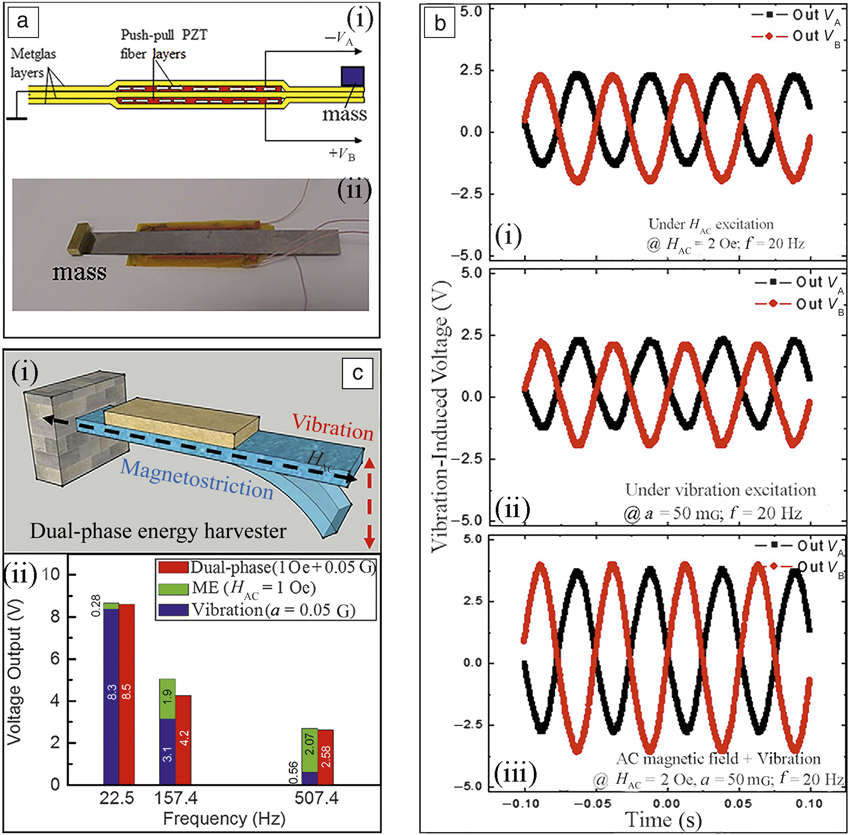
Dong et al.Reference Dong, Zhai, Li, Viehland and Priya20 initially demonstrated a dual-phase harvester system consisting of a cantilever beam with tip mass and a ME laminate (FeBSiC/PZT fibers/FeBSiC) attached to the center of the beam (Figure 3a[i–ii]). By using the cantilever beam structure and varying the tip mass, the operating frequency of the system was lowered to 20–40 Hz. Under an AC magnetic field of 2 Oe, the device generated an open-circuit voltage of ∼4 Vpp (peak-to-peak voltage) and an electric power of 0.5 μW/Oe cm3. Similar output voltage and power were generated at the first bending mode by mechanical vibration with an acceleration of 50 mG. However, under a simultaneous magnetic field (2 Oe) and vibration (50 mG), both at a frequency of 20 Hz, the output voltages were doubled relative to a single source to 8 Vpp (Figure 3b). Kambale et al. designed ME rectangular unimorph beam structures of 〈001〉- and 〈011〉-oriented PMN-PZT single crystals on a Ni plate.Reference Kambale, Yoon, Park, Choi, Ahn, Kim, Hahn, Jeong, Lee, Chung and Ryu39 Under excitation with 0.7 Oe and 3 G proof mass and at a resonance drive of 255 Hz, the hybrid system with 〈011〉-oriented PMN-PZT in d 32 mode (working mode of the piezoelectric element, where 3 refers to the polarization direction and 2 refers to the working stress/strain direction) showed an output voltage and power density of 86.4 Vpp and 17.06 mW/cm3, respectively, which were better than those for other orientations of PMN-PZT.
(a[i]) Schematic diagram of the prototype. In this magnetoelectric (ME) laminate configuration, two PZT fiber layers with push-pull-type symmetric polarization units were laminated together with four magnetostrictive FeBSiC ribbons. (a[ii]) Photograph of the prototype. (b) Experimental confirmation of the bimechanism for magnetic field and mechanical vibration EH.Reference Dong, Zhai, Li, Viehland and Priya20 (iii) The output voltage doubled relative to a single source ([i] magnetic field and [ii] mechanical vibration) to 8 Vpp. (c) Dual-phase energy harvester consisting of (i) magnetostrictive bender and ME composite. (ii) Comparison of the EH voltage output at single mode and dual-phase mode under different driving frequencies. Reprinted with permission from Reference Zhou, Apo and PriyaReference 26. © 2013 AIP Publishing. The peak voltage under the dual-phase mode is close to the summation of the peak voltage under each single mode, implying an additive effect was found in the dual-phase EH. Note: EH, energy harvesting; PZT, Pb(Zr,Ti)O3; HAC, alternating current magnetic field; a, external acceleration; Vpp, peak-to-peak voltage; V A, V B, output voltage induced from the two PZT fiber layers as shown in a[i]; f, working frequency; metglas, FeBSiC alloy.

Zhou et al.Reference Zhou, Apo and Priya26 proposed a dual-phase MME energy harvesting system utilizing a self-biased ME response to eliminate the requirement of external magnetic bias for obtaining the optimum ME sensitivity. The MME structure consisted of a piezoelectric macrofiber composite bonded to a Ni cantilever (Figure 3c[i]). The nonzero piezomagnetic coefficient of Ni is responsible for the self-biased magnetoelectric response in the corresponding ME composites. In dual-phase operation (1 Oe field + 0.05 G acceleration) at its first three resonance frequencies of 22.5 Hz, 157.4 Hz, and 507.4 Hz, the MME displayed improvements in voltage outputs of 2.4%, 35.5%, and 360.7%, respectively, in the absence of a DC bias (Figure 3c[ii]).
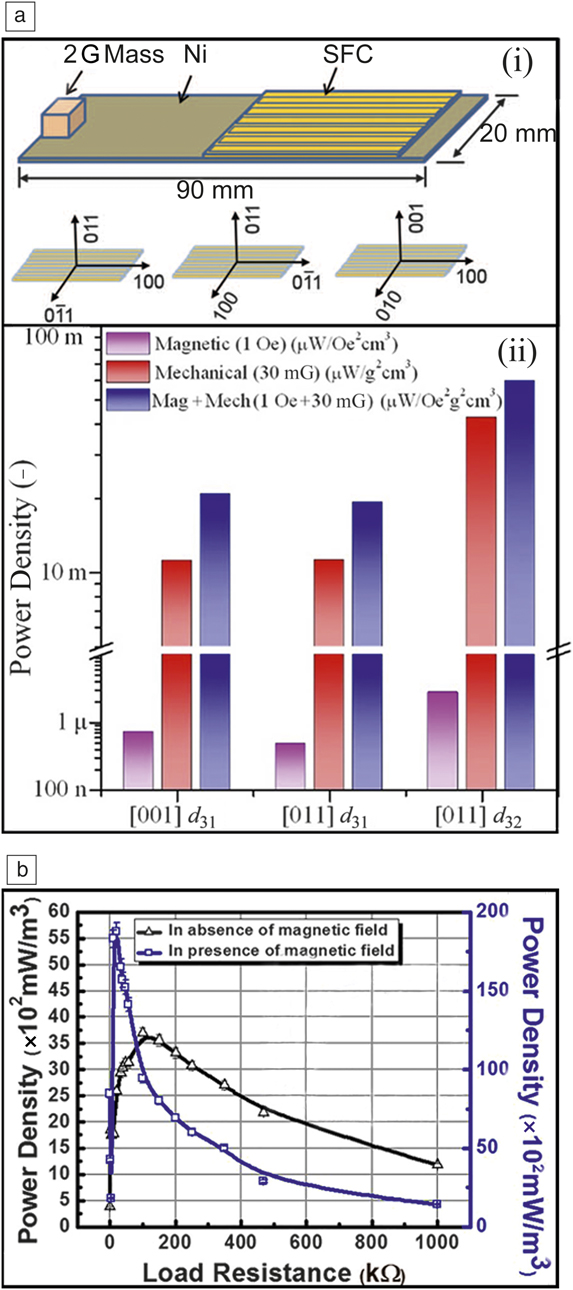
Patil et al.Reference Patil, Zhou, Kang, Sharpes, Jeong, Kim, Kim, Priya and Ryu38 developed a flexible and self-biased MME energy harvester able to sustain the harsh vibration conditions using Ni metal shims laminated with single-crystal fiber composites (SFCs). Size-dependent demagnetization effects were considered for tuning the magnitude of the self-biased ME response. Three SFCs with different crystallographic orientations ([011]-d 32, [011]-d 31, and [001]-d 31, where 3 refers to the polarization direction and 1 refers to the working strain/stress direction) were employed for comparison (Figure 4a[i]). All of the ME composites showed self-biased ME coupling with different magnitudes, depending on the SFC orientation. The ME composite with the [011]-d 32 SFC, due to its large piezoelectric coefficient, exhibited the highest ME coupling (αME) in both off-resonance (1.2 V/cm•Oe @ 1 kHz) and resonance (82.9 V/cm•Oe @ 21 Hz) conditions. The energy-harvesting response of the designed MME cantilevers, at zero DC bias and in the bending resonance mode, was studied under three different conditions (1) under only stray magnetic excitation (HAC = 1 Oe), (2) under only stray vibrational excitation (30 mG), and (3) under both stray magnetic and vibrational excitations (1 Oe + 30 mG). As expected, the Ni/[011]-d 32 SFC showed the maximum output voltage and power density consistent with the ME coupling data (Figure 4a[ii]).
(a[i]) (Top) Ni/SFC (single-crystal fiber composite) magneto-mechano-electric (MME) composites with (bottom) different orientations of SFC and (ii) comparison of the power densities of MME harvesters at single excitations and dual-phase (magnetic + mechanical) excitations.Reference Patil, Zhou, Kang, Sharpes, Jeong, Kim, Kim, Priya and Ryu38 The power densities under dual-phase excitation are not only additive, but also show large synergic enhancement of 40.8%, 70.5%, and 86.7%, respectively, for Ni/[011]-d 32 SFC cantilever, Ni/[011]-d 31 SFC cantilever, and Ni/[001]-d 31 SFC cantilever. The additive effect of the MME harvesters is related to the combinatory effect of two mechanisms. (b) Output power density of PZT/Ni-film-based harvesters in the presence and absence of an AC magnetic field.Reference Gupta, Tomar, Rammohan, Katiyar and Gupta40 The dual effect (magnetoelectric and piezoelectric) results in higher induced stress in the PZT layer, and hence, an enhanced output power generated across the cantilever. Note: d 31, d 32, transverse piezoelectric constants; PZT, Pb(Zr,Ti)O3. (a) Reprinted with permission from Reference Patil, Zhou, Kang, Sharpes, Jeong, Kim, Kim, Priya and RyuReference 38. © 2014 AIP Publishing. (b) Reprinted with permission from Reference Gupta, Tomar, Rammohan, Katiyar and GuptaReference 40. © 2016 AIP Publishing.
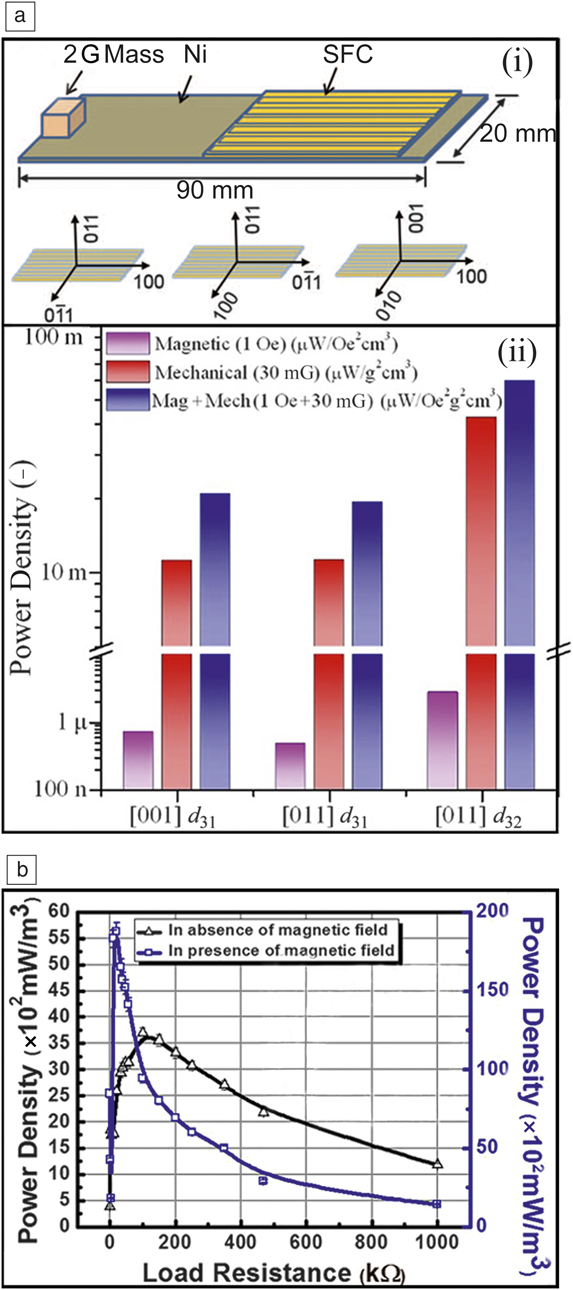
Gupta et al.Reference Gupta, Tomar, Rammohan, Katiyar and Gupta40 recently explored thin-film-based PZT/Ni cantilevers that were exploited as dual-phase MME energy harvesters. PZT films (∼2-μm thick) were prepared on a 100-μm-thick nickel substrate (22 mm × 4 mm) using pulsed laser deposition. The PZT film grown at 300 mTorr (∼40 Pa) possessed a high degree of texturing (71%) along the (110) plane as compared to films grown at other pressures. The top surface of the PZT/Ni cantilever was coated with a Pt inter-digital electrode using radio-frequency magnetron sputtering. With an acceleration of 0.5 G, a maximum vibration-induced power density of 3600 mW/m3 was measured from the PZT/Ni system at 320 Hz. The output power of the harvester was further enhanced to 18,700 mW/m3 by the application of an AC magnetic field of 50 Oe (Figure 4b). The result indicated efficient dual functioning of the energy harvester under the superimposed magnetic field; mechanical vibrations would also be feasible in thin-film architecture. The better energy-harvesting performance of the PZT/Ni cantilever was attributed to the highly textured growth of the PZT film, the good piezoelectric properties, and the large ME coupling induced in the PZT/Ni composite.
Summary and future opportunities
This article reviewed current research efforts to enhance the energy-harvesting performance of dual-stimuli ME composite harvesters. The two biggest existing challenges are improvement of the output power density and the realization of broadband frequencies. Nonlinear ME harvesting systems using static magnetic field coupled vibration energy harvesting could effectively broaden the working frequency band and therefore could be suitable for multidimensional vibration energy harvesting. In addition, dual-stimulus (magnetic field and vibration) ME energy harvesting is promising for enhancing the power density.
There is still a long way to go to turn dual-stimulus ME energy harvesters into practical applications. Future challenges include (1) the development of self-bias magnetostrictive materials with high piezomagnetic and mechanical coupling coefficient for improved ME coupling performance, (2) refined vibration mode matching of the magnetic and mechanical excitations through theoretical investigations and experiments, and (3) miniaturization of whole ME energy harvesters. Static magnetic field coupled vibration energy-harvesting systems also show great potential to harvest geomagnetic field energy, which is the most widely available and economical energy source.
SUPPLEMENTARY MATERIAL
To view supplementary material for this article, please visit https://doi.org/10.1557/mrs.2018.31.
Acknowledgments
This work was supported by the National Natural Science Foundation of China (Grant Nos. 51772005, 51132001); Beijing Municipal Science and Technology Projects (Grant Nos. Z131100003213020, Z151100003715003).V.A. would also like to acknowledge support from the Department of Science and Technology, Government of India under the INSPIRE Faculty scheme. J.R. would like to acknowledge support from the National Research Foundation of Korea (Grant No. NRF-2016R1A2B4011663), Korea Institute of Materials Science Internal R&D Program (Grant No. PNK5061), National Research Council of Science and Technology (NST) grant by the Korean government (MSIP) (No. CAP-17-04-KRISS), and the US Office of Naval Research Global (Grant No. N62909–16–1-2135).

Zhaoqiang Chu is a doctoral candidate in the Department of Materials Science and Engineering in the College of Engineering at Peking University, China. He received his MS degree in materials science from University of Science and Technology, Beijing, China, in 2015. His current research focuses on magnetoelectric and piezoelectric materials, magnetic sensors, and energy harvesters. Chu can be reached by email at zhaoqiangchu@pku.edu.cn.

Venkateswarlu Annapureddy is a DST-INSPIRE faculty member at CSIR-National Physical Laboratory, India. He was a postdoctoral researcher at Korea Institute of Materials Science, South Korea, from 2014 to 2017. He received his PhD degree in physics from the Indian Institute of Technology Roorkee (IIT–R), India. Prior to joining IIT–R, he was a Young Scientist Research Fellow at Raja Ramanna Centre for Advanced Technology, India. His research interests include piezoelectric, magnetoelectric, and triboelectric energy harvesting and multifunctional materials. Annapureddy can be reached by email at reddydph@gmail.com.

MohammadJavad PourhosseiniAsl is a doctoral candidate in the Department of Materials Science and Engineering in the College of Engineering at Peking University, China. He received his BSc degree in materials engineering at Azad University, Iran, in 2011, and his MSc degree in materials engineering at Malek-Ashtar University of Technology, Esfahan, Iran, in 2014. His current research interests include piezoelectric and magnetic materials, magnetoelectric (ME) composites, energy harvesting, multifunctional materials, and development of ME sensors. PourhosseiniAsl can be reached by email at pourhosseini@pku.edu.cn.

Haribabu Palneedi is a postdoctoral researcher at the Korea Institute of Materials Science, South Korea. He received his PhD degree in materials science and engineering from Korea Advanced Institute of Science and Technology, South Korea in 2016. His research interests include electroceramics for piezoelectric, magnetoelectric, and energy-harvesting applications. Palneedi can be reached by email at harry.mse@kaist.ac.kr.

Jungho Ryu is a professor in the School of Materials Science and Engineering at Yeungnam University, South Korea. He received his PhD degree in materials science and engineering from Seoul National University, South Korea, in 2001. His current research interests include development of piezoelectric and ferroelectric devices, energy harvesting, ceramic processing, smart actuators, and functional thin/thick ceramics. He has authored more than 200 journal publications and holds more than 100 patents. He has more than 5500 citations for his research articles and an h-index of more than 35. Ryu can be reached by email at puggy96@hanmail.net.

Shuxiang Dong is professor of materials science and engineering in the College of Engineering at Peking University, China. He received his MSc and PhD degrees from Tsinghua University, China. He was a research associate at the Materials Research Institute, The Pennsylvania State University, from 2000 to 2001, and a research scientist and research professor of materials science and engineering, Virginia Institute of Technology, from 2002 to 2008. His research focuses on piezoelectric ceramics and magnetoelectric composite materials, piezoelectric actuators and micromotors, magnetic sensors, smart electronic devices, and their applications. He has authored more than 150 papers and 30 patents. He was named one of the Most Cited Chinese Researchers by Elsevier in 2014, 2015, and 2016. Dong can be reached by email at sxdong@pku.edu.cn.