Methicillin-resistant Staphylococcus aureus (MRSA) remains one of the most prevalent bacterial pathogens worldwide. Although there has been a decrease in invasive healthcare-associated MRSA infection rates in many countries in the past decade,Reference Dantes, Mu and Bellflower 1 – Reference Köck, Becker and Cookson 3 MRSA bloodstream infections (BSI) continue to be associated with substantial morbidity and mortality, prolonged length of hospital stay, and excess healthcare costs.Reference Köck, Becker and Cookson 3 – Reference De Kraker, Wolkewitz, Davey and Grundmann 5 Host factors, microbial characteristics, and timeliness of administration of appropriate antimicrobial therapy may contribute to determining the outcome of these infections.Reference Soriano, Marco and Martinez 6 – Reference Gasch, Camoez and Dominguez 10 However, the relative importance of these variables is not well understood. The primary objectives of this study were to determine the incidence and outcome of MRSA BSI in Canadian hospitals from January 1, 2008, through December 31, 2012, and to assess whether certain host, microbial, and treatment factors are associated with risk of mortality in patients with this infection.
METHODS
Surveillance Methods and Participants
Prospective surveillance for MRSA infection among hospitalized patients in Canada has been conducted by the Canadian Nosocomial Infection Surveillance Program (CNISP) since 1995.Reference Simor, Gilbert and Gravel 11 In 2012, the CNISP included a network of 51 acute-care hospitals working in collaboration with the Public Health Agency of Canada’s Centre for Communicable Diseases and Infection Control, and the National Microbiology Laboratory. Most participating centers (27, 53%) were tertiary care teaching hospitals, and 8 provided care exclusively to pediatric patients. Surveillance for MRSA BSI was laboratory based, using previously described methods.Reference Simor, Gilbert and Gravel 11 Hospitalized patients with a MRSA isolate recovered from at least 1 set of blood cultures were included; patients were included only once (with the initial blood culture isolate). When MRSA was identified in a patient’s blood culture, medical records were reviewed for clinical and demographic information. Patients were followed up for 30 days from the detection of MRSA bacteremia, and 30-day all-cause mortality was determined. Data regarding antimicrobial therapy and previous MRSA colonization were collected starting in 2010.
Surveillance Definitions
The presumed source of the bacteremia was determined using standard surveillance definitions.Reference Simor, Gilbert and Gravel 11 , Reference Horan, Andrus and Dudeck 12 The BSI was considered healthcare-associated if the first blood culture that yielded MRSA was obtained at least 48 hours after hospital admission, or if the positive blood culture was obtained within 48 hours of admission in patients with healthcare exposure (such as hospitalization, residence in a long-term care facility, hemodialysis, or receipt of intravenous therapy) in the previous 90 days.Reference Friedman, Kaye and Stout 13 The BSI was considered community-acquired if the blood cultures were obtained before admission or in the first 48 hours of hospitalization and did not meet criteria for healthcare-associated infection.
Empirical antimicrobial therapy was defined as the antibiotics administered before the blood culture isolate was determined to be oxacillin-resistant. Definitive antimicrobial therapy was that administered within 24 hours after MRSA was identified as the blood culture isolate. Appropriate antibiotics were those with in vitro activity against MRSA and considered as recommended therapy for MRSA BSI in clinical practice guidelines.Reference Liu, Bayer and Cosgrove 14
Laboratory Methods
MRSA isolates were identified at participating hospital sites using standard laboratory methods. One blood culture isolate per patient was submitted to a central laboratory for further characterization. Antimicrobial susceptibility testing was performed by broth microdilution in accordance with Clinical and Laboratory Standards Institute guidelines. 15 Vancomycin susceptibility of isolates obtained in 2010–2012 was also determined by Etest (bioMérieux) in accordance with the manufacturer’s instructions.
DNA isolation and polymerase chain reaction amplification of the spa repeat region were performed as previously described.Reference Golding, Campbell and Spreitzer 16 Amplicons were sequenced in both directions, analyzed using BioNumerics, version 5.1 (Applied Maths), and submitted to the online Ridom StaphType spa software program and database for spa type designation (Ridom). The Canadian MRSA typing database was used to assign a pulsed-field gel electrophoresis type on the basis of previous correlations observed between spa and such types.Reference Golding, Campbell and Spreitzer 16 Strains designated as pulsed-field gel electrophoresis type CMRSA-2 resemble USA100/800 (spa type t002, multilocus sequence type 5, and clonal complex 5); and type CMRSA-10 resembles the community-associated MRSA genotype USA300 (t008; sequence type 8; clonal complex 8). Polymerase chain reaction assay was used to detect the presence of the Panton-Valentine leukocidin gene.
Statistical Analysis
The incidence of MRSA BSI was calculated as the number of cases per 1,000 admissions and per 10,000 patient-days. The χ2 test for trend was used to determine changes in incidence over time. To assess differences between patient populations, categorical variables were compared using the χ2 test or the Fisher exact test as appropriate. Continuous variables were compared using the t test or Wilcoxon rank sum test as appropriate. We used Kaplan-Meier curves to compare survival rates among those receiving appropriate or inappropriate antimicrobial therapy. Differences in survival were determined with the log-rank test.
Logistic regression analysis was used to evaluate the association between 30-day mortality and host- or microbial-related variables. Variables considered in the model were selected a priori on the basis of previously published dataReference Soriano, Marco and Martinez 6 , Reference Pastagia, Kleinman, Lacerda de la Cruz and Jenkins 9 , Reference Gasch, Camoez and Dominguez 10 , Reference Gasch, Camoez and Domínguez 17 , Reference Nair, Ammann, Rysavy and Schweizer 18 and included age, BSI acquisition (community- or healthcare-associated, or intensive care unit [ICU]–acquired), subsequent transfer to ICU, presumed source of BSI (skin/soft tissue, intravascular line–associated, pleuropulmonary infection, endocarditis), receipt of appropriate empirical or definitive antimicrobial therapy, molecular strain type, and infecting strain with reduced susceptibility to vancomcyin (as determined by Etest). To avoid multicollinearity, when 2 or more independent variables showed strong mutual associations, only 1 of these was included in the multivariable model (because Panton-Valentine leukocidin was strongly associated with strain type, it was not included in the final model). The goodness of fit of the final model was assessed using the Hosmer-Lemeshow test. All tests were 2-tailed. Statistical analyses were performed using SAS, version EG 5.1 (SAS Institute).
Ethics
Because the surveillance was observational, ensured that patient confidentiality was maintained, and was considered to be within the usual scope of infection prevention and control programs at most of the participating hospital sites, research ethics board approval was not routinely required, although it was obtained at some of the participating hospitals.
RESULTS
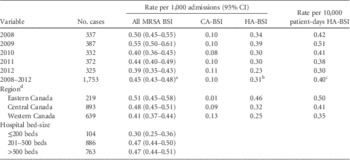
A total of 1,753 patients with MRSA BSI were identified in CNISP hospitals from January 1, 2008, through December 31, 2012, representing 18.2% of all MRSA infections identified. The MRSA BSI incidence was 0.45 (95% CI, 0.43–0.48) per 1,000 admissions, and 0.59 (0.56–0.62) per 10,000 patient-days (Table 1). Smaller hospitals (≤200 beds) had lower rates (0.30/1,000 admissions) compared with larger hospitals (0.47/1,000 admissions; P<.001). During the 5 years of surveillance there was a reduction in healthcare-associated MRSA BSI rates (P=.006). No significant regional differences in the rates were observed.
Incidence of Methicillin-Resistant Staphylococcus aureus (MRSA) Bloodstream Infection (BSI) in Canadian Hospitals

NOTE. CA-BSI, community-acquired BSI; HA-BSI, healthcare-associated BSI.
a P=.08, as determined by χ2 test for trend.
b P=.006, as determined by χ2 test for trend.
c P<.001, comparing rates in hospitals with ≤200 beds with those in larger hospitals.
d Eastern Canada: Newfoundland and Labrador, Prince Edward Island, Nova Scotia, and New Brunswick; Central Canada: Quebec and Ontario; Western Canada: Manitoba, Saskatchewan, Alberta, and British Columbia.
The median age of patients was 63.0 years (range, 1 day–101 years); only 97 patients (5.5%) were younger than 18 years, and 817 (46.6%) were at least 65 years. A total of 1,097 patients (62.6%) were male. Previous MRSA colonization or infection was known to have been present in 399 patients (22.8%). Skin and soft-tissue infections, including those involving a surgical site, were most common (26.6%), followed by intravascular catheter–related infections (22.0%).
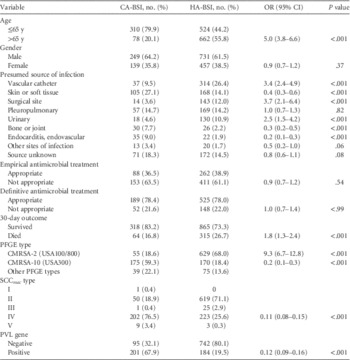
The BSI was determined to have been community-acquired in 388 isolates (24.6%) and healthcare-associated in 1,188 (75.4%). Patients with community-acquired infection were younger (mean age, 47.3 y vs 64.2 y; P<.001), were more likely to have had a nonsurgical skin or soft-tissue infection (27.1% vs 14.1%; P<.001) or an endovascular source of infection (9.0% vs 1.9%; P<.001), and were more likely to have been infected with a Panton-Valentine leukocidin–positive community-associated MRSA strain (67.9% vs 19.5%; P<.001) (Table 2).
Characteristics of Patients and Isolates With Community-Associated and Healthcare-Associated Methicillin-Resistant Staphylococcus aureus (MRSA) Bloodstream Infection (BSI)

NOTE. CA-BSI, community-associated BSI; HA-BSI, healthcare-associated BSI; OR, odds ratio; PFGE, pulsed-field gel electrophoresis; PVL, Panton-Valentine leukocidin; SCC mec , staphylococcal cassette chromosome encoding methicillin resistance.
Outcome at 30 days was known for 1,742 patients (99.4%). A total of 468 patients of 1,683 patients (27.8%) were transferred to the ICU within 30 days of the MRSA BSI, and the 30-day all-cause mortality was 23.8%. For those in whom the date of death was known, 22% of those who died, did so within 24 hours after the blood cultures were obtained. There was no change in mortality rates over time, but mortality was lower in hospitals with fewer than 200 beds (11.5%) compared with that in larger hospitals (24.5%; P=.004).
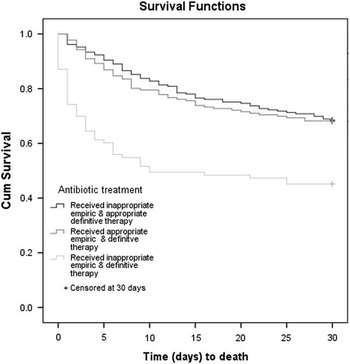
Appropriate empirical antimicrobial therapy (prior to identification of MRSA) was prescribed for 379 patients of 1,006 patients (37.7%); 785 (78.0%) received appropriate definitive antimicrobial therapy within 24 hours after MRSA identification in blood culture (97% treated with vancomycin). Most of those not receiving appropriate definitive therapy died within the first 24–48 hours. Patients were more likely to receive appropriate empirical antimicrobial therapy if they were known to have had prior MRSA colonization or infection (87% vs 33%; P=.001) or if they had ICU-acquired BSI (49% vs 35%; P<.001). Choice of empirical antimicrobial therapy was not associated with survival, whereas receipt of appropriate definitive antimicrobial therapy (within 24 hours of identification of MRSA) was associated with improved outcome (P<.001). Kaplan-Meier survival curves are displayed in Figure 1.
Kaplan-Meier estimates of survival in patients with methicillin-resistant Staphylococcus aureus (MRSA) bloodstream infection who received either appropriate or inappropriate empirical antimicrobial therapy (before identification of MRSA), and who received either appropriate or inappropriate definitive antimicrobial therapy (within 24 hours after MRSA was identified in blood culture). Cum, cumulative.

There were 1,329 MRSA isolates (75.8%) available for typing. Of these, 735 (55.3%) were t002 (CMRSA-2/USA100/800) and 387 (29.1%) were t008 (CMRSA-10/USA300). CMRSA-10/USA300 were more likely to have been recovered from younger patients (mean age, 49.7 y vs 62.8 y; P<.001) and from patients with skin and soft-tissue infection (24.5% vs 14.7%; P<.001), and to possess the PVL toxin gene (97.2% vs 5.3%; P<.001). Although CMRSA-10/USA300 isolates were more commonly responsible for community-acquired BSI (59.3%), they caused 18.4% of the healthcare-associated BSIs.
Antimicrobial susceptibility testing by broth microdilution and Etest was performed in 1,237 and 809 isolates, respectively. Resistance to vancomycin, linezolid, or daptomycin was not identified. Only 28 isolates (3.2%) had vancomycin minimum inhibitory concentration of 2.0 µg/mL or greater as determined by Etest.
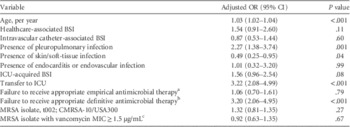
The multivariate logistic regression model for variables associated with all-cause 30-day mortality is summarized in Table 3. Increased mortality was associated with increasing age (approximately 3% per year), the presence of pleuropulmonary infection (odds ratio, 2.27; P=.001), transfer to ICU within 30 days of the BSI (3.22; P<.001), and failure to receive appropriate antimicrobial therapy within 24 hours of MRSA identification (3.20; P<.001). A skin/soft-tissue source of the BSI was associated with decreased mortality (odds ratio, 0.49; P=.04).
Multivariate Analysis of Variables Associated With 30-Day All-Cause Mortality in Patients With Methicillin-Resistant Staphylococcus aureus (MRSA) Bloodstream Infection (BSI)

NOTE. ICU, intensive care unit; MIC, minimum inhibitory concentration; OR, odds ratio.
a Empirical therapy, administered prior to identification of MRSA in blood cultures
b Definitive therapy, administered within 24 hours after identification of MRSA in blood cultures
c As determined by Etest.
DISCUSSION
This report describes the epidemiology and outcome of 1,753 patients with MRSA BSI in Canadian hospitals. The observed incidence of 0.45/1,000 admissions and 0.59/10,000 patient-days is lower than that recently reported in the United States (1.59/1,000 admissions; 4.1–5.0/10,000 patient-days)Reference Klein, Sun, Smith and Laxminarayan 19 , Reference David, Daum and Bayer 20 but is comparable with rates reported in parts of the United Kingdom (0.43–2.48 per 10,000 bed-days).Reference Johnson, Davies and Guy 2 As observed elsewhere, healthcare-associated MRSA BSI rates decreased during the course of this surveillance.Reference Dantes, Mu and Bellflower 1 – Reference Köck, Becker and Cookson 3 These changes have been attributed, at least in part, to implementation of effective infection prevention and control measures.Reference Dantes, Mu and Bellflower 1 , Reference Jarvis, Jarvis and Chinn 21 , Reference Widmer, Lakatos and Frei 22 Active surveillance with adoption of evidence-based measures has been standard in the great majority of Canadian hospitals in the past decade.Reference Williams, Simor and Kiss 23 However, the burden of disease remains substantial: with current incidence and case-fatality, and assuming approximately 2.4 million admissions annually (Canadian Institute for Health Information), we can estimate approximately 1,080 new MRSA BSIs and 260 related deaths occurring each year in Canadian hospitals.
The 30-day all-cause mortality observed in this study (23.8%) is in the range previously reported.Reference De Kraker, Wolkewitz, Davey and Grundmann 5 , Reference Gasch, Camoez and Dominguez 10 , Reference Wang, Wang and Fang 24 , Reference Kalil, Van Schooneveld, Fey and Rupp 25 Studies assessing variables associated with outcome in patients with MRSA BSI have often been limited because they describe a single center’s experience, or because of inadequate adjustment for confounding variables. The current study was able to overcome these limitations. Similar to several previous investigations, we found that host factors, such as increasing age, and requirement for ICU admission (a marker of severity of disease) were associated with increased mortality.Reference Soriano, Marco and Martinez 6 , Reference Pastagia, Kleinman, Lacerda de la Cruz and Jenkins 9 , Reference Gasch, Camoez and Dominguez 10 , Reference Gasch, Camoez and Domínguez 17 Our results also indicate that certain “high risk” sources of BSI, such as pleuropulmonary infection, are associated with increased mortality, whereas BSI with skin and soft-tissue infection was associated with lower mortality.Reference Walraven, North, Marr-Lyon, Deming, Sakoulas and Mercier 8 , Reference Gasch, Camoez and Dominguez 10
Studies that have examined the relationship between microbial factors and outcome in patients with MRSA BSI have given conflicting results. One study found that infections caused by USA300 were associated with increased mortality,Reference Kempker, Farley, Ladson, Satola and Ray 7 but our study was consistent with others that did not confirm this association.Reference Gasch, Camoez and Domínguez 17 , Reference Nair, Ammann, Rysavy and Schweizer 18 , Reference Wang, Wang and Fang 24 , Reference Tattevin, Schwartz and Graber 26 Higher vancomycin minimum inhibitory concentrations may be associated with treatment failure,Reference Soriano, Marco and Martinez 6 , Reference van Hal, Lodise and Paterson 27 but many studies, including this one, found that reduced vancomycin susceptibility is not a risk factor for increased mortality.Reference Soriano, Marco and Martinez 6 , Reference Walraven, North, Marr-Lyon, Deming, Sakoulas and Mercier 8 , Reference Gasch, Camoez and Dominguez 10 , Reference Gasch, Camoez and Domínguez 17 , Reference Nair, Ammann, Rysavy and Schweizer 18 , Reference Kalil, Van Schooneveld, Fey and Rupp 25 Although the association was not examined in the current study, previous investigations have also determined that strains with the heterogeneous vancomycin-intermediate (hVISA) phenotype are not associated with increased mortality.Reference Pastagia, Kleinman, Lacerda de la Cruz and Jenkins 9 , Reference van Hal and Paterson 28
Appropriate empirical antimicrobial therapy was prescribed for only a little more than one-third of patients with MRSA BSI, presumably because of a perception that MRSA is an uncommon cause of sepsis in Canadian hospitals. However, patients known to have been previously colonized or infected with MRSA were more likely to have received appropriate empirical therapy. In an Australian study of patients with S. aureus bacteremia, a history of prior MRSA colonization/infection was associated with improved outcome, and this was attributed to a greater likelihood of receiving empirical therapy with a glycopeptide.Reference Robinson, Phillips, Christiansen, Pearson, Coombs and Murray 29 A few studies have found that higher mortality in patients with MRSA BSI is associated with inadequate initial therapy,Reference Soriano, Marco and Martinez 6 , Reference Gasch, Camoez and Dominguez 10 , Reference Paul, Kariv and Goldberg 30 but this has not been confirmed in other investigations.Reference Kim, Park and Lee 31 , Reference Schweizer, Furuno and Harris 32 In our study, patients who did not receive appropriate therapy within 24 hours of identification of MRSA in blood cultures were 3 times more likely to die within 30 days. It is possible that our finding of increased survival with appropriate definitive antimicrobial therapy may be biased by a survivor effect due to patients who died early, before MRSA was identified in blood cultures. However, we believe this is unlikely to have had a significant effect because the association of increased mortality with failure to receive appropriate antimicrobial therapy within 24 hours of the identification of MRSA in blood cultures was maintained even if the early deaths (occurring in the first 24 hours) were excluded from the analysis (online supplemental Figure 2). Because almost all patients were treated with vancomcyin we were unable to assess the effect of other antimicrobial agents on outcome. Our study did not assess vancomycin dosing or the impact of monitoring vancomycin blood levels, but one study determined that in patients with MRSA BSI, mortality was not associated with guideline-recommended vancomycin dosing or achieving specified target trough vancomycin levels.Reference Hall, Giuliano and Haase 33
To our knowledge, this study is the first to describe the incidence and outcomes of MRSA BSI in Canadian hospitals. An audit of MRSA surveillance conducted by CNISP found the data to be robust and reliable.Reference Forrester, Collet and Mitchell 34 Hospitals that participated in the CNISP surveillance were predominantly tertiary care teaching hospitals, with a greater number of inpatient beds compared with non-CNISP hospitals, and therefore may not be representative of other healthcare facilities in Canada.Reference Rutledge-Taylor, Mitchell, Pelude, Abdelmalik and Roth 35 A small number of patients with MRSA BSI may have been missed if blood cultures were not obtained, if the organism failed to grow because of prior antimicrobial therapy, or if patients with MRSA BSI died prior to hospitalization. Although an effort was made to account for confounders in the analysis of variables associated with mortality, information about important confounding covariates such as the presence of underlying comorbidities, timeliness of source control, and duration of antimicrobial therapy was not available.
In conclusion, the results of this national surveillance indicate that MRSA BSIs account for substantial morbidity and mortality even in a country with relatively low infection rates. This study also confirms the importance of host factors, such as age and source of bacteremia, as variables associated with outcome in patients with MRSA BSI, whereas MRSA genotype and reduced vancomcyin susceptibility were not found to be associated with mortality. There may be other, as yet unidentified, microbial factors that are associated with poor outcomes in these patients. Receipt of appropriate therapy within 24 hours of identification of MRSA in blood cultures was associated with a significant reduction in mortality.
Members of the CNISP Who Participated in the Surveillance for MRSA BSI
David Boyd, National Microbiology Laboratory, Public Health Agency of Canada, Winnipeg, Manitoba; Natalie Bridger, Health Sciences Centre, St. John’s, Newfoundland; Elizabeth Bryce, Vancouver General Hospital, Vancouver, British Columbia; John Conly, Foothills Medical Centre, Calgary, Alberta; John Embil, Health Sciences Centre, Winnipeg, Manitoba; Joanne Embree, Health Sciences Centre, Winnipeg, Manitoba; Gerald Evans, Kingston General Hospital, Kingston, Ontario; Sarah Forgie, Stollery Children’s Hospital, Edmonton, Alberta; Charles Frenette, McGill University Health Centre, Montreal, Quebec; Greg German, Queen Elizabeth Hospital, Charlottetown, Prince Edward Island; George Golding, National Microbiology Laboratory, Public Health Agency of Canada, Winnipeg, Manitoba; Denise Gravel, Centre for Communicable Diseases and Infection Control, Public Health Agency of Canada, Ottawa, Ontario; Deanna Hembroff, University Hospital of Northern British Columbia, Prince George, British Columbia; Elizabeth Henderson, Peter Lougheed Centre, Calgary, Alberta; Michael John, London Health Sciences Centre, London, Ontario; Lynn Johnston, Queen Elizabeth II Health Sciences Centre, Halifax, Nova Scotia; Kevin Katz, North York General Hospital, Toronto, Ontario; Pamela Kibsey, Royal Jubilee Hospital, Victoria, British Columbia; Magdalena Kuhn, Moncton Hospital, Moncton, New Brunswick; Joanne Langley, I. W. K. Health Centre, Halifax, Nova Scotia; Bonita Lee, Stollery Children’s Hospital, Edmonton, Alberta; Camille Lemieux, University Health Network, Toronto, Ontario; Yves Longtin, SMBD-Jewish General Hospital, Montreal, Quebec; Mark Loeb, Hamilton Health Sciences Corporation, Hamilton, Ontario; Anne Matlow, Hospital for Sick Children, Toronto, Ontario; Allison McGeer, Mount Sinai Hospital, Toronto, Ontario; Dominik Mertz, Hamilton Health Sciences Corporation, Hamilton, Ontario; Mark Miller, SMBD-Jewish General Hospital, Montreal, Quebec; Dorothy Moore, Montreal Children’s Hospital, Montreal, Quebec; Michael Mulvey, National Microbiology Laboratory, Public Health Agency of Canada, Winnipeg, Manitoba; Suzanne Pelletier, Health Sciences North, Sudbury, Ontario; Caroline Quach, Montreal Children’s Hospital, Montreal, Quebec; Susan Richardson, Hospital for Sick Children, Toronto, Ontario; Virginia Roth, Ottawa Hospital, Ottawa , Ontario; Andrew Simor, Sunnybrook Health Sciences Centre, Toronto, Ontario; Stephanie Smith, University of Alberta Hospital, Edmonton, Alberta; Kathryn Suh, Ottawa Hospital, Ottawa, Ontario; Geoffrey Taylor, University of Alberta Hospital, Edmonton, Alberta; Nisha Thampi, Children’s Hospital of Eastern Ontario, Ottawa, Ontario; Eva Thomas, Children’s and Women’s Health Centre, Vancouver, British Columbia; Nathalie Turgeon, CHUQ-Hôtel-Dieu, Quebec City, Quebec; Mary Vearncombe, Sunnybrook Health Sciences Centre, Toronto, Ontario; Joseph Vayalumkal, Alberta Children’s Hospital, Calgary, Alberta; Karl Weiss, Maisonneuve-Rosemont Hôpital, Montreal, Quebec; Alice Wong, Royal University Hospital, Saskatoon, Saskatchewan.
ACKNOWLEDGMENTS
We thank the infection prevention and control professionals and laboratory personnel from all of the CNISP hospitals for their assistance in data collection.
Financial support. The Public Health Agency of Canada.
Potential conflicts of interest. A.E.S. reports that he has served as a consultant on advisory boards for Merck Canada and Sunovion Pharmaceuticals Canada and has received research funding from Pfizer Canada. All other authors report no conflicts of interest relevant to this article.
SUPPLEMENTARY MATERIAL
To view supplementary material for this article, please visit http://dx.doi.org/doi:10.1017/ice.2015.323