Introduction
Food security is increasingly perceived as an urban concern in the Global North (Pothukuchi and Kaufman, Reference Pothukuchi and Kaufman2000; Opitz et al., Reference Opitz, Berges, Piorr and Krikser2016). In US metropolitan areas, roughly 14% of the population is food insecure, a condition defined as having ‘limited or uncertain access to adequate food’ (Coleman-Jensen et al., Reference Coleman-Jensen, Rabbit, Gregory and Singh2017). As a form of city-based food production, urban agriculture (UA) has emerged as one potential—but inherently partial (Horst et al., Reference Horst, McClintock and Hoey2017)—strategy for increasing the food security of urban residents. UA may contribute to the community food environment by offering local sources of production, such as community gardens and alternative distribution outlets, such as farmers markets (Allen, Reference Allen1999; Anderson and Cook, Reference Anderson and Cook1999). In this paper, we evaluate the contributions of urban gardens to food security, using a five-part framework that incorporates food availability, nutritional adequacy, accessibility, cultural acceptability and agency (Rocha, Reference Rocha2007; Chappell, Reference Chappell2018).
Recent studies of UA highlight the quantities and nutritional quality of the food produced (e.g. Algert et al., Reference Algert, Diekmann, Renvall and Gray2016b; Conk and Porter, Reference Conk and Porter2016), but cultural acceptability, as a dimension of food security, has particular salience for food gardeners. Researchers have noted that even among food-insecure gardeners, garden produce is valued ‘as much or more for its social value than for its contribution to their and their families’ subsistence’ (Kortright and Wakefield, Reference Kortright and Wakefield2011, p. 40). Rather than view gardeners’ emphasis on the subjective elements of the food they grow as a contradiction, we contend that it is integral to a robust, holistic concept of food security. Acceptability offers a way to integrate the cultural significance gardeners attach to growing their own food with the material contributions of gardens to gardeners’ diets and/or food budgets. By embracing the cultural elements of food and self-provisioning, we can expand our understanding of food security to encompass food's broader values, which include not only calories and nutrients, but also relate to preference, quality, cultural traditions and methods of production and distribution (Hayes-Conroy and Sweet, Reference Hayes-Conroy and Sweet2015).
In this study, we describe how urban gardens in Santa Clara County, California, contribute to food security using the ‘Five A's of Food Security’ framework developed by Cecilia Rocha (Rocha, Reference Rocha2007; Centre for Studies in Food Security, 2016; Chappell, Reference Chappell2018). To begin, we review the different dimensions of food security as they relate to UA while making the case for an integrated approach. Following Hammelman and Hayes-Conroy (Reference Hammelman and Hayes-Conroy2015), we argue that cultural acceptability extends beyond access to cultural foods to include cultural values concerning the environmental and social conditions of food production. Next, we present the mixed methods we used to develop a quantitative and qualitative understanding of the contributions of urban gardens to food security. Because of our focus on food insecurity, we purposely recruited members of two gardening programs that assist low-income families with growing their own organic vegetables to participate in garden harvest weighing, surveys and interviews. Our findings demonstrate the nutritional contributions that gardens make for gardeners, but also show the emphasis that low-income gardeners place on having ‘good food’ and exercising agency in their gardens to create access to culturally acceptable produce when it is otherwise unobtainable. We contend that a full accounting of UA's role in urban food security requires examining all five elements of food security.
Literature review
Since the mid-1970s ideas about food security have undergone significant shifts, which affect how food security is understood and evaluated (Maxwell, Reference Maxwell1996). For much of the twentieth century, the problem of food insecurity was viewed primarily as one of underproduction of food that could be best addressed through technological improvements that increased agricultural production (Chappell, Reference Chappell2018). More recently, critical perspectives have emerged from the food sovereignty, food justice and community food security (CFS) movements. While varying in their emphases, these critiques posit that true food security can be achieved only through food systems that are environmentally sustainable, healthy, fair and democratically controlled (Rocha, Reference Rocha2007; Heynen et al., Reference Heynen, Kurtz and Trauger2012; Lang and Barling, Reference Lang and Barling2012; Carolan, Reference Carolan2013). As food security has shifted from a singular focus on supply to include access and other elements of demand, it has become a multi-faceted concept that requires a multi-part framework for evaluation.
We use the Five A's Framework because it incorporates many of the changes to general understandings of food security and, inspired by the food sovereignty and food justice movements, adds agency, which recognizes the need to consider the role of political power and structural inequities in creating the conditions that give rise to food insecurity. Availability addresses supply and means that there is food in sufficient quantities to meet people's needs (Chappell and LaValle, Reference Chappell and LaValle2011). Access refers to the physical and economic ability to acquire food (Rocha, Reference Rocha2007) and is a recognition that the majority of food insecurity worldwide is caused not by lack of available food, but rather poverty and other obstacles that keep people from acquiring food (Chappell, Reference Chappell2018). Adequacy encompasses food safety, the nutritional quality of diets and has been extended to include the environmental sustainability of production methods (Rocha, Reference Rocha2007). Acceptability, or more often ‘cultural acceptability’, addresses the many connections between food and culture (Hammelman and Hayes-Conroy, Reference Hammelman and Hayes-Conroy2015). Finally, agency refers to the knowledge and power to make changes to the food system at various levels of governance (Chappell and LaValle, Reference Chappell and LaValle2011). This conceptualization of food security bridges traditional concerns about food supply with more recent concerns about the environmental sustainability of the food system, public health, political power and poverty (Heynen et al., Reference Heynen, Kurtz and Trauger2012; Lang and Barling, Reference Lang and Barling2012; Carolan, Reference Carolan2013).
Echoing early concepts of food security, much of the UA literature focuses on production. At the metropolitan level, studies have combined inventories of available land with different land-use, agricultural management and consumption scenarios to estimate UA's productive capacity. These projections suggest that UA has the potential to make meaningful contributions to residents’ aggregate vegetable intake, ranging from supplying 5% of the vegetables consumed in Oakland (McClintock et al., Reference McClintock, Cooper and Khandeshi2013), to 10% in Toronto (MacRae et al., Reference MacRae, Gallant, Patel, Michalak, Bunch and Schaffner2010) and 31% in Detroit (Colasanti and Hamm, Reference Colasanti and Hamm2010). At the site level, studies have used crop weighing methods to quantify the amount of production from urban gardens. Although garden production is highly variable (Conk and Porter, Reference Conk and Porter2016; Pourias et al., Reference Pourias, Duchemin and Aubry2015), weighing studies have found that some gardens yield more per unit area than commercial or biointensive agriculture (Gittleman et al., Reference Gittleman, Jordan and Brelsford2012; Algert et al., Reference Algert, Baameur, Diekmann, Gray and Ortiz2016a). Studies of gardeners’ consumption habits have emphasized the nutritional importance of having a diversity of high quality produce fresh from the garden (Kortright and Wakefield, Reference Kortright and Wakefield2011; Minkoff-Zern, Reference Minkoff-Zern2014a; Taylor and Lovell, Reference Taylor and Lovell2014) and found evidence that gardening positively affects eating habits, including the frequency and quantity of fruit and vegetable consumption (Litt et al., Reference Litt, Soobader, Turbin, Hale, Buchenau and Marshall2011; Carney et al., Reference Carney, Hamada, Rdesinski, Sprager, Nichols, Liu, Pelayo, Sanchez and Shannon2012; Gray et al., Reference Gray, Guzman, Glowa and Drevno2014; Algert et al., Reference Algert, Diekmann, Renvall and Gray2016b). Limited land area and methods of local distribution are seen to constrain UA's food provisioning capacity, particularly for staple grains and proteins (Opitz et al., Reference Opitz, Berges, Piorr and Krikser2016). Yet the ability to supply fresh fruits and vegetables remains significant, given their importance to a healthy diet and the fact that the majority of Americans eat far fewer than recommended (HHS and USDA, 2015).
Access is another important aspect of food security, as it is widely recognized that adequate food supplies do not preclude hunger. To reduce food insecurity, food produced through UA must reach people who suffer from uncertain or inadequate access to food. Studies examining the distribution of urban gardens find that the extent to which gardens occur in low-income communities—as a proxy for food insecurity—varies between and within US cities (Meenar and Hoover, Reference Meenar and Hoover2012; Schupp and Sharp, Reference Schupp and Sharp2012; McClintock et al., Reference McClintock, Mahmoudi, Simpson and Santos2016). For instance, in Madison, Wisconsin, older community gardens are located in neighborhoods with low median household income, but home gardens and newer community gardens occur in neighborhoods with above-average median income (Smith et al., Reference Smith, Greene and Silbernagel2013). Other studies have emphasized the affordability aspect of access, finding that individuals use gardening as a strategy for coping with economic hardship (Schupp and Sharp, Reference Schupp and Sharp2012) and to offset the cost of healthy food (McClintock et al., Reference McClintock, Mahmoudi, Simpson and Santos2016; Hammelman, Reference Hammelman2018). Finally, although UA is often associated with food justice and food security, research has shown that these initiatives are frequently dominated by—and therefore, may disproportionately benefit—people who are white, well educated and well-off (Slocum, Reference Slocum2007; McClintock et al., Reference McClintock, Mahmoudi, Simpson and Santos2016; Reynolds and Cohen, Reference Reynolds and Cohen2016). Beyond these issues of disproportionate representation lies a deeper cultural question about whose values, knowledge and experiences are being represented in UA and in food access initiatives more generally. There is a growing call to understand how food insecure populations acquire food and how they define ‘good food’—both their food preferences and broader aspirations for the food system (Alkon et al., Reference Alkon, Block, Moore, Gillis, DiNuccio and Chavez2013; Bacon and Baker, Reference Bacon and Baker2017).
In the context of food security, cultural acceptability often goes undefined but is frequently taken to mean the availability of particular ‘ethnic’ food items. Hammelman and Hayes-Conroy (Reference Hammelman and Hayes-Conroy2015, p. 43) have argued for a broader conceptualization of cultural acceptability that takes into account ‘the multifaceted and nuanced role of culture throughout the food system.’ They outline a framework that includes the cultural values, practices and knowledge associated with food production, preparation and consumption. This expanded definition recognizes that food procurement, preparation and consumption play a role in forming and reproducing identity and community. It is well documented that garden products, practices and spaces all have links to culture. Gardens are cultural landscapes with unique plant assemblages and layouts that reflect individual creativity and history along with cultural preferences (Kortright and Wakefield, Reference Kortright and Wakefield2011; Taylor et al., Reference Taylor, Lovell, Wortman and Chan2017). Gardens also support a range of cultural practices that include foodways (Airriess and Clawson, Reference Airriess and Clawson1994; Corlett et al., Reference Corlett, Dean and Grivetti2003) and traditional spiritual and healing practices (Mazumdar and Mazumdar, Reference Mazumdar and Mazumdar2012).
Less frequently discussed are the connections between gardening and cultural food values that pertain to the agency within the food system more broadly. One way to frame these food-system-related values is as food (system) imaginaries— that is, visions of ‘how, where, and for whom food is produced and for whose benefit’ (Hammelman and Hayes-Conroy, Reference Hammelman and Hayes-Conroy2015, p. 42)—that critique the industrial food system and offer a more community-centered alternative. Often the environmental and social relationships developed and expressed in the garden conform to gardeners’ sense of the appropriate relationship between people and food better than either commercial food production or emergency food assistance (e.g., Minkoff-Zern, Reference Minkoff-Zern2014a, Hammelman Reference Hammelman2018). Additionally, for some, who identify historical and ongoing racist or colonial disruptions of their access to food, such as Black farmers in Detroit (White, Reference White2011) or indigenous communities (Norgaard et al., Reference Norgaard, Reed, Van Horn, Alkon and Agyeman2011; Fazzino and Loring, Reference Fazzino, Loring, Hayes-Conroy and Hayes-Conroy2013), self-provisioning is linked to self-determination, self-reliance and liberation. As these examples demonstrate, gardens do not represent universal food values; instead, they are a place where people from different socio-economic positions and cultural backgrounds can express their own alternative food system vision.
While previous studies of urban gardens have often looked at either food supply measures or cultural significance, we contend that approaching food security holistically offers a more complete picture of the possibilities, limitations and potential trade-offs between various aspects of food security in the context of UA. This multidimensional framework is well-suited to an analysis of UA because a focus on supply and nutrition alone may overemphasize limits to production (Allen, Reference Allen1999; Opitz et al., Reference Opitz, Berges, Piorr and Krikser2016), while underestimating the importance to UA participants of having food that aligns with their cultural and ethical values and the ability to exercise greater autonomy in making food choices (Hammelman, Reference Hammelman2018).
Methods
Study context
This study examines urban food gardening in Santa Clara County, the southernmost county in the San Francisco Bay Area and home to 25% of the region's population as well as its largest city, San Jose. Once a leading national producer of stone fruits, the county is well suited to agriculture, with fertile soils and a mild Mediterranean climate, but it is better known today as part of Silicon Valley. In 2015, the year of our study, median household income in Santa Clara County was US$102,340 (Data USA, no date). However, the wealth generated by the high tech economy has not been distributed evenly; between 1970 and 2015, income for the poorest households grew by just 4% compared with 47% for the richest households (MTC, 2017a). In 2015, 20.7% of county residents lived below 200% of the federal poverty level (MTC, 2017b) and 10.5% of residents were food insecure (Feeding America, 2018). Studies that take into account the area's high cost of living, particularly soaring housing costs, suggest that the rate of food insecurity is even greater; in what it calls ‘the Silicon Valley paradox,’ Second Harvest Food Bank estimates that 26.8% of people in the region are at risk for hunger (Simmonds, Reference Simmonds2017). During the 2007–2009 financial crisis, several new UA projects emerged, in part as a way to address problems of food insecurity (e.g., Gray et al., Reference Gray, Guzman, Glowa and Drevno2014; Veggielution, 2018).
Our data collection focused on three main categories of gardeners. Because of our interest in food insecurity, we worked with gardeners who participate in two programs—La Mesa Verde (LMV) and Valley Verde (VV)—that focus on increasing food access for low-income families. Throughout this paper, we refer to these two programs collectively as CFS programs. They provide materials and education to enable low-income families to grow their own organic vegetables, usually at home. LMV is a project of Sacred Heart Community Services, a nonprofit social service agency. VV is its own nonprofit organization. The other two categories of gardeners represented in this study are home gardeners and community gardeners who are not affiliated with either LMV or VV. These other types of gardens also include low income and/or food insecure gardeners and offer a comparison for the more targeted intervention and recruitment by CFS programs.
Harvest weighing
During the winter and/or summer growing season in 2015, 86 gardeners, acting as citizen scientists (Gittleman et al., Reference Gittleman, Jordan and Brelsford2012), recorded the amount, type and destination of their garden harvest using a protocol developed by Algert et al. (Reference Algert, Baameur and Renvall2014). Urban food gardeners were recruited by email through the County's Master Gardener listserv, in person at community gardens with the garden manager's permission and from LMV and VV. News of the study also spread by word-of-mouth and a few gardeners contacted the lead author to volunteer their participation. Ninety-nine people enrolled in the study and 86 people completed at least 1 month's worth of weighing for an 87% participation rate. Each gardener received a portable digital electronic scale (Chesnut Tools), a lightweight reusable grocery bag to hold their produce and a weighing log to record their harvest. Materials were provided in Spanish when needed. Weighing data was collected monthly and gardeners received a US$25 payment for each month that they participated.
Having gardeners weigh their own produce is a common method for calculating garden production, but it has several limitations. First, the quality of the data depends on gardeners consistently and accurately weighing what they harvest. Weighing and recording each harvest may be burdensome for gardeners and may lead to underreporting. Secondly, this method requires gardeners who are committed to the task. While volunteers may not be representative of the gardening population as a whole, they are more likely to follow through with data collection because they have a greater interest in participating than someone who is selected randomly. Finally, implementing a crop weighing project is labor intensive for program staff or research partners (e.g., Gittleman et al., Reference Gittleman, Jordan and Brelsford2012).
Crop weights were used to calculate the retail value of garden produce and the number of cups of produce grown per garden. During the summer of 2015, research assistants visited two grocery store chains twice a month to record the price per pound of common garden crops, both conventionally and organically grown. These prices were used to calculate the retail value of garden produce by multiplying the weight of each crop by the average price per pound for summer 2015. This analysis did not take into account gardeners’ expenses or their labor, in part because many gardeners did not consider the time spent in the garden to be a cost, but rather something that contributed to their physical and mental wellbeing. To compare cups of vegetables produced per garden to USDA nutritional recommendations for vegetable consumption (HHS and USDA, 2015), we converted produce weights into cups of fresh vegetables using data on grams of each vegetable per cup from the USDA Food Composition Databases. We considered both the total cups of vegetables produced and the cups of each subgroup of vegetable produced (e.g., red-orange, dark green, starchy).
Surveys
Between April and September 2015, we surveyed 424 urban food gardeners. The survey contained questions about motivations for gardening, gardening practices, garden impacts on nutrition and demographic information. To recruit community gardeners for the survey, we used a stratified random sampling approach. We divided the county into four geographic regions and randomly selected 10 gardens total from within those strata to receive an email invitation to participate in the online survey.
Because of the difficulty in identifying home gardens, which are private and less accessible than other forms of UA (Gray et al., Reference Gray, Guzman, Glowa and Drevno2014; Taylor and Lovell, Reference Taylor and Lovell2014), we used a purposive sampling strategy, recruiting through three garden networks (Santa Clara County Master Gardeners, LMV and VV). These networks were selected because they represent gardeners with different levels of gardening experience as well as different socio-economic backgrounds. Master Gardeners is a volunteer organization whose members complete a 16-week training program in order to provide ‘gardening information from the University of California to the Santa Clara County community’ (UC Master Gardeners, 2018). Home gardeners were recruited in-person at the Master Gardeners’ annual spring garden market and via email through the Master Gardener listserv. LMV gardeners participating in the weighing study took the survey as did nearly all of the 2015 VV cohort. When surveys were administered in person, they were available in both English and Spanish. In addition, the survey was given to all gardeners who participated in the harvest weighing project. Survey data were analyzed using Pearson's χ2 test in the statistical program SPSS.
Interviews
Finally, data for this study is drawn from two sets of interviews. The authors interviewed 25 home, community and CFS program gardeners in 2015. These semi-structured qualitative interviews lasted approximately 1 h and covered gardening practices, motivations for gardening, gardening challenges and the significance of having a garden. Additionally, three LMV interns independently conducted interviews with 31 LMV members during the summer of 2016. These interviews, conducted either in English or Spanish, asked about perceptions of healthy food, healthy food access and the role of the garden. At the request of LMV, our research team transcribed and analyzed those interview recordings. Both sets of interviews were coded for emergent themes, using the qualitative data analysis method described by Auerbach and Silverstein (Reference Auerbach and Silverstein2003).
Limitations
The gardeners in our study are not representative of all the home and community gardeners in Santa Clara County. Because our survey was sent to community gardeners by email, results are biased toward those gardeners who have access to a computer and are fluent in English, which likely excludes some of the more disadvantaged community gardeners. As shown in Table 1, relatively few of the surveyed home gardeners were low-income or food insecure. The majority of home gardeners were recruited through the Master Gardeners network or the Master Gardeners’ spring garden market. Master Gardeners are frequently older, college-educated gardeners (e.g., Tarkle et al., Reference Tarkle, Haynes and Schrock2017), which may help to explain the demographic profile of our sample. Finally, we suspect that gardeners who participate in an organized garden program, such as Master Gardeners, LMV and VV, may be different from gardeners who are not affiliated with a program. Garden program participants may have a different orientation toward gardening—in this case seeing it as part of a broader social or environmental undertaking with impacts that extend beyond garden boundaries—and also have access to program-based opportunities for ongoing education, community building, or civic engagement. While there are limitations to the sample of gardeners we were able to recruit from each population, taken together they present a cross-section of gardeners that cuts across gradients of income, race/ethnicity and gardening experience.
Gardeners’ demographic characteristics based on survey data

Demographic data for Santa Clara County as a whole provided for comparison.
Results
Gardener characteristics
Among the 424 surveyed urban food gardeners, the greatest sociodemographic differences are evident between participants in the CFS programs and all other home and community gardeners (Table 1). More than three-quarters of CFS program participants identified as nonwhite compared with approximately one-quarter of other gardeners. Home and community gardeners were generally more highly educated than CFS gardeners. The CFS programs’ focus on recruiting low-income families is reflected in the makeup of their members: nearly 75% of those surveyed reported a household income of less than US$50,000 annually. In Santa Clara County, a family of four that earns less than US$84,500 annually is considered low income (Simmonds, Reference Simmonds2017). Paralleling these differences in income, a greater portion of CFS program participants reported sometimes or frequently feeling anxious about having enough food—a proxy for food insecurity—than other gardeners. Nearly 40% of CFS participants were food insecure, compared with 10% of community gardeners, and 3% of home gardeners. Residence type has been identified as an important predictor of garden presence (Schupp et al., Reference Schupp, Som Castellano, Sharp and Bean2016). Among all three gardening groups, a greater portion of surveyed gardeners live in single-family residences than is typical for the county as a whole. However, CFS participants and community gardeners were more likely than home gardeners to live in apartments. Gardeners who participated in the harvest weighing study were demographically similar to the population of gardeners surveyed.
Surveyed gardeners were overwhelmingly female, a trend that was especially pronounced among CFS and home gardeners, suggesting that gardening may a gendered activity (Taylor and Lovell, Reference Taylor and Lovell2014). However, as Gray et al. (Reference Gray, Guzman, Glowa and Drevno2014) noted of LMV, while women may be the ‘family face of the program,’ the actual work of gardening often involves many family members from multiple generations, including men and children.
Availability
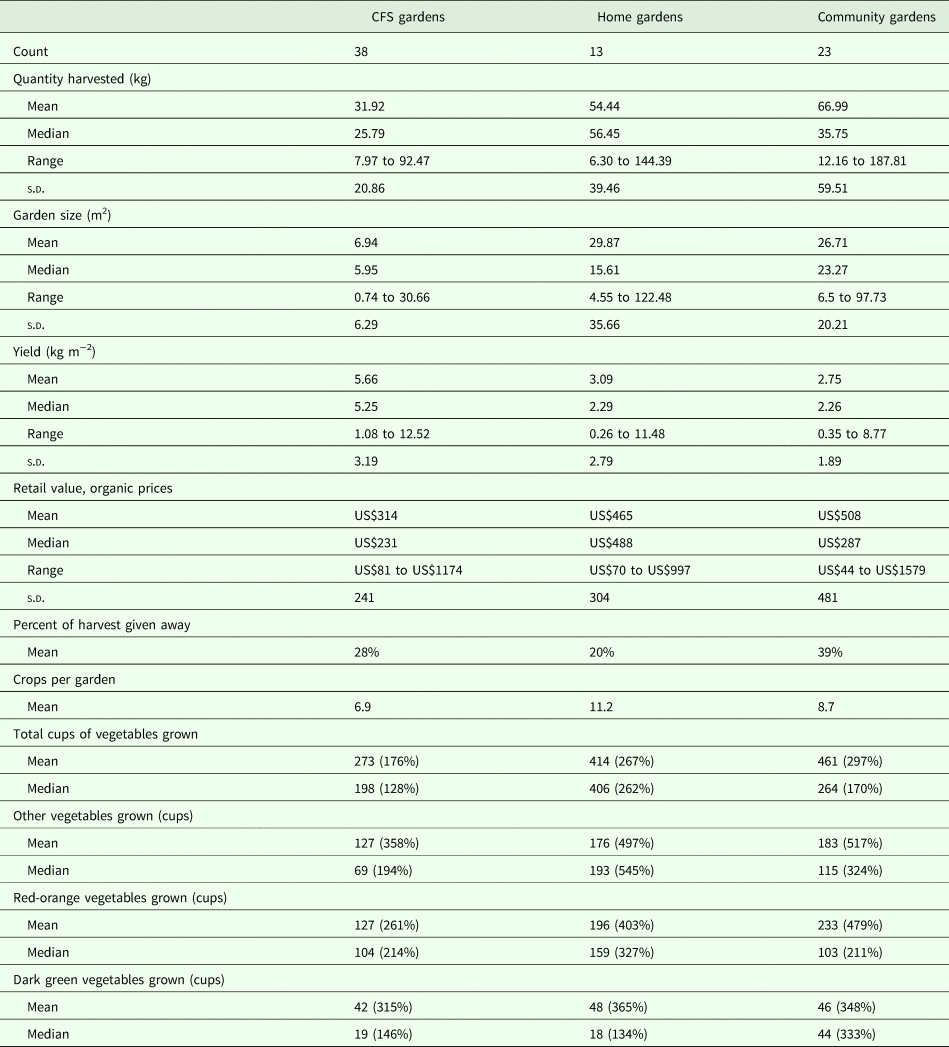
Garden harvest data provide information about the supply of food from home, community and CFS gardens (Table 2). Over the 2-month period from July to August 2015, median production was 56 kg (124 lb) from home gardens, 36 kg (79 lb) from community gardens and 26 kg (57 lb) from CFS participants’ gardens. There was considerable variability in harvest amounts among all gardens. Median yields were lower from home and community gardens [2.3 kg m−2 (0.47 lb ft−2)] than from CFS participants’ gardens [5.2 kg m−2 (1.08 lb ft−2)]. The size of garden plots was an important factor driving these differences. Participants in CFS programs had garden plots that were, on average, three to four times smaller than home and community gardens.
Garden output and characteristics by category of gardener

Data represents 2-month time period from July to August 2015. Values in parentheses show cups of vegetables grown as a percent of the USDA nutritional recommendations for this two-month period.
Survey and interview data help to relate quantities of produce harvested to gardeners’ produce consumption habits. On surveys, all three types of gardeners reported that their gardens produced a median of 50% of the produce their households consumed in the summer and 25% of the produce consumed in the fall. However, CFS participants reported obtaining a greater portion of their fresh produce from the garden in the winter (25%) and spring (50%) than other gardeners. For the majority of gardeners, summer appears to be the only season when they obtain a sizeable amount of produce from their gardens relative to their overall vegetable intake. During the rest of the year, most gardeners received 25% or less of the produce they consumed from their garden. While these numbers describe the central tendency of the gardeners in the study, in each season a subset of gardeners grew 75–100% of the produce they consumed, ranging from 6% of gardeners in the winter to 37% in the summer.
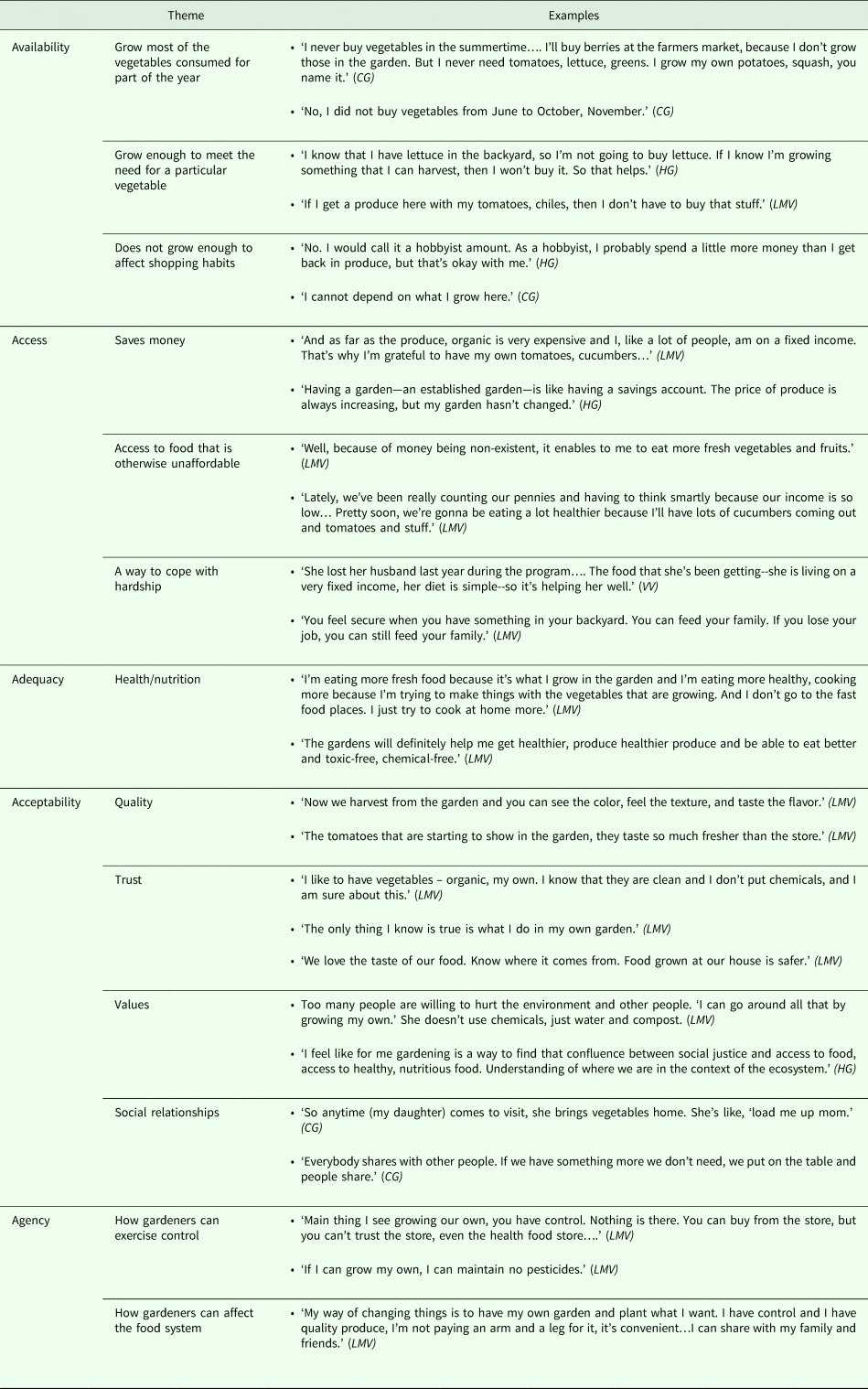
In interviews, gardeners described three levels of production, ranging from near self-sufficiency in vegetable production to no meaningful contribution of food (Table 3), a scale similar to that outlined by Pourias et al. (Reference Pourias, Duchemin and Aubry2015). The gardeners who emphasized self-sufficiency described being able to grow most of the vegetables they consumed for a portion of the year. These gardeners came from a variety of economic circumstances, but they were committed to gardening, devoting significant time and/or space to their gardens. The second set of gardeners described producing enough of a particular crop (e.g., lettuce, other greens, or tomatoes) for some portion of the year that they did not need to purchase that particular item at the store. The third set of gardeners did not grow enough produce to contribute much food to their diet. Some of these gardeners explained that gardening was a hobby and while the food was a welcome reward, it was not their main objective. Others in this category would have liked to produce more but were constrained by poor environmental conditions (e.g., soil quality, shading, water availability), lack of time, or other factors.
Interview themes for urban food gardens and food security

The category of the gardener is indicated in parentheses. HG indicates a home gardener; CG indicates a community gardener.
Access
Access to food refers to the ability both to obtain food in close geographic proximity to one's home and to pay for food purchases. Most of the LMV gardeners interviewed identified the cost of food as a bigger obstacle to access than proximity to a grocery store. Survey data support this finding: two-thirds of CFS program members were motivated to garden in order ‘to save money,’ more than double the portion of others gardeners (P < 0.0001). Gardening can help address both the physical and economic elements of access by providing an alternative source of produce. For those for whom cost is a barrier, having one's own garden can either save money or provide food that otherwise would not be purchased (Table 3). Several LMV gardeners were able to replace produce they would have normally purchased at the store with produce from their gardens. As two such LMV members noted ‘I was buying swiss chard, but now I am growing (it)’ and ‘with all the vegetables I have, I don't have to buy much vegetables.’ Several community gardeners and LMV members reported that they would not be able to purchase the same types, quantities, or quality of vegetables if they did not grow them in their gardens. Exemplifying this trend, two LMV members explained ‘Sometimes there isn't enough money to buy vegetables’ and ‘I rarely ever get organic food, which is what prompted us to grow it.’ Many LMV gardeners wanted to buy organic produce but lamented that they could not afford it. Thus, gardening allowed them to have the diet they wanted—one with many organically grown vegetables—but could not otherwise afford to purchase.
To approximate how much food spending garden produce replaced, we used harvest amounts and average grocery store prices to calculate how much it would have cost gardeners to purchase the same amounts and types of foods they grew in their gardens. The retail value of gardeners’ harvests ranged from a median of US$231 for CFS participants to a median of US$488 for home gardeners (Table 2). Garden expenses, as reported in the survey, were minimal for CFS participants, who receive all the supplies they need to start a garden for free, while other home and community gardeners reported spending significantly more (P > 0.0001). Community gardeners, who have the additional expense of paying for the use of their garden plots, reported costs ranging from US$15 to US$600 (median = US$100). For those gardeners who weighed their harvest and completed the survey, we calculated costs savings by subtracting their reported expenses from the estimated retail value of their produce. Taking into account general expenses and community garden payments, the potential savings from garden produce were remarkably similar across garden types (US$222 for CFS participants, US$236 for community gardeners and US$252 for home gardeners). How gardeners valued these savings depended in large part on income level. For some saving a few hundred dollars on food over the course of the summer was inconsequential, while for others it made the difference between a diet rich in fresh, organic vegetables and one that was not. A smaller set of gardeners explained that gardening was a strategy for coping with economic hardship, most often as the result of their own or a spouse's loss of work. In these cases, gardening offered a sense of security, helping to meet immediate food needs and to prepare for future upheaval (Table 3). One gardener, who was motivated to join LMV because of the 2008 financial crisis, said of the garden: ‘If you lose your job, you can still feed your family.’
Finally, access to garden produce was not limited to gardeners and their immediate households. Among all three garden groups, giving away produce was a common practice, independent of overall production amounts. On average, community gardeners gave away nearly 40% of their harvest by weight, CFS gardeners gave away 29% and home gardeners gave away 20% (Table 2). In aggregate, the 76 gardeners who weighed their harvest from July to August 2015 gave away 1396 kg (1.5 tons) of produce over that two-month time period. Friends (34%), extended family (31%) and neighbors (20%) received most of the produce that was given away. Survey data supports this finding: 56% of survey respondents reported that they often gave away fresh fruits and vegetables they had grown. There was no significant difference between garden groups in their self-reported frequency of gifting garden produce (P = 0.643).
Adequacy
Our results show that garden produce can make a substantial contribution to gardeners’ vegetable intake during the summer growing season (Table 2). Between July and August, the typical CFS, home and community gardens all produced enough cups of vegetables for one person to consume the recommended 155 total cups of vegetables for that 2-month period. Among CFS participants, gardens produced enough other (e.g., cucumbers, zucchini) and red-orange (e.g., tomatoes, red peppers) vegetables for nearly two adults to meet their recommended intake of these vegetable subgroups. Home and community gardens, which were typically 3–4 times larger than CFS gardens, produced enough vegetables for two or more adults to meet the recommended cups consumed of red-orange and other vegetables during July and August. Community gardeners produced more than three times the required cups of leafy greens, which was more than double the cups of leafy greens produced by home and CFS gardeners.
Urban food gardens can also contribute to the nutritional quality of gardeners’ diets through dietary diversification. In Santa Clara County, gardeners averaged 8.2 self-identified crops per garden, with a range of 2–26 crops recorded per garden (Table 2). Additionally, gardeners recorded a large number of crop varieties, including 32 different varieties of tomato. Surveyed gardeners were asked if they had made any changes to their eating habits since they started gardening. All types of gardeners reported eating larger amounts of fruits and vegetables since they started gardening. They also indicated that their diets had become more diverse in several ways since they started gardening: 85% reported eating different types of vegetables depending on the season, 76% indicated that they enjoy trying new vegetables and 79% eat more than one kind of vegetable each day. A larger portion of CFS participants (96%) than home or community gardeners reported encouraging their family to eat more fruits and vegetables (P = 0.008).
Acceptability
An expanded conception of cultural acceptability still includes the presence of various cultural crops. In this study, many gardeners devoted a portion of their gardens to crops associated with particular cultural and family traditions, including bitter melon, bok choy, chayote, Chinese broccoli, Chinese celery, goji berries, loofah, nopales, opo squash, rhubarb, taro, tree collards and yam leaves. Additionally, gardeners of all nationalities and ethnicities took pleasure in experimenting with different or unusual crops or varieties.
Regardless of the garden type or income level, study participants valued certain attributes and practices associated with garden-grown produce more than they valued the availability of particular crops. Gardeners frequently commented on the high quality of the food they grew themselves, often contrasting it with store-bought produce. Exemplifying this trend, one community gardener noted the difference in freshness and flavor between his tomatoes, which are harvested the day they are eaten and a commercial tomato, which is harvested unripe and then transported long distances. In addition to freshness and flavor, having organically grown produce was important for many gardeners. Organic gardening was the most common system of production in all garden types: 100% of CFS and community gardeners and 94% of home gardeners reported that they gardened either organically or mostly organically. As noted above, some low-income gardeners used gardening as a strategy to obtain a variety of fresh produce, grown without pesticides, when they could not afford to purchase these items in the store. Some gardeners, from across the income spectrum, commented that growing one's own produce was the only way to ensure that it was truly organic. As one representative LMV member explained ‘I don't worry if it's from our garden. If it's from the store, I don't know what's in it.’
In interviews, a number of gardeners—whether growing at home, in community gardens, or through a CFS program—expressed mistrust of nebulous actors in the food system and concern about the environmental, health and social impact of the conventional food system. Interviewed LMV members described a lack of certainty about the origin of conventional food and concern about the ‘unnatural’ elements of production, post-harvest handling and processing practices (e.g., the use of pesticides or ethylene gas). Coupled with a lack of knowledge about food because of the distance and complexity of the conventional food chain, LMV members felt they lacked control over the foods obtained through this system. One described the role of large food companies, saying ‘We have to buy from them…. (T)hey are big giants, there is nothing we can do.’ As evidence that people's food values encompass the social and environmental conditions along the food supply chain, LMV gardeners noted ‘to me healthy food is something I know where it's coming from; that it went through a good process to get to my table’ and ‘I think about where the foods come from, how it's been harvested, and who has been employed to obtain it.’ While some LMV gardeners described having to compromise their food preferences because of what they could afford, members of this group emphasized that although they were poor, they still cared deeply about what they ate and had strong preferences for food that was healthy, fresh and free of pesticides. Presented in contrast to the conventional food supply system, gardens represented an alternative a way to have ‘good food’ – that is, food that was fresh, flavorful, organic, knowable and trusted.
Gardening is also perceived as a socially acceptable way of obtaining food and many gardeners valued the social dimensions of gardening. Giving away garden produce was important to many gardeners, who enjoyed sharing what they had grown with their children or grandchildren, their friends and neighbors, their coworkers and others. Some also associated gardening with dignity. One disabled gardener described how having a garden allowed her to reciprocate at a time when she felt like she depended on the kindness of others:
‘I love to be able to do that because I don't have much to give anymore. I can't give my time, I can't give my energy, I can't give my effort, what I can give is my produce. It's kind of like I feel a lot of people helped me out, they'll bring me food, they'll give me money, they'll take care of me and I don't have any way of reciprocating but I can give them a cucumber or some tomatoes and it's my way of kind of thanking people who were kind enough to help me. So it's really beneficial because it's all I have to give.’
Agency
The final ‘A’ of food security is process-oriented, referring to people's ability to affect the food system. Gardening offers avenues for both individual and collective agency, particularly through garden-based networks. For individuals, gardens can offer a sense of control over and hence trust of, the produce they consume, which otherwise seems suspect. Particularly for low-income gardeners, gardening was a way to make a statement about the kind of food system they wanted to see but did not have the purchasing power to signal through their consumption choices. As one LMV gardener explained in response to a question about changing the food system ‘If you have the luxury of buying locally, that would be the next best thing. If you can't, grow your own garden.’ Many LMV members indicated that gardening was a food system alternative that was available to them and gave them a chance to enact some of their vision of what the economic, environmental, social and health dimensions of food should be. As one said ‘My way of changing things is to have my own garden and plant what I want. I have control and I have quality produce. I'm not paying an arm and a leg for it. It's convenient…. I can share with my family and friends…. Every aspect it's better.’ Although there are limits to this approach, gardeners still found value in having the ability to express their food values: ‘I don't make a big dent, but what I do (grow) is quality food.’
The literature contains many examples of community gardeners mobilizing to protect their gardens (e.g., Smith and Kurtz, Reference Smith and Kurtz2003; Lawson, Reference Lawson2007), but CFS gardening networks—such as LMV and VV—present additional opportunities for collective action in the food system. Both LMV and VV have program goals that extend beyond food production to empowering their members to make food system change. LMV members, for instance, work to improve access to good food through community organizing and policy advocacy. Since 2014, LMV's community organizing committee has been actively involved in advocating for the adoption of UA Incentive Zones (UAIZs) in San Jose. To achieve this policy objective, LMV members have met individually with city council members, orchestrated postcard mailing campaigns, and testified repeatedly before the San Jose City Council. San Jose adopted UAIZs in 2016, a testament to the success of LMV members in bringing the interests and concerns of low-income residents before the City Council to change city policy with the goal of creating a more equitable urban food system.
VV's approach to food system change is focused on economic autonomy and supplementing livelihoods, although they too have been involved with UAIZs. VV has developed the Super Jardineros program which teaches low-income gardeners to grow commercial-quality organic vegetable seedlings ‘that reflect the cultural preferences of Santa Clara County's largest ethnic groups’ (Valley Verde, 2018). These seedlings are intended to be a source of income for participating households, who sell them back to VV for new cohorts of gardeners and will eventually sell them to other gardeners through retail channels. The goal is for participating families to receive supplemental income, develop entrepreneurial skills and increase healthy food access. The efforts of both LMV and VV show that through garden-based networks, gardening efforts can scale up to produce community- or city-level impacts.
Discussion and conclusions
In this study, we draw on multiple lines of evidence to describe how urban food gardens in Santa Clara County contribute to food security by improving the availability, accessibility, adequacy and cultural acceptability of fresh produce while also providing avenues for an agency within the food system. Combining different types of data helps to contextualize the contributions of gardens to food security. While weighing data provides one measure of the quantity and monetary value of garden vegetables, survey data adds a self-assessment of how much of a household's overall fruit and vegetable intake garden produce represents. Interviews allow gardeners to explain what good food means to them, any barriers they face in obtaining culturally acceptable foods and the role of their garden in realizing their food aspirations. From an applied perspective, this study suggests a mixed method approach may be valuable for UA practitioners seeking to evaluate impact. Because weighing can be difficult for UA organizations and researchers (Taylor and Lovell, Reference Taylor and Lovell2015), we recommend it be done on a small scale with just a few gardeners and then supplemented with survey or interview data that examines other aspects of the food security puzzle. In a larger sense, a mixed method approach responds to the call for efforts to improve food security to broaden their focus by considering yields alongside a broader suite of social, environmental and equity concerns (APLU, 2017; Chappell, Reference Chappell2018).
Our study adds to the literature showing that urban gardens contribute a meaningful amount of fresh produce to gardeners’ diets (Kortright and Wakefield, Reference Kortright and Wakefield2011; Litt et al., Reference Litt, Soobader, Turbin, Hale, Buchenau and Marshall2011; Gray et al., Reference Gray, Guzman, Glowa and Drevno2014; Algert et al., Reference Algert, Diekmann, Renvall and Gray2016b; Conk and Porter, Reference Conk and Porter2016). Gardeners in this study grew enough for at least one adult to consume the recommended cups of vegetables over the summer growing season. They also reported greater dietary diversity through eating different kinds of vegetables over the day and in different seasons. These findings apply to the three categories of gardeners in the study: home gardeners, community gardeners and CFS gardeners, who are often novice gardeners with small plots and more likely to be at risk for food insecurity. Yields from gardens in Santa Clara County fall within the range reported for other gardens in the Global North (National Gardening Association, 2009; Algert et al., Reference Algert, Baameur, Diekmann, Gray and Ortiz2016a; Conk and Porter, Reference Conk and Porter2016). However, just as others have noted, there was great variability in harvest (Shamasunder et al., Reference Shamasunder, Mason, Ippoliti and Robledo2015; Conk and Porter, Reference Conk and Porter2016; Pourias et al., Reference Pourias, Duchemin and Aubry2015). Some of the variability observed in this study was due to different orientations toward gardening—such as focus on production vs recreation (Pourias et al., Reference Pourias, Duchemin and Aubry2015; Taylor et al., Reference Taylor, Lovell, Wortman and Chan2017)—as well as constraints on time, changes in employment or health status and the presence of poor environmental conditions or pests. The degree of variability between growing seasons, years and gardeners indicates that instability in the supply of garden-grown produce may be an obstacle to using gardens to improve food security. Formal and informal gardening networks can help to mitigate this issue, by providing technical assistance, resources (such as compost or seedlings) and a system for sharing produce among members (e.g., Taylor et al., Reference Taylor, Lovell, Wortman and Chan2017).
The extent to which gardens affected food access depended in large part on gardeners’ economic circumstances. In interviews, LMV gardeners confirmed what studies of other cities have shown (e.g. Alkon et al., Reference Alkon, Block, Moore, Gillis, DiNuccio and Chavez2013): that the cost of healthy food was a greater barrier to access than neighborhood food environment. Many of the middle- or upper-income gardeners in this study did not have to rely on their gardens for access to fresh produce. However, for gardeners who struggled with the cost of healthy food, having a garden often enabled them to have more of the diet they wanted, rather than the diet they could afford. In the context of this study, access refers to food as well as gardens. Schupp et al. (Reference Schupp, Som Castellano, Sharp and Bean2016) found that homeowners were more likely to have gardens than renters. In Santa Clara County, LMV and VV play an important role in creating access to gardens for low-income residents, who often rent. For those who receive permission from their landlords to garden at home, these programs help make gardening more accessible to low-income gardeners by providing education, start-up materials and a supportive social environment. However, land access remains a serious challenge for aspiring gardeners. Both programs find many people who are interested in gardening but lack adequate space and/or permission from landlords to garden at home.
While gardening's impact on access varied by income, urban gardening was able to provide culturally acceptable foods for gardeners regardless of income level or garden type. As others have found (Airriess and Clawson, Reference Airriess and Clawson1994; Corlett et al., Reference Corlett, Dean and Grivetti2003; Taylor et al., Reference Taylor, Lovell, Wortman and Chan2017), some people garden to have access to foods that are specific to their identity and cultural heritage. In this study, gardeners also frequently shared a set of food values—which could be enacted in their gardens—related to health, knowledge, control, trust, freshness, flavor, organic production methods and sharing. Like other studies (Kortright and Wakefield, Reference Kortright and Wakefield2011; Carney et al., Reference Carney, Hamada, Rdesinski, Sprager, Nichols, Liu, Pelayo, Sanchez and Shannon2012; Minkoff-Zern, Reference Minkoff-Zern2014b; Pourias et al., Reference Pourias, Aubry and Duchemin2016; Gauder et al., Reference Gauder, Hagel, Gollmann, Stängle, Doluschitz and Claupein2019), our research suggests that gardeners prize quality and other aspects of good food. While many gardeners grew cultural crops, to focus an analysis of cultural acceptability on this alone would miss the values that gardeners hold about how food is produced and the relationships between food, people and the environment. The interviews done by and with LMV members reinforce the idea that food values are strongly held by people of all income levels – despite popular claims that low-income people lack knowledge about what constitutes healthy or good food (Alkon et al., Reference Alkon, Block, Moore, Gillis, DiNuccio and Chavez2013; Minkoff-Zern, Reference Minkoff-Zern2014b) or that interest in food that is fresh, organic, local and/or seasonal are largely white, middle-class concerns (Guthman, Reference Guthman2008). While low-income gardeners may not be able to afford the food they want, gardeners in this study had a clear vision of the type of food they preferred and a clear understanding of the elements of a healthy diet.
Gardening allows gardeners to step outside a food system that often fails to adhere to their values and offers some degree of agency in regards to food, in contrast to the conventional food system in which many feel relatively powerless. These two dimensions of food security—acceptability and agency—are interlinked. If the conventional food system fails to meet gardeners’ expectations about the social and environmental conditions of food production or lacks mechanisms for addressing perceived problems, then gardening enables people to enact their values by growing, sharing, and eating their own good food. The knowledge and control that gardeners celebrate in their own gardens are the flip-side of their desire for greater transparency, accountability and agency within the larger food system. Agency within the garden happens on a small-scale, but it has the ability to scale up to broader movements for policy (e.g., LMV) or food system (e.g., Detroit; White, Reference White2011) change if gardens are seen not just as spaces of, but catalysts for, food system change (Raja et al., Reference Raja, Morgan and Hall2017; Valley and Wittman, Reference Valley and Wittman2018).
While this study confirms what others have found about the positive contributions of UA to a diverse, nutritious diet, it complements those results with the finding that gardeners of all incomes care about other, subjective aspects of their food. Future analyses of UA and food security should integrate availability and adequacy with access, cultural acceptability and agency. The idea of good food put forth by gardeners is not just about the quantity, type, or nutritional value of produce, but about the ways in which food is produced, with special emphasis on pesticide-free production practices, crops bred and grown for flavor and freshness rather than durability, connections between producers and consumers that allow for transparency and accountability and the social relationships that are formed and reinforced through labor in the garden and the distribution of garden-grown produce. Gardening is also a way for people to act on their discontent with other areas of the food system. Increasing self-sufficiency through gardening may be one way to step outside the conventional food system. Additionally, gardening-related social networks such as LMV and VV are working at a broader scale to change local policy and the local food environment.
Even when problems with production limit food supply, gardeners’ sense of food security may still improve if gardening provides access to food that meets their standards for what is ethically and culturally acceptable and creates a space for agency in the food system. Without taking cultural acceptability and agency into consideration, it is quite possible to increase food production in the city without meeting citizens’ expectations about what constitutes good food and who it should be for (e.g., Vitiello and Wolf-Powers, Reference Vitiello and Wolf-Powers2014). As Valley and Wittman (Reference Valley and Wittman2018, p. 7) have written about Vancouver, the food security question we should ask is not ‘can urban agriculture feed the city?’ but rather how should the city be fed? Uncovering the food imaginaries of gardeners and other urban residents is an important first step in designing UA programs that improve food security. It can also link localized forms of production to broader food system issues by initiating a larger discussion about how to feed urban populations in ways that adhere to residents’ values.
Acknowledgements
We are grateful to all the gardeners who volunteered their time to participate in this study and the garden programs that hosted us: City of San Jose Parks and Recreation; City of Mountain View Recreation Department; City of Palo Alto Community Services Department; City of Cupertino Recreation Department; Morgan Hill Community Garden; City of Campbell Facilities Department; Charles Street Gardens; and the Master Gardeners of Santa Clara County. A special thanks to Jamie Chen, Tori Truscheit, and Jacky Rivera at Sacred Heart Community Service and Raul Lozano at Valley Verde for their collaboration. Santos Hernandez developed the interview questionnaire for La Mesa Verde gardeners in summer 2016 and conducted interviews of La Mesa Verde gardeners with Martha Barona and Dulce Martinez. They generously shared their interview recordings with us. At Santa Clara University, we wish to thank Allison Carmody, Beatriz Clift, Teri Escobar-Ochoa, Alison Ho, Efren Oxlaj, Lee Panich, Leigh Pond, Josh Shao and Alexandra Sudomoeva for their assistance with data collection, analysis, translation and transcription. This paper also benefited from the comments of three anonymous reviewers.
Financial support
This work is supported by the National Institute of Food and Agriculture, U.S. Department of Agriculture, under award number 2014-67012-22270 and the Food & Agribusiness Institute in the Leavey School of Business at Santa Clara University.