The Gradient Symbolic Computation (GSC) model presented in the keynote article (Goldrick, Putnam & Schwarz) constitutes a significant theoretical development, not only as a model of bilingual code-mixing, but also as a general framework that brings together symbolic grammars and graded representations. The authors are to be commended for successfully integrating a theory of grammatical knowledge with the voluminous research on lexical co-activation in bilinguals. It is, however, unfortunate that a certain conception of bilingualism was inherited from this latter research tradition, one in which the contrast between native and non-native language takes a back seat.
More specifically, in the GSC model of code-mixing, monolingual and late-learned grammars are indistinguishable, except that they may vary in general parameters such as their ‘strength’. There is, however, much evidence for selective differences between native and non-native representations, and these should also be modelled, if the GSC is to have wider applicability.
Here, we illustrate how the GSC framework can be used to model both native and non-native grammars by changing the weights of specific constraints. We consider a phenomenon that involves the contribution of multiple constraints and displays interesting native versus non-native contrasts: the plurals-in-compounds effect. This effect concerns the avoidance of regular plurals inside compounds (*rats catcher), relative to both irregular plurals (?mice catcher) and singular forms (rat catcher).
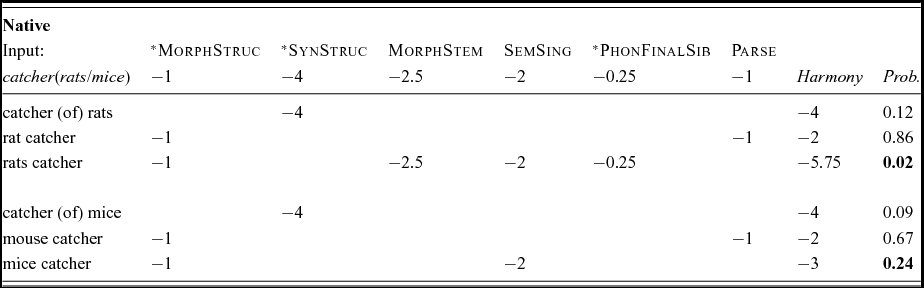
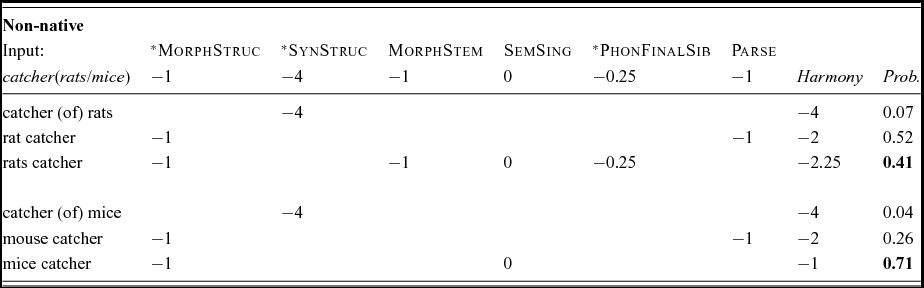
Table 1 displays the target behaviour for our model, the results of a study by Murphy (Reference Murphy2000), in which native and non-native speakers were asked to form novel compounds from verbs and nouns (e.g., catches rats). Tables 2 and 3 display GSC grammars that generate synthetic compounds, for native and non-native speakers.
Table 1.
Proportions of regular and irregular plurals inside compounds, in Murphy's (Reference Murphy2000) study and in the current model.
Table 2.
GSC grammar of synthetic compounds for native speakers.
Table 3.
GSC grammar of synthetic compounds for non-native speakers.
The first two constraints in Tables 2 and 3, *MorphStruc and *SynStruc, militate against morphological and syntactic structure, respectively, ultimately creating a preference for synthetic compounds instead of their syntactic counterparts (e.g., catcher of rats). The plurals-in-compounds effect arises from the three constraints that follow. Firstly, a morphological constraint against regular inflectional processes feeding lexical compounding (Kiparsky, Reference Kiparsky, van der Hulst and Smith1982). We formalise it as MorphStem, which states that the compound's non-head must be a lexicalised stem (like mouse or mice), rather than a morphologically structured plural (like rat-s). The next constraint, SemSing, is violated by non-heads with plural semantics and explains why irregular plurals inside compounds are less acceptable than singulars. This difference in acceptability is typically smaller than the one between regular and irregular non-heads (Clahsen, Gerth, Heyer & Schott, Reference Clahsen, Gerth, Heyer and Schott2015); therefore, we attribute a smaller weight to SemSing than to MorphStem. The plurals-in-compounds effect has also been argued to result from a phonological constraint against sibilant codas. As the evidence for such a phonological constraint is scant (Berent & Pinker, Reference Berent and Pinker2007), we attribute a small weight to *PhonFinalSib. Finally, as in the keynote article, Parse ensures the expression of every element of semantic representation.
Table 2 shows a clear plurals-in-compounds effect for native speakers: forms like rats catcher are rare because they violate all three constraints (morphological, semantic, and phonological); forms like mice catcher only violate the semantic constraint and are more frequently produced; and compounds with singular non-heads are the most acceptable response.
In order to model Murphy's (Reference Murphy2000) results with non-native speakers, only two constraints need to be adjusted (see Table 3). Firstly, by eliminating the semantic constraint (i.e., setting the weight of SemSing to 0), irregular plurals become the most frequent response. Secondly, by reducing the weight of the morphological constraint (MorphStem, from −2.5 to −1), a smaller plurals-in-compounds effect is obtained and responses containing regular plurals become more common. Both of these changes find independent support in Clahsen et al.’s (Reference Clahsen, Gerth, Heyer and Schott2015) study, in which non-native speakers rated compounds with irregular plurals as being acceptable (indicating that no semantic constraint is at play), and rated regular plurals as more acceptable than native speakers (indicating a reduced morphological constraint). As can be seen in Table 1, our model's predicted probabilities are remarkably similar to the proportions obtained in Murphy's study.
To conclude, we note that if native and non-native grammars differ in the weights of compounding constraints, it is hard to see how this could result from “the probability distribution of forms in [learners’] linguistic experience” (Goldrick et al.). This is because plurals (both regular and irregular) are extremely rare inside compounds. Instead, the fundamental difference between native and non-native language would have to be in the learning biases that are brought to the language acquisition task (e.g., Johnson & Newport, Reference Johnson and Newport1989).






 You have
Access
The Gradient Symbolic Computation (GSC) model presented in the keynote article (Goldrick, Putnam & Schwarz) constitutes a significant theoretical development, not only as a model of bilingual code-mixing, but also as a general framework that brings together symbolic grammars and graded representations. The authors are to be commended for successfully integrating a theory of grammatical knowledge with the voluminous research on lexical co-activation in bilinguals. It is, however, unfortunate that a certain conception of bilingualism was inherited from this latter research tradition, one in which the contrast between native and non-native language takes a back seat.
More specifically, in the GSC model of code-mixing, monolingual and late-learned grammars are indistinguishable, except that they may vary in general parameters such as their ‘strength’. There is, however, much evidence for selective differences between native and non-native representations, and these should also be modelled, if the GSC is to have wider applicability.
Here, we illustrate how the GSC framework can be used to model both native and non-native grammars by changing the weights of specific constraints. We consider a phenomenon that involves the contribution of multiple constraints and displays interesting native versus non-native contrasts: the plurals-in-compounds effect. This effect concerns the avoidance of regular plurals inside compounds (*rats catcher), relative to both irregular plurals (?mice catcher) and singular forms (rat catcher).
Table 1 displays the target behaviour for our model, the results of a study by Murphy (Reference Murphy2000), in which native and non-native speakers were asked to form novel compounds from verbs and nouns (e.g., catches rats). Tables 2 and 3 display GSC grammars that generate synthetic compounds, for native and non-native speakers.
Proportions of regular and irregular plurals inside compounds, in Murphy's (Reference Murphy2000) study and in the current model.
GSC grammar of synthetic compounds for native speakers.
GSC grammar of synthetic compounds for non-native speakers.
The first two constraints in Tables 2 and 3, *MorphStruc and *SynStruc, militate against morphological and syntactic structure, respectively, ultimately creating a preference for synthetic compounds instead of their syntactic counterparts (e.g., catcher of rats). The plurals-in-compounds effect arises from the three constraints that follow. Firstly, a morphological constraint against regular inflectional processes feeding lexical compounding (Kiparsky, Reference Kiparsky, van der Hulst and Smith1982). We formalise it as MorphStem, which states that the compound's non-head must be a lexicalised stem (like mouse or mice), rather than a morphologically structured plural (like rat-s). The next constraint, SemSing, is violated by non-heads with plural semantics and explains why irregular plurals inside compounds are less acceptable than singulars. This difference in acceptability is typically smaller than the one between regular and irregular non-heads (Clahsen, Gerth, Heyer & Schott, Reference Clahsen, Gerth, Heyer and Schott2015); therefore, we attribute a smaller weight to SemSing than to MorphStem. The plurals-in-compounds effect has also been argued to result from a phonological constraint against sibilant codas. As the evidence for such a phonological constraint is scant (Berent & Pinker, Reference Berent and Pinker2007), we attribute a small weight to *PhonFinalSib. Finally, as in the keynote article, Parse ensures the expression of every element of semantic representation.
Table 2 shows a clear plurals-in-compounds effect for native speakers: forms like rats catcher are rare because they violate all three constraints (morphological, semantic, and phonological); forms like mice catcher only violate the semantic constraint and are more frequently produced; and compounds with singular non-heads are the most acceptable response.
In order to model Murphy's (Reference Murphy2000) results with non-native speakers, only two constraints need to be adjusted (see Table 3). Firstly, by eliminating the semantic constraint (i.e., setting the weight of SemSing to 0), irregular plurals become the most frequent response. Secondly, by reducing the weight of the morphological constraint (MorphStem, from −2.5 to −1), a smaller plurals-in-compounds effect is obtained and responses containing regular plurals become more common. Both of these changes find independent support in Clahsen et al.’s (Reference Clahsen, Gerth, Heyer and Schott2015) study, in which non-native speakers rated compounds with irregular plurals as being acceptable (indicating that no semantic constraint is at play), and rated regular plurals as more acceptable than native speakers (indicating a reduced morphological constraint). As can be seen in Table 1, our model's predicted probabilities are remarkably similar to the proportions obtained in Murphy's study.
To conclude, we note that if native and non-native grammars differ in the weights of compounding constraints, it is hard to see how this could result from “the probability distribution of forms in [learners’] linguistic experience” (Goldrick et al.). This is because plurals (both regular and irregular) are extremely rare inside compounds. Instead, the fundamental difference between native and non-native language would have to be in the learning biases that are brought to the language acquisition task (e.g., Johnson & Newport, Reference Johnson and Newport1989).