Although we agree with the focal article (Kath etal., Reference Kath, Salter, Bachiochi, Brown and Hebl2021) that Industrial and Organizational (I-O) psychology educators need to “practice what they preach,” we believe that the authors overlooked a critical area of I-O psychology—namely, that of psychological well-being. In the face of growing evidence of increasing mental health issues in university students and growing demand for campus counseling services (Lipson etal., Reference Lipson, Lattie and Eisenberg2019), we suggest that this is an area in which our I-O psychology knowledge can also provide important benefits to our student body.
Pressman etal. (Reference Pressman, Kraft and Bowlin2013) define well-being as, “a broad term that encompasses what it means to be functioning as a healthy person across multiple domains” (p. 2048). Wright and Huang (Reference Wright and Huang2012) note, furthermore, that well-being involves three elements: (a) a subjective experience; (b) the feeling, experience, and processing of emotions; and (c) a global evaluation made about multiple aspects of life, including work and relationships.
Student psychological well-being
Although well-being involves multiple dimensions, much of the research into undergraduate students has focused largely on their psychological well-being and, to a lesser extent, their social well-being. In this respect, compelling evidence has emerged recently for what some have termed a “crisis” in mental health at universities, with increasing demand for mental health services and undergraduate students reporting significant distress (Duffy, Reference Duffy2019). Data from the American College Health Association (2015) tell us that clinical depression and anxiety affect a substantial proportion of students.
Why should we be concerned about this issue? The data suggest that poor psychological well-being in students is associated with a wide range of outcomes including poor academic performance, social withdrawal, financial and accommodation difficulties, reduced emotional and behavioral skills, poor class attendance, and intention to leave university (for a review, see Storrie etal., Reference Storrie, Ahern and Tuckett2010).
Supporting student psychological well-being
First, we wish to emphasize that all students should receive professional help to manage serious mental health concerns. As we have noted already, however, this is not always possible, highlighting the important role that educators can play in supporting students' psychological well-being. As I-O psychology educators, we are uniquely placed to support our students’ psychological well-being through our teaching practices and specific strategies and approaches that we use in the classroom. In this regard, the authors of the focal article observed that educators can make small, medium, or large-scale changes and incorporate those that they believe are most relevant to their course and context. Here, we suggest that educators begin with three broad areas of focus: (a) reducing the stigma of mental illness; (b) increasing mindfulness; and (c) improving the prevention and management of stress.
Reducing the stigma of mental illness
Many individuals that are affected by relatively common mental health conditions such as depression and anxiety do not disclose their illness and do not seek professional help in a timely manner, which can prevent recovery. One barrier to the disclosure of psychological distress and seeking professional help is stigma. Mental illness stigma comprises negative attitudes and behaviors toward a person with a mental illness, for example, being thought of as weak, lacking in character, being rejected, discriminated against, or excluded from participating in a number of different areas of society including the workplace (Shann etal., Reference Shann, Martin, Chester and Ruddock2019).
The role of teachers and the ways in which they talk about mental health will be influential, including the use of appropriate nonstigmatizing language when discussing mental health conditions. Paying careful attention to language is an example of a small change that educators can make (see for example https://everymind.org.au/mental-health/understanding-mental-health/language-and-stigma).
A medium change that educators could make is to include a discussion activity, which actively encourages students to identify their existing attitudes, values, knowledge, and experiences about mental health; help them understand the context, relevance, and value of existing mental health knowledge; and identify how prior organizational or community socialization may be framing stigmatizing (self- or other-directed) attitudes and behavior.
An example of a more extensive or large change could be to expose students to a formal mental illness stigma-reduction intervention/training program. Research on stigma-reduction interventions (e.g., see Gronholm etal., Reference Gronholm, Henderson, Deb and Thornicroft2017) focuses on three main methods: (a) education: to develop mental health literacy; (b) contact: direct or indirect exposure to a person with a mental illness; and (c) protest: refuting stigmatizing attitudes and representations of mental illness.
Increasing mindfulness
Bishop etal. (Reference Bishop, Lau, Shapiro, Carlson, Anderson, Carmody, Segal, Abbey, Speca, Velting and Devins2004) define mindfulness as an intentional attentiveness to the present moment experience with an orientation of curiosity, openness, and acceptance. In a study among university graduate students, Barry etal. (Reference Barry, Woods, Martin, Stirling and Warnecke2019) found that a mindfulness intervention led to a reduction in depression symptoms and increased reports of self-efficacy, hope, and resilience.
A small change that educators could make is to discuss mindfulness research in lecture/learning materials, highlighting what it is and the potential benefits. A medium change could include the promotion of mindfulness courses as optional activities for students via university-sponsored counseling services or community services. A large change could involve embedding active experimentation with mindfulness practice in courses that have a personal development focus, using strategies such as providing access to reputable smartphone apps or bringing in mindfulness teachers for live instruction that can be integrated with reflective activities.
Improving the prevention and management of stress
Stress can negatively affect students’ well-being and academic outcomes. We suggest that one small-scale change for stress prevention that educators can make is to ensure they examine the amount and frequency of student assessment in their course and take steps to make sure that students’ academic workload is realistic and manageable. This means ensuring that students have adequate time and resources to complete tasks and that assessment deadlines do not overlap. Allowing flexibility in the submission of work may also help to increase students’ perceptions of control.
A strong social support network is one factor that can help to buffer the negative effects of stress on psychological well-being (Viswesvaran etal., Reference Viswesvaran, Sanchez and Fisher1999). In relation to this, a medium change might involve introducing regular teamwork activities and providing students with ongoing opportunities to build supportive peer relationships. We have found from our own teaching experience that although occasionally challenging for some, most students find teamwork experiences very beneficial for building social support, especially during the ongoing COVID-19 pandemic (albeit technology-mediated).
An example of a large-scale change that educators can make to increase student psychological well-being is building a culture in the classroom that emphasizes the importance of preventing and managing stress and normalizes help-seeking behavior. We suggest that this kind of change should involve multiple interrelated activities. For example, educators can make clear at the beginning of a course that they prioritize student well-being and create a value statement that reflects this.
Conclusion
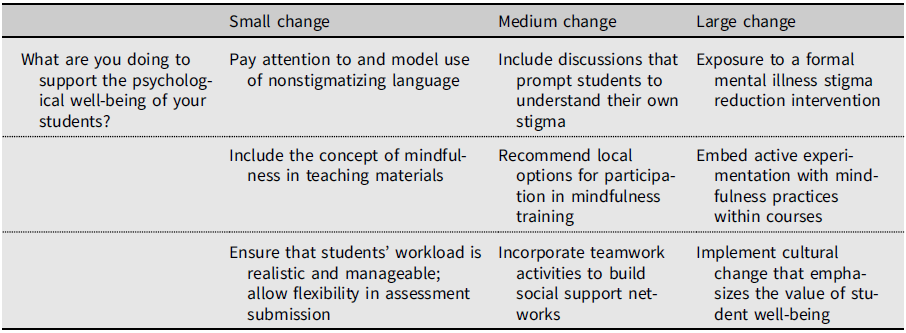
In this commentary, we have argued that the practice of teaching I-O psychology needs to address issues of student psychological well-being and suggested three areas of focus for consideration: (a) reducing the stigma of mental illness, (b) increasing students’ mindfulness, and (c) improving the prevention and management of stress within the academic context. Consistent with the focal article we have identified small, medium, and large changes that I-O educators may wish to implement to address these three areas (Table 1).
Table 1.
Summary of potential changes to support student psychological well-being




 You have
Access
Although we agree with the focal article (Kath etal., Reference Kath, Salter, Bachiochi, Brown and Hebl2021) that Industrial and Organizational (I-O) psychology educators need to “practice what they preach,” we believe that the authors overlooked a critical area of I-O psychology—namely, that of psychological well-being. In the face of growing evidence of increasing mental health issues in university students and growing demand for campus counseling services (Lipson etal., Reference Lipson, Lattie and Eisenberg2019), we suggest that this is an area in which our I-O psychology knowledge can also provide important benefits to our student body.
Pressman etal. (Reference Pressman, Kraft and Bowlin2013) define well-being as, “a broad term that encompasses what it means to be functioning as a healthy person across multiple domains” (p. 2048). Wright and Huang (Reference Wright and Huang2012) note, furthermore, that well-being involves three elements: (a) a subjective experience; (b) the feeling, experience, and processing of emotions; and (c) a global evaluation made about multiple aspects of life, including work and relationships.
Student psychological well-being
Although well-being involves multiple dimensions, much of the research into undergraduate students has focused largely on their psychological well-being and, to a lesser extent, their social well-being. In this respect, compelling evidence has emerged recently for what some have termed a “crisis” in mental health at universities, with increasing demand for mental health services and undergraduate students reporting significant distress (Duffy, Reference Duffy2019). Data from the American College Health Association (2015) tell us that clinical depression and anxiety affect a substantial proportion of students.
Why should we be concerned about this issue? The data suggest that poor psychological well-being in students is associated with a wide range of outcomes including poor academic performance, social withdrawal, financial and accommodation difficulties, reduced emotional and behavioral skills, poor class attendance, and intention to leave university (for a review, see Storrie etal., Reference Storrie, Ahern and Tuckett2010).
Supporting student psychological well-being
First, we wish to emphasize that all students should receive professional help to manage serious mental health concerns. As we have noted already, however, this is not always possible, highlighting the important role that educators can play in supporting students' psychological well-being. As I-O psychology educators, we are uniquely placed to support our students’ psychological well-being through our teaching practices and specific strategies and approaches that we use in the classroom. In this regard, the authors of the focal article observed that educators can make small, medium, or large-scale changes and incorporate those that they believe are most relevant to their course and context. Here, we suggest that educators begin with three broad areas of focus: (a) reducing the stigma of mental illness; (b) increasing mindfulness; and (c) improving the prevention and management of stress.
Reducing the stigma of mental illness
Many individuals that are affected by relatively common mental health conditions such as depression and anxiety do not disclose their illness and do not seek professional help in a timely manner, which can prevent recovery. One barrier to the disclosure of psychological distress and seeking professional help is stigma. Mental illness stigma comprises negative attitudes and behaviors toward a person with a mental illness, for example, being thought of as weak, lacking in character, being rejected, discriminated against, or excluded from participating in a number of different areas of society including the workplace (Shann etal., Reference Shann, Martin, Chester and Ruddock2019).
The role of teachers and the ways in which they talk about mental health will be influential, including the use of appropriate nonstigmatizing language when discussing mental health conditions. Paying careful attention to language is an example of a small change that educators can make (see for example https://everymind.org.au/mental-health/understanding-mental-health/language-and-stigma).
A medium change that educators could make is to include a discussion activity, which actively encourages students to identify their existing attitudes, values, knowledge, and experiences about mental health; help them understand the context, relevance, and value of existing mental health knowledge; and identify how prior organizational or community socialization may be framing stigmatizing (self- or other-directed) attitudes and behavior.
An example of a more extensive or large change could be to expose students to a formal mental illness stigma-reduction intervention/training program. Research on stigma-reduction interventions (e.g., see Gronholm etal., Reference Gronholm, Henderson, Deb and Thornicroft2017) focuses on three main methods: (a) education: to develop mental health literacy; (b) contact: direct or indirect exposure to a person with a mental illness; and (c) protest: refuting stigmatizing attitudes and representations of mental illness.
Increasing mindfulness
Bishop etal. (Reference Bishop, Lau, Shapiro, Carlson, Anderson, Carmody, Segal, Abbey, Speca, Velting and Devins2004) define mindfulness as an intentional attentiveness to the present moment experience with an orientation of curiosity, openness, and acceptance. In a study among university graduate students, Barry etal. (Reference Barry, Woods, Martin, Stirling and Warnecke2019) found that a mindfulness intervention led to a reduction in depression symptoms and increased reports of self-efficacy, hope, and resilience.
A small change that educators could make is to discuss mindfulness research in lecture/learning materials, highlighting what it is and the potential benefits. A medium change could include the promotion of mindfulness courses as optional activities for students via university-sponsored counseling services or community services. A large change could involve embedding active experimentation with mindfulness practice in courses that have a personal development focus, using strategies such as providing access to reputable smartphone apps or bringing in mindfulness teachers for live instruction that can be integrated with reflective activities.
Improving the prevention and management of stress
Stress can negatively affect students’ well-being and academic outcomes. We suggest that one small-scale change for stress prevention that educators can make is to ensure they examine the amount and frequency of student assessment in their course and take steps to make sure that students’ academic workload is realistic and manageable. This means ensuring that students have adequate time and resources to complete tasks and that assessment deadlines do not overlap. Allowing flexibility in the submission of work may also help to increase students’ perceptions of control.
A strong social support network is one factor that can help to buffer the negative effects of stress on psychological well-being (Viswesvaran etal., Reference Viswesvaran, Sanchez and Fisher1999). In relation to this, a medium change might involve introducing regular teamwork activities and providing students with ongoing opportunities to build supportive peer relationships. We have found from our own teaching experience that although occasionally challenging for some, most students find teamwork experiences very beneficial for building social support, especially during the ongoing COVID-19 pandemic (albeit technology-mediated).
An example of a large-scale change that educators can make to increase student psychological well-being is building a culture in the classroom that emphasizes the importance of preventing and managing stress and normalizes help-seeking behavior. We suggest that this kind of change should involve multiple interrelated activities. For example, educators can make clear at the beginning of a course that they prioritize student well-being and create a value statement that reflects this.
Conclusion
In this commentary, we have argued that the practice of teaching I-O psychology needs to address issues of student psychological well-being and suggested three areas of focus for consideration: (a) reducing the stigma of mental illness, (b) increasing students’ mindfulness, and (c) improving the prevention and management of stress within the academic context. Consistent with the focal article we have identified small, medium, and large changes that I-O educators may wish to implement to address these three areas (Table 1).
Summary of potential changes to support student psychological well-being