Introduction
The herbarium of the Botanische Staatssammlung München (M) hosts one of the most important public collections of lichenicolous fungi in the world with c. 250 type specimens of mainly Central European species (Triebel & Scholz Reference Triebel and Scholz2001). Since 2006 it has offered free and open access to the core data of the collection online under http://www.botanischestaatssammlung.de/DatabaseClients/BSMlichfungicoll/. Thus the data of 4700 specimens of lichenicolous fungi now encourages researchers by providing the opportunity for detailed studies and facilitating loan requests to M. This paper is an example of how current problems in biodiversity research on lichenicolous fungi can be solved by using material curated and in the database at M.
The first author encountered the problem of some Xenonectriella species, in a recent publication from the southern Hemisphere (Etayo & Sancho Reference Etayo and Sancho2008). He realized that there was some confusing data in Rossman et al. (Reference Rossman, Samuels, Rogerson and Lowen1999) and Diederich (Reference Diederich2003) about the Solorina parasite Xenonectriella lutescens (Arnold ex Rehm) Weese. In the original description (Rehm Reference Rehm1883) and in Weese (Reference Weese1919) and Keissler (Reference Keissler and Zahlbruckner1930), Xenonectriella lutescens was characterized by orange-brown KOH+ purple perithecial walls, and 2–5 brown, submuriform spores, per ascus. Later, Rossman et al. (Reference Rossman, Samuels, Rogerson and Lowen1999) described and drew (fig. 32e) the species in accordance with the previous papers but the photographs (fig. 36a–d) represented another clearly different species with 8-spored asci and hyaline, uniseptate, ellipsoid spores with acute ends. For the generic description of Xenonectriella Weese (with X. lutescens as type species) Rossman et al. (l.c.) mentioned the typical features of the genus, even the scarlet, KOH+ reaction of the exciple, although they reported the colour to be bay when dry. According to their family concept Xenonectriella belongs to the family Nectriaceace (with reddish, KOH+ perithecial wall) while the species which they confused with X. lutescens has no such colour reaction and therefore would belong to the Bionectriaceae. As part of this paper, material of both species housed in M was studied and one lichenicolous fungus, Pronectria rolfiana, is described as new to science.
Further lichenicolous fungi deposited in M have been revised and two other species new to science were detected: Scutula pseudocyphellariae on large Pseudocyphellaria taxa with yellow medulla from southern South America and Unguiculariopsis fasciculata, an apparently rare species growing on Ramalina stenospora from Florida. In addition, we studied the holotype of Sphaeria psoromatis A. Massal., which proved to represent an earlier synonym for the common Mediterranean parasite on Squamarina, Clypeococcum epicrassum (H. Olivier) Nav.-Ros. & Cl. Roux.
Material and Methods
Specimens have been analysed using standard microscopical techniques. Hand-cut sections have been studied in water and 10% KOH [K]. Amyloid reactions were tested in Lugol's iodine [I] with and without pre-treatment with KOH [K/I]. Ascospore measurements were made on material mounted in water. Macro- and microphotographs were taken with a digital camera Nikon Coolpix 5200 on a MEIJI stereomicroscope and Olympus CH (up to × 1000).
The Species
Clypeococcum psoromatis (A. Massal.) Etayo, comb. nov
Sphaeria psoromatis A. Massal., Flora 38: 241 (1855).— Pharcidia psoromatis (A. Massal.) Vouaux, Bull. Soc. Mycol. France 30: 242 (1914); type: [Italy, Verona] on Squamarina cartilaginea (= S. crassa), on soil, [without date], A. Massalongo (M-0040864!—holotypus).
Clypeococcum epicrassum (H. Olivier) Nav.-Ros. & Cl. Roux, Bull. Soc. linn. Provence 45: 423 (1994).— basionym: Buellia epicrassa H. Olivier, Bull. Int. Acad. Géogr. Bot. 14: 281 (reprint p. 29) (1905); type: France, Tarn, on Squamarina cartilaginea (= S. crassa), E. Sudre]. There is no indication in Navarro-Rosinés et al. (Reference Navarro-Rosinés, Roux and Llimona1994) nor in Hafellner (Reference Hafellner, Daniels, Schulz and Peine1995) where the type material of Buellia epicrassa is deposited.
Massalongo's description is short but concise. He described the ascomata as aggregated and the spores as brown “sporidiis ferrugineo-opacis”. The ascospores were recorded as 12–18 × 6 μm but no figure was provided.
Notes. Clypeococcum psoromatis is a common lichenicolous fungus growing on several species of Squamarina. It is especially abundant in Mediterranean areas. The species was recognized as belonging to the genus Clypeococcum by Navarro-Rosinés et al. (Reference Navarro-Rosinés, Roux and Llimona1994, under the name C. epicrassum). Apart from the type material of C. psoromatis, there are four other specimens of the species from Italy, Portugal and Spain deposited in M (see online access to the database http://www.botanischestaatssammlung.de/DatabaseClients/BSMlichfungicoll/).
Pronectria rolfiana Etayo sp. nov
Fungus lichenicola in thallo Solorinae crescens. Ascomata immersa, papillata, globosa, 300–350 μm diametro, isabellina. Setae nullae. Parietes c. 30 μm crassae. Asci cylindrici, 100–130 × 12–15 μm, octospori. Ascosporae uniseriatae, ellipsoideae vel naviculatae, 21–26 × 10–13 μm, uniseptatae, hyalinae, verruculosae. Anamorphosis ignota.
Typus: Germany, Alpen, Isarwinkelgebirge, Benediktenwand am Ostweg, on Solorina sp., on soil, 27 May 1958, J. Poelt (M-0043790—holotypus).
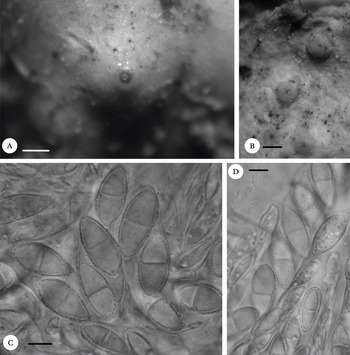
(Fig. 1)
Pronectria rolfiana (holotype). A & B, perithecia slightly erumpent from the Solorina thallus; C & D, asci and spores. Scales: A & B = 100 μm; C & D = 10 μm.

Ascomata completely immersed in the thallus of the host lichen, sometimes arising and forming a verruca with or without a papilla, dispersed, globose, 300–350 μm diam., beige. Ascomatal wall without hairs, about 30 μm thick, composed of several rows of hyaline to pale yellow cells, paraplectenchymatous, KOH−. Hymenium I−, KI−. Periphyses covering the inner ostiolar cavity, well-developed, long and 1–1·5 μm wide. Hamathecial hyphae disappearing. Asci cylindrical, 100–130 × 12–15 μm, thin-walled, with simple, convex apex, 8-spored. Ascospores uniseriate, ellipsoid to naviculate, with pointed ends, hyaline, uniseptate, in KOH multiguttulate, wall ornamented, rugose-verruculose, 21–26 × 10–13 μm.
Etymology. The epithet “rolfiana” refers to Rolf Santesson who first realized that the material collected by J. Poelt represented an undescribed species and added a label to the material with the ad interim name “Nectriella rugulosa R. Sant. (sp. nov.)” (see label image of the specimen online). R. Santesson constantly supported the research of the authors by giving them advice and sending them material.
Notes. Pronectria rolfiana differs from Xenonectriella lutescens, another hypocrealean fungus on Solorina by its colourless to pale brown perithecial wall without a KOH reaction and by the hyaline spores.The genus Pronectria Clem. now includes many lichenicolous species. Pronectria rolfiana is distinguished by its host, colour of the perithecial wall and by the size, shape (acute ends) and ornamentation of its spores. Among the lichenicolous taxa with spores larger than 20 μm, there is P. tenuispora (D. Hawksw.) Lowen, with fusiform, narrow and smooth spores of 22–28 (–33) × 3·5–5 μm, which grows on Peltigera (Hawksworth Reference Hawksworth1978). The spores of Pronectria xanthoriae Lowen & Diederich (17–24 × 4–5·5 μm; Lowen & Diederich Reference Lowen and Diederich1990) and P. tincta (Fuckel) Lowen (17–22 × 4–5.5 μm; Lowen Reference Lowen1990) are similar to the latter. Pronectria dealbans (Müll.Arg.) Etayo & Breuss (Etayo & Breuss Reference Etayo and Breuss1996) also has narrower spores [(13–)16–21(–24) × 5–7·5 μm] than P. rolfiana, and they are smooth; the perithecia are orange and the species develops its perithecia on lichens of the genus Endocarpon. The recently described P. fragmospora Etayo (Etayo & Sancho Reference Etayo and Sancho2008) with spores 20–25 × 5–6 μm is found on Usnea; the ascomata are pink and smaller (120–150 μm) than those of P. rolfiana.
The photographs of “X. lutescens” in Rossman et al. (fig. 36a–d, 1999) correspond to Pronectria rolfiana and were made from the following material: Germany, Allgäuer Alpen, Schwaben: Iseler über Oberjoch bei Hindelang, Nordhang, Gipfelgrat, auf Solorina, 10 ix 1978 J. Poelt (GZU).
Pronectria rolfiana is represented by two samples from Bavaria, both collected by J. Poelt from alpine regions. In both specimens, the host lichen is in a very bad condition and lacks ascomata so that it could not be identified to species level. We do not know any other records of this taxon and since this region of Central Europe is well-collected, even for lichenicolous fungi, the species would appear to be rare.
Scutula pseudocyphellariae Etayo & Triebel sp. nov
Fungus lichenicola in thallo Pseudocyphellariae crescens. Ascomata apothecioidea, erumpentia vel superficialia, fusca vel nigra, epruinosa, 0·1–0·15 mm diametro. Epihymenium aurantiacum. Hymenium hyalinum, paucum inspersum, c.70 μm crassum. Hypothecium brunneum. Asci clavati, octospori, 43–52 × 10–12 μm. Ascosporae uniseptatae, hyalinae, stricte ellipsoideae, 20–22 × 3·5–4 μm cum iuveniles, vel ellipsoideae, (10–)15–17 × 4–5·5 μm cum maturae.
Typus: Chile, [Región de los Lagos] Kleiner Nationalpark bei Angol, c. 1500 m, auf Pseudocyphellaria flavicans auf Nothofagus sp., 27 November. 1999, [without collector] (M-0044262—holotypus; ex hb. P. Dornes PP-49).
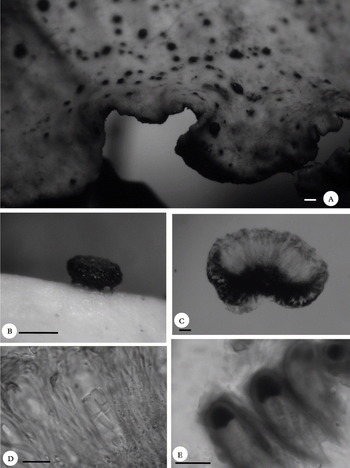
(Fig. 2)
Scutula pseudocyphellariae. A, thallus of Pseudocyphellaria berberina with several apothecia of S. pseudocyphellariae, many of them still primordially immersed in the cortex (hb. Etayo 23628); B, mature apothecium breaking the cortex of Pseudocyphellaria (hb. Etayo 23628); C, transverse section of apothecium showing the subhyaline spots in the external exciple (hb. Etayo 23669); D, ascus and paraphyses (in water) showing the relatively long young spores (hb. Etayo 23669); E, asci with KI (hb. Etayo 23679). Scales: A & B = 100 μm; C = 20 μm; D & E = 10 μm.

Apothecia at first immersed, of perithecium-like shape, breaking the cortex of the host, finally sessile and constricted at the base, scattered, round, 0·1–0·15 mm diam. Disc plane to slightly convex, brown to dark brown, matt. Margin distinct, black, thick and slightly crenulate. Excipulum prominent composed of radiating, branched, strongly agglutinated hyphae, brown to orange-brown, KOH−, N+ bright orange, outermost parts colourless in zones, laterally 50–70 μm, basally 50–60 μm, in the centre sometimes with a long stipe until 120–130 μm deep. Hypothecium pale brown. Hymenium colourless, c. 70 μm thick, with a pale yellow to orange epihymenium, not granular, of 15–20 μm, I+ blue, KI+ blue, slightly inspersed in the lower part, inspersion not disappearing with KOH. Paraphyses septate, simple to slightly branched, apical cells not or slightly clavate, abundant, 1–2 μm thick. Asci 8-spored, claviform, with amyloid tholus and thick outer amyloid wall layer, 43–52 ×10–12 μm. Ascospores 1-septate, narrowly ellipsoid when young (20–22 × 3·5–4 μm) and ellipsoid when adult (10–)15–17 × 4–5·5 μm, colourless.
Conidiomata not observed.
Notes. Kondratyuk & Galloway (Reference Kondratyuk and Galloway1995) reported Scutula stereocaulorum (Anzi) Körb., which is usually found on Stereocaulon, for the first time on Pseudocyphellaria flavicans. There is no doubt that the material cited in that paper belongs to S. pseudocyphellariae. As it is known from similar habitats in Chile, S. pseudocyphellariae has to be compared with S. nephromatis (Speg.) Etayo, a lichenicolous fungus inhabiting Nephroma antarcticum (Etayo & Rosato Reference Etayo and Rosato2008; Etayo & Sancho Reference Etayo and Sancho2008). The ascomata of the latter species are usually aggregated, polygonal when young and much larger (0·2–0·5 mm diam.) than those of S. pseudocyphellariae. Microscopically the exciple of S. nephromatis is subhyaline with irregular brown zones while that of S. pseudocyphellariae is orange-brown, except for the outermost layer with several subhyaline patches. In S. pseudocyphellariae only the lower part of the hymenium is inspersed, whereas in S. nephromatis the hymenium is abundantly inspersed. In additon, young spores of S. pseudocyphellariae have a different shape to the adult ones.
The new species described here differs from another mutualistic species, S. miliaris (Wallr.) Trevis. growing on Peltigera, by its smaller and scattered apothecia (0·2–0·45 mm diam. in S. miliaris.), and by the inspersed hymenium, larger spores (11·5–14 × 4·8–5·8 μm in S. miliaris) and by different host lichens (see Triebel et al. Reference Triebel, Wedin and Rambold1997).
Sometimes S. pseudocyphellariae has a similar outer appearance as Dactylospora orygamea, a fungus living on the same host lichen, which, however, in most cases differs by regularly producing large and characteristic galls. Furthermore, the mature ascomata of Scutula pseudocyphellariae have brown discs whereas those of the Dactylospora are black. Microscopically there are many differences, such as the colour of the ascospores, different ascus apical structures and an exciple that is gelatinized and not paraplectenchymatous in Scutula.
Scutula pseudocyphellariae seems to be a parasymbiont on Pseudocyphellaria flavicans and P. berberina, both relatively common in southern South America. It was not found in Isla Navarino (Etayo & Sancho Reference Etayo and Sancho2008) but is not rare in forests of the Beagle Channel (Región de Magallanes y de la Antártida Chilena). The infected host thalli often show many apothecia of the fungus. It occurs on healthy thalli as well as on pale yellow or more degraded thalli; in the latter case infections must be caused by other lichenicolous fungi.
Specimens examined. Chile: Región de Los Lagos: Palena, Portezuelo Moraga, north Santa Lucía, near P.N. Corcovado., in Nothofagus betuloides forest, with Podocarpus nubigena and Saxegothea, on Pseudocyphellaria berberina, 43°20′55″ S, 72°24′06″ W, 640 m a.s.l., 2006, J. Amigo & J. Etayo 23626 (hb. Etayo); Palena, P.N. Corcovado, Ventisquero del lago Yelcho, path to glacier, in evergreen forest (N. dombeyi, N. nitida, N. betuloides and tineo), on P. berberina, 43°16′32″ S, 72°25′54″ W, 180–230 m a.s.l, 2006, J. Amigo & J. Etayo 23679, 23680 (hb. Etayo, VAL); P.N. Vicente Pérez Rosales, path to volcán Osorno by way from La Ensenada, N. dombeyi wood, on P. flavicans, 41°11′26″ S, 72°31′57″ W, 50 m a.s.l., 2006, J. Etayo 23897 (hb. Etayo); P.N. Puyehue, way to Antillanca, N. pumilio with Drymis forest in the neighbourhood of refugio Marc Blancpain, on P. flavicans, 40°46′27″ S, 72°12′26″ W, 980 m a.s.l., 2006, J. Etayo 23741 (hb. Etayo). Región de Aysén: Aysén. P.N. Queulat in Portezuelo Queulat, N. betuloides forest, on P. berberina, 44°37′32″ S, 72°27′01″ W, 500 m a.s.l, 2006, J. Amigo & J. Etayo 23655, 23669 (hb. Etayo); Aysén. P.N. Queulat, way to ventisquero, slope wood with coihue and tepa-tineo, on P. berberina, 44°27′29″ S, 72°52′05″ W, 150–250 m a.s.l., 2006, J. Amigo & J. Etayo 23840 (hb. Etayo); ibid., sobre Ps. flavicans, J. Etayo 23662 (VAL).
Unguiculariopsis fasciculata Etayo sp. nov
Fungus lichenicola in thallo Ramalinae stenosporae crescens. Ascomata apothecioidea, aggregata, fusca, primo immersa deinde superficialia, 0·15–0·35 mm diametro et 70–100 μm alta. Setae 30–60 × 1–2·5 μm, hyalinae, septatae. Hypothecium hyalinum. Epihymenium melleum. Asci subcylindrici, octospori, 40–65 × 5–6 μm. Ascosporae biseriati, simples, hyalinae, ellipsoideae vel fusiformes, (6–) 8–11 × 1·5–2·5 (–3) μm.
Typus: USA, Florida, Marion Co., Ocala National Forest, c. 20 km westlich von Ocala, Lake Eaton Loop Trail, on Ramalina stenospora in an open pine/oak scrub, 24 March 1996, P. Dornes PP-37 (M-0044257—holotypus).
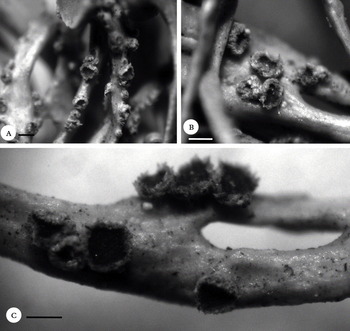
(Fig. 3)
Unguiculariopsis fasciculata (holotype). A, B & C, apothecia on Ramalina stenospora. Scale: A – C = 200 μm.

Apothecia at first immersed in the host thallus, finally sessile, 0·15–0·35 mm diam. and 70–100 μm high, gregarious and deformed by compression, with a plane, brown disc and surrounded by a silvery white margin with hairs grouped in fascicles. Exciple paraplectenchymatous, pale orange, KOH−, N−, formed by subglobose to prismatic cells 4–6 μm diam. in the basal exciple (c. 20 μm thick), longer and thinner in the lateral exciple (c. 10 μm thick); hairs densely covering the margin, 30–60 × 1–2·5 μm, hyaline, septate, smooth, with a very thin wall, glued in fascicles of many of them and removed easily by application of KOH. Hypothecium hyaline, c. 10 μm thick. Hymenium pale yellow, especially in the epihymenium, 40–65 μm thick; paraphyses filiform, simple, thin-walled, apically not or scarcely enlarged, abundant, c. 1 μm thick, inspersed with very small crystals dissolving in KOH. Asci subcylindrical to clavate, 8-spored, 40–65 × 5–6 μm, I−, KI− (only epiplasma orange), apex round or applanate, apically slightly enlarged when adult, basally with a short stipe. Ascospores biseriate, hyaline, irregularly ellipsoidal to fusiform, simple, with two guttules, thin-walled, (6–)8–11 × 1·5–2·5 (–3) μm.
Notes. The thin and hyaline hairs of U. fasciculata which are grouped in fascicles appearing like a silvery, fibrose margin under a hand lens, are not characteristic of the genus Unguiculariopsis. They resemble those of Polydesmia lichenis Huhtinen & R. Sant. as described in Huhtinen & Santesson (Reference Huhtinen and Santesson1997), a species growing on Peltigera species in northern Europe (Fennoscandia and Luxembourg). However, other features typical of Unguiculariopsis sensu Diederich & Etayo (Reference Diederich and Etayo2000) are shared by U. fasciculata: simple spores, simple paraphyses, asci without an apical ring and with short stipe and slightly enlarged in the apical wall (such as, e.g., U. lesdainii (Vouaux) Etayo & Diederich).
Apart from the fasciculate silvery white hairs, U. fasciculata also differs from other lichenicolous species of similar genera treated by Diederich & Etayo (Reference Diederich and Etayo2000) by its normally fusiform small spores and by the host-selection (Ramalina). Only one helotialean species studied by Diederich & Etayo (Reference Diederich and Etayo2000) grows on Ramalina: Llimoniella ramalinae (Müll.Arg.) Etayo & Diederich. It differs in its black, not hairy ascomata, violaceous to purplish brown, KOH+ green or partly violaceous exciple, red-vinaceous epihymenium and longer, uniseptate ascospores of (10–)12–16(–17) × 3–4 μm.
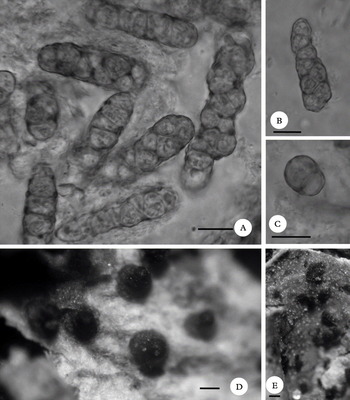
Xenonectriella lutescens (isolectotype). A & B, spores formed by aggregation of uniseptate spores; C, uniseptate spore; D, ascomata on host thallus without cortex; E, ascomata on corticated host thallus. Scales: A, B & C = 10 μm; D & E = 10 μm.

Distribution and hosts. The species is hitherto known only from the type locality in Florida, growing on Ramalina stenospora. We suggest that it is a rare species.
Xenonectriella lutescens (Arnold ex Rehm) Weese
Anzeiger/Akademie der Wissenschaften in Wien, Mathematisch-Naturwissenschaftliche Klasse, Abt. I, 128: 749, 1919.—Nectria lutescens Arnold ex Rehm Hedwigia 22(4): 54; type: Germany, Bavaria, Kreuzberg near Vilseck, Oberpfalz, on Solorina saccata, September 1882, F. Arnold, Rehm, Ascomyc. no. 681 (M-0043827—isolectotypus designated here; lectotypus in BPI, designated in Rossman et al. Reference Rossman, Samuels, Rogerson and Lowen1999)
(Fig. 4)
Notes. This species was originally described by Arnold ex Rehm (Reference Rehm1883). More or less detailed descriptions were published by Weese (Reference Weese1919), Keissler (Reference Keissler and Zahlbruckner1930) and Rossman et al. (Reference Rossman, Samuels, Rogerson and Lowen1999). Xenonectriella lutescens is the type species of the genus Xenonectriella but is hitherto the only known species of the genus with submuriform ascospores. Rossman et al. (Reference Rossman, Samuels, Rogerson and Lowen1999) recombined several species of Pronectria Clem. into Xenonectriella, due to their orange brownish reddish perithecial wall (KOH+ purple) and spores that are heavily ornamented and finally pale brown, in contrast to the yellowish brownish pink perithecial wall without KOH reaction and the hyaline spores in Pronectria.
The genus Xenonectriella comprises at least eight species (Rossman et al. Reference Rossman, Samuels, Rogerson and Lowen1999; Etayo Reference Etayo2002; Etayo & Sancho Reference Etayo and Sancho2008) of which only one has the characteristic submuriform spores. After studying drawings of Weese (Reference Weese1919) and original material in M we are convinced that the submuriform spores are the result of bicellular spores glued secondarily and forming masses which look like primarily muriform spores. Thus, in the same sample it is possible to observe 1-septate entities, as well as all kinds of submurifom spores formed by 2–8 spores glued together.
Etayo (Reference Etayo1998, Reference Etayo2002) and Diederich (Reference Diederich2003) hesitated to accept Xenonectriella with uniseptate spores as different from Pronectria. In this paper we accept the two genera, because the perithecial wall reaction with KOH is a very important character in the segregation of genera and even families in Hypocreales (Rossman et al. Reference Rossman, Samuels, Rogerson and Lowen1999), and the ‘patched’ spores of the type species of Xenonectriella noted above are really distinctive and similar to those in other Xenonectriella species.
Distribution. Xenonectriella. lutescens was collected at the end of the 19th century from one locality in Germany (three specimens are included in the online database under http://www.botanischestaatssammlung.de/DatabaseClients/BSMlichfungicoll/). The taxon might be regarded as extremely rare or even extinct, since it has not been collected again in a lichenologically well studied region.
We thank Dr P. Diederich and an anonymous referee for valuable comments on the manuscript.