

While governments satisfy some of their borrowing needs via commercial bank loans, bilateral official credit or multilateral official credit, bond-based private financing has been a central element of sovereign finance since the early 1990s (World Bank International Debt Statistics). To explore the political economy of sovereign debt, we analyze 245,000 initial bond issues in primary markets by 131 countries (1990–2016). With these unique data, we examine the full population of recent issuers, including dozens of developing countries excluded from other recent analyses, at the point when sovereign borrowers and their creditors transact directly.
Our core contribution is to establish that global capital market dynamics generate a conditional, rather than constant, ‘democratic advantage’ for sovereign borrowers. We establish that democracies are able to issue more debt, more often in primary capital markets, consistent with the interrelated mechanisms that increased ‘liberal’ democracy, executive constraints, rule of law and policy transparency reassure investors and reduce their estimations of sovereign risk (Beaulieu, Cox, and Saiegh Reference Beaulieu, Cox and Saiegh2012; Biglaiser and Staats Reference Biglaiser and Staats2012; Cordes Reference Cordes2012; Schultz and Weingast Reference Schultz and Weingast2003; Stasavage Reference Stasavage2011).Footnote 1 Yet this advantage depends on dynamics in global capital markets. When interest rates and returns on safe assets are relatively high, global liquidity is low. Investors have attractive outside options and are therefore discerning regarding risk, including sovereign risk. Under these conditions, risk-mitigating domestic political institutions affect governments’ capacity to borrow. In contrast, when returns on safe assets are relatively low, global markets are liquid. Investors’ search for higher yield renders them more tolerant of risk. Under these conditions, democratic institutions are unlikely to significantly affect the placement of investments. Flush global markets improve even non-democratic, developing countries’ capacity to issue more debt, more often. Our theory of a conditional democratic advantage departs from the traditional ‘open economy politics’ approach: much more than a background feature, global conditions are a central mediating force in international economic relations (Chaudoin, Milner, and Pang Reference Chaudoin, Milner and Pang2015; Oatley Reference Oatley2011).
Our novel, comprehensive issue-level data provide us the optimal setting in which to test our claims. Borrowers sell and investors buy sovereign bonds in primary capital markets. It is at this bond issuance stage that governments have the ability to choose whether to issue and in what amount. As governments coordinate with potential investors in timing an issue, they necessarily factor in the effects of global conditions on their access to capital. Any democratic advantage should manifest exactly when a democratic government chooses to lock in its financing costs. Previous scholarship has focused on the pricing of debt when it is traded in secondary markets. While trends in trading on secondary markets may correlate with governments’ future borrowing costs, those correlations only bite when the government chooses to issue in primary markets. Moreover, examining primary capital markets allows us to test our claims on the population of sovereign borrowers, rather than subsets that issue a benchmark instrument (such as a ten-year, domestic currency bond); that are included in an index (for instance, JP Morgan’s Emerging Markets Bond Index (EMBI)); those for which a market for credit default swaps (CDS) exists; or those that have a sovereign credit rating. Non-random selection processes underlie these samples, which impede generalizability (Beaulieu, Cox, and Saiegh Reference Beaulieu, Cox and Saiegh2012). Most importantly, these samples exclude large numbers of developing countries that issue debt on international markets, many of which have non-democratic institutions and thus would particularly benefit from a conditional democratic advantage. When global capital markets are flush, non-democratic countries will be able to issue considerable amounts of debt – as they have been able to do in recent years.
The Democratic Advantage and its Limits
Contemporary capital account openness allows governments access to a broad pool of international capital, often facilitating reductions in financing costs. Openness also can subject borrowing governments to market discipline (Kaplan and Thomsson Reference Kaplan and Thomsson2016; Przeworski and Wallerstein Reference Przeworski and Wallerstein1988). Investors are better able to demand higher interest rates in response to greater perceived sovereign risk, because openness renders credible their threats of exit. At the extreme, investors can refuse to lend to a government at any rate of return, a phenomenon known as credit rationing (Tomz Reference Tomz2007). When governments find themselves highly indebted and facing the prospect of default, cuts in fiscal outlays are often necessary to restore investors’ confidence, even if such cuts have devastating effects on the real economy. Indeed, a common trope beginning in the 1990s was the ‘golden straitjacket’, in which financial globalization afforded opportunities for governments but also constrained their policy choices (Kurzer Reference Kurzer1993; Strange Reference Strange1998).
Investors are interested in governments’ future ability and willingness to repay sovereign debt, because sovereigns possess the unique ability to repudiate their financial obligations (Ballard-Rosa Reference Ballard-Rosa2016; Eaton and Gersovitz Reference Eaton and Gersovitz1981; North and Weingast Reference North and Weingast1989; Simmons Reference Simmons1994). Ability to pay is often associated with economic outcomes: governments with lower inflation, smaller fiscal deficits, lower levels of public debt and higher rates of economic growth are better able to service their debt. Governments commonly engage in reforms to improve these outcomes – reducing fiscal deficits, liberalizing labor markets or making monetary authorities more independent from political officials – with the stated purpose of reassuring bond market investors, especially in times of crisis (Bodea and Hicks Reference Bodea and Hicks2015; Campello Reference Campello2015; Kaplan Reference Kaplan2013; Maxfield Reference Maxfield1997). Willingness to pay, in contrast, is driven by politics. To convince investors of its willingness to pay, a government must establish the extent to which it will privilege external commitments, including sovereign bond contracts, over internal motivations to resist payment. A central finding regarding ‘willingness’ is the democratic advantage: investors expect that countries with democratic political institutions are more willing than their non-democratic counterparts to honor their debt commitments.Footnote 2 As such, democracies have easier access to sovereign finance, all else equal.
Scholars have identified a number of mechanisms driving the democratic advantage. Legislative constraints on executive power can limit leaders’ fiscal profligacy (Cox Reference Cox2016; Cox and Saiegh Reference Cox and Saiegh2018; North and Weingast Reference North and Weingast1989). Democratic leaders may fear electoral penalties in response to default, either because some bondholders are part of the electorate, or because the electorate prefers that leaders uphold their foreign obligations (Saiegh Reference Saiegh2005; Schultz and Weingast Reference Schultz and Weingast2003; Stasavage Reference Stasavage2011). So-called ‘liberal’ democracies are characterized by strong respect for the rule of law and judicial independence; these limits on arbitrary government action further enhance investors’ confidence that governments will honor contracts (Biglaiser and Staats Reference Biglaiser and Staats2012; Cordes Reference Cordes2012). Additionally, because democracies tend to be more transparent in their release of economic and financial information, as well as policymaking processes, investors may be more confident in their ability to price risk (Campello Reference Campello2015; Copelovitch, Gandrud, and Hallerberg Reference Copelovitch, Gandrud and Hallerberg2018; Devlin Reference Devlin1989; Hollyer, Rosendorff, and Vreeland Reference Hollyer, Rosendorff and Vreeland2011). Several empirical studies establish that, via these reinforcing mechanisms, democracy leads to lower risk premiums on outstanding (secondary market) debt, lower prices for insurance against default (credit default swaps) and higher sovereign credit ratings (Beaulieu, Cox, and Saiegh Reference Beaulieu, Cox and Saiegh2012; DiGiuseppe and Shea Reference DiGiuseppe and Shea2016; North and Weingast Reference North and Weingast1989; Saiegh Reference Saiegh2005). We confirm these democratic advantage mechanisms, conditional on global liquidity, in our empirical analyses of primary market outcomes. At the same time, we establish that elections and election outcomes do not systematically disrupt democracies’ debt issuance. In secondary markets, pre-election stimulus, partisan swings and protracted cabinet formation negotiations involving new players can increase sovereign risk premiums (Bechtel Reference Bechtel2009; Bernhard and Leblang Reference Bernhard and Leblang2006; Block, Schrage, and Vaaler Reference Block, Schrage and Vaaler2005; Campello Reference Campello2015; Hardie Reference Hardie2006; Jensen and Schmith Reference Jensen and Schmith2005; Leblang and Satyanath Reference Leblang and Satyanath2006; McMenamin, Breen, and Muoz-Portillo Reference McMenamin, Breen and Muoz-Portillo2016; Mosley Reference Mosley2003; Spanakos and Renno Reference Spanakos and Renno2009). However, unlike outstanding debt for which only the price can adjust, governments and investors can adjust the price and other terms of debt at issuance. Thus, governments can creatively continue issuing debt around elections while benefiting from underlying stable institutions. This distinction between institutions and elections is especially important for developing countries marked by electoral volatility.
Despite our confirmation of an average democratic advantage in primary markets, we challenge the premise in the literature that the democratic advantage is absolute, operating independently of external factors. Global capital market conditions affect investors’ sensitivity to risk and, therefore, to domestic political institutions and the mechanisms through which they affect risk. When global markets are liquid, and investors are searching for yield, investors tolerate more political risk. We argue that, at these moments, borrowers with non-democratic institutional features are as able to get credit as their democratic counterparts, and we provide compelling evidence via primary market data.
Democracy and Primary Capital Markets
Scholars have relied on secondary market indicators to understand the political economy of sovereign debt, including spreads versus low-risk bonds; spreads versus a composite bond index; credit default swap prices; trading prices of existing debt instruments; and sovereign credit ratings. Secondary market outcomes allow us to see how investors and ratings agencies adjust their assessments of risk over time (Archer, Biglaiser, and DeRouen Reference Archer, Biglaiser and DeRouen2007; Beaulieu, Cox, and Saiegh Reference Beaulieu, Cox and Saiegh2012; Cox and Saiegh Reference Cox and Saiegh2018; Longstaff et al. Reference Longstaff, Pan, Pedersen and Singleton2011; Pan and Singleton Reference Pan and Singleton2008; Saiegh Reference Saiegh2005; Wellhausen Reference Wellhausen2015). Yet political scientists’ key interest in sovereign bond markets is the extent to which markets affect governments’ policy autonomy (Mosley Reference Mosley2003). Once governments have coordinated with sovereign bond buyers, they issue debt instruments in primary capital markets. It is at this point that the government commits to the cost of borrowing. A bond issued at 5 per cent interest today, but trading at 7 per cent next year, costs the government 5 per cent in annual interest payments throughout the life of the bond. The 7 per cent in secondary markets correlates with terms available for new primary market debt, but those terms are relevant only when a government selects to issue new debt. Analysis of primary market access is thus a crucial, and somewhat overlooked, arena of fiscal politics.Footnote 3
In addition to this theoretical motivation, studying bond issues in primary markets mitigates problems that plague secondary market data. Secondary market data are available at high frequency and over long periods of time for OECD countries with well-developed government bond markets. These governments routinely issue benchmark bonds (ten-year maturity, local currency denominated instruments), facilitating comparison across markets. Additionally, insurers typically offer CDS contracts for issuers with moderate to high credit quality, and with high levels of bond market liquidity; as a result, CDS price datasets typically include fewer than thirty sovereign issuers (Brooks, Cunha, and Mosley Reference Brooks, Cunha and Mosley2015; Longstaff et al. Reference Longstaff, Pan, Pedersen and Singleton2011). Analyzing the population of primary issuers allows us to demonstrate that the democratic advantage is not a function of wealth-driven selection effects. Moreover, as political scientists, much of the variation in political institutions in which we are interested occurs outside the OECD, in emerging or frontier market countries, for which secondary market data is limited. The full population of sovereign borrowers issues a wide variety of instruments, making price comparisons more challenging. Secondary market indices help to address this challenge: JP Morgan’s Emerging Market Bond (EMBI) indices capture countries with debt outstanding above a liquidity threshold (EMBI +); with comparable foreign currency denominated issues (EMBI Global Diversified); or with sufficiently developed domestic currency debt markets (GBI-EM Global Diversified). Yet because of these strict criteria, emerging market bond indices record data for non-random subsets of developing countries. For example, JP Morgan’s indices include from sixteen to sixty-three developing countries, while we have data on 131 countries.
One also could turn to sovereign credit ratings from agencies such as Moody’s and Standard and Poor’s to overcome limits in secondary market data, as a large number of countries are rated. Beaulieu, Cox, and Saiegh (Reference Beaulieu, Cox and Saiegh2012) use credit ratings to substantiate the democratic advantage, in particular by leveraging the fact that governments select into getting rated. It is problematic for our purposes that credit ratings move in response to sovereign risk rather than anticipating it. They are also a blunt instrument, as there are a limited number of ratings categories and, again, high-risk countries may select out of getting rated. And credit ratings move much more slowly than political institutions and events: changes occur in only 2 per cent of our country-year-month observations. Nonetheless, as one of our robustness checks, we repeat our analyses using sovereign ratings as the dependent variable.Footnote 4 Our measures of primary market outcomes – a government’s issuance of new sovereign debt as well as how much debt it issues – reflect joint decisions by governments (the sell side) and investors (the busy side). On the sell side, governments seek to issue debt for a variety of reasons: to fill gaps between revenues and expenditures; to smooth expenditures given a fiscal surplus; to maintain liquidity; or, in the words of an attorney working with sovereigns, ‘remind investors they exist’.Footnote 5 A government issues via its debt management office (DMO). DMO mandates typically emphasize (1) minimizing the cost of financing and (2) considering refinancing risk. DMOs, however, vary in their specific mandates, their degree of professionalization, and their institutional location.Footnote 6 On the buy side, private sector financial actors, typically investment banks, underwrite sovereign issues.Footnote 7 While investment banks earn a relatively small fee for their sovereign debt work (between ten and twenty-five basis points), underwriting is attractive because it often brings additional business from the country’s corporate sector.
Government DMOs and private sector underwriters work jointly to assess the existence and nature of the market for a given sovereign issue, with an eye toward accessing markets when conditions are most favorable.Footnote 8 Through ‘road show’ presentations to pools of potential investors, DMOs and their underwriters present information about the sovereign’s economic and political situation and gauge market sentiment.Footnote 9 Governments typically employ legal counsel to mediate their relationship with underwriters. Similar to the benefits investment banks gain from serving as underwriters, law firms with practices in primary capital markets typically expect to be awarded other work with an issuing government, or with sub-national and quasi-sovereign entities in the issuing country.
Once the DMO and the underwriter agree on the parameters of an issue, the underwriter gathers potential buyers.Footnote 10 On the day of issue, the underwriter buys the entire primary issue, typically at a small discount. Then the underwriter places the issue with a diverse investor base: institutional investors, hedge funds, foreign central banks, commercial banks, retail investors, and, increasingly, sovereign wealth funds (Chwieroth Reference Chwieroth2014; Datz Reference Datz2008). A successful issue may be placed in an hour or less; for new or riskier sovereign borrowers, the marketing period may last a few weeks. In the wake of a successful issue by one government, underwriters often contact other governments’ debt managers to encourage them to consider entering the market.Footnote 11 The quick turnaround between issuance and resale highlights the importance to governments of timing market entry (Bradley, Salvatierra, and Gulati Reference Bradley, De Lira Salvatierra and Gulati2014; Gelos, Sahay, and Sandleris Reference Gelos, Sahay and Sandleris2011; Nieto-Parra Reference Nieto-Parra2009; Weidemaier and Gulati Reference Weidemaier, Gulati and Parisi2017).
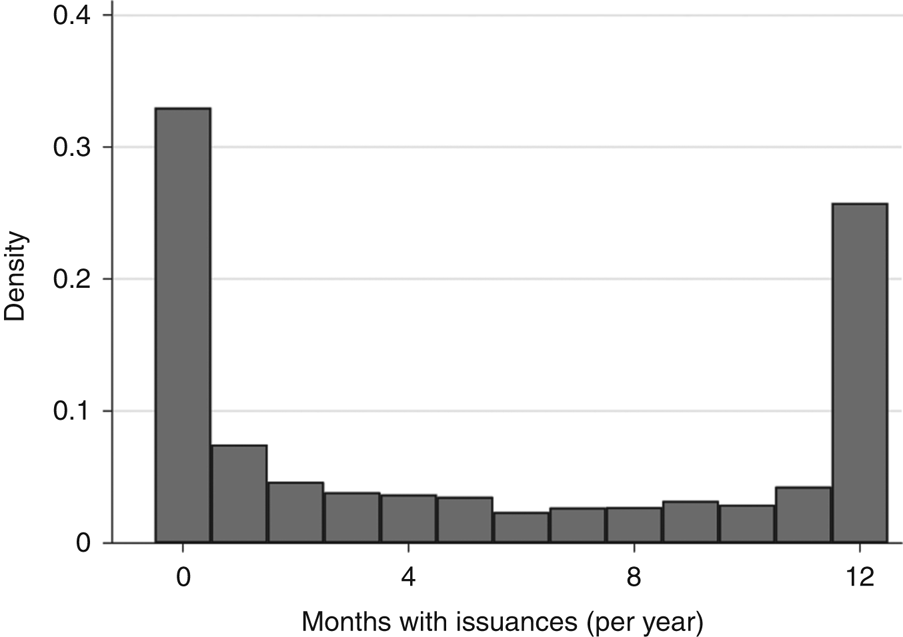
To explore the political economy of government–financial market interactions in primary markets, we employ a novel dataset of all available issues of central government sovereign bonds from 1990 to 2016; it encompasses approximately 245,000 individual issues by 131 countries.Footnote 12 From this issue-level dataset, we construct a dichotomous measure of whether a government issues new debt in a given month. The average government issues new bonds in five months of the year, with a standard deviation of 5 (see Figure 1).Footnote 13 The binary variable Issuance is our key measure of the timing of, and thus global conditions under which, governments and investors coordinate such that the government issues debt.
Distribution of number of months with issue(s) of sovereign bonds per country-year (1990–2016)

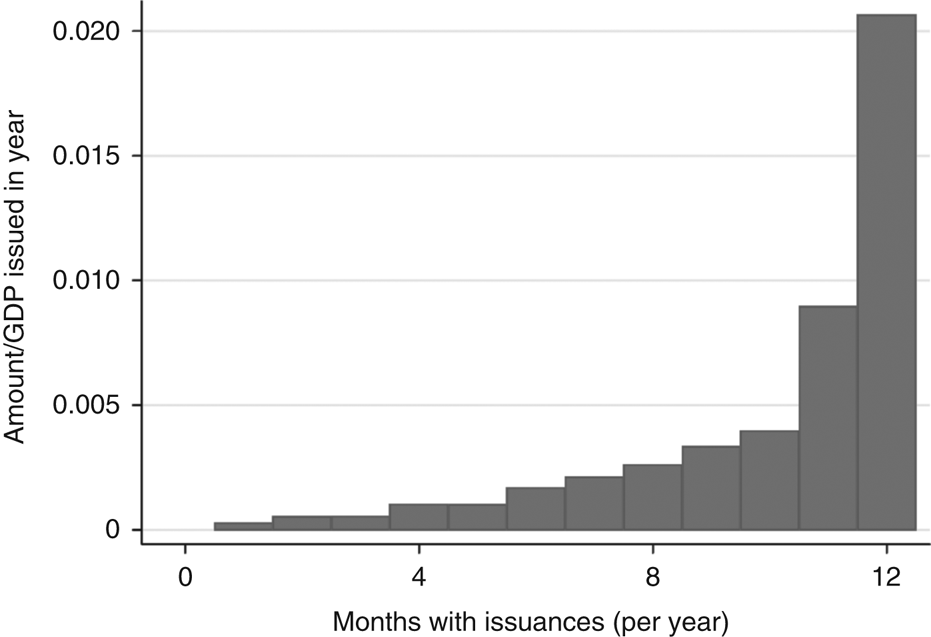
Issuance would be less useful if some government DMOs spread a given amount of debt over several issues, while others offer fewer, larger issues. Figure 2 – which shows the median amount of debt issued against the average number of months with issues – offers evidence that the choice to issue debt is closely linked to the amount of debt brought to market. This strong positive correlation makes sense, as underwriters charge relatively low fees, so government transaction costs around multiple issuances should not be prohibitive. Further, debt managers’ standard operating procedures call for them to smooth the profile of maturing debt over time, which suggests issuing more debt in more bonds. Nonetheless, our second outcome measure is Amount, the amount of debt a government issues in a given month (logged, constant US$).
Distribution of amount issued per year (constant US$), as a fraction of GDP, by count of months issued (country-years, 1990–2016)

Note that Issuance and Amount capture transactions in which the seller and buyers were able to come to a satisfactory agreement on the terms of the issue, including its interest rate, maturity, and currency denomination. Tradeoffs across terms are likely to be shaped by politics and thus are important phenomena to be examined in future research (Sadeh and Porath n.d.). Already advancing that agenda, Cox and Saiegh (Reference Cox and Saiegh2018) compare the secondary market pricing of two Argentine government bonds with different revenue guarantees to assess the importance of executive constraints to investors’ responses to the 1890 Baring Crisis.
Our choice to set aside terms in this study of debt issuance and amount is motivated, first, by the need to test a key implication in the democratic advantage literature: democracies should have better access to international debt markets from the moment of issuance, and not just in secondary market or credit rating outcomes. Second, our data show that the terms of bond issues vary, implying that governments do not simply time their entries to the market based on their ability to negotiate the most favorable terms. For example, for non-OECD borrowers in our data, issue level yield has a mean of 7.9 per cent and a large standard deviation of 11.6 per cent; maturity averages five years, with a large standard deviation of 5.3 years. Because borrowers coordinate market entry with a wide variety of underlying terms, we know that issuance is not a product of the incidence of the ‘right’ terms. Third, our argument that the democratic advantage is conditional rests on the expectation that governments and investors vary in their ability to coordinate on debt issuance based on global conditions. It is a more difficult test for us to provide evidence of a conditional effect when using issuance as the outcome variable rather than terms. If governments and investors could always find mutually agreeable terms under which to issue debt whatever the liquidity on global capital markets, then results on issuance would not be conditional on global dynamics.
Hypotheses
We first confirm that the several mechanisms identified as sources of the democratic advantage in the literature operate at the moment of issuance. Since constraints on arbitrary executive behavior, respect for rule of law and policy transparency are highly correlated and have all been found important in explaining secondary market dynamics, we expect to find evidence that democracy overall and each mechanism in isolation have expected effects in primary markets.Footnote 14
Hypothesis 1: More democratic countries are more likely to issue debt and in greater amounts. Democracy will be associated with issuance (1) when treated as an overall measure of regime type, as well as when separated into its component parts, including (2) limits on arbitrary government, (3) legislative constraints on the executive, (4) judicial independence and (5) transparency.
However, repeated examples of market access for sovereign borrowers with weak or nonexistent democratic political institutions challenge the unconditional logic of the democratic advantage as presented in Hypothesis 1. In the mid-2000s, when global capital markets were flush in advance of the 2008 financial crisis, weak or non-democratic sub-Saharan African countries including Kenya, Nigeria, Senegal, Gabon and Uganda first sought sovereign credit ratings and issued debt on international markets. In 2014, non-democracies Ethiopia and Vietnam issued debt. In recent years, investors have been willing to hold Venezuela’s public debt, despite the severe deterioration of its democratic institutions and corresponding concerns about high default risk (not to mention its economic crisis). In a 2017 article, Bloomberg News posited that investors now love authoritarian regimes, citing dollar-denominated issues by Bahrain, Belarus, Cameroon, Ethiopia, Iraq and Tajikistan. The author raises the classic hypothesis that investors appreciate the policy certainty that comes with (stable) autocratic regimes.Footnote 15
Our take on these trends in authoritarian borrowing is consistent with that offered by one emerging markets fund manager: ‘The quest for yield squeezes money into some strange places’.Footnote 16
In an environment of low US and European interest rates in 2017, some of those ‘strange places’ have included democracies in which core institutions like property rights protections have eroded. In June 2017, Argentina – a country that has defaulted five times in the last century, remains classified by the MSCI equity index as ‘frontier’, and had only returned to international markets in 2016, after a fifteen-year absence – issued a 100-year maturity bond offering an effective yield of 8 per cent. The US$ 9.75 billion in orders far exceeded the supply of US$ 2.75 billion.Footnote 17 July 2017 saw Greece’s first bond sale in five years; the five-year maturity bond it issued, at a yield of 4.625 per cent, was also oversubscribed. To explain the Greek sale, the Financial Times put it simply: ‘investors do not seem to care [about political risk]’.Footnote 18
Consistent with a large literature in financial economics, we argue that investors’ risk preferences are not fixed over time but rather depend on the yield environment.Footnote 19 When markets are flush, the hunt for yield incentivizes investors to buy riskier assets. For example, exceptionally low returns on US Treasuries in the early to mid-2000s pushed investors to invest in assets including opaque collateralized debt obligations, credit default swaps and mortgage-backed securities (Rajan Reference Rajan2011). We hypothesize that an analogous dynamic plays out with regard to sovereign debt issued by less-democratic regimes. What might be an investment carrying untenable political risk in the presence of attractive outside options may be tolerable when those attractive outside options disappear. Democracies gain an advantage when yields on global safe assets are relatively high, because it is at that time – and not others – that risk-sensitive investors care most about the political risks of a sovereign borrower.
Hypothesis 2: More democratic states are more likely to issue sovereign debt, and to issue greater amounts of debt, when yields on global safe assets are high.
Data and empirical strategy
We collapse our data of bond issues such that the unit of analysis is (1) the instance or (2) the (logged) amount of any sovereign bond issue on international markets in a country-month.Footnote 20 Our aggregated data include only new issues and not tapped bonds, as their responsiveness to political institutions is less clear-cut.Footnote 21 Additionally, we exclude money-management bonds with maturities under six months. Our primary findings are not driven by either of these theoretically informed choices.Footnote 22 We exclude the United States, as its sovereign debt shapes global capital markets.
Our aggregate measure of Democracy is a country’s (lagged) Polyarchy score, a continuous variable that measures the ruler’s responsiveness to citizens (VDem).Footnote 23 In our sample, Democracy ranges from essentially zero (most autocratic) to one (most democratic), with a mean of 0.6 and standard deviation of 0.25. All analyses use country fixed-effects to identify off within-unit heterogeneity, which is substantial (within variance is about 0.25). Results are robust to decade-by-decade analyses to address the changing composition of democracies in the world over time (Appendix Table 8). To isolate potential effects of regime stability rather than institutional type, we control for Regime duration or the count of the years since the current (binary) regime was established (Magaloni, Chu, and Min Reference Magaloni, Chu and Min2013).
We draw from the literature to measure four main mechanisms via which democratic institutions are expected to signal reduced risk to international investors. First, a ‘liberal’ conception of democracy often views the advantages of popular rule in terms of the limits placed on arbitrary government activity (Biglaiser and Staats Reference Biglaiser and Staats2012); to capture this, we include VDem’s Liberal democracy measure, which captures the ‘quality of democracy by the limits placed on government. This is achieved by constitutionally protected civil liberties, strong rule of law, an independent judiciary, and effective checks and balances.’ Given heavy theoretical emphasis by the original work on democratic advantage on the importance of Legislative constraints on the executive (North and Weingast Reference North and Weingast1989; Schultz and Weingast Reference Schultz and Weingast2003), we also include VDem’s measure capturing ‘to what extent . . . the legislature and government agencies . . . [are] capable of questioning, investigating, and exercising oversight over the executive’. Third, following accounts that emphasize the importance of rule of law in democratic societies (Cordes Reference Cordes2012), we include a measure from VDem of Judicial independence. Finally, given the importance of accurate reporting of domestic conditions for investors to make well-informed decisions (Campello Reference Campello2015; Copelovitch, Gandrud, and Hallerberg Reference Copelovitch, Gandrud and Hallerberg2018), we also introduce a measure of government Transparency, taken from work by Hollyer, Rosendorff, and Vreeland (Reference Hollyer, Rosendorff and Vreeland2011).
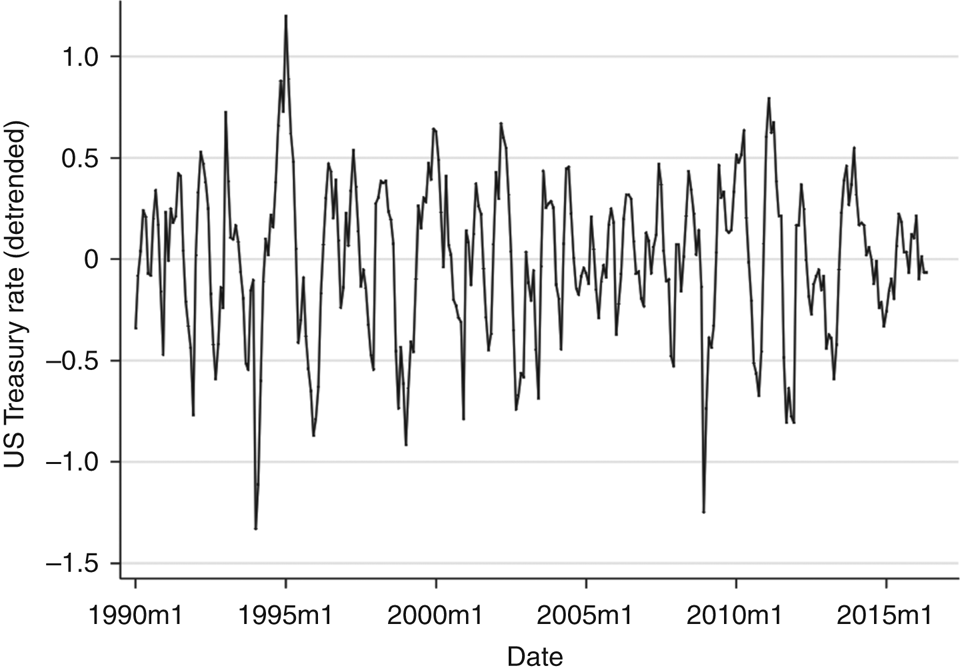
Because the US economy significantly affects global asset allocation, we capture global yield conditions with the interest rate on US ten-year constant maturity Treasury bonds (US Treasury) (Bauerle Danzman, Oatley, and Winecoff Reference Bauerle Danzman, Oatley and Winecoff2017).Footnote 24 During our sample period, interest rates on US Treasuries ranged from nearly 9 per cent to 1.5 per cent; there is a definite downward trend across years. To help safeguard against estimating the effects of secular trends in democracy and Treasury rates, in all specifications we include year fixed effects; this ensures that we leverage only intra-annual variation in interest rates (Figure 3).Footnote 25 We also include dummies for the Quarter of the year, because sovereign debt tends to be issued earlier in the calendar year: first, corporations’ fiscal years typically are off-cycle, so governments issuing early face less competition for investors’ attention; second, early sovereign issues set a financing cost benchmark for later domestic corporate debt.Footnote 26
Residualized monthly interest rate on ten-year constant maturity US Treasury bonds (1990–2016), after regressing on year fixed effects

Controls include standard (lagged) annual economic determinants of borrowing: GDP per capita; GDP growth; Current account balance; Chinn-Ito index (financial openness); and Public debt.Footnote 27 For robustness, we include CBI, if central bank independence affects bond market behavior; a dummy for Pegged XR, which could impact currency risk; and Oil rents (per cent GDP), as the borrowing needs of commodity exporters track world prices.Footnote 28 We also control for economic crisis with dummies for IMF program in place, Inflation crisis and Default crisis.Footnote 29
Notwithstanding country-specific economic covariates, investors often use cognitive heuristics in the process of evaluating huge amounts of information relevant to sovereign risk, in particular by categorizing countries in peer groups (Brooks, Cunha, and Mosley Reference Brooks, Cunha and Mosley2015; Gray Reference Gray2013; Gray and Hicks Reference Gray and Hicks2014; Mosley Reference Mosley2003). We expect that as more of a country’s peers issue bonds, the country will be assessed more positively and more likely to issue, such that institutions in peer countries affect government borrowing costs. First, we expect peer issuance in a country’s geographic region to influence investors (Brooks, Cunha, and Mosley Reference Brooks, Cunha and Mosley2015). Second, we define the relevant peer groups as Developed, Emerging, Frontier or unrated countries per a measure of portfolio market development.Footnote 30 Each peer issuance measure is the (one-month lag of) the proportion of countries in the category that have issued debt in a given month (excluding the country in question). We also include region and MSCI category dummies.
With Issuance as the dependent variable, we use probit with country-fixed effects and standard errors clustered by country to account for within-unit serial correlation.Footnote 31 With Amount as the dependent variable, we employ tobit regression to account for the censoring of values at zero.Footnote 32 Unless otherwise specified, all covariates are lagged by twelve months to protect against concerns of simultaneity bias. Finally, we note that including our full set of controls substantially reduces sample size; our findings are robust to multiple imputation to deal with concerns of data missingness that is not orthogonal to the political or economic conditions we argue are important.Footnote 33
Results
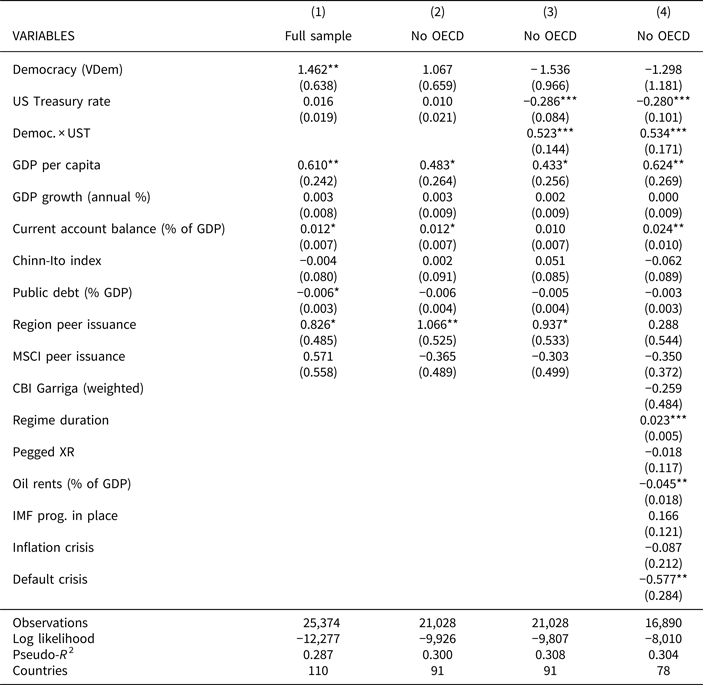
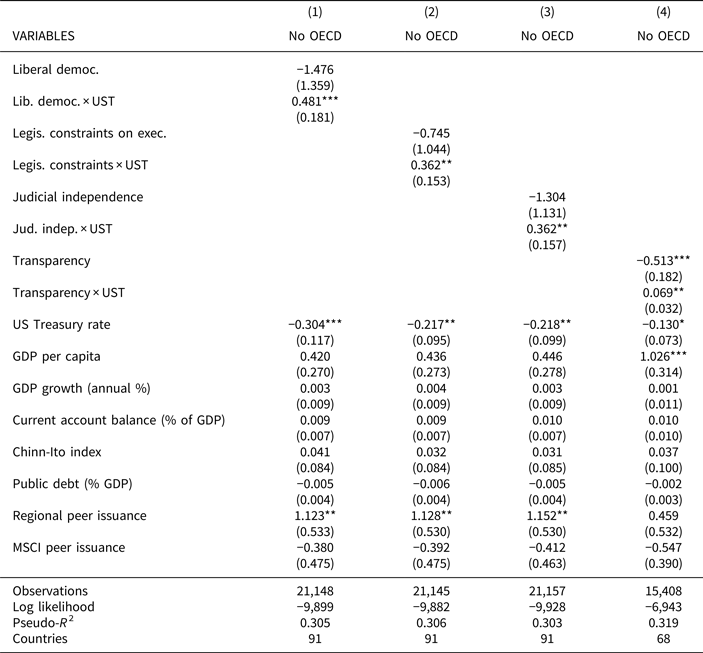
We begin with a straightforward test of the democratic advantage in primary capital markets (Hypothesis 1). In our full sample, we recover a positive and statistically significant relationship between Democracy and Issuance (column 1, Table 1). When we drop OECD countries, the coefficient is positive but insignificant (column 2). However, per Hypothesis 2, we expect to recover evidence of the democratic advantage even in the subset of developing countries, once we take into account the conditioning role of international capital market dynamics on investors’ tolerance for political risk. Once we interact Democracy and US Treasury, we recover a positive and significant effect as expected (columns 3 and 4): as rates rise on US Treasuries, and global capital becomes scarce, the benefits of democratic institutions increase even in developing countries.
Sovereign bond issuance and Democracy (1990–2016)

This table reports results of probit regressions using sovereign bond issuance as the dependent variable. Country and year fixed effects are suppressed, as are region, MSCI and quarter dummies.
Robust standard errors clustered by country in parentheses.
***p<0.01, **p<0.05, *p<0.1.
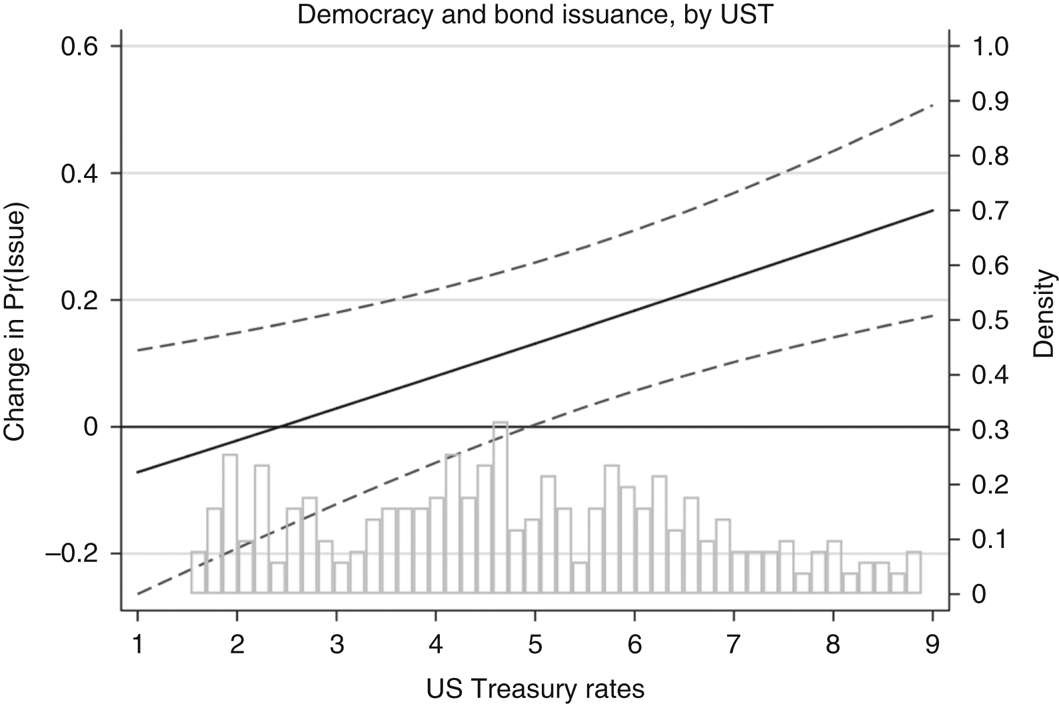
Figure 4 shows the marginal effect of increases in democracy on issuance, conditional on prevailing US Treasury rates. To best communicate the substantive meaning of our results, these estimates are based on a model that replicates Table 1, column 4, but changes the measurement of Democracy so that estimated marginal effects in Figure 4 arise from one-standard-deviation increases in democracy.Footnote 34 For example, when US Treasuries are around 7 per cent, a one-standard-deviation increase in Democracy increases the probability of issuance by 24 percentage points. Consistent with Hypothesis 2, the democratic advantage exists when US Treasuries are high. In contrast, a one-standard-deviation increase in democracy does not increase the probability of issuance when US Treasuries are low, at about 5 per cent or less.Footnote 35
Marginal effect of an increase in a standardized measure of democracy on the probability of issuance, conditional on US Treasuries (Appendix Table 15, model 1). Dotted lines represent 95 per cent confidence intervals. Grey boxes show the density of US Treasury rates across the distribution.

While it is common to report substantive effects for standardized increases in measures like democracy using sample variation, the fact that we employ country fixed effects suggests that a more conservative estimate of our effect sizes would be to consider the impact of within-country variation in Democracy. The ‘within’ standard deviation for Democracy (in the subsample of observations with US Treasury rates of at least 7 per cent) is approximately 0.57 times the size of the full sample standard deviation; a one-standard deviation increase in this within measure is associated with an increased probability of issuance of approximately 13 percentage points when US Treasury rates are at 7 per cent.Footnote 36 Even this conservative estimate represents a meaningful increase. For comparison, consider that, all else equal, analysts expect investors to be more willing to buy debt from wealthier countries, as wealth reduces repayment risk. Accordingly, we find that GDP per capita is always positively and significantly associated with issuance (Table 1). Using the estimates in column 1, a one-standard-deviation (sample) increase in GDP per capita is associated with a 25 percentage point increase in the likelihood of issuance. Most importantly, a one-standard-deviation increase in ‘within-country’ GDP per capita is associated with an 8 percentage point increase in issuance. Thus, the substantive benefit we detect for democracy – when yields on safe assets are high – is of somewhat larger magnitude than that from economic development.
Yet, what is it about democracy that generates reductions in perceived investment risk? As we discuss, extant literature emphasizes several (potentially interrelated) mechanisms via which democratic institutions are expected to reduce investors’ worries about default. We consider four such pathways explicitly below: ‘liberal’ limits on arbitrary government, legislative constraints on the executive, judicial independence and government transparency. As reported in Table 2, we find that each of these democratic sub-mechanisms are associated with systematically greater capacity to issue sovereign bonds; however, consistent with our general argument that these institutional sources of risk reduction are conditional on the broader yield regime, each of these is significantly positive only when global interest rates are high.
Sovereign Bond Issuance and Subindices of Democracy (1990–2016)

This table reports results of probit regression of sovereign bond issuance. Country and year fixed effects are suppressed, as are region, MSCI and quarter dummies.
Robust standard errors clustered by country in parentheses.
***p<0.01, **p<0.05, *p<0.1.
Amount
To this point, we have measured the political determinants of the likelihood of sovereign bond issuance. Variation in issuance, or the ability to access international markets, affects the extent to which governments can pursue their agendas. That said, the analyses presented so far cannot answer whether the conditional democratic advantage affects how much debt a country can raise from private markets. Recall that, as described in Figure 2, countries that issue more frequently also issue a greater amount of debt. We use these data to replicate our primary results, computing the (logged constant US$) total amount issued by a country in a given month.Footnote 37
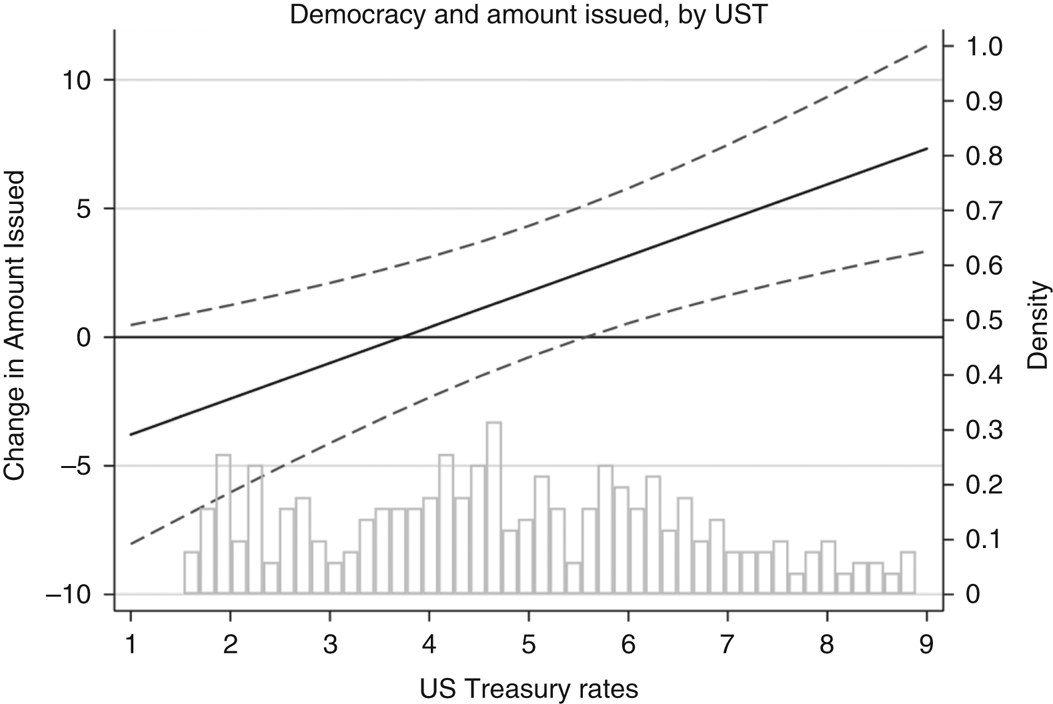
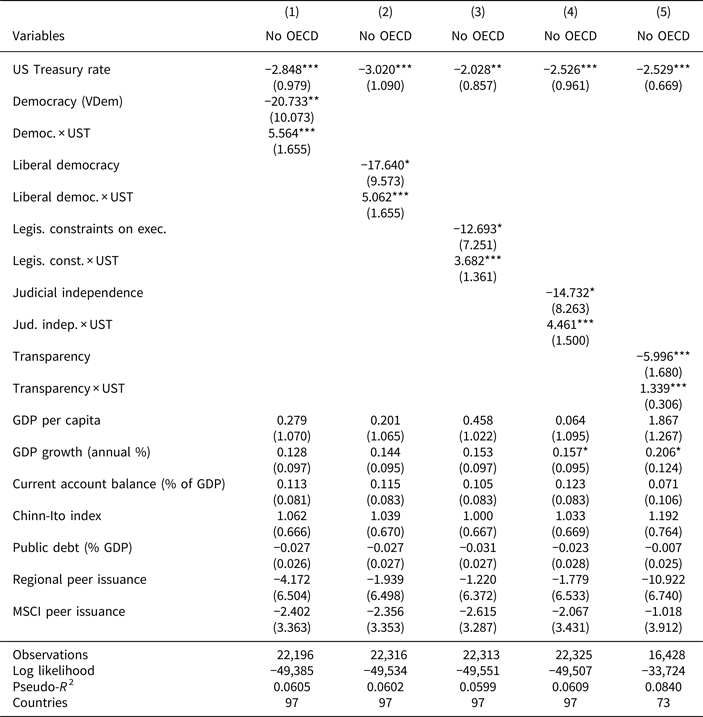
In Table 3 we report results of tobit regressions on the amount issued by a sovereign in a given month.Footnote 38 We again focus specifically on non-OECD countries, seeking to avoid any conflation of ‘democracy’ with economic development. The conditional effect of Democracy on amount issued, when US Treasuries are high, is remarkably similar to that on issuance (Figure 5) – when markets are sufficiently attentive to risk, democracies not only issue more frequently, but issue sovereign bonds in greater amounts. The (conditional) benefits of each of the four democratic mechanisms are also found to be significantly related to amount issued, as reported in columns 2–5.
Marginal effects for increases in democracy on the amount of debt issued, conditional on US Treasuries (Table 15, column 3). Dotted lines represent 95 per cent confidence intervals. Grey boxes show the density of US Treasury rates across the distribution.

Amount of Bond Issuance and Democracy (1990–2016)

This table reports results of tobit regressions of the amount of debt issued. Country and year fixed effects are suppressed, as are region, MSCI and quarter dummies.
Robust standard errors clustered by country in parentheses.
***p<0.01, **p<0.05, *p<0.1
Robustness
Recall that we hypothesize that democratic institutions shape primary market outcomes, but we do not hypothesize that elections have effects. Why? First, stable institutions can blunt investors’ concerns about electoral risks. Governments may engage in pre-electoral economic expansion, but leaders facing greater institutional constraints are less likely to do so to extremes. Orderly transitions of power can minimize the impact of closely contested or surprising elections. Moreover, given their credible threat of exit, investors can expect with some certainty that democratically elected governments will pursue policies that include monetary restraint and respect for property rights (Bodea and Hicks Reference Bodea and Hicks2015; Campello Reference Campello2014; Kaplan and Thomsson Reference Kaplan and Thomsson2016; Pandya Reference Pandya2014).
Here, we provide evidence that elections do not have effects on the incidence of debt issued, consistent with these arguments. These null findings do not allow us to establish that strong institutions alone are doing all the work of mitigating electoral risk. In fact, we posit that sellers and buyers may address remaining electoral risk by pricing it into an election-proximate issue’s interest rate, maturity structure and/or currency denomination. For instance, in September 2016, Ghana – rated as a strong democracy – was in the run-up to what was expected to be a contentious December election. Observers worried about pre-election fiscal expansion, yet they nevertheless submitted orders more than five times greater than the offered bond. This came at a cost, however, with a 9.25 rate of interest for the ten-year bond, in a year marked by low global interest rates.Footnote 39 Consistent with this example, we expect future research may find significant effects of elections on the tradeoffs across bond terms.
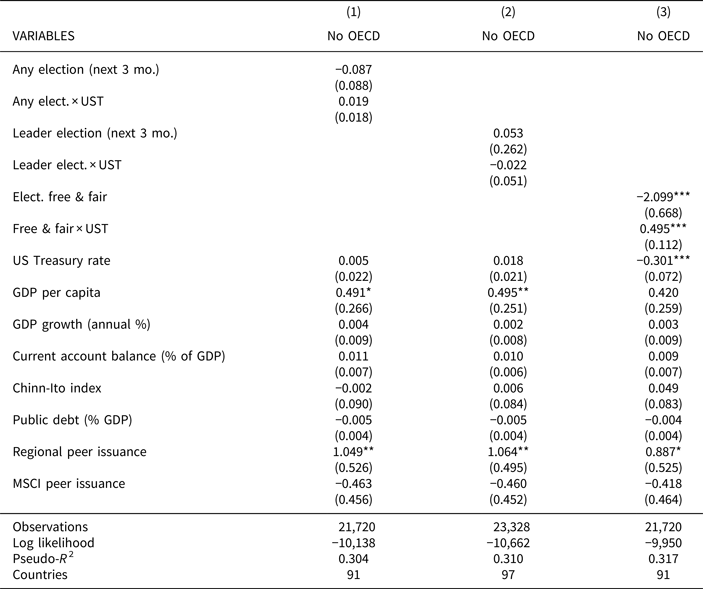
Among non-OECD countries for which we have information on elections, there are 3,842 country-months with an election (19 per cent of observations). We subset on non-OECD countries to conduct the most compelling tests, given that these countries have greater financing needs, greater exposure to externally induced economic volatility and often particularly tumultuous elections. In Table 4, we first consider possible effects on issuance of Any election for the executive or for a national legislature in the next three months, to approximate the political business cycle (column 1). We also code only Leader election, or the election of the executive in a presidential system or the legislature in a parliamentary system (column 2). As expected, we find no conditional effects on issuance. Null findings remain if we (1) increase the election window up to twelve months, (2) subset on parliamentary or non-parliamentary systems, (3) subset on close elections (5 per cent or less margin of victory) or (4) subset on country-months in which a given country is a democracy.Footnote 40 Finally, null effects remain when amount is the dependent variable. In contrast, and consistent with our theory on the institutional democratic advantage, we do find that an institutional measure of elections – whether they are ‘free and fair’ – has a significant and positive effect on issuance when interacted with US Treasury.Footnote 41
Sovereign Bond Issuance and Elections (1990–2016)

This table reports results of probit regressions of determinants of sovereign bond issuance. Country and year fixed effects are suppressed, as are region, MSCI and quarter dummies.
Robust standard errors clustered by country in parentheses.
***p<0.01, **p<0.05, *p<0.1.
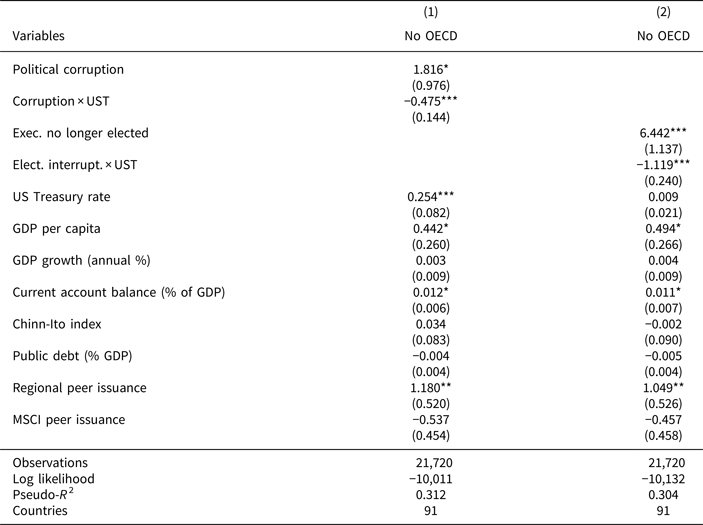
Our theory implies that, if any aspects of political institutions are in fact associated with increased risk, then they should have conditional negative effects on issuance. We expect corrupt or non-functioning institutions in a given country to be sources of increased perceptions of (conditional) political risk. In Table 5, we show that the interaction of Political corruption and US Treasury is negative and significant (column 1), as is the interaction with Election interruption (column 2).Footnote 42 This conditional effect suggests limits on the downside risk of corrupt or non-functioning democratic institutions: when global capital markets are flush, failing institutions are not systematically correlated with penalties to issuance.
Sovereign Bond Issuance and Corrupt or Non-Functioning Democratic Institutions (1990–2016)

This table reports results of probit regression of sovereign bond issuance on sources of political risk. Country and year fixed effects are suppressed, as are region, MSCI and quarter dummies.
Robust standard errors clustered by country in parentheses.
***p<0.01, **p<0.05, *p<0.1.
Conclusion
We explore the political economy of the interaction between governments and investors in the issuance of sovereign bonds in primary markets. First, we confirm that the democratic advantage holds in primary capital markets, at the point when governments and investors interact to affect debt issuance. At this stage, constrained executives, rule of law and transparent policymaking all are associated with the capacity of governments – via their effect on investors’ risk perceptions – to issue more debt more often. However, the democratic advantage is conditional: it depends on structural factors in global finance. When global liquidity is low, investors act in a more discriminating fashion; democratic political institutions are a means of discrimination. When capital market liquidity is high, however, investors seek out higher yields and are less sensitive to risk, including political risk. Hence, global capital cycles, which are exogenous to all but the largest sovereign borrowers, mediate the effects of domestic institutions (Bauerle Danzman, Oatley, and Winecoff Reference Bauerle Danzman, Oatley and Winecoff2017).Footnote 43
Our argument represents a departure from typical open economy politics theories, as we identify a top-down global effect of international markets. We pick up on the role of global capital liquidity as a push factor, a feature external to borrowers, in addition to borrower-specific pull factors. Our focus on global push factors amplifies recent methodological critiques of open economy politics approaches by theorizing about, rather than merely controlling for, the effects of global market dynamics (Brooks, Cunha, and Mosley Reference Brooks, Cunha and Mosley2015; Chaudoin, Milner, and Pang Reference Chaudoin, Milner and Pang2015; Mosley Reference Mosley2003; Oatley Reference Oatley2011).
Future work would do well to explore not only when and in what amounts governments borrow, but also the price, maturity structure and currency denomination of sovereign debt issues. We expect tradeoffs across bond terms to be associated with regime type, as well as other political variables like ideology, government time horizons, and the features of government DMOs. Additionally, underwriters sell government bonds to a diverse array of purchasers, including institutional investors, hedge funds, foreign central banks, commercial banks, retail investors and sovereign wealth funds. Some are resident in the country of issue, while many are not. The composition of the investor base likely affects the ways in which governments are constrained in their ability to access global capital markets at the time, in the amount and with the terms that they prefer.
Finally, exploring governments’ strategic considerations in accessing primary capital markets allows us to address bigger questions related to the international relations of sovereign finance. The monetary policy decisions made by large, mature economies – especially the United States – have consequences for other governments’ financing strategies. Our findings imply that future tightening in the US is likely to intensify borrowing constraints for developing countries, especially those with non-democratic political systems. Given the centrality of fiscal policy to government, US financial decisions could therefore affect low- and middle-income countries’ tax policies, social policies and societal conflict.
Supplementary material
Data replication sets can be found in Harvard Dataverse at: https://doi.org/10.7910/DVN/HPTPDQ and online appendices at: https://doi.org/10.1017/S0007123418000455
Full List of Countries
Albania, Angola, Argentina, Armenia, Aruba, Australia, Austria, Azerbaijan, Bahamas, Bahrain, Bangladesh, Barbados, Belarus, Belgium, Belize, Benin, Bolivia, Bosnia-Herze., Botswana, Brazil, Bulgaria, Burkina Faso, Cameroon, Canada, Cape Verde, Chile, China, Colombia, Congo, Costa Rica, Cote d’Ivoire, Croatia, Cyprus, Czech Rep., Dem. Rep. Congo, Denmark, Dom. Republic, Ecuador, Egypt, El Salvador, Estonia, Ethiopia, Fiji, Finland, France, Gabon, Georgia, Germany, Ghana, Greece, Grenada, Guatemala, Honduras, Hong Kong, Hungary, Iceland, India, Indonesia, Iraq, Ireland, Israel, Italy, Jamaica, Japan, Jordan, Kazakhstan, Korea, Kuwait, Kyrgyzstan, Latvia, Lebanon, Lesotho, Lithuania, Luxembourg, Macedonia, Malaysia, Malta, Mauritius, Mexico, Moldova, Mongolia, Montenegro, Morocco, Mozambique, Namibia, Netherlands, New Zealand, Nicaragua, Nigeria, Norway, Oman, Pakistan, Panama, Papua New Guinea, Paraguay, Peru, Philippines, Poland, Portugal, Qatar, Romania, Russia, Rwanda, Saudi Arabia, Senegal, Serbia, Seychelles, Singapore, Slovakia, Slovenia, Solomon Island, South Africa, Spain, Sri Lanka, St. Vincent, Suriname, Sweden, Switzerland, Taiwan, Thailand, Trinidad and Tobago, Tunisia, Turkey, UAE, Uganda, Ukraine, United Kingdom, Venezuela, Vietnam
Acknowledgements
We thank Robert Galantucci and Mitch Watkins for assistance in compiling bond issue data; Bailee Donahue for research on debt management practices; and Kelly Kennedy and Benjamin Roberts for assistance with credit rating and election data. We also thank Sarah Brooks, Raphael de Cunha, Joonseok Yang, participants at Princeton University’s International Relations Colloquium, the Columbia University International Relations Workshop, the Penn University International Relationships Workshop, the University of Wisconsin-Madison International Relations Colloquium, the University of Pittsburgh, the UNC International Relations Brown Bag, the Public Debt Management in the EU and Beyond workshop at the Center for European Studies at UNC, the 2016 American Political Science Association meeting and the 2017 International Political Economy Society meeting.