One of the key developmental tasks children face is adapting the demands of school, given the long-term importance of early school success on later school adjustment and wellbeing (Entwisle & Hayduk, Reference Entwisle and Hayduk1988a). Research has indicated that children's adaptation to school can be supported, or thwarted, by the quality of their relationships with teachers (Hamre & Pianta, Reference Hamre and Pianta2001; Pianta & Stuhlman, Reference Pianta and Stuhlman2004). As children begin formal schooling, the quality of relationship they establish with their teachers contributes to their experiences in this new setting (Pianta, Reference Pianta1999). Close, supportive relationships are conducive to positive school adjustment; relationships marked by conflict, on the other hand, may maintain or aggravate children's behaviour and academic problems (e.g., Birch & Ladd, Reference Birch and Ladd1997; Hamre & Pianta, Reference Hamre and Pianta2001; Hughes, Reference Hughes2011; Hughes & Kwok, Reference Hughes and Kwok2007; Jerome, Hamre, & Pianta, Reference Jerome, Hamre and Pianta2009; O’Connor, Dearing, & Collins, Reference O’Connor, Dearing and Collins2010).
However, we understand little about how high quality teacher-child relationships are formed. Teachers are sensitive to children's behaviours, and their relationship quality likely derives, at least in part, in response to their perceptions of children's behaviours. Certain behavioural qualities will lead some teachers to feel close to students, other behaviours will likely engender conflict with students. But teachers’ perceptions of student behaviour may be as much about what behaviours are expected of particular children as they are about the behaviours themselves. Gender stereotypes may be one source of expectations. Teachers may expect certain behaviours in boys, but hold girls to account for the same behaviours. But we know little about how teachers’ perceptions of closeness and conflict are predicted by gender-specific behaviours. If teachers’ relationship judgments are a function of a particular behaviour, we would expect that behaviour to predict relationship quality equitably for boys and girls. However, if teachers have gendered expectations for children's behaviours, we instead might find that certain behaviours predict conflict or closeness more strongly for boys than girls, or vice versa. This study examines whether teachers’ ratings of children's behaviours predict their judgments of relationship quality, and whether the same, or different, behaviours predict relationship quality for boys and for girls. This purpose of this study is to examine how teachers’ perceptions of children's social behaviours predict their own judgments of relationship quality, and whether the same behaviours predict relationship quality for boys and girls, or whether child gender is a factor in determining the impact of behaviours on teacher-child relationship.
What Behaviours Predict Teacher-Child Relationship Quality?
A small body of literature has focused on children's behavioural contributors to teachers’ judgments of relationship quality. The best predictor of teacher-child relationship quality is children's externalising problems. Children who show behaviour problems (e.g., aggression and problems with impulsive or hyperactive behaviours) are at risk of developing teacher-child relationships marked by conflict (Birch & Ladd, Reference Birch and Ladd1998; Jerome et al., Reference Jerome, Hamre and Pianta2009). Similarly, effortful control — that is, the capacity to consciously regulate one's behaviours when called upon to do so — predicts low levels of conflict for children in early elementary school (Rudasill, Reio, Stipanovic, & Taylor, Reference Rudasill, Reio, Stipanovic and Taylor2010; Rudasill & Rimm-Kaufman, Reference Rudasill and Rimm-Kaufman2009), and a closer relationship in years 1 and 3 (Rudasill et al., Reference Rudasill, Reio, Stipanovic and Taylor2010; Rudasill & Rimm-Kaufman, Reference Rudasill and Rimm-Kaufman2009).
Very few studies have examined children's other behaviours as predictors of teacher-child relationship. Internalising problems — problems with social reticence (i.e., shyness) or emotional problems (e.g., poor control of sadness and distress) may impede the establishment of positive teacher-child relationships. Shyness predicts lower levels of teacher-child closeness (Rudasill & Rimm-Kaufman, Reference Rudasill and Rimm-Kaufman2009) for boys and girls (Arbeau, Coplan, & Weeks, Reference Arbeau, Coplan and Weeks2010; Valiente, Swanson, & Lemery-Chalfant, Reference Valiente, Swanson and Lemery-Chalfant2012). Rudasill et al. (Reference Rudasill, Reio, Stipanovic and Taylor2010) found a negative relationship between shyness (rated during preschool by parents) and teacher-child conflict in year 1, suggesting that shy children may engage the teacher so little that conflict is less likely in their relationship. On the other hand, children who demonstrate more prosocial behaviours may more easily establish close relationships with teachers, and have less conflict with teachers (Birch & Ladd, Reference Birch and Ladd1998). Taken together, these studies suggest that children's social and emotional behaviours influence the quality of relationship between teachers and children.
Gender and Teacher Expectations
To date, little research has examined whether teacher-child relationship might be differentially sensitive to the same behaviours expressed by children of different genders. The bulk of prior research has focused on gender as a main effect predictor of teacher-child relationship quality (e.g., Birch & Ladd, Reference Birch and Ladd1998; Jerome et al., Reference Jerome, Hamre and Pianta2009; O’Connor, Reference O’Connor, Dearing and Collins2010; Rudasill et al., Reference Rudasill, Reio, Stipanovic and Taylor2010; Winer & Phillips, Reference Winer and Phillips2012), or as a moderator of relationship quality on subsequent socio-emotional or academic outcomes (Baker, Reference Baker2006; Ewing & Taylor, Reference Ewing and Taylor2009). From this research it is clear that teacher-child relationship conflict is more common among boys and that average levels of closeness are higher for girls (Baker, Reference Baker2006; Birch & Ladd, Reference Birch and Ladd1998; Jerome et al., Reference Jerome, Hamre and Pianta2009; Rudasill et al., Reference Rudasill, Reio, Stipanovic and Taylor2010), although such gender differences have not universally been noted (cf., Ewing & Taylor, Reference Ewing and Taylor2009). Only one study has found that temperamental anger (as rated by the teacher) is more strongly predictive of teacher-child conflict for preschool boys than for girls (Justice, Cottone, Mashburn, & Rimm-Kaufman, Reference Justice, Cottone, Mashburn and Rimm-Kaufman2008), suggesting that teachers may respond differentially to anger tendencies expressed by boys than equivalent anger expressed by girls. This suggests that teachers’ expectations of children's behaviours vary for boys and for girls. Winer and Phillips (Reference Winer and Phillips2012) have discussed the ‘two cultures’ that mark gender differences in same-sex peer play, and argue that those cultures derive from differential expectations and treatment on the part of adult caregivers. These differential expectations and treatment may reflect implicit gender schema (Bem, Reference Bem1981) held by teachers, which influences the development of relationships with boy and girl students. Gender schema can support differential expectations for and treatment of children based on their gender (Auster & Ohm, Reference Auster and Ohm2000; Sadker & Sadker, Reference Sadker and Sadker1994).
Germaine to the notion of schema is its role in filtering one's experiences of the world, and that schema relevant information is evaluated relative to one's schematic expectations and not simply on its own merits. Just as parents may react more favourably when their children engage in gender-preferred behaviours (Fagot, Reference Fagot1978), so too might teachers relate better to children who demonstrate behaviours consistent with the gender stereotypes for those behaviours.
Several lines of evidence provide ample fodder for the formation of gender-linked stereotypes. Teachers tend to rate boys as higher in externalising problems, and girls as more prosocial (Birch & Ladd, Reference Birch and Ladd1998; Groeben, Perren, Stadelmann, & von Klitzing, Reference Groeben, Perren, Stadelmann and von Klitzing2011; Vitaro, Gagnon, & Tremblay, Reference Vitaro, Gagnon and Tremblay1991). Cultural narratives that ‘boys don't cry’ (Goodey, Reference Goodey1997) may serve as gender schema pertinent to internalising problems that influences relationships between boys and their teachers: Even preschool-aged children appear to hold stereotypes of girls being more prone to sadness (Parmley & Cunningham, Reference Parmley and Cunningham2008). It is possible that such stereotypes filter teachers’ perceptions of boys and girls who have emotional problems, thereby affecting their perceptions of relationship quality. Aside from the work of Justice et al. (Reference Justice, Cottone, Mashburn and Rimm-Kaufman2008), however, no studies have examined whether teachers’ perceptions of behaviour predict their relationship quality with children differently for girls than for boys.
The Present Study
In establishing relationships with students, do teachers respond to the quality of children's behaviour, regardless of whether it is a boy or girl showing that behaviour? Or are teachers’ relationships with students a function of expectations about how boys and girls are ‘supposed’ to behave? The present study attempts to provide preliminary insight into these possibilities by testing whether teacher-rated conflict and closeness are predicted by teachers’ perceptions of children's behaviours in similar or in different ways for boys and girls. If a behaviour, as rated by the teacher, predicts conflict or closeness regardless of gender, this would constitute preliminary evidence that it is the behaviour per se that influences how teachers feel about that child, and hence their perceptions of closeness or conflict with that child. If, on the other hand, a behaviour predicts teacher-child relationship better for one gender than the other, then this would suggest that gender schema may, in part, be influencing teacher-child relationship development.
In this study, aggression, hyperactivity, social withdrawal, emotional problems and prosociality — all rated by teachers — were tested as concurrent predictors of teacher-child conflict and closeness. As reviewed earlier, externalising problems (e.g., hyperactivity and aggression), internalising problems (e.g., social withdrawal and emotional problems) and prosocial behaviours have all been shown in previous work to predict teacher-child relationship quality. Based on previous research, some main effects were hypothesised: aggression and hyperactivity were hypothesised to predict conflict and closeness; social withdrawal and emotional problems were hypothesised to predict low levels of teacher-child closeness; and prosociality was hypothesised to predict high levels of closeness. But the study was more concerned with addressing the possibility that differential behavioural expectations held by teachers might manifest themselves with regard to quality of the relationship, and here hypotheses were less straightforward. Based on Justice et al. (Reference Justice, Cottone, Mashburn and Rimm-Kaufman2008), we expected that perceptions of externalising behaviours would more strongly predict boys’ conflict with teachers. Justice and her colleagues found no moderation by gender of teacher-rated shyness on ratings of relationship closeness or conflict. We were interested to test specific aspects of children's behaviours, including externalising and internalising problems, more closely, and examined aggression, hyperactivity, social withdrawal, emotional problems and prosociality.
The current study, then, was interested to determine (a) whether children's behaviour has a predictive role for teacher-child relationship quality; and whether (b) children's behaviours in their absolute sense, and with no moderation by gender, predict relationship quality; or rather whether (c) gender moderates the link between child behaviours and relationship quality differentially for boys and girls.
The present study aimed to understand the concurrent relationship of teacher-rated behaviours and relationship quality within the same teacher. But behavioural expectations are not stable in the earliest years of schooling (Vitaro et al., Reference Vitaro, Gagnon and Tremblay1991). In light of normative changes in behaviour (e.g., Broidy et al., Reference Broidy, Nagin, Tremblay, Bates, Brame, Dodge and Vitaro2003), teachers may also expect more prosocial behaviours and less antisocial behaviour from their students the longer the students have been in school. This study examined 3 years cross-sectionally, with data from prekindergarten, kindergarten and year 1, to examine whether links between teachers’ ratings of children's behaviours and their perceptions of the quality of their relationships with the children vary over these early years of schooling, and whether the way that child gender influences the link between child behaviours and relationship quality changes over the early years of schooling.
Method
Participants and Recruitment
Participants in this study were drawn from a larger sample of children who constituted a waitlist control condition in an intervention study in a large Australian city. Schools were randomly selected from low, middle, and high socioeconomic strata via the 2001 Socio-Economic Indices for Areas (SEIFA) Index of Disadvantage (Australian Bureau of Statistics, 2008). Thirty-six schools were contacted and 24 schools participated in the intervention study (8 per strata). During recruitment, parents of 1,310 students were contacted, with consent obtained for 1,167 students, for an 89% consent rate. Children were recruited in their prekindergarten year. The average age at the first data collection was 4 years, 10 months (SD = 3.78 months). Subsequent data collection occurred 1 year and 2 years later, for a total of three annual data collections.
Control school teacher-report data were available for 598 children in prekindergarten, 496 children in kindergarten, and 451 children in year 1. In the first year of the study, 10 students were identified as having received a formal developmental disability diagnosis that would impact on their school functioning. Preliminary analysis indicated that their data constituted severe multivariate outliers, and these children were therefore excluded from the study. The children had a new teacher each year, and the student composition of classes (with approximately 20 students per class) was not stable from year to year. All teachers were female. Teachers ranged in age from 25 to 60 years of age.
In the prekindergarten year, 49.3% of students were girls. The majority (85.4%) of students had English as their first language. Of the other 87 students, only 7.1% required additional language support in the classroom. Teachers provided ratings of the children's perceived ancestry for 494 of the students. Of these, 285 were identified with ancestries that would likely originate in north-western Europe, 22 were of Aboriginal or Torres Straight Islander descent, and 34 were identified as Asian or of Oceanian heritage. A small number were African students (9) or of Middle-Eastern (8) backgrounds. Finally, teachers indicated that they did not know the child's ancestry for 139 students.
Measures
Student-teacher relationship quality
Teachers completed the official short form of the Student-Teacher Relationship Scale (STRS; Pianta, Reference Pianta2001; Pianta & Stuhlman, Reference Pianta and Stuhlman2004). The short form includes closeness and conflict subscales. Items were measured on a 5-point scale from 1 (definitely does not apply) to 5 (definitely does apply). High scores on the conflict subscale reflect teachers’ perception that ‘his or her relationship with a particular student [involves] struggles with the students, [perceptions of] the student as angry or unpredictable, and consequently [a sense of feeling] emotionally drained and … ineffective …’ (Pianta, Reference Pianta2001, p. 2). The scale consists of seven items (e.g., ‘This child and I always seem to be struggling with each other’). The Closeness scale consists of nine items (e.g., ‘I share an affectionate, warm relationship with this child’). Scores were derived as means of responses to the scale items. Piloting provided test–retest data over a span of 2 weeks. Test–retest reliability was assessed via intra-class correlations, with coefficients of .75 for closeness and .85 for conflict. Cronbach's alpha for conflict was .89, .87, and .87 for the 3 years of the study. Cronbach's alpha for closeness was .86 in prekindergarten, .87 in kindergarten, and .85 for year 1.
Physical aggression
As with all the child behaviour scales, physical aggression was rated by teachers via the Social Behaviour Questionnaire (SBQ; Tremblay, Loeber, Gagnon, Charlebois, Larivée, & LeBlanc, Reference Tremblay, Loeber, Gagnon, Charlebois, Larivée and LeBlanc1991). Three items measured physical aggression in the previous month (‘got into fights’, ‘physically attacked people’, and ‘hit, bit, or kicked other children’); a 3-point scale (1 = never; 2 = sometimes; 3 = often) was used. This scale has previously been used in studies on physical aggression in the earliest school years through adolescence with teachers providing ratings, and predictive validity of ratings for future violent and non-violent conduct problems, oppositionality, and hyperactivity among adolescents has been well established (Broidy et al., Reference Broidy, Nagin, Tremblay, Bates, Brame, Dodge and Vitaro2003). Additionally, a pilot study found good test–retest reliability for parent-ratings over a 1-month period of r = .85 (n = 93). Cronbach's alpha of .82, .82, and .78, for prekindergarten through year 1 respectively, indicated acceptable internal consistency.
Children's hyperactive tendencies
Teachers’ perceptions of children's impulsive behaviours were assessed through nine items from the SBQ (Tremblay et al., Reference Tremblay, Loeber, Gagnon, Charlebois, Larivée and LeBlanc1991). These items included such statements as ‘could not sit still, was restless, or hyperactive’, and ‘interrupted conversations or games of others’. Our piloting indicated a very good test–retest, ICC = .87, for teacher reports. Cronbach's alpha was also excellent, .92, .92, .89 for prekindergarten through year 1, respectively.
Children's shyness
Teachers’ perceptions of children's shyness and social reticence were also assessed in each year using eight items from the SBQ (Tremblay et al., Reference Tremblay, Loeber, Gagnon, Charlebois, Larivée and LeBlanc1991). A sample item, typical of the items, is ‘[child is] shy with children he/she didn't know’. Teacher test–retest reliability was calculated during piloting, ICC = .77. Cronbach's alpha was also adequate, .83, .81, .72, for prekindergarten through year 1, respectively.
Children's emotional problems
Teachers’ views on children's depressive symptoms (e.g., ‘showed little interest in games, outings, or other amusing activities’) and poor self-esteem (‘says that he/she is not as good as other children’) were assessed via seven items from the SBQ (Tremblay et al., Reference Tremblay, Loeber, Gagnon, Charlebois, Larivée and LeBlanc1991). Cronbach's alpha for prekindergarten through year 1, respectively, were acceptable, .77, .81, .80. Teacher test–retest, derived via piloting, was also acceptable, ICC = .76.
Children's prosocial behaviours
Finally, teachers provided data on their perceptions of children's tendencies toward cooperation and responsibility in the classroom via nine items on the SBQ (Tremblay et al., Reference Tremblay, Loeber, Gagnon, Charlebois, Larivée and LeBlanc1991). Sample items include ‘[child] comforted a child who was crying or upset’, ‘invited a child to join in a game’, and ‘offered to help out without being told or asked’. Cronbach's alpha of .88, .87, and .85, for prekindergarten through year 1 respectively, indicated good internal consistency.
Procedures
In each of the 3 years (prekindergarten, kindergarten, year 1), confidential data on participating children were obtained from teachers via questionnaires. Outside of class time, teachers provided reports for all participating children, and were remunerated for their time.
Results
Analytic Plan
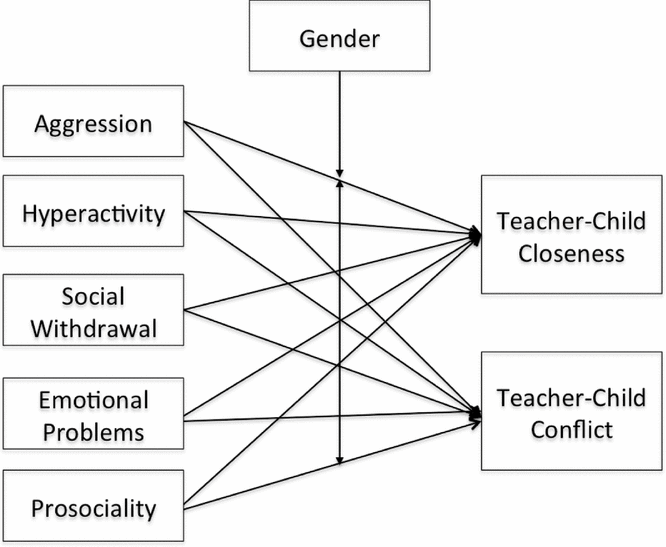
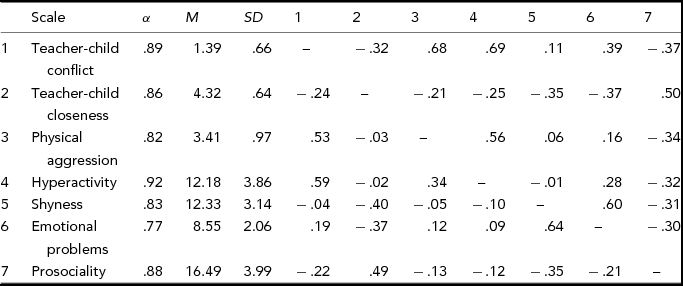
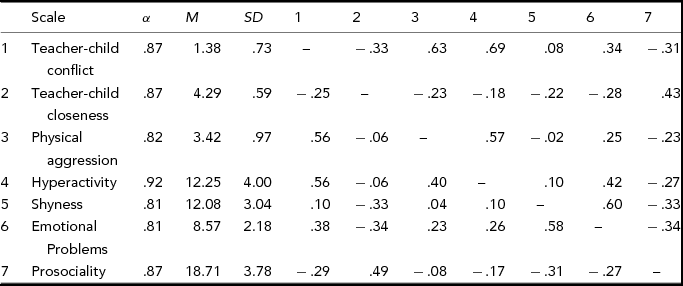
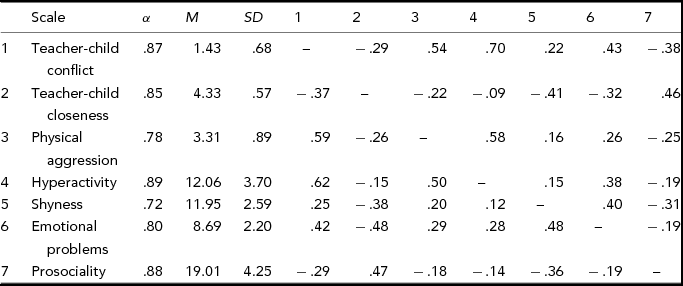
Descriptive analyses were conducted first, including intercorrelations of the variables at each of the three time points. To assist in interpretation of gender moderation, zero-order correlations are presented separately by gender. To better understand teachers’ ratings of child behaviours and teacher-child relationship, t tests were conducted next. To address the hypotheses regarding the role of teacher-rated child behaviours on their perceptions of relationship quality with those children, and whether gender moderates these relationships, moderated path analyses were conducted for each of the 3 years of this study (i.e., cross-sectionally). Path analyses provide an opportunity to examine the concurrent predictive relationships of multiple predictors on multiple outcome variables (see Figure 1). Moderation by gender was assessed in the path models by examining whether path parameters should be allowed to vary for boys and girls. To determine whether gender moderates the links, STATA was used to run Lagrange multiplier tests; significant chi-square test results provide evidence that allowing parameters to vary by gender provided a better fit to the data, and thereby provide support for moderation. If the Lagrange test does not provide significant chi-square tests, no evidence of gender moderation was found, and parameters in the path models were constrained to be equal for boys and girls, Given that the assumption of independence was violated in this study due to the multiple ratings provided by single raters (i.e., teachers), the observations within classes may have been correlated in unknown ways (Arellano, Reference Arellano1987). This can bias standard errors estimates and lead to invalid statistical significance. To correct for this risk, school-level clustering was accounted for via robust standard error estimates in STATA.
Schematic of path analyses examinging teacher ratings of child behaviour as predictors of teacher-child closeness and conflict, moderated by child gender.

Preliminary Analyses
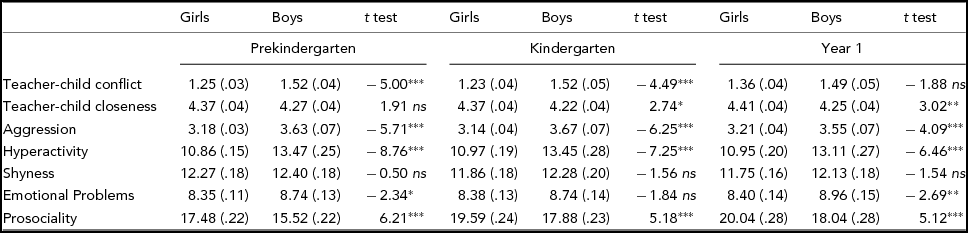
Overall means and standard deviations, pooled across gender, as well as intercorrelations within waves for prekindergarten, kindergarten, and year 1 appear, respectively, in Tables 1–3. Intercorrelations are presented by gender, to examine zero-order correlations for boys and girls at each time point. Details on mean levels (with standard error values) of children's behaviour and teacher-child relationship quality are presented by gender in Table 4 for each grade of the longitudinal study; t test analyses indicated that teachers’ relationships with boys were more conflictual than those with girls in prekindergarten and kindergarten, but not in year 1. Girls were seen to have closer relationships with teachers from kindergarten, but not before. At each grade, teachers rated boys as significantly more physically aggressive, more hyperactive, and having more emotional problems than girls, and girls were seen as more prosocial.
Descriptive Statistics and Zero-Order Correlations Between Teacher-Ratings of Child Behaviours and of Teacher-Child Relationship Quality in Prekindergarten (n = 598)
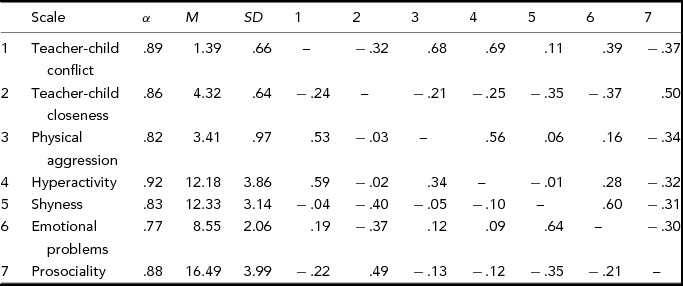
Note: Girls intercorrelations are presented below the diagonal; boys are presented above; coefficients greater than .19 are significant at p < .001; those greater than .11 are significant at p < .05.
Descriptive Statistics and Zero-Order Correlations Between Teacher-Ratings of Child Behaviours and of Teacher-Child Relationship Quality in Kindergarten (n = 496)
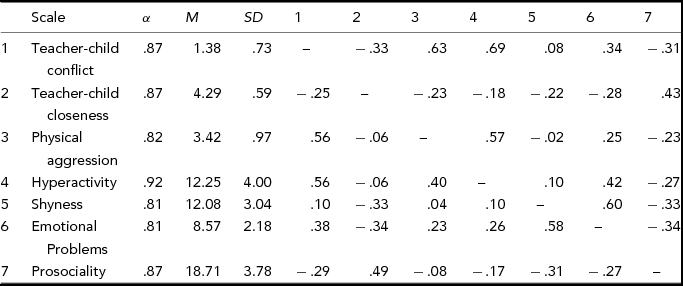
Note: Girls intercorrelations are presented below the diagonal; boys are presented above; coefficients greater than .24 are significant at p < .001; those greater than .13 are significant at p < .05.
Descriptive Statistics and Zero-Order Correlations Between Teacher-Ratings of Child Behaviours and of Teacher-Child Relationship Quality in Year 1 (n = 451)
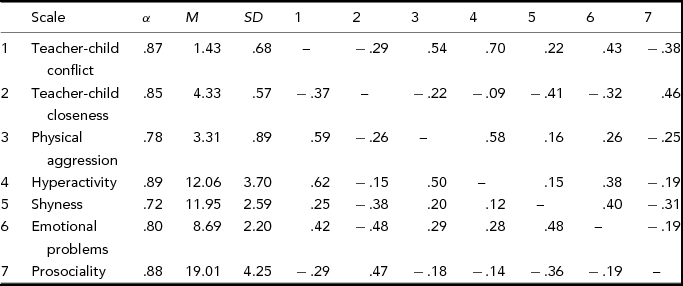
Note: Girls intercorrelations are presented below the diagonal; boys are presented above; coefficients greater than .25 are significant at p < .001; those greater than .15 are significant at p < .05.
Means (and Standards Errors) by Gender and t Test Results for Mean Difference Testing
* < .05; *** < .001.
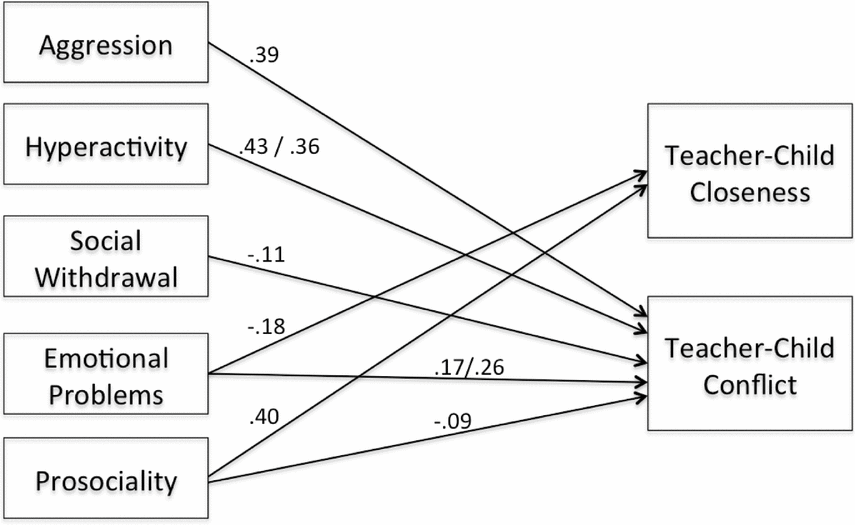
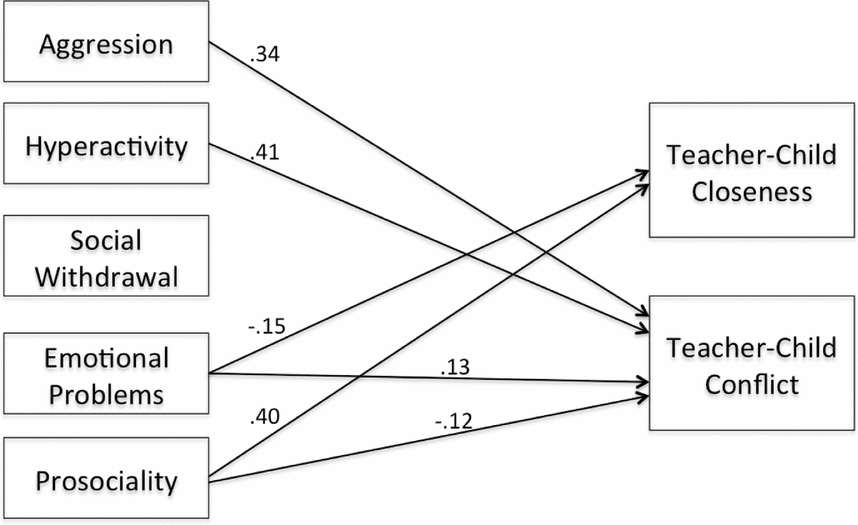
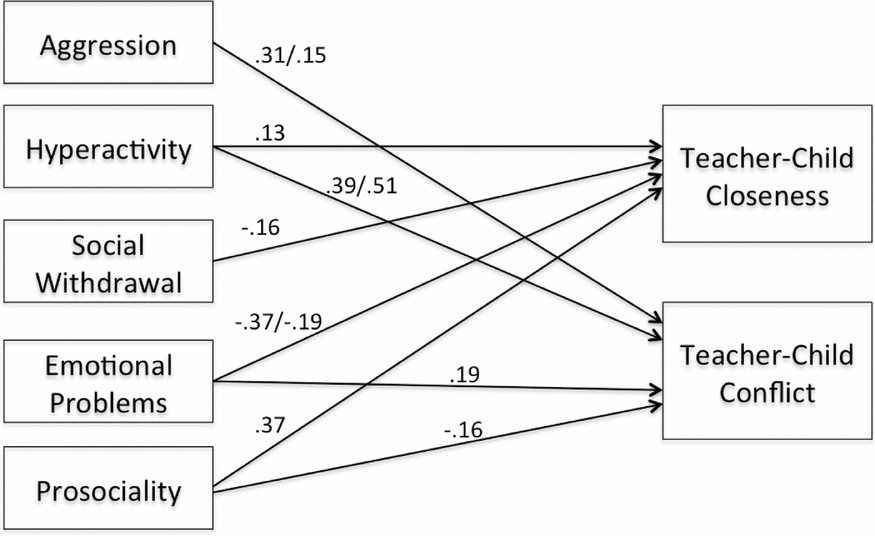
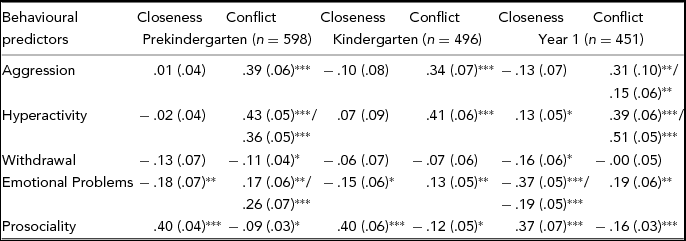
Next, tests of the prediction of child behaviour to teacher-child relationship quality were conducted. For the prekindergarten ratings of conflict, tests of parameter invariance (i.e., Lagrange multiplier tests) were significant for hyperactivity, χ2 = 4.15 (df = 1), p < .05, and emotional problems, χ2 = 6.14 (df = 1), p < .05, thereby signalling moderation by gender. These paths were consequently allowed to vary in predicting teacher-child conflict. Prekindergarten predictors of closeness did not vary by gender. For kindergarten ratings of teacher-child relationship, tests of invariance were non-significant for all predictors for both closeness and conflict, indicating no gender moderation. For year 1 teacher-child relationship, gender moderation of emotional problems was observed in predicting closeness, χ2 = 5.11 (df = 1), p < .05; and gender moderation of physical aggression, χ2 = 17.72 (df = 1), p < .001, and hyperactivity, χ2 = 5.23 (df = 1), p < .05, was observed for teacher-child conflict.
Based on these tests, path analytic models were run for genders together, and separate models for boys and girls were also estimated. Figures 2–4 present significant paths for the prekindergarten, kindergarten, and year 1 measurement waves, respectively. Note that for these analyses, correlated variance components across behaviours and between teacher-child conflict and closeness are accounted for in the estimation of paths, but not reported. For paths between predictors and outcomes that were allowed to vary by gender, path estimates for girls and for boys are presented separately; otherwise, the path estimate reflects the coefficient for both boys and girls. (See Table 5 for details on all paths.)
Child social-emotional predictors of teacher-child relationship, and moderation by gender in prekindergarten. Only paths that are statistically significant are represented in the final model. In cases of significant gender moderation, values for girls are presented first, followed by values for boys.
Child social-emotional predictors of teacher-child relationships, and moderation by gender in kindergarten. Only paths that are statistically significant are represented in the final model. In cases of significant gender moderation, values for girls are presented first, followed by values for boys.
Child social-emotional predictors of teacher-child relationships, and moderation by gender in year 1. Only paths that are statistically significant are represented in the final model. In cases of significant gender moderation, values for girls are presented first, followed by values for boys.
Results of Path Analyses for Prekindergarten, Kindergarten, and Year 1 With Child Behaviours Predicting Teacher-Child Closeness and Conflict (Standardised Beta and Robust Standard Error)
Note: For gender-differentiated results, values for girls are presented first, then values for boys.
* < .05; *** < .001.
Consistently across grades, closeness was a function of perceived prosociality, and an absence of emotional problems. Conflict was a function of aggression, hyperactivity, emotional problems, and poor prosociality. Some less consistent results were also observed. In prekindergarten, social withdrawal was negatively predictive of conflict; however, by year 1, it was negatively associated with closeness, although neither of these suggested large effects. In year 1, hyperactivity also predicted closeness, but in a positive relationship such that children who showed greater problems with impulsivity (controlling for physical aggression) had somewhat closer relationships with their teacher. However, for neither boys nor girls was hyperactivity correlated with closeness, and zero-order correlations were negative, not positive, suggesting this may be a spurious effect resulting from statistical suppression (Tzelgov & Henik, Reference Tzelgov and Henik1991).
Overall, then, children's behaviours predicted teacher-child relationship quality in an absolute manner; that is, there was, for the most part, only modest support for the hypothesis that teachers’ relationships with boys and girls were differentially influenced by children's gender. However, several cases did appear to support the notion that gender moderates the relationship between teachers’ perceptions of children's behaviours and teachers’ perspectives on their relationship quality with children. These moderation effects, however, were not consistent across the years of the study. For example, prekindergarten emotional problems predicted conflict more strongly for boys than for girls; but in kindergarten and year 1, no gender moderation was observed, with only the main effect on conflict. However, emotional problems also had a significant negative effect on closeness in prekindergarten and kindergarten, and only by year 1 was this moderated by gender, with these problems predicting less closeness in relationships more strongly for girls than for boys.
Teacher-child conflict was also differentially predicted by gender in some cases in ways that shifted over the 3 years of the study. Hyperactivity was a stronger predictor of conflict in prekindergarten for girls than for boys. In kindergarten, hyperactivity only served as a main effect predictor of conflict with no gender moderation. But, by year 1, hyperactivity more strongly predicted conflict for boys than for girls. Finally, physical aggression did not show gender moderation in the first 2 years, but by year 1, conflict was differentially predicted by physical aggression, such that it more strongly predicted conflict for girls. In this case, the beta value for girls is more in line with previous beta values; the beta associated with boys’ aggression was notably lower than previous years.
Discussion
The current study aimed to examine whether teachers’ relationships with their students (from prekindergarten to year 1) were associated with the teachers’ perceptions of children's behaviour in similar, or distinct, ways for boys and girls. In many cases, teachers’ relationships with children appear to be influenced by their perceptions of children's behavioural tendencies similarly for boys and girls. Children who show externalising problems, regardless of gender, are at risk of conflict with their teachers; boys and girls alike who do not share or engage in the social responsibilities of the classroom, or who appear to be inexplicably unhappy, do not develop as close relationships with teachers as their peers tend to. These results largely replicate those of Birch and Ladd (Reference Birch and Ladd1998), and indicate that these associations are present even in prekindergarten.
The primary contribution of this study is to show that the strength of association between children's behaviours and their relationships with teachers is, in some cases, dependent on the gender of the child. Boys who show greater emotional problems in prekindergarten are at greater risk for high levels of conflict with their teachers than are girls who have emotional problems. This suggests gender-stereotype confirmation (e.g., that boys shouldn't cry). It may be that preschool teachers expect a degree of exuberance from boys, and those who appear especially unhappy engender conflict by refusing to partake in activities, for example. In year 1, the predictive role of emotional problems appears to shift in how it is differentiated by gender, such that emotional problems among girls appear to be more compromising to the establishment of close relationship with the teacher. (Boys who show emotional problems are still at risk of less close teacher-child relationships, but their risk appears to be in line with the risk in previous years.)
Why might emotional problems become more important and potentially damaging for girls by year 1? It may be that in earlier, relatively less structured grades, teachers have a greater opportunity to get to know the girls in their classes; by year 1, the shift to focusing increasingly on academic outcomes and the decrease in unstructured time may leave teachers with less opportunity to get to know the girls in their class who are not effusive or demonstratively happy. Put another way, girls may be expected to be more overtly chipper in the early school years, and if teachers do not see that from girls, and cannot compensate by getting to know them well, their perceived closeness decreases. Boys may not be expected to be chipper in the same way, and sullenness is not taken so seriously. This hypothesis, however, goes beyond the capacity of this data to speak to it, and further research is required that explicitly models teachers’ expectations over the early school years and how those expectations feed into their interpretations of children's behaviours and consequently into their relationships.
The role of externalising problems in predicting teacher-child conflict also appeared to undergo changes over the early years with regard to gender differentiation. Aggression is a consistent predictor of conflict, but not of problems with closeness (cf., Justice et al., Reference Justice, Cottone, Mashburn and Rimm-Kaufman2008). But, by year 1, for boys, problems with aggression are notably less strongly related to teacher-child conflict, and problems with hyperactivity are more strongly predictive of conflict than in the previous grades. Given that boys’ mean levels of aggression and hyperactivity are stable over those years, it seems likely that these patterns reflect changes in teachers’ expectations. By year 1, boys aggression may take place largely outside the classroom, and hence may not incur direct conflict with the teachers, who may still know of it but have less of a role in managing it than they did in the earlier years. Boys’ hyperactive behaviours, however, are very likely to be reflected in their classroom behaviour, at an age when expectations for classroom behavioural control are getting higher (Vitaro et al., Reference Vitaro, Gagnon and Tremblay1991). Teachers may anticipate that prekindergarten boys will show poor impulse control and be somewhat disruptive, relative to girls. At that age, those behaviours among girls may be a cause of greater concern for teachers, based on their stereotypes of girls’ behaviours in the preschool years. But by year 1, when students are expected to have obtained a degree of self-control, boys who still do not show such control may be ‘cracked down’ upon more stringently. However, these conjectures require a more detailed, observational approach than was possible in this study.
Taken together, these findings provide modest support for the notion that teachers’ responses, and relationships with students, are differentially influenced by gender schema that guide their interpretation of students’ behaviours. There is adequate evidence here to suspect that differential responses to the same behaviours are occurring, and to suggest that teacher gender schema are influencing the development of teacher-child relationship via a subtle process of divergent expectations. However, without direct evidence measuring teachers’ expectations and their implicit or explicit endorsement of gender stereotypes, this account remains speculative.
Limitations
Although this research touches upon one aspect of how children's social environments may evoke different responses contingent in part on children's gender, it cannot speak to important discussions in gender development (Bandura & Bussey, Reference Bandura and Bussey2004). For example, although this study may provide insight into how expectations of gender role behaviours may influence teacher-child relationship, it does not speak to how those expectations are internalised, and whether those expectations inform children's developing gender self-schema.
As well, as a set of cross-sectional snapshots of the relationship between teacher-child conflict and closeness and children's behaviours, the study is open to reinterpretation that the behaviours are consequences of teacher-child relationship quality. A stronger response to the questions posed here would follow the same teacher with students over the course of a year, and assess cross-lagged relationships, as Doumen et al. (Reference Doumen, Verschueren, Buyse, Germeijs, Luyckx and Soenens2008) have done with regard to the relationship between teacher-child conflict and aggression.
Conclusions
The results of the present study suggested that students’ characteristics may not only play a role in the sorts of relationships that teachers build with students, but that those relationships may be differentially influenced by behaviours based on the gender of the child. Differential expectations for boys and girls behaviours may influence relationship quality in subtle ways, and more research is needed to explore and examine processes whereby teachers’ expectations and gender stereotypes might affect how close they feel to particular boys and girls. It is also important to further study how expectations for boys and girls’ behaviour might change over the course of schooling, as gender expectations shift for younger and older children. Further research, with observational measures and direct assessment of teachers’ gender stereotypes — both explicit and implicit — is recommended to better understand these phenomena.
There could be a role for school psychologists and counsellors to work with teachers, not just with children, to ascertain and address the teachers’ behavioural expectations, and how their gender role beliefs may be differentially influencing their expectations and consequently their relationship with their students. Undoubtedly, for such consultation to be effective, it will have to be approached not as a transfer of knowledge, but as a collaborative effort on the part of teacher and school psychologist to enhance professional practice in all its dynamic complexities (Askell-Williams & Murray-Harvey, Reference Askell-Williams and Murray-Harvey2014; Dall’Alba & Sandberg, Reference Dall’Alba and Sandberg2006). With support, teachers and early childhood educators can recognise behaviours to which they are prone to adverse reactions, and adapt their interaction style to adjust to these sensitivities (Rimm-Kaufman, Voorhees, Snell, & La Paro, Reference Rimm-Kaufman, Voorhees, Snell and La Paro2003).
Others have already called for more systematic studies of programs that aim to build teachers’ skills in providing supportive, non-conflictual learning settings (e.g., Hughes, Reference Hughes2011; Sabol & Pianta, Reference Sabol and Pianta2012). Teachers need to be trained to establish the best possible relationship with their students, with strategies for relationship building, self-diagnosis of relationship problems, and concrete ideas to repair their relationships with individual children as needed. The contribution this study makes is to highlight that teachers may be differentially sensitive to particular behaviours from girls and other behaviours from boys, and their interactions and relationships with students may thereby be differentially influenced. Educators of young children may benefit from structured professional development experiences that bring gender stereotypes to the fore, examine their impact on teachers’ responses to child behaviours, and encourage them to reflect on how those differential expectations might influence their relationships.
Acknowledgments
This research was funded by a grant from Healthway, the West Australian Health Promotion Agency. I would like to acknowledge the support of the teacher, principals, and students of the CAP Project Schools, and Thérèse Shaw, Donna Cross, Tommy Cordin, Stacey Waters, and the staff and volunteers of the Child Health Promotion Research Centre, Edith Cowan University.