Introduction
Mood disorders are one of the most common types of mental disorders in Canada and throughout the world. A 2012 Canadian survey showed that more than 1.5 million (or 5.4%) Canadians aged 15 or older had been affected by symptoms compatible with a mood disorder in the preceding 12-months (Pearson et al. Reference Pearson, Janz and Ali2013). Similar global annual prevalence estimates have also been reported (Waraich et al. Reference Waraich, Goldner, Somers and Hsu2004; Ferrari et al. Reference Ferrari, Baxter and Whiteford2011, Reference Ferrari, Charlson, Norman, Patten, Freedman, Murray, Vos and Whiteford2013; Merikangas et al. Reference Merikangas, Jin, He, Kessler, Lee, Sampson, Viana, Andrade, Hu, Karam, Ladea, Medina-Mora, Ono, Posada-Villa, Sagar, Wells and Zarkov2011). Two groups of mood disorders are generally recognized: (1) depressive disorders, which consist mainly of major depressive episode or disorder (two or more episodes) and persistent depressive disorder; and (2) bipolar disorders, which include bipolar type I, bipolar type II and cyclothymia (a milder but chronic form of bipolar disorder).
Mood disorders have a major impact on the daily lives of those affected causing significant functional impairments. For instance, the 2010 Global Burden of Disease reported that depressive disorders alone were the second leading cause of years lived with disability globally and in North America (Ferrari et al. Reference Ferrari, Charlson, Norman, Patten, Freedman, Murray, Vos and Whiteford2013).
While being prevalent, a number of studies have revealed that mood disorders are under-recognised and under-diagnosed (Goldman et al. Reference Goldman, Nielsen and Champion1999; Akiskal et al. Reference Akiskal, Bourgeois, Angst, Post, Möller and Hirschfield2000; Wittchen et al. Reference Wittchen, Höfler and Meister2001; Hirschfeld et al. Reference Hirschfeld, Cass, Holt and Carlson2005; Lecrubier, Reference Lecrubier2007; Cepoiu et al. Reference Cepoiu, McCusker, Cole, Sewitch, Belzile and Ciampi2008; Mitchell et al. Reference Mitchell, Vaze and Rao2009; Smith et al. Reference Smith, Griffiths, Kelly, Hood, Craddock and Simpson2011). This may be due to individual and/or health system factors. While individual factors include low mental health literacy, fear of stigmatisation, or preference to manage one's own health, health system factors relate more to access to mental health care, or limited knowledge and skills of the professional consulted (Goldman et al. Reference Goldman, Nielsen and Champion1999; Cepoiu et al. Reference Cepoiu, McCusker, Cole, Sewitch, Belzile and Ciampi2008; Mitchell et al. Reference Mitchell, Vaze and Rao2009).
Mood disorders are under-diagnosed, particularly in primary care where most of the health care encounters occur (Wittchen et al. Reference Wittchen, Höfler and Meister2001; Hirschfeld et al. Reference Hirschfeld, Cass, Holt and Carlson2005; Cepoiu et al. Reference Cepoiu, McCusker, Cole, Sewitch, Belzile and Ciampi2008; Mitchell et al. Reference Mitchell, Vaze and Rao2009; Smith et al. Reference Smith, Griffiths, Kelly, Hood, Craddock and Simpson2011). Two recent meta-analyses have shown that the accuracy of depression diagnosis in primary care is sub-optimal with 50% or less of the persons presenting with symptoms compatible with depression being accurately diagnosed (Cepoiu et al. Reference Cepoiu, McCusker, Cole, Sewitch, Belzile and Ciampi2008; Mitchell et al. Reference Mitchell, Vaze and Rao2009).
While also under-diagnosed, misdiagnosis of bipolar disorders has been identified as a considerable challenge, with an important proportion of bipolar type II cases being diagnosed and treated for recurrent depressive episodes (Akiskal et al. Reference Akiskal, Bourgeois, Angst, Post, Möller and Hirschfield2000; Hirschfeld et al. Reference Hirschfeld, Cass, Holt and Carlson2005; Smith et al. Reference Smith, Griffiths, Kelly, Hood, Craddock and Simpson2011). Finally, it should be noted that over-diagnosis of mood disorders has also been recognised as a major cause for concern in the last decade (Aragones et al. Reference Aragones, Pinol and Labad2006; Cepoiu et al. Reference Cepoiu, McCusker, Cole, Sewitch, Belzile and Ciampi2008; Mitchell et al. Reference Mitchell, Vaze and Rao2009, Mitchell, Reference Mitchell2012; Ghouse et al. Reference Ghouse, Sanches, Zunta-Soares, Swann and Soares2013).
Although over-diagnosis and misdiagnosis are important issues, considering the potential risk of increasing severity and chronicity associated with under-diagnosis, this paper focuses on those who have symptoms compatible with a mood disorder as per Diagnostic and Statistical Manual of Mental Disorders (DSM-IV) criteria but have never been diagnosed by a health professional. To our knowledge, this is the first of its kind in Canada. The most comparable study undertaken at sub-national level showed that only about 50% of those with symptoms compatible with depression had sought treatment (Lin & Parikh, Reference Lin and Parikh1999).
Using data from a nationally representative sample of Canadians 15 years of age or older, the objectives of this study were to: (1) characterize those with symptoms compatible with a mood disorder; (2) compare those with symptoms compatible with a mood disorder by diagnosis status (i.e., not professionally diagnosed v. previously diagnosed) and to those without symptoms; and (3) describe the health impacts, contacts with health professionals, medication use and perceived need for mental health care among those with mood disorder symptoms by diagnosis status.
Methods
Data source and study sample
The 2012 Canadian Community Health Survey – Mental Health (CCHS – Mental Health) is a cross-sectional survey with a multistage stratified cluster sampling design covering the Canadian population 15 years of age and older living in the ten provinces. Exclusions include persons living on reserves and other Crown lands, homeless persons, full-time members of the Canadian Forces and the institutionalized population, which represent about 3% of the target population.
The overall survey response rate was 68.9% (Statistics Canada, 2013). For this study, we used the ‘Share file’. Share files are confidential files in which the participants in the survey have signed a consent form permitting Statistics Canada to allow access to their information for approved research. These files consist of a subset of the cases in the master file. Access to share files may be granted to specific government departments without the need for their researchers to work within a Research Data Centre (n = 23 709) and excluded the respondents (n = 205) with missing responses to either of the two mood disorder measures (i.e., symptom based and self-reported professional diagnosis) for a total study sample of 23 504.
More detailed information on the 2012 CCHS – Mental Health including the questionnaire can be found at: http://www23.statcan.gc.ca/imdb/p2SV.pl?Function=getSurvey&SDDS=5015&Item_Id=119790&lang=en.
Mood disorder measures
Symptom based
Respondents were defined as having symptoms consistent with a mood disorder if they met the CCHS – Mental Health/World Health Organization Composite International Diagnostic Interview (WHO-CIDI) criteria for any of the measured mood disorders (Major Depressive Episode, Bipolar I, Bipolar II, Hypomania) in the past 12 months.
The CCHS-Mental Health/WHO-CIDI criteria are based on a Canadian adaptation of the WHO-CIDI. The WHO-CIDI is a standardised instrument for the assessment of mental disorders and conditions according to an operationalisation of the definitions and criteria of the DSM-IV. It was designed to measure the prevalence of mental disorders at the community level, and can be administered by lay interviewers (Statistics Canada, 2013). However, since the CCHS-Mental Health/WHO-CIDI is a fully structured diagnostic interview rather than a full clinical assessment, those with a positive result are described in this study as having symptoms compatible with a mood disorder. A clinical appraisal based on the Structured Clinical Interview for DSM-IV conducted in four countries found generally good concordance with 12-month mood disorder diagnosis for adults based on the CIDI (Haro et al. Reference Haro, Arbabzadeh-Bouchez, Brugha, de Girolamo, Guyer, Jin, Lepine, Mazzi, Reneses, Vilagut, Sampson and Kessler2006).
Self-reported professional diagnosis
Respondents were defined as having a professionally diagnosed mood disorder by answering ‘yes’ to the following question, which asks them to consider conditions that had been diagnosed by a health professional and that had lasted or were expected to last 6 months or longer: ‘Do you have a mood disorder such as depression, bipolar disorder, mania or dysthymia?’ (Statistics Canada, 2013). The timeframe that respondents received their mood disorder diagnosis was not specified.
Description of the measures used to determine the socio-demographics, health characteristics, health impacts, medication use, health services use and need, is available in Appendix 1.
Statistical analysis
Descriptive analyses were performed (1) to characterise those reporting symptoms compatible with a mood disorder in the 12 months preceding the survey v. those without symptoms and (2) to compare those with mood disorder symptoms in the 12 months preceding the survey by diagnosis status (i.e., diagnosed v. undiagnosed). Univariate and multivariate logistic regression analyses were carried out to determine the associations between various socio-demographic and health characteristics and being undiagnosed v. diagnosed among individuals with mood disorder symptoms (Barros & Hirakata, Reference Barros and Hirakata2003). Finally, descriptive analyses were conducted to determine the health impacts, contacts with health professionals, medication use and perceived need for mental health care among those reporting symptoms compatible with a mood disorder by diagnosis status.
To account for sample allocation and survey design, all estimates were weighted using survey weights generated by Statistics Canada in order to reflect the age and sex distribution of the household population aged 15 or older in the ten provinces.
Furthermore, variance estimates (95% confidence intervals and coefficients of variation) were generated through bootstrap weights provided with the data and adjusted ORs were carried out using the relevant variance estimates (Rust & Rao, Reference Rust and Rao1996). Significance was defined as a p-value of <0.05.
The analyses were performed with SAS Enterprise Guide version 5.1 (SAS Institute, Cary, NC).
Results
Prevalence and characteristics of individuals with mood disorder symptoms
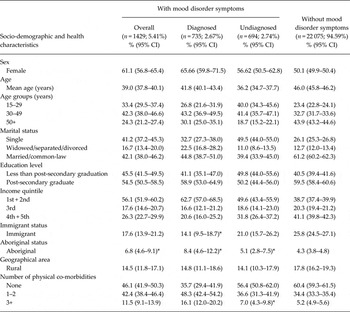
The prevalence of reporting symptoms compatible with a mood disorder in the 12 months preceding the survey was 5.4%. The associations between those with mood disorder symptoms v. those without and all socio-demographic and health characteristics studied were significant, with those relating to sex, age, marital status, income level and the presence of physical co-morbidity demonstrating the greatest significance (p < 0.0001) (Table 1; χ2 test results not shown).
Socio-demographic and health characteristics among individuals with mood disorder symptoms (overall and by diagnosis status) and without mood disorder symptoms, household population aged 15 years and older, Canada excluding the territories, 2012 (n = 23 504)

Proportions (%), means and 95% Confidence Intervals (CIs) are based on weighted data.
* High sampling variability (coefficient of variation between 16.6 and 33.3%).
Those affected were more likely to be a female (61.1 v. 50.1%), of younger age (mean age 39.0 v. 46.0 years) and single (41.2 v. 26.1%) and more likely to be in the lowest income quintiles (Q1 and Q2) (56.1 v. 38.7%) than those unaffected. Finally, those with mood disorder symptoms were more likely to have at least one physical co-morbidity (53.9 v. 39.6%).
Comparison of individuals with mood disorder symptoms by diagnosis status
Among Canadians with symptoms compatible with a mood disorder, only half reported to have been previously diagnosed with a mood disorder by a health professional (Table 1). While there were some similarities in socio-demographic and health characteristics between those having received a previous diagnosis v. those who had not, they were different on many levels. For instance, those undiagnosed were more likely than those with a previous diagnosis to be aged between 15 and 29 years (40.0 v. 26.8%) and more likely to be single (49.5 v. 32.7%).
Those undiagnosed were more likely to have less than a post-secondary graduation but conversely, less likely to be part of the lowest income quintiles (Q1 and Q2) (49.6 v. 62.7%). No difference was observed in the immigration or the Aboriginal statuses between the two groups. About 85% of the individuals in both groups lived in urban area.
Finally, the undiagnosed group was more likely to have no physical co-morbidity compared with the diagnosed group (56.4 v. 35.7%).
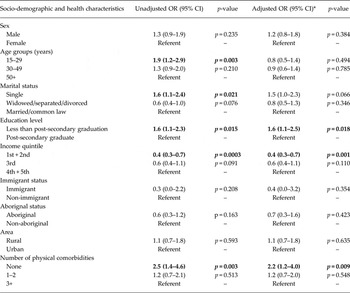
Upon controlling for all socio-demographic and health characteristics, the associations with age and marital status disappeared (Table 2).
Associations between socio-demographic/health characteristics and not having a mood disorder diagnosis among individuals with mood disorder symptoms, household population aged 15 years and older, Canada excluding the territories, 2012 (n = 1429)

Bold values represent association reaching statistical significance based on a p-value of <0.05.
* Adjusted for all variables in the model; Odds Ratios (ORs) and 95% Confidence Intervals (CIs) are based on weighted data; Significance was defined as a p-value of <0.05.
Physical and mental health impacts among individuals with mood disorder symptoms by diagnosis status
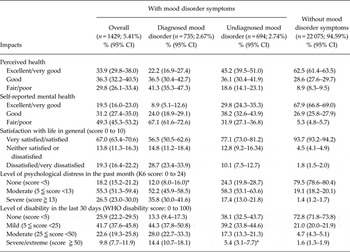
Overall, those with mood disorder symptoms demonstrated significantly worse physical and mental health related impacts compared with those without mood disorder (Table 3).
Physical and mental health impacts among individuals with mood disorder symptoms (overall and by diagnosis status) and without mood disorder symptoms, household population aged 15 years and older, 2012 Canada excluding the territories, 2012 (n = 23 504)

Proportions (%) and 95% Confidence Intervals (CIs) are based on weighted data.
* High sampling variability (coefficient of variation between 16.6–33.3%).
Among those with mood disorder symptoms, the proportion that reported suboptimal perceived health (41.3 v. 18.6%), dissatisfaction with life (28.7 v. 10.1%), suboptimal self-reported mental health (67.1 v. 31.9%), severe distress (35.8 v. 17.4%) and moderate/severe/extreme disability (42.4 v. 22.7%) was close to, or more than double among those with a previous diagnosis compared with those undiagnosed. It should be noted that although the undiagnosed group fared better than those diagnosed, as shown in Table 3, their self-reported mental health status, levels of psychological distress and disability were much worse than those with no mood disorder symptoms.
Contacts with health professionals, medication use and perceived need for mental health care among individuals with mood disorder symptoms by diagnosis status
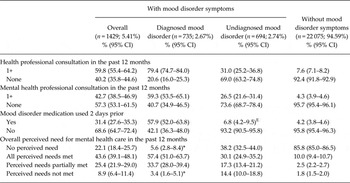
As expected, the majority of those undiagnosed had not consulted a health professional or a mental health professional for their symptoms in the 12 months preceding the survey (69.0 and 73.6%, respectively). Although somewhat incongruous, 6.8% of them reported taking a mood disorder medication (Table 4).
Health professional consultations, medication use and perceived need for care among individuals with mood disorder symptoms (overall and by diagnosis status) and without mood disorder symptoms, household population aged 15 years and older, Canada excluding the territories, 2012 (n = 23 504)

Proportions (%) and 95% Confidence Intervals (CIs) are based on weighted data.
* High sampling variability (coefficient of variation between 16.6–33.3%).
In contrast, nearly 80% of those previously diagnosed had seen a health professional at least once in the preceding 12 months, with nearly 60% having consulted a mental health professional as well as nearly 60% having taken a mood disorder medication within the 2 days prior to the interview.
Finally, 6 out of 10 of those undiagnosed and nearly all (94.4%) individuals with a previous diagnosis reported a need for mental health care in the previous 12 months. While a higher proportion of those undiagnosed stated their health care needs were not met compared with those with a previous diagnosis (14.4 v. 3.4%, respectively), more than a third of those with a previous diagnosis reported that their needs were only partially met.
Discussion
An estimated 1.5 million Canadians (5.4%) aged 15 years and older experienced symptoms compatible with a mood disorder in 2012; however, only half of these individuals reported having been professionally diagnosed in the past. In light of the fact that a comparable study conducted 20 years ago in Ontario (the largest province in Canada) reported similar results, little improvement appears to have taken place (Lin & Parikh, Reference Lin and Parikh1999).
Upon comparing symptomatic individuals by diagnosis status, we found several differences in terms of age, marital status, education and income levels and physical co-morbidities. As shown in a number of studies, teenagers and young adults are less likely to seek care for mental health problems. Although mental health literacy in that age-group appears to be adequate in Canada (Marcus & Westra, Reference Marcus and Westra2012), still many youths do not consult a health professional for their problems. Reported reasons include that they prefer to manage on their own, they do not trust the health care system and/or by fear of stigmatisation (Rickwood et al. Reference Rickwood, Deane and Wilson2007; Marcus & Westra, Reference Marcus and Westra2012; Stuart et al. Reference Stuart, Patten, Koller, Modgill and Liinamaa2014). It is therefore important to consider the specific needs and preferences of this population in order to improve their help-seeking behaviours. It should be noted, however, that after adjustment for all socio-demographic and health characteristics, the association with age and marital status disappeared.
Less than post-secondary graduation was associated with being undiagnosed – this possibly reflects a lower mental health literacy level and/or higher degree of perceived stigma in this population leading to sub-optimal help-seeking behaviours (Lin & Parikh, Reference Lin and Parikh1999; Starkes et al. Reference Starkes, Poulin and Kisely2005; Cook & Wang, Reference Cook and Wang2010; Coppens et al. Reference Coppens, Van Audenhove, Scheerder, Arensman, Coffey, Costa, Koburger, Gottlebe, Gusmão, O'Connor, Postuvan, Sarchiapone, Sisask, Székely, van der Feltz-Cornelis and Hegerl2013). Unexpectedly, the undiagnosed group was less likely to be part of the lower income quintiles than the diagnosed group. While this is not generally consistent with the literature, a similar study conducted in Ontario also showed a comparable pattern for household income, although not statistically significant (Lin & Parikh, Reference Lin and Parikh1999). It may relate to the fact that the undiagnosed group is apparently less impacted and hence more likely to be functional, working and earning income compared with those who have received a mood disorder diagnosis. It should be noted that we reported household income and not personal income, which may also influence this finding.
Furthermore, our study demonstrated that those with no other co-morbid physical chronic conditions were less likely to have been diagnosed; probably implying that having less encounters with the health care system in general decreases the likelihood of being diagnosed as shown in other studies (Lin & Parikh, Reference Lin and Parikh1999; Vasiliadis et al. Reference Vasiliadis, Tempier, Lesage and Kates2009; Fleury et al. Reference Fleury, Grenier and Caron2015).
While the undiagnosed individuals reported less physical and mental health impacts compared with those with a previous diagnosis, more than 75% reported moderate to severe psychological distress. Despite their high levels of distress, less than a third consulted a health professional regarding their emotional or mental status and only 14.4% reported that their mental health care needs had not been met at all. As mentioned previously, many reasons could explain the apparent discrepancy between their level of distress and health professional consults/need for care. These include the fact that they may not accept or recognize their condition. Alternatively, some may think they will get better on their own or may rely more on informal support. Finally some may fear the judgement of their peers or the medical community (Goldman et al. Reference Goldman, Nielsen and Champion1999; Cepoiu et al. Reference Cepoiu, McCusker, Cole, Sewitch, Belzile and Ciampi2008; Mitchell et al. Reference Mitchell, Vaze and Rao2009).
On the other hand, those who reported symptoms and a previous professional diagnosis were more adversely impacted both physically and mentally with over two-thirds reporting suboptimal mental health, nearly nine out of 10 reporting moderate to severe psychological distress and close to half reporting moderate to severe/extreme disability.
This study did not allow for the categorization of disease severity but given these findings, one might assume that those with a previous diagnosis experienced more severe disease compared with those undiagnosed although meeting the DSM-IV criteria. As shown in previous studies, those with the greatest need that is, those with more severe symptoms, long term symptoms, suicidal thoughts, higher level of distress and incapacity, severe role impairment and other psychiatric co-morbidity are more likely to seek and receive care (Kessler et al. Reference Kessler, Berglund, Demler, Jin, Koretz, Merikangas, Rush, Walters and Wang2003; Starkes et al. Reference Starkes, Poulin and Kisely2005; Wang et al. Reference Wang, Lane, Olfson, Pincus, Wells and Kessler2005).
In addition, the results from our study suggest that the mental health care needs of a substantial proportion of those with a mood disorder (diagnosed or undiagnosed) were either partially met or not met at all in the past 12 months (37 and 32%, respectively) – a well-documented care gap, which exists in Canada and throughout the world (Patten et al. Reference Patten, Sedmak and Russell2001; Kohn et al. Reference Kohn, Saxena, Levav and Saraceno2004; Starkes et al. Reference Starkes, Poulin and Kisely2005; Wang et al. Reference Wang, Aguilar-Gaxiola, Alonso, Angermeyer, Borges, Bromet, Bruffaerts, de Girolamo, de Graaf, Gureje, Haro, Karam, Kessler, Kovess, Lane, Lee, Levinson, Ono, Petukhova, Posada-Villa, Seedat and Wells2007; Sunderland & Findlay, Reference Sunderland and Findlay2013). Therefore, although those undiagnosed may have less severe disease, as shown by their lower levels of psychological distress and disability, they have nevertheless health care needs.
Finally, as shown by our study, the undiagnosed individuals fall in between those with no mood disorder symptoms and those diagnosed with a mood disorder, therefore it is essential to consider and assess the heterogeneity of those affected in terms of symptoms severity, impacts and prognosis (Lorenzo-Luaces, Reference Lorenzo-Luaces2015a ). Accordingly, the type and level of intervention(s) recommended should correspond to this assessment ranging from watchful waiting, self-management strategies (such as exercise) for milder cases to traditional psychological and pharmaceutical treatments for more severe cases (Jones, Reference Jones2007; Kennedy et al. Reference Kennedy, Lam, Parikh, Patten and Ravindran2009; Davidson, Reference Davidson2010; NICE, 2011; Yatham et al. Reference Yatham, Kennedy, Parikh, Schaffer, Beaulieu, Alda, O'Donovan, Macqueen, McIntyre, Sharma, Ravindran, Young, Milev, Bond, Frey, Goldstein, Lafer, Birmaher, Ha, Nolen and Berk2013; Lorenzo-Luaces et al. Reference Lorenzo-Luaces, DeRubeis and Bennett2015b ).
Strengths and limitations
Our study has a number of strengths, including a large, population-based sample and the administration of the survey by trained personnel using a recognised and validated instrument. It provides essential information on those affected by a mood disorder as identified through self-reported symptoms compared to those with only a professional diagnosis. However, the findings should be interpreted in light of a number of limitations.
First, since the results are based on self-reported symptoms, they are subject to social desirability and recall bias. In addition, results may be influenced by non-responder bias since mental illness can be a very sensitive topic and individuals may chose not to participate. Similarly, in addition to recall and social desirability biases, lack of unawareness that they had been diagnosed with a mood disorder may have resulted in an under-estimation of those called ‘previously diagnosed’.
Second, CCHS coverage is limited to the Canadian household population therefore, individuals at risk for mental illness such as Aboriginal peoples living on-reserve or in the three territories (Public Health Agency of Canada, 2006; MacMillan et al. Reference MacMillan, Jamieson, Walsh, Wong, Faries, McCue, MacMillan and Offord2008), the homeless (Krausz et al. Reference Krausz, Clarkson, Strehlau, Torchalla, Li and Schuetz2013), institutionalized patients (Seitz et al. Reference Seitz, Purandare and Conn2010) and prison residents (Simpson et al. Reference Simpson, McMaster and Cohen2013) were not included in the survey. Although altogether they represent only 3% of the population, it has likely affected the estimated prevalence.
Third, as previously mentioned, the 2012 CCHS-Mental Health did not measure the severity of the symptoms of the mood disorders studied, which would have been useful in assessing treatment/care needs. As well, it did not capture dysthymic disorders (milder but more chronic symptoms associated with persistent depressive disorder), and cyclothymia, underestimating the true prevalence of overall mood disorders.
Fourth, symptoms compatible with mood disorders were identified by an algorithm based on responses to the CCHS-Mental Health/WHO-CIDI instrument, not a clinical diagnosis by a mental health professional, which is seen as the gold standard.
Fifth, the reference periods for the reported mood disorder symptoms (previous 12 months) and the reported professional diagnosis (no timeframe specified) may be different, making a direct comparison difficult and possibly increasing the proportion of those deemed previously diagnosed.
Last, the results observed are based on a cross-sectional design; therefore, we could not determine whether the associated factors contributed to the development of mood disorder or were a consequence of it.
Conclusions
In summary, our study confirms that mood disorders are not only prevalent but can also profoundly impact the lives of those affected. There still exists under-diagnosis and unmet health care needs in Canada and reasons for this are likely both individual and health system-based. While family doctors in Canada are the primary contact and have a critical role in the diagnosis and management of mood disorders, efforts to empower families, schools and co-workers to engage those at risk to seek care are essential. Finally, since mood disorders present with a wide spectrum of severity and prognosis, interventions must be tailored accordingly.
Supplementary material
The supplementary material for this article can be found at http://dx.doi.org/10.1017/S2045796016000329.
Acknowledgements
Scott B. Patten is a Senior Health Scholar with Alberta Innovates, Health Solutions. The authors would like to acknowledge Margot Shields and Lidia Loukine for their advice on the analysis.
Financial Support
This research received no specific grant from any funding agency, commercial or not-for-profit sectors.
Conflict of Interest
None.
Ethical standard
This research does not contain clinical studies or patient data.