Introduction
Cuticular hydrocarbons (CHCs) of insects function mainly as a water barrier to avoid desiccation, but also play an important role in intraspecific communication. Because of their low volatility, they act mostly over short distances as contact pheromones (Singer, Reference Singer1998; Gibbs, Reference Gibbs2002; Blomquist & Bagnères, Reference Blomquist, Bagnères, Blomquist and Bagnères2010). CHC profiles are complex mixtures of aliphatic long-chain alkanes and alkenes, as well as methyl-branched alkanes. Described functions of CHCs comprise the mediation of recognition, aggregation, dispersal, alarm and sexual behaviour in insects (Howard, Reference Howard, Stanly-Samuelson and Nelson1993; Tillmann et al., Reference Tillmann, Seybold, Jurenka and Blomquist1999; Blomquist & Bagnères, Reference Blomquist, Bagnères, Blomquist and Bagnères2010). While social insects also use CHCs for recognition and interaction with nestmates and as fertility and dominance signals (Singer, Reference Singer1998; Liebig, Reference Liebig, Blomquist and Bagnères2010), solitary insects mainly use CHCs for the discrimination of conspecifics and enemies, location of mating partners and the elicitation of courtship behaviour (Ruther et al., Reference Ruther, Döring and Steiner2011). Evidence for solitary insects using CHCs as contact sex pheromones comes from several insect orders, for example the Coleoptera (Buprestidae: Lelito et al., Reference Lelito, Boroczky, Jones, Fraser, Mastro, Tumlinson and Baker2009; Silk et al., Reference Silk, Ryall, Lyons, Sweeny and Wu2009; Cerambycidae: Ginzel, Reference Ginzel, Blomquist and Bagnères2010; Chrysomelidae: Sugeno et al., Reference Sugeno, Hori and Matsuda2006; Peterson et al., Reference Peterson, Dobler, Larson, Juárez, Schlarbaum, Monsen and Francke2007; Geiselhardt et al., Reference Geiselhardt, Otte and Hilker2009), Diptera (Drosophilidae, Glossinidae and Muscidae: Wicker-Thomas, Reference Wicker-Thomas2007; Ferveur & Cobb, Reference Ferveur, Cobb, Blomquist and Bagnères2010) and Hymenoptera (Syvertsen et al., Reference Syvertsen, Jackson, Blomquist and Vinson1995; Schiestl et al., Reference Schiestl, Ayasse, Paulus, Löfstedt, Hansson, Ibarra and Francke2000; Sullivan, Reference Sullivan2002; Mant et al., Reference Mant, Brandli, Vereecken, Schulz, Francke and Schiestl2005; Steiner et al., Reference Steiner, Steidler and Ruther2005, Reference Steiner, Herrmann and Ruther2006, Reference Steiner, Mumm and Ruther2007). Within the parasitic wasp family Pteromalidae, females of Roptrocerus xylophagorum (Sullivan, Reference Sullivan2002), Lariophagus distinguendus (Steiner et al., Reference Steiner, Steidler and Ruther2005, Reference Steiner, Mumm and Ruther2007), Nasonia vitripennis (Steiner et al., Reference Steiner, Herrmann and Ruther2006) and Dibrachys cavus (Ruther et al., Reference Ruther, Döring and Steiner2011) produce CHCs which act at short-range as contact sex pheromones eliciting courtship behaviour in males.
The diet of an insect can be an important factor influencing its pheromone communication (Landolt & Phillips, Reference Landolt and Phillips1997; Tillmann et al., Reference Tillmann, Seybold, Jurenka and Blomquist1999; Blomquist, Reference Blomquist, Blomquist and Bagnères2010). With respect to CHCs, three ways of acquisition are conceivable which are not mutually exclusive: (a) CHCs may be sequestered from the diet after ingestion, (b) absorbed from the environment, or (c) synthesized de novo in oenocytes from dietary precursors (Blomquist & Jackson, Reference Blomquist and Jackson1973; Etges et al., Reference Etges, Veenstra and Jackson2006; Bagnères & Blomquist, Reference Bagnères, Blomquist, Blomquist and Bagnères2010). In the case of parasitic wasps, the first two ways are of particular interest because, due to their parasitic life cycle, these insects have been suggested to have lost the ability to biosynthesize fatty acids (Visser et al., Reference Visser, Le Lann, den Blanken, Harvey, van Alphen and Ellers2010), i.e. the same machinery involved in CHC biosynthesis (Blomquist, Reference Blomquist, Blomquist and Bagnères2010). However, the way how parasitic wasps acquire their CHCs and how the composition is controlled is not well understood. In any case, resources provided by the host should be of crucial importance for the cuticular chemistry.
Because of the influence of diet on the pheromone chemistry of insects, it is reasonable to assume that changes in the diet, e.g. caused by host switches in phytophagous or carnivorous insects, may lead to a breakdown in communication between mating partners and may ultimately contribute to the formation of host races and speciation. In fact, an example for such a host shift-induced breakdown in communication is reported for Drosophila serrata and D. melanogaster. In these species, the development on different substrates was found to induce differences in the CHC profiles, leading to preferential mating of individuals from the same substrates (Rundle et al., Reference Rundle, Chenoweth, Doughty and Blows2005; Sharon et al., Reference Sharon, Segal, Ringo, Hefetz, Zilber-Rosenberg and Rosenberg2010). A similar scenario is also thinkable in oligophagous and polyphagous parasitic wasps. Different hosts may provide different pools of precursors for CHC biosynthesis or different CHCs to be sequestered by the wasps. Consequently, feeding on different hosts might lead to differences in the CHC profiles of male and female wasps of one population, causing a breakdown in sexual communication and eventually leading to speciation.
As a first step to study this hypothesis, the present paper examines the influence of hosts on the CHC profile in Lariophagus distinguendus, a quasi-gregarious and polyphagous ectoparasitoid of grain infesting beetles (Steidle & Schöller, Reference Steidle and Schöller1997). Female cuticular hydrocarbons have been shown to arrest males and elicit wing fanning, a typical element of the male courtship behaviour (Steiner et al., Reference Steiner, Steidler and Ruther2005). Interestingly, also pupae of both sexes and newly emerged males elicit courtship behaviour in older males. Unlike females, however, males deactivate the behaviourally active chemicals within 32h after emergence (Steiner et al., Reference Steiner, Steidler and Ruther2005, 2007; Ruther & Steiner, Reference Ruther and Steiner2008). Thus, CHCs evolved to a sex-specific contact pheromone mediating mate recognition in L. distinguendus. We analyzed the CHCs of wasps from six strains reared on four different host species and analyzed the relative composition of the profiles by multivariate statistical methods. Our questions were: Are there differences between the CHC profiles from strains reared on different hosts? Do these differences occur in both sexes? Which compounds account for the differences in CHC profile? Can differences in the CHC profiles be caused by a host shift on an alternative host already within one generation? Do the wasps directly sequester significant amounts of host CHCs? The results are discussed with respect to a possible role of CHCs in prezygotic isolation and sympatric speciation.
Materials and methods
Insects
Six strains of L. distinguendus were reared on four different beetle species as hosts as described by Steidle & Schöller (Reference Steidle and Schöller1997) (table 1). The wasp cultures were kept in Petri dishes at 25°C, L16:D08 photoperiod and 50% RH. Freshly emerged wasps were isolated and kept under the same conditions for two days. Afterwards, they were deep frozen and stored at −23°C until they were extracted for chemical analysis.
Investigated Lariophagus distinguendus strains reared on different beetle hosts.

n, number of samples in chemical analysis.
Chemical analysis
For the analysis of CHCs, three L. distinguendus individuals from the same strain and sex were pooled and extracted for 15min in 30μl of hexane containing tetracosane (2.6ng μl–1) as an internal standard. The solvent was evaporated under a gentle stream of nitrogen, and the sample was re-dissolved in 10μl of hexane. To investigate the possible sequestration of ingested host-derived CHCs by the parasitoid, we also analyzed the CHC profiles of the four beetle hosts both in the larval and in the adult stage following the protocol described above (n=3 for each host species and stage, respectively). Aliquots (1μl in splitless mode) of these extracts were analyzed by coupled gas-chromatography mass spectrometry (GC-MS) on a Shimadzu GCMS-QP2010 Plus quadrupole MS (Shimadzu, Tokyo, Japan) equipped with a 30m×0.32mm I.D. BPX5 forte capillary column (film thickness 0.25μm) (SGE Analytical Science Europe, Milton Keynes, UK). Helium was used as carrier gas at a constant column flow of 1.73ml min−1. The oven program started at 150°C and was increased at 3°C min−1 up to 300°C (held for 20min). The GC effluent was ionized by electron impact ionization at 70eV; the mass range reached from m/z 35 to m/z 600.
Relative retention indices (LRI) of methyl-branched and unsaturated hydrocarbons were estimated by co-injection of straight-chain hydrocarbons (van Den Dool & Kratz, Reference van Den Dool and Kratz1963). Methyl-branched hydrocarbons were identified by diagnostic ions resulting from the favoured fragmentation at the branching points (Lockey, Reference Lockey1988; Nelson, Reference Nelson, Stanley-Samuelson and Nelson1993) and by comparing LRI values with literature data (Carlson et al., Reference Carlson, Bernier and Sutton1998; Steiner et al., Reference Steiner, Steidler and Ruther2005, Reference Steiner, Herrmann and Ruther2006, Reference Steiner, Mumm and Ruther2007). Positions of the double bonds of unsaturated hydrocarbons were determined by iodine-catalyzed methylthiolation using dimethyl disulphide (Francis & Velant, Reference Francis and Velant1981; Howard, Reference Howard, Stanly-Samuelson and Nelson1993). MS and LRI data of identified compounds were used to build a custom MS library allowing automatic analysis of GC-MS runs with the help of a two-dimensional search algorithm (MS+LRI) using the GC-MS Solution scientific software (Shimadzu) of the mass spectrometer.
Host shift experiment
Female wasps from the BerSit strain kept on Sitophilus granarius (F0) were reared for one generation on Stegobium paniceum (F1). The CHC profiles of the wasps from the F1 generation were analyzed as described above. The resulting data were compared to those from female wasps, which were reared at the same conditions but without a host shift (F1 S. granarius).
Statistical analysis
We integrated the 50 largest peaks (by area) within each run (overlapping compounds were calculated together). All peaks larger than 1% of the whole peak area were selected for further analysis. The absolute amount of each compound was calculated by relating individual peak areas to the internal standard. Statistical analysis was conducted with PAST version 2.01 scientific software (Hammer et al., Reference Hammer, Harper and Ryan2001). We used the non-metric multidimensional scaling (NMDS, Bray-Curtis similarity measure) to visualize the data and the non-parametric MANOVA (NPMANOVA, Bray-Curtis similarity measure of Bonferroni-corrected data) for calculation of the differences between CHC profiles of wasps from the different hosts. Similarity percentage (SIMPER) was used to calculate the individual contribution of each peak to the differences between wasps from different hosts.
Results
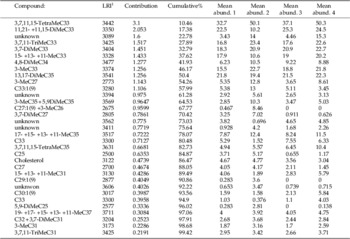
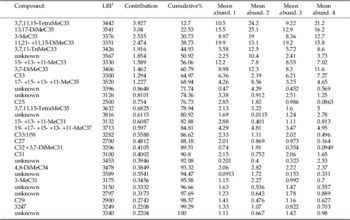
The CHC profiles of the wasps consisted mainly of methyl-branched long chain alkanes. For the analysis of female and male profiles, 33 and 30 compounds, respectively, were used (table 2–3). Overall, 83 female and 58 male samples were analyzed. Data of wasps originating from different strains but reared on the same host species (table 1) were pooled for statistical analysis since there were no significant differences in the NPMANOVA analysis between strains reared on the same host-species (S. granarius Berlin vs. Pforzheim: P=1 (males), P=0.9285 (females); S. paniceum Stuttgart vs. Ravensburg: P=1 (males); permutation n=10,000) with the exception of female wasps grown on Stegobium paniceum from the Ravensburg and the Pforzheim strain (P=0.0045).
Similarity Percentage (SIMPER) analysis of the L. distinguendus females CHC-profiles (overall average dissimilarity: 29.19).

1 Linear Retention Index according to van Den Dool & Kratz (Reference van Den Dool and Kratz1963).
Similarity Percentage (SIMPER) analysis of the L. distinguendus males CHC-profiles (Overall average dissimilarity: 30.92).

1 Linear Retention Index according to van Den Dool & Kratz (Reference van Den Dool and Kratz1963).
Differences in CHC profiles of females reared on different host-species
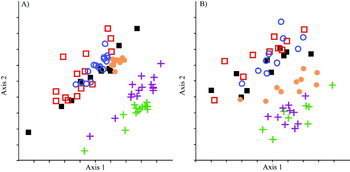
The NMDS analysis of the CHC profiles of L. distinguendus females reared on different beetle species as hosts (fig. 1A) showed a distinct separation between a cluster consisting of wasps from S. granarius, A. obtectus and L. serricorne and a cluster of wasps from S. paniceum. While wasps from S. granarius and A. obtectus overlapped fully, L. serricorne was concentrated at one edge of the cluster. This is also reflected in the NPMANOVA analysis, which gave significant differences between all hosts (P<0.05; permutation n=10,000) with the exception of S. granarius and A. obtectus (P=0.1566). The SIMPER analysis allowed identification of compounds contributing most to the dissimilarity of the CHC profiles of wasps from different beetle hosts. The compounds with the strongest impact were: 3,7,11,15-tetramethyltritriacontane, 11,21- +11,15-dimethyltritriacontane, 3,7,11-trimethyltritriacontane, and an unknown compound with an LRI of 3089 (table 2).
Non-metric multidimensional scaling (NMDS; Bray-Curtis similarity measure) of the CHC profiles of L. distinguendus females (A) and males (B). Hosts: □=S. granarius (Pforzheim); ■, S. granarius (Berlin); +, S. paniceum (Ravensburg); +, S. paniceum (Stuttgart); o, A. obtectus (Berlin); ●, L. serricorne (Berlin).

Differences in CHC profiles of males reared on different host-species
In L. distinguendus males reared on different beetle species, NMDS indicated also a separation of a cluster consisting of males from S. granarius and A. obtectus and a cluster consisting of males from S. paniceum (fig. 1B). Males from Lasioderma serricorne were located in a third cluster intermediate to the others. While wasps from S. granarius and A. obtectus overlapped, the other clusters did not. This result was also supported by NPMANOVA analysis, which revealed significant differences between all hosts (P<0.05; permutation n=10,000) with the exception of wasps from S. granarius and A. obtectus (P=1). SIMPER analysis of the male profiles revealed 3,7,11,15-tetramethyltritriacontane, 13,17-dimethylpentatriacontane, 3-methyltritriacontane and 11,21- +11,15-dimethyltritriacontane as compounds with major influence on the dissimilarity of the CHC profiles of wasps from different beetle hosts (table 3).
Host shift experiment
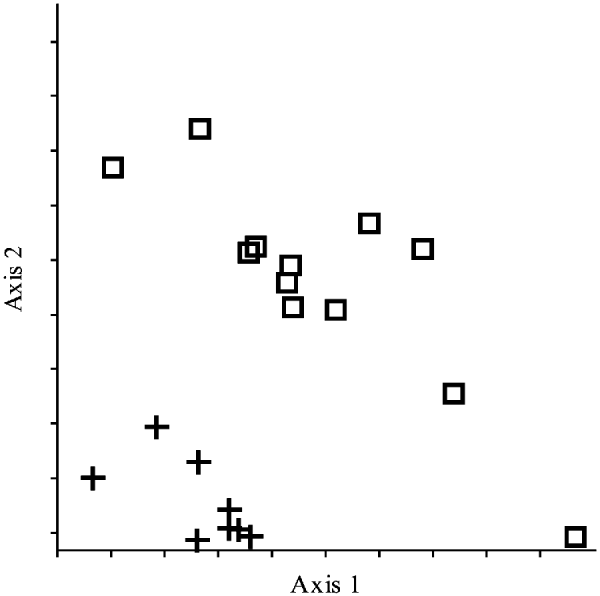
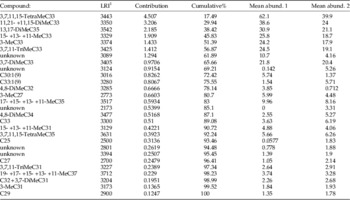
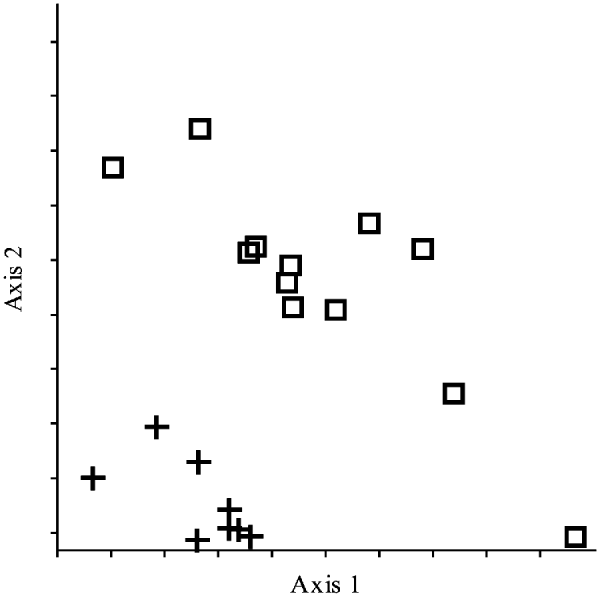
NMDS-analysis of female wasps (fig. 2) showed a clear separation between clusters formed by CHC profiles of wasps reared on S. granarius and S. paniceum in the F1 generation. This result was supported by NPMANOVA analysis, which revealed significant differences between both strains (P<0.05; permutation n=10,000). The compounds with the highest influence on the dissimilarity of profiles were 3,7,11,15-tetramethyltritriacontane, 11,21- +11,15-dimethyltritriacontane, 13,17-dimethylpentatriacontane and the peak belonging to the co-eluting compounds 15- +13- +11-methyltritriacontane (SIMPER analysis; table 4).
Host shift experiment: Non-metric multidimensional scaling (NMDS; Bray-Curtis similarity measure) of the CHC profiles of L. distinguendus females Hosts: □, S. granarius (BerSit; F1); +, S. paniceum (formerly BerSit; reared for one generation on S. paniceum; F1).
Similarity Percentage (SIMPER) analysis of CHC-profiles of L. distinguendus wasps from the host shift experiment (Overall average dissimilarity: 25.76).

1 Linear Retention Index according to van Den Dool & Kratz (Reference van Den Dool and Kratz1963).
Comparison of CHC profiles from hosts and parasitoid
To investigate the possible direct sequestration of CHCs from the host into the parasitoid, we compared the CHC profiles of beetle hosts and the respective parasitoids. These analyses revealed that host CHCs cannot account for the observed major differences of the CHC profiles because the CHC profiles of the wasps are generally composed of compounds with higher molecular masses when compared to larval and adult stages of the respective beetle hosts (for comparative fingerprint chromatograms see figs S1–4 in the supplementary material). The major compound of the parasitoids are almost absent in the hosts. Conversely, several major compounds of the beetle hosts occurred only in traces in the CHC profiles of the wasps or were completely absent. Apart from A. obtectus, CHCs were hardly present in cuticular extracts from larvae.
Discussion
The chemical analysis of CHC profiles of female and male L. distinguendus wasps reared on different beetle hosts revealed significant quantitative differences. These were not only observed between strains from different hosts but also between individuals from the same strain which were reared on the two hosts, S. granarius and S. paniceum. In contrast, the profiles of wasp strains reared on the same host species were similar with the exception of female wasps from the Ravensburg and Pforzheim strain reared on S. paniceum. Furthermore, some of the compounds with major influence on the differences between wasp strains reared on S. granarius or S. paniceum were also found to be important in the host-shift experiment. Thus, the CHC profiles of L. distinguendus are indeed host dependent.
Remarkably, the differences in CHC profiles between wasps from S. granarius and S. paniceum were present already after one generation and did not require several generations to develop. This indicates that the presence and quantity of compounds in the CHC profiles do not depend on strain-related features but are presumably caused by host-dependent precursors in the diet of the wasps. Although direct incorporation of host CHCs can only be demonstrated by labelling experiments (Blomquist & Jackson, Reference Blomquist and Jackson1973), which, to our knowledge, have never been performed in parasitic wasps, this is unlikely in L. distinguendus. Neither larvae nor adults of the four beetle hosts had significant amounts of the parasitoids' major CHCs on their cuticle, and vice versa many major components of the beetle CHCs were absent from the wasps' cuticle or occurred only in traces. This suggests that the host species influences the wasps' own CHC metabolism rather than serving as a direct source for CHC sequestration. The published literature on parasitoid/host CHCs does not provide a clear picture of whether parasitoids are able to sequester significant amounts of host CHCs or not. Some species share major components with their hosts (see for instance Howard & Liang, Reference Howard and Liang1993; Howard & Infante, Reference Howard and Infante1996); whereas, in other studies, host and parasitoid profiles differed clearly (Howard & Perez-Lachaud, Reference Howard and Perez-Lachaud2002). Like in the present study, the qualitative composition of the CHC profile was largely independent from the host in the bethylid wasp Cephalonomia hyalinipennis and the pteromalid wasp Pteromalus cerealellae, whereas the relative quantities of the components differed (Howard, Reference Howard2001; Howard & Perez-Lachaud, Reference Howard and Perez-Lachaud2002). The biosynthesis of CHCs is closely associated with the fatty acid metabolism. For the synthesis of methyl-branched compounds, considerable amounts of valine, leucine, isoleucine, and methionine are also needed (Blomquist, Reference Blomquist, Blomquist and Bagnères2010). These amino acids are among the essential dietary resources for insects, which cannot be biosynthesized de novo by themselves (Behmer, Reference Behmer and Goodman2006). Hence, differing pools of limiting primary nutrients provided by the different hosts might account for the observed differences in the CHC profiles.
Interestingly, the CHC profiles of L. distinguendus wasps reared on A. obtectus and S. granarius overlapped in NMDS analysis, and the CHC profiles of wasps reared on L. serricorne cluster close to this group and are well separated from the CHC profiles of wasps reared on S. paniceum. Thus, the CHC profiles of wasps from these non-related hosts are more similar than the CHC profiles of those reared on L. serricorne and S. paniceum, which belong to the same family. It is most likely that S. granarius, A. obtectus and L. serricorne represent similar food substrates and provide qualitative and quantitative similar precursors for the CHCs of L. distinguendus, despite their phylogenetic differences.
In conclusion, our data demonstrate that the composition of CHC profiles in parasitic wasps depend on the host on which the wasps have developed. Because these differences arise already within one generation on a specific host, the composition of the CHC profiles is most likely determined by host-dependent precursors in the diet of the wasps. Since CHCs are known to play an important role in the recognition of conspecifics and mating partners in these insects (Sullivan, Reference Sullivan2002; Steiner et al., Reference Steiner, Steidler and Ruther2005, Reference Steiner, Herrmann and Ruther2006, Reference Steiner, Mumm and Ruther2007; Ruther, et al., Reference Ruther, Döring and Steiner2011), it is possible that the differences in CHC profiles caused by different hosts represent a reproductive barrier and may finally contribute to the formation of host-races and eventually to new species. This scenario might be more common in parasitic wasps, which could explain the high diversity in this group of insects. Future studies will have to address the question if the observed effects on the cuticular chemistry actually influence the courtship behaviour of L. distinguendus. Furthermore, it will be interesting to study which differences in host chemistry are responsible for the differences in the CHC profiles of L. distinguendus.
Acknowledgements
We are grateful to C. Schmid for technical assistance and J. Stökl for his help with statistical analyses. Two anonymous reviewers gave helpful comments on an earlier draft of the manuscript. This research was funded by the Deutsche Forschungsgemeinschaft (DFG, grant RU-717/8-2.). S.K. was supported by a doctoral scholarship of the Universität Bayern e.V.
Text summary of Supplementary Material
The supplementary material (pdf, 455 KB) consists of four figures showing comparative GC-MS chromatograms of cuticular extracts from female Lariophagus distinguendus wasps and the respective hosts (adult and larval stage).