Introduction
Obsessive–compulsive disorder (OCD) is an often chronic, and potentially debilitating, psychiatric condition characterized by unwanted recurrent and persistent thoughts or feelings (i.e. obsessions) and repetitive behaviors or mental acts that one feels compelled to perform (i.e. compulsions) with various manifestations (American Psychiatric Association, 2013). Studies on error monitoring in OCD have initially been driven by the hypothesis that OCD symptoms may result from dysfunctional brain's error monitoring system, which compares actual to executed response, leading to exaggerated error signals (Pitman, Reference Pitman1987). Consequently, they experience repeated doubts about actions and excessive worries about potential mistakes, by which ritualistic behaviors can alleviate (Cools, Reference Cools, Bateson and Klopfer1985). The phenomenology of OCD can thus be characterized as excessive or hyperactive error monitoring (Hajcak & Simons, Reference Hajcak and Simons2002).
Converging evidence from neuroimaging studies and neurobiological models of OCD indicates the involvement of overactivity in frontostriatal brain regions (Saxena et al. Reference Saxena, Brody, Schwartz and Baxter1998; Aouizerate et al. Reference Aouizerate, Guehl, Cuny, Rougier, Bioulac, Tignol and Burbaud2004; Menzies et al. Reference Menzies, Chamberlain, Laird, Thelen, Sahakian and Bullmore2008). The overactive error processing in patients with OCD, which is typically examined by measuring the event-related potentials (ERPs) evoked by error-related brain activity, provides support for this model (Milad & Rauch, Reference Milad and Rauch2012). The error-related negativity (ERN) (Gehring et al. Reference Gehring, Goss, Coles, Meyer and Donchin1993) is a sharp negative deflection in the response-locked ERP that peaks within 100 ms after an incorrect response; moreover, the ERN can be induced by errors that are committed unconsciously (O'Connell et al. Reference O'Connell, Dockree, Bellgrove, Kelly, Hester, Garavan, Robertson and Foxe2007). The ERN has a frontocentral distribution and is assumed to be generated in the anterior cingulate cortex (ACC) (Debener et al. Reference Debener, Ullsperger, Siegel, Fiehler, Von Cramon and Engel2005; Fitzgerald et al. Reference Fitzgerald, Welsh, Gehring, Abelson, Himle, Liberzon and Taylor2005). Increased error-related brain activity in patients with OCD has been consistently demonstrated using ERPs (Endrass et al. Reference Endrass, Klawohn, Schuster and Kathmann2008; Xiao et al. Reference Xiao, Wang, Zhang, Li, Tang, Wang, Fan and Fromson2011; Melloni et al. Reference Melloni, Urbistondo, Sedeño, Gelormini, Kichic and Ibanez2012) and functional magnetic resonance imaging (Kiehl et al. Reference Kiehl, Liddle and Hopfinger2000).
Despite growing evidence for increased error monitoring in OCD, the specificity of the ERN to OCD has been challenged (Endrass & Ullsperger, Reference Endrass and Ullsperger2014). Enhanced ERN amplitudes have also been found in disorders that are characterized by affective distress and anxiety such as generalized anxiety disorder (Weinberg et al. Reference Weinberg, Olvet and Hajcak2010; Xiao et al. Reference Xiao, Wang, Zhang, Li, Tang, Wang, Fan and Fromson2011), social anxiety disorder (Endrass et al. Reference Endrass, Riesel, Kathmann and Buhlmann2014), and depression (Cavanagh et al. Reference Cavanagh, Bismark, Frank and Allen2011; Tang et al. Reference Tang, Zhang, Simmonite, Li, Zhang, Guo, Li, Fang, Xu and Wang2013; Weinberg et al. Reference Weinberg, Kotov and Proudfit2015). However, studies examining the relationship between the ERN and symptom severity or symptom dimensions in patients with OCD have found little or no correlation. For instance, while a few studies have shown an association between the ERN amplitude and symptom severity (Gehring et al. Reference Gehring, Himle and Nisenson2000; Endrass et al. Reference Endrass, Klawohn, Schuster and Kathmann2008), most studies report that there is no relationship between these factors (Endrass et al. Reference Endrass, Schuermann, Kaufmann, Spielberg, Kniesche and Kathmann2010; Stern et al. Reference Stern, Liu, Gehring, Lister, Yin, Zhang, Fitzgerald, Himle, Abelson and Taylor2010; Riesel et al. Reference Riesel, Endrass, Kaufmann and Kathmann2011; Hanna et al. Reference Hanna, Carrasco, Harbin, Nienhuis, LaRosa, Chen, Fitzgerald and Gehring2012). Additionally, the ERN was shown to be insensitive to symptom changes following psychotherapeutic intervention (Hajcak et al. Reference Hajcak, Franklin, Foa and Simons2008; Riesel et al. Reference Riesel, Endrass, Auerbach and Kathmann2015) or current symptom expression (Riesel et al. Reference Riesel, Kathmann and Endrass2014).
Most correlational studies of the ERN in OCD examined OCD symptoms by using symptom scales; hence, little is known about the relationship between experimental manipulations of error monitoring and OCD symptoms. Although experimental manipulations of the ERN have been performed in healthy individuals (Wiswede et al. Reference Wiswede, Münte, Goschke and Rüsseler2009; Weinberg et al. Reference Weinberg, Riesel and Hajcak2012; Grützmann et al. Reference Grützmann, Endrass, Klawohn and Kathmann2014), the modulatory influences of clinical symptom provocation on the ERN have not been examined previously. Investigating the error signal alterations that are induced by provoking OCD symptoms has the potential to enhance our understanding of the distinct processes involved in the pathogenesis of OCD symptoms.
Therefore, in the present study, we used ERPs to investigate the effects of task-irrelevant OCD-symptom provocation on the ERN in patients with OCD. OCD-symptom provocation was achieved by presenting the participants with highly symptom-relevant pictures that were individually selected from a validated set of images consisting of a variety of OCD themes (Simon et al. Reference Simon, Kischkel, Spielberg and Kathmann2012). We hypothesized that the ERN would be larger in patients with OCD than it would be in healthy control subjects with or without OCD-symptom provocation. In accordance with our previous findings (Roh et al. Reference Roh, Chang and Kim2016), we also hypothesized that patients with OCD would show a more distinct increase in the ERN amplitude after the OCD-symptom provocation than would healthy controls. Furthermore, we investigated the relationship between the ERN and various clinical correlates.
Method
Participants and clinical assessments
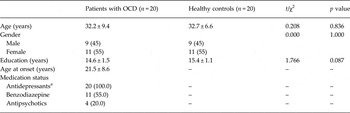
Twenty patients with OCD and 20 healthy control subjects were interviewed by two board-certified psychiatrists; relevant information about the participants was also obtained from accompanying family members, medical records, and psychological reports. Participants were carefully matched in terms of age and gender (Table 1). Patients were recruited from the outpatient unit of a university psychiatric hospital and satisfied the Diagnostic and Statistical Manual of Mental Disorders, Fourth Edition, Text Revision (DSM-IV-TR) (American Psychiatric Association, 2013) criteria for OCD as their primary diagnosis. The inclusion criteria were as follows: (a) men and women aged between 18 and 65 years, (b) subjects who were able to understand and follow the instructions and procedures, and (c) a primary OCD diagnosis according to the DSM-IV-TR criteria for OCD with or without major depressive disorder. The exclusion criteria were as follows: (a) current or previous psychotic disorders or bipolar disorder, including schizophrenia, schizoaffective disorder, delusional disorder, or bipolar I or II disorders, according to the DSM-IV-TR criteria; (b) subjects exhibiting any behavior(s) consistent with alcohol or substance abuse, as defined by the criteria outlined in the DSM-IV-TR; and (c) any history of head trauma or neurological disease. Diagnostic verification was performed by a senior psychiatrist at the rank of full professor through discussions with two psychiatrists in regular research meetings. Healthy controls were recruited through local advertisements and none reported having a family history of OCD or past or present signs of psychiatric disease. Face-to-face diagnostic interviews were performed to check if healthy controls had any functional impairment or major symptom related to anxiety disorders and affective disorders according to DSM-IV criteria. The study protocol was approved by the Institutional Review Board at Severance Mental Health Hospital. All participants provided written informed consent.
Demographic and clinical characteristics of the patients with obsessive–compulsive disorder (OCD) and healthy controls

Values are the mean ± the standard deviation or n (%).
a Antidepressants include clomipramine, fluoxetine, escitalopram, duloxetine, and sertraline.
The psychopathological symptoms of patients with OCD were assessed by a psychiatrist using the Yale-Brown Obsessive-Compulsive Scale (Y-BOCS) (Goodman et al. Reference Goodman, Price, Rasmussen, Mazure, Fleischmann, Hill, Heninger and Charney1989), Hamilton Anxiety Scale (HAM-A) (Hamilton, Reference Hamilton1959), and Hamilton Rating Scale for Depression (HAM-D) (Hamilton, Reference Hamilton1960). Other clinical symptoms of all participants were assessed with self-report questionnaires, including the Obsessive-Compulsive Inventory-Revised (OCI-R) (Foa et al. Reference Foa, Huppert, Leiberg, Langner, Kichic, Hajcak and Salkovskis2002), Dimensional Obsessive-Compulsive Scale (DOCS) (Abramowitz et al. Reference Abramowitz, Deacon, Olatunji, Wheaton, Berman, Losardo, Timpano, McGrath, Riemann and Adams2010), Obsessive-Compulsive Trait Core Dimensions Questionnaire (OC-TCDQ) (Summerfeldt et al. Reference Summerfeldt, Kloosterman, Parker, Antony and Swinson2001), Beck Depression Inventory (BDI) (Beck et al. Reference Beck, Ward and Mendelson1961), and State-Trait Anxiety Inventory (STAI) (Spielberger & Lushene, Reference Spielberger and Lushene1966).
Stimuli and experimental paradigm
The OCD-relevant and neutral stimuli were taken from a previously validated set of pictures (Simon et al. Reference Simon, Kischkel, Spielberg and Kathmann2012). In accordance with majority of previous EEG research, grayscale images were used as stimuli to minimize confounding factors to EEG signals. The use of grayscale images was based on assumption that color information does not play a critical role in recognition of the emotional content (Codispoti et al. Reference Codispoti, De Cesarei and Ferrari2012). The OCD-relevant stimuli included photographs of seven OCD symptom dimensions (e.g. checking, contamination fear & washing). Two hours prior to the experimental session, all patients attended a rating session where they evaluated the OCD symptoms provoked by the OCD-relevant and neutral pictures with Likert scales. Based on the symptom ratings, an individualized stimulus set consisting of the 25 most provoking images in terms of OCD symptoms was selected for each patient with OCD (online Supplementary Table S1); this same set of pictures was also presented to the matched control subject.
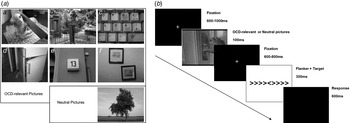
A modified version of an existing flanker task, with task-irrelevant OCD-related and neutral stimuli (Fig. 1), was presented to participants using E-Prime 2.0 software (Psychology Software Tools, Pittsburgh, PA, USA). Participants were instructed to respond with their left or right index finger in accordance with the direction of the target arrow, which was the center arrow in a set of arrows. Half of the trials were congruent (i.e. the target and flanker arrows were pointed in the same direction), whereas the other half were incongruent (i.e. the target and flanker arrows were pointed in opposite directions). Congruency and direction pseudo-randomly varied across trials.
(A) Examples from the stimulus set, including OCD-relevant and neutral pictures. OCD-relevant stimuli were from the following categories: (a) aggressive obsessions, (b) religious obsessions, (c) contamination/washing, (d) checking, (e) counting, and (f) symmetry/ordering. (B) Illustration of the modified flanker task with individually tailored OCD symptom provocation. Participants were instructed to respond to the direction of the target arrow with their left or right index finger as quickly and accurately as possible.

Example stimuli and a depiction of the trial sequence are shown in Fig. 1. Each trial began with the presentation of a fixation point (‘+’) for durations varying from 600 to 1000 ms to decrease eye movements, followed by the appearance of an OCD-relevant or neutral stimulus for 100 ms. Next, after the presentation of another fixation point for durations varying from 600 to 800 ms, the target and flanker arrows were presented for 300 ms, followed by a 600-ms response period. The experiment featured four primary conditions of interest consisting of different combinations of congruent/incongruent target and flanker arrows and OCD-relevant or neutral stimuli. After each block of the 200 trials, participants were allowed a short break, during which feedback about their responses was presented. The feedback was intended to encourage participants to respond more accurately when their error rates during the preceding block were >20%, to respond both quickly and accurately when their error rates ranged from 10% to 20%, and to respond at a faster pace when their error rates were <10%. The four blocks of 200 trials lasted approximately 25 min.
Electroencephalogram (EEG) recording, data reduction, and analysis
EEG signals were recorded with a 64-channel, AgCl-lead pre-cabled cap according to the international 10/10 system. All electrode impedances were <5 kΩ. EEG activity was recorded at a sampling rate of 1000 Hz and filtered with a band pass of 0.015–100 Hz (SynAmpsII; Compumedics, Inc., El Paso, TX, USA). The ground electrode was placed on the forehead. The recordings were referenced to linked electrodes placed on the left and right mastoid processes. Eye blinks and movements were monitored by electrodes placed near the outer canthus and beneath the left eye.
Recording was performed in a dimly lit, quiet, and electrically shielded room. Participants were seated in a comfortable reclining chair, with their eyes at a distance of 50 cm from the computer monitor (visual angle, 9 × 12°); they were instructed to concentrate on the center of the monitor and to avoid blinking as much as possible. Participants’ performance levels were monitored by a closed-circuit camera; participants did not report their sleepiness levels during the experiments.
EEG data were analyzed offline. Salient noise originating from the EEG was removed upon visual inspection. The continuous EEG signals were digitally filtered with a low-pass filter of 40 Hz. To control for eye movement artifacts, trials were adjusted by regression from the electrooculograms (Semlitsch et al. Reference Semlitsch, Anderer, Schuster and Presslich1986). Data were average-referenced offline. Response-locked epochs with durations of 850 ms, including a 200-ms pre-response interval, were extracted. Epochs containing voltages with standard deviations >75 µV between consecutive data points were excluded from further analysis. A pre-response interval from −150 to −50 ms prior to the response served as a baseline for response-locked ERPs. To quantify the response-related negativities, the mean amplitude of the ERN or correct response negativity (CRN) was computed on response trials in a window from 0 to 80 ms following the error or correct response.
Statistical analysis
Chi-squared tests and independent-sample t tests were used to analyze the demographic variables and clinical symptom scores. Behavioral and ERP data were analyzed using repeated-measures analyses of variance (ANOVAs), with group (OCD, control) as the between-subjects factor and electrode (Fz, FCz, Cz), response type (correct, error), stimulus (OCD-related and neutral), and/or congruency (congruent, incongruent) as the within-subjects factors. If the main effects or interactions were significant, then we reported the Bonferroni-corrected p-values for the post hoc comparisons. For all repeated-measures analyses, the p-values were adjusted with the Greenhouse–Geisser procedure. All statistical analyses were conducted using SPSS Statistics version 18 software.
Results
Participant characteristics
Patients with OCD and healthy controls were similar in terms of their age, gender, and years of education (Table 1). As expected, however, the two groups exhibited significantly different clinical symptom scores (online Supplementary Table S2), with patients with OCD showing higher levels of obsessive–compulsive symptoms (OCI-R: 25.2 ± 11.1 v. 9.3 ± 6.0, t = 5.324, p < 0.001), state and trait anxiety, and depression compared with healthy controls. The mean YBOCS scores for OCD patients fell by severe range (25.6 ± 7.7).
Behavioral results of the modified flanker task
Repeated-measures ANOVAs did not reveal any significant main effects or interactions for the response times (online Supplementary Table S3). However, for error rates, participants committed fewer errors during congruent trials than they did during incongruent trials, as indicated by a significant main effect of congruency [F(1,37) = 47.727, p < 0.001]. A Bonferroni post hoc test of the simple main effects indicated that participants’ responses were significantly more accurate during congruent trials than they were during incongruent trials (p < 0.001) for both the OCD-relevant (94.9 ± 5.3% v. 84.3 ± 11.8%) and neutral stimuli (94.6 ± 5.2% v. 84.8 ± 10.7%). In patients with OCD, no significant main effect of stimulus [F(1,18) = 0.054, p = 0.818) or interaction [F(1,18) = 0.193, p = 0.665] by a congruency × stimulus ANOVA revealed no significant differences in error rates depending on stimulus type.
ERP results of the modified flanker task
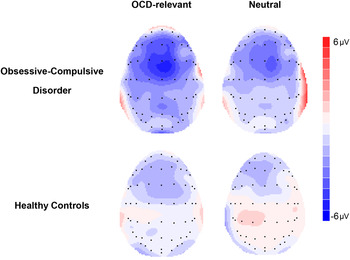
Participants showed more pronounced ERPs with erroneous than with correct responses, as reflected by a significant main effect of response type [F(1,38) = 79.355, p < 0.001]. After finding a significant response type × electrode interaction [F(2,37) = 10.934, p < 0.001), a Bonferroni post hoc test of the simple main effects (p < 0.001) indicated that the ERN amplitudes were maximal at the FCz electrode (−4.17 ± 4.41) compared with at the Cz electrode. This was consistent with past research showing that ERN amplitudes are the highest at frontal–central midline sites (Holroyd & Coles, Reference Holroyd and Coles2002), thus we focused mainly on the ERN data recorded at FCz (Fig. 2).
Scalp topographies representing the error-related negativity (ERN) component in the 30–70 ms window after the commission of error responses. OCD, obsessive-compulsive disorder.

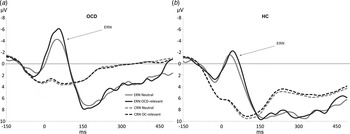
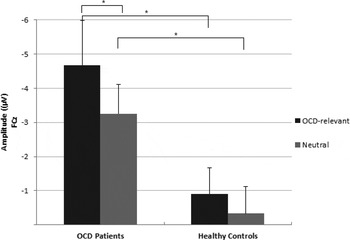
For ERP amplitudes at the FCz electrode, response type × stimulus × group ANOVA showed a significant main effect of stimulus [F(1,38] = 13.655, p = 0.022] and group [F(1,38) = 15.056, p < 0.001] with no significant interactions between response type, stimulus, and group [F(1,38) = 1.812, p = 0.426). Post hoc tests to compare differences between groups revealed that for trials with OCD-relevant stimuli, patients with OCD had significantly larger ERN (p = 0.017) and CRN (p = 0.003) amplitudes than did healthy controls (online Supplementary Table S4 and Fig. 3). Similar results were observed for trials with neutral stimuli, as patients with OCD had significantly larger ERN (p = 0.017) and CRN (p = 0.004) amplitudes than did healthy controls. Further within-subjects comparison, between the trials with OCD-relevant and neutral stimuli, was tested separately for each group. For patients with OCD, there was a significant main effect of stimulus [F(1,19) = 6.306, p = 0.021], and Bonferroni post hoc tests of the simple main effects indicated that the amplitudes for erroneous responses were significantly larger (p = 0.048) during trials with OCD-relevant stimuli (−4.68 ± 5.82) than during trials with neutral stimuli (−3.26 ± 3.84) (Fig; 4). However, the CRN amplitudes during trials with OCD-relevant stimuli were not significantly different from those during trials with neutral stimuli (p = 0.328) in patients with OCD. In contrast, no significant main effect of stimulus was found for healthy controls [F(1,19) = 2.775, p = 0.988), and no difference in the ERN amplitude was noted between the two stimulus conditions (p = 0.439). As for the ERP amplitudes evoked by the OCD-relevant and neutral stimuli, no overall difference was observed between the response types [F(1,38) = 19.852, p = 0.103) and no significant response type × group interaction was found [F(1,42) = 7.024, p = 0.327].
Overall averages of the response-locked event-related potentials (ERN, error-related negativity; CRN, correct response negativity) recorded at FCz for error and correct trials from (A) patients with obsessive–compulsive disorder (OCD) and (B) healthy controls (HC).

Mean amplitudes of the error-related negativities recorded at FCz (*p < 0.05; error bars indicate the standard error). OCD, obsessive–compulsive disorder.

Correlation analysis
No significant correlations were detected between the ERN measurement at FCz and the participants’ clinical features or psychopathological symptom scores for either condition across the two subject groups or in the subgroup analysis. No other correlations among the ERN amplitude difference between the two stimulus conditions and the clinical or psychopathological symptom scores were significant.
Discussion
In the present study, we examined the effects of OCD-symptom provocation on error monitoring in both patients with OCD and healthy controls. In line with previous studies (Santesso et al. Reference Santesso, Segalowitz and Schmidt2006; Endrass et al. Reference Endrass, Klawohn, Schuster and Kathmann2008; Gründler et al. Reference Gründler, Cavanagh, Figueroa, Frank and Allen2009; Riesel et al. Reference Riesel, Kathmann and Endrass2014; Riesel et al. Reference Riesel, Endrass, Auerbach and Kathmann2015), patients with OCD had larger ERN amplitudes than did healthy controls regardless of the stimulus type, reflecting that overactive error monitoring is a characteristic feature of OCD. Overall, the CRN amplitudes were larger in patients with OCD than they were in healthy control subjects. Furthermore, patients with OCD but not healthy controls showed significantly increased ERN amplitudes in the OCD symptom-relevant condition compared with the neutral condition.
Our findings demonstrated that the ERN in OCD could be experimentally manipulated by OCD-symptom provocation. Thus, to our knowledge, the present study is the first to show that the ERN in patients with OCD is directly influenced by OCD-symptom provocation. This finding is important for furthering our understanding of the disorder because it shows that when patients with OCD encounter OCD-symptom-provoking triggers or circumstances, their error signals in the brain becomes exaggerated. Functionally, it is possible that the ERN acts as an automated alarm signal that is induced when an error is encountered (Ridderinkhof et al. Reference Ridderinkhof, Ullsperger, Crone and Nieuwenhuis2004). OCD-symptom-relevant stimuli may signal harm or threat to individuals with OCD, as reflected by the appearance of the ERN. From the point of view that an elevated ERN reflects earlier defensive responses that increase with threat sensitivity (Proudfit et al. Reference Proudfit, Inzlicht and Mennin2013), OCD-related threat might prime OCD patients to make response-locked signals enhanced after error response. Other individually tailored OCD-symptom provocation studies using the same picture set as that used here have repeatedly reported the significant induction of anxiety and discomfort in patients with OCD (Simon et al. Reference Simon, Kaufmann, Kniesche, Kischkel and Kathmann2013; Simon et al. Reference Simon, Adler, Kaufmann and Kathmann2014). More specifically, it has been proposed that anxiety may cause greater uncertainty about an individual's optimal performance, resulting in increased ERN amplitudes (Cavanagh & Shackman, Reference Cavanagh and Shackman2015). Therefore, therapeutic interventions should be aimed at helping patients regulate their emotions when faced with immediate intense feelings of anxiety caused by individually different triggers of OCD.
Although ERN relates to trait-like vulnerabilities, as many trait-like measures (Coan et al. Reference Coan, Allen and McKnight2006), ERN can be altered in short-term modulation. Emerging data suggest that variation in anxiety (anxiety apprehension or anxiety arousal) (Wiswede et al. Reference Wiswede, Münte, Goschke and Rüsseler2009; Vaidyanathan et al. Reference Vaidyanathan, Nelson and Patrick2012; Moser et al. Reference Moser, Moran, Schroder, Donnellan and Yeung2013) or motivation (Hajcak et al. Reference Hajcak, Moser, Yeung and Simons2005; Riesel et al. Reference Riesel, Weinberg, Endrass, Kathmann and Hajcak2012) to make errors can impact ERN. Endrass & colleagues’ (2010) results suggest that no significant increase of ERN in the OCD group during punishment reflected increased compensatory error monitoring, which was already at ceiling during the standard condition. In contrast, we consistently demonstrated enhanced ERN findings in the OCD group with anxiety-provoking conditions, by using either fearful face stimuli (Roh et al. Reference Roh, Chang and Kim2016) or OCD relevant stimuli. Therefore, we would predict that anxiety arousal manipulations should have greater effect on ERN amplitude in OCD than motivation manipulations. However, further studies are needed to elucidate the interaction between variety of anxiety-related constructs or motivations and ERN in anxious individuals, including OCD patients.
Our findings support existing evidence of the critical involvement of the amygdalo-cortical circuitry in the pathophysiology of OCD. Although a predominantly cognitive view of error monitoring including the involvement of corticostriatal circuitry, has received support, researchers (Luck & Kappenman, Reference Luck and Kappenman2011) emphasize that affective and cognitive processes underlying the ERN are not mutually exclusive, but could modulate each other. Other studies support fronto-striato-limbic models of OCD (Simon et al. Reference Simon, Kaufmann, Müsch, Kischkel and Kathmann2010; Diniz et al. Reference Diniz, Miguel, de Oliveira, Reimer, Brandão, de Mathis, Batistuzzo, Costa and Hoexter2012; Milad & Rauch, Reference Milad and Rauch2012), which also critically involve amygdalo-cortical interactions. The amygdala is extensively connected, both anatomically and functionally, to the ACC (Cavada et al. Reference Cavada, Tejedor, Cruz-Rizzolo and Reinoso-Suárez2000; Rodman et al. Reference Rodman, Milad, Deckersbach, Im, Chou and Dougherty2012), which is known to be the neural generator of the ERN. Interestingly, the ACC is responsible for both the attentional control and cognitive processing of emotions (Mohanty et al. Reference Mohanty, Engels, Herrington, Heller, Ringo Ho, Banich, Webb, Warren and Miller2007; Etkin et al. Reference Etkin, Egner and Kalisch2011). Amygdala hyperactivation to individually tailored OCD-relevant stimuli reflecting emotional hyperarousal has been demonstrated previously (Simon et al. Reference Simon, Kaufmann, Müsch, Kischkel and Kathmann2010; Simon et al. Reference Simon, Adler, Kaufmann and Kathmann2014). Thus, the enhanced ERN that was observed here in response to OCD-symptom provocation implies that the ACC may mediate augmentable cognitive processes when patients with OCD are presented with symptom-related triggers.
Consistent with our first hypothesis, we found that the ERN can be manipulated by symptom provocation in patients with OCD, which extends previous findings showing enhanced ERNs in patients during emotional interference with fearful face stimuli (Roh et al. Reference Roh, Chang and Kim2016). While our previous study did not find consistently larger ERN amplitudes in patients with OCD depending on the stimulus condition, the present findings showed larger ERN amplitudes regardless of the stimulus type. Although a direct comparison between the studies is difficult owing to the different task designs, the hyperactive error signals in patients with OCD were more prominent in trials with OCD-relevant stimuli (mean ERN at FCz: −4.68 µV) than they were in trials with face stimuli (mean ERN at FCz: −3.84 µV). Additionally, while the facial stimuli produced controversial results (Britton et al. Reference Britton, Stewart, Killgore, Rosso, Price, Gold, Pine, Wilhelm, Jenike and Rauch2010; Cannistraro et al. Reference Cannistraro, Wright, Wedig, Martis, Shin, Wilhelm and Rauch2004), the OCD-relevant stimuli (Simon et al. Reference Simon, Kaufmann, Müsch, Kischkel and Kathmann2010; Cardoner et al. Reference Cardoner, Harrison, Pujol, Soriano-Mas, Hernández-Ribas, López-Solá, Real, Deus, Ortiz and Alonso2011; Simon et al. Reference Simon, Adler, Kaufmann and Kathmann2014) more consistently involved amygdala hyperactivation in patients with OCD. As the activity of the amygdala increases, more frontolimbic processing is needed. Thus, the increased amygdala engagement in patients with OCD seems to be reflected by the more prominent ERN findings with OCD-relevant stimuli compared with those with face stimuli.
In the present study, no significant correlations were identified between the clinical variables and the ERN amplitude. The ERN amplitudes were not differentiated according to the obsessive–compulsive symptom dimensions measured by the DOCS. Our results provide further evidence that the ERN is both a trait-like signal that is independent of the symptom severity or dimensions and a modulatory process that is sensitive to OCD-symptom provocation.
Our results support that enhanced error signals are prominent features in OCD and that OCD-symptom triggers can affect those neural indices. Although the specificity of the changes in error monitoring identified in patients with OCD remains unclear, our findings provide convincing evidence that overactive error monitoring is reliably associated with OCD and its underlying phenomenology. Recently, ERN effects with task modulation have been shown to vary with individual differences in the clinical diagnosis (Klawohn et al. Reference Klawohn, Endrass, Preuss, Riesel and Kathmann2015; Roh et al. Reference Roh, Chang and Kim2016). Hence, further investigations of the experimental influences, including affective modulation, on error monitoring might be able to differentiate among various clinical groups.
Although no significant change of ERN was observed in OCD patients after successful cognitive behavioral treatment (Hajcak et al. Reference Hajcak, Franklin, Foa and Simons2008; Riesel et al. Reference Riesel, Endrass, Auerbach and Kathmann2015), further treatment follow-up study is needed to test whether the enhanced ERN by individually tailored symptom provocation would not change with effective intervention. Additionally, OCD patients could receive different treatment strategies that may potentially influence ERN. As suggested by Moser & colleagues (2013), proactive control training (Edwards et al. Reference Edwards, Barch and Braver2010) or expressive writing intervention (Ramirez & Beilock, Reference Ramirez and Beilock2011) can result in decrease in ERN amplitude, which might mediate the effectiveness of intervention in terms of symptom reduction.
The present study has some limitations. First, the relatively small sample size might have resulted in a lack of statistical power, thus replication of the findings is needed. Second, the clinical group included individuals on psychotropic medications. Previous studies (de Bruijn et al. Reference de Bruijn, Sabbe, Hulstijn, Ruigt and Verkes2006; Stern et al. Reference Stern, Liu, Gehring, Lister, Yin, Zhang, Fitzgerald, Himle, Abelson and Taylor2010), however, report that the increased ERNs in patients with OCD are unrelated to medication. Furthermore, if medications affect the ERN, our findings might still be meaningful, because many of the prescribed drugs may attenuate the ERN differences between the groups (Riba et al. Reference Riba, Rodríguez-Fornells, Münte and Barbanoj2005; de Bruijn et al. Reference de Bruijn, Sabbe, Hulstijn, Ruigt and Verkes2006; Jocham & Ullsperger, Reference Jocham and Ullsperger2009). Third, although diagnostic verification was double-checked by two board-certified psychiatrists, structured psychiatric assessments were not used. Additionally, the comorbidity of depression might have been problematic. Consequently, the effect of MDD comorbidity on ERN and CRN amplitudes was analyzed, and paired comparisons between patients with (N = 9) and without comorbid MDD (N = 11) via Mann–Whitney U test did not reveal a significant effect on ERN (OCD-relevant condition, Z = 1.254, p = 0.210; neutral condition, Z = 0.874, p = 0.382) and CRN amplitudes (OCD-relevant condition, Z = 0.570, p = 0.603; neutral condition, Z = 0.342, p = 0.766). Finally, although the main cortical generators of the ERN scalp potentials were in the ACC-related region (mainly at FCz), the present study was limited in that we did not perform brain electrical source analysis to localize the activity of the ACC.
Conclusion
In summary, we examined the modulatory effects of individually tailored OCD-symptom provocation on error monitoring in patients with OCD. Patients with OCD showed larger ERN amplitudes than did healthy controls in both stimulus conditions and showed greater ERN amplitudes during trials with OCD-relevant stimuli than during trials with neutral stimuli. This experimental modulation of ERN amplitudes provides convincing evidence that hyperactive error monitoring is associated with OCD and that such monitoring is significantly affected by OCD-symptom triggers. These findings imply that affective modulation of the frontostriatal network is an important part of the neural basis of OCD. Furthermore, therapeutic interventions for patients with OCD should employ emotion regulation strategies aimed at reducing the perceived threatening value of OCD triggers.
Supplementary material
For supplementary material accompanying this paper visit https://doi.org/10.1017/S0033291717000514.
Acknowledgements
This study was supported by a research grant from Yonsei Psychiatry Alumni Association in 2013. The authors thank Suk Kyoon An and Hyun-Sang Cho for help with study planning and execution.
Declaration of Interest
The authors report no biomedical financial interests or potential conflicts of interest.