Latino cultures place a strong emphasis on values that reflect the importance of family, referred to as familism values (Knight et al., Reference Knight, Gonzales, Saenz, Bonds, German, Deardorff and Updegraff2010; Sabogal, Marín, Otero-Sabogal, Marín, & Perez-Stable, Reference Sabogal, Marín, Otero-Sabogal, Marín and Perez-Stable1987), familismo (Calzada, Tamis-LeMonda, & Yoshikawa, Reference Calzada, Tamis-LeMonda and Yoshikawa2012), or familialism (Campos et al., Reference Campos, Schetter, Abdou, Hobel, Glynn and Sandman2008). Familism values encompass beliefs that family is an important source of support and attachment, that one must be loyal to one's family, and that the needs of the family should be placed above one's own needs (Knight et al., Reference Knight, Gonzales, Saenz, Bonds, German, Deardorff and Updegraff2010; Sabogal et al., Reference Sabogal, Marín, Otero-Sabogal, Marín and Perez-Stable1987; Steidel & Contreras, Reference Steidel and Contreras2003). This strong emphasis in Latino cultures on familism values is conceptualized as a key source of resilience for Latino adolescents’ psychosocial adjustment (Gonzales, Germán, & Fabrett, Reference Gonzales, Germán, Fabrett, Chang and Downey2012). Yet, an important limitation in the field is the failure to consider cultural constructs, such as familism values, as developmental processes rather than as static, fixed characteristics of individuals (Causadias, Reference Causadias2013). Studying how cultural processes unfold at both individual and social levels is critical to understanding their role in the development and maintenance of adaptive and maladaptive behaviors (Causadias, Reference Causadias2013).
A small body of longitudinal research has documented the development of familism values from adolescence through early adulthood (Fuligni & Pederson, Reference Fuligni and Pedersen2002; Knight, Mazza, & Carlo, Reference Knight, Mazzo and Carlo2018; Padilla, McHale, Rovine, Updegraff, & Umaña-Taylor, Reference Padilla, McHale, Rovine, Updegraff and Umaña-Taylor2016), as well as the implications of familism values for family functioning and youth adjustment (e.g., Knight et al., Reference Knight, Mazzo and Carlo2018; Padilla et al., Reference Padilla, McHale, Rovine, Updegraff and Umaña-Taylor2016; Zeiders et al., Reference Zeiders, Updegraff, Umaña-Taylor, Wheeler, Perez-Brena and Rodriguez2013). We know little, however, about cultural development among adolescents who experience an atypical life transition during adolescence, such as the early transition to adolescent motherhood. Understanding these developmental patterns among adolescent mothers has important implications both for advancing research on the role of culture in developmental psychopathology (Causadias, Reference Causadias2013) and for informing intervention efforts with at-risk populations. Toward this end, the current study examined trajectories of familism values from middle through late adolescence among Latina females of Mexican origin making an early transition to motherhood. Further, we examined the link between adolescents’ familism values and relationship factors within the family, focusing on warmth, support, and conflict experienced between the adolescent and her mother figure (biological mother or other close female family member). Within Latino cultures, mothers heavily rely upon family members during the transition to parenthood (Campos et al., Reference Campos, Schetter, Abdou, Hobel, Glynn and Sandman2008), and this is particularly true for adolescent mothers whose own mother figures provide needed resources during this time (Contreras, Narang, Ikhlas, & Teichman, Reference Contreras, Narang, Ikhlas, Teichman, Contreras, Kerns and Neal-Barnett2002). Finally, we tested whether familism values were associated with adolescents’ psychosocial adjustment, including depressive symptoms and self-esteem. Our conceptualization of psychosocial functioning includes indicators of both positive adaptation (i.e., self-esteem) and adjustment problems (i.e., depressive symptoms), reflecting that health and well-being is more than the absence of maladjustment, and also includes indicators of positive youth development and functioning (Causadias, Reference Causadias2013).
The Development of Familism Values in the Context of Adolescent Motherhood
Adolescence is an important period for the development of cultural values (Knight et al., Reference Knight, Basilio, Cham, Gonzales, Liu and Umaña-Taylor2014). As a result of significant biological, cognitive, and social changes, adolescents assume more active roles in their cultural development (Bernal, Knight, Garza, Ocampo, & Cota, Reference Bernal, Knight, Garza, Ocampo and Cota1990), they have more autonomy in choosing how and where they spend their time, and they demonstrate more complex processes of cultural adaptation, such as behaviors that involve individual choice and internalization of cultural values (Knight, Jacobsen, Gonzales, Roosa, & Saenz, Reference Knight, Jacobson, Gonzales, Roosa, Saenz, Dalla, Defrain, Johnson and Abbott2009). Adolescence is also a developmental period when the task of identity formation is central (Erikson, Reference Erikson1968), and for ethnic–racial minority youth in the United States, this includes exploring cultural values, practices, and traditions associated with their group membership (Umaña-Taylor, Reference Umaña-Taylor, Balter and Tamis-LeMonda2016). A result of this process of exploration is the “emergence of one's cultural self that is subject to change and continuity over time” (Causadias, Reference Causadias2013, p. 1379).
Evidence from several longitudinal studies suggests that early adolescence to young adulthood is a period of cultural development, including in familism values (Knight et al., Reference Knight, Mazzo and Carlo2018; Padilla et al., Reference Padilla, McHale, Rovine, Updegraff and Umaña-Taylor2016). From early to late adolescence, overall declines are evident in adolescents’ familism values (Knight et al., Reference Knight, Mazzo and Carlo2018; Padilla et al., Reference Padilla, McHale, Rovine, Updegraff and Umaña-Taylor2016). As youth transition through late adolescence and into early adulthood, they stabilize in their familism values (Padilla et al., Reference Padilla, McHale, Rovine, Updegraff and Umaña-Taylor2016) and, possibly, come to endorse stronger familism values in early adulthood (Fuligni & Pederson, Reference Fuligni and Pedersen2002; Padilla et al., Reference Padilla, McHale, Rovine, Updegraff and Umaña-Taylor2016). In line with the principle of equifinality (Cicchetti & Rogosch, Reference Cicchetti and Rogosch1996), developmental changes in familism values may be explained by a wide array of individual, developmental, and contextual factors and their interactions. These may include adolescents’ engagement in more varied settings beyond the family and exposure to distinct (and sometimes competing) values systems, as well as their own efforts to organize and integrate their values into a coherent set of beliefs (Knight et al., Reference Knight, Basilio, Cham, Gonzales, Liu and Umaña-Taylor2014). More specific evidence of equifinality comes from research using a person-oriented approach to document different patterns of change in cultural values (Knight et al., Reference Knight, Basilio, Cham, Gonzales, Liu and Umaña-Taylor2014). In a sample of Mexican-origin adolescents, Knight et al. (Reference Knight, Basilio, Cham, Gonzales, Liu and Umaña-Taylor2014) identified four different groups characterized by their change in traditional cultural values (including familism) and mainstream values. Three of the four groups exhibited linear declines in traditional cultural values, but differed in rates and initial levels of cultural values. Together, this small body of research provides insights about patterns of individual development in familism values and variability in such developmental patterns for community- and school-based samples of nonparenting teens. How such processes unfold for youth making an atypical transition during adolescence is unknown.
A life-course perspective holds that the timing of key transitions in one's life, such as the transition to parenthood, has implications for how development unfolds (Elder, Reference Elder1987; Elder, Caspi, & Burton, Reference Elder, Caspi, Burton, Gunnar and Collins1988). An “off-time” and early transition to parenthood that occurs during adolescence may alter normative processes, such as value development. For Latina adolescents who become mothers, strong familism values may be particularly important as they often rely on their family for support during pregnancy and the early years of parenting (Contreras et al., Reference Contreras, Narang, Ikhlas, Teichman, Contreras, Kerns and Neal-Barnett2002; East & Chien, Reference East and Chien2010). In addition, the process of becoming a parent can foster engagement in one's cultural background, as young mothers begin to think more about their culture and the role it will play in parenting (Hughes et al., Reference Hughes, Rodriguez, Smith, Johnson, Stevenson and Spicer2006). In contrast to evidence of normative declines in individual levels of familism values during adolescence for nonparenting teens (Knight et al., Reference Knight, Mazzo and Carlo2018; Padilla et al., Reference Padilla, McHale, Rovine, Updegraff and Umaña-Taylor2016), an early transition to motherhood may serve to strengthen familism values across adolescence. Drawing on a life-course perspective (Elder et al., Reference Elder, Caspi, Burton, Gunnar and Collins1988) and Causadias's (Reference Causadias2013) call for increased attention to the study of cultural development at the individual level, this study examines the developmental progression of familism values among Latina adolescents making an early transition to motherhood and tests whether the developmental timing of the pregnancy results in different patterns of change.
Familism Values, Family Relationship Dynamics, and Adolescent Adjustment
Among Latina adolescents who experience a teenage pregnancy and an early (and off-time) transition to motherhood, familism values may be an important source of variation and contribute to a broader understanding of the diverse outcomes of adolescents in response to pregnancy (i.e., multifinality; Cicchetti & Rogosch, Reference Cicchetti and Rogosch1996). Furthermore, in this context, adolescents’ endorsement of familism values may set into motion developmental cascades (positive or negative) that have implications for adolescents’ family functioning and individual adaptation and maladaptation, and, ultimately, the health and functioning of their young children (Masten & Cicchetti, Reference Masten and Cicchetti2010). Yet, we know little about the progression of familism values within this context or about how intraindividual change in familism values are associated with other adaptive or maladaptive processes that may have cascading implications for adolescents and their young children's long-term adjustment. The second and third goals of this study address these associations and are theoretically situated within the integrative model for minority children's development (García Coll et al., Reference García Coll, Lamberty, Jenkins, McAdoo, Cronic, Wasik and Vazquez Garcia1996) and White, Nair, and Bradley's (Reference White, Nair and Bradley2018) elaboration of the adaptive culture framework (White, Nair, & Bradley, Reference White, Nair and Bradley2018). Adolescents’ familism values are part of their adaptive culture, specifically “a social system defined by sets of goals, values, and attitudes that differ from the dominant culture” (García Coll et al., Reference García Coll, Lamberty, Jenkins, McAdoo, Cronic, Wasik and Vazquez Garcia1996, p. 1896). The adaptive culture is the result of both culture of origin influences and contextual circumstances and demands; the adaptive culture also has implications for family life, including family interaction patterns, support systems, and routines, and for youth development and adjustment (García Coll et al., Reference García Coll, Lamberty, Jenkins, McAdoo, Cronic, Wasik and Vazquez Garcia1996). White et al. (Reference White, Nair and Bradley2018) expanded on the concept of adaptive culture by introducing the notion of “adapting cultural systems” (p. 3) to reflect the idea that cultural systems are transactional and they evolve via continuous interactions between culture of origin influences (i.e., defined by a group's history and cultural traditions, beliefs, and practices) and current contextual circumstances.
White et al. (Reference White, Nair and Bradley2018) proposes that adapting cultural systems are not universally advantageous to youth, but instead may lead to benefits, costs, or both depending on a complex set of factors, such as the particular developmental outcome or competency under consideration, family structures and roles, individual characteristics, contextual demands, and developmental timing. Applied to the current study, adolescents’ familism values were conceptualized as one important feature of their larger adapting cultural systems that were mutually informed by adolescents’ culture of origin and their current circumstances. Specifically, these adolescents were adapting to the new responsibilities of motherhood while simultaneously navigating the normative developmental tasks of adolescence and living in predominantly economically disadvantaged, multigenerational households. Situated within this framework, Mexican-origin adolescents’ familism values were examined in association to family functioning, indexed by adolescent–mother figure relationship dynamics, and to adolescents’ psychosocial adjustment as reflected in indicators of both positive adaptation and adjustment problems (Causadias, Reference Causadias2013).
Familism values and adolescent–mother figure relationship dynamics
Consistent with the idea that adaptive culture (García Coll et al., Reference García Coll, Lamberty, Jenkins, McAdoo, Cronic, Wasik and Vazquez Garcia1996) and adapting cultural systems (White et al., Reference White, Nair and Bradley2018) have implications for family relationship dynamics, the associations between familism values and multiple indicators of family relationship quality have been a focus of empirical work (for a review, see Stein et al., Reference Stein, Cupito, Mendez, Prandoni, Huq and Westerberg2014). Theoretically, the premise of this work is that Latino cultures place a strong emphasis on close, supportive, and cohesive family relationships, which in turn may promote family relationships that are consistent with these cultural ideals (Campos et al., Reference Campos, Schetter, Abdou, Hobel, Glynn and Sandman2008; Stein et al., Reference Stein, Cupito, Mendez, Prandoni, Huq and Westerberg2014). Understanding the role of familism values in promoting or hindering supportive family relationship dynamics among Latina adolescent mothers is critical given the importance of family support for these young mothers as they navigate an early parenting transition (Contreras, Mangelsdorf, Rhodes, Diener, & Brunson, Reference Contreras, Mangelsdorf, Rhodes, Diener and Brunson1999; Contreras et al., Reference Contreras, Narang, Ikhlas, Teichman, Contreras, Kerns and Neal-Barnett2002; Grau, Azmitia, & Quattlebaum, Reference Grau, Azmitia, Quattlebaum, Villarruel, Carlo, Grau, Azmitia, Cabrera and Chahin2009). Specifically, the majority of adolescent mothers reside with their families of origin (Acs & Koball, Reference Acs and Koball2003) and rely on their own mothers for caregiving assistance, emotional support, financial resources, and parenting advice (Contreras et al., Reference Contreras, Narang, Ikhlas, Teichman, Contreras, Kerns and Neal-Barnett2002). Thus, our focus was on the relation between familism values and multiple aspects of the adolescent–mother figure relationship within this developmental context, including normative relationship dynamics (i.e., warmth and conflict) that typically characterize the parent–adolescent relationship (Steinberg, Reference Steinberg2001), and unique features of this relationship that result from adolescent motherhood, including adolescent–mother figure coparenting (communication and conflict), and social support (emotional, instrumental, and companionship) provided by mother figures to adolescents.
Mother–adolescent relationship quality
Research linking adolescents’ familism values to greater warmth, support, and communication among school-age youth generally provides support for positive associations between familism values and perceptions of family relationship quality (Fuligni, Tseng, & Lam, Reference Fuligni, Tseng and Lam1999; Lorenzo-Blanco, Unger, Baezconde-Garbanati, Ritt-Olsen, & Soto, Reference Lorenzo-Blanco, Unger, Baezconde-Garbanati, Ritt-Olsen and Soto2012). Among a multiethnic sample of adolescents, including Latino youth of Mexican, Central, and South American origin, adolescents’ stronger endorsement of family obligation values was related to their perceptions of high levels of closeness and support and more frequent communication among family members (Fuligni et al., Reference Fuligni, Tseng and Lam1999). In another study, Mexican-origin adolescents’ stronger familism values were associated with emotional closeness among siblings, both concurrently (Updegraff, McHale, Whiteman, Thayer, & Delgado, Reference Updegraff, McHale, Whiteman, Thayer and Delgado2005) and longitudinally (Killoren, Rodríguez de Jesús, Updegraff, & Wheeler, Reference Killoren, Rodríguez de Jesús, Updegraff and Wheeler2017). Further, among Latino high school students (84% Mexican origin), those who endorsed stronger familism values also reported more cohesive and supportive family relationships concurrently (Lorenzo-Blanco et al., Reference Lorenzo-Blanco, Unger, Baezconde-Garbanati, Ritt-Olsen and Soto2012). Looking within the developmental context of adolescent motherhood, East and Chien (Reference East and Chien2010) examined Latina adolescents’ (and their family members’) familism values during adolescents’ third trimester of pregnancy as predictors of family relationship quality from the third trimester of pregnancy through the first year of parenting. Pregnant adolescents’ stronger endorsement of familism values was related to a sharp increase in family cohesion.
Scholars also have hypothesized that stronger familism values are related to more harmony, or less conflict and negativity, in family relationships (Peterson & Bush, Reference Peterson, Bush, Peterson and Bush2013). Supporting this idea, adolescents’ stronger family obligation values were associated with less frequent conflict with fathers (Fuligni et al., Reference Fuligni, Tseng and Lam1999), and familism values were associated with lower levels of negativity among adolescent siblings (Updegraff et al., Reference Updegraff, McHale, Whiteman, Thayer and Delgado2005) and less conflictual relations among family members (Lorenzo et al., Reference Lorenzo-Blanco, Unger, Baezconde-Garbanati, Ritt-Olsen and Soto2012). Further, among Latino high school students (66% Mexican origin), familism was associated with less parent–youth conflict both concurrently (Smokowski & Bacallao, Reference Smokowski and Bacallao2007) and over time (Smokowski, Bacallao, & Buchanan, Reference Smokowski, Bacallao and Buchanan2009). In the only study addressing these relations among Latina adolescent mothers, familism values as rated by the mothers of pregnant Latina adolescents were related to less family conflict during pregnancy (East & Chien, Reference East and Chien2010).
Collectively, this body of research provides consistent support for associations between adolescents’ familism values and their perceptions of more supportive and harmonious (i.e., less conflictual or negative) family relationships within the context of school- and community-based samples of adolescents. Whether such cultural influences are related to similar or distinct family relationship qualities within the context of adolescent motherhood is less clear. As White et al. (Reference White, Nair and Bradley2018) argues, it is important to consider such processes within different contexts and circumstances to understand the conditions under which cultural influences serve to benefit or disadvantage youth. Consistent with the notion of multifinality (Cicchetti & Rogosch, Reference Cicchetti and Rogosch1996), it is possible that strong endorsement of familistic cultural values could be associated with one outcome for nonparenting Latina adolescents and a different outcome for parenting Latina adolescents, given that the contextual demands associated with teenage pregnancy and parenting may modify the process and function of the adolescent–mother figure relationship (White et al., Reference White, Nair and Bradley2018). To our knowledge, only two studies to date have examined familism values and family relationship quality in the context of Latina adolescent motherhood (East & Chien, Reference East and Chien2010; Zeiders, Umaña-Taylor, Jahromi, & Updegraff, Reference Zeiders, Umaña-Taylor, Jahromi and Updegraff2015); thus, we have a limited understanding of whether familism values will be associated with higher warmth and less conflict between adolescents and their mother figures in the transition to and early years of parenthood.
Coparenting
A unique feature of the adolescent–mother figure relationship within the context of adolescent motherhood is their shared role as coparents of the adolescent's young child. Because adolescent mothers look to their own mothers for support and typically live with their families of origin, adolescents are likely to engage in a coparenting relationship (i.e., the shared responsibility of caring for a child) with their own mothers (Pittman & Coley, Reference Pittman, Coley, McHale and Lindahl2011). Coparenting is a multidimensional construct (Feinberg, Reference Feinberg2003), and our particular focus within the context of adolescent motherhood was on adolescents’ communication and conflict with their mothers regarding the coparenting of their young child; we relied on these two dimensions as indices of the quality of the adolescent–mother figure coparenting relationship. Within the context of adolescent motherhood, stronger familism values may be related to more frequent coparenting communication and less coparenting conflict.
Social support
Familism values are conceptualized as particularly important in promoting social support within Latino families. Campos et al. (Reference Campos, Schetter, Abdou, Hobel, Glynn and Sandman2008) argues that familism values “may create a context that makes it easier for members of the culture to perceive, obtain, and benefit from social support from their close relationships, including family relationships” (p. 156). Findings from Campos et al.’s (Reference Campos, Schetter, Abdou, Hobel, Glynn and Sandman2008) study of pregnant women show that the positive associations between prenatal familism values and mothers’ perceptions of social support were significantly stronger for Latina women than for European American women. Links between familism values and social support may be critical in the context of Latina adolescent motherhood as their needs for support may be substantial given their dependence on family and the developmental timing of their pregnancy. This study examined adolescent mothers’ familism values in relation to multiple dimensions of social support, including emotional, instrumental, and companionship, given their importance for teen mothers (Toomey, Umaña-Taylor, Updegraff, & Jahromi, Reference Toomey, Umaña-Taylor, Updegraff and Jahromi2013).
Adolescents’ familism values and psychosocial adjustment
Strong familism values are conceptualized as an important resource within Latino cultures (Gonzales et al., Reference Gonzales, Germán, Fabrett, Chang and Downey2012; Neblett, Rivas-Drake, & Umaña-Taylor, Reference Neblett, Rivas-Drake and Umaña-Taylor2012) that may be promotive or protective. As a promotive factor, familism may serve to enhance positive adaptation and the development of competencies, whereas as a protective effect, familism values may serve to buffer the negative effects of pregnancy or related risk factors on adolescent mothers (Causadias, Reference Causadias2013). The third goal of our study was to examine whether stronger endorsement of familism values within the context of adolescent motherhood was associated with adolescents’ psychosocial adjustment. Recognizing the importance of examining indicators of both positive adaptation and maladjustment (Causadias, Reference Causadias2013; García Coll et al., Reference García Coll, Lamberty, Jenkins, McAdoo, Cronic, Wasik and Vazquez Garcia1996), adolescents’ psychosocial adjustment was measured by depressive symptoms and self-esteem. Adolescence is a developmental period noted for substantial increases in depressive symptoms, particularly among females (Zahn-Waxler, Shirtcliff, & Marceau, Reference Zahn-Waxler, Shirtcliff and Marceau2008; Zeiders et al., Reference Zeiders, Updegraff, Umaña-Taylor, Wheeler, Perez-Brena and Rodriguez2013). Further, adolescent mothers are at higher risk of experiencing depression than adult mothers and nonparenting adolescents (Figueiredo, Bifulco, Pacheco, Costa, & Magarinho, Reference Figueiredo, Bifulco, Pacheco, Costa and Magarinho2006; Lanzi, Bert, & Jacobs, Reference Lanzi, Bert and Jacobs2009; Mollborn & Morningstar, Reference Mollborn and Morningstar2009). One's perceptions of self, including global self-esteem, are central in adolescence as youth form more differentiated ideas about their sense of self in multiple domains (Harter, Reference Harter2012). This study examined whether adolescents’ strong familism values reduced depressive symptoms and enhanced self-esteem during the transition to and early years of adolescent motherhood.
Depressive symptoms
Adolescents’ endorsement of familism values may serve to strengthen family bonds and supports and reduce feelings of depression that are common for adolescent females (Zahn-Waxler et al., Reference Zahn-Waxler, Shirtcliff and Marceau2008; Zeiders et al., Reference Zeiders, Updegraff, Umaña-Taylor, Wheeler, Perez-Brena and Rodriguez2013). This may be particularly true for the younger (relative to older) adolescent mothers who are more likely to be experiencing normative increases in depressive symptoms as a function of the transition through early and middle adolescence (Zeiders et al., Reference Zeiders, Updegraff, Umaña-Taylor, Wheeler, Perez-Brena and Rodriguez2013). To date, evidence suggesting the benefits of strong familism values for reducing youth depressive and internalizing symptoms comes primarily from studies of Mexican-origin youth in community- and school-based settings (Berkel et al., Reference Berkel, Knight, Zeiders, Tein, Roosa, Gonzales and Saenz2010; Burrow-Sanchez, Ortiz-Jensen, Corrales, & Meyers, Reference Burrow-Sanchez, Ortiz-Jensen, Corrales and Meyers2015; Cupito, Stein, Gonzalez, & Supple, Reference Cupito, Stein, Gonzalez and Supple2016; Zeiders et al., Reference Zeiders, Updegraff, Umaña-Taylor, Wheeler, Perez-Brena and Rodriguez2013). In a longitudinal study of Mexican-origin youth from early adolescence to young adulthood, for example, Zeiders et al. (Reference Zeiders, Updegraff, Umaña-Taylor, Wheeler, Perez-Brena and Rodriguez2013) showed that within-person fluctuations in familism values were related to depressive symptoms, such that on occasions when youth reported higher familism values than their own cross-time average, they also reported fewer depressive symptoms.
Findings are mixed, however, as there is also evidence that familism values may be related to higher levels of internalizing symptoms. In a sample composed of Latina adolescents (50% suicide attempters), familism values were associated with higher levels of internalizing symptoms (Kuhlberg, Peña, & Zayas, Reference Kuhlberg, Pena and Zayas2010). In a recent systematic review of the relations between familism values and Latino mental health outcomes (Valdivieso-Mora, Peet, Garnier-Villarreal, Salazar-Villanea, & Johnson, Reference Valdivieso-Mora, Peet, Garnier-Villarreal, Salazar-Villanea and Johnson2016), the authors noted a small effect size for the negative association between familism values and depressive symptoms. Although the largest percentage of studies in this review drew from middle school and high school samples, the average effect size was aggregated across studies of school-/community-based and high-risk samples, adolescents and adults, and Latinos from multiple subgroups (Valdivieso-Mora et al., Reference Valdivieso-Mora, Peet, Garnier-Villarreal, Salazar-Villanea and Johnson2016). Thus, the possibility that familism values may have stronger or weaker associations with Latino adolescents’ depressive symptoms in particular developmental periods and contextual circumstances requires further investigation. Within the context of adolescent motherhood among Mexican-origin adolescents in economically disadvantaged settings, this study explored whether higher familism values were related to lower levels of depressive symptoms.
Self-esteem
Familism values also may be associated with more positive self-esteem among Latina adolescent mothers, particularly for younger adolescent mothers in our sample who are more likely to experience normative declines in self-esteem that characterize early to middle adolescence (Harter, Reference Harter2012; Smokowski, Rose, & Ballacao, Reference Smokowski, Rose and Bacallao2010), as compared to older adolescent mothers in our sample. Again, evidence in support of positive associations comes from samples of nonparenting teens. Among Mexican-origin adolescents in high school, there was a significant positive (concurrent) association between their familism values and self-esteem (Piña-Watson, Ojeda, Castellon, & Dornhecker, Reference Piña-Watson, Ojeda, Castellon and Dornhecker2013). In contrast, Kline, Killoren, and Alfaro (Reference Kline, Killoren and Alfaro2016) found no concurrent associations between familism and self-esteem among Mexican-origin college students, although this same study did find a direct association between familism and depressive symptoms. Using longitudinal data Smokowski et al. (Reference Smokowski, Rose and Bacallao2010) found that higher familism was associated with increases in self-esteem among Latino high school students. Examining a related outcome, positive emotional well-being, Fuligni and Pederson (Reference Fuligni and Pedersen2002) found that stronger family obligation values predicted more positive emotional well-being in an ethnically diverse sample of late adolescents. Although we could find no research linking familism values to adolescent mothers’ self-esteem, it was hypothesized that strong familism values in the context of adolescent motherhood may enhance Latina adolescents’ positive sense of self to the extent that their cultural values align with their new roles as mothers, and this may be particularly true for younger adolescent mothers.
The Present Study
This study examines trajectories of familism values among Latino adolescent mothers of Mexican origin who made an early transition to motherhood (i.e., between 15 and 18 years of age). Latina adolescent females (ages 15–19) have the highest rate of teenage births among all ethnic–racial groups in the United States (Child Trends, 2016). The rate for Latinas (34.9 births per 1,000) is more than twice the rate for non-Latino Whites (16 births per 1,000; Martin, Hamilton, Osterman, Driscoll, & Mathews, Reference Martin, Hamilton, Osterman, Driscoll and Mathews2017). Within the Latino population, Mexican-origin adolescents have the highest adolescent birthrate of all Latino national origin subgroups (Martin et al., Reference Martin, Hamilton, Osterman, Driscoll and Mathews2017). Mexican-origin youth also comprise the majority of US Latino youth (70%; Murphey, Guzman, & Torres, Reference Murphey, Guzman and Torres2014), the largest ethnic/racial group in the United States (US Census Bureau, 2016), making these disparities in teenage births significant for public health in the United States.
Beyond the importance of focusing on a specific ethnic group because of its overrepresentation in a public health concern, teenage mothers are disproportionately likely to come from economically disadvantaged families and communities (Penman-Aguilar, Carter, Snead, & Kourtis, Reference Penman-Aguilar, Carter, Snead and Kourtis2013), and both teen mothers and their young children are, on average, at substantial risk for poor psychosocial, health, and educational outcomes (Borkowski et al., Reference Borkowski, Bisconti, Weed, Willard, Keogh, Whitman, Borkowski, Ramey and Bristol-Power2002; Gibb, Fergusson, Horwood, & Boden, Reference Gibb, Fergusson, Horwood and Boden2014; Hoffman, Reference Hoffman, Hoffman and Maynard2008). Thus, the current study contributes to our understanding about how an important cultural process, familism values, develops within the context of adolescent motherhood and whether these values are related to adolescent mothers’ family relationships and psychosocial adjustment.
The first goal was to examine trajectories of familism values among adolescent mothers from their third trimester of pregnancy to 5 years postpartum, and to test whether the developmental timing of the adolescent pregnancy altered these trajectories. We hypothesized that familism values would increase slightly or remain stable across the transition to adolescent motherhood (Hypothesis 1.1a), rather than exhibiting the typical decline in familism values documented among nonparenting adolescents (Knight et al., Reference Knight, Mazzo and Carlo2018; Padilla et al., Reference Padilla, McHale, Rovine, Updegraff and Umaña-Taylor2016). This may be particularly true for adolescents making an early transition (e.g., 15–16 years of age), as they may be most reliant on family members given the developmental timing of the pregnancy and parenting transition (Hypothesis 1.1b).
Our second and third goals of the study were to examine how interindividual (between-person) and intraindividual (within-person) fluctuations in familism values linked to adolescent–mother figure relationship dynamics and adolescent adjustment. Such modeling is a rigorous test of associations because it controls for stable individual characteristics (Jacobs, Lanza, Osgood, Eccles, & Wigfield, Reference Jacobs, Lanza, Osgood, Eccles and Wigfield2002), while accounting (controlling) for normative developmental changes in family relationship dynamics and individual adjustment (East & Chien, Reference East and Chien2010; Smokowski et al., Reference Smokowski, Rose and Bacallao2010; Zeiders et al., Reference Zeiders, Updegraff, Umaña-Taylor, Wheeler, Perez-Brena and Rodriguez2013). We also accounted for other individual (i.e., adolescent nativity) and contextual factors (i.e., economic hardship) related to family dynamics and psychosocial adjustment (Murphey et al., Reference Murphey, Guzman and Torres2014). Building on prior research largely on nonparenting adolescents, we hypothesized that adolescents’ familism values would be associated with greater warmth (Hypothesis 2.1a), less frequent mother–adolescent conflict (Hypothesis 2.2a), more frequent coparental communication (Hypothesis 2.3a), less coparental conflict (Hypothesis 2.4a), and more social support (Hypothesis 2.5a). As for the links between familism values and adolescents’ psychosocial adjustment, we hypothesized that familism values would be associated with lower levels of depressive symptoms (Hypothesis 3.1a) and higher levels of self-esteem (Hypothesis 3.2a). For each relationship and psychosocial adjustment construct, we also tested whether the developmental timing of the pregnancy moderated these associations, anticipating stronger links between familism values and family relationships among younger (as compared to older) adolescents for whom the family context may be particularly salient for their early transition to parenthood because of its developmental timing (Hypotheses 2.1b through 2.5b). Similarly, for psychosocial outcomes, we hypothesized stronger familism–adjustment links for younger (vs. older) adolescents for whom familism values may counteract normative increases in depressive symptoms (Hypothesis 3.1b and 3.2b; Zeiders et al., Reference Zeiders, Updegraff, Umaña-Taylor, Wheeler, Perez-Brena and Rodriguez2013) and declines in self-esteem (Smokowski et al., Reference Smokowski, Rose and Bacallao2010).
Method
Participants
Data for the current study came from a 6-year longitudinal study of 204 Mexican-origin adolescent mothers that began in 2007 and ended in 2013 (Umaña-Taylor, Updegraff, Jahromi, & Zeiders, Reference Umaña-Taylor, Updegraff, Jahromi and Zeiders2015). At Wave 1 (W1), adolescent participants were unmarried, in their third trimester of pregnancy (M weeks = 30.86, SD = 4.52), and an average of 16.80 years old (SD = 1.00). Adolescents were reinterviewed annually for the next 5 years (Waves 2 through 6; W2–W6). The current study focused on the subset of adolescent mothers having their first child (N = 191), 94% of the larger sample, given the focus on familism values across the transition to adolescent motherhood. Retention rates for this subset of 191 adolescents were 97% at W2, 86% at W3, and 84% at W3 through W6. Attrition analyses comparing participants who participated at all six waves (n = 136) versus those who did not (n = 55) revealed no significant differences in demographic variables at W1 including adolescents’ nativity, χ2 (1) = 0.005, p = .95, adolescents’ age, t (159) = –1.12, p = .27, and adolescents’ perceived economic hardship, t (159) = –0.008, p = .99.Footnote 1
Adolescents in the current analytic sample averaged 16.76 years of age (SD = 0.98; range 15.02 to 18.99). A majority of adolescents were born in the United States (63.4%) and completed the interview in English at each wave (>63%). Among those born in Mexico, the average age of arrival in the United States was 7.74 years (SD = 4.62). At W1, over half of adolescent mothers were enrolled in high school (60.7%), and by W6 their average level of education was 12.11 years (SD = 2.97). Among those who participated at W6, 55.3% had graduated from high school or earned a GED and were not currently pursuing more education, 9.3% were currently enrolled in school, and 35.4% had not earned a high school diploma or GED. The average household income at W1 was $27,951 (SD = $20,186) and remained relatively stable across waves: W2 = $24,014 (SD = $18,572), W3 = $24,870 (SD = $19,142), W4 = $24,844 (SD = $19,601), W5 = $23,349 (SD = $18,324), and W6 = $27,998 (SD = $19,825).
Procedures
Our community-based sample of adolescent mothers was recruited from a US southwestern metropolitan area. The research team delivered study brochures to community agencies, resource centers serving women and children in need, guidance counselors at high schools, and health centers serving pregnant women. Bilingual project staff members were available at the various recruitment sites to answer questions and clarify participation requirements; staff members also attended scheduled community events or meetings for pregnant women (e.g., prenatal health fair) to announce the project and answer questions about eligibility to participate. Potential participants completed a contact information form (N = 321), and project staff were able to contact by phone and assess the eligibility and interest of 305 adolescent mothers. Of those contacted and screened, 260 were eligible (85%), and 207 (80%) agreed to participate. Among the 20% of eligible adolescent mothers who did not participate, 39 declined and 14 could not be reached to schedule the home interview or were not home for multiple interview attempts.
Data were collected via in-home, face-to-face individual interviews at all waves. Interviewers received extensive training (i.e., a minimum of 30 hr) upon joining the project. Interviewers were trained on general topics such as cultural sensitivity, safety protocols while in the field, and global interviewing skills (e.g., uniformity in asking questions and appropriate ways to probe and to clarify questions for participants); training also included appropriately administering consent and assent forms, accurately following skip patterns in the survey, and attention to detail in all data collection protocols. At each new wave of data collection, interviewers were trained on any changes in the protocol.
All measures were translated to Spanish and back-translated to English by two separate individuals, and the final wording of items was determined via a decentering approach with the goal of achieving conceptual equivalence across language versions (see Knight, Roosa, & Umaña-Taylor, Reference Knight, Roosa and Umaña-Taylor2009). In addition, a native Spanish speaker of Mexican origin reviewed the final Spanish version of items to assess cultural validity for Mexican dialect. At W1, parental consent and youth assent were obtained for participants who were younger than 18 years old, and informed consent was obtained for participants who were 18 years and older. Participant incentives were $25 at W1, $30 at W2, $35 at W3, $40 at W4, $50 at W5, and $60 at W6. All study procedures were approved by the university's human subjects review board.
For the current analyses, all measures were reported by adolescent mothers. Specifically, we examine W1–W6 data for familism values, mother–adolescent warmth, mother–adolescent conflict, depressive symptoms, and self-esteem. Only W2 through W6 data were used for support (i.e., emotional, instrumental, and companionship) and coparenting constructs (i.e., coparenting interaction and conflict) because these constructs were not assessed at W1 (when adolescents were pregnant). Hereafter we refer to adolescent mothers as adolescents and their mother figures as mothers for simplicity.
Measures
Familism values (W1–W6)
Adolescents’ familism values were measured with the 16-item familism subscale of the Mexican American Cultural Values Scale developed and validated for Mexican-origin adolescents and parents (Knight et al., Reference Knight, Gonzales, Saenz, Bonds, German, Deardorff and Updegraff2010). Together, the 16 items assessed family support/closeness (e.g., “It is always important to be united as a family”), obligation to family (e.g., “Children should be taught that it is their duty to care for their parents when their parents get old”), and family as referent (e.g., “A person should always think about their family when making important decisions”). All items were rated on a 5-point scale (1 = strongly disagree, 5 = strongly agree) and averaged to create an overall score. Higher scores indicated stronger familism values. Cronbach αs were 0.87, 0.86, 0.85, 0.79, 0.82, and 0.81, for W1 through W6, respectively.
Adolescent–mother relationship quality (W1–W6)
Adolescents reported on the degree of warmth and frequency of conflict in their relationships with their mothers at Waves 1 through 6. Mothers were primarily biological mothers (89.5%), but also could be aunts (2.1%), grandmothers (2.1%), or other close family members (e.g., stepmother, 6.3%). Warmth was measured using the 8-item Children's Report of Parental Behavior Inventory (Schwarz, Barton-Henry, & Pruzinsky, Reference Schwarz, Barton-Henry and Pruzinsky1985), with each item rated on a 5-point scale ranging from 1 (almost never) to 5 (almost always). Higher average scores reflected greater warmth and acceptance. This scale has been shown to be reliable and valid with Latino populations in English and Spanish (Knight, Virdin, & Roosa, Reference Knight, Virdin and Roosa1992). For Waves 1 through 6, respectively, Cronbach αs were 0.88, 0.92, 0.93, 0.94, 0.94, and 0.93.
The frequency of adolescent–mother figure conflict also was assessed at Waves 1 through 6 using a scale adapted from Smetana (Reference Smetana1988) for Mexican Americans (Updegraff, Delgado, & Wheeler, Reference Updegraff, Delgado and Wheeler2009). Specifically, at each wave, adolescents rated the frequency of conflict with their mothers in 16 areas (e.g., talking back or being disrespectful, spending money, and friends) on a 6-point scale (1 = not at all, 6 = several times a day) at separate points in the interview. Items were averaged, with high scores reflecting more frequent conflict. Cronbach αs were 0.83, 0.81, 0.87, 0.86, 0.88, and 0.86, respectively, for Waves 1 through 6.
Coparenting (W2–W6)
Two dimensions of the adolescent–mother coparenting relationship were assessed; communication and conflict. Coparenting communication was adapted from Ahron's (Reference Ahrons1981) 10-item coparenting measure, and included a total of 7 items (Madden-Derdich, Reference Madden-Derdich2002). Adolescents reported on the frequency of communication with their mothers regarding childrearing issues (e.g., “How often do you talk to your mother about major decisions regarding your child's life?”). Items were rated on a 5-point scale (1 = never to 5 = always), with higher scores indicating more frequent coparenting communication. Cronbach αs were 0.91, 0.92, 0.93, 0.92, and 0.91 for Waves 2 through 6, respectively.
Coparenting conflict was assessed with a 4-item conflict subscale of the Quality of Coparental Communication Scale (Ahrons, Reference Ahrons1981). Adolescents rated the frequency of conflict over parenting issues with their mothers (e.g., “When you and your mother discuss parenting issues, how often does it result in an argument?”). Responses ranged from (1) never to (5) always, and higher scores indicated more frequent coparenting conflict. For Waves 1 through 6, Cronbach αs were 0.87, 0.85, 0.86, 0.88, and 0.88, respectively.
Social support from mothers (W2–W6)
Adolescents’ perceptions of social support from their mothers was assessed using the three subscales of the Global Support from Mother Figure Postpartum Scale (Toomey et al., Reference Toomey, Umaña-Taylor, Updegraff and Jahromi2013). Adolescents were instructed to think specifically about support related to their parenting in rating these items. The emotional support subscale included seven items (e.g., “I get the emotional support I need from [my mom/mother figure name]”); four items tapped instrumental support (e.g., “I get good ideas about parenting from [my mom/mother figure name]”); and four items assessed companionship support (e.g., “[My mom/mother figure name] and I get to relax and have fun together”). All items were rated on a 5-point Likert scale, ranging from 1 (not at all) to 5 (very much). Across Waves 2 through 6, respectively, Cronbach αs were 0.95, 0.96, 0.95, 0.95, and 0.94 for emotional support; Cronbach αs were 0.83, 0.91, 0.85, 0.88, and 0.86 for instrumental support; and Cronbach αs were 0.83, 0.86, 0.85, 0.87, and 0.88 for companionship support.
Adolescent depressive symptoms (W1–W6)
The Center for Epidemiological Studies Depression Scale (CES-D; Radloff, Reference Radloff1977) was used to assess adolescents’ affective, cognitive, and behavioral depressive symptoms at Waves 1 through 6. This measure consists of 20 items (e.g., “I had crying spells) scored on a 4-point Likert scale ranging from 0 (rarely or none of the time [less than 1 day]) to 3 (mostly or almost all the time [5–7 days]). A mean score was computed across all items, and higher values indicated greater depressive symptoms. Prior work has provided support for the reliability and validity of the CES-D with samples of adolescent mothers (e.g., Kalil, Spencer, Spieker, & Gilchrist, Reference Kalil, Spencer, Spieker and Gilchrist1998; Mollborn & Morningside, Reference Mollborn and Morningstar2009), and for the Spanish and English versions of the measure with Mexican American samples (Mosicicki, Locke, Rae, & Boyd, Reference Mosicicki, Locke, Rae and Boyd1989). Furthermore, an empirical review noted that the CES-D, which is a commonly used measure to assess depressive symptoms among adolescent mothers, appears to provide a reliable and valid assessment of symptomology among adolescent mothers (Reid & Meadows-Oliver, Reference Reid and Meadows-Oliver2007). For Waves 1 through 6, Cronbach αs were 0.88, 0.89, 0.90, .089, 0.91, and 0.92, respectively.
Adolescent self-esteem (W1–W6)
Adolescents’ self-esteem was assessed using the Rosenberg Self-Esteem Scale (Rosenberg, Reference Rosenberg1979). Participants responded to 10 items (e.g., “I feel that I have a number of good qualities”) using a 4-point Likert scale ranging from 1 (strongly disagree) to 4 (strongly agree). An average score was computed across all items, with higher scores reflecting greater self-esteem. Support for the validity and reliability of the measure has emerged in prior work with Latino adolescents (e.g., Umaña-Taylor, Yazedjian, & Bámaca-Gómez, Reference Umaña-Taylor, Yazedjian and Bámaca-Gómez2004). For Waves 1 through 6, Cronbach αs were 0.78, 0.81, 0.82, 0.85, 0.87, and 0.87, respectively.
Background characteristics and covariates
Adolescents’ nativity was coded as 0 = Mexico born and 1 = US born. Age was calculated from birthdate and interview date at W1, and represents adolescents’ age at pregnancy. Economic hardship was included to measure families’ economic circumstances at W1 through W6 using a measure developed by Barrera, Caples, and Tein (Reference Barrera, Caples and Tein2001). This scale assesses four components of economic hardship. The financial strain subscale consisted of two items and asked adolescents to indicate how often in the next 3 months their family is likely to be without food, housing, and basic necessities. Responses were rated on a 5-point Likert scale from 1 (almost never) to 5 (almost always). The inability to make ends meet (three items) and the not enough money for necessities (four items) subscales assessed the degree to which adolescents and their families have had difficulties making ends meet, and perceptions of their ability to afford necessities, respectively. Responses were rated on a 5-point Likert scale from 1 (strongly disagree) to 5 (strongly agree). The economic adjustments subscale (nine items) asked adolescents to respond to questions about adjustments or cutbacks their family has had to make (e.g., “In the last 3 months, has your family had to change food shopping or eating habits to save money?”). Adolescents responded either no (0) or yes (1). Scoring guidelines from Barrera et al. (Reference Barrera, Caples and Tein2001) were followed, whereby a composite score was created by standardizing each subscale score, weighting them based on the number of items within each subscale, and creating a mean with the scores. Higher scores reflected greater perceived economic hardship. For Waves 1 through 6, Cronbach αs were 0.78, 0.81, 0.82, 0.85, 0.87, and 0.87, respectively.
Analytic plan
To address the first goal, growth curve analyses were conducted via multilevel modeling in Mplus 7.11 (Muthén & Muthén, Reference Muthén and Muthén1998–2010). Growth curves of familism values were based on six waves of data (W1–W6), with wave serving as the metric of time (centered at W1). Differences in familism effects by W1 age were tested by (a) examining an interaction between BP familism and W1 age and (b) examining a cross-level interaction between WP familism and W1 age. For our second and third goals, we conducted similar analyses; however, familism served as the independent variable and adolescent–mother relationship dynamics and adolescent mothers’ psychosocial adjustment served as the dependent variables. Given the changes in family relationship dynamics and psychosocial adjustment during this time, these models included time trend predictors (i.e., linear and quadratic) to examine the effects of familism above and beyond normative developmental patterns. Familism and other Level 1 time-varying predictors (i.e., economic hardship) were centered at each person's mean to represent within-person effects. Level 2 predictors were grand-mean centered (i.e., person-level cross-time mean and sample grand mean) to represent between-person effects. A significant positive within-person effect suggests that on occasions when an adolescent reported higher familism values (relative to her own average level of familism values), she reported a higher level of the dependent variable, accounting for study covariates (i.e., developmental changes, economic hardship, and adolescent nativity). A significant positive between-person effect indicates an average association across the sample; adolescent mothers who report higher levels of familism values (compared to the overall sample mean) also report higher levels of the dependent variable, accounting for covariates. In all models, adolescent nativity at W1 was included as a time-invariant covariate and economic hardship (assessed at all waves) was included as a time-varying covariate. All missing data were accounted for using robust maximum likelihood, an estimation that is robust to nonnormality and nonindependence of observations (Enders, Reference Enders2010, Muthén & Muthén, Reference Muthén and Muthén1998–2010).
Results
Descriptive and preliminary analyses
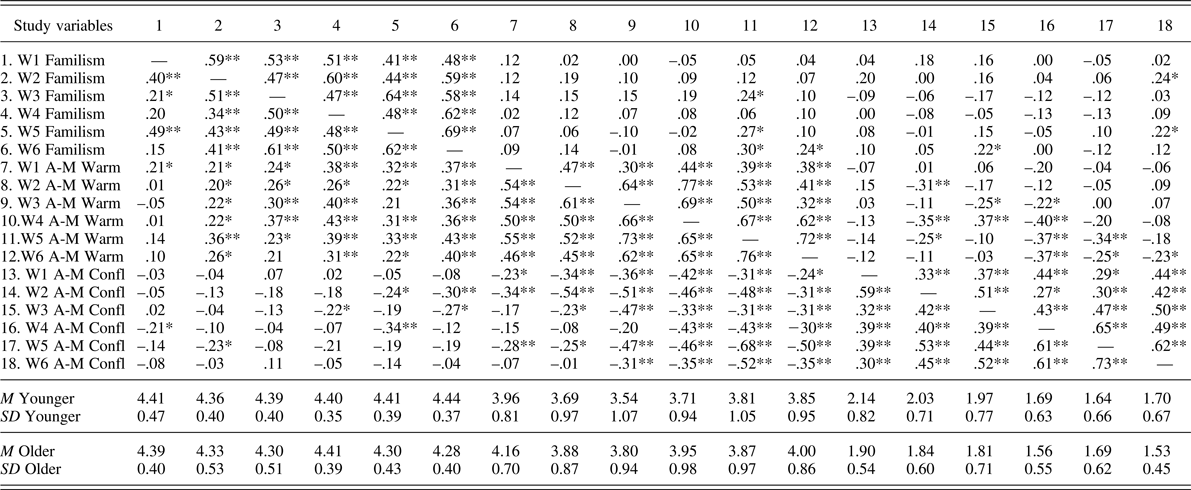
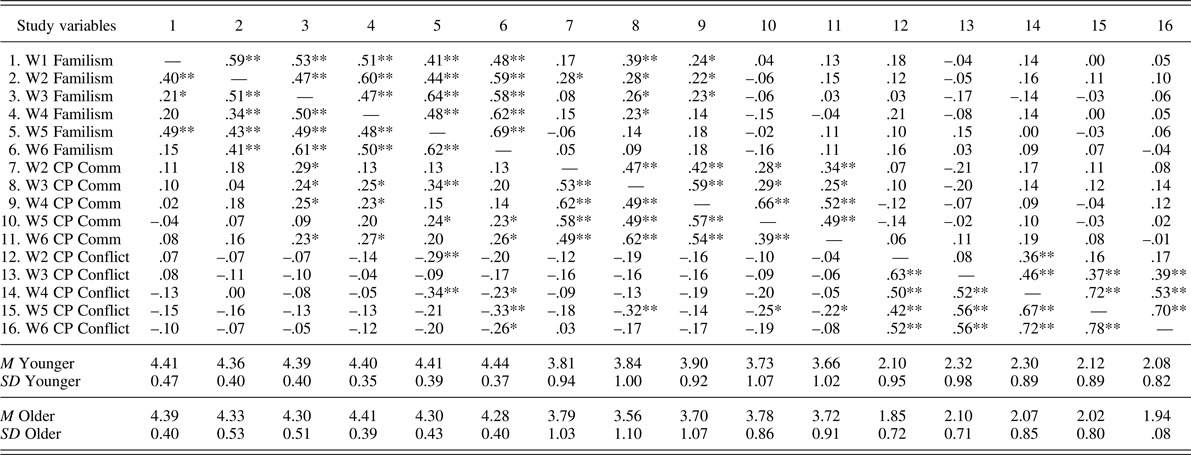
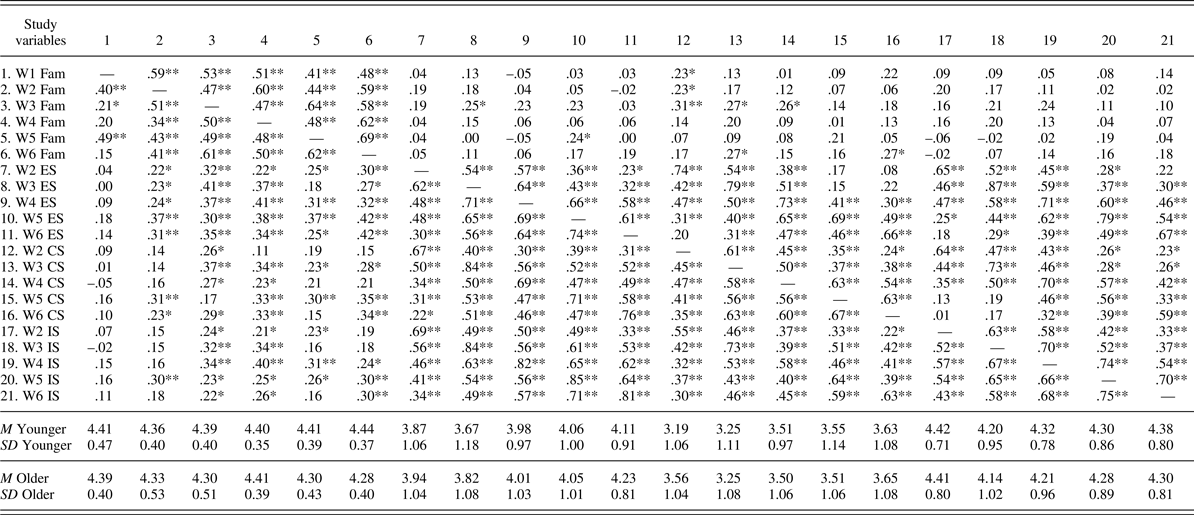
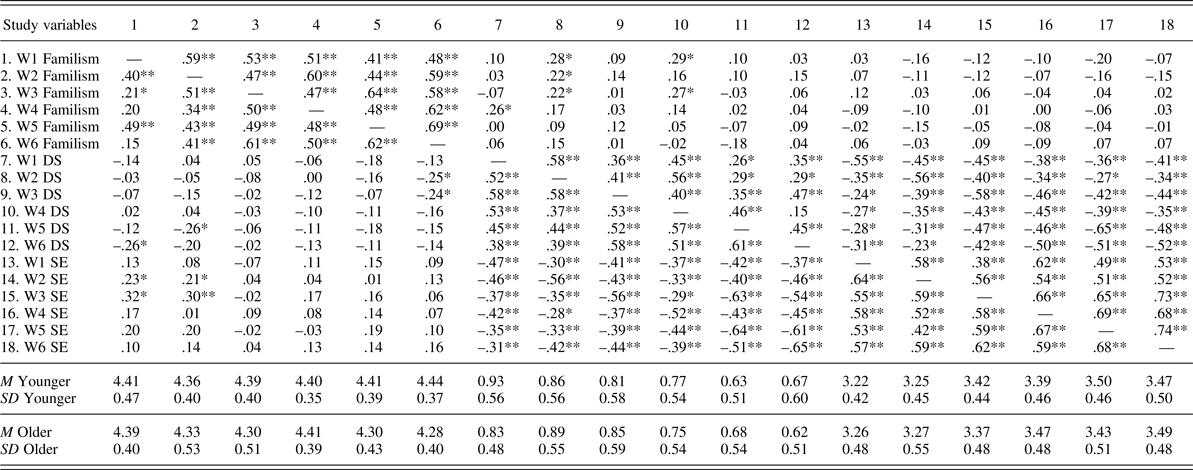
Means, standard deviations, and bivariate correlations are presented in the first four tables, split by adolescents’ age (15–16 vs. 17–18) given our hypotheses about age at pregnancy as a potential moderator. Beginning with Table 1, adolescents reported moderately high levels of familism and adolescent–mother warmth, and low to moderate adolescent–mother conflict across all waves. Further, bivariate correlations were positive for familism and warmth (particularly for younger adolescents), and generally nonsignificant or negative for familism and conflict. As shown in Table 2, adolescents reported moderate to high levels of coparental communication and low to moderate coparental conflict with their mothers. Coparental communication was modestly and positively correlated with familism, again more so for younger than for older adolescents; coparental conflict was negatively correlated with familism, but primarily in the later waves of the study and only for younger adolescents. Turning to social support (Table 3), adolescents reported moderate to high levels of social support from mothers across all waves, and adolescents’ familism was positively correlated with social support, more consistently for younger than for older adolescents. As shown in Table 4, adolescents’ familism was inconsistently and negatively related to depressive symptoms for younger adolescents and positively related to depressive symptoms for older adolescents. In addition, familism and self-esteem were positively correlated for younger adolescents (inconsistently), but unrelated for older adolescents.
Bivariate correlations and means (M) and standard deviations (SD) for older and younger adolescents’ familism and adolescent–mother (A-M) warmth and conflict

Note: Warm, warmth; Confl, conflict. Older adolescents are above the diagonal (n = 84); younger adolescents are below the diagonal (n = 107). W1 – W6, Wave 1 through Wave 6. *p < .05. **p < .01.
Bivariate correlations and means (M) and standard deviations (SD) for older and younger adolescents’ familism and coparenting communication and conflict (N = 191)

Note: Older adolescents (n = 84) above the diagonal; younger adolescents (n = 107) below the diagonal. CP, coparenting; Comm, communication; W1–W6, Wave 1 through Wave 6. *p < .05. **p < .01.
Bivariate correlations and means (M) and standard deviations (SD) for older and younger adolescents’ familism (Fam) and emotional support (ES), companionship support (CS), and instrumental support (IS) from mothers

Note: Older adolescents (n = 84) are above the diagonal; younger adolescents (n = 107) are below the diagonal. W1–W6, Waves 1 through 6. * p < .05. ** p < .01.
Bivariate correlations and means (M) and standard deviations (SD) for older and younger adolescents’ familism and depressive symptoms (DS) and self-esteem (SE)

Note: Older adolescents (n = 84) are above the diagonal; younger adolescents (n = 107) are below the diagonal. W1–W6, Waves 1 through Wave 6. * p < .05. ** p < .01.
Given prior work suggesting potentially different patterns of change in cultural values as a function of adolescent nativity (Updegraff, Umana-Taylor, McHale, Wheeler, & Perez-Brena, Reference Updegraff, Umaña-Taylor, McHale, Wheeler and Perez-Brena2012), we examined whether familism trajectories differed significantly by adolescents’ nativity status as a preliminary step by testing the interaction between nativity and the intercept and between nativity and the slope. No significant differences in the intercept, b = 0.02, SE = 0.06, p = .74, or slope, b = 0.004, SE = 0.01, p = .78, emerged suggesting trajectories of familism values did not differ by adolescent nativity.
Trajectories of adolescent mothers’ familism values
Hypotheses 1.1a and 1.1b
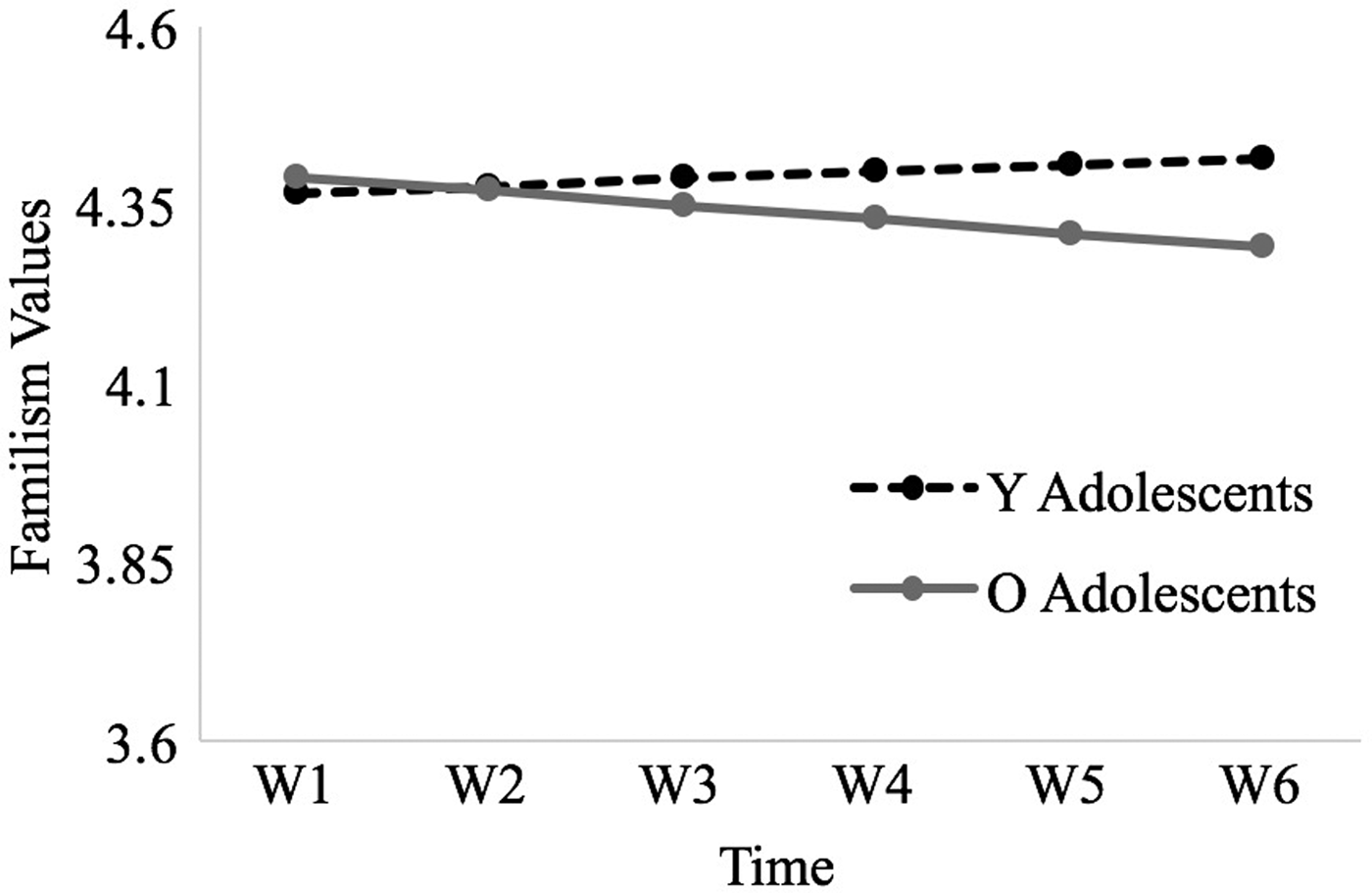
Testing hypothesis 1.1a, the initial growth model suggested no linear change in familism across time, b = –0.005, SE = 0.006, p = .47, but significant variability in the intercept, b = 0.087, SE = 0.01, p < .001, and slope, b = 0.001, SE = 0.001, p = .08.Footnote 2 We then examined whether familism trajectories differed by adolescent age at pregnancy (Hypothesis 1.1b) by adding the cross-level interaction between W1 age and the intercept and W1 age and the slope. No differences emerged on the intercept (W1 familism), b = –0.02, SE = 0.03, p = .41, but there was a significant W1 age by familism slope interaction, b = –0.011, SE = 0.005, p = .04. Probing of the interaction for the purposes of interpretation was conducted using simple slopes analyses and revealed that at 1 SD above age, familism values declined across time, b = –0.02, SE = 0.008, p = .051; whereas at 1 SD below age, familism values did not change, b = 0.007, SE = 0.009, p = .43 (see Figure 1).
Trajectories of adolescents’ familism values cross the transition to motherhood. W1–W6, Wave 1 through Wave 6. Y, younger. O, older.

Familism values, adolescent–mother relationship quality, and adolescent adjustment
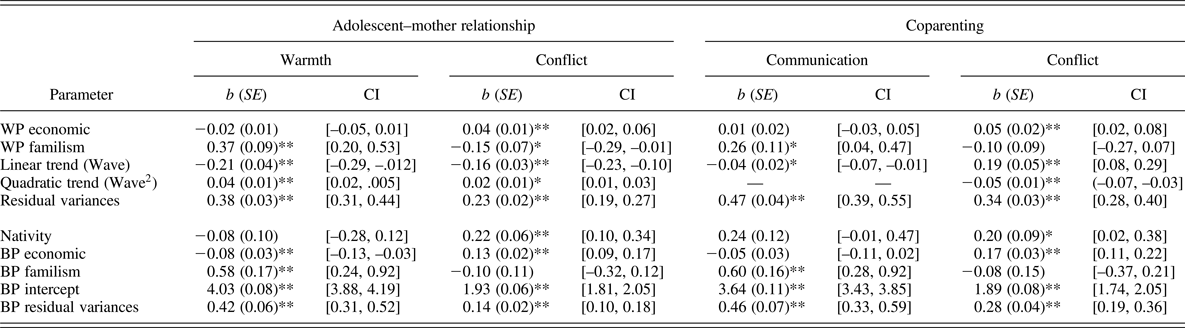
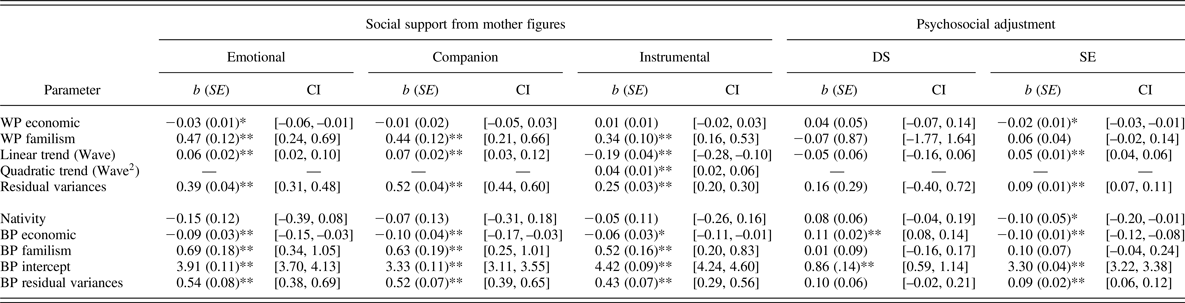
To address our second and third goals, we used multilevel models to examine within- and between-person relations between familism values and adolescent–mother relationship dynamics and adolescent psychosocial adjustment. The findings for adolescent–mother relationship quality (warmth and conflict) and coparenting (communication and conflict) are displayed in Table 5, and the findings for social support and adjustment (depressive symptoms and self-esteem) are shown in Table 6. As a preliminary step, we examined time trends (both linear and quadratic) in each relationship dynamic outcome across the study. If time trends were significant, they were included as covariates in the subsequent analyses.
Multilevel models of familism values predicting adolescent–mother figure relationship dynamics and coparenting (N = 191)

Note: WP, within-person. BP, between-person. Linear, linear growth. Quadratic, quadratic growth. Nativity, adolescents’ nativity coded as 0 = Mexico born and 1 = US born. Economic, Economic hardship. *p < .05, **p < . 01.
Multilevel models of familism values predicting social support from mother figures and adolescents’ psychosocial adjustment (N = 191)

Note: WP, within-person. BP, between-person. Linear, linear growth. Quadratic, quadratic growth. Nativity, adolescents’ nativity coded as 0 = Mexico born and 1 = US born. Economic, economic hardship. DS, depressive symptoms; SE, self-esteem. *p < .05. **p < .01.
Hypotheses 2.1a and 2.1b
Beginning with adolescent–mother warmth, time trend analyses indicated that warmth followed a quadratic pattern of change from W1 to W6. Specifically, warmth initially declined, b = –0.21, SE = 0.04, p < .001, but the decline slowed across time, b = 0.04, SE = 0.01, p < .001. Consistent with Hypothesis 2.1a, there was a significant within-person familism effect; on occasions when adolescents reported higher familism values (compared to their own cross-time average), they also reported higher adolescent–mother warmth, controlling for adolescents’ nativity status and economic hardship. The between-person familism effect was also significant, suggesting that, on average, adolescents who reported more familism also reported higher levels of warmth. Testing of differences by age (Hypothesis 2.1b) revealed a nonsignificant interaction between age and within-person familism, b = 0.05, SE = 0.08, p = .52. Differences did emerge, however, on the between-person familism effect, b = –0.40, SE = 0.20, p = .046. Probing of the interaction revealed that for younger adolescents only (1 SD below the mean of age), familism values were positively related to warmth, b = 1.02, SE = 0.28, p < .001. For older adolescents (1 SD above the mean), familism values, on average, were not related to warmth, b = 0.22, SE = 0.24, p = .35.
Hypotheses 2.2a and 2.2b
For adolescent–mother conflict, initial time trend analyses indicated a quadratic pattern of change across time. Specifically, conflict levels initially declined, b = –0.15, SE = 0.03, p < .001, but the decline slowed across time, b = 0.01, SE = 0.01, p = .04. There was a significant within-person familism effect; on occasions when adolescents reported greater familism values (compared to their own cross-time average), they reported lower levels of conflict (Hypothesis 2.2a). The between-person familism effect was not significant. Analyses examining age differences (Hypothesis 2.2b) revealed no differences on the within-person familism effect, b = –0.07, SE = 0.07, p = .34, but differences in the between-person familism effect, b = 0.28, SE = 0.13, p = .04. Probing of the interaction revealed that for younger adolescents, familism values, on average, were related to lower conflict, b = –0.41, SE = 0.18, p = .02. For older adolescents, familism values, on average, were not related to conflict, b = 0.14, SE = 0.16, p = .37.
Hypotheses 2.3a and 2.3b
For coparenting communication, initial time trend analyses indicated a negative linear slope, b = –0.04, SE = 0.02, p = .05. Consistent with Hypothesis 2.3a, there was a significant within-person familism effect; on occasions when adolescents reported higher levels of familism, they also reported more frequent coparenting communication with their mothers. A significant between-person familism effect also emerged; adolescents who reported greater familism values also reported more coparenting communication. The within- and between-person familism effects did not differ by age group (Hypothesis 2.3b), b = –0.15, SE = 0.11, p = .17, and b = 0.05, SE = 0.18, p = .79, respectively.
Hypotheses 2.4a and 2.4b
For coparenting conflict, initial time trend analyses suggested a quadratic pattern of growth. Specifically, coparenting conflict increased, b = 0.19, SE = 0.05, p < .01, but the increase slowed across time, b = –0.05, SE = 0.01, p < .001. Contrary to the hypotheses, there were no significant within- or between-person familism effects, and age did not moderate the within- or between-person familism effects, b = –0.01, SE = 0.08, p = .95, b = 0.19, SE = 0.20, p = .36, respectively.
Hypotheses 2.5a and 2.5b
For emotional and companionship support, initial time trend analyses suggested a linear increase across time, b = 0.06, SE = 0.02, p =.002, and b = 0.07, SE = 0.02, p < .001, respectively. In contrast, instrumental support demonstrated a quadratic pattern of change. Specifically, instrumental support levels decreased initially, b = –0.19, SE = 0.05, p < .001, but the decrease slowed across time, b = 0.04, SE = 0.01, p < .001. The same pattern of findings emerged for within-person familism effects across all three dimensions of social support (Hypothesis 2.5a). That is, on occasions that adolescent mothers reported greater familism values (as compared to their cross-time average), they also reported greater emotional, companion, and instrumental support. Significant between-person effects also emerged across all three constructs, suggesting that, on average, adolescent mothers who reported greater familism also reported more support. Analyses examining moderation by adolescent age (Hypothesis 2.5b) revealed no differences in the within- and between-person familism effect on emotional support, b = 0.09, SE = 0.11, p = .42, and b = –0.34, SE = 0.20, p = .09, respectively; no differences on companionship support, b = 0.05, SE = 0.11, p = .66, and b = –0.10, SE = 0.24, p = .67, respectively; and no differences on instrumental support, b = 0.02, SE = 0.10, p = .84, and b = –0.04, SE = 0.16, p = .79, respectively.
Hypotheses 3.1a and 3.1b
For depressive symptoms, initial time trend analyses suggested that symptoms followed a linear decline across the study, b = –0.05, SE = 0.01, p < .001. Contrary to Hypothesis 3.1a, the within-person and between-person familism effects were not significant on depressive symptoms. Age differences (Hypothesis 3.1b) did not emerge for within- or between-person familism effects, b = 0.01, SE = 0.05, p = .87; b = 0.11, SE = 0.11, p = .34, respectively.
Hypotheses 3.2a and 3.2b
Turning to self-esteem, initial time trends revealed a linear increase across the study, b = 0.05, SE = 0.01, p < .001. Within- and between-person familism effects were not significant, contrary to Hypothesis 3.2a. Age differences (Hypothesis 3.2b) did not emerge for within- or between-person familism effects, b = –0.01, SE = 0.04, p = .78; b = –0.13, SE = 0.08, p = .11, respectively.
Discussion
The development of Mexican-origin adolescents’ familism values is a significant source of within-group variation that has implications for adolescents’ family dynamics and psychosocial adjustment (Gonzales et al., Reference Gonzales, Germán, Fabrett, Chang and Downey2012; Knight et al., Reference Knight, Mazzo and Carlo2018; Updegraff et al., Reference Updegraff, Umaña-Taylor, McHale, Wheeler and Perez-Brena2012). Addressing Causadias's (Reference Causadias2013) call to examine cultural development at the individual level, we examined trajectories of familism values among Mexican-origin adolescents who were making the transition to motherhood and simultaneously navigating the normative developmental tasks of adolescence. In line with a life-course perspective (Elder, Reference Elder1987; Elder et al., Reference Elder, Caspi, Burton, Gunnar and Collins1988), our findings showed that the developmental timing of the pregnancy had implications for changes in adolescent mothers’ familism values from the third trimester of pregnancy through the first 5 years of motherhood. Further, framed within the integrative model (García Coll et al., Reference García Coll, Lamberty, Jenkins, McAdoo, Cronic, Wasik and Vazquez Garcia1996) and White et al.’s (Reference White, Nair and Bradley2018) concept of adapting cultural systems, the results of this study documented that adolescent mothers’ familism values were consistently associated with mother–adolescent warmth and conflict, coparental communication, and social support provided by mothers. Such findings contribute to our understanding of the resilience of Mexican-origin adolescents and how familism values may be one mechanism that explains differential family functioning among Latina adolescents who experience an early transition to pregnancy (i.e., multifinality; Cicchetti & Rogosch, Reference Cicchetti and Rogosch1996). Our contributions are strengthened by our focus on Mexican-origin adolescent mothers, who face the highest risk of becoming teenage mothers of any Latino subgroup in the United States (Martin et al., Reference Martin, Hamilton, Osterman, Driscoll and Mathews2017). Further, we capitalized on our longitudinal design with six annual assessments to examine within-person associations, controlling for stable individual characteristics. Together, these findings have the potential to advance our understanding of the role of individual cultural development, and the implications for adaptation and maladaptation (Causadias, Reference Causadias2013) in a high-risk population of adolescent mothers.
A life-course perspective holds that the timing of key transitions has the potential to alter how one's development unfolds, and particular attention should be paid to transitions that are off-time, such as an early transition to parenthood (Elder et al., Reference Elder, Caspi, Burton, Gunnar and Collins1988). To our knowledge, this study is the first to examine whether the timing of pregnancy altered trajectories of cultural values among Latina adolescent mothers. Our results revealed significant differences in the slope of familism values for younger versus older adolescents. For younger adolescents the slope of familism values was zero, indicating stable levels across the transition to parenthood and the first 5 years of parenting. For older adolescents, in contrast, the slope was negative and consistent with the typical declines in familism values that have been documented among Mexican-origin youth who are not adolescent parents (Knight et al., Reference Knight, Mazzo and Carlo2018; Padilla et al., Reference Padilla, McHale, Rovine, Updegraff and Umaña-Taylor2016). The earlier timing of the transition to motherhood for younger adolescents may preserve their familism values, as motherhood may facilitate a stronger attachment to the family and greater endorsements of beliefs regarding the family as a source of support. Further, the sociocultural context of these young mothers’ lives (i.e., residence within multigenerational households with limited socioeconomic and educational resources) may be particularly likely to promote the maintenance of strong familism values when an early parenting transition occurs. For older adolescents in our sample, who are close to or have reached the legal age of adulthood in the United States, and who are likely to have greater behavioral autonomy (McElhaney, Allen, Stephenson, & Hare, Reference McElhaney, Allen, Stephenson, Hare, Lerner and Steinberg2009; Steinberg, Reference Steinberg2001), the transition to motherhood may not prevent the typical decline in familism values. Broadly, our findings align with the premise of the life-course perspective (Elder, Reference Elder1987) that it is important to consider whether the developmental timing of key life transitions may alter normative trajectories of development, including one's cultural values, within the broader sociocultural and historical contexts in which these transitions occur.
Our second goal addressed familism values as one aspect of adolescents’ adapting cultural systems (White et al., Reference White, Nair and Bradley2018) that may have implications for family relationship dynamics. White et al. (Reference White, Nair and Bradley2018) proposed that whether adapting cultural systems promote or inhibit family functioning and individual adjustment depends on other key factors, such as the developmental period under consideration, family structure, and contextual factors. Evidence of the benefits of strong familism values for adolescents’ family relationships comes primarily from studies of school-based samples of Mexican-origin youth who are not adolescent parents (Fuligni et al., Reference Fuligni, Tseng and Lam1999; Killoren et al., Reference Killoren, Rodríguez de Jesús, Updegraff and Wheeler2017; Lorenzo-Blanco et al., Reference Lorenzo-Blanco, Unger, Baezconde-Garbanati, Ritt-Olsen and Soto2012). Our second goal extended this prior work to examine whether familism values were related to positive family relationship dynamics (i.e., more warmth, communication, and support; less conflict) within the context of the transition to adolescent motherhood. Our study further recognizes cultural development (at the individual level) as an important mechanism that may promote positive adaptation and/or inhibit the development of maladjustment (Causadias, Reference Causadias2013).
Latina adolescent mothers look to their own mothers as primary sources of support when they make an early transition to parenthood (Contreras et al., Reference Contreras, Narang, Ikhlas, Teichman, Contreras, Kerns and Neal-Barnett2002; Grau et al., Reference Grau, Azmitia, Quattlebaum, Villarruel, Carlo, Grau, Azmitia, Cabrera and Chahin2009), and thus, we focused on this important relationship in this developmental and cultural context. We studied both the normative features of the adolescent–mother relationship (i.e., warmth and conflict) and unique aspects of this relationship that come from their shared coparenting roles (i.e., coparenting communication and conflict) and mothers’ roles as significant providers of social support to their adolescent daughters during the transition to and early years of parenting. With the exception of coparenting conflict, adolescents’ familism values were significantly associated with all dimensions of family functioning examined in this study. Stronger familism values were associated with higher levels of mother–adolescent warmth and lower levels of conflict, more frequent coparenting communication, and greater social support (emotional, instrumental, and companionship). These associations emerged at the within-person level meaning that, on occasions when adolescents reported higher levels of familism than their own cross-time average, they also reported more warmth and less conflict in the mother–adolescent relationship, and more communication and social support relative to their cross-time average. Such findings are notable, given the rigorous nature of within-person analyses: the effects account for (or cannot be explained by) stable individual characteristics. Such findings suggest that adolescents’ familism values may be an important factor associated with a supportive relationship with their own mothers as they navigate adolescence and motherhood at the same time. These findings also are consistent with research on Mexican-origin youth in school- and community-based samples in which familism values were associated with greater warmth and communication in parent–youth and sibling relationships (Killoren et al., Reference Killoren, Rodríguez de Jesús, Updegraff and Wheeler2017; Lorenzo-Blanco et al., Reference Lorenzo-Blanco, Unger, Baezconde-Garbanati, Ritt-Olsen and Soto2012) and less frequent conflict (Smokowski et al., Reference Smokowski, Rose and Bacallao2010).
Stronger associations between familism values and family relationship dynamics for younger (vs. older) adolescents in our sample emerged within the mother–adolescent relationship (i.e., warmth and conflict), but not for coparenting or social support from mothers. These findings suggested that, on average or at the between-person level, the associations between familism values and mother–adolescent relationship quality were evident only for younger adolescents. Within-person associations, in contrast, emerged for all adolescents regardless of the developmental timing of their pregnancy. It is possible that when looking across this period of time from the third trimester of pregnancy through the first 5 years of parenting, adolescents who make a particularly early transition (i.e., prior to the age of 16) may benefit from stronger familism values in terms of the normative aspects of the mother–adolescent relationship. The same overall (average) benefits may not emerge for older adolescents who are farther along in the developmental tasks of adolescence (e.g., autonomy and identity) and perhaps less reliant on their mothers (Steinberg, Reference Steinberg2001). Additional research with adolescent mothers who fall outside the range of 15 to 18 years of age and who come from other backgrounds and circumstances will be important in further examining whether familism values are universally associated with more positive adolescent–mother relationship qualities or whether the benefits or costs vary in particular circumstances (White et al., Reference White, Nair and Bradley2018).
We also examined whether familism values were associated with better psychosocial adjustment (i.e., fewer depressive symptoms and higher levels of self-esteem) in the context of the transition to adolescent motherhood among Mexican-origin adolescents. Contrary to our expectations, there were no within- or between-person associations between adolescent mothers’ familism values and depressive symptoms. Generally, samples drawn from public schools and community settings suggest protective features of familism values for adolescents’ depressive symptoms (Berkel et al., Reference Berkel, Knight, Zeiders, Tein, Roosa, Gonzales and Saenz2010; Burrow-Sanchez et al., Reference Burrow-Sanchez, Ortiz-Jensen, Corrales and Meyers2015; Cupito et al., Reference Cupito, Stein, Gonzalez and Supple2016), including a longitudinal study that also tested within-person associations (Zeiders et al., Reference Zeiders, Updegraff, Umaña-Taylor, Wheeler, Perez-Brena and Rodriguez2013). Among vulnerable Latina adolescents (with 50% of the sample having a prior suicide attempt), however, one study showed that familism values were related to higher rates of internalizing symptoms (Kuhlberg et al., Reference Kuhlberg, Pena and Zayas2010). Further, a systematic review of the links between familism and depressive symptoms revealed a small negative effect size, aggregated across studies of adolescents and young adults and clinical and community-based samples (Valdivieso-Mora et al., Reference Valdivieso-Mora, Peet, Garnier-Villarreal, Salazar-Villanea and Johnson2016). Collectively, this body of research underscores White et al.’s (Reference White, Nair and Bradley2018) proposition that adaptive cultural systems can have different meanings and implications depending on the unique contexts and circumstances of adolescents’ lives. It will be important to begin to identify the conditions (i.e., contextual factors, developmental periods, and circumstances) under which familism values may be associated with greater versus lower risk for depression and internalizing problems.
We also hypothesized, but did not find, a positive association between adolescents’ familism values and self-esteem. This may be less surprising than the findings for depressive symptoms, as there is substantially less research linking familism values and self-esteem. Concurrently, there is evidence of positive associations between familism values and self-esteem among Mexican-origin high school students (Piña-Watson et al., Reference Piña-Watson, Ojeda, Castellon and Dornhecker2013), but not among college students (Kline et al., Reference Kline, Killoren and Alfaro2016). Only one study (to our knowledge) examined how familism values were linked to longitudinal changes in self-esteem among Latino high school students (Smokowski et al., Reference Smokowski, Rose and Bacallao2010), showing familism values predicted positive growth in self-esteem. Our study, in contrast, tested whether intraindividual (within-person) changes in familism values were related to fluctuations in self-esteem. As such, our test of these associations was more stringent than in prior research. Given the field's relatively limited attention to linkages between familism and self-esteem, particularly using designs that account for the developmental nature of both constructs, more research is needed.
The findings addressing our second and third goals align well with the propositions set forth by White et al. (Reference White, Nair and Bradley2018) on adapting cultural systems. That is, adapting cultural systems can provide benefits, costs, or both to youth, and must be studied as they are situated within the particular developmental and cultural contexts of families’ and youth's lives. Within the context of Mexican-origin adolescents making the transition to motherhood, younger adolescent mothers demonstrated stable levels of familism values across the transition to motherhood and the first 5 years as parents, whereas older adolescent mothers demonstrated declines in familism during this developmental period (Knight et al., Reference Knight, Mazzo and Carlo2018; Padilla et al., Reference Padilla, McHale, Rovine, Updegraff and Umaña-Taylor2016). For both groups of adolescent mothers, these familism values were associated with within-person (intraindividual) variation in warmth and conflict within the adolescent–mother relationship, coparenting communication, and social support with their own mothers. In contrast, there were no significant direct associations between familism values and adolescent mothers’ depressive symptoms and self-esteem. Thus, we found that there were some potential advantages of strong familism values for our sample of Mexican-origin adolescent mothers, specifically more positive family relationship dynamics for older and younger adolescents. It was also the case, however, that other hypothesized benefits of familism values did not emerge in the current study. Because it is not possible to determine whether the unsupported hypotheses regarding the associations between familism and depressive symptoms and self-esteem are a result of limited power to detect such effects of a lack of effects in the population (Aczel et al., Reference Aczel, Palfi, Szollosi, Kovacs, Szaszi, Szecsi and Wagenmakersin press), replication with larger samples will be important.
Limitations and future directions
The contributions of our study must be considered with several limitations in mind. Most notable, all measures in the present study were collected from adolescent mothers, and thus represent their perceptions of relationship quality with their mothers, coparenting dynamics, and social support. This introduces the possibility of shared method variance when the same reporter rates both the predictor and the criterion measures. It remains to be determined whether adolescents’ familism values are related to how other family members perceive family dynamics and support within this context. Future research that examines other family members’ perspectives, as well as accounts for the unique and shared experiences of family members (Jager, Bornstein, Putnick, & Hendricks, Reference Jager, Bornstein, Putnick and Hendricks2012), and includes more objective measures, will be an important next step. As recommended by Causadias (Reference Causadias2013), for example, measuring both cultural-related cognitions and observed cultural behaviors will broaden our understanding of how familism values and behaviors are sources of adaptation and maladaptation for Latina adolescent mothers.
The focus of this study was Latina adolescents and their mothers. Other family members including adolescents’ own fathers and the biological fathers of their children are important in the family system. Research on Latino families underscores the important role of fathers in the lives of young children, and shows that family dynamics, like coparenting, are important in promoting fathers’ involvement (Cabrera & Bradley, Reference Cabrera and Bradley2012). Thus, expanding the focus of future research to examine how adolescent mothers’ familism values promote or inhibit adolescent mother–father relationship dynamics is an important next step.
Another future direction will be to identify whether there are indirect associations between familism values and adolescent mothers’ depressive symptoms and self-esteem. Findings of direct benefits of familism values for adolescent mothers’ psychosocial adjustment did not emerge. It may be that, within the context of adolescent motherhood, the benefits of familism values for adolescents’ psychosocial adjustment are mediated by other proximal processes (e.g., Zeiders, Updegraff, Umaña-Taylor, McHale, & Padilla, Reference Zeiders, Updegraff, Umaña-Taylor, McHale and Padilla2016). One possibility is that familism values are predictive of interpersonal supports and stressors within adolescent mothers’ key relationships and, in turn, these supports and stressors predict adolescents’ psychosocial adjustment. As such, familism values may not be directly associated with benefits or costs for adolescents’ psychosocial adjustment, but rather have implications through the interpersonal processes in which these values are manifested in the family context (Zeiders et al., Reference Zeiders, Updegraff, Umaña-Taylor, McHale and Padilla2016).
Finally, our work draws on a specific sample of Mexican-origin adolescent mothers who come from predominantly economically disadvantaged communities and live in multigenerational households. The sample was situated within a southwest metropolitan area in the United States that has a large and well-established Mexican-origin community and is in close proximity to Mexico. Thus, testing the generalizability of this research to other Latino subgroups, social class backgrounds, and geographic locations is necessary. The larger contextual constraints and affordances (e.g., institutional supports for teen mothers and availability of services) may have implications for how adolescent motherhood unfolds within this unique developmental, cultural, and family context.
Conclusion
In the United States, Mexican-origin adolescent females are more likely than any other ethnic–racial group to make an early transition to motherhood (Martin et al., Reference Martin, Hamilton, Osterman, Driscoll and Mathews2017), which has long-term implications for their own and their young children's trajectories of development and adjustment (Borkowski et al., Reference Borkowski, Bisconti, Weed, Willard, Keogh, Whitman, Borkowski, Ramey and Bristol-Power2002; Gibb et al., Reference Gibb, Fergusson, Horwood and Boden2014; Hoffman, Reference Hoffman, Hoffman and Maynard2008). Critical to enhancing scientific knowledge about and improving the lives of these young women are efforts to understand their development as it occurs in the unique contextual circumstances of their lives (García Coll et al., Reference García Coll, Lamberty, Jenkins, McAdoo, Cronic, Wasik and Vazquez Garcia1996; White et al., Reference White, Nair and Bradley2018). Toward this end, the current study contributes to a growing body of literature aimed at examining how cultural development unfolds and has implications for youth's family and individual functioning. Familism values, largely conceived as a cultural resource among nonparenting teens, may come with distinct benefits and costs in the context of the transition to early motherhood. Continued efforts to identify cultural mechanisms and the ways in which they may promote, inhibit, or both promote and inhibit development and functioning within the specific contexts of youth's lives will inform future research and prevention efforts.