1. Introduction
On 31 October 2014, the European Union requested consultations with Russia challenging 12 separate measures regarding Russia's tariff treatment of various agricultural and manufacturing products. The EU claimed in Russia – Tariff Treatment of Certain Agricultural and Manufacturing Products (Russia–Tariff Treatment) that each of the 12 measures were inconsistent with Article II:1(a) and (b) of GATT 1994, the article which spells out that members may not apply duties more than their bound duty rates, or the maximum duty rates that they agreed upon in their schedule of concessions. A Panel was established on 25 March 2015 to consider the EU's complaints, and the Panel Report was circulated to members on 12 August 2016.
Most of the measures challenged by the EU as being inconsistent with Article II were individual tariff lines associated with a variety of products. These 11 tariff lines, which included palm oil, refrigerators, and paper board products, accounted for nearly $880 million of European Union exports to Russia in 2014. Although this is approximately equivalent to the average size of a dispute at the World Trade Organization, the products accounted for less than 1% of total EU exports to Russia.Footnote 1 Press reports regarding the dispute even noted, ‘EU–Russia relations always have a share of mystery about them. And indeed, some WTO dispute settlement case[s] are very odd. In the case that the EU won in 2016 [Russia–Tariff Treatment], some critics questioned Brussels' rationale for litigating for palm oil. The EU does not export the product’.Footnote 2
However, the final measure in the EU's complaint was characterized as a ‘more general measure consisting of systematic duty variations’, or SDVs, and five of the individual tariff lines challenged in the dispute (including palm oil) were examples of this SDV.Footnote 3 The Appellate Body has widely recognized the general possibility to challenge unwritten measures in WTO dispute settlement proceedings, and the EU has been successful in the past at pursuing such cases. As Conconi and Schepel (Reference Conconi and Schepel2017) explain, members can bring claims against measures ‘as such’, regardless of whether and how these measures have been applied in particular cases. For example, in US–Corrosion-Resistant Steel Sunset Review, the Appellate Body explicitly held that ‘[i]n principle, any act or omission attributable to a WTO Member can be a measure of that Member for purposes of dispute settlement proceedings’.Footnote 4 In US – Zeroing, the Appellate Body allowed for claims against unwritten rules as long as that rule had a ‘general and prospective application’.Footnote 5 In these cases, complaining countries must substantiate that the measure exists specifically as they describe it.
There have also been previous cases in which complainants alleged a ‘systematic’ violation of WTO law, including, for instance, Argentina–Textiles and Apparels.Footnote 6 The key question in this case, however, was the extent of the breach of WTO law. In Argentina–Textiles and Apparels, the Panel found (and the Appellate Body confirmed) that if the complainant has shown that a measure is apt to affect a certain category of tariffs, it can be safely assumed that the measure is in all these instances in violation of WTO law. It is then for the defendant to rebut the prima facie case established by the complainant. The European Union successfully litigated another dispute in which the application of an unwritten, systematic measure was at issue in Argentina–Import Measures.Footnote 7 However, in this case there was sufficient other documentary evidence to prove the measure's existence. Although there was also no direct proof, the Panel could establish the features of the measure from a variety of evidence, such as copies of domestic laws, regulations, and policy documents; communications addressed to Argentine officials by private companies; statements by Argentine officials and notes posted on websites of the Argentine Government; articles in newspapers and magazines; statements by company officials; data from industry surveys; and reports prepared by market intelligence entities.Footnote 8 In addition, the Argentine government had refused to make available certain pieces of evidence to the Panel (agreements between the Argentine government and importers), the existence of which was not denied by any party to the dispute.Footnote 9
Russia–Tariffs can be distinguished from Argentina–Textiles and Apparels in that it concerns the preliminary question of the very existence of the challenged measure. The case is also different from Argentina–Import Measures because unlike in that case there was no ‘hard’ evidence that proved the intentions of the Russian government, and the EU had to rely on other means to argue its case. The Panel ultimately ruled that although each of the individual tariff lines challenged by the EU did violate Article II of the GATT, the EU failed to establish the existence of the SDV in their submission. Specifically, the Panel determined that as set forth by the EU, the SDV consisted of three separate elements: ‘(1) the systematic application; (2) of certain types of tariff treatment; (3) to or in respect to a significant number of tariff lines’.Footnote 10 Moreover, the SDV was further defined by the EU as a ‘general practice’. While the Panel ruled that the EU adequately established the existence of ‘certain types of tariff treatment’ applied to a ‘significant number of tariff lines’, it failed to establish that this tariff treatment was applied in a systematic fashion, or that it was a general practice.
As the EU failed to adequately prove that their proposed tariff treatment was systematic in nature, in this paper we first review the Panel's findings and then explore what evidence could have convinced the Panel that such systematic treatment exists. To that end, we draw partially from the experience in other legal orders, particularly in the United States. We also briefly discuss the tension between conflicting objectives that arises from the introduction of ‘systematic non-compliance’ claims, in particular between cost savings through reduced fact finding on the one hand and legal certainty on the other.
Russia–Tariffs raises several other highly interesting questions of law. For example, the report touches upon the question of attribution in cases of members of customs unions (CU), if they are required by the terms of the CU to impose the measure questions. It goes without saying that the case accordingly also relates to other issues that could arise in the context of the application of Article XXIV GATT 1994. However, given our limited focus on the EU's claim of Russia's ‘systematic non-compliance’ with its WTO obligations, such questions are outside the scope of this paper.
2. Dispute overview
In the following section, we explore each of the characteristics of the SDV in turn, particularly the nature of a systematic or general practice, the evidence submitted by the European Union, as well as the Panel's findings on each characteristic.
2.1 ‘Certain types of tariff treatment’
Tariffs typically take one of two forms. An ad valorem tariff is one in which the duties are collected based upon the total value of imports. In other words, collected duties are defined by (p*q) * (x%), where p is the price and q is the quantity of imports. A specific tariff, on the other hand, is one in which the duties are collected based upon the number of units imported, or q*y. As noted by the Appellate Body, ‘for any specific duty, there is an ad valorem equivalent deduced from the ratio of the absolute amount collected to the price of the imported product’.Footnote 11 The ad valorem equivalent (AVE) of y, or the ad valorem rate which would result in the same value of duties collected as the specific rate of y, is y/p. The smaller the price, the larger the ad valorem equivalent of any specific tariff.
Between 2010 and 2014, Russia's applied tariffs were jointly determined by the members of the Eurasian Customs Union (EACU), whose members included Belarus, Kazakhstan, and Russia. In 2015, the Common Customs Tariff (CCT) from this union was incorporated into the Eurasian Economic Union and membership was expanded to include Armenia and Kyrgyzstan. The first six measures challenged by the EU in DS-485 alleged that Russia's applied ad valorem tariffs as set forth in the CCT exceeded the bound ad valorem tariffs as set forth in Russia's schedule of concessions, which was negotiated as part of its accession negotiations to the WTO in 2011. The Panel concurred with the EU on all six measures in a fairly straight forward ruling.Footnote 12
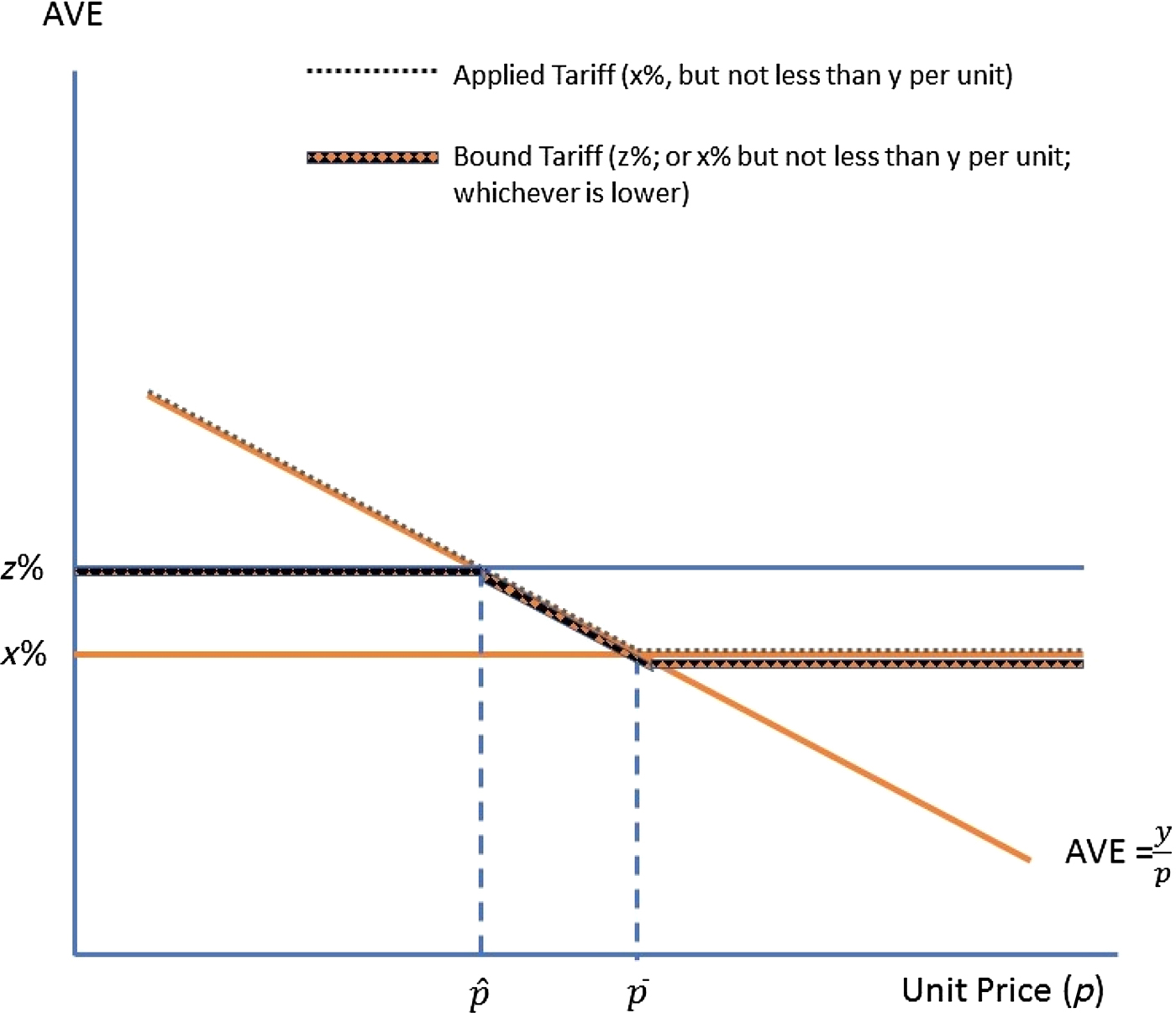
The next five measures, and indeed the ‘certain types of tariff treatment’ defined in the SDV, required more analysis to assess the EU's claims. Throughout the CCT, Russia uses a hybrid of ad valorem and specific tariffs known as either a ‘combined’ or ‘mixed’ duty rate; these combined duty rates essentially include alternative tariff rates. In the case of a combined duty rate of the form ‘x%, but not less than y per unit’, the specific duty rate serves as the minimum rate of duty. As illustrated in Figure 1, the AVE of this minimum rate decreases as the unit price increases, thus the applied tariff would be this minimum rate of duty y when the unit price is below the threshold  $\bar p$, and the ad valorem rate of x% when the unit price exceeds this threshold. The threshold unit price can be calculated as the price in which
 ${y \over {\bar p}} = x\% $, or
 $\bar p = {y \over {x\%}} $.
Combined duty rates

The EU alleged in their submission to the Panel that the combined duties associated with the 7th to 9th measures of the form ‘x%, but not less than y per unit’ as included in the CCT resulted in a violation of Article II of GATT 1994. In each of these measures, the bound duty in Russia's schedule of concessions was essentially x%, thus the EU argued that should the unit price ever fall below  $\bar p$, Russia's applied tariff would exceed its bound tariff rate. The only way to avoid such an inconsistency, according to the EU, would be to include some kind of cap or ceiling mechanism in the combined duty rate itself to prevent situations in which the duties levied would exceed the bound duty rates.
In its defense, Russia argued that the EU was not incorporating the methodology that Russia developed to calculate the AVE of the specific tariffs during its accession negotiations. In its working party report, Russia asserted that it would ensure that the AVE of its specific tariff rates would be no higher than the ad valorem tariff rates in its combined duties. Specifically, each year Russia would determine whether it should raise the applied specific duty rate to ensure that it was no higher than the ad valorem component by calculating the AVE using the average unit prices from a five-year period, excluding data for years with the highest and lowest amount of trade during the period. Russia also argued in their submission to the Panel that the European Union's complaint was essentially about the structure of the applied duties – in other words about the use of a combined duty rate without a cap or ceiling mechanism.
However, the EU argued and the Panel concurred that while the procedure described above might ensure that on average the AVE of the specific tariff does not exceed the ad valorem tariff in the applied combination tariff, it was not designed to ensure that the combined tariff rate does not exceed Russia's bound tariff rate. The Panel specifically stated that Article II(b) ‘prohibits duties imposed in excess of a bound duty, even if these duties are balanced or offset (at the same time or later) by duties imposed on identical products that are below the bound duty’.Footnote 13
The Panel also confirmed that according to the Appellate Body, applying a duty type different from the duty type in the member's schedule of concessions is not inconsistent with Article II:1(b).Footnote 14 Moreover, the Panel emphasized that the EU was not challenging the lack of a ceiling mechanism, rejecting Russia's view that the challenge was about the structure of the duty. The Panel agreed with the EU's analysis, and ruled that the 7th to 9th measures were inconsistent with Article II:1(b).
In the 10th and 11th measures challenged by the EU, Russia's applied tariff also took the form of ‘x%, but not less than y per unit’, however Russia's bound tariff took the form of ‘z%; or x% but not less than y per unit; whichever is the lower’. This combined duty is also illustrated in Figure 1. In this example, when the unit price falls below  $\hat p$, the bound duty would be z%, which is a lower ad valorem rate than either x%or the AVE of y. Between the price of
 $\hat p$ and
 $\bar p$, the bound duty would be y per unit, which is lower than z% but higher than x%; above the price of
 $\bar p$ the bound would be x%. The value of
 $\hat p$ can also be determined as the unit price at which
 $z\% = \displaystyle{y \over {\hat p}},\; {\rm or}\; \hat p = \displaystyle{y \over {z\%}} $.
The EU claimed, and the Panel concurred, that while the applied and bound rates of the 10th and 11th measures were equivalent to one another above the price of  $\hat p$, below the price of
 $\hat p$ the applied rate of y per unit exceeded the bound rate of
 $z\% $.
In evaluating whether the SDV could be defined as a ‘certain type of tariff treatment’, the Panel defined two types. The first included measures in which the applied tariff took the form of ‘x%, but not less than y per unit’ and the bound tariff was an ad valorem tariff, as in measures 7 to 9. Note that the Panel ruled in this first ‘type’ that the bound ad valorem rate could be either equal to or more than  $x\% $. The second included measures in which the applied tariff took the form of ‘x%, but not less than y per unit’, but the bound rate took the form ‘z%; or x%, but not less than y per unit; whichever is lower’, where the value of z% was higher than x%, as in measures 10 and 11.
2.2 Significant number of tariff lines?
As noted above, the European Union stated in their Panel submission that the SDV impacted a ‘significant number of tariff lines’. The Panel interpreted the EU's use of this word to indicate that the number of lines effected was quantitatively important, but that the ‘significant number of tariff lines’ did not mean all, or nearly all, tariff lines, but merely a large, substantial, or considerable number of tariff lines.Footnote 15
The European Union submitted an illustrative list of 39 tariff lines that met the definition of the certain type of tariff treatment as evidence of the existence of the SDV. These tariff lines, which included the three lines specifically included as the 7th through 9th measures in the petition, were from five chapters of the Harmonized System. Thus, including the 10th and 11th measures, the Panel confirmed that there were at least 41 tariff lines that could be considered as part of the SDV.
The European Union submitted into evidence Decision No. 52 (Exhibit EU-6) and Decision No. 103 (Exhibit EU-8), which established the applied duty rates set by Russia relating to its claims concerning the 7th to 9th measures at issue.Footnote 16 These legal documents also established the applied tariff rates for 21 of the other tariff lines included in the illustrative list. Because the European Union did not provide the relevant excerpts from the CCT that would demonstrate the existence of the other applied duty rates alleged in the illustrative list, the Panel could only rule on the evidence establishing the existence of 23 lines (21 from the illustrative list and measures 10 and 11) that met the ‘certain type of tariff treatment’ criteria.Footnote 17
Although the Panel noted that the 23 tariff lines was not a significant proportion of the total number of tariff lines in the CCT, it could be considered a significant number of tariff lines when compared to the five tariff lines specifically considered by the Panel.
2.3 Systematic application
According to the Panel, the key criterion to ascertain whether a certain type of tariff treatment is ‘systematically applied’ is to reveal a system, plan, or organized method or effort that connects the individual instances of application of particular types of tariff treatment.
Interestingly, to give meaning to the term ‘systematically applied’ the Panel turned to the wording of the EU's written submission. In other words, to develop a standard of how to assess whether there is systematic application of the alleged treatment, the Panel considered that the wording of the EU's submission is a useful and permissible source of information. On this basis, the Panel first found that ‘the systematic nature of the measure's application consists in something other than the mere fact that it applies to or affects a significant number of tariff lines’.Footnote 18 Given that the EU itself did not suggest a definition of the term, the Panel continued thereafter with the term's textual meaning. Based on the relevant dictionary definitions, the Panel found that the term can be used to describe ‘violations that are the consequence of a system, plan, or organized method’.Footnote 19
The Panel turned next to a statement of the Appellate Body in Argentina–Import Measures. In this report, the AB contrasted the ‘sporadic’ to the ‘systematic’ application of a measure. In view of the AB, the ‘systematic’ nature of the measure at issue was evidenced in the fact that it ‘applied to economic operators in a broad variety of different sectors as part of an organized effort, coordinated and implemented at the highest levels of government, and aimed at achieving import substitution and reduction of trade deficit within the framework of the “managed trade” policy’.Footnote 20 From this statement, the Panel extracted that ‘systematic application’ refers ‘to a situation where individual applications in a broad variety of different economic sectors are connected (“related”) to one another inasmuch as they are all the result of an “organized effort” undertaken in support of a particular “aim”’.Footnote 21
It is unclear whether the mentioned aspects should indeed be the criteria for assessing whether a measure is systematic, at least in the case at hand. First, it is unclear why economic operators in a broad variety of different sectors should be affected. One could argue that precisely targeting a few specific sectors is characteristic of a systematic measure. Second, there is no reason to assume that an organized effort is a precondition. As even the Panel admits in a later part of the report that no inquiry into the subjective intentions of the parties involved is required. However, if there is no need to ascertain the objective pursued with the measure, how can one say that there is any organization or effort? In sum, the AB's statement in Argentina–Import Measures was arguably useful for the Argentina case but bears little relevance for the case the Panel had to decide.
Finally, the Panel addressed the question of whether ‘systematic application’ of a measure requires a certain frequency of application. The Panel found that this was not necessarily the case even though it added that in some cases observed repetition can be a clear indication for a systematic activity.Footnote 22 The Panel seemed open to the submission of evidence in the form of statistical analysis of the pattern of violations, noting that it is theoretically possible to ‘infer the existence of a system where the observed repetition is so substantial as to render it more likely than not’ that an underlying system exists. In other words, the repetition itself could be submitted as evidence from which the existence of a system could be inferred.Footnote 23
Against this background the Panel assessed whether the European Union had adduced sufficient evidence to establish a prima facie case. The Panel found that the EU had failed to do so. The key evidence relied upon by the European Union to prove the systematicity of the SDV consisted of several tariff lines included in the Illustrative List.Footnote 24 The evidential test the Panel applied was to ask ‘whether the tariff lines submitted as evidence are so numerous as to make it more likely than not that an underlying system exists’.Footnote 25 To this end, the Panel deemed it necessary to ‘to compare the frequency with which the relevant types of tariff treatment have been accorded in the present dispute with the total number of tariff lines in respect of which the relevant type of tariff treatment could potentially have been applied (that is, the universe of all possibly affected tariff lines). If the difference were small, then it might be justified to infer that the relevant types of tariff treatment have been applied systematically’.Footnote 26
The Panel considered the following as possible ‘universes of affected tariff lines’ against which the 23 tariff lines submitted by the EU should be compared:
• all tariff lines contained in the CCT;Footnote 27 or
• the total number of tariff lines contained in the CCT for which the bound duty rate is expressed in either ad valorem or the relevant combined duty form.Footnote 28
Eventually, the Panel found that it did not have to decide which would be the appropriate comparator because the EU had not provided the relevant information for any of these two possibilities.Footnote 29 Thus, the Panel decided based solely on the allocation of the burden of proof.
Despite this finding the Panel continued its analysis and distinguished the case at hand from the AB's approach in Argentina–Textiles and Apparel, in which the AB had found an inconsistency with respect to all relevant tariff categories, even though the complaining party had only submitted evidence relating to 118, or at most 124, out of approximately 940 relevant tariff lines.Footnote 30 The Panel rejected the EU's reliance on this case because the referenced passage concerned the consistency with the covered agreements and not the question of whether the measure existed in the first place. By contrast to the case at hand, the measures in the report were ‘described in a set of distinct documents’ and accordingly there was no uncertainty as to the measure's existence. In addition, in the Argentina case the AB found the measure to be inconsistent by ‘structure and design’ and simply extended this finding to additional tariff lines.Footnote 31 By contrast, in Russia–Tariff Treatment the very question was whether there was any ‘structure and design’ in Russia's tariff schedule.
On this basis, the Panel was unable to infer from the 23 demonstrated instances of relevant tariff treatment that other tariff lines exist that have also been subjected to the particular types of tariff treatment at issue.Footnote 32 In and of itself, the Panel considered the 23 tariff lines to be inconclusive as to the question of whether it is more likely than not that they form part of a ‘system’ or ‘plan’.Footnote 33
Subsequently, the Panel considered whether there was any other evidence to prove the alleged ‘system’. Notably, the Panel did not require proof of the subjective intentions of the Russian government but ‘objective’ connections or relationships between the identified instances of tariff treatment,Footnote 34 which rather contradicts the Panel's previous definition of a ‘system’. For there to be such a connection, the Panel identified four constitutive elements: first, each instance is an example of a particular kind of tariff treatment; second, each instance is embodied (i.e. is written down) in the CCT; third, each individual instance, and the CCT itself, is legally binding and has general and prospective application; and, fourth, the relevant types of tariff treatment have been accorded repeatedly.Footnote 35
The Panel concluded as follows:
• the mere fact that different chapters were affected does not prove that there is a system in place, if there is no explanation provided as to the connection between them.Footnote 36
• even accepting that the 23 instances of duty type/structure variation identified by the European Union were the result of decisions establishing the relevant duty rates, this element by itself did not demonstrate that it is more likely than not that the resulting instances of duty variation were inter-connected and formed part of a common system, plan or organized method or effort.
2.4 ‘General practice’
The Panel defined the term ‘general practice’ as an indication ‘that the SDV is not confined to particular parts of the CCT or specific tariff lines’. In other words, what mattered was whether the alleged types of tariff treatment could be observed throughout the CCT and not only in some of its chapters.
As potential evidence for the existence of such a ‘general practice’ the Panel primarily focused on the Illustrative List. However, for the following reasons the Panel found that the Illustrative List could not be considered proof for the existence of general practice so defined: first, the Illustrative List only contained examples from five chapters, whereas the CCT consists of at least 87 chapters. This, the Panel stated, was not sufficient. Thus, at least implicitly the Panel found that the sample was too small. Second, the European Union had only provided documentary evidence in respect of 23 tariff lines but not for the remaining 18 tariff lines in the Illustrative List. Again, the Panel considered the lack of documentary evidence decisive for its evaluation of the evidence and therefore disregarded the latter 18 tariff lines.
Table 1 summarizes the Panel's findings regarding each of the elements of the SDV.
Overview of the Panel's finding in relation to the SDV

3. Systematic non-compliance in other legal orders
In this section, we provide a brief overview of how other legal orders or branches of law identify alleged systematic non-compliance. To this end, the approaches deployed under the (international) human rights regime and US law are sketched out. In both legal orders, the question of systematic rights violations has gained some prominence, although only the latter developed an analytical framework to distinguish ‘systematic’ patterns from randomly occurring phenomena.
3.1 Systematic violations in (international) human rights law
In international human rights law, the concept of a ‘systematic’ violation is often used to express the gravity or seriousness of the behavior in question. For instance, according to the OHCHR (2012), ‘human rights violations … can also count as gross violations if they are grave and systematic, for example violations taking place on a large scale or targeted at particular population groups’. Scholars as Medina Quiroga (Reference Medina Quiroga1988) and Ermacora (Reference Ermacora1974), on the other hand, have tried to define the term in a manner that renders it a bit more operational and propose three or four criteria that must be satisfied for a finding of a ‘gross and systematic’ violation, such as: (i) quantity; (ii) time; (iii) quality; and (iv) planning.
There is also some practice in the European Human Rights System that addresses the question of ‘systematic’ violations of the Convention. The European Commission on Human Rights stated in a report that:
Although one single act contrary to the Convention is sufficient to establish a violation, it is evidence that the violation can be regarded as being more serious if it is not simply one outstanding event but forms part of a number of similar events which might even form a pattern. (European Commission of Human Rights, 1977)
In a case concerning an administrative practice, the European Court of Human Rights found a systematic violation to ‘consist of an accumulation of identical or analogous breaches which are sufficiently numerous and inter-connected to amount not merely to isolated incidents or exceptions but to a pattern or system’.Footnote 37
It remains unclear, however, what is meant by a ‘pattern’ or ‘system’ and how to identify it. Accordingly, it seems that there is no common understanding in (international) human rights law as to what precisely amounts to ‘systematic’ violation, how to discern it and/or how to distinguish it from other, non-systematic but frequently occurring violations of human rights. The proposed elements remain vague and entail a significant amount of discretion. None of the approaches suggests a clear methodology as how to distinguish ‘systematic’ from other observed phenomena and in particular leave open what measuring scale could be employed. Hence, it seems the term's main purpose is to be used as a label in the legal and political discourse but not as a test to identify certain types of infringements.
3.2 Pattern and practice cases under US law
Questions akin to whether certain measures amount to systematic infringements of certain rights have been subject to a number of court decisions in the United States, such as in so-called ‘pattern and practice cases’. The key issue in these cases is whether a disparity between any two demographic groups, in terms of hiring, promotion, and even jury compositions, is more likely to be the result of discrimination than of benign, non-discriminatory causes. The underlying assumption in these cases is that the treatment of the alleged type is the defendant's ‘standard operating procedure’ and that the many individual decisions form a pattern that a court can adjudicate. In cases attacking implicit policies, plaintiffs may offer statistical proof of widespread disparities to demonstrate both that the implied discriminatory policy exists and that the resulting disparities are sufficiently large to evidence a widespread discriminatory intent, i.e., a pattern and practice. Thus, no direct proof for intentional discrimination, such as documents or testimony, is required but the showing of pattern and practice evidences that the alleged treatment is not a random phenomenon but the result of some planning. Given that pattern and practice cases usually concern instances of systematic discrimination, many circuits hold that they are only suitable for class actions.Footnote 38
In pattern and practice cases US law essentially works with a shift of the burden of proof in two stages.Footnote 39 In the first phase, the complainant needs to prove by a preponderance of the evidence (i.e. the ‘more likely than not’ standard of proof) a pattern and practice of discrimination. If the complainant prevails in the first stage, the burden of proof shifts. In the second stage, a rebuttable presumption applies that every decision/act of the defendant concerning the group/class that was found to have been discriminated in stage one results from the discriminatory practice. The main advantage of being able to prove a pattern and practice is accordingly an easement of the burden of proof for the complainant. Otherwise a complainant would have to show that every individual decision or act amounts to discrimination. Having proven that there is an underlying pattern or system, it is now for the defendant to prove the contrary.
The main evidence to be provided by a plaintiff in the first stage is statistical evidence, at times supplemented with anecdotal testimony that brings the statistical evidence ‘convincingly to life’. This evidence then must show ‘gross statistical disparities’ between the treatment of the two groups. The Supreme Court stated that ‘two or three standard deviations’ usually amount to such disparities, lower courts found ‘statistically significant’ differences to suffice.
By contrast to the human rights regime, US law provides concrete guidance on how to discern systematic non-compliance. In addition, the consequences of showing such non-compliance are clearly spelled-out, i.e. a shift of the burden of proof. Given that the approach is based on general statistical methods, it is not confined to a certain branch of law and could therefore be applied in the WTO framework, too. In addition, also in US ‘pattern and practice’ cases the question addressed with statistical methods is – as in Russia–Tariffs – whether the measure exists in the first place and not whether it complies with the applicable legal rules.
Transposed to the trade law context, one could instead of comparing two groups of people, compare two types of products – e.g. import sensitive versus non-import sensitive. Which group of products, tariffs, regulation, or other population should be compared would, of course, be a question of the facts of the individual case and the alleged ‘theory of harm’ underlying the ‘systematic violation claim’ that is put forward by the complainant.
In parallelism to US law, the procedural consequences resulting could be easily applied in WTO dispute settlement proceedings as well. That is to say, if a party is able to show some discernable pattern affecting a certain group of products in violation of WTO law (stage 1), the burden of proving that a product from the respective group is not detrimentally affected would shift to the defendant (stage 2). Such an allocation of the burden of proof would correspond to the current practice of the Appellate Body, according to which once a claimant has established a case of prima facie violation, the burden of proof shifts onto the defendant who would then have to submit affirmative evidence to the contrary.Footnote 40 Only if the defendant overcomes the prima facie case established by the claimant, would the burden of proof shift back.
4. Statistical proof of ‘systematic’ treatment
In this section, we explore whether there may have been statistical evidence that the EU could have submitted in support of their claim that the tariff treatment was systematically applied using statistical techniques similar to those used in US pattern and practice cases. To assess the systematic nature of the ‘certain types of tariff treatment’ described above, we collected Russia's applied and bound duty rates by the ten-digit Harmonized System (HS) in 2014 from the World Trade Organization's Tariff Analysis Online database.Footnote 41 We found 66 examples of the certain type of tariff treatment among Russia's duty schedule, accounting for 0.6% of all HS tariff lines. Note that the two tariff lines challenged in the petition of the second form of violation, those in which the bound tariff took the form of ‘z%; or x%, but not less than y per unit; whichever is lower’, were the only instances of this form of violation that we could identify within Russia's tariff schedule.
As noted by the Panel in their discussion of the illustrative list, a visual inspection of these tariff lines does not suggest a clear pattern. For example, the tariff lines that would be classified under the SDV arise in 12 separate HS Chapters, although over half are in two chapters: Vehicles (Chapter 87) and Meat (Chapter 2). In 30% of the tariff lines, the ad valorem component of the mixed applied duty rate was equal to the bound ad valorem tariff rate, and in another 25% of these tariff lines the ad valorem component was less than the bound tariff rate. In the remaining 28 tariff lines, the ad valorem component of the mixed applied tariff rate exceeded the bound tariff rate; thus the tariff line would potentially violate Article II of the GATT with or without the addition of the minimum specific tariff rate.
The terms systematic and systemic discrimination are often used interchangeably in the pattern and practice cases described above, whereby discrimination is alleged to have occurred based on an observable trait, such as gender, race, or ethnic origin.Footnote 42 Generally in legal cases alleging systematic discrimination (also known as direct discrimination or disparate treatment), the complainant has a priori beliefs regarding the grounds by which such discrimination is taking place, thus outcomes such as employment status can be compared across targeted and non-targeted groups. Although the EU does not posit such grounds in their submission to the Panel, for the purposes of illustration we hypothetically suggest that the EU could have proposed to the Panel that Russia used the SDV as part of a plan to increase the level of protection on products based on several different characteristics.
For example, assume that the EU posited that Russia used the SDV as part of their strategy to increase the level of protection even further for highly protected products. Consider Table 2, which presents the frequency HS tariff lines that fall into the SDV category amongst highly protected and other products. We define highly protected products as those whose ad valorem bound tariffs are in the top 25% of all bound ad valorem tariffs.
Number of HS tariff lines (share of row), highly protected products

The selection rate is the proportion of HS tariff lines that have been chosen for the SDV tariff treatment. Among highly protected products, 38 out of the 1,880 highly protected products were assigned the SDV tariff treatment, for a selection rate of 2%. The corresponding selection rate for other products is 0.4%. These proportions can be compared in several different ways. For example, the simple difference (2–0.4 = 1.6) indicates that the highly protected selection rate is 1.6 percentage points higher than the selection rate for other products. The simple ratio (2/0.4 = 5) indicates that the highly protected selection rate is five times that of other products.
The US Equal Employment Opportunity Commission (EEOC)’s Uniform Guidelines on Employment Selection suggests that there should be no more than an 80% difference in the selection rate between any two groups (King, Reference King2007: 278). This is sometimes known as the four-fifths rule. In this case, there is a 500% difference in the rates at which products were ‘selected’ for the SDV.
Court cases such as Castaneda v. Partida and Hazelwood School District v. United States have instead relied on a binomial statistical test, which compares the actual number of products selected for the SDV with the expected number selected based on the proportion of highly protected products in the tariff schedule. In this case, highly protected products account for 23% of the population of tariff lines, thus we would expect 15 of the 64 tariff lines receiving SDV treatment to be selected from amongst the import sensitive products. Comparing this difference (38–15 = 23) to the standard deviation (or the spread) of the binomial process results in the binomial test statistic.Footnote 43 As discussed in King (Reference King2007), the US court noted in Castaneda v. Partida that ‘social scientists general concern themselves when the difference exceeds two or three standard errors’. In this case, the standard deviation of the binomial process is 3.4, and the disparity between the actual number of tariff lines selected for SDV treatment and the expected number is 6.7 times the standard deviation.
Assume instead that the EU believed that Russia's SDV unfairly targeted Russia's most imported products. Defining ‘high import value’ products as those six-digit HS products in the top quarter of import values, we can conduct a similar analysis using the statistics in Table 3. In this case, although the actual number of line items receiving SDV treatment was 31, the predicted number based on the high-import value products share in the population is 18. This disparity is 3.6 times the standard deviation.
Number of HS tariff lines (share of row), import value

Economic theory may suggest other potential motivations for instituting a systematic tariff structure that increases protection levels. For example, economists have long hypothesized that welfare maximizing countries should impose higher levels of protection on products in which they have market power, or those products that are supplied inelastically. Intuitively, although tariffs typically result in welfare loss due to the imposition of production and consumption distortions, tariffs imposed on products that are supplied inelastically (or those imported by so-called ‘large countries’) will reduce the world price of those products, thus potentially increasing the welfare of the importing countries. Bagwell and Staiger (Reference Bagwell and Staiger1999) demonstrate theoretically that such behavior provides one potential motivation for the World Trade Organization – the WTO's principle of reciprocity allows countries to negotiate an escape from the inefficient equilibrium in which total welfare is lower as a result of all countries imposing tariffs to improve their terms-of-trade.
Recent literature, including in such papers as Broda et al. (Reference Broda, Limao and Weinstein2008), find evidence supporting the hypothesis that countries set higher tariffs on products in which they have more market power.Footnote 44 Similarly, Bagwell and Staiger (Reference Bagwell and Staiger2011) find strong support for the theory that one of the primary rationales for the multilateral trading system is to escape from a terms-of-trade driven inefficient equilibrium, at least among their sample of countries, including Russia, that had recently acceded to the WTO. Bown and Reynolds (2017) find similar econometric evidence that terms of trade motivations may play a significant role in the outcomes of WTO disputes. We also test this theory by analyzing whether Russia is more likely to apply SDV treatment to products in which they have more market power, or which are supplied inelastically. Specifically, using the export supply elasticities calculated in Broda et al. (Reference Broda, Limao and Weinstein2008), we test whether the SDV treatment is more likely amongst inelastic products, or those whose inverse export supply elasticity is in the upper tercile of Russian imported products.Footnote 45 The results are included in Table 4. Note that the expected number of products that should have received SDV treatment among those products with market power is 20, only a two-product difference from what is observed or 0.536 times the standard deviation of the binomial process. Thus, we reject the hypothesis that that Russia is targeting those products in which it has more market power.
Number of HS tariff lines (share of row), high inverse export elasticities

More generally, one could use a k x 2 test to compare proportions across k categories of products, and use a Pearson Chi-Squared Test for independence to test whether the proportions of the outcome (in this case the SDV treatment) across categories is significantly different than what one would expect to find based on the proportion of each category in the full sample (Romei and Ruggieri, Reference Romei and Ruggieri2014). When we conducted such a test across two-digit HS chapters, we found statistical evidence that SDV products are not evenly distributed across chapters, but rather concentrated in certain sectors such as transportation equipment.Footnote 46
As discussed in Paetzold and Willborn (Reference Paetzold and Willborn2002), legal cases associated systemic disparate treatment allegations have also used logistic regression to analyze selection decisions, particularly when there may be a variety of factors that influence the decision to accord SDV treatment. Estimates of the odds ratios from such an analysis are included in Table 5. As illustrated in Column 1 of the table, highly protected products are 473% more likely to be assigned SDV treatment by Russia than other products, while those with the highest value of imports are 274% more likely to be assigned SDV treatment.Footnote 47 Column 2 of Table 5 includes HS Chapter dummies as additional controls. Results for highly protected products are virtually the same, even controlling for the chapter of the product, suggesting that after controlling for the fact that transportation equipment (for example) is more likely to be assigned SDV treatment, it is the most protected products within the category that are more likely to be afforded SDV treatment. Interestingly, results from this logistic regression suggest that Russia is more likely to accord SDV treatment to those products in which it has more market power after controlling for the broad, two-digit product category – products in the upper tercile of values of the inverse export supply elasticity are 309% more likely to be afforded SDV treatment within the same two-digit HS chapter.
Likelihood of SDV treatment (odds ratio)

Notes: Odds ratios from the logistic regression estimating determinants of the likelihood of SDV status. ***,* indicates odds ratios significant at the 1% and 10% levels respectively.
5. Should WTO Members be able to claim systematic violations?
We have shown that it would have been in principle possible for the EU to prove the existence of the SDV based on indirect evidence such as statistical methods even without access to ‘incriminating’ documents. In this section, we discuss some pros and cons of allowing claims of ‘systematic’ violations in the WTO dispute settlement that rest on indirect proof, such as the statistical methods discussed supra.
5.1 Arguments in favor
There are a number of arguments in support of allowing the claims of the type advanced by the EU. First, relying on statistical generalizations is less expensive than a full-fledged investigation of all possible infringements. By not having to prove every individual infringement but only the underlying system, fact finding costs may be reduced for all participants. Thereby, the costs of litigating a case may be lowered to a level that is worthwhile pursuing, which would increase enforcement. Without these types of claims, it may be impossible for complainants to argue and prove their case because of the sheer number of violations. Thus, not allowing ‘systematic violation complaints’ would in fact favor non-compliant WTO Members and those that are particularly quick to change their tariff or regulatory regimes, thereby making it much more difficult for complainants to enforce WTO rules, due to the length of WTO dispute settlement procedure.
Second, allowing complainants to rely on indirect evidence could mitigate information asymmetries. Usually, one could argue, there is some reason why a pattern is discernible in a tariff or regulatory regime, even when this reason is unknown. Thus, if there is a robust evidence to show a pattern, and the complainant is also able to provide some kind of ‘theory of harm’ that supports the evidence, it is justified to shift the burden of proof to the party that is more likely to possess the private information necessary to explain why the system is benign in nature.
5.2 Arguments against
However, there are also considerations militating against the possibility to prove the existence of systematic violations solely based on statistical evidence. First, allowing claims that are solely based on indirect evidence could unnecessarily impair legal certainty. As of today, there is no clear benchmark as to what amounts to a systematic violation of WTO law. For instance, it is already unclear how many instances of non-compliance are required or what scale the violations must have for there to be systematic non-compliance. Accordingly, instead of providing guidance to WTO Members, the law would not establish any clear standard according to which governments could enact their policies. Thus, rather than enhancing the predictability and certainty of the global trade regime, there would be less legal certainty for governments and eventually also private traders.
On the other hand, there are many instances in which the law – at least at the margins – is not clear-cut and requires clarification through case-law. This is precisely what could be developed through the case law of WTO Panels and the Appellate Body. Thus, not being able to tell conclusively what behavior amounts to a systematic violation does not as such exclude the possibility to rely on indirect evidence for these types of complaints.
Second, it is unclear what a finding of a systematic violation would require in terms of compliance. Given that the finding does not only concern individual tariff lines (or other rules), it would not suffice to simply alter the instances that form the sample which prove the infringement. Eventually, it would probably rather be necessary to identify each single instance in which the ‘system’ might lead to frustration of a Member State's WTO obligations. Thus, while no full-fledged fact finding would be required to bring the complaint, it could become necessary afterwards, when the defendant seeks to bring its regime into compliance with a ruling.
On the other hand, one could argue that such increased compliance efforts are simply the result of a government's previous non-compliance. Accordingly, it would be justified to impose additional costs on the actor who has caused the breach, also to induce future compliance.
6. Conclusion
In 2016, a WTO Dispute Panel ruled that certain of Russia's combined tariffs violated Article II of GATT 1994, concurring with the EU that those combined tariffs could exceed Russia's bound ad valorem if unit prices fell below certain thresholds. However, the Panel ruled that the EU failed to establish that the imposition of these combined tariffs was ‘systematically applied’, meaning something that is ‘done according to a system, plan or organized method’.
The Panel inferred that it could not undertake an analysis of whether the tariff treatment was systematically applied without observing whether the application was more or less frequent among the universe of all tariff lines, and that the EU did not submit evidence allowing for such analysis. In this paper, we review how other branches of law, particularly (international) human rights and US disparate treatment law identify alleged systematic non-compliance, and whether similar approaches could be used within the WTO dispute settlement system. Although there are some potential pitfalls with allowing such an approach, it could potentially lower litigation costs and increase compliance.