Introduction
Projecting the occurrence of chemical terrorism and large chemical disasters, an on-site system has been built in Japan and various training measures have been implemented. The Tokyo subway sarin attack in 1995 occasioned this move. In this incident, the focus was on the problem of secondary injuries to firefighters who responded on-site and medical care providers who treated the injured at the hospital.Reference Nozaki, Hori and Shinozaki1 Consequently, very strict rules were established for detection, zoning, decontamination, and protection. Training for on-site rescue activities assumes that on-site rescue begins with the delivery of large pieces of equipment while setting a framework for protection, detection, and decontamination, after which the rescue starts. As a result, it becomes common to take a long time, one hour or more, for the injured to be rescued. Given this, doubt is cast over whether the lives of victims who are exposed to chemicals can be saved. In Japan, fire departments, which are established for each city, town, or village, possess a manual to respond independently to chemical terrorism and disasters. However, there are no common national guidelines. In 2013, a committee was established consisting of representatives from fire departments and a few medical care providers to discuss securing the safety of staff who undertake on-site actions. The details of the discussion were summarized as a report of the study meeting regarding the advancement of firefighting and rescue technology by the Fire and Disaster Management Agency (FDMA; Tokyo, Japan). This report was revised in 2016. The report points out issues that require attention in terms of what kinds of actions firefighters should undertake at the sites of chemical terrorism and disasters. Anan and others developed a Mass-Casualty Life Support (MCLS) for disasters involving chemical agents, biological agents, radiation/nuclear attacks, or explosives (CBRNE) course and offered it at many locations in Japan.Reference Anan, Otomo and Kondo2 However, there are salient issues, such as the over-emphasis on ensuring the safety of actions taken by firefighters at sites sprayed with chemicals and the difficulty of selecting the decontamination method. In the case that Japan is beset by another incident in which sarin is used, there is fear that the number of deaths will be higher than that in 1995. For this reason, this report aims to study the issues of on-site actions and to propose a reform to change the Japanese system to take action that focuses on saving lives.
Methods
First, issues were identified in the FDMA’s 2016 report of a study meeting regarding the advancement of firefighting and rescue technology. The report was prepared as safety guidelines for fire departments, which are the first responders to chemical terrorism and disasters. Second, issues were identified from interviews with firefighters who had participated in the MCLS-CBRNE course. This course is the most popular of its kind in Japan as a method to learn about CBRNE disasters. In this course, various professional participants learn about on-site actions using a number of desktop simulations.Reference Anan, Otomo and Kondo2 In-person interviews with and written feedback from the participants were used to identify problems in understanding evacuation, zoning, protection, and decontamination. Finally, Japanese guidelines were compared with those that were considered in the US and UK, particularly the Primary Response Incident Scene Management (PRISM) Guidance.Reference Chilcott and Amlôt3 Based on this, new proposals were formulated as an ideal way of running rescue operations to save as many lives as possible. This research was conducted with funding from the Ministry of Health, Labour, and Welfare (MHLW; Chiyoda, Tokyo, Japan) of Japan. The following personnel participated in the research: doctors who were specializing in disaster medical care, specialists who were conducting research on chemical agents in the Self-Defense Force, and those who were in charge of the field at the Japan MHLW. Moreover, those who were in charge at the FDMA were selected to reflect the views of the firefighters. This research was approved by the ethics committee at Fujisawa City Hospital (Fujisawa, Kanagawa, Japan).
Results
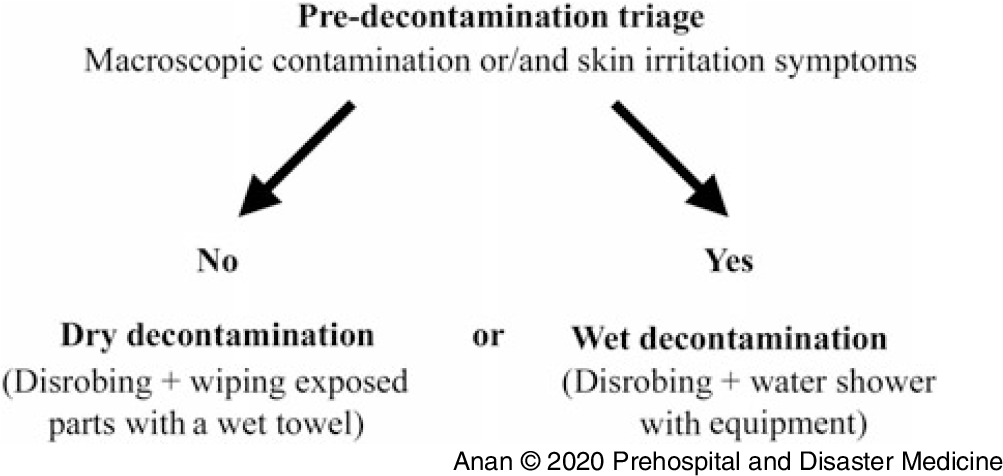
The report of the study meeting regarding the advancement of firefighting and rescue technology focused mainly on securing the safety of the rescue team. However, the examination in this report about the effect of life saving in mass-casualty events was inadequate. Moreover, although there was substantial content regarding individual techniques and activity methods, there were few principles and grounds for action. Therefore, insufficient weight was given to the necessity of swift rescue, as time regulation and objectives of actions to be taken were lacking. Actions such as detection and zoning were prioritized, while evacuation, rescue, and decontamination were not. As Figure 1 shows, decontamination took place by deciding between dry and wet decontamination. Disrobing and dry contamination were treated the same and no attention was given to the importance of speedy disrobing. Dry decontamination was rarely selected, and the focus was given to using wet contamination by building large equipment on-site. Zoning was based on military manuals to secure a very long distance for safety. As a result, these methods posed major problems in applications to urban areas. There was also a logical inconsistency in wearing Level C personal protective equipment (PPE) during rescue activities in cold zones that were in contact with the injured after decontamination. The report did not consider victims who require extra support, such as foreigners, the handicapped, and elderly people, and no discussion was provided on how instructions are given to the victims.
Conventional Decontamination Selection Method in Japan.

The following issues were identified among the 132 firefighters, police officers, and Self-Defense Force personnel who participated in MCLS-CBRNE. As for evacuation and rescue, the importance of quickly evacuating victims from the scene was not recognized. As for zoning, the participants persisted in setting clear boundaries. In terms of protection, during their duties, all participants believed that Level A PPE should be worn until the chemical substance was identified. In addition, there were no standards for changing PPE after such substances are identified. In terms of decontamination, all participants believed that the wet decontamination method should be done after construction of the facility was complete. They did not recognize the importance of disrobing, and there were no time targets set to achieve each action.
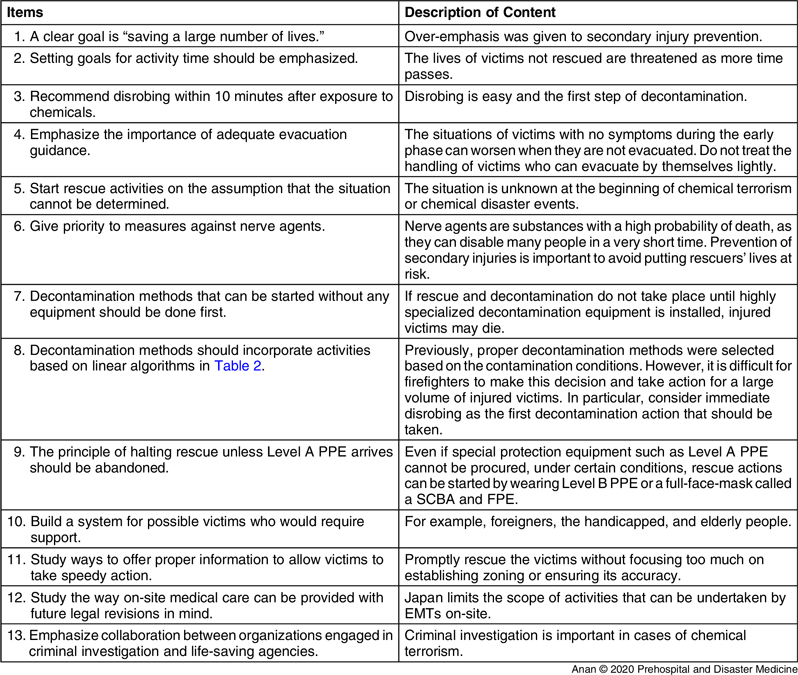
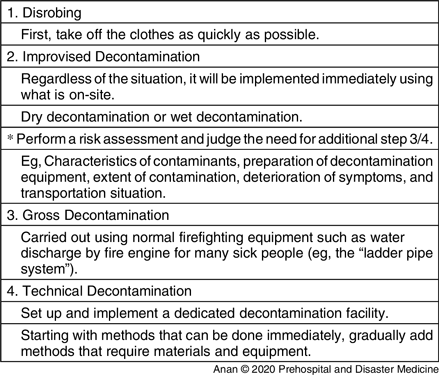
Table 1 contains the main revised points of the rescue activities. Table 2 shows the linear algorithm used for decontamination.
Main Revised Points of Rescue Activities

Abbreviations: EMT, emergency medical technician; FFPE, firefighter protective ensemble; PPE, personal protective equipment; SCBA, self-contained breathing apparatus.
Linear Algorithm for Decontamination

Note: This table is a modified procedure of the PRISM Guidance.Reference Chilcott and Amlôt3
Discussion
Eight people died and 600 or more were injured in the Matsumoto sarin attack in 1994. Twelve people died and around 6,000 people were injured in the Tokyo subway sarin attack in 1995. These are incidents particular to Japan.Reference Okumura, Hisaoka and Yamada4–6 The firefighters, police officers, and medical care providers did not conduct decontamination or protection when dealing with these incidents. As they would with the everyday rescue of emergency patients, they instantly approached the injured and provided emergency care. For this reason, firefighters and medical care providers suffered from secondary injury.Reference Nozaki, Hori and Shinozaki1 However, due mainly to their efforts, the number of deaths was minimized as a result.
From the standpoint of taking action that emphasizes ensuring safety, thinking is needed that will shift the objective of rescue actions to one that focuses on saving lives. Various guidelines and manuals are available in the UK and the US PRISM Guidance which integrate these and emphasize the importance of early disrobing.Reference Chilcott and Amlôt3 Chilcott, et al point out that the effects of disrobing sharply decrease with the passage of time.Reference Chilcott7 The UK guidelines clearly state the importance of disrobing within 15 minutes after exposure.8,9 Considering the amount of time it takes for fire departments to receive a notification and firefighters to arrive on-site, it makes sense to set the standard that disrobing must take place within 10 minutes after exposure if rescue begins as soon as the firefighters arrive on-site.
It was common sense to wear Level A PPE to ensure safety. This was the cause of delaying commencement of rescue activities. This is due to the understanding that in handling unknown substances, Level A PPE is the safest in terms of respiratory inhalation and transdermal absorption. It is vital to remove fears from firefighters who undertake rescue activities. However, high-level PPE like these are expensive, and are not available to all firefighters. Moreover, putting on PPE takes time. The air cylinder offers air supply only for a short period, making movement wearing the equipment extremely limited. Consequently, this causes a delay in rescuing the seriously injured who must be rescued promptly. To modify this, anxiety among the firefighters had to be alleviated by apprising them that rescue activities are possible without wearing Level A PPE. The highest importance was also given to take measures against nerve agents for two factors: the properties of each agent, such as volatility, odor, immediate effects, and effects depending on its concentration; and the likelihood of many people getting injured over a short period of time from terrorist attacks. When chemical substances are inhaled via the respiratory tract, it immediately poisons the body. However, gaseous chemicals require time to be absorbed dermally. In consideration of this, rescue activities with a full-face-mask called a self-contained breathing apparatus (SCBA) and firefighter protective ensembles (FFPEs) were approved for a specified time period. This approach has been already considered in the US as a rescue method based on various experiments and the collection of evidence.10
So far, in Japan, disrobing has been included in dry decontamination. As discussed above, often, firefighters wearing high-level PPE act by selecting between wet or dry decontamination when handling a large number of injured victims. Moreover, decontamination of the injured who can evacuate on their own during the early phase was not considered when deciding on the decontamination method. Consequently, it takes time for disrobing and decontamination to take place. They were missing the chance of preventing the entry of evaporating substances and transdermal absorption from clothing. To improve this, the importance of disrobing first must be emphasized. Next, thoughts and actions were linearly organized to start decontamination immediately, where possible, regardless of the equipment being used, and to add methods to use water and other special equipment as needed. These approaches are heavily influenced by the “Rule of TENS,” which is mentioned in the PRISM Guidance. Disrobing alone decontaminates 90% of the substances, with 10% remaining. Adding dry contamination, one percent remains. Gross decontamination that follows reduces this number to 0.1%.6 By simplifying actions, early actions can be expected to be taken without waiting for the preparation of equipment and materials to be completed. Compared with the past, decontamination will be expedited.
Increasingly, more foreigners have been visiting Japan in recent years. Thus, the possibility of handling victims with different languages and cultures must be considered. Moreover, in Japan, which is experiencing an aging society to the greatest degree in the world, it will become more likely for the elderly to become victims. Plans must be made for cases in which the injured require special support.
Limitations
In setting forth this proposal, the unresolved issues are presented as “Limitations.” First, because there are legal regulations on treating wastewater resulting from decontamination, in Japan, it cannot be easily disposed of. For this reason, care must be taken in implementing the concept of gross decontamination. Next, the issue of legal restrictions imposed on activities undertaken on-site by the rescue team emergency medical technicians (EMTs) cannot be easily resolved. Giving an antagonist to the injured to treat nervous system agents has not been approved. Moreover, EMTs must be supervised by doctors in the case of conducting medical practice. Giving instructions comprehensively to a large number of injured victims is not allowed. Finally, a conclusion has not been reached as to who must be given priority for rescue among the victims who fail to evacuate. A remaining issue is to determine whether to prioritize relatively mild victims or the most severe victims who are mortally injured.
Conclusion
This proposal is based on research subsidized by the MHLW of Japan. It emphasizes the importance of saving the lives of critically injured victims from the viewpoint of medical care. However, further study at the FDMA, which controls the firefighters who undertake on-site rescue activities, is needed, as are revisions to the report. A framework must be built in which rescue activities can take place so that the number of deaths would not rise, even if another unfortunate case of scattered sarin and other poisons was to occur.
Conflicts of interest/funding
Financial support provided by Ministry of Health, Labour, and Welfare (Chiyoda, Tokyo, Japan). The authors have no conflicts of interest to disclose.