


Introduction
Internet-delivered CBT (iCBT) has been recognized as an option that can facilitate access to therapy (Hadjistavropoulos et al., Reference Hadjistavropoulos, Alberts, Nugent and Marchildon2014; Titov et al., Reference Titov, Dear, Staples, Bennett-Levy, Klein, Rapee and Nielssen2015b; Titov et al., Reference Titov, Dear, Nielssen, Staples, Hadjistavropoulos, Nugent and Repål2018). It typically consists of structured lessons and homework accessed online over 6–10 weeks. Its delivery can be either clinician-guided or self-guided/unguided. Clinician-guided iCBT involves scheduled or optional minimal weekly contact with a clinician for about 10–15 minutes either through asynchronous online messaging or by telephone to assist with the application of specific therapy techniques (Hadjistavropoulos et al., Reference Hadjistavropoulos, Schneider, Edmonds, Karin, Nugent, Dirkse and Titov2017; Lindefors and Andersson, Reference Lindefors and Andersson2016). Self-guided iCBT may involve automated emails, but no support pertaining to the therapeutic content is provided (Karyotaki et al., Reference Karyotaki, Riper, Twisk, Hoogendoorn, Kleiboer, Mira and Andersson2017). Numerous studies support the efficacy and effectiveness of clinician-guided iCBT for the treatment of anxiety and depression (Andrews et al., Reference Andrews, Basu, Cuijpers, Craske, McEvoy, English and Newby2018; Hedman et al., Reference Hedman, Andersson, Lindefors, Andersson, Rück and Ljótsson2013a; Hedman et al., Reference Hedman, Ljótsson, Rück, Bergström, Andersson, Kaldo and Lindefors2013b; Hedman et al., Reference Hedman, Ljótsson, Kaldo, Hesser, El Alaoui, Kraepelien and Lindefors2014; Mewton et al., Reference Mewton, Wong and Andrews2012; Mewton et al., Reference Mewton, Smith, Rossouw and Andrews2014; Newby et al., Reference Newby, Twomey, Li and Andrews2016; Olthuis et al., Reference Olthuis, Watt, Bailey, Hayden and Stewart2016; Priemer and Talbot, Reference Priemer and Talbot2013; Titov et al., Reference Titov, Dear, Nielssen, Staples, Hadjistavropoulos, Nugent and Repål2018; Williams and Andrews, Reference Williams and Andrews2013). Therapeutic gains have been found to be comparable to face-to-face therapy (Carlbring et al., Reference Carlbring, Andersson, Cuijpers, Riper and Hedman-Lagerlöf2018). Compared with clinician-guided iCBT, meta-analyses and literature reviews have revealed significantly lower adherence or treatment outcomes for self-guided iCBT (Andersson and Titov, Reference Andersson and Titov2014; Baumeister et al., Reference Baumeister, Reichler, Munzinger and Lin2014; Talbot, Reference Talbot2012; Wright et al., Reference Wright, Owen, Richards, Ells, Richardson, Brown, Barrett, Rasku, Polser and Thase2019). However, more recent trials, albeit limited in numbers, suggest that the gap between iCBT with and without clinician guidance is non-existent or closing (Dear et al., Reference Dear, Staples, Terides, Karin, Zou, Johnston and Titov2015; Dear et al., Reference Dear, Staples, Terides, Fogliati, Sheehan, Johnston and Titov2016; Fogliati et al., Reference Fogliati, Dear, Staples, Terides, Sheehan, Johnston and Titov2016, Olthuis et al., Reference Olthuis, Watt, Bailey, Hayden and Stewart2016; Titov et al., Reference Titov, Dear, Johnston, Lorian, Zou, Wootton, Spence, McEvoy and Rapee2013; Titov et al., Reference Titov, Dear, Staples, Terides, Karin, Sheehan and McEvoy2015a). A common theme found in the programs employed in these trials is the use of multiple strategies including a screening process, careful monitoring of progress and safety, and engagement strategies such as a pre-treatment telephone call and weekly automated emails (Lindefors and Andersson, Reference Lindefors and Andersson2016). These strategies may overlap with the structure of clinician-guided programs explaining the closing gap between clinician- and self-guided programs (Andersson and Titov, Reference Andersson and Titov2014; Baumeister et al., Reference Baumeister, Reichler, Munzinger and Lin2014). This contrasts with self-guided iCBT such as open access programs in which participation is anonymous and there is no requirement from the user or provider in terms of screening or monitoring (Lindefors and Andersson, Reference Lindefors and Andersson2016). To distinguish these iCBT programs from self-guided iCBT programs including a number of monitoring strategies, we are proposing the term ‘minimally monitored iCBT’.
Efforts have been made to provide universal access to iCBT. Although a majority of programs are in English, several are available in different languages. In an international project examining different implementation models, clinician-guided iCBT was implemented in five European countries in Danish, Dutch, Norwegian, Swedish and English with evidence supporting its effectiveness (Titov et al., Reference Titov, Dear, Nielssen, Staples, Hadjistavropoulos, Nugent and Repål2018). Access to iCBT nevertheless remains limited in many countries. The expertise and resources required to develop and evaluate iCBT programs as well as the training necessary for the delivery of clinician-guided iCBT represent barriers that can limit a more widespread use of iCBT across countries (e.g. Kruse et al., Reference Kruse, Karem, Shifflett, Vegi, Ravi and Brooks2016; Titov et al., Reference Titov, Dear, Nielssen, Staples, Hadjistavropoulos, Nugent and Repål2018). In the international project cited above, each country had to secure funding to develop and implement their own iCBT program.
Potential solutions to overcome these barriers may lie in the use of a collaborative approach to implement existing and empirically supported programs in their original or translated version and the provision of a minimally monitored delivery model, less resources being required for this model (Gerhards et al., Reference Gerhards, De Graaf, Jacobs, Severens, Huibers, Arntz and Evers2010). Translating existing programs was recommended years ago by the International Society for Research on Internet Interventions as a strategy to increase access to iCBT (Ritterband et al., Reference Ritterband, Andersson, Christensen, Carlbring and Cuijpers2006). In countries with similar cultures, translating iCBT programs would only require a minimum of resources and may not require cultural adaptations. So far, only one randomized controlled trial (RCT) has assessed the translation of an iCBT program with no cultural adaptations. The program, MoodGym, targets depression and was translated from English to Norwegian (Lintvedt et al., Reference Lintvedt, Griffiths, Sørensen, Østvik, Wang, Eisemann and Waterloo2013b). An open access iCBT program consisting of five lessons was used. Participants were not monitored, nor did they receive reminders. The results obtained among 163 university students showed moderate improvements on symptoms of depression. A cost analysis was also conducted, highlighting that translation is a cost-effective alternative as opposed to developing a new program (Lintvedt et al., Reference Lintvedt, Griffiths, Eisemann and Waterloo2013a).
The RCT in this study aims to evaluate the efficacy of an iCBT program, the Wellbeing Course, translated from English to French and offered in Canada using a minimally monitored delivery model for the treatment of anxiety and depression. This is the first RCT of minimally monitored iCBT with a sample of French-speaking people. Access to iCBT is very limited in Canada, and to our knowledge, no evidence-based program is available in French. French is an official language in this country with an estimated 274 million speakers worldwide (International Organisation of La Francophonie, 2018). Amongst available iCBT programs, the Wellbeing Course is a transdiagnostic program that has consistently been shown to be an efficacious treatment for anxiety and depression using a clinician-guided delivery (Dear et al., Reference Dear, Titov, Schwencke, Andrews, Johnston, Craske and McEvoy2011a; Kirkpatrick et al., Reference Kirkpatrick, Manoukian, Dear, Johnston and Titov2013; Titov et al., Reference Titov, Dear, McMillan, Anderson and Zou2011b; Titov et al., Reference Titov, Dear, Johnston, Lorian, Zou, Wootton, Spence, McEvoy and Rapee2013; Titov et al., Reference Titov, Dear, Johnston, McEvoy, Wootton, Terides and Rapee2014; Titov et al., Reference Titov, Dear, Staples, Terides, Karin, Sheehan and McEvoy2015a; Titov et al., Reference Titov, Dear, Staples, Bennett-Levy, Klein, Rapee and Nielssen2015b). RCTs that are more recent have revealed that it can also be effective using a minimally monitored delivery (Dear et al., Reference Dear, Staples, Terides, Karin, Zou, Johnston and Titov2015; Dear et al., Reference Dear, Staples, Terides, Fogliati, Sheehan, Johnston and Titov2016; Fogliati et al., Reference Fogliati, Dear, Staples, Terides, Sheehan, Johnston and Titov2016, Titov et al., Reference Titov, Dear, Johnston, Lorian, Zou, Wootton, Spence, McEvoy and Rapee2013; Titov et al., Reference Titov, Dear, Staples, Terides, Karin, Sheehan and McEvoy2015a). Its transportability using an English and clinician-guided version has been supported in routine care in Saskatchewan, Canada (Hadjistavropoulos et al., Reference Hadjistavropoulos, Alberts, Nugent and Marchildon2014; Hadjistavropoulos et al., Reference Hadjistavropoulos, Nugent, Alberts, Staples, Dear and Titov2016; Hadjistavropoulos et al., Reference Hadjistavropoulos, Schneider, Edmonds, Karin, Nugent, Dirkse and Titov2017). Translations in Arabic and Mandarin combined with cultural adaptations of the program have been made with encouraging results (Choi et al., Reference Choi, Zou, Titov, Dear, Li, Johnston and Hunt2012; Kayrouz et al., Reference Kayrouz, Dear, Johnston, Gandy, Fogliati, Sheehan and Titov2015; Kayrouz et al., Reference Kayrouz, Dear, Karin, Gandy, Fogliati, Terides and Titov2016a; Kayrouz et al., Reference Kayrouz, Dear, Karin, Fogliati and Titov2016b), but no study has yet evaluated a translated version of the program with no cultural adaptations. It was hypothesized that compared with a waiting-list control group, the French Wellbeing Course (DaPonte et al., Reference DaPonte, Talbot, Titov, Dear, Hadjistavropoulos, Hadjistavropoulos and Jbilou2018), when provided using a minimally monitored delivery, would produce significantly higher improvements from pre- to post-treatment on primary outcome measures of anxiety and depression and secondary outcome measures of quality of life and life satisfaction. It was also hypothesized that the majority of participants would be satisfied with the program. The impact of the program on secondary disorder-specific anxiety measures, although involving small subsamples, was explored. The objective was to assess if the translated version of this transdiagnostic program could impact both general and disorder-specific symptoms as found with the original English version of the Wellbeing Course using a minimally monitored delivery model (Dear et al., Reference Dear, Staples, Terides, Karin, Zou, Johnston and Titov2015; Dear et al., Reference Dear, Staples, Terides, Fogliati, Sheehan, Johnston and Titov2016; Fogliati et al., Reference Fogliati, Dear, Staples, Terides, Sheehan, Johnston and Titov2016, Titov et al., Reference Titov, Dear, Johnston, Lorian, Zou, Wootton, Spence, McEvoy and Rapee2013; Titov et al., Reference Titov, Dear, Staples, Terides, Karin, Sheehan and McEvoy2015a).
Method
To facilitate comparison with past literature, the methodology was similar to past studies on the minimally monitored Wellbeing Course, specifically an RCT comparing the English version of the Wellbeing Course to a waiting-list control group and a feasibility study examining a minimally monitored English version with Arabic adaptations (Kayrouz et al., 2016; Titov et al., Reference Titov, Dear, Johnston, Lorian, Zou, Wootton, Spence, McEvoy and Rapee2013).
Participants
People applied online to participate via a secured website (https://etherapies.ca) by completing the screening questionnaire. The sample size was determined by a power analysis using the software G*Power. A sample size of 60 was estimated to be sufficient with a power of 80% and an alpha of 0.05 to detect large within-group effect sizes from pre-treatment to post-treatment on the Generalized Anxiety Disorder 7-item scale (GAD-7) and Patient Health Questionnaire 9-item scale (PHQ-9). Recruitment took place in the Atlantic provinces of Canada over 9 months using different media. A total of 104 people applied and out of those, 63 were included in the study. Selection criteria were: (1) at least 18 years of age; (2) clinical levels of depression or anxiety as indicated by the total score on at least one of the following measures: PHQ-9 ≥ 10 (Kroenke et al., Reference Kroenke, Spitzer and Williams2001), GAD-7 ≥ 8 (Spitzer et al., Reference Spitzer, Kroenke, Williams and Löwe2006), Penn State Worry Questionnaire (PSWQ) ≥ 45 (Behar et al., Reference Behar, Alcaine, Zuellig and Borkovec2003), Social Phobia Inventory (SPIN) ≥ 19 (Connor et al., Reference Connor, Davidson, Churchill, Sherwood, Weisler and Foa2000), Panic and Agoraphobia Scale (PAS) ≥ 19 (Bandelow, Reference Bandelow1999) or minimally, a self-reported difficulty with anxiety or depression (yes/no)Footnote 1; (3) French as the first official language spoken; (4) good understanding of written French; (5) not currently following a cognitive behavioral therapy (CBT); (6) if taking psychotropic medication, no change of the medication at least 1 month prior to the study; (7) no evidence of psychosis or severe symptoms of depression (score ≥23 or a score >2 on item 9 (suicidal ideation) of the PHQ-9; (8) access to the internet; (9) agreement to give contact information.
Measures
Outcome measures were self-report questionnaires administered online through the secure study website (https://etherapies.ca) at pre-treatment (T1) and post-treatment (T2). The primary outcome measures as well as questionnaires on quality of life and life satisfaction were administered at 3-month follow-up (T3). Outcome measures were French translations or adaptations of psychometrically sound English questionnaires. Primary outcome measures were translated using an internationally accepted translation methodology (Acquadro et al., Reference Acquadro, Conway, Giroudet and Mear2012). They showed adequate internal consistency and sensitivity to change during therapy (DaPonte et al., Reference DaPonte, Talbot, Titov, Dear, Hadjistavropoulos, Hadjistavropoulos and Jbilou2018). Their use online using the original English version was supported (Erbe et al., Reference Erbe, Eichert, Rietz and Ebert2016).
Primary outcome measures
Patient Health Questionnaire 9-item scale
The PHQ-9 (Gilbody et al., Reference Gilbody, Richards, Brealey and Hewitt2007; Kroenke et al., Reference Kroenke, Spitzer and Williams2001, translation by MAPI Research Institute) is a 9-item measure of the symptoms and severity of depression based on the DSM-IV diagnostic criteria for major depression. Item scores are summed with higher scores representing higher levels of depression (α = .85).
Generalized Anxiety Disorder 7-item scale
The GAD-7 (Löwe et al., Reference Löwe, Decker, Müller, Brähler, Schellberg, Herzog and Herzberg2008; Spitzer et al., Reference Spitzer, Kroenke, Williams and Löwe2006, translation by MAPI Research Institute) is a 7-item measure of the symptoms and severity of general anxiety based on the DSM-IV diagnostic criteria for GAD. Higher scores represent higher levels of anxiety (α = .89).
Secondary outcome measures
The Satisfaction with Life Scale
The SWLS (Blais et al., Reference Blais, Vallerand, Pelletier and Briere1989; Diener et al., Reference Diener, Emmons, Larsen and Griffin1985) is a 5-item measure of one’s global life satisfaction with higher scores indicating higher satisfaction with life (α = .76).
Mental Component Summary of the Quality of Life questionnaire SF-12v2
The MCS (Ware et al., Reference Ware, Kosinski, Gandek, Sundaram, Bjorner, Turner-Bowker and Maruish2010) is a 12-item subscale assessing functional health and wellbeing. The MCS is scored using QualityMetric’s Health Outcomes TM Scoring Software 5.0 to produce a total score. Higher scores reflect better quality of life in relation to mental health.
Penn State Worry Questionnaire
The PSWQ (Meyer et al., Reference Meyer, Miller, Metzger and Borkovec1990; translation by Gosselin et al., Reference Gosselin, Dugas, Ladouceur and Freeston2001) is a 16-item scale measuring worry as found in generalized anxiety disorder. Higher scores indicate higher levels of worry. The PSWQ is useful in distinguishing symptoms of generalized anxiety disorder from symptoms of other anxiety disorders (Behar et al., Reference Behar, Alcaine, Zuellig and Borkovec2003) (α = .89).
Social Phobia Inventory
The SPIN (Connor et al., Reference Connor, Davidson, Churchill, Sherwood, Weisler and Foa2000; translation by Radomsky et al., Reference Radomsky, Ashbaugh, Saxe, Ouimet, Golden, Lavoie and O’Connor2006) is a 17-item questionnaire measuring the severity of fear, avoidance and physiological symptoms associated with social anxiety disorder. Higher scores indicate higher levels of social anxiety (α = .94).
Panic and Agoraphobia Scale
The PAS (Bandelow, Reference Bandelow1999; translation by Roberge et al., Reference Roberge, Marchand, Grenier and Marchand2003) is a 13-item scale measuring the frequency and intensity of panic based on the DSM-IV diagnostic criteria for panic disorder with or without agoraphobia. Higher scores indicate more severe symptoms of panic (α = .87).
Treatment acceptability
Treatment acceptability was assessed post-treatment using four questions (Titov et al., Reference Titov, Dear, Johnston, Lorian, Zou, Wootton, Spence, McEvoy and Rapee2013): (1) ‘Overall, how satisfied are you with the Course?’ (totally unsatisfied/generally unsatisfied/mostly unsatisfied/neither satisfied nor unsatisfied/mostly satisfied/generally satisfied/totally satisfied); (2) ‘How would you evaluate the quality of the material?’ (poor/acceptable/good/very good/excellent); (3) ‘Would you recommend this treatment to a friend suffering from anxiety or depression?’ (yes/no) and (4) ‘Was it worth your time doing the Course?’(yes/no). Participants also provided feedback over the telephone at post-treatment on what was the most and least helpful to them, and suggestions for improvements. They were also asked if they would have liked the guidance of a clinician.
Intervention
The French Wellbeing Course is an 8-week structured iCBT program teaching practical psychological skills consisting of five lessons (DaPonte et al., Reference DaPonte, Talbot, Titov, Dear, Hadjistavropoulos, Hadjistavropoulos and Jbilou2018). A translation process similar to the approach used by other researchers who translated iCBT programs was used (Choi et al., Reference Choi, Zou, Titov, Dear, Li, Johnston and Hunt2012; Lintvedt et al., Reference Lintvedt, Griffiths, Sørensen, Østvik, Wang, Eisemann and Waterloo2013b). The program was translated by two bilingual members of our research team including a clinical psychologist with expertise in the treatment of anxiety and depression using CBT (DaPonte et al., Reference DaPonte, Talbot, Titov, Dear, Hadjistavropoulos, Hadjistavropoulos and Jbilou2018). A professional translator reviewed the translation and differences of opinion were discussed. They were limited and focused primarily on maintaining a similar reading level. The translation was finalized after a consensus had been reached. Names in case stories were changed and statistics pertaining to Australia replaced by statistics relevant to Canada.
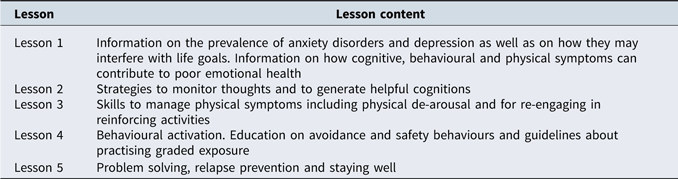
Each lesson included approximately 60 slides of material comprised of text and pictures. A description of each lesson is provided in Table 1. Each lesson included a ‘Do it Yourself’ guide intended to provide participants with relevant homework assignments, summaries and case-enhancing learning examples. These examples are modelled after program users and are embedded in the lessons. They illustrate how users experiencing depression, generalized anxiety disorder, panic or social phobia successfully begin to gain mastery over their symptoms. Additional material included two brief case stories written in the form of a letter as well as resources on topics not covered in the lessons such as assertiveness, problem solving skills and sleep hygiene.
Lesson content of the Wellbeing Course
Procedure
Design
An RCT was conducted using a waiting-list control group. Participants were randomized by one of the authors using a sequence generator from www.random.org. Participant’s ID numbers were randomly allocated to one of two sequences corresponding to the treatment group (TG) and waiting list (CG). Those in the TG started the course the week following randomization. Participants completed the lessons in order. Lessons were available at the beginning of weeks 1, 2, 4, 5 and 7, respectively.
A minimally monitored model of delivery involving brief pre- and post-treatment telephone calls, weekly automated emails, weekly symptom monitoring, and a safety protocol was used. Brief 5–10 minute pre- and post-treatment telephone calls were made as such contacts may encourage engagement (Carlbring et al., Reference Carlbring, Bohman, Brunt, Buhrman, Westling, Ekselius and Andersson2006; Nordin et al., Reference Nordin, Carlbring, Cuijpers and Andersson2010). During the pre-treatment telephone call, study procedures were reviewed and answers provided to any questions participants may have had. Weekly automated emails, personalized using participants’ first name, offered instructions, reminders, normalization of challenges and encouragement. Symptoms of anxiety and depression were monitored on a weekly basis and a safety protocol put in place [see Titov et al. (Reference Titov, Dear, Johnston, Lorian, Zou, Wootton, Spence, McEvoy and Rapee2013) for more details]; participants whose PHQ-9 total score was above 23 or who scored ‘3’ to question 9 on suicidal ideation were telephoned by the second author to conduct an assessment of the situation and to provide a management plan if need be. This occurred only once and was for a participant in the control group. The suicidal risk was estimated to be minimal and resources to use in the event of a deterioration were reviewed. This minimally monitored iCBT program differed in a number of ways from fully automated services. As such, it allowed greater clinical governance and safety.
The study was approved by the Human Research Ethics Committee of the Université de Moncton (New Brunswick, Canada). All participants provided informed consent electronically. The trial is registered as File 1516-077 at ClinicalTrials.gov, the United States National Library of Medicine’s clinical trial registry.
Statistical analyses and clinical significance of the results
Chi-square tests and t-tests were used to compare pre-treatment difference between TG and CG, study completers and non-completers as well as treatment completers and non-completers. The French Wellbeing Course’s efficacy was evaluated using intention-to-treat mixed linear model analyses. All assumptions were met, and Little’s tests showed that data on outcome measures were missing completely at random (χ2 (36) = 45.267, p < 0.14). Differences between TG and CG were examined by modelling Time × Group interactions. Models with random intercepts and fixed slopes provided the best fit to the data.
The clinical significance of the findings was assessed using recovery and remission rates. These indices were selected based on previous studies on the Wellbeing Course to ensure comparisons of the results. They have also been used in several iCBT studies (e.g. Kayrouz et al., Reference Kayrouz, Dear, Karin, Gandy, Fogliati, Terides and Titov2016a; Titov et al., Reference Titov, Dear, Johnston, Lorian, Zou, Wootton, Spence, McEvoy and Rapee2013) as well as in large dissemination trials assessing traditional face-to-face CBT and iCBT (e.g. Clark et al., Reference Clark, Layard, Smithies, Richards, Suckling and Wright2009; Richards and Suckling, Reference Richards and Suckling2009). The recovery index was defined as the proportion of participants whose scores on the PHQ-9 or GAD-7 improved by 50% or greater at post-treatment (Kayrouz et al., Reference Kayrouz, Dear, Karin, Gandy, Fogliati, Terides and Titov2016a). The index of remission was the percentage of participants whose pre-treatment scores were at or above the clinical cut-off scores (≥10 on the PHQ-9; ≥8 on the GAD-7; >45 on the PSWQ; >19 on the SPIN; >19 on the PAS) and below these cut-off scores at post-treatment or follow-up (Clark and Oates, Reference Clark and Oates2014; Titov et al., Reference Dear, Titov, Sunderland, McMillan, Anderson, Lorian and Robinson2011). In calculating recovery and remission rates, an intent-to-treat (ITT) model was employed for all outcome measures with the pre-treatment observation carried forward for estimates that are more conservative (Karin et al., Reference Karin, Dear, Heller, Crane and Titov2018). For comparison purposes, recovery and remission rates based on the primary outcome measures were also computed for treatment completers defined as participants who completed all five lessons of the Wellbeing Course at post-treatment. Lesson completion was monitored using participants’ activity logs and involved consulting all slides. Deterioration rates, defined as a 5-point increase on the PHQ-9 or the GAD-7 from pre- to post-treatment or follow-up, were also calculated (Titov et al., Reference Titov, Dear, Johnston, Lorian, Zou, Wootton, Spence, McEvoy and Rapee2013).
Results
Baseline data
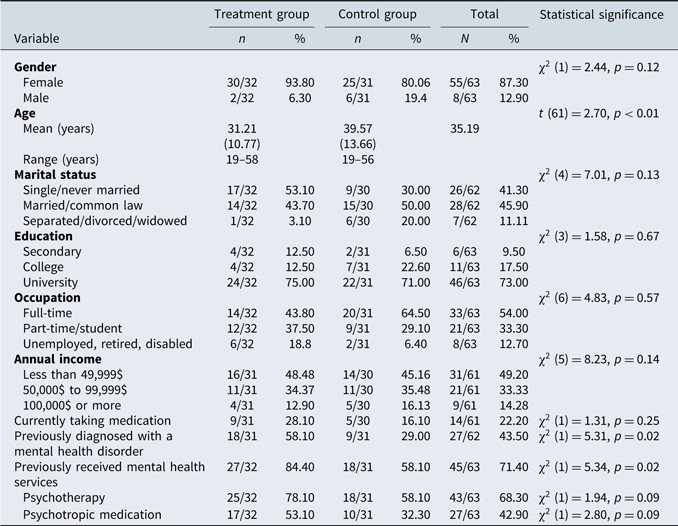
Of the 104 applicants, 63 met inclusion criteria, signed the consent form and completed the pre-treatment questionnaires. Thirty-two participants were randomized to the treatment condition and 31 participants to the waitlist. The mean age of participants was 35.19 years (SD = 12.88, range 19–59) and the majority were women (n = 55; 87%). Table 2 presents the sociodemographic and mental health-related characteristics of the sample. Participants in the treatment group (TG) were significantly younger and a significantly greater portion had been previously diagnosed with a mental disorder or had received mental health services. TG and control group (CG) did not significantly differ on outcome measures at pre-treatment (p > 0.08; d ≤ 0.30).
Demographic and mental health-related variables for the treatment and control groups and the overall sample
Attrition and treatment adherence
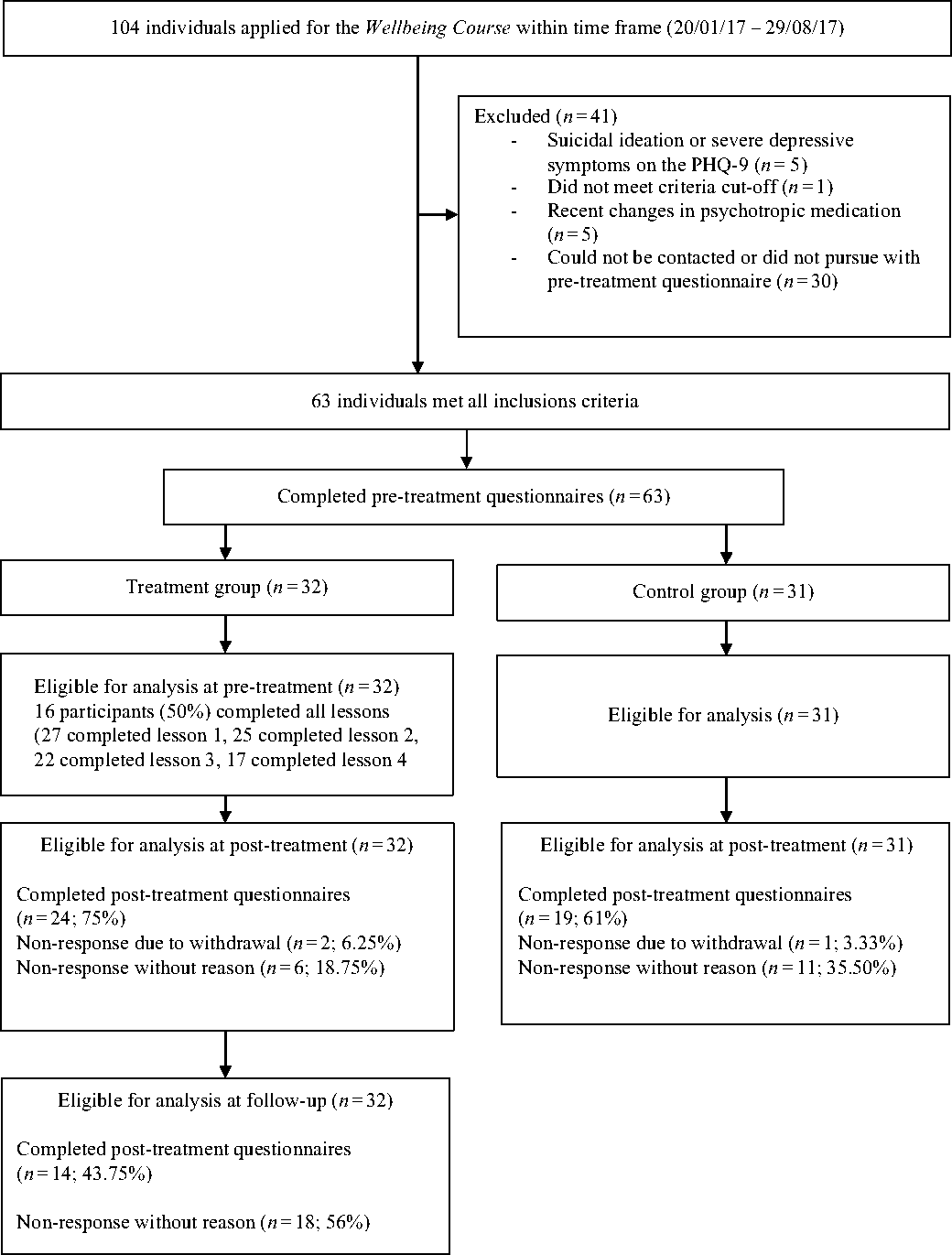
Post-treatment and follow-up attrition rates for TG and CG are shown in Fig. 1. Attrition in TG and CG did not significantly differ. Treatment adherence was the rate of completion of all five lessons as described above. As indicated in Fig. 1, half of the participants completed all lessons (n = 16/32, 50%). A significantly higher annual income was found for study completers (χ2 (5) = 12.82, p < 0.03) and neared significance for treatment completers (p < 0.06). No other significant differences on sociodemographic variables or pre-treatment outcome measures were found between the study completers and non-completers, nor between treatment completers and non-completers. Effect sizes for all comparisons were small (p > 0.12, d < 0.30, v < 0.35).
Participant flowchart.
Acceptability
All but one study completer (n = 23/24; 96%) reported being mostly to totally satisfied with the program and assessed the quality of the program as being good to excellent (n = 23/24; 96%). Likewise, 92% (n = 22/24) reported that the program was worth doing and 96% (n = 23/24) that they would recommend the program to a friend with anxiety or depression. At the post-treatment telephone call, the majority of participants stated that learning practical psychological techniques to manage their symptoms, such as behavioural activation and thought challenging, was most helpful to them (n = 17/24; 71%). Nine reported that the case stories were not as relevant to them (n = 9/24; 38%). When asked if they would have liked contact with a clinician, 25% (n = 6/24) of the participants reported that they may have appreciated it had it been available. A number of participants suggested improving the look and speed of the site and making the program compatible with products like tablets and smartphones (29%; n = 7/24). No other suggestions were given.
Treatment efficacy
Primary psychological outcome measures
Means for the PHQ-9 and GAD-7 are shown in Table 3. Mixed-models analyses revealed a significant Group × Time interaction on the PHQ-9 (F 1,47.43 = 5.30, p < 0.05) and the GAD-7 (F 1,46.89 = 7.40, p < 0.01). Pairwise comparisons revealed that the TG had significantly lower post-treatment PHQ-9 and GAD-7 scores than the CG. Within-group analyses among the TG revealed a significant time effect on the PHQ-9 (F 2,42.04 = 17.07, p < 0.01) and GAD-7 (F 2,40.79 = 28.40, p < 0.01) including the three time points T1, T2 and T3. Pairwise comparisons revealed significant improvements between T1 and T3 (p < 0.01 and p < 0.01, respectively), but not between T2 and T3 (p = .54 and .69, respectively).
Primary outcome means for the overall sample and treatment completers at pre-treatment (T1), post-treatment (T2) and follow-up (T3)
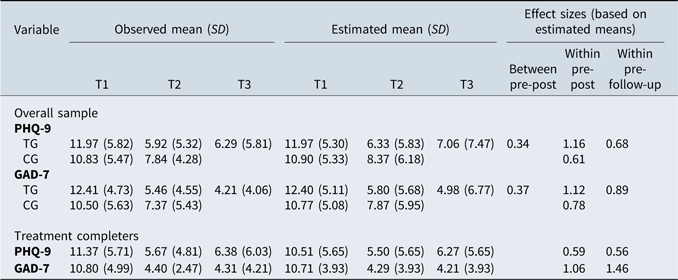
T1, pre-treatment; T2, post-treatment; T3, follow-up; TG, treatment group; CG, control group; PHQ-9, Patient Health Questionnaire-9; GAD-7, Generalized Anxiety Disorder-7.
Secondary psychological outcome measures
The Time × Group interaction on the MCS approached significance (F 1,51.08 = 3.27, p < 0.07) and was found not significant on the SWLS (F 1,56.19 = 1.98, p = 0.17). Mixed-models analyses revealed a significant Time × Group interaction on the PSWQ (F 1,46.46 = 5.50, p < 0.03) and the SPIN (F 1,43.46 = 4.21, p < 0.05). Pairwise comparisons revealed that the TG had significantly lower post-treatment PSWQ and SPIN scores than the CG. The Time × Group interaction on the PAS (F 1,39.944 = 0.353, p = 0.56) was not significant.
Effect sizes
Effect sizes were calculated using the estimated means (see Tables 3 and 4). Small between-group effect sizes were found on primary outcome measures (≤.30). In the TG, large effects were obtained on primary outcomes measures and medium to large effects on secondary outcome measures. Effect sizes were smaller in the CG, ranging from small to moderate.
Secondary outcome means for the overall sample at pre-treatment (T1), post-treatment (T2) and follow-up (T3)
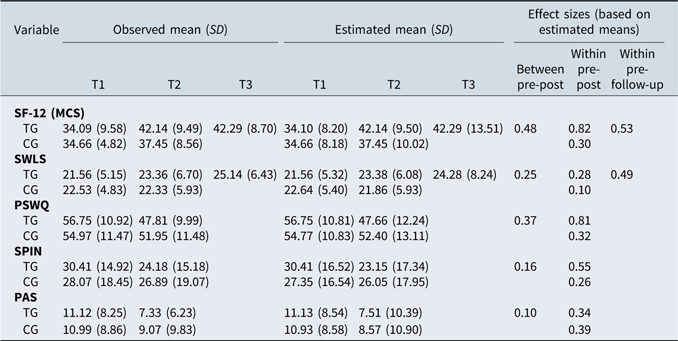
T1, pre-treatment; T2, post-treatment; T3, follow-up; TG, treatment group; CG, control group; SF-12 (MCS), SF-12 Health Survey–Mental Component summary; SWLS, Satisfaction with Life Scale.
Clinical significance and deterioration
Primary outcome measures
Intent-to-treat. Significantly more TG participants (40 and 56%, respectively) than CG participants (13 and 16%, respectively) reached recovery on the PHQ-9 (χ2 (1) = 6.14, p = 0.01, v = 0.31) and the GAD-7 (χ2 (1) = 10.93, p < 0.01, v = 0.41).
At pre-treatment, 69% (n = 22/32) of TG and 61% (n = 19/31) of the CG scored above the clinical cut-off on the PHQ-9. At post-treatment, more TG participants (41%; n = 9/22) than CG (32%; n = 6/19) reached remission on the PHQ-9, but the difference did not reach significance (χ2 (1) = 0.38, p = 0.53, v = 0.09). At pre-treatment, 81% (n = 26/32) of TG and 61% (n = 19/31) of the CG scored above the clinical cut-off on the GAD-7. At post-treatment, significantly more TG participants (50%; n = 13/26) than CG (10%; n = 2/19) reached remission on the GAD-7 (χ2 (1) = 7.70, p < 0.01, v = 0.41). At T3, remission rates remained satisfactory for both the PHQ-9 (45%; n = 10/22) and GAD-7 (42%; n = 11/26). No participant showed deterioration on the GAD-7 or the PHQ-9.
Treatment completers. About half (53%; n = 8/15) reached recovery on the PHQ-9 compared with 80% (n = 12/15) on the GAD-7. For the PHQ-9, 47% of the treatment completers (n = 7/15) had a score above the clinical cut-off score. Of these participants, 63% (n = 5/15) were below the cut-off score at T2 and 69% (n = 9/15) at T3. At T1, 73% of the treatment completers (n = 11/15) had a GAD-7 at or above the clinical cut-off. Of those participants, 73% (n = 8/15) were below the cut-off score at T2 and 77% (n = 10/15) at T3.
Secondary outcome measures
At pre-treatment, 94% (n = 30/32) of the TG and 97% (n = 30/31) of the CG scored above the clinical cut-off on the PSWQ. At post-treatment, more TG participants (33%; n = 10/30) than CG (20%; n = 6/30) reached remission on the PSWQ, but the difference did not reach significance (χ2 (1) = 1.36, p = 0.24, v = 0.15). At pre-treatment, 78% (n = 25/32) of TG and 61% (n = 19/31) of the CG scored above the clinical cut-off on the SPIN. At post-treatment, significantly more TG participants (24%; n = 6/26) than CG (0%; n = 0/19) reached remission on the SPIN (χ2 (1) = 5.28, p < 0.03, v = 0.34). The small number of participants with PAS scores in the clinical range at pre-treatment who completed the study (n = 5) precluded the calculation of remission rates.
Discussion
This RCT aimed to assess a minimally monitored delivery model which, combined with the translation of an already empirically validated iCBT program, could facilitate access to iCBT. The findings support the efficacy of the translated program when delivered as such. As postulated, the French Wellbeing Course produced significantly superior improvements from pre- to post-treatment on primary outcome measures of anxiety and depression. Gains were also maintained at the 3-month follow-up. Effect sizes on primary outcome measures were similar to the original minimally monitored version (Dear et al., Reference Dear, Staples, Terides, Karin, Zou, Johnston and Titov2015; Titov et al., Reference Titov, Dear, Johnston, Lorian, Zou, Wootton, Spence, McEvoy and Rapee2013; Titov et al., Reference Titov, Dear, Staples, Terides, Karin, Sheehan and McEvoy2015a). Recovery rates on the GAD-7 (56%) and PHQ-9 (40%) were significantly higher than in the control group (16% and 13%, respectively) and higher than in the minimally monitored Wellbeing Course with Arabic adaptations (36% and 31%, respectively) (Kayrouz et al., Reference Kayrouz, Dear, Karin, Gandy, Fogliati, Terides and Titov2016a). Remission rates on the GAD-7 (50%) and the PHQ-9 (41%) were smaller than the ones obtained with the minimally monitored English version of the Wellbeing Course (58% and 56%, respectively) but comparable to the minimally monitored Arabic adaptation (43% and 46%, respectively) (Kayrouz et al., Reference Kayrouz, Dear, Karin, Gandy, Fogliati, Terides and Titov2016a; Titov et al., Reference Titov, Dear, Johnston, Lorian, Zou, Wootton, Spence, McEvoy and Rapee2013). The absence of deterioration among participants suggests that a minimally monitored delivery can be used safely with moderate symptomatology. The possibility remains, however, that the occurrence of a deterioration or of other negative effects contributed to attrition. Negative effects may include any unexpected or undesirable effects, such as the experience of novel symptoms or unmet treatment needs (Rozental et al., Reference Rozental, Castonguay, Dimidjian, Lambert, Shafran, Andersson and Carlbring2018).
Treatment completion (50%) was acceptable. It was comparable to the rates reported for the original minimally monitored version of the Wellbeing Course (53%) and higher than the Arabic adapted minimally monitored version (36%) (Kayrouz et al., Reference Kayrouz, Dear, Karin, Gandy, Fogliati, Terides and Titov2016a; Titov et al., Reference Titov, Dear, Johnston, Lorian, Zou, Wootton, Spence, McEvoy and Rapee2013). Higher recovery and remission rates post-treatment and at follow-up on primary outcome measures were obtained among treatment completers than in the ITT sample, namely for depression (remission rate at T3 of 69% versus 45%, respectively). Although based on a small subsample, these findings highlight the importance of completing treatment for better outcomes. Given the nature of depression, which can affect engagement, additional strategies may be useful to promote treatment completion such as providing participants with information on the benefits of treatment completion or adding a telephone call mid-treatment to address any issues that may impede engagement.
The study hypothesis pertaining to treatment satisfaction was supported with positive ratings on all indices and 96% of participants reporting that they would recommend the program to a friend with anxiety or depression. Learning concrete skills to manage symptoms was seen as a major asset of the program. Participants who indicated that the additional case stories were not as relevant to them mentioned finding their content similar to the one of the lessons and stopped consulting them after a few weeks into the treatment. In future studies, these stories may be modified to address issues not covered in the lessons or may be included as part of the supplementary material. These case stories are only two pages and may not be essential to the program. As per participants’ suggestions, improvements to the site are a work in progress. Likewise, the site layout is now compatible with tablets and smartphones.
Hypotheses regarding quality of life and life satisfaction were partially supported. The impact of the French Wellbeing Course on quality of life, albeit not reaching statistical significance, was large. Substantial and meaningful effect sizes can be obtained despite non-significant statistical results as effect sizes are not influenced by sample size while alpha values are (Sullivan and Feinn, Reference Sullivan and Feinn2012). No statistically significant change was found on life satisfaction. However, the effect size increased from small to moderate over time. Recent findings suggest that higher-order constructs such as quality of life or life satisfaction may take more time to change with iCBT than with face-to-face CBT (Enrique et al., Reference Enrique, Burke, Richards and Timulak2018; Hofmann et al., Reference Hofmann, Wu and Boettcher2014; Kolovos et al., Reference Kolovos, Kleiboer and Cuijpers2016). This may be because iCBT programs typically target mild to moderate symptoms of anxiety and depression, making changes in quality of life more gradual (Enrique et al., Reference Enrique, Burke, Richards and Timulak2018). iCBT is also briefer than CBT; as people continue to practise the skills that they have learned, positive changes may start to occur in other life areas thereby affecting quality of life and life satisfaction as found in other iCBT studies (Dear et al., Reference Dear, Staples, Terides, Karin, Zou, Johnston and Titov2015; Titov et al., Reference Titov, Dear, Staples, Terides, Karin, Sheehan and McEvoy2015a). In the present study, the gradual increase in life satisfaction may also be because a majority of the treatment group participants had previously received mental health services (84%). They may have had problems that are more chronic, therefore increasing the likelihood that changes in life satisfaction would occur at a slower pace.
The exploration of the impact of the French Wellbeing Course on disorder-specific measures of anxiety suggests that the program can also improve symptoms of generalized anxiety and social anxiety. A lower remission rate was found with the PSWQ than the GAD-7. The GAD-7 may measure changes in more general anxiety symptoms associated with GAD and as such be more sensitive to initial treatment change than the PSWQ (Dear et al., Reference Titov, Dear, Schwencke, Andrews, Johnston, Craske and McEvoy2011). As for panic symptoms, significant but small improvements were found in both groups. Small improvements were also reported with the English clinician-guided version of the Wellbeing Course (Titov et al., Reference Titov, Andrews, Johnston, Robinson and Spence2010). The program may primarily target general anxiety symptoms while improving symptoms of specific anxiety disorders to different degrees.
Limitations to this study include the reliance on self-report measures and restrictions to the assessment of disorder-specific effects given the subsamples’ size. The follow-up period was brief, but studies on the minimally monitored version of the Wellbeing Course suggest that gains can be maintained for up to 2 years (Dear et al., Reference Dear, Staples, Terides, Karin, Zou, Johnston and Titov2015; Dear et al., Reference Dear, Staples, Terides, Fogliati, Sheehan, Johnston and Titov2016; Fogliati et al., Reference Fogliati, Dear, Staples, Terides, Sheehan, Johnston and Titov2016; Titov et al., Reference Titov, Dear, Staples, Terides, Karin, Sheehan and McEvoy2015a). Likewise, a recent review consisting of 14 iCBT studies with follow-ups averaging 3 years supported the enduring effects of iCBT for treatment protocols of 8–15 weeks for varied psychological problems (Andersson et al., Reference Andersson, Rozental, Shafran and Carlbring2018). Another limitation is the elevated attrition rate in both groups. While the attrition rate in the TG (25%) is higher than for the minimally assisted original English version (15%), it is lower than for the minimally monitored Arabic adaptation (39%), and within the range of other minimally monitored programs where a higher rate is found for fully unguided programs (19–49%) (Baumeister et al., Reference Baumeister, Reichler, Munzinger and Lin2014; Berger et al., Reference Berger, Caspar, Richardson, Kneubühler, Sutter and Andersson2011a; Berger et al., Reference Berger, Hämmerli, Gubser, Andersson and Caspar2011b; Berger et al., Reference Berger, Urech, Krieger, Stolz, Schulz, Vincent and Meyer2017; Kayrouz et al., Reference Kayrouz, Dear, Karin, Gandy, Fogliati, Terides and Titov2016a; Kobak et al., Reference Kobak, Greist, Jacobi, Levy-Mack and Greist2015; Lintvedt et al., Reference Lintvedt, Griffiths, Sørensen, Østvik, Wang, Eisemann and Waterloo2013b; Morgan et al., Reference Morgan, Mason, Newby, Mahoney, Hobbs, McAloon and Andrews2017; Richards and Richardson, Reference Richards and Richardson2012; Rosso et al., Reference Rosso, Killgore, Olson, Webb, Fukunaga, Auerbach and Rauch2017; Titov et al., Reference Titov, Dear, Johnston, Lorian, Zou, Wootton, Spence, McEvoy and Rapee2013). Although an ITT approach was used to handle missing data, the results nevertheless have to be interpreted with caution.
The generalizability of the findings is limited given the sociodemographic profile of the participants including mostly women with post-secondary education and participants of a younger age in the treatment group (Vessey and Howard, Reference Vessey and Howard1993). The sample’s sociodemographic profile may have also negatively influenced attrition. Nearly half of the sample reported annual incomes lower than 49,999$ (49.2%) and the majority was single or divorced (56.2%). A lower income and being single have been associated with early drop-out (Forste and Heaton, Reference Forste and Heaton2004; Pope and Arthur, Reference Pope and Arthur2009; Williams et al., Reference Williams, Ketring and Salts2005). Adherence may have also been impacted by the samples’ mental health characteristics. A greater proportion of participants in the treatment group reported having already received mental health services (84.4% vs 58.1%). It may then have been consisted of individuals presenting more chronic mental health problems, which may have made adherence more challenging. In addition, as mentioned above, the treatment group was younger (31.2 vs 39.6 years). Lower rates of adherence to mental health services have been found among young adults (Collins et al., Reference Collins, Westra, Dozois and Burns2004; Merikangas et al., Reference Merikangas, He, Burstein, Swendsen, Avenevoli, Case and Olfson2011) including for iCBT (Dear et al., Reference Dear, Fogliati, Fogliati, Johnson, Boyle, Karin and Titov2017). The efficacy of the French Wellbeing Course against an active treatment group and the generalizability of the findings in routine care remain to be assessed.
Findings from this RCT suggest that the provision of a translated transdiagnostic iCBT program using a minimally monitored delivery model may be a cost-effective approach to facilitate the access of iCBT across linguistic cultures for the treatment of self-reported generalized anxiety and depression. The large within-group effect sizes on the PHQ-9 and GAD-7 (d =1.12–1.16) are comparable to the ones obtained with the clinician-guided English version in Australia (d = 1.77–1.48) and Canada (d = 1.00–1.14) and the clinician-guided Arabic version (d = 1.39–1.18) (Dear et al., Reference Dear, Staples, Terides, Karin, Zou, Johnston and Titov2015; Hadjistavropoulos et al., Reference Hadjistavropoulos, Alberts, Nugent and Marchildon2014; Hadjistavropoulos et al., Reference Hadjistavropoulos, Nugent, Alberts, Staples, Dear and Titov2016; Hadjistavropoulos et al., Reference Hadjistavropoulos, Schneider, Edmonds, Karin, Nugent, Dirkse and Titov2017; Kayrouz et al., Reference Kayrouz, Dear, Karin, Fogliati and Titov2016b; Titov et al., Reference Titov, Dear, Staples, Terides, Karin, Sheehan and McEvoy2015a). Lower rates of study completion, treatment adherence and remission were found than for the clinician-guided version of the Wellbeing Course. However, they are superior to the available data on open access iCBT programs for anxiety or depression and their translated versions (Baumeister et al., Reference Baumeister, Reichler, Munzinger and Lin2014; Berger et al., Reference Berger, Caspar, Richardson, Kneubühler, Sutter and Andersson2011a; Berger et al., Reference Berger, Hämmerli, Gubser, Andersson and Caspar2011b; Berger et al., 2016; Kobak et al., Reference Kobak, Greist, Jacobi, Levy-Mack and Greist2015; Lintvedt et al., Reference Lintvedt, Griffiths, Sørensen, Østvik, Wang, Eisemann and Waterloo2013b; Morgan et al., Reference Morgan, Mason, Newby, Mahoney, Hobbs, McAloon and Andrews2017; Richards and Richardson, Reference Richards and Richardson2012; Rosso et al., Reference Rosso, Killgore, Olson, Webb, Fukunaga, Auerbach and Rauch2017). A number of participants indicated, when asked, that they might have liked the guidance of a clinician. An area of improvement in future trials may be, as mentioned above, to include a check-in telephone call halfway into the treatment or to offer varying degrees of clinician guidance. In this delivery model, referred to as person-centred iCBT, clinician guidance is provided when requested or clinically indicated. Recent trials have supported the provision of optional guidance (Dear et al., Reference Dear, Fogliati, Fogliati, Johnson, Boyle, Karin and Titov2017; Hadjistavropoulos et al., Reference Hadjistavropoulos, Schneider, Edmonds, Karin, Nugent, Dirkse and Titov2017). While a person-centred iCBT model may be best, based on our findings, the use of translated and minimally monitored transdiagnostic iCBT programs may be an optimal and acceptable first step to increase access to iCBT. Once in place, sufficient human and financial resources as well as expertise can be acquired to implement a wider range of iCBT services including varying levels of clinical guidance. These results provide support for a larger trial of the French Wellbeing Course in routine care.
Author ORCID
Miguel Robichaud, 0000-0002-1078-879X
Acknowledgements
We would like to thank the Université de Moncton, the Université Sainte-Anne, the Réseau de santé Vitalité (Unité de médecine familiale de Dieppe), the Réseau Santé Nouvelle-Écosse and the Fédération des francophones de Terre-Neuve et du Labrador for their help with the recruitment process.
Ethical statements
This study adheres to the Ethical Principles of Psychologists and Code of Conduct as set out by the Canadian Psychology Association. The study was approved by the Human Research Ethics Committee of the Université de Moncton (New Brunswick, Canada, file number 1516-077). All participants provided informed consent electronically.
Conflicts of interest
There are no conflicts of interest to disclose.
Financial support
This research received no specific grant from any funding agency, commercial or not-for-profit sectors.




Comments
No Comments have been published for this article.