INTRODUCTION
The common dolphinfish (Coryphaena hippurus, Linnaeus 1758) is a cosmopolitan species distributed through the tropical and subtropical regions of the Pacific, Indian and Atlantic Oceans (Palko et al., Reference Palko, Beardsley and Richards1982). In Ecuador, this species is exploited by artisanal boats and represents one of the most important fishery resources because its flesh is highly appreciated in American markets (Patterson & Martinez, Reference Patterson and Martinez1991). In spite of the local commercial importance, few studies have been conducted so far to evaluate the feeding habits of the dolphinfish in the Ecuadorian Pacific coast. Trophic ecology studies based on stomach content analysis provide useful information to guide management and conservation efforts of fishery resources within the ecosystem-based fisheries management framework (EBFM) (Ainsworth et al., Reference Ainsworth, Kaplan, Levin and Mangel2010).
The dolphinfish are usually confined to the upper 30 m of the water column, or between the surface and the thermocline (<30 m) (Palko et al., Reference Palko, Beardsley and Richards1982; Tripp-Valdez et al., Reference Tripp-Valdez, Galván-Magaña and Ortega-García2015). Like other large pelagic fishes, this species plays an important role in epipelagic ecosystems, since it may delineate the structure of the food-webs by top-down controls. Previous trophic biology studies carried out in the Northern Pacific Ocean, Atlantic Ocean and Mediterranean Sea have revealed that C. hippurus feeds on a wide variety of fish and invertebrate pelagic organisms (Oxenford & Hunte, Reference Oxenford and Hunte1999; Tripp-Valdez et al., Reference Tripp-Valdez, Galván-Magaña and Ortega-García2015), and so has been defined as a non-selective and generalist predator (Massutí et al., Reference Massutí, Deudero, Sanchez and Morales-Nin1998; Castriota et al., Reference Castriota, Pipitone, Campagnuolo, Romanelli, Potoschi and Andaloro2007). New data regarding the dolphinfish trophic biology in Ecuadorian waters may be useful to understand the pelagic food webs in the Eastern Pacific Ocean (EPO) ecosystem. With this purpose, the present study was undertaken to determine the diet composition, feeding patterns, niche width and consumption rate of the common dolphinfish considering temporal and size-related variations.
MATERIALS AND METHODS
Sampling and stomach-content analysis
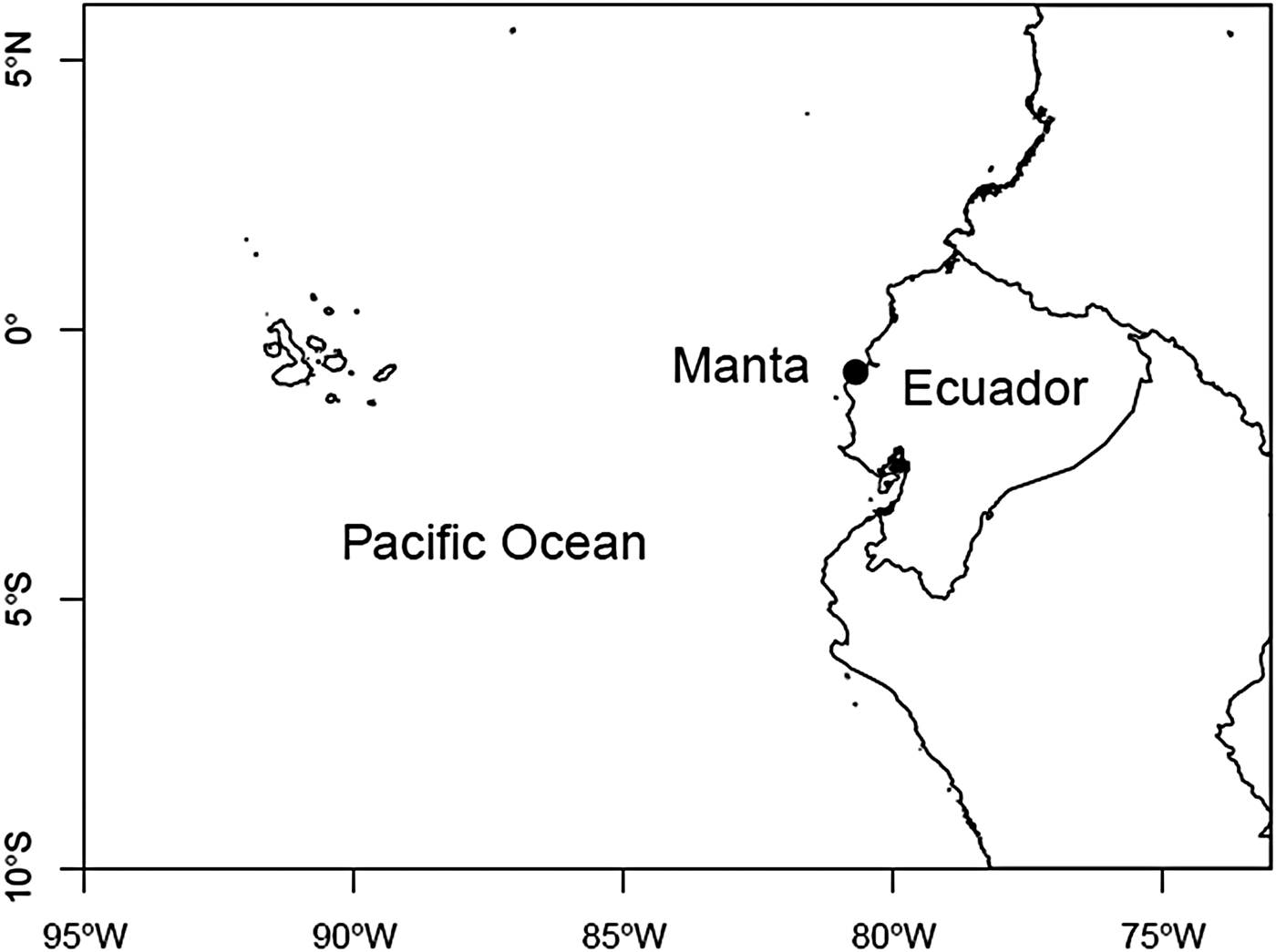
Freshly caught common dolphinfish (N = 320), ranging from 51 to 149 cm in total length (TL), were sampled in Playita Mía (Manta, Ecuador) (Figure 1). The fish were captured by artisanal boats during night-time hours off the coast of Ecuador in December–May (2014–2015). The main bait species used in the fishing operations were jumbo squid (Dosidicus gigas), longfin salema (Xenichthys xantii) and chere-chere grunt (Haemulon steindachneri).
Common dolphinfish were captured in the Pacific coast of Ecuador. The filled circle represents the sampling location.

Whole stomachs (N = 320) were collected from each fish and stored at −20°C until analysis. In the laboratory, they were dissected for prey identification to the lowest possible taxonomic level. Food items considered to be bait were not taken into consideration for analysis, and the stomachs containing only bait were classified as empty. Hard parts (fish otoliths and cephalopod beaks) were used for identification of partially digested prey using specific taxonomic keys (Clarke, Reference Clarke1986; Harvey et al., Reference Harvey, Loughlin, Perez and Oxman2000; García-Godos Naveda, Reference García-Godos Naveda2001).
Data analysis
The dietary importance of each prey was assessed by three indices: (1) percentage of wet weight (%W i ), (2) frequency of occurrence (%O i ) and (3) the alimentary index proposed by Kawakami & Vazzoler (Reference Kawakami and Vazzoler1980) expressed as percentage according to the formula: %AIi = [(%O i × %W i )/(Σ%W i × %O i )] × 100.
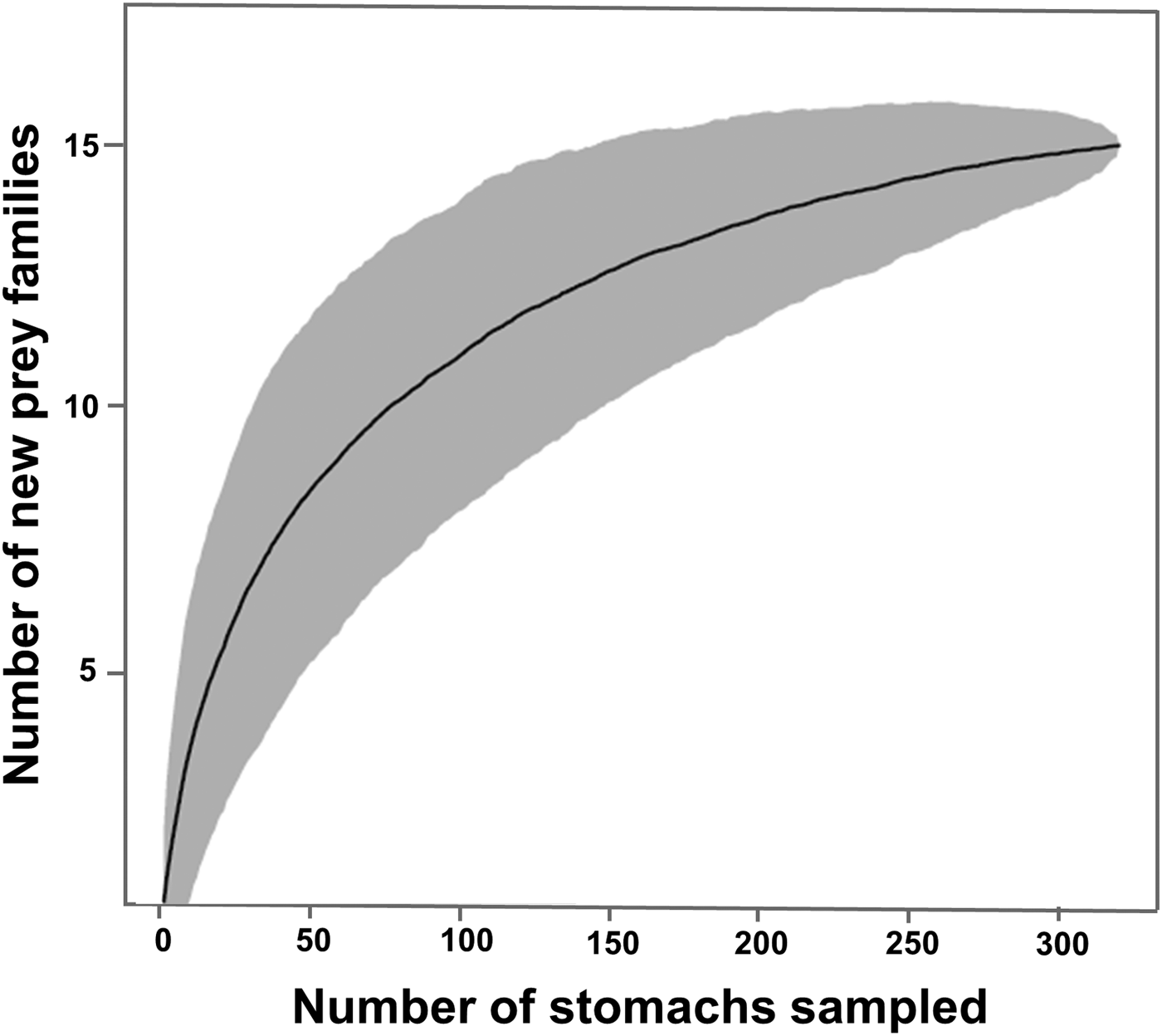
To assess whether the number of stomachs analysed was adequate to describe the diet, the cumulative curve of new prey items was plotted against the cumulative number of stomachs (Ferry & Cailliet, Reference Ferry, Cailliet, Makinlay and Shearer1996). The cumulative curve was randomly built by resampling the stomachs 500 times by the software R (R Development Core Team, 2015). To determine whether the curve reached an asymptote, the slope of the linear regression estimated from the last four stomachs was compared with 0 (horizontal asymptote) by t-test. The cumulative prey curve was constructed grouping the prey categories by family.
The feeding behaviour of C. hippurus was evaluated through modification of the graphing method proposed by Costello (Reference Costello1990) (Amundsen et al., Reference Amundsen, Gabler and Staldvik1996). In this procedure, prey-specific abundance is plotted against %O i in order to obtain information about prey importance and feeding strategy of the predator. The prey-specific abundance is calculated as follows: %P i = (Σprey i weight/Σ weight of all prey in the stomach containing prey i) × 100. Prey species that only appear in one stomach were not taken into account in the analyses.
The dietary niche breadth was explored by the standardized Levin's index expressed as:
 ${B_i} = [1/(n - 1)][{(\Sigma (1/P_{ij}^2 ))^{ - 1}}]$
, where B
i
is the measure of the Levin's niche breadth, n is the number of prey categories and P is the proportion of the AI. The standardized Levin's index ranges between 0 and 1, where low values indicate specialist feeding behaviour and high values indicate generalist feeding behaviour (Krebs, Reference Krebs1989).
Size-related and temporal shifts in diet composition were evaluated by a permutational multivariate analysis of variance (PERMANOVA) (Anderson, Reference Anderson2001; McArdle & Anderson, Reference McArdle and Anderson2001). An experimental design with two fixed factors was considered: ‘Size class’ (with three levels, <80 cm in TL, 80–110 cm in TL, ≥110 cm in TL) and ‘Date of capture’ (with three levels, December–January, February–March, April–May). The analysis was based on a Bray–Curtis similarity matrix calculated from the prey weight values, after performing a fourth-root transformation (Bray & Curtis, Reference Bray and Curtis1957). Significant terms were investigated using a posteriori pair-wise comparisons with the PERMANOVA test. Similarity percentages (SIMPER; Clarke, Reference Clarke1993) were used to identify which dietary categories typified particular groups. Multivariate analyses were performed using the software PRIMER v6.1.11 & PERMANOVA+ v1.0.1 statistical package (Clarke & Gorley, Reference Clarke and Gorley2006).
The consumption food rate was calculated as proposed by Olson & Mullen (Reference Olson and Mullen1986), according to the formula:
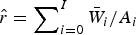 $\hat r = \sum\nolimits_{i = 0}^I {{{\bar W}_i}/{A_i}} $
, where
 $\hat r$
is the feeding rate measured in grams per hour,
 ${\bar W_i}$
is the weight of prey i divided by the total number of stomachs and A
i
is the average time required to evacuate the average proportion of prey i.
Because the dolphinfish feeds during day and night hours (Olson & Galván-Magaña, Reference Olson and Galván-Magaña2002), daily meal was estimated by multiplying
 $\hat r$
by 24 h. Daily ration (expressed as percentage) was then calculated by dividing the daily meal by the body mass of the dolphinfish. The body mass was estimated from the length using the equation proposed by Lasso & Zapata (Reference Lasso and Zapata1999): BM = 0.0224 × (0.8278 × TL)2.78, where BM is the body mass (g) and TL is the total length (cm). Size-related shifts in daily ration were investigated by grouping the fish into three size classes: Class I (<80 cm in TL), Class II (80–110 cm in TL) and Class III (≥110 cm in TL).
RESULTS
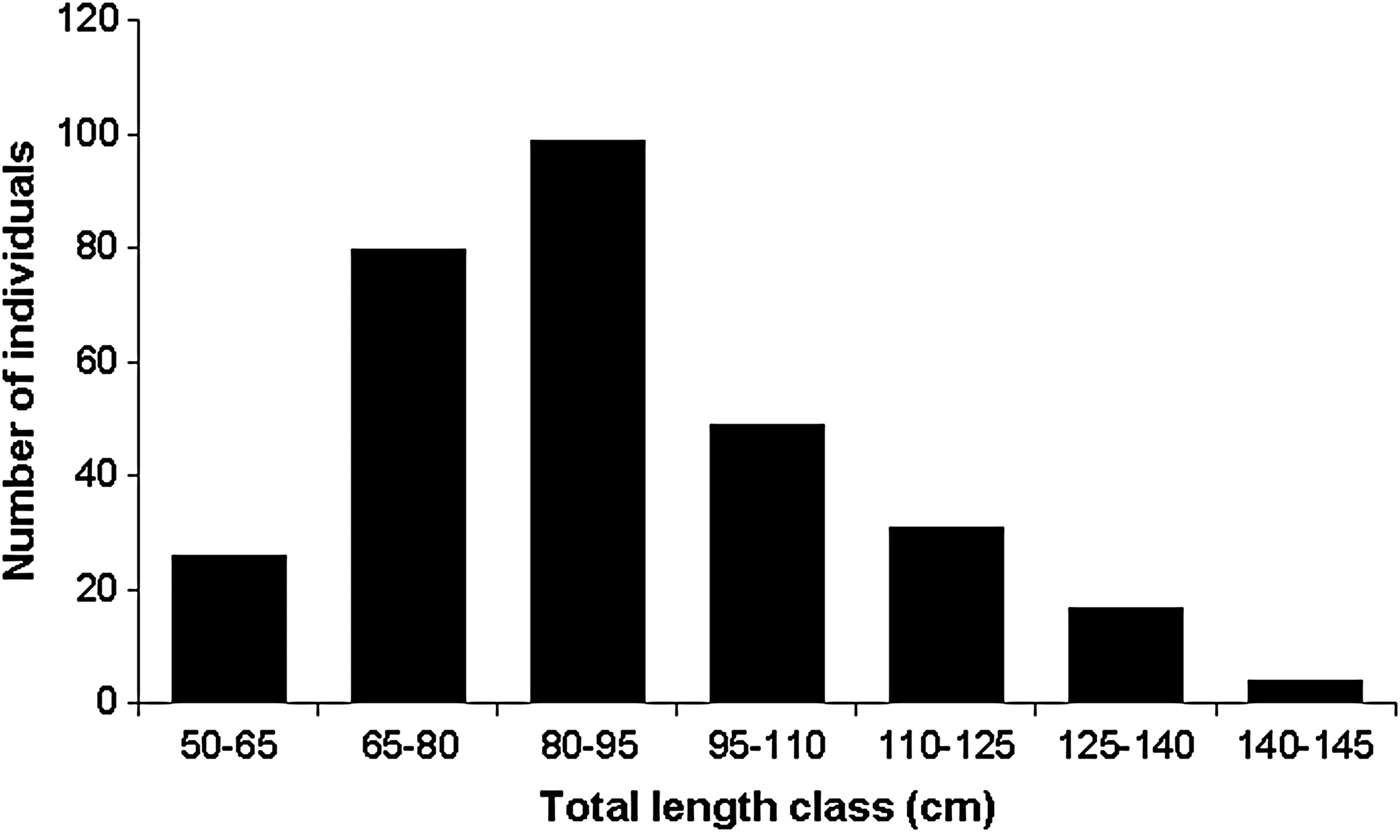
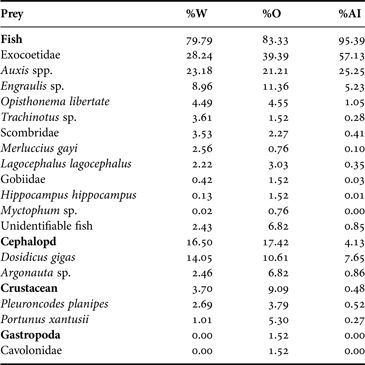
The size frequency distribution of the sampled fish is presented in Figure 2. Of the 320 stomachs examined, 188 were considered empty (58.75%) and 132 contained prey (41.25%). The diet comprised of 16 taxa, including 11 fishes, two cephalopods, two crustaceans and one gastropod (Table 1). Fish was the most abundant prey group (%AI = 95.39) followed by cephalopod (%AI = 4.13) and crustacean (%AI = 0.48). The most abundant taxa in terms of %AI were the Exocoetidae family and Auxis sp. (57.13 and 25.25%, respectively), whereas the jumbo squid (Dosidicus gigas) was the most important invertebrate prey-species (%AI = 7.65) (Table 1).
Length–frequency distribution of the common dolphinfish sampled.

Diet composition of common dolphinfish capture in the Pacific coast of Ecuador. Percentage of weight (%W), occurrence (%O) and alimentary index (%AI).

The cumulative prey curve reached the asymptote for the last four points (Figure 3) (t-test, P > 0.05) and, therefore, the number of samples was considered adequate to describe the diet.
Cumulative prey curve for common dolphinfish captured in the Pacific coast of Ecuador.

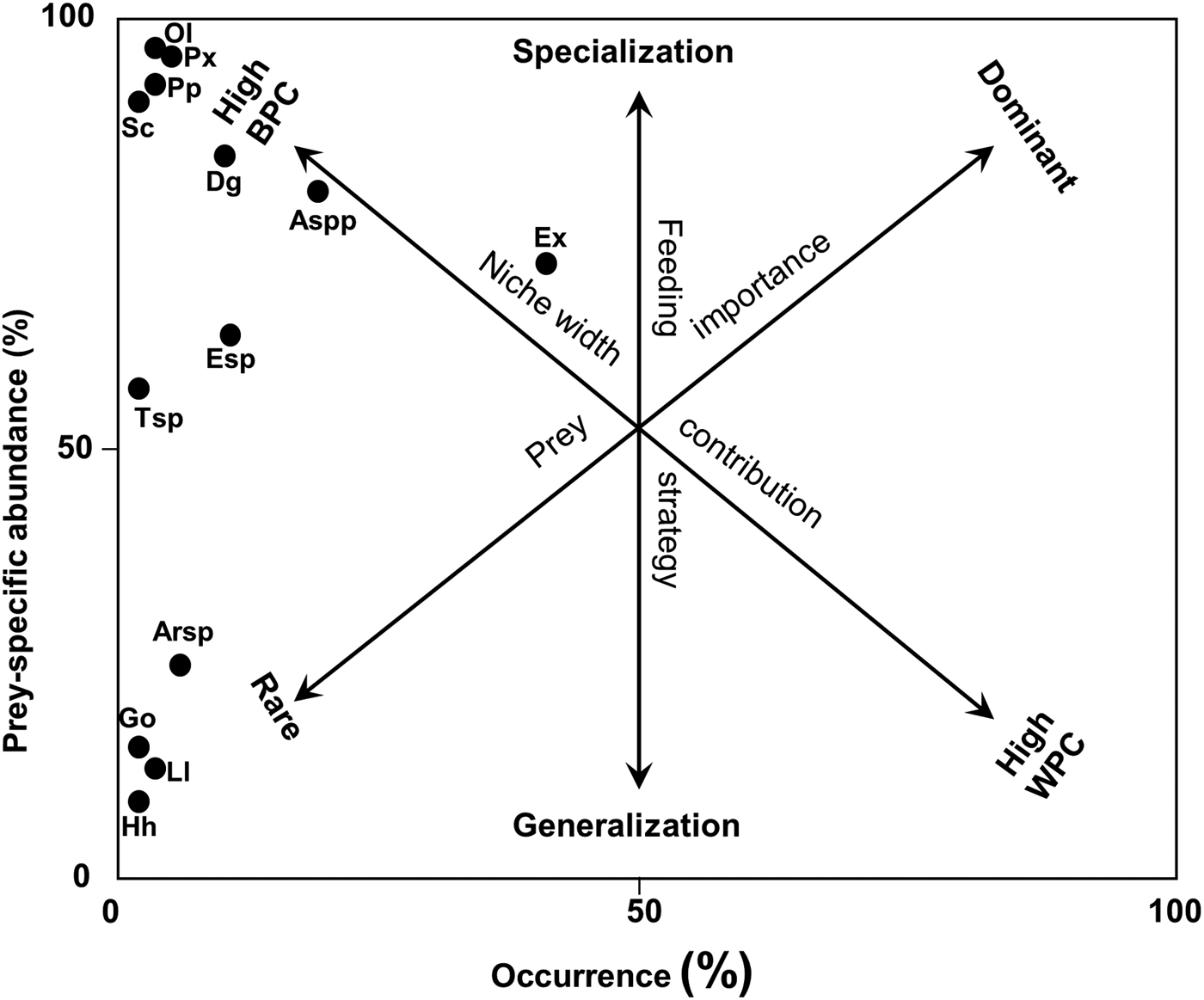
The Amundsen plot based on prey-specific abundance against occurrence (Figure 4) suggests that in the Ecuadorian Pacific the common dolphinfish has a varying degree of specialization on different prey taxa. Thus, Hippocampus hippocampus, Lagocephalus lagocephalus, Gobiidae and Argonauta sp. showed low occurrence and low prey-specific abundance (lower left), suggesting that all these species are unimportant and rare prey. Scombridae, Pleuroncodes planipes, Portunus xantusii and Opisthonema libertate showed low occurrence and high prey-specific abundance (upper left), indicating they are predated by a low number of individuals. Exocoetidae, located in the upper central area of the graph, may be considered the most important prey species, since it was found in a high percentage of stomachs (%O = 39.39). In spite of the fact that some individuals predated on a small proportion of prey, many of them fed on the dominant taxa (Exocoetidae), explaining the narrow niche width observed (B i = 0.10).
Prey-specific abundance plotted against frequency of occurrence of prey species for common dolphinfish from the Pacific coast of Ecuador. Explanatory axes for foraging patterns are those of Costello (Reference Costello1990) as modified from Amundsen et al. (Reference Amundsen, Gabler and Staldvik1996). The two diagonal axes represent the importance of prey (dominant vs rare) and the contribution to the niche width (high between-phenotype vs high within-phenotype contribution); the vertical axis defines the predator feeding strategy (specialist vs generalist). Aspp, Auxis spp.; Arsp, Argonauta sp.; Dd, Dosidicus gigas; Esp, Engraulis sp.; Ex, Exocoetidae; Go, Gobiidae; Hh, Hippocampus hippocampus; Ll, Lagocephalus lagocephalus; Ol, Opisthonema libertate; Sc, Scombridae; Tsp, Trachinotus sp.; Pp; Pleuroncodes planipes; Px, Portunus xantusii.

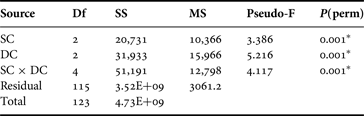
The PERMANOVA analysis showed significant differences in the diet of C. hippurus among the three levels of ‘Size class’ and ‘Date of capture’. The interactions between both of the factors were also significantly different, indicating that the differences in ‘Date of capture’ were not homogeneous across the levels of the ‘Size class’ factor (PERMANOVA, P = 0.001) (Table 2). Pair-wise PERMANOVA test revealed significant differences in the dietary composition among the three levels of ‘Date of capture’ for the smallest and medium specimens (PERMANOVA, P < 0.01) (Table 3). Only the largest specimens of C. hippurus (≥110 cm in TL) fed on the same prey-species throughout the period of sampling (Table 3).
Results of PERMANOVA test performed on Bray–Curtis dissimilarity matrix based on biomass of prey per stomach.

Asterisk indicates a significant difference. SC, Size Class; DC, Date of capture.
A posteriori pair-wise permutational multivariate analysis of variance comparison for the significant ‘Size Class’ and ‘Data of capture’ interaction.

Asterisk indicates a significant difference. Dec–Jan, December 2014–January 2015; Feb–Mar, February–March 2015; Apr–May; April–May 2015.
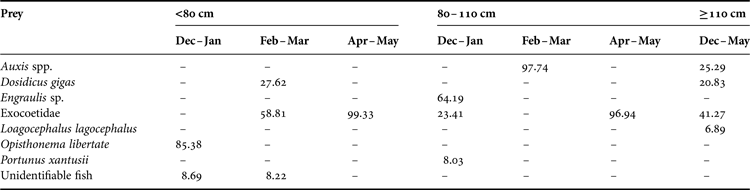
According to the SIMPER analysis (Table 4), the diet of C. hippurs was quantitatively characterized by eight prey items (six fish, one cephalopod and 1 crustacean). Exocoetidae was the only prey item that quantitatively characterized the diet in all size classes, whereas Auxis spp. and Dosidicus gigas were the heaviest contributors to the similarity in two size classes. Thus, Auxis spp. was consumed by the medium (contributing to 97.74% of the similarities) and largest specimens (25.29%), and D. gigas was consumed by the smallest (27.62%) and biggest ones (20.83%). The other prey species identified by SIMPER analysis exclusively characterized a single size class. Otherwise, for the three levels of the ‘Date of capture’ factor, a single prey contributed to the diet with more than 40%.
Contribution of main prey types (expressed as percentage) to diet of Coryphaena hippurus identified by similarity percentage (SIMPER) analysis.

Dec–Jan, December 2014–January 2015; Feb–Mar, February–March 2015; Apr–May, April–May 2015; Dec–May, December 2014–May 2015.
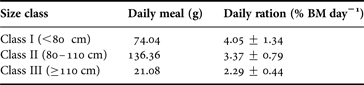
Daily meal and daily ratio were calculated from A i values reported in earlier studies aimed at determining the consumption rate of the dolphinfish (see Olson & Galván-Magaña, 2002; Varghese et al., Reference Varghese, Somvanshi, John and Dalvi2013). Both daily meal and daily ratio showed variations with size length. Thus, whereas daily meal increased from 74.04 g day−1 in the smallest specimens to 210.08 g day−1 in the largest ones, the daily ratio decreased from 4.05 ± 1.34 to 2.29 ± 0.44% BM day−1 (Table 5).
Size-related shifts in daily meal and daily ration (mean ± SD) of Coryphaena hippurus in the Pacific coast of Ecuador.

DISCUSSION
The high importance of fish in the diet of C. hippurus captured in the Pacific coast of Ecuador is in accordance with previous dietary studies carried out on this species (Aguilar-Palomino et al., Reference Aguilar-Palomino, Galván-Magaña, Abitia-Cardenas, Muhlia-Melo and Rodriguez-Romero1998; Olson & Galván-Magaña, Reference Olson and Galván-Magaña2002; Tripp-Valdez et al., Reference Tripp-Valdez, Galván-Magaña and Ortega-García2010). Within the fish group, flyingfish (Exocotidae) was the most important prey category, as has also been reported in all seas worldwide (Massutí et al., Reference Massutí, Deudero, Sanchez and Morales-Nin1998; Oxenford & Hunte, Reference Oxenford and Hunte1999; Sakamoto & Kojima, Reference Sakamoto and Kojima1999; Olson & Galván-Magaña, Reference Olson and Galván-Magaña2002; Malone et al., Reference Malone, Buck, Moreno and Sancho2011; Varghese et al., Reference Varghese, Somvanshi, John and Dalvi2013). This family represents a good source of amino acids and lipids (Harewood et al., Reference Harewood, Wood and Constantinides1993), showing a high caloric content in comparison with the invertebrate prey species found in the stomachs (Robertson & Chivers, Reference Robertson and Chivers1997; Tripp-Valdez et al., Reference Tripp-Valdez, Galván-Magaña and Ortega-García2010).
Because C. hippurus were captured during night-time hours, the presence of Myctophum sp., Merluccius gayi and D. gigas at an early stage of digestion suggests nocturnal foraging events. Nevertheless, the great number of empty stomachs found (58.75%) indicates that this species feeds mainly in the daytime. This fact was also suggested in similar studies carried out in the Mediterranean, Caribbean and Arabian Seas (Masutti et al., Reference Massutí, Deudero, Sanchez and Morales-Nin1998; Oxenford & Hunte, Reference Oxenford and Hunte1999; Varghese et al., Reference Varghese, Somvanshi, John and Dalvi2014). Yet, this hypothesis should be addressed in further studies, since previous observations made in the Gulf of Mexico stream indicated that dolphinfish do not feed during the night (Gibbs & Collette, Reference Gibbs and Collette1959). The jumbo squid (D. gigas) was the most abundant invertebrate found, although its contribution may be overestimated because this species is a common bait used in fishing operations. This squid serves as a trophic link between small mesopelagic organisms and top predators (Gilly et al., Reference Gilly, Markaida, Baxter, Block, Boustany, Zeidberg, Reisenbichler, Robison, Bazzino and Salinas2006) and represents an important component in the diet of sharks, tunas and billfishes in the Ecuadorian Pacific coast (Galván-Magaña et al., Reference Galván-Magaña, Polo-Silva, Hernández-Aguilar, Sandoval-Londoño, Ochoa-Díaz, Aguilar-Castro, Castañeda-Suárez, Cabrera Chavez-Costa, Baigorrí-Santacruz, Torres-Rojas and Abitia-Cárdenas2013; Olson et al., Reference Olson, Duffy, Kuhnert, Galván-Magaña, Bocanegra-Castillo and Alatorre-Ramirez2014; Rosas-Luis et al., Reference Rosas-Luis, Loor-Andrade, Carrera-Fernández, Pincay-Espinoza, Vinces-Ortega and Chompoy-Salazar2016). For instance, Galván-Magaña et al. (Reference Galván-Magaña, Polo-Silva, Hernández-Aguilar, Sandoval-Londoño, Ochoa-Díaz, Aguilar-Castro, Castañeda-Suárez, Cabrera Chavez-Costa, Baigorrí-Santacruz, Torres-Rojas and Abitia-Cárdenas2013) reported that D. gigas was the predominant prey in the diet of two pelagic sharks, while Olson et al. (Reference Olson, Duffy, Kuhnert, Galván-Magaña, Bocanegra-Castillo and Alatorre-Ramirez2014) and Rosas-Luis et al. (Reference Rosas-Luis, Loor-Andrade, Carrera-Fernández, Pincay-Espinoza, Vinces-Ortega and Chompoy-Salazar2016) observed that this species is frequent in the diet of yellowfin tuna (Thunnus albacares) and swordfish (Xiphias gladius). In South Baja California, Aguilar-Palomino et al. (Reference Aguilar-Palomino, Galván-Magaña, Abitia-Cardenas, Muhlia-Melo and Rodriguez-Romero1998) and Tripp-Valdez et al. (Reference Tripp-Valdez, Galván-Magaña and Ortega-García2015) reported that the jumbo squid was the most important species in the diet of dolphinfish, while no individual was identified by Tripp-Valdez et al. (Reference Tripp-Valdez, Galván-Magaña and Ortega-García2010) in the same area. These marked discrepancies are probably associated with environmental changes, which may cause variation in the abundance of this ommastrephid (Nevárez-Martínez et al., Reference Nevárez-Martínez, Morales-Bojórquez, Cervantes-Valle, Santos Molina and López-Martínez2010).
The presence of the squat lobster (Pleuroncodes planipes) in the diet of dolphinfish was also reported in earlier studies carried out in the eastern Pacific coast (Aguilar-Palomino et al., Reference Aguilar-Palomino, Galván-Magaña, Abitia-Cardenas, Muhlia-Melo and Rodriguez-Romero1998; Olson & Galvan-Magaña, Reference Olson and Galván-Magaña2002; Torres-Rojas et al., Reference Torres-Rojas, Hernández-Herrera, Ortega-García and Soto-Jiménez2014). In terms of energy budget, this crustacean is of little importance for top predator fishes, since galaterids only contain 0.94 kcal g−1 dry weight (Abitia-Cardenas et al., Reference Abitia-Cardenas, Galván-Magaña and Rodriguez-Romero1997). Nevertheless, this anomuran can appear in a vast abundance in association with El Niño Southern Oscillation (ENSO) events (Thompson et al., Reference Thompson, Tsukada and Laughlin1993; Gutiérrez et al., Reference Gutiérrez, Ramirez, Bertrand, Morón and Bertrand2008), as the one that occurred in 2015 (NOAA, 2015).
The size-related and temporal shifts observed in the dietary composition of the common dolphinfish are probably related to the availability of its potential preys. It is known that oscillations in physical (e.g. temperature or salinity) or chemical (e.g. oxygen) factors influence on the abundance of marine organisms (Chavez et al., Reference Chavez, Bertrand, Guevara-Carrasco, Soler and Csierke2008). Thus, the 2015 El Niño, which increased the water temperature in the coast of Ecuador (NOAA, 2015), may cause not only the proliferation of squat lobster but also sporadic increases in squid (i.e. D. gigas) and small fishes (i.e. Myctophidae or Engraulis sp.) (Chavez et al., Reference Chavez, Bertrand, Guevara-Carrasco, Soler and Csierke2008).
The daily food intake (74.04–210.08 g) suggests that C. hippurus plays an important trophic role in pelagic ecosystems, consuming an estimated 27.03–76.68 kg of prey per individual per year in the Pacific coast of Ecuador. In the eastern Arabian Sea, a higher daily food consumption was found for this species (332.63 g) (Varghese et al., Reference Varghese, Somvanshi, John and Dalvi2013). In comparison with scombrid species, the daily meal estimated in the present study was higher than that reported for tuna mackerel (Euthynnus affinis) in eastern Australia (26–108 g) (Griffiths et al., Reference Griffiths, Kuhnert, Fry and Manson2009) and lower than that found for yellowfin tuna in the Equatorial Atlantic Ocean (363.2–1530.9 g) (Ménard et al., Reference Ménard, Stéquert, Rubin, Herrera and Marchal2000). Otherwise, the daily prey consumption rate (2.29–4.05% BM day−1) was lower than those previously reported for dolphinfish in the Eastern Pacific Ocean (5.6 ± 0.56 BM day−1) (Olson & Galván-Magaña, Reference Olson and Galván-Magaña2002) and in the eastern Arabian Sea (5.23% BM day−1) (Varghese et al., Reference Varghese, Somvanshi, John and Dalvi2013). In contrast, Young et al. (Reference Young, Lamb, Le, Bradford and Whitelaw1997) and Griffiths et al. (Reference Griffiths, Fry, Manson and Pillans2007) estimated values of 0.73–12.69 and 1.30–2.36% BM day−1 for tunas captured in Australian waters. The marked differences in the consumption rate among locations and taxa may be caused by several factors, including temperature, prey availability, prey biomass and prey type (Buckel & Conover, Reference Buckel and Conover1997).
In agreement with an earlier study (Olson & Galván-Magaña, Reference Olson and Galván-Magaña2002), the dolphinfish daily consumption rate decreased with size length. This finding can be explained by the fact that young fish have faster metabolic rates and thus require more feed relative to their body mass than do larger fish (NRC, 1978). Similarly, Maldeniya (Reference Maldeniya1996) and Griffiths et al. (Reference Griffiths, Kuhnert, Fry and Manson2009) found that in scombrids the daily ration decreases with increasing body size.
The results of this study indicate that the common dolphinfish is an opportunistic feeder, which is able to ingest a wide variety of schooling epipelagic organisms. In order to complement the available information obtained from stomach content analysis, stable isotope analyses, which provide information at larger time-scales, should be undertaken in further investigations aimed at increasing our knowledge on the trophic biology of this species.
FINANCIAL SUPPORT
The present work has been funded by the Andalucía Talent Hub Program launched by the Andalusian Knowledge Agency, co-funded by the European Union's Seventh Framework Program, Marie Skłodowska-Curie actions (COFUND – Grant Agreement no. 291780) and the Ministry of Economy, Innovation, Science and Employment of the Junta de Andalucía. J.L.V. benefitted from a grant under the Prometeo Project programme (SENESCYT, Ecuador). This is CEIMAR contribution #114.