

Introduction
Institutional ownership of stock markets has been rising consistently since the 1970s. The initial growth was driven by pension funds, leading Peter Drucker in 1993 to fear the onset of “pension fund socialism” in which workers, through their pension fund holdings, would dominate corporate strategy.Footnote 1 In the 1980s and 1990s the rise of mutual funds took over the lead from pension funds resulting in the coining of the term “mutual fund capitalism.” More recent definitions, such as “asset manager” capitalism, seek to be flexible so as to incorporate both mutual funds and Exchange Traded Funds (ETFs).Footnote 2 Whatever the term used to describe the contemporary capitalism, the growth of institutional investors has brought about a re-concentration of ownership and a curtailment of the collective action problem that hitherto complicated shareholders’ exercise of control.Footnote 3
Institutional ownership of companies has grown to the point that institutions today own approximately 80 percent of the market value of U.S. stocks.Footnote 4 Recent academic research explores this rising ownership concentration and debates the growing importance of “passive” or “index” investors.Footnote 5 This literature raises concerns that asset managers in general, and index funds in particular, may be becoming too powerful, while also exhibiting conflicts of interests.Footnote 6 Some, therefore, suggest that index funds have become so powerful, they will cast the deciding vote on any proxy battles between activist investors and corporate management.Footnote 7 Others see a conflicts of interest resulting from asset managers seeking to gain incremental assets from corporate pension funds, with the result that they will vote mainly with management, thereby inhibiting the corrective influence exerted by activist investors within the capitalist system.Footnote 8 One solution that has, therefore, been suggested is to disenfranchise index investors by preventing them from voting their proxy votes.Footnote 9
Instead, this paper highlights that for the largest index investors, on whom much of the literature focusses, the cost of engagement (when expressed in basis points of profits earned from asset under management) has fallen to a level where it is today negligible. The literature fails to account fully for the significant economies of scale and therefore posits that index funds will not invest beyond a minimum standard of corporate governance as the benefits will accrue to all investors. However, the concentration amongst index funds, with the three largest fund managers controlling over 90 percent of assets, ensures sufficient return on any governance investment.Footnote 10
Drawing on information collected in more than fifty interviews with institutional investors, corporate issuers, and their advisors, this paper contributes to this literature an examination of the nature of the investor-corporate dialogue. It finds that engagement on issues of corporate governance beyond proxy voting is, to date, primarily a domestic exercise, focused on the largest companies in each country. This is because domestic companies typically represent investors’ largest holdings, both in terms of the percentage of the funds’ assets and in percentage of the companies’ outstanding shares.
This focus on high-profile companies has left some corporates with the belief that asset managers are motivated by marketing considerations as opposed to genuine concern for the issues at hand. Companies report no substantial increase in the number of engagements in recent years but remark instead that engagement is becoming increasingly public as illustrated by the publication of investors’ letters to company boards. Satisfaction with the level of engagement appears to vary with company size. Larger, especially “mega-cap,” companies report a high level of satisfaction with the level of engagement with investors while smaller companies voice concerns about a lack of access to investors’ corporate governance teams. This corresponds with investors’ strategy of focusing on their largest holdings.
Finally, interviews with activist investors suggest that index investors do not pose barriers to successful campaigns. Instead activists have learned how to engage them through online presentations, direct email communication, and conference calls. Indeed, the main concern corporations raised in relation to index funds was a fear that they may become instrumentalized by activist funds. This paper therefore advocates against restricting index funds’ voting rights as index funds compete not only with one another for assets but also compete against active funds for assets.Footnote 11 The way for them to succeed in this competition is to invest in measures to ensure index constituents follow superior corporate governance practices.
Limiting the voting rights of index funds would muzzle those shareholders with the deepest pockets. Instead what is needed is regulation that ensures greater disclosure of engagement efforts by the largest fund companies. These companies have grown so large that they have become institutions of public interest. The condensed stewardship reports, published annually by asset managers, typically only provide abstract statistics on the number of companies engaged without providing the names of those companies, thereby frustrating academic and public attempts of oversight.
At a point in time when society is increasingly turning to the asset management industry for help in resolving issues the political process has failed to address, an understanding of the motives of institutional investors, their capacity limitations, and the process by which they prioritize corporate engagement is essential.Footnote 12 This paper concludes that for the largest institutional investors today, engagement is a more feasible choice than selling their stock. Unable to sell due to a mixture of passive mandates and liquidity constrained active funds, engagement is the only option to safeguard their customers’ assets against corporate misconduct.
The interview methodology
This paper draws on information collected in interviews with twenty-one institutional investors and thirty-three stock market-listed companies (“corporate issuers”), as well as a number of corporate governance advisors to arrive at a multi-dimensional understanding of how engagement occurs in practice. The semi-structured interviews were mostly conducted in the spring and summer of 2018 and interviewees were selected from the United Stated, the United Kingdom, and Germany, with the aim of having approximately one third from each jurisdiction. These countries were selected due to the fact that they represent both common law and civil law countries, as well as different varieties of capitalism.Footnote 13
In sum the investors interviewed managed total assets of $14.3 trillion as of September 2018 with the smallest asset manager managing assets of $4 billion dollars and the largest asset manager managing assets of several trillion. The companies interviewed for this paper had a combined market capitalization of approximately $2.5 trillion, with individual market capitalizations ranging from $4 billion to $400 billion. Balancing assets under both management and market capitalizations was important as these are proxies for the financial means companies have at their disposal.
The selection of companies was a random sample from each of the countries, with the aim of ensuring a balance across sectors and market capitalizations. Once initial interviews were secured, interviewees were asked whether they would be prepared to provide further introductions. While this “snowballing” approach risks the selection of interviewees becoming non-random, a pre-set list of quadrants (size, type, and location of institutions) was used to steer recommendations. This, together with the fact that the governance community is a relatively small group of experts, ensured that the typical pitfalls of snowball sampling were addressed.
The rise of index investors
According to Hirschman, shareholders unhappy with a company's performance have three choices: they can simply sell their stock and move on (also referred to as the “Wall Street Walk”), retain their stock and voice their concerns, or choose to do nothing. Hirschman refers to these options as exit, voice, and loyalty, respectively.
Much has changed since Hirschman first published his thoughts on exit and voice in 1970. While the initial era of globalization from the 1950s onwards was focused on the trade of goods, by the 1990s the role of finance independent of trade became increasingly important. Davis remarks that while “twentieth-century American society was organized around large corporations, particularly manufacturers and their way of doing things. It is now increasingly organized around finance” (Reference Davis2009: xi).
Institutional ownership has been growing because individual investors increasingly delegate their asset management decisions to institutional investors. They do so for a number of reasons, including the diversification benefits funds offer, access to specific investment themes, as well as the perceived stock selection expertise on offer. Around the turn of the century, when institutional ownership surpassed 50 percent of all shares in issuance, Useem, Hawley and Williams, and Harmes drew attention to this phenomenon, referring to it as investor capitalism, fiduciary capitalism, and mass investment, respectively.Footnote 14 Further significant factors contributing to the growth of institutional assets have been pension reforms and the falling costs of fund management products, caused in large part by the rise of passive investments, such as ETFs.Footnote 15
The decrease in asset management fees has not been entirely voluntary. The growth of ETFs has played a large role. The fund management industry differentiates between two types of funds. “Active” funds, which typically charge higher fees, have fund managers who take active bets selecting only those stocks they believe will have the best risk versus reward characteristics. “Passive” funds, on the other hand, track established industry benchmarks such as the S&P 500 or the FTSE 100. In the case of passive funds, the aim of the fund manager is to limit the “tracking error” between her fund and the reference index. Tracking error indicates how closely a fund follows an index.
While not proving causality, Figure 1 shows how the rise in the assets of ETFs has been accompanied by a decrease in the fees charged by actively managed mutual funds. The following quote by Larry Fink, the CEO of the world's largest asset manager BlackRock, underlines this dynamic “When I am able to increase margins and increase market share through price cuts, I am going to do that. The key element is scale.”Footnote 16
Rising ETF assets coincide with falling expense ratios of actively managed funds
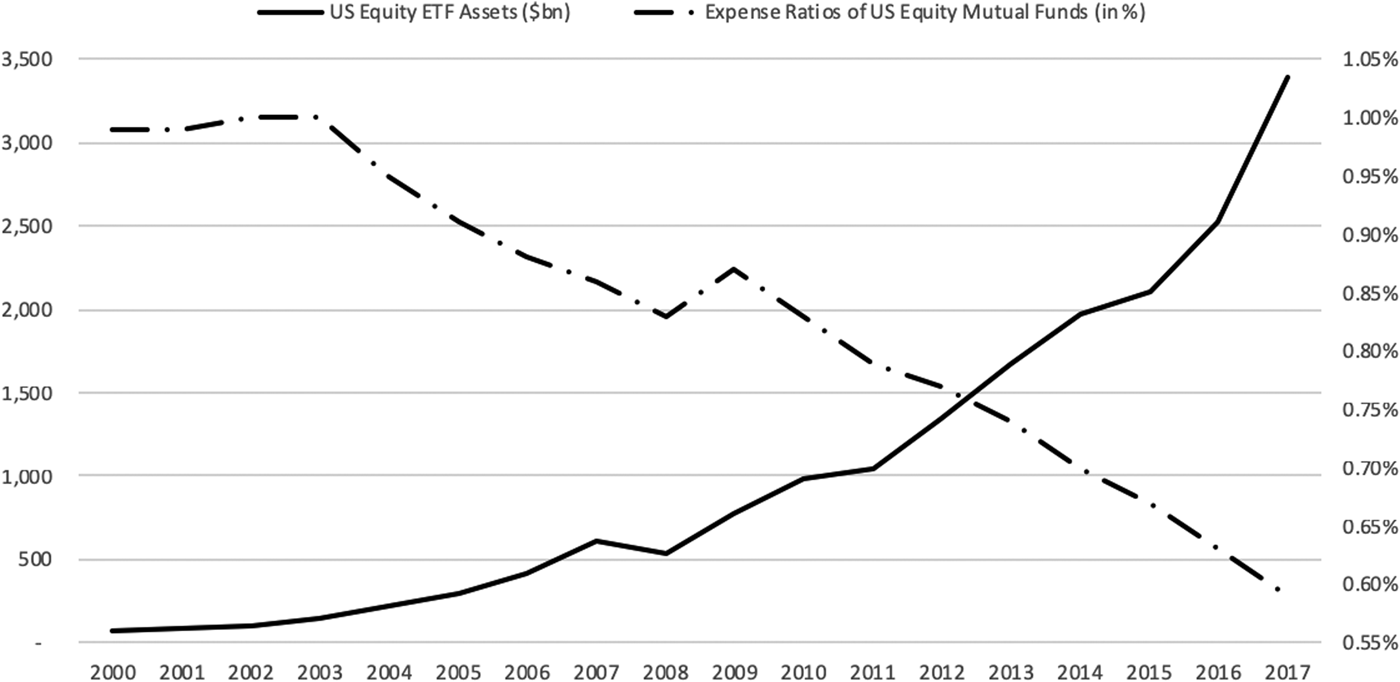
Figure 1 further shows that U.S. equity ETFs have accumulated close to $2.5 trillion in assets over the past decade. This accumulation of assets has come at the cost of active managers. Not only have they had to lower management fees in response to the success of ETFs, ICI (2018) data shows that while ETFs enjoyed cumulative inflows of approximately $1 trillion since 2008, U.S. equity mutual funds suffered equivalent cumulative outflows of approximately $1 trillion over the same period. While initially regarding ETFs as the enemy, many mutual fund companies soon realized they could not afford not to have their own ETF offering. As a result, many of the large fund companies today offer both active mutual funds and ETFs.Footnote 17
The popularity of ETFs and mutual funds has resulted in the ownership structure of companies being turned on its head. While in 1970 it was individual investors that controlled around 70 percent of all outstanding shares in the United States, today it is institutional investors who own 80 percent of the outstanding shares of U.S. companies by market capitalization. Also, much of what remains as individual ownership today is in fact ownership by founders and senior management. This change in ownership structure has had profound consequences for the corporate governance of firms. In the period of “managerialism” that preceded the 1980s, company executives faced a disjointed shareholder base as individual shareholders were faced with a collective action problem in their ability to co-ordinate their views on company policy.Footnote 18 “The scattering of stock among thousands of small owners had undercut the capacity of shareholders to oversee their enterprises.”Footnote 19 However, the onset of asset manager capitalism provided a solution to this collective action problem.Footnote 20 This is because “by centralizing investment decision making within disintermediated capital markets, institutional investors seem to have increased the ability of investors to exercise direct forms of power over corporate and sovereign borrowers.”Footnote 21 In asset manager capitalism it is not the many ultimate investors but their intermediaries that typically engage with companies and exercise the voting power.Footnote 22
While providing a remedy for the collective action problem, asset manager capitalism also poses a new challenge. Ever-greater shareholdings by a relatively small number of very large institutional investors means it is increasingly difficult for these institutions to sell their positions in a company without substantial negative price effects. The tracking error constraints that come with passive management further limit the ability to sell. While asset manager capitalism has given investors greater influence over company strategy, if this influence does not suffice to achieve the desired effect in corporate policies, then investors may find themselves in a situation where they have little say and no ability to sell. In Hirschman's terms, asset manager capitalism has increased the potential of voice but decreased the ability to exit.
Choosing between voice and exit
The use of voice is motivated by the (in)ability to exit and the prospect for successful use of voice.Footnote 23 As ownership concentration increases, the ability to exit stocks becomes less feasible and voice should become a preferred option. In their 1998 paper “Law and Finance,” La Porta, Lopez-de-Silanes, Shleifer, and Vishney (hereafter referred to as LLSV) study the relationship between shareholder concentration and shareholder rights. For their analysis they identified the ten largest companies by market capitalization for each country, excluding companies that were part-owned by governments, as well as financial companies. At the time they found that for U.S. listed companies the median ownership of the ten largest non-financial domestic firms by the three largest shareholders was 12 percent. Table 1 shows that repeating this calculation twenty years later returns a median holding of 19 percent for the United States. This gives an indication of the extent to which ownership concentration in the United States has increased over the past two decades.Footnote 24
1998 vs 2018: Ownership of ten largest nonfinancial domestic firms by three largest shareholders
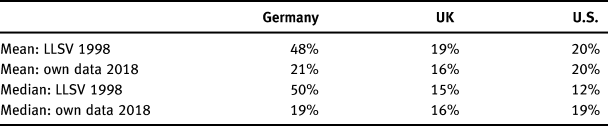
Source: LLSV (1998), Bloomberg, author's own calculations, as of August 2018
But not only have the levels of ownership concentration harmonized across countries, so too have the names on the share register. When one looks at the shareholder registry of a typical company, whether in Germany, the United Kingdom, or the United States, there are six names that come up repeatedly. These are BlackRock, Vanguard, State Street, Fidelity, BNY Mellon Investment Management, and Capital Group. Together these asset managers control approximately $20 trillion of assets, equal to approximately 25 percent of the $79.2 trillion global asset management industry.Footnote 25 The assets of these fund management companies are contained in a large number of individual funds. Together they make up “fund families.”
Fichtner et al. separate out the passive equity assets and show that BlackRock, Vanguard, and State Street manage over 90 percent of all Assets under Management (AuM) in passive equity funds and that these three institutions (the “Big Three”) together constitute the largest owner in 438 of the 500 most important American corporations.Footnote 26 Substantial economies of scale are responsible for this concentration of assets in the investment management industry. A fund manager has the same investment universe to look through whether his portfolio has €10 million euro or €1 billion in assets under management so long as the benchmark investment universe remains the same (though fund size will impact what stocks can be invested in from a liquidity perspective). An established fund management team can therefore manage, for example, a doubling of assets without the need for a meaningful increase in resources. Similarly, other staff such as legal and governance support will also not need to be increased so long as the total number of stocks held does not increase in response to the new assets. Index investing further increases the importance of economies of scale, as fees typically explain the majority of any performance differential. Scale has been employed by the larger asset managers to decrease fees with the aim of taking market share from the smaller asset managers, who typically have a higher cost base.Footnote 27
While the increase in ownership concentration is supportive of the use of voice, it has negative consequences for the ability to exit. The ability to sell shares and exit a stockholding is primarily determined by three factors: a fund's investment guidelines (whether it is an active or passive fund), the fund managers’ willingness to take on tracking error risk, and transaction costs. Since it is passive managers’ task to track a reference benchmark as closely as possibly, they will usually opt to buy all stocks contained in such indices.Footnote 28 A passive fund manager will not be able to sell a stock for as long as it is contained within her benchmark. Bank of America Merrill Lynch estimates the market share of passive managers at 45 percent.Footnote 29
However, it is not only index funds that are unable to sell. Active managers typically have a universe from which they may pick stocks and a benchmark against which their performance is tracked. If a fund manager decides to sell her holding in a stock that is contained within her benchmark this will increase “tracking error” (similarly, buying a stock that is not included in the benchmark may do the same).Footnote 30 Even when funds do not have an official benchmark they track, the fund manager will often have an internal benchmark according to which her performance is measured. In some cases, fund managers may have a formal quantitative “tracking error constraint” that specifies how much tracking risk they may take; in the other cases it will be down to their own discretion and thus their personal risk appetite. Risk appetite will be a function of the pay structure of the fund management company as well as the career risk a fund manager perceives will result from a bad result (closely tracking an index may ensure that one is not one of the worst performers and thus at risk of being let go). In practice, some fund managers have therefore chosen to invest in a manner that has been referred to as “closet indexing” or “benchmark hugging.”Footnote 31
Benchmark hugging must not be voluntary though. There are also fund managers who would like to be more active but are liquidity-constrained due to the size of their funds. While the exit of any one individual retail investor is an insignificant affair, the exit of a large institutional shareholder may have a much more substantial impact. Any institutional investor looking to sell out of a stock holding on the open market will have a negative impact on that company's share price as the size of the institutional investors’ stake is likely to be greater than the available liquidity in the stock. Any such “market impact” resulting from a negative impact on the share price contributes to the cost of exit. For a typical mutual fund where the fund manager's performance is evaluated versus that of her peers, at the end of the year a few basis points often make the difference between coming, say, third or fifteenth in a league table. A 2015 study by McKinsey & Company estimated that 10 percent of U.S. assets qualify as “benchmark-hugging.”Footnote 32 Adding the market share of index funds (45 percent) to this gives an indication of those managers currently unable or unwilling to sell. In today's financial markets “voice” has become more relevant than “exit.”
Why passive investors engage
Increased press coverage of corporate governance matters gives the impression of a widespread increase in the number of engagement activities by investors.Footnote 33 However, the reality is more mixed. The Big Three asset management firms have bulked up their corporate governance teams significantly in recent years, yet the wider industry changes are subtler than the press attention suggests.Footnote 34 Interviews revealed that while the nature and focus of engagement has changed, the actual volume of engagement has remained relatively unchanged in recent years; signified by the fact that investor relations (IR) headcounts at corporate issuers have remained largely constant.
Rather than the number of engagements increasing, it is the type of engagement that has changed. IR managers commented on the increased use of “CEO letters” written by fund management CEOs and addressed to corporate managers. These are either directly released to the press or find their way there indirectly. The IR manager of one U.S. listed corporation explained that when he returned to work in IR in 2016, after a period of four years working in an operational role, he found “a much bigger marketing element to governance.”
Investors have sought to reduce the free-rider problem inherent in governance activity through the establishment of investor networks that amplify the collective voice while reducing the individual investor's costs of engagement. Institutional investors therefore regularly meet both in general forums, such as the United Nations Principles for Responsible Investment (PRI), as well as at designated networks, such as the International Corporate Governance Network (ICGN) or the Ceres Investor Network on Climate Risk and Sustainability (CERES).Footnote 35 There they are able to find common ground on which to engage with corporates.
While critics may question the motivation behind investors’ engagement, the majority of IR managers described the quality of engagement as good. As the head of IR of a German DAX company put it, there has been a learning curve as both corporates and investors have had to figure out how to handle topics of corporate governance. Overall, IR managers felt that institutional investors are still figuring out how to incorporate corporate governance into their investment processes.Footnote 36
Index funds have no apparent financial incentive to engage with corporates. They are paid only to track an index and any engagement they conduct has costs attached to it. Furthermore, any improvement in corporate governance that results from engagement benefits all other shareholders, enabling them to free-ride. This line of argument, however, ignores the fund management industry's structure. In reality, the Big Three asset managers have such large asset bases and such dominant market positions when it comes to the share of equity inflows captured that the cost of engagement is minimal when compared to the profits they generate.Footnote 37 As a result, the benefit from engagement only needs to be marginal to justify the money spent on engagement.Footnote 38 Yet as this section will show, the benefits are anything but marginal.
Firstly, the Big Three are not entirely passive investors. On top of their passive assets, BlackRock, Vanguard, and State Street manage $478 billion, $431 billion, and $102 billion respectively in active assets.Footnote 39 That $1 trillion in active assets would require a voting function irrespective of whether passive funds vote or not. In practice, the large asset managers have one corporate governance team that votes all shares of all funds irrespective of whether the mandates are passive or active.Footnote 40 Just as with fund management in general, the economies of scale in proxy voting are almost limitless.
Secondly, better corporate governance will lead to higher share prices which will lead to greater inflows.Footnote 41 Along these lines, Professor John Kay, author of the United Kingdom's 2012 Kay Review, suggests “it is in the interest of passive managers to engage. If they helped increase the value of their investee companies, this would raise their assets under management and thus their fee income.”Footnote 42
While the impact of governance improvements may be reflected in only very minor valuation accretions, failure of governance systems may result in much more significant losses, such as those that occurred in the share prices of Facebook following the data scandal, BP following the Deepwater Horizon oil spill, or Volkswagen AG following the diesel scandal. Their market share means that the Big Three benefit most from equity inflows that result from a country having a strong equity culture. Any such equity culture requires trust in markets and corporate scandals undermine this trust. It is thus in the interest of the big passive managers to ensure no corporate scandals occur in the large benchmark indices. The fact that passive investors, cannot sell out of holdings means that corporate governance is their only control function. Consequently, this may actually make them more incentivized than active managers to ensure good corporate governance.Footnote 43 An example of this is the impact of the March 2018 “data scandal” at Facebook and the resultant sell-off in U.S. equities it caused that resulted in $245 billion of market value being wiped off the S&P 500 index on 19 March 2018.
Such significant stock moves can affect the size of the AuM of asset managers in two ways. First, there is the stock specific drop in AuM and second there may be a wider stock market sell-off if the affected stock is of significant enough size. A rough calculation illustrates the potential financial impact: In Q1 of 2018, Blackrock, Vanguard, and State Street held approximately 146.2 million, 173.6 million, and 87 million shares, respectively.Footnote 44 On Friday, 16 March, Facebook closed at a price of $185.09. Following the news of the data scandal, the stock closed $12.53 lower at $172.56 on Monday, 19 March, and continued to fall by approximately an additional $20 over the following days. Taking just the initial first-day move equates to a decrease in AuM of $1.83 billion, $2.18 billion, and $1.09 billion for the Big Three, respectively. Assuming an average management fee of 0.1 percent of assets (across passive and active) the loss in revenue would equate to $1.83 million, $2.18 million, and $1.09 million, respectively. However, this loss is not a one-off loss, but lowers the AuM of asset managers in perpetuity. There are several ways to approximate this. One could, for example, treat the $2 million as a negative perpetuity that is discounted with an interest rate to arrive by a present value estimate. Alternatively, one could approximate the loss in income by the negative income this will have to the valuation of the asset manager itself. Asset managers are typically valued at between 1-2 percent of their AuM. In the case of the Facebook example, the $1.83 billion reduction in AuM for BlackRock would, by that logic, equate to a loss of between $18.3 million to $36.6 million.
But the above calculation covers only the stock-specific loss in AuM; there is also the wider market sell-off it triggered. Prior to the Facebook announcement the S&P 500 had a market capitalization of approximately $24 trillion. On 19 March 2018, the S&P 500 subsequently lost 1.17 percent in value. Assuming an average valuation of 1 percent of AuM for the Big Three, and a mean holding of 17.6 percent of S&P companies (Fichtner et al. (Reference Fichtner, Heemskerk and Garcia-Bernardo2017)), implies that these three asset managers lost as much as $718 million in market value as a result of the S&P 500 move on 19 March 2018.Footnote 45 The fewer scandals occur, the safer equities appear and the more assets the passive managers can attract. And while the Big Three might have to pay for it, they also receive a large portion of the inflows.
Bebchuk and Hirst argue that index funds have strong incentives to under-invest in stewardship due to the agency relationship between asset managers and their beneficiaries, the ultimate owners of the assets.Footnote 46 Due to the low fees they charge, the authors argue, index fund managers will only capture a very small proportion of any increase in company value that their governance efforts generate. The authors provide the following numerical example: An asset manager holding a stock position worth $1 billion increases the value of said company by 0.10 percent as a result of better corporate governance. Since the asset manager only charges a fee of 0.50 percent, they will only capture $5,000 worth of value ($1 billion x 0.10 percent x 0.50 percent). However, this example only considers a very small stock move such as it may result from better governance. It does not account for the annual compounding of this benefit and it does not consider the possibility that a significant stock sell-off might be avoided as a result of better governance.
In addition to these valuation effects, there may also be a marketing consideration to engagement as there may be a “halo effect” emanating from engagement activities. For example, a fund management company challenging excessive executive remuneration is likely to improve their public image. The head of IR of a German DAX corporation said that he believed institutional investors have discovered a positive correlation between their assets under management and the frequency with which they appear in the press with corporate governance issues.Footnote 47 A fund manager at a German mutual fund company, who acknowledged that they track the frequency with which they appear in the press for this purpose, confirmed this point. This may also explain why corporates reported engagement mainly from domestic investors and only rarely from international shareholders. Confrontations between investors and their domestic corporations are most likely to gain the attention of the investors’ local customer base.Footnote 48
The largest asset managers are likely to benefit the most from the overall halo effect, but even for the smaller managers, corporate engagement, when conducted in the open, is a cheap means of publicity. Along similar lines the IR manager of a U.S. listed corporate noted how “shareholder letters are an interesting dynamic. They are full of platitudes that probably everyone can agree to, but the recommendations are not necessarily actionable. These letters come particularly from passive CEOs and we receive three to five letters regularly. The fact that they are also released to the press tells you a lot about their purpose.”Footnote 49 However, even critics accept that what may have started as a marketing exercise has matured into serious governance engagement because retail investors “have taken the bait and are showing interest” in engagement as the head of investor relations for a German DAX company put it. In their study of index fund incentives, Bebchuk and Hirst assume that “stewardship does not affect the flow of funds.”Footnote 50 Yet this assumption neglects both the existence of the halo effect as well as the fact that the Big Three receive the majority of inflows and thus stand to suffer the greatest losses should a major scandal harm the reputation of stocks as a safe means of investment.
Finally, client demand is an important driver of passive investors’ engagement activities. When institutional asset owners outsource their asset management mandates, they typically not only outsource the portfolio management function but also with it proxy voting and engagement functions. Clients will expect proxy voting at the very least and fund managers have reported explicitly charging for this function. Regulators may also have an expectation of what the fiduciary duty towards clients entails. In a world in which ownership concentration has reduced the ability to sell the shares of underperforming companies, institutional investors increasingly have no choice other than to become active stewards of the companies they invest in if they are to fulfill their fiduciary duties towards their clients. Regulatory requirements differ from country to country, and in the case of Germany, for example, proxy voting is not required legally. In the United States employing the services of a proxy advisory firm may suffice for the fulfillment of fiduciary duties.Footnote 51 In the United Kingdom the Stewardship Code explicitly states that “For investors, stewardship is more than just voting.”Footnote 52 Engagement by passive fund managers may therefore also be seen as a safeguard from future regulation.Footnote 53 In addition to the previously mentioned marketing-halo, index investors may therefore also engage with companies in order to seek protection from regulation by means of a regulatory-halo.
Ownership concentration and activist campaigns
In recent years, the criticism of passive investors has shifted from accusations of being “absentee landlords” with no “skin in the game” towards unease about their influence.Footnote 54 At the heart of this debate lies a concern that passive investors may have different objectives to active investors and that these differing objectives could hamper the proxy campaigns of other shareholders, especially activists.Footnote 55 What is indisputable is that the sheer size of their combined assets means that in an increasing number of proxy battles they will cast the deciding vote. Their objectives and proxy voting policies, therefore, warrant extra attention.
Passive managers’ objectives may differ from those of other shareholders, in particular with regards to three dimensions: time horizon, “universal ownership,” and “common ownership.” Activist investors may seek certain corporate actions, such as special dividends or disposals of certain business units, to drive up the share price. Some of these measures, however, may only have a short-term impact on share prices. As passive managers cannot sell stocks when they please, they cannot take advantage of corporate actions that increase share prices only in the short-term. In such instances, passive investors may therefore choose to vote against such proposals if they feel the short-term effect may come at the cost of better long-term performance.Footnote 56 Unable to sell on bad news, passive investors may be considered as providers of “patient capital.”Footnote 57
The concept of universal ownership refers to the fact that the big asset managers hold stakes in virtually every company and thus a slice of the entire economy.Footnote 58 Universal owners will therefore care about externalities, such as pollutions, as the costs saved by one portfolio company shirking environmental regulation may be outweighed by additional costs faced by another portfolio company that will need to clean up the pollution. An example of this would be two plants operating on the same river. The company operating the upstream plant saves on filtration devices and pumps its untreated sewage into the river. The downstream plant operated by another firm will need to invest in additional filtration units before being able to use the water.Footnote 59
“Horizontal shareholding,” often referred to as “common ownership,” may be considered the dark side of universal ownership. The debate here is concerned with the anti-competitive effects that may result from asset managers owning stakes in multiple companies within the same industry. The literature does not assume that there is explicit collusion or that asset managers directly request that companies do not compete. Instead, corporate executives aware of the portfolio holdings of their owners internalize their owners’ objective function. Any one company going for market share would do more harm to the industry's combined profits than that one company would generate in additional profits. Common ownership will therefore lead to increased prices as companies do not compete for market share but instead increase price, thereby maximizing returns to their owners’ portfolios.Footnote 60
Furthermore, the “blockholder” literature suggest that the Big Three may be harming activist campaigns by further splitting the voice of shareholders.Footnote 61 If this were the case, then the rise of index funds should have decreased the presence of activists. However, between 2010 and 2015 activists’ assets increased by 269 percent.Footnote 62 In fact, following an already busy 2017, activists had their busiest year yet in 2018.Footnote 63 Not only has the number of activist campaigns increased, so too has the size of the companies targeted. Campaigns have targeted such “mega cap” companies as Nestlé, Unilever, Procter & Gamble, and DowDuPont. This suggests that activists have learned to adapt to the peculiarities of the new finance capitalism.Footnote 64 If they are able to mobilize the large fund management companies on their behalf, the necessity for proxy battles with corporate management teams may decrease, thereby significantly reducing the activists’ costs and reducing any free-rider problem. There is thus no need to curtail the voting rights of index investors in order to ensure activists continue to play their role within capital markets.
A strategy followed by activists in their communication with other investors is to publish online presentations explaining the business case for their campaigns, often on dedicated internet domains registered for this purpose.Footnote 65 The purpose of these presentations is to explain the activist's thinking and to give other shareholders the means to engage the target companies more easily. One European activist investor explained that they seek contact with the large mutual fund companies in order to convince them of their arguments and to encourage them to engage with the corporate in question. Another European activist explained that they will regularly look at the shareholder structure, and even look up the proxy advisors employed by the largest shareholders, before deciding on whether and how to engage with a corporate. In the August of 2018, I sat in on such a call between an American activist and a German mutual fund company. The activist explained that the purpose of the call was a mutual exchange of views and to see whether the mutual fund company could be persuaded to engage the corporate. The activist explained that they had scheduled calls with fifteen institutional investors representing approximately 10 percent of the company. The activist acknowledged that companies expected activists to be “loud” and that as a result the voice of traditional institutional investors carried greater weight due to the fact that they raised their voice less frequently.Footnote 66
Indeed, an issue that was brought up repeatedly in the interviews with corporates was the fear that activists could instrumentalize passive investors. The same fear has been raised with regards to the proxy advisor industry. However, an example involving the activist investor Nelson Peltz indicates that activists have a mixed record in mobilizing passive investors: In 2017, Nelson Peltz took on the management of Procter & Gamble and tried to gain a seat on the board. According to CNBC Peltz lost the vote by 0.2 percent this is despite winning the support of the three big proxy solicitors, Egan-Jones, Glass Lewis and ISS. State Street and BlackRock sided with Peltz, while Vanguard backed Procter & Gamble. This is noteworthy for two reasons: the proxy advisors were not on the winning side, and the three big passive houses did not vote in concert with one another. This implies that, at least in such large high-profile cases, index investors are carefully considering their voting decisions.Footnote 67
Conclusion
“It's amazing how all those tiny nest eggs can add up when you put them together and let a handful of people decide how to invest them.”Footnote 68
The growth of the asset management industry, and its ownership concentration in particular, poses both a major opportunity and significant challenge. More influential shareholders provide better oversight of corporate conduct. If investors do so only by constraining the ability for corporate executives to enrich themselves (principal-agent thinking), the increased influence of shareholders may be a net-positive for society. If, however, the increased influence comes at the cost of other stakeholder groups such as employees and consumers, recent trends in ownership concentration may raise social concerns. The debates surrounding the desirability of share buybacks, investigations into common ownership, as well as the debates in the United Kingdom and the United States about adopting worker representation on company boards are indicative of this.
“Corporate power and responsibility are matters of public concern” and as such these new institutions, with the means to challenge corporate conduct, are also of public concern.Footnote 69 It is therefore imperative that we question the policies and processes by which these investors engage with corporate issuers. However, we also have to acknowledge that the control of corporate power is the first-order concern, while the means by which asset managers seek to exercise control over their investee companies is the second-order concern. Limiting the influence of institutional investors, risks forgoing the opportunity to employ them for the benefit of private governance alongside regulatory governance.
Global asset managers increasingly match the global footprint of the companies in which they invest. This means they have the potential to act as global standard setters working alongside governmental oversight. Serafeim therefore argues for index funds, benchmark-constrained active funds, and large pension funds to act as the “stewards of the commons.”Footnote 70 With their long time horizons and common ownership they are able to provide the “commitment mechanism” necessary to ensure that companies work together to internalize externalities created within each industry.
Rather than the big asset managers exercising too much influence, there appears to be too little engagement beyond the domestic, high-profile, “mega-cap” companies. Indeed, the extent of shareholder influence on corporate policies to date is unclear.Footnote 71 The level of critical engagement appears to be in its infancy, with Fichtner et al. reporting that the Big Three vote with management in more than 90 percent of all proxy votes.Footnote 72 The Financial Times further reports that BlackRock, as the world's largest asset manager, said it had never filed a shareholder resolution.Footnote 73 The Big Three will need to become active stewards in order to avoid the “power vacuum” that would leave “corporate chieftains unaccountable.”Footnote 74
Hirschman posits that the “decision on whether to exit will often be taken in the light of the prospects for the effective use of voice.”Footnote 75 In this regard, the increased ownership concentration has reduced the cost of voice, as any engagement costs can now be spread across a greater asset base. Moody's Investor Service estimates passive investing will overtake active in just four to seven years in the United States.Footnote 76 The future of engagement will depend, in part, on how the market share of passive managers develops in relation to active managers and how the market share of the Big Three develops within the passive market. If passive assets continue to grow faster than active assets and the Big Three continue to take the lion's share of new inflows, then perhaps little will change as the voting “degradation” that comes with growing passive investing is counterbalanced by the fact that the majority of new passive assets are won by the comparatively well-resourced large houses. They may control the outcome of shareholder interventions as Shapiro Lund suggests, but it is likely they will do so from an informed position, at least as regards the largest proxy battles.Footnote 77



