Introduction
In 2014 M. Sandowicz presented a criminal story from the 14th year of Nabonidus.Footnote 1 The story tells us about crimes committed by some men from Uruk. According to BM 114574 it begins on the 9th day of the month of Abu (V) when Rēmūt, son of Nergal-ašarēd, descendant of the Rīmanu family, said by order of the king (amat šarri) to Ilī-rēmanni (ša rēš šarri bēl piqitti ajakki)Footnote 2 before eight nobles that Isinnāya, the slave of Rēmūt, Anu-napištī-uṣur, son of Ša-pī-Bēl, Nabû-lū-sālim, the slave of Marduk-ēṭir, Kalbu, son of Nūrēa and Aḫu-iddin, son of Arad-Bēl are criminals and that the royal supervisor should not release them. However, one day later, on the 10th of the month of Abu (YOS 6 213) a bail release was written, in which Nūrēa, son of Aḫulap-Ištar, the father of Kalbu (penultimate on the list in the previous document) and another individual, Balāṭu, son of Nabû-ušallim, from the well-known Urukean Sîn-lēqi-uninnī family made a guarantee to bring Kalbu back to the royal supervisor in a month's time. Should they fail, they would “bear a ḫīṭu of the king.”Footnote 3 According to AnOr 8 21, a week later in the same month, on the 17th day, Isinnāya denounced as many as thirty-nine people to the royal supervisor before a group of nobles as being Isinnāya's accomplices. Sandowicz has underlined the importance of the latter record and called it “of crucial importance for the reconstruction of the case.”Footnote 4
The records do not always clearly introduce what kind of crime they committed. In BM 114574 they are called ‘criminals’ before eight mar banê: lúsa-ar-ri-ú-tu šú-nu. YOS 6 213 is a legal sanction for a restraining order, most likely in case Kalbā tried to flee. AnOr 8 21 is Isinnāya's confession, but again without any details of the actual crime. Sandowicz carefully looked for other records from the Eanna dossier. She presented two undated and unsigned memoranda undoubtedly relating to the story. The first, Stigers, JCS 28 no. 39, begins with the list of seven men and then there follows the deposition of fNuptā, who according to Sandowicz could be related to the gang. She is an important witness because in her testimony she reports that Isinnāya spoke in her presence about breaking into the house of a certain Balāṭu, son of Ištar-šum-ēreš. The second, GCCI 2 350, mentions several people from the gang informing about thefts committed by them. She also spotted BM 114603 dated on the 10th day of the month Abu. In this record, fEsagil-bēlet, daughter of Nergal-iddin, descendant of the Arrabtu family, explains that she took a šir'am-tunic from a certain fNuptā, daughter of Nabû-ēṭir. Probably the same fNuptā explained in Stigers, JCS 28 no. 39 what kind of crime Isinnāya committed. Now, the story reappears in FLP 1596.
The text
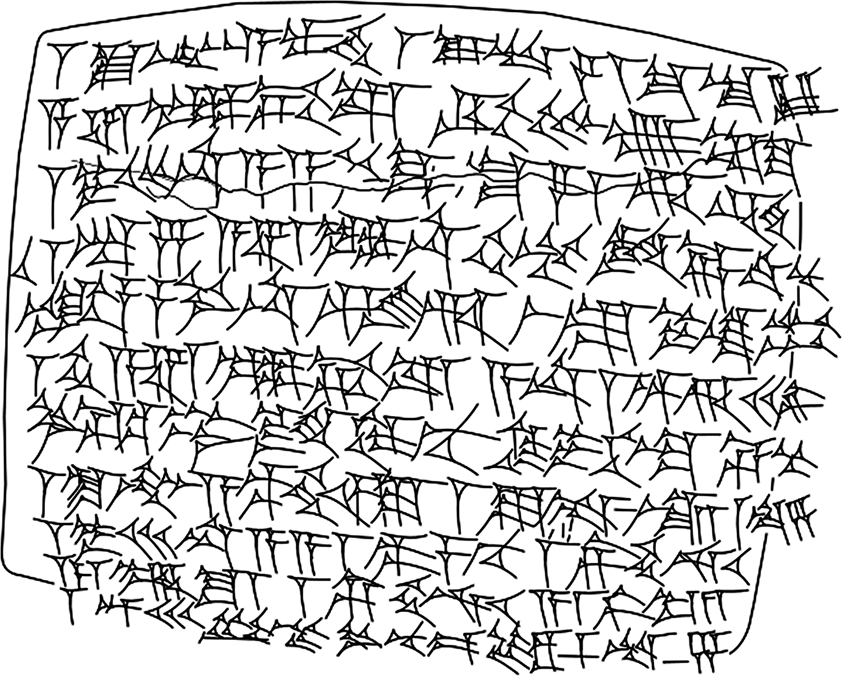
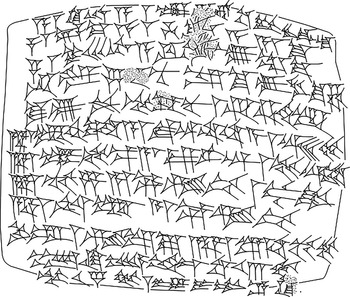
FLP 1596Footnote 5
Dimensions: 5.81 × 4.76 × 2.07 cm

The obverse of FLP 1596.

The lower edge of FLP 1596.

The reverse of FLP 1596.

Translation
1 šira'm-tunic (and) 1 sheep about which Balāṭu, son of Nabû-gāmil said as follows: “Isinnāya, the slave of Rēmūt and Ardia, son of Nabû-nādin-šumi gave (it) to me.” After a herald had passed through the city (in search of stolen goods), Balāṭu, son of Nabû-gāmil gave it to Ilī-rēmanni ša rēš šarri (bēl piqitti ajakki). If he (Balāṭu) received anything apart from the 1 tunic and 1 sheep from Ardia, Isinnāya, Pašānu, Nidintu, son of Bēl-erība, Nidintu, son of Ibni-Ištar, Sîn-aḫ-iddin, the ikkaru, Ardia, son of Nanāya-uṣallu, Ḫuzālu, son of Kīnā, Nabû-rēḫti-uṣur, the slave of Kalbāya (and) Ḫašdāya, son of Gimillu, (and) about whom Isinnāya said: “They are my companions”, he (himself) is the thief.
Witnesses: Rēmūt-Bēl, son of Bēl-uballiṭ, descendant of Gimil-Nanāya family, Sîn-ēreš, son of Nabû-šum-līšir, descendant of Ibni-ilu family, Arad-Marduk, son of Zēria, descendant of Egibi family, Arrab, son of Arad-Bēl, descendant of Egibi family. Scribe: Gimillu, son of Innin-zēr-iddin. Uruk. The 13th day of the month of Abu, the 14th year of Nabonidus, king of Babylon.
Notes
4. For ittanna more frequently written than ittannu with Ventive in the Neo-Babylonian period see Hackl Reference Hackl and Vita2021: 1447, and cf. also GAG: 172.
5. The use of the verb etēqu in smiliar context see YOS 3 174: 7’-8’ (na-gi-ri ina uru li-ti-iq).
19. The reading Arad-Marduk against Iddin-Marduk is confirmed by many records from Eanna dossier and above all by the BM 114574 related to the gang.
The structure of FLP 1596
The record was written on the 13th day of the month of Abu. It means that the first record belonging to the story was written four days before FLP 1596, YOS 6 213 and BM 114603 three days, but FLP 1596 predates Isinnāya's general confession in AnOr 8 21 by four days. The content of FLP 1596 is not easy to work out and the reason for bringing Balāṭu to justice is not explicitly given. It is quite clear that Balāṭu, son of Nabû-gāmil is the main character of FLP 1596. The first sentence reports what Balāṭu, son of Nabû-gāmil, was talking about: one šira'm-tunic (and) one sheep. According to his words, he had received it (it-tan-na-nu) from Isinnāya, the slave of Rēmūt and Ardia, son of Nabû-nādin-šumi. Next, it is clarified that a herald nāgiru had passed through the city (egir šá lúna-gi-ri ina uru i-te-qu), who was probably announcing that any thief will be held responsible and is searching for the stolen goods. But according to the the next, third sentence, Balāṭu gave everything to Ilī-rēmanni ša rēš šarri (a-na mdingir.‹meš›-ri-man-ni id-di-nu). The last sentence of the first part of the operative section has the conditional mode construction. The protasis begins with kî “if” + elat clauseFootnote 6 + interjection of Isinnāya's words, and ending with the apodosis “he (Balāṭu) is a thief” (lúšu.ḫa šu-ú):
ki-i mim-ma e-lat 1 túgšir-a-am ù 1 udu.níta ina šuii … iš-šu-ú šá mi-sin-na-a iq-[bu]-ú um-ma en kaskalii-iá ⸢šú⸣-nu lúšu.ḫa šu-ú Footnote 7
“(protasis) If Balāṭu received anything apart from the one šira'm-tunic (and) one sheep from – the names of ten individuals – about whom Isinnāya said: “they are my companions”, (apodosis) he (Balāṭu) is the thief.”
The next structural part of the text contains the names of four witnesses, the scribe, and the dating formula. The witness list begins quite unusually for tablets belonging to the Gimillu dossier.Footnote 8 Although it begins as usual with lúmu-kin-nu it starts directly after the operative section in the middle of a line, and not on a new line as usual. Gimillu left blank spaces at the beginning of the first five lines of the reverse. It is hard to believe whether leaving some free space at the beginning of these lines was due to the sloppiness of an experienced scribe (Gimillu runs away a bit with the last three lines on the obverse and one line of the lower edge from the edge of the tablet), or it was a deliberate move for the graphic separation of the two basic parts of the text structure. The next, sixth, line, with the patronym of the first witness, begins close to the edge. The beginning of the date is placed again a bit further to the right than the first five lines. Beyond that, the tablet contains no means of authentication.
The actors
Balāṭu, son of Nabû-gāmil did not appear in any previous record relating to the gang, but there is no reason to doubt that the FLP 1596 was created due to his suspect activity, even if the document does not say anything else about him. He is probably the same person who seven years earlier in GCCI 1 285 (14.10.Nbn 7) gave the silver stemming from the sale of sheep hides and wool.Footnote 9 The context of the record seems to suggest that Balāṭu, son of Nabû-gāmil was involved in animal husbandry in Uruk, but the kind of activity he performed in Eanna is not explicitly given.
The same is true considering his exact role in the events of which FLP 1596 is the aftermath. There is no doubt that the story presented in FLP 1526 is a new thread in the matter. Balāṭu, son of Nabû-gāmil could either be suspected of stealing the listed items or accused of collaborating with robbers. For example, he could have hidden their belongings. After all, the gang was quite numerous. Most of the ten people on the list in FLP 1526 in lines 8–14 are well-known gang members. Isinnāya, the slave of Rēmūt is the main character in the story, in all the records, and the main accused. Ardia, son of Nabû-nādin-šumi was identified as criminal along with his brother in AnOr 8 21. The latter, in turn, appears individually in the undated Stigers, JCS 28 no. 39 and GCCI 2 350. Now in FLP 1596 Ardia alone appears for the first time on the 13th day. Pašānu is mentioned next, right after Ardia and Isinnāya. He might be the son of Nabû-mušētiq-uddē who appears with a such patronym in AnOr 8 21 and Stigers, JCS 28 no. 39. Gimillu, son of Innin-zēr-iddin, the scribe of the text (the same writer as in other texts on the subject, see below), wrote only the personal name of Pašānu without his patronym. He was probably well known to officials, and his name, on the other hand, is not common in Babylonia.Footnote 10 Next is Nidintu, son of Bēl-erība (4) and his namesake (5), son of Ibni-Ištar, both attested only in AnOr 8 21. The sixth on the list is Sîn-aḫ-iddin, an ikkaru. He is probably a son of Inīya from AnOr 8 21, but this time identified by occupation. Nabû-rēḫti-uṣur, the slave of Kalbāya, also known only from AnOr 8 21, is ninth on the list. Ḫašdāya, son of Gimillu is the last person on the list, and he is attested in AnOr 8 21 and in Stigers, JCS 28 no. 39.
A new character, or rather one incorrectly identified by Sandowicz due to text damage, is Ḫuzālu, son of Kīnāya, the eighth on the list, whose name Isinnāya disclosed in the confession in AnOr 8 21. At the beginning of line 20 on AnOr 8 21 there is only the beginning of his name (mḫu-), a fragment of the second syllable (z[a]) and the last syllable of his father's name ([…]-a). This means that he is not Ardia's brother as Sandowicz thought.Footnote 11 Ardia, son of Nanāya-uṣallu was also absent from previous texts. He might be the same Ardia, son of Nanāya-uṣallu who appears in two records from Uruk, which are not related to the gang case and dated sometime after the intriguing events of the 14th year of Nabonidus. He guaranteed, along with the well-known Gimillu, son of Innin-šum-ibni in YOS 7 111: 2 (13.11.Camb 1) to the chief administrator and royal supervisor of the Eanna that they would deliver the group of men who were accused of the illegal slaughter of some of the Eanna's animals. In turn, he is attested as dēkû in YOS 21 196: 1, 13 (13+.[X].Bar 0). The latter record is the contract for the hiring out of a female temple serf to conduct a service. If, indeed, all the texts concern the same person, then the events described in FLP 1596 did not affect his professional affairs in later times.Footnote 12
Isinnāya used the words en-kaskalii-iá ⸢šú⸣-nu to characterise his colleagues in FLP 1596. The term en-kaskalii appears in some records from the 1st Millennium B.C.Footnote 13 Their context doesn't suggest organising a larger military undertaking. The most reasonable interpretation, comparing these words and their contexts, is that they refer to a “travelling companion”, and in FLP 1596 simply to a “companion.”
The Witnesses
The witnesses are the next element that link FLP 1596 with the remaining texts about Isinnāya's gang and they appear in the text as follows:
• The first witness, Rēmūt-Bēl, son of Bēl-uballiṭ, descendant of the Gimil-Nanāya family, is also the first person on the list of nobles in AnOr 8 21.Footnote 14
• The second witness, Sîn-ēreš, son of Nabû-šum-līšir, descendant of Ibni-ilu family, is the first witness in YOS 6 213.Footnote 15
• The third witness, Arad-Marduk, son of Zēria, descendant of Egibi family is also the first person on the list of the nobles in BM 114574.Footnote 16
• The fourth witness, Arrab, son of Arad-Bēl, descendant of Egibi family, is not attested in the other records relating to the gang. Moreover, I do not know any other record of Arrab, son of Arad-Bēl, descendant of Egibi family.
All the witnesses occupying the position from one to three in the list on FLP 1596 also have the highest position in the other texts. They always take the first place on the lists. This may indicate their special involvement in the matter of the gang. This is more reliable, as the frequency of joint participation in similar roles in other texts is rather rare. Only Sîn-ēreš and Arad-Marduk are attested together in some other texts (cf. notes 15 and 16, where I marked in bold the texts in which they appear together), but the number of cases of such texts is still much lower than the number of texts listing them separately.
The Administration of justice
The role of the state administration in the matter is another element that joins all the texts, apart from BM 114603. On the 9th Abu the royal decree of amat šarri was delivered to Uruk by a certain Rēmūt, son of Nergal-ašarēd, a descendant of the Rīmanu family to the hands of Ilī-rēmanni ša rēš šarri bēl piqitti ajakki, Sandowicz rightly sees him as an official sent to Uruk from Babylon.Footnote 17 A day later, the release on bail of one of the suspects is tied to a guarantee carrying a royal sanction ḫīṭu,Footnote 18 and the document was written under close supervision (ina ušuzzu)Footnote 19 by a state official rab qišti ša māt tâmti. In the document from 17th Abu Isinnāya testifies before Ilī-rēmanni ša rēš šarri bēl piqitti ajakki. In FLP 1596 the nāgiru official was also involved, as well as, once more, Ilī-rēmanni ša rēš šarri bēl piqitti ajakki.
The evidence needed to identify the precise role and range of competences of the nāgiru official in the Neo-Babylonian period still remains patchy.Footnote 20 The nāgiru is known from several documents from Uruk, above all from letters. GCCI 2 395 = DUBSAR 3 no. 67 and BIN 1 93 (both come from the reign of Nebuchadnezzar), mention the involvement of the royal herald in a case of deserters. The first letter raises the question of deserters hiding in the areas of Uruk and Babylon. The sender of the letter, a certain Mukīn-Marduk, writes directly to the king about men summoned by the royal herald (lúna-gi-ru šá lugal en-iá muḫ-ḫi-šú-nu il-su-ú), but who had not responded to that summons, and he had seen them in the houses of Urukeans. The same Mukīn-Marduk also writes that he had already raised the matter with a courtier in Larsa in the presence of two witnesses, but clearly the matter had not been dealt with as expected. In the second example, BIN 1 93, Bēl-nādin-apli directly informs the king of the whereabouts of some deserters. This time the deserters had taken to the hills. In turn, according to BIN 1 49, the herald's competence was limited to the city region. In this letter, the imprisoned inhabitants of Uruk (lúunugki-a-a ṣab-tu-tu) write to the šatammu about the flight of Innin-zēr-iqīša, son of Nergal-uballiṭ and Marduk-šum-uṣur, son of Nabû-iddin, from the Šangû-Ninurta family. The deserters fled immediately after having signed a guarantee with the senders of the letter. Now, the letter's senders explained how the flight of these two people damaged their good name, because now, nobody would trust them. They ask the šatammu, to keep searching for the deserters until they are caught and brought back in chains. They want the nāgiru to issue a warrant for their arrest in the city (lúnigir ina uru a-na muḫ-ḫi-šú-‹nu› lil-is) and the šatammu (“the lord” the addressee of the letter) should send men out (a-na edin) for them. Finally, they desperately try to use emotional blackmail on the šatammu stating that the two deserters should be more valuable to the šatammu than their lives. If the šatammu fails to catch the deserters, he should at least bring their brothers in chains, or even their sons. The šatammu held sway outside the city limits.
FLP 1526 simply uses the title nāgiru without giving a name. This means that only one person held that office at any one time and was sufficiently well-known in the town, and it is the same in the above-mentioned letters. In FLP 1526 the competences of the herald also seem to be limited to urban areas (ina uru i-te !-qu), though there is not mention of any action to be taken outside it. In the light of FLP 1526 it seems more reasonable to ask about the relation between the competences of the nāgiru and the ša rēš šarri bēl piqitti ajakki. If I have properly understood the narration from lines 5–7, initially one šira'm-tunic (and) one sheep were sought by the nāgiru, without success. These things were ultimately passed on by Balāṭu for the ša rēš šarri bēl piqitti ajakki.
Conclusion
The story of Balāṭu, son of Nabû-gāmil, described in FLP 1596 is a new strand to the case. In FLP 1596 it emerges that Balāṭu is suspected of contact with criminals. He will be denounced as a thief if he has taken more than he has admitted thus far. This is a clear difference in comparison with the texts concerning the other members of the gang, for they are suspected or accused of burglary and theft of the property of the citizens of Uruk. The course of events presented in the FLP suggests that Balāṭu himself reported to the representatives of state power. In this way, by blaming Isinnāya and Ardia for giving him sheep and a tunic, he tries to free himself from suspicion and, perhaps, charges against him.
The story presented in 2014 by Sandowicz, and now added to by the publication of FLP 1596, is linked by a few important elements, like the suspects and the witnesses, who appear first on the lists in the remaining texts about the gang. Next, all these documents were written by Gimillu, but it must be emphasised that the use of the rare term (en-kaskalii), or the long since unused (lúšu.ḫa) in FLP 1596 testify that Gimillu, the author of the text, was a very well educated scribe, although his background and the precise trajectory of his career in the temple administration is somewhat shrouded in obscurity. Additionally, the case is being investigated by the state administration, yet in FLP 1596 the nāgiru is involved for the first time.
The case should definitely be treated as ongoing, and we should expect to discover further texts about the gang. Above all, we do not know how the case was decided. We do not have the final document, the trial record. We can only presume that, on account of the involvement of the state administration, the trial took place not in Uruk, but in Babylon. If that was the case, we shall not find the document in the archive of the Eanna temple.