Since the emergence of severe acute respiratory syndrome coronavirus 2 (SARS-CoV-2) omicron variant in November 2021, it became the dominant variant circulating globally. The evolving SARS-CoV-2 omicron sublineages from (BA.1 to BA.2 to BA.4 to BA.5) have demonstrated progressively increased transmissibility, Reference Shrestha, Foster, Rawlinson, Tedla and Bull1 leading to explosive outbreaks in the community. Reference Cheng, Ip and Chu2 Whether the SARS-CoV-2 omicron variant increased the risk of coronavirus disease 2019 (COVID-19) transmission in the healthcare setting remains uncertain. Recent studies have shown that the universal use of surgical respirators as a component in infection prevention contributed to the rapid control of SARS-CoV-2 omicron transmission in the hospital. Reference Baker, Rhee and Tucker3 Universal use of surgical respirators in the healthcare setting was also advocated when the infection rate of COVID-19 in community was high. Reference Klompas, Rhee and Baker4 The preliminary findings of surgical respirator use in the SARS-CoV-2 omicron era may provide an indirect implication of airborne transmission of SARS-CoV-2 omicron variant in the clinical areas.
Demonstration of air dispersal of the SARS-CoV-2 omicron variant may further support the use of surgical respirators by healthcare workers (HCWs) in general wards. Based on our previous experience in performing air sampling to detect SARS-CoV-2 RNA in the airborne infection isolation room (AIIR) of hospitals and community treatment facilities during the COVID-19 pandemic, Reference Cheng, Wong and Chan5–Reference Wong, Leung and Tong7 we performed air sampling to assess the air dispersal of SARS-CoV-2 in general wards that were temporarily converted into negative-pressure wards (NPWs) for COVID-19 patients during the surge of SARS-CoV-2 omicron cases in the fifth wave of COVID-19 in Hong Kong. These findings may have implications for infection control.
Methods
Collection of air samples for SARS-CoV-2 RNA in wards
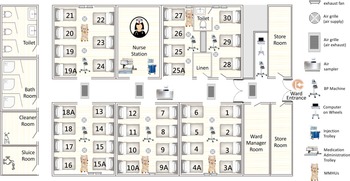
To assess the air dispersal of SARS-CoV-2, air samples were collected in Queen Mary Hospital using an AerosolSense Sampler (Thermo Fisher Scientific, MA) as previously described. Reference Wong, Yuen and Chan6,Reference Wong, Chan and AuYeung8 The air sample was collected through an omnidirectional inlet and directed toward the collection substrate through an accelerating slit impactor at a flow rate of 200 L per minute for a total of 1–6 hours, resulting in 12,000 L to 72,000 L of air per sample. The air sampler was placed outside the nursing station, which was located at the center of the ward (Fig. 1).
Floor plan of a negative-pressure ward for COVID-19 patients. This is a general ward in Queen Mary Hospital, a 1,700-bed university-affiliated hospital, to be temporarily converted into negative-pressure ward caring for COVID-19 patients. The ward has an open cubicle design with ceiling height of 2.2 m. In the original design, the air supply was vented to each patient cubicle and the air exhaust was located in the corridor. During the conversion process, the air exhaust in the corridor was closed. With the installation of mobile modular high efficiency particulate arrestance filter units (MMHUs) and exhaust fans in each cubicle, negative pressure was established and the direction of airflow was demonstrated from the cubicle to window by engineers at the time of testing and commissioning. The air changes per hour increased from 6 to at least 10 for enhancing indoor air dilution. The air sampler was placed outside the nursing counter, which was located at the center of the ward.

Viral load assessment of air samples and respiratory specimens
The collection substrate of each air sample was immersed in 2 mL viral transport medium, and 1 mL medium was used for total nucleic acid extraction using the eMAG extraction system (bioMérieux, Marcy-l’Etoile, France) following the manufacturer’s instructions. Quantification of SARS-CoV-2 RNA was performed by reverse-transcription polymerase chain reaction (RT-PCR) as previously described. Reference Cheng, Wong and Chan5 For clinical specimens, total nucleic acid extraction was performed using 250 µL of the specimen and was subjected to RT-PCR as described above.
Whole-genome sequencing of respiratory specimens
Whole-genome sequencing (WGS) and determination of viral lineage were performed using the Oxford Nanopore MinION device (Oxford Nanopore Technologies) and Nanopore protocol, that is, the PCR tiling of COVID-19 (version PTC_9096_v109_revH_06Feb2020), respectively, as we described previously. Reference Cheng, Ip and Chu2 This study was approved by the Institutional Review Board of The University of Hong Kong/Hospital Authority Hong Kong West Hospital Cluster.
Statistical analysis
Univariate analysis and multiple linear regression were used where appropriate. All reported P values were 2-sided. A P value of <.05 was considered statistically significant. Computation was performed using SPSS version 15.0 software for Windows (IBM, Armonk, NY).
Results
Analysis of air samples for SARS-CoV-2 RNA in wards
For this study, 24 air samples were collected in 8 NPWs (Supplementary Table online). The median number of patients in each NPW was 19 (range, 8–37) at the time of air sampling. SARS-CoV-2 RNA was detected at a cycle threshold (Ct) value of 39.1±2.3 in 19 (79.2%) of 24 air samples. Univariate analysis revealed that detectable SARS-CoV-2 RNA in air samples was significantly associated with more COVID-19 patients in the ward, lower mean Ct value of clinical specimens, longer duration of air sampling, and timing of air sampling. Multivariable analysis with multiple linear regression showed that the duration of air sampling was negatively correlated with the Ct value of air samples (B = −0.929; P = .006) (Table 1).
Univariate and Multivariable Analysis on the Results of SARS-CoV-2 RNA in Air Samples

Note. COVID-19, coronavirus disease 2019; Ct, cycle threshold; NA, not applicable; SARS-CoV-2, severe acute respiratory syndrome coronavirus 2; SD, standard deviation.
a Student t test was used for 2-group comparison of continuous variables.
b Variables that were considered as statistically significant in univariate analysis were subjected to multivariable analysis using multiple linear regression to determine whether there is any correlation between Ct value of air samples and each variable. Any negative air samples were assigned with a Ct value of 45 for statistical analysis.
c Clinical sample of COVID-19 patients included deep throat saliva, combined nasal and throat swab, or nasopharyngeal swab.
d Timing of air sampling was defined as day of air sampling counting from the start of the study.
Analysis of WGS of respiratory specimens
Of 495 RT-PCR–positive respiratory specimens collected from COVID-19 patients in 8 NPWs, 41 (8.3%) were randomly selected for WGS, of which 3 (6.7%) of 45 specimens were collected from ward A2, 7 (10.1%) of 69 from ward B2, 2 (3.5%) of 57 from ward B3, 6 (15.4%) of 39 from ward D4, 10 (15.4%) of 65 from ward D6, 6 (7.0%) of 86 from ward E4, 3 (2.9%) of 102 from E6, and 4 (12.5%) of 32 from ward K13N. All sequences were identified to be SARS-CoV-2 omicron sublineage BA.2.2.
Discussion
We have consistently demonstrated the phenomenon of air dispersal of SARS-CoV-2 RNA in almost 80% of air samples collected in the NPWs caring for patients infected with SARS-CoV-2 omicron sublineage BA.2.2 during the fifth wave of COVID-19 in Hong Kong. Detectable SARS-CoV-2 RNA in the air samples were significantly associated with more COVID-19 patients in wards, patients with higher viral load using Ct value as surrogate, and longer duration of air sampling by univariate analysis. These are reasonable findings because more COVID-19 patients in the ward with higher viral load would result in exhalation of more virus-laden aerosol. However, viral load in our air samples was low, probably because of the installation of mobile modular high efficiency particulate arrestance filter units (MMHUs) and exhaust fans in the windows to improve the indoor air dilution (Fig. 1).
The finding of SARS-CoV-2 dispersal in the NPWs may have an impact on hospital infection control, especially in general wards or other clinical areas where the indoor air dilution is not as good as AIIRs or NPWs. Asymptomatic COVID-19 patients may spread the virus in these areas via airborne route, which may result in outbreaks. Prolonged exposure to COVI9-19 patients may have an increased risk of infection. This factor was indirectly implied in our multivariable analysis in which the duration of air sampling was negatively correlated with the Ct value of air samples. The use of surgical respirators by HCWs may protect them from acquisition of SARS-CoV-2 and may minimize the risk of SARS-CoV-2 dispersal from infected HCWs. However, discomfort would increase over time with continual respirator use at work, Reference Shenal, Radonovich, Cheng, Hodgson and Bender9 making universal use of surgical respirator not practical, especially during a nonoutbreak period. In addition, it is impossible to eliminate the risk of SARS-CoV-2 dispersal from infected patients. Although surgical masks can be provided to all patients, compliance may not be 100%. Reference Wong, Lam and AuYeung10 The MMHUs cannot be installed at all wards because of its large size. Enhancement of indoor air dilution by installation of MMHUs could not eliminate the virus, as shown in our study. Therefore, it is difficult to prevent airborne transmission of SARS-CoV-2 in hospitals. Promulgation of COVID-19 vaccination is the key to protect patients and HCWs from developing severe infection when transitioning from the pandemic to endemicity.
This study had several limitations. We did not perform WGS for the air samples due to low viral load. However, the WGS of our hospitalized patients confirmed the presence of SARS-CoV-2 omicron sublineage BA.2.2, which was also the predominant sublineage during the fifth wave of COVID-19 in Hong Kong. Reference Cheng, Ip and Chu2 We did not report the details of COVID-19 transmission in wards. Given the finding of air dispersal of SARS-CoV-2 RNA, nosocomial transmission of COVID-19 would be possible. We did not perform virus isolation for the air samples. The low level of RNA detected may not directly translate to an infective dose. Nevertheless, our results provide an alert to support continued vigilance against nosocomial airborne transmission of COVID-19.
Supplementary material
To view supplementary material for this article, please visit https://doi.org/10.1017/ice.2022.258
Acknowledgments
We thank Dr. Kelvin Hei-Yeung Chiu, Department of Microbiology, Queen Mary Hospital, for advice on the statistical analysis during revision of manuscript.
Financial support
This study was partially supported by the Health and Medical Research Fund (HMRF) Commissioned Research on Control of Infectious Disease (Phase IV), CID-HKU1-16, Food and Health Bureau, Hong Kong SAR government.
Conflict of interest
All authors report no conflicts of interest relevant to this article.