On 10 March 1962, in a letter to District Commissioner (DC) M.G. Johnson, the Acting Secretary General of Bugisu District, G.W.N. Bwayo asserted ‘that this [imbalu] has something of vital importance to Bugisu customs and therefore should not be mixed with the Mbale problem.’Footnote 2 Bwayo was contesting Johnson's instructions prohibiting a proposed imbalu (male circumcision) display by the Gisu at Malukhu in Mbale town in eastern Uganda.Footnote 3 Bugisu District Council members had tasked him with appealing to Johnson for permission for the display. They reasoned that the ceremony held significant cultural value for the Gisu and refusal to grant them permission to hold it ‘means that the Bagisu have been denied one of the Fundamental Human Rights reached at the recent Uganda Constitutional Conference.’Footnote 4 The Constitutional Conference had been held in London in 1961 with Bwayo as the representative for Bugisu district. The members of the District Council, thus, drew on the rights afforded them under the negotiations for Uganda's independence as they asserted an ethnic claim to Mbale.
Drawing on archival records, field notes of previous researchers on Bugisu, newspapers, oral interviews, and the Masaba Historical Research Association (MHRA) records, this article explores the ways in which Gisu ethnic architects appropriated imbalu and gave it new meaning during a moment of heightened ethnic nationalism.Footnote 5 Contrary to Bwayo's assertion that these phenomena were unrelated, this article argues that the Bugisu District Council's demand to hold an imbalu display at Malukhu was designed to assert their claim over Mbale. Empowered by the 1955 African Local Government Ordinance, which granted significant administrative autonomy to elected district councils, Bwayo's colleagues championed Gisu demands and pressed the Protectorate government to declare that Mbale — which was claimed by both the Gisu and Gwere — belonged to Bugisu. Recognition of Mbale as a Gisu town was critical because, as Jean La Fontaine argues, it ‘would have given the Gisu a status symbol indicating equality with Ganda and other peoples considered by the Gisu as powerful within the state of Uganda.’Footnote 6 Being the largest ethnic group and major producers of coffee for export in the region, the Gisu saw the control of Mbale as a just reflection of their status. Their creative repurposing of a cultural ceremony in order to strengthen ethnic unity and assert territorial exclusivity adds new understanding of African societies’ responses to late-colonial decentralization and impending decolonization. Within the historiography of Ugandan decolonization, scholars have tended to mention the boundary dispute between Bugisu and Bukedi in passing, as one item on the list of obstacles towards the transition to independence.Footnote 7 The evidence analysed in this article demonstrates that territorial antagonisms were particularly powerful where farmers’ interests aligned with those of elites making claims to urban infrastructure and adds new understanding of Uganda's uneasy transition to self-government.
GISU ANXIETIES AND LATE COLONIAL ETHNIC MOBILIZATION
The postwar period was a time of moral and political anxiety among eastern African political activists, prompting them to mobilize against the colonial state. The 1945 and 1949 political disturbances in Uganda, the 1953 Kabaka crisis, and the Mau Mau uprising in Kenya all put intense pressure on the British colonial authorities.Footnote 8 In their response to the colonial political order, some elites focused on issues that concerned them as members of ethnic communities and mobilized along militant ethnic identities.Footnote 9
Scholarship that considered ethnicity to have been invented as part of the colonial framework – that argued that modern expressions of ethnicity emerged through Africans’ defensive response to colonial frameworks of administration, employment and urbanization – has long been critiqued.Footnote 10 All criticism notwithstanding, the ‘invention of tradition’ framework, albeit in modified form, is still useful in understanding ethnic nationalism in Africa. Across East Africa and beyond, members of ethnic groups that were either largely excluded from power or anxious about their status often expressed that anxiety in violent ways that included reinventing and redeploying older cultural practices. In South Africa, Inkatha cultural brokers crafted a masculinist discourse based on their Zulu cultural traditions which shaped their relationship with both the apartheid state and the ANC.Footnote 11 Ethnicity was both a lens through which to engage in political debates and a space through which political thinkers constituted communities linked by ‘blood and history.’Footnote 12 Political activists, thus, repurposed and reinvented existing cultural practices to create local ethnic unity in response to an interventionist state.
Scholars have also demonstrated the centrality of geography and boundaries in the formation of ethnic identities in Kenya.Footnote 13 Created for administrative convenience, boundaries presented opportunities for some groups and disadvantages for others, often creating tensions between indigenous and migrant communities.Footnote 14 As they competed for land, African communities defined themselves ‘in both ethnic and political terms’ using the label ‘outsider’.Footnote 15 Thus in western Kenya, the Luhya used a ‘geographic identity’ to imagine and defend their ethnic polities.Footnote 16 Still, even within the ‘tribal geography’ of colonial Kenya, individuals adopted different strategies. While some Kikuyu migrants to Meru willingly accepted assimilating into Meru identity in order to access land, others defied the colonial state and their hosts by retaining their Kikuyuness.Footnote 17 In contrast, Gisu political activists responded to colonial decisions by seeking to unify all Gisu males. Further, they asserted territorial claims by turning an indigenous, albeit shifting, cultural practice — imbalu — into a tool of political advocacy. Their use of a ceremony to imagine themselves as a political entity, to override pre-existing descent-group-based rivalries, and to police what they considered to be Gisu territory around Mbale is what makes their case so distinctive.
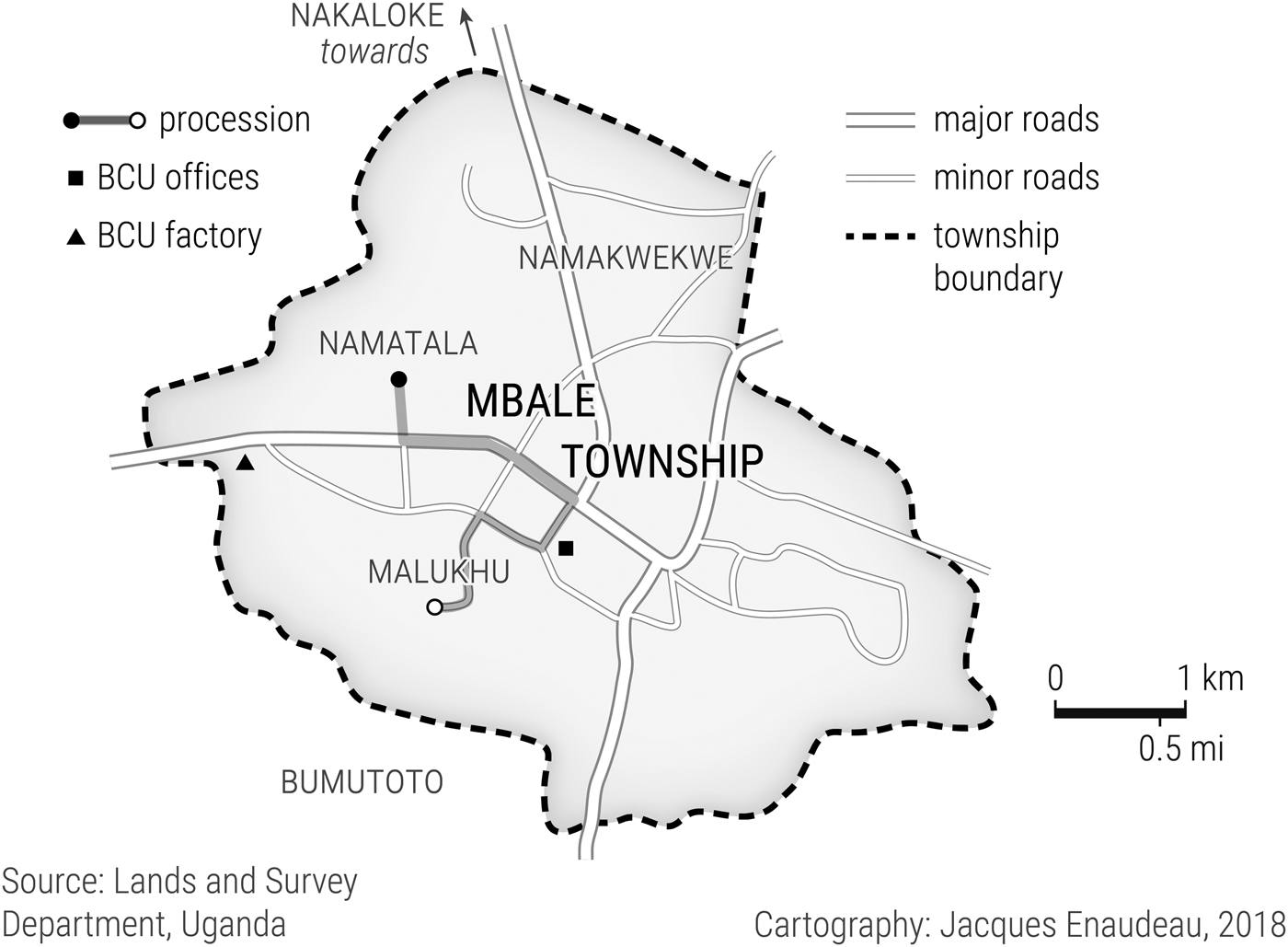
In 1954, colonial authorities dissolved Mbale district and created the districts of Bugisu and Bukedi with Mbale Township as a separate entity hosting the administrative offices of both districts. This heightened tensions between residents of Bugisu and Bukedi districts as both sides struggled for control and ownership of this wealthy commercial and administrative town. In 1954, to protest the colonial decision, Bugisu District Council officials organized an imbalu dance demonstration that brought imbalu candidates and their entourages of dancers from across Bugisu to Malukhu (see Fig. 1), where they showcased cultural performances relating to the history and significance of imbalu. As the procession marched through the town to Malukhu, some militant Gisu men and local circumcision surgeons forcibly circumcised non-Gisu bystanders.
The Mbale township in 1954.

Circumcision as a rite of passage into manhood is relatively common in sub-Saharan Africa. For example, among the Xhosa of South Africa, the acquisition of adult status gives men power and authority. Circumcised men ascend to the top of the social hierarchy, whereas women and uncircumcised men are deemed to be children and therefore are not entitled to manly rights and responsibilities. Such marginalization of uninitiated males puts social pressure on Xhosa boys to undergo ritual circumcision.Footnote 18 Moreover, the ritual has survived and remained relevant because of its ability to adapt to changing social contexts. It was, for example, central to political maturity and group ethnic identity of Xhosa men — as opposed to Zulu or white identity — during the anti-apartheid struggle of the later twentieth century.Footnote 19
Over the past century in eastern Africa, political activists have used forcible circumcision to harass and intimidate non-circumcising communities with whom they competed over resources or political positions.Footnote 20 However, the skill with which Gisu political activists reformulated and sustained imbalu to address their political concerns in the 1950s and 1960s is noteworthy. Ethnic architects consisting mainly of District Councilors, developed a Gisu territory-wide event to be held in Mbale marking the official onset of the biennial imbalu ceremonies.Footnote 21 In the 1950s, violent assertions of ethnic hegemony were able to be sustained because cultural brokers within the district administration could represent imbalu to the colonial state as a traditional ceremony of relevance only within Gisu society.
Until the early 1950s, imbalu included elaborate rituals which were organized at the clan level. As a cultural ritual, imbalu embodied pain and created hierarchical and social differentiation through marking generation, gender, and manhood alongside political distinctions.Footnote 22 Irrespective of age, even today, an uninitiated male is considered to be of low and insignificant status. In the past, such a person was not entitled to own land or join the council of men, both of which are privileges associated with male adulthood.Footnote 23 On average, boys underwent circumcision between the ages of 12 and 25.Footnote 24 The circumcision was performed publicly in open locations within homesteads where men, women, and children watched.Footnote 25 It was carried out by specialist surgeons (bakhebi, sing. umukhebi) who did not administer anaesthesia and yet onlookers expected candidates to remain still, silent, and refrain from showing emotions.Footnote 26 Candidates who failed to endure the pain were beaten and subsequently ridiculed as incomplete men throughout their lives.Footnote 27 The move away from the localized, clan-level ceremony to a centralized display in 1954 marks a departure from internally-focused generational and gender politics into geographically grounded, externally-oriented ethnic competition. From this point, both the choreography of the dance demonstrations and exhibition in Mbale, as well as the forcible circumcision of non-Gisu, revealed that ethnic advocates had reconstituted imbalu into a political currency, which could mobilize Gisu patriots and undermine Gwere rivals and colonial arbiters.
Whereas scholars of Bugisu emphasize the centrality of colonialism and imbalu in the production of Gisu ethnic unity beyond the clan or lineage level, they do not focus on imbalu as a unit of historical analysis.Footnote 28 Even those who emphasize that imbalu and ideal manhood provided a foundation for the Gisu sense of collectivity do not historicize how imbalu became the central mobilizing force during the period of militant nationalism in the decade leading to independence.Footnote 29 This article unveils how Gisu ethnic architects reformulated imbalu into an Mbale-centered display in order to impress upon the colonial government the importance of resolving the controversy over the town before handing power in Uganda to local, independent government. They reinterpreted and refashioned it into a litmus test of ethnic belonging. In so doing, they used imbalu to define and distinguish them as basaani (circumcised and masculine men) from their non-circumcising neighbors who they referred to as basinde (uncircumcised boys) and of insignificant status, drawing on a mode of thought that stretched back to the nineteenth century and earlier.Footnote 30
THE MBALE CONTROVERSY
Mbale was not effectively occupied prior to 1900, but by the 1950s it had become a powerful commercial and administrative hub in eastern Uganda.Footnote 31 It became more prominent at the turn of the twentieth century as a trade centre bringing together both neighbouring groups of people, including Gwere, Gisu and Iteso, and distant ones, like Arabs, Baluchis and Indians.Footnote 32 Soon it attracted the attention of colonial officials and in January 1904 Commissioner Sadler of the Protectorate government relocated the government station of Bukedi district there from Budaka in Bugwere.Footnote 33 As a commercial centre, Mbale brought together traders and government officials to a bazaar in 1908.Footnote 34 A year later, colonial authorities introduced cotton cultivation in Bugisu in order to add to their extractive economy. In 1912, they introduced coffee. The cultivation of these crops — though initially resisted — further developed Mbale as a centre of commercial activity.
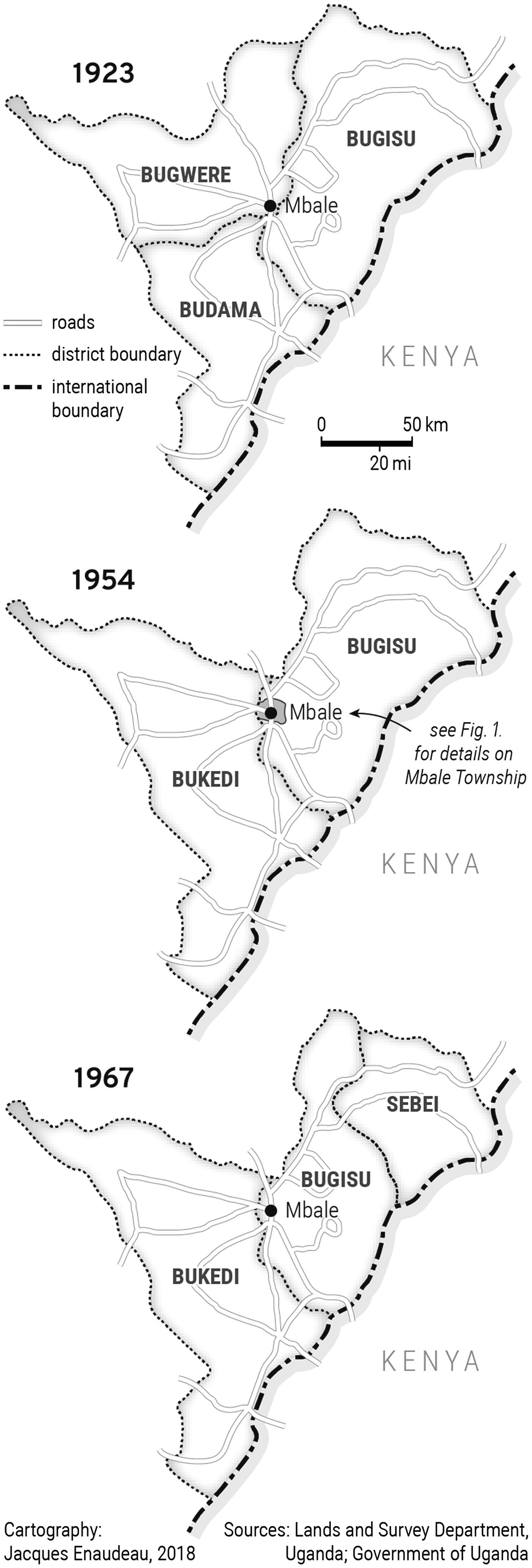
However, the Gisu were disgruntled about the colonial allocation of what they perceived to be Gisu land in the vicinity of Mbale to Semei Kakungulu and his Ganda chiefs. Dispossessed of their land, some Gisu were turned into ‘tenants who were expected to perform labour services for their new landlords.’Footnote 35 Amidst increasing tensions over land ownership and user rights, colonial taxation, demand for cash crop cultivation, and labour, colonial officials split Bukedi district in 1923 into Bugisu, Budama, and Bugwere districts with administrative offices located at Bubulo, Tororo, and Mbale respectively.Footnote 36 This upset the Gisu elite who interpreted this as the colonial administration awarding Mbale to the Gwere and thereby dispossessing them of even more land.
To assert their claim over Mbale in light of this decision, some called for a joint circumcision ceremony for all Gisu to be held in the town, even though it was by then in Bugwere.Footnote 37 While the available sources do not allow us to examine this issue in depth, the call was an attempt to use imbalu to mobilize Gisu-wide support against colonial policy. This marked a turning point as previously, the Gisu constituted a number of segmented political units, based on descent groups, with no overriding authority.Footnote 38 They all practiced some form of imbalu even though the ritual details varied.
In 1925, a group of teachers, chiefs, clerks, and peasants led by Reverend Edrisa Masaba founded the Bagisu Welfare Association (BWA) with the objective of protecting Gisu traditions and territory.Footnote 39 BWA members demanded recognition of their version of customary Gisu land law, which they claimed the Ganda had misinterpreted in order to deny that individual land tenure ever existed in Bugisu. Through the 1930s and into the postwar period, members of the BWA repeatedly challenged colonial officials over issues of land tenure.Footnote 40
Meanwhile, in 1937, in an effort to reduce administrative costs, Uganda's Protectorate government merged Bugwere and Bugisu into Central district and, four years later, amalgamated Central district with Budama to form Mbale district (see Fig. 2). The new district consisted of the two sub-districts of Bugisu and Bukedi (comprising Budama and Bugwere) with each retaining its own local government.Footnote 41 A few years later in 1941, Nakaloke sub-county was transferred to Bugisu Native Administration from Bugwere, to which it had belonged since 1923.Footnote 42 In subsequent years, the Gwere in Nakaloke repeatedly complained of discrimination and harassment by Gisu activists.Footnote 43
District boundaries from 1923 to 1967.

In 1954, ‘in the interest of closer and more efficient administration,’ colonial authorities divided Mbale district into Bugisu, Bukedi, and Mbale Township.Footnote 44 Subsequently, both Gisu and Gwere competed for the territorial possession and administration of the town. This evolved into a major dispute. The Gwere detested having to cross Bugisu soil to reach their district offices and unsuccessfully pushed for the removal of the Bugisu district offices from Malukhu.Footnote 45 Similarly, Bugisu District Council officials asserted their claim over the entire Mbale area and, as part of that claim, recast the imbalu dance as a Bugisu-wide event to be held in the town.
INVENTION OF MBALE-CENTERED IMBALU AND FORCIBLE CIRCUMCISION
Historians of eastern Africa have focused on the female circumcision controversy in interwar Kenya as a site of nationalist politics and reproductive struggles in both colonial and postcolonial debates.Footnote 46 Such scholarship challenges us to interrogate what appear to be local cultural events and understand their mobilization as part of political struggles. It is in this light that we should examine the events of 1954, when members of the African Local Government in Bugisu used imbalu to mobilize support against the colonial decision to co-locate the two district offices in Mbale. They developed a centrally-coordinated circumcision program, indicating the dates on which circumcision ceremonies would be performed in the three counties of south, central, and north Bugisu. They set aside 18 and 19 August for the circumcision of schoolboys and 8 August to 14 September for the circumcision of village boys.Footnote 47
The District Councillors also organized a joint circumcision dance display in which groups of imbalu candidates and dancers displayed crowd power when they marched through Mbale to Malukhu to perform the dance.Footnote 48 Candidates were adorned in imbalu paraphernalia consisting of items such as ankle, leg, and thigh bells, colobus skin headdresses, and cowrie shells. Meanwhile the dancers carried tree branches, sticks, and clubs. Together they displayed their fearlessness and conveyed a powerful impression to terrified onlookers, including government appointed Gisu chiefs, colonial administrators, and missionaries.Footnote 49
The accoutrements symbolized virility and gave the candidates the appearance of warriors preparing for battle.Footnote 50 The bells produced a rhythm while the candidates danced and made public their brave decision to undergo initiation. John Roscoe, who had provided a detailed description of the ceremonies in Bugisu, as performed in the 1920s, noted that there were ‘three or four iron bells like cow-bells, strung around the right thigh so that they rattled as the wearer stamped to the rhythm.’Footnote 51 By stamping their feet and causing the bells to jingle, the candidates invited onlookers to join in the dance and cheer them on during this important moment in their lives. They carried aloft reeds or thick bamboo canes and went from village to village performing the dance under the guidance of a knowledgeable initiated clansman, who taught them the songs and dance steps. He also warned them about the pain of imbalu and the consequences they and their kin would suffer if they displayed signs of fear during the operation.Footnote 52 Thus, the procession of 1954 revealed the ways in which its organizers had transformed imbalu into a Gisu-wide affair centred in Mbale, which tied together cultural, ethnic, and territorial claims.
Imbalu surgeons forcibly circumcising non-Gisu bystanders who did not practice male circumcision traumatized non-Gisu and confirmed that activists had reformulated imbalu into a political apparatus.Footnote 53 Whereas the history of Bugisu reveals earlier episodes of robust dancing and candidates displaying ferocity as they made a show of scaring the crowd, there is no evidence of violent attacks on non-Gisu bystanders. Clan elders primarily encouraged aggressive dancing in order to assess a candidate's rhythmic preparedness. They believed that more robust and stylistic dancers were better prepared than less energetic ones.Footnote 54 On the day of circumcision, the candidates displayed their steadfastness and mimicked warriors as they jumped up and down wielding heavy clubs or sticks to mock and scare away the crowd.Footnote 55 The 1954 Mbale-centered ceremonies were different from the kind that Roscoe observed in the 1920s. By marching through the town and forcibly circumcising non-Gisu, Gisu activists asserted an invented claim: that Mbale was a territory only for circumcised men.
Applauding the 1954 procession, Gisu elders and members of the District Council named the age-group of men circumcised in that year ‘Balukholele’ (a traditional gathering).Footnote 56 This was another invention, considering that the circumcision dance display was not a ‘traditional gathering’ in the sense that they claimed. The history of Bugisu prior to 1954 does not suggest any such circumcision gatherings incorporating the various clans and candidates in Mbale or anywhere else.Footnote 57 Accounts compiled by MHRA ethnic intellectuals in 1960 indicate that in the past ceremonies were organized locally because each clan was responsible for mobilizing food and beer for its members’ festivities.Footnote 58 The candidates only danced between neighbouring villages so as to invite their relatives to the ceremonies. By inventing a Mbale-centered imbalu, the architects of the display gave imbalu a new meaning and purpose.
Moreover, 1954 also was a turning point in the struggle by the Gisu to control the sale of their coffee with the formation of the Bugisu Cooperative Union (BCU).Footnote 59 After the introduction of large-scale, commercial coffee cultivation in 1912, production increased exponentially from 11 tons in 1915, to 50 tons in 1925 and over 4,000 tons in 1940.Footnote 60 By the mid-1950s, coffee exports contributed more than half of Uganda's foreign exchange, with Bugisu alone supplying over ten percent of the total value.Footnote 61 From the 1930s onward, Western-educated Gisu men in the civil service opposed the government's control of coffee marketing and questioned the distribution of coffee revenue. Their activism helped lead to the establishment of BCU, an important step towards local market control. BCU leaders became powerful at both the local and national levels. Several of them — including Samson Kitutu (the first president of the BCU) and Mutenio (BCU president, elected in 1958) — were elected to the District Council in 1955 and they constituted the radical faction that pushed for Gisu control of their own commercial and political affairs.Footnote 62 Their hard-headed economic nationalism makes the mobilization of a cultural ceremony as the route to regional primacy all the more striking.
THE EMPOWERMENT OF UGANDA'S DISTRICT COUNCILS
During the 1950s Ugandans experienced intensifying ethnic identification and nationalism across the protectorate. In Buganda, Kabaka Muteesa II demanded Bugandan independence and rejected British plans to create an East African federation.Footnote 63 In November 1953, Governor Andrew Cohen deported Muteesa to London. Buganda's indigenous parliament formed a committee to advocate the return of Kabaka Muteesa II. Following a 1954 congress held in Namirembe, Muteesa returned in October 1955. The British then signed a new agreement, redefining Buganda's relationship with the Protectorate and reducing British interference in Buganda's internal government.Footnote 64 The enhanced special status of Buganda, in turn, prompted other ethnic groups to make their own demands upon the Protectorate government.
In 1955, the British colonial government enacted the African Local Government Ordinance, providing the legal framework for the proclamation of district councils.Footnote 65 Unlike the 1949 Ordinance under which representatives to the district African Local Government were appointed or approved by the governor, the 1955 ordinance provided for direct elections to the District Council.Footnote 66 This change significantly shifted the distribution of power in favour of the council at the expense of the district commissioner who, henceforth, could only attend council meetings by invitation.Footnote 67 It also empowered the council to constitute a largely independent Appointments Committee that would ‘recruit, discipline, and dismiss chiefs and other officials.’Footnote 68 The District Council would now be responsible for running the district administration.
The newly elected Bugisu District Council took full advantage of these powers. In 1956, the council members organized another imbalu dance display, during which candidates and dancers marched through Mbale to Malukhu as they had in 1954. During the procession, unruly dancers blocked roads and stopped vehicles, while imbalu surgeons forcibly circumcised both Gisu and non-Gisu bystanders.Footnote 69 Colonial authorities took punitive action against the perpetrators of this violence and convicted the local surgeons involved.Footnote 70
A year later, the District Council officials warned against waiting until after independence to resolve the boundary conflict with Bugwere. After independence, they argued, ‘everything will be decided by votes’ and Bugisu, being ‘only a very small portion of the Protectorate’ would not have enough votes to win a majority.Footnote 71Agitated by the 1956 violence and Gisu demands over control of Mbale, the colonial authorities increasingly condemned imbalu ceremonies and the centralized display in particular. In June 1958, as the circumcision season approached, the Provincial Commissioner (PC) of the Eastern Province warned the DC of Mbale Township against allowing Gisu to hold an imbalu dance display at Malukhu. Echoing the DC of Bugisu District, he cautioned that the ‘holding of this dance at Maluku is also likely to cause provocation to the Bukedi officials there.’Footnote 72 The Bugisu District Administration promptly outlawed imbalu dance processions and forcible circumcision, providing a legal justification for colonial authorities to ban processions in Mbale.Footnote 73 During the biennial ceremonies of 1958 and 1960, the DC of Mbale Township refused to issue permits for imbalu displays and Bugisu District officials honoured the ban.Footnote 74
Further condemnation of imbalu dance displays came in 1959 from Mr J.R.B. Hodges (DC of Bugisu) who decried both the colonial government's ambivalent attitude towards the ceremonies and the involvement of Bugisu District officials in the processions. In his view, government officials who attended the displays at Malukhu caused people to believe that the ceremonies had been officially sanctioned.Footnote 75 Hodges condemned the brutal manner in which the ceremonies were performed and cautioned that the ‘long-drawn out singing and dancing coming at this particular time when the coffee is ready for picking will have an even more serious effect as the size of the coffee crop in the country increases.’Footnote 76 He urged Bugisu District officials to rethink the function of the ‘archaic customs of circumcision.’Footnote 77 For Hodges, imbalu was an obstacle to economic activity; for Gisu activists, it had become a tool for political advocacy.
To reinforce Gisu claims, members of the MHRA collected and compiled local traditions relating to Bugisu, Mbale and their immediate environs.Footnote 78 Formed in 1954 by George Wamimbi and other Western-educated Gisu men, including Andrew Mayegu, the MHRA sought ‘to collect the past and present [contemporary] history of Bugisu.’Footnote 79 MHRA researchers produced a manuscript on the history of Bugisu in 1960 and a constitution of the association in 1962. In his MHRA writing, Wamimbi defined what land belonged to which clans and explained the Gisu mechanisms of marking territorial boundaries. He explained that, in the past, Gisu clans demarcated their land from that of their neighbours using cairns and a particular type of tree. ‘To the casual observer,’ he noted, ‘it might appear that there is still unoccupied and unclaimed land in Bugisu; but to the initiated, boundary marks are discernible in the deep forests and on the scrub-covered hills of South Bugisu.’Footnote 80 This assertion was intended to further the Gisu activists’ project while undermining claims by Gwere and others who, according to Wamimbi, did not understand Gisu boundary marks and so could not legitimately discuss them. It is not surprising, as Richard Reid observes, ‘that interest in “historical research” spiked during a boundary dispute with neighbouring Bukedi.’Footnote 81
On 5 October 1962, just four days prior to independence, Wamimbi wrote a memorandum to the Minister of Regional Administration titled ‘Bugisu land belongs to the Bagisu’. In it he outlined a brief history of Bugisu and asserted that all areas within the disputed boundary surrounding Mbale, including/specifically Nkoma, Namakwekwe, and Dooko, were part of Mbale town land and as such belonged to Bugisu.Footnote 82 He noted that the area covered by Mbale had been occupied by the Bangokho clan in the 1890s.Footnote 83 Wamimbi blamed Bugwere District and Central Government for the confusion over Mbale town land and claimed that the situation was clear cut. Although the evidence on which he based these claims was not as straightforward as he asserted, his writings promoted the nationalist agenda.
BUGISU DISTRICT COUNCIL AND THE OBSTRUCTION OF INDEPENDENCE
Scholarship on late colonial Uganda highlights obstacles towards independence. Historians underscore the intransigence of the Ganda as they demanded federal status and threatened to secede. They also invoke the unresolved boundary disputes between Buganda and Bunyoro in the ‘lost counties’.Footnote 84 While the boundary dispute between Bugisu and Bukedi is usually included in the list of obstacles, it has not been explored at length. Yet, it posed a real threat to a peaceful transition to independence.
In 1960 the Chief Secretary's office admitted: ‘The difficult questions of the boundary between Bugisu and Bukedi, and the “ownership” of Mbale town, have been a source of friction for many years.’ The office's proposed solution was ‘to leave both headquarters where they are, and to continue to encourage the two tribes to live and work amicably side by side.’Footnote 85 Unsurprisingly, this was rejected by both parties. The following year, the Bugisu District Council instead demanded that the Central Government accept that Mbale was part of Bugisu District. Council members threatened to cut off water supplies in the town unless their demand was met.Footnote 86 By 1961, the urban area of Mbale had tremendously increased with tarmac roads, a modernized hospital, a large dispensary, a post office, hotels, residential houses, piped water supply, and sewerage facilities. The town clerk reported that ‘Less than eight years ago Mbale was only a little more than one-third its present size in built up area.’Footnote 87 It hosted the district offices and the headquarters for the Eastern Region. Cutting off water supplies would have been disastrous in economic and political terms and therefore the Council members’ threat marked an escalation in tensions.
As independence drew closer, Gisu activists resorted to intransigence to assert their claim against Bukedi. At a special District Council meeting in February 1962, they constituted a committee both to press again for a Central Government declaration that Mbale was part of Bugisu and to demand the immediate appointment of an impartial boundaries commission.Footnote 88 Inspired by the Uganda National Movement's (UNM) trade boycott of non-African goods in Buganda in 1959, the committee members called on all Gisu to avoid business with non-Gisu Mbale residents, to cut off their food and water, and to boycott the forthcoming elections to the National Assembly, if the Central Government did not accede to their demands.Footnote 89 These threats angered Johnson who called for ‘drastic action’ against the Council. On 15 February, in a letter to the PC, Eastern Province, Johnson chastised the ‘intransigent and belligerent attitude’ of the Bugisu District Council. He wrote:
the Council has now reached a point when they are deliberately and openly defying the Central Government. If it continues to follow the present course[,] it seems probable that a security situation may arise in the District. The Council has ignored advice from the Central Government and passed several irresponsible resolutions … during the last few months. If the Council continues to think that it can carry on in this fashion with impunity it will seriously undermine Central Government influence in the area. Like the Karamojong, the Bagisu tend to look on the Government as “an old woman.”Footnote 90
Empowered by the 1955 Ordinance and dominated by Gisu activists from BCU, the Bugisu District Council had become a political force to be reckoned with. The establishment of the BCU, coinciding with the first direct elections to the District Council and the popular control of the council by BCU staff, provided a strong foundation for opposition to colonial rule.Footnote 91 At the local level, council operations revealed an escalation of political activism, in particular of opposition to the Gwere.
The Council members defied Johnson because they knew that the 1955 Ordinance disempowered the district commissioner leaving only the provincial commissioner with the ability to confirm or reject the council's decisions.Footnote 92 They were also aware that the PC of the Eastern Region was sympathetic to them and unpersuaded by Johnson's appeal for action. Even when Johnson reported that the Chairman and Vice Chairman of the Bugisu District Council had rejected his invitation to discuss the Mbale problem, the PC replied cautiously: ‘it does not seem to me that the Bugisu District Council can be regarded as any more intransigent than a number of others in different parts of Uganda,’ he observed.Footnote 93 The PC warned that acting against the Council's directives ‘would be construed in Bugisu as action designed to prevent the Bagisu pressing their claim to Mbale Township, and possibly also as action in support of the corresponding Bukedi claim.’ He opposed taking action that ‘could easily inflame local feelings’ and lead to disturbances.Footnote 94
In March 1962, several Council members formed a ‘Bugisu Discussion Group’ that prepared arguments asserting that Mbale was part of Bugisu, and subsequently sent them to the Prime Minister of Uganda and the Minister of Local Government. They argued that any attempt by the Uganda Government to set up a boundary commission to inquire into the issue would be ‘wasting everybody's time and public money,’ because the issue was clear-cut.Footnote 95 The Bugisu Discussion Group recommended that Bugisu boycott the April 1962 elections unless the district was granted a federal form of government. The ethnic architects had moved from simply claiming ownership of Mbale to demanding federal status equivalent to that of Buganda.
Gisu representatives to the National Assembly also drew attention to the Mbale problem. On 7 March 1962, S.G. Muduku, representative of Northwest Bugisu, appealed to the Assembly to support a motion seeking to address the Gisu-Gwere boundary problems. Representatives of the Bukedi district supported this motion. However, those such as J.N.K. Wakholi, the representative of Southwest Bugisu, considered it unnecessary because they believed that there was no boundary dispute. In J.N.K Wakholi's view, it was obvious that ‘Mbale was within Bugisu’ and so there was no need for an inquiry.Footnote 96 Wakholi thought that the Central Government should simply announce that Mbale was part of Bugisu. Nonetheless, the Assembly adopted Muduku's proposal and created a Boundary Commission in May 1962.
Meanwhile, at the district level, on 10 March 1962, Bwayo wrote to Johnson, under pressure from the District Council, asking him to revoke his prohibition of a circumcision display at Malukhu. Suspicious that a display would turn into a protest over Mbale, Johnson rejected the demand. Instead, he alerted the DC of Mbale Township to be on alert should the Gisu proceed with their plans. In his letter to the DC, Johnson warned that in his discussions with Bwayo, it had become ‘apparent that the Bagisu [were] unlikely to accept gracefully the ban on circumcision dancing in Mbale Township.’ He also cautioned that although District officials had provisionally set the date of 28 July for the display to take place, there was ‘likely to be illegal dancing before that date.’ He advised the DC: ‘We must take a firm line from the beginning and not allow dancers to pass through the town, in groups or individually, unless they remove their bells and also refrain from dancing.’Footnote 97 Johnson knew that dancing in the streets would attract crowds that would be difficult to control.
Johnson further directed the Officer-in-Charge of Police (OC) in Mbale to issue instructions to the rest of the police force regarding the display. Less than two days later, the DC of Mbale instructed the OC to arrest any circumcision dancers: ‘Arrest without warrant is permitted unless the offender supplies a name and address to the satisfaction of the Police.’Footnote 98 The tone of these communications reveals the magnitude of the perceived threat posed by the intended circumcision display. By late March 1962, Johnson's instructions against a possible circumcision display were very firm. Bugisu District officials, for their part, were equally adamant that the display would proceed as planned.
HEIGHTENED TENSIONS AND THE BOUNDARY COMMISSION
As independence drew closer, colonial authorities across eastern Africa faced the problem of resolving internal boundary disputes before handing over power to African governments. Thus, the territorial claims that the ethnic architects had been making with imbalu ceremonies in the 1950s became both more urgent and more relevant. In Kenya, a Regional Boundaries Commission was constituted in 1962 and its members travelled across the country holding public meetings and collecting ‘testimonies, petitions, and maps from African communities who gathered to participate in this drama of cultural production.’Footnote 99 In Uganda, disgruntled cultural minorities were sceptical about their future in an independent nation where issues would be resolved by democratic elections. They therefore urged the British to reorganize the country's internal boundaries. In western Uganda, the Nyoro pressed the British to return the ‘lost counties’ to Bunyoro. The Protectorate Government appointed the Molson Commission in December 1961, but the problem was not resolved until a post-independence referendum in 1964.Footnote 100 A year after the Molson Commission, in August 1962, the Konzo and Amba in Western Uganda, who accused the Toro kingdom of colonizing them in the late nineteenth century, submitted a petition to the Uganda Central Government demanding that Rwenzururu become its own, separate district independent of Toro.Footnote 101 As in the case of the Nyoro, the colonial state did not resolve the issue.
The colonial state did, however, settle the territorial dispute between Bugisu and Sebei. Since 1941, Sebei had been a county in North Bugisu. As independence approached, the Sabiny demanded a separate district so as not to remain a minority within Bugisu. To express their grievances, they blocked the only road leading to their region.Footnote 102 After escalating struggles, on 1 February 1962, Protectorate authorities granted Sebei district status. The Gisu were not keen on maintaining administrative unity with the Sabiny, in part because of linguistic and cultural differences. Moreover, Bugisu district officials resented the use of district revenue to improve roads and other services in Sebei.Footnote 103
With the boundary between Bugisu and Bukedi districts still in dispute, the colonial government constituted a Boundary Commission in May 1962, tasking it with reviewing the boundary and making recommendations about the status of Mbale.Footnote 104 Sir Kenneth O'Connor, a retired president of the Eastern Africa Court of Appeal, chaired the Commission.Footnote 105 Boundary committees, representing both Bugisu and Bukedi districts, visited the disputed areas and held a public inquiry at the School of Hygiene in Mbale. Upon their arrival there on 21 May, they were met by thousands of protesters along the streets holding posters bearing slogans such as ‘Return Mbale to Bukedi’ and ‘Bukedi go to Tororo’. Whereas the Gwere activists demanded the return of Mbale to Bukedi, the Gisu activists demanded that Bukedi district offices be relocated to Tororo.
During the hearing, Gwere witnesses described how they had been intimidated and, in some cases, forcibly circumcised by Gisu assailants in the outskirts of Mbale.Footnote 106 One 70-year-old man testified that in 1961 he was stopped by a gang of Gisu men who would not let him enter Mbale on the grounds that he was not circumcised. Another witness, aged 74 years, spoke of an incident in 1960 where Gisu assailants forcibly circumcised Gwere men at Nakaloke. He also reported that Gisu men had ordered him out of Mbale that year while he was shopping and two years later another group denied him entry to the town because he was not circumcised.Footnote 107 Bugisu district authorities admitted that a small group of about 35 Gisu men had forcibly circumcised people but asserted that they had been prosecuted and that the Chairman of Bugisu District Council had condemned the acts.Footnote 108 This distancing from communal acts of aggression that Gisu ethnic extremists had encouraged, at least tacitly, was designed to prevent this powerful criticism from derailing their political project.
By both forced circumcision and denial of access to Mbale, Gisu ethnic architects stripped Gwere men of their masculinity and asserted the hegemony of this particular vision of Gisu identity. They reinvented Mbale town as a hyper-masculine space within which the uncircumcised were despised and humiliated. Circumcision thus reinforced the uneven power dynamics between the Gisu and Gwere. Gisu activists created militant groups that hunted and harassed Gwere men in Mbale and along its borders. In this way, Gisu activists circumvented the ban on imbalu processions while still asserting their own vision of Gisu ethnicity. The Gwere were targeted, whereas other groups were not. Indeed, Gisu activists staged circumcision check points along the Bugisu-Bugwere boundary, making circumcision an entry requirement for the Gwere, but not their other non-circumcising neighbours like the Banyole, Japadhola or Iteso with whom they had no conflict.Footnote 109
In June 1962, while the Commission continued with its work, members of Bugisu District Council sent another delegation to the Minister of Local Government. They were not willing to simply wait for the outcome of the Commission and perhaps were concerned that the testimony about the Gisu groups’ violence would work against them. They increased the pressure on the colonial government by passing ‘a resolution that the people of Bugisu would not take any part in Uganda's independence celebrations unless Mbale is restored to them and federal status is granted to the district.’Footnote 110 In a letter to the Ministry of Regional Administrations, Johnson confirmed that the Gisu representatives had not been present for the preparation and coordination of independence celebrations in Mbale. He observed: ‘Future co-operation by the Bagisu will probably depend on the findings of the recent Boundary Commission.’Footnote 111 Here, Bugisu District officials displayed their resoluteness, hoping that using non-co-operation would pressure the Central Government to acquiesce to their demands.
In the same month, during the Uganda People's Congress (UPC) Regional Conference in Mbale — with delegates from Mbale, Bugisu, and Bukedi districts — most Gisu delegates walked out, announcing that they had formed a new Bugisu Region. The walk-out was spearheaded by Councilor George Natolo, after his motion for the formation of a separate Bugisu region including Mbale township was opposed by non-Gisu delegates.Footnote 112 Bugisu was a UPC stronghold and by this time, it was clear that the UPC-Kabaka Yekka alliance would lead Uganda to independence. By walking out, Gisu delegates sought to gain the UPC's sympathy in their fight for Mbale.
Exclusive control of Mbale was critical for ethnic patriots because it would bolster their ethnic competitiveness and give them a status symbol similar to other powerful ethnic groups like the Ganda. The 1921, 1931, 1948 and 1959 censuses confirm that Mbale town had rapidly acquired a large and dense population.Footnote 113 By 1962, it had become the third largest town in Uganda with a population of approximately 9,000 Africans, 5,000 Asians, and 400 Europeans.Footnote 114 It also brought together Gisu from the different counties, creating a sense of ethnic coherence and exclusiveness. Gisu activists feared that losing Mbale would balkanize and weaken the political entity that they had consolidated under colonial rule.Footnote 115 They also believed that the Gisu had contributed to the physical infrastructure of Mbale including industrial developments and the coffee-curing works of the BCU. Mbale had become a centre for the export of produce from, and the distribution of imported goods for, Uganda's Eastern and Northern Provinces.Footnote 116 Gisu prosperity and political identity depended on their continued control of the region's key trading and administrative functions, all of which were based in Mbale.
In mid-June, the radical faction of the District Council organized a protest targeting the Boundary Commission in session at Malukhu, defying the official ban on imbalu dance processions. The leaders of the protest included Councilors Natolo, Yona Weswa, (Chief Judge of Bugisu), Yonosani Buyi Mungoma (Speaker of Bugisu District Council) and councillors Musamali and Kitutu who were well known for championing ethnic rights.Footnote 117 They worked with lower-level councillors, chiefs and activists to mobilize people for the march.Footnote 118 The protesters consisted of ‘a large crowd of Bagisu (300 to 400 strong men), comprising circumcision dancers and boundary dispute demonstrators,’ donning imbalu regalia, isumbati (cow hides) and decorated with leaves. The chief architects adorned leopard skins and colobus monkey headdresses, signifying their status as political leaders. As the crowd marched through the town they chanted, ‘Bamasaaba inyukha haasi khutse khupane ni kimisinde [Bamasaaba, get up. Let's go fight the uncircumcised].’Footnote 119 Carrying tree branches, sticks, spears, and clubs while blowing animal horns, beating drums, and shouting slogans, the protesters marched to Malukhu overpowering the police and marching in the main Mbale/Soroti road, disrupting trafficFootnote 120 The police used tear gas to disperse them.
This angered the District Council officials who reported the incident to the PS of the Ministry of Regional Administration and asked for an impartial inquiry into the matter.Footnote 121 Predictably, Johnson strongly defended the police's actions and blamed the District Council officials for ‘grossly exaggerating’ the incident. In his letter to the PS, Johnson reported that the protesters had not been granted permission and moreover that their actions threatened members of the Boundary Commission who were meeting in Mbale at the time. He explained further that the police only used teargas after loudhailers failed to disperse the crowd. In his view, ‘the police deserve[d] great credit for their prompt action’ which ‘prevented a more serious situation from developing.’Footnote 122 Johnson further warned that, ‘[p]rovactive demonstrations of this nature were likely to exacerbate the situation and result in violence breaking out.’ He emphasized that there was no justification for an impartial inquiry and instead recommended that the police be complimented ‘on their initiative and conduct.’Footnote 123 Johnson used this opportunity to communicate to Bugisu District Council that he was not ‘an old woman’ who could be ignored or bullied; although the letter was addressed to the PS, it also sent a clear message to the councillors.
To subject the Gisu to firm state control, colonial authorities, through the African Local Government, had passed by-laws to control imbalu. The protesters thus defied Johnson's instructions and the 1962 by-law that outlawed imbalu dancing groups in the towns.Footnote 124 But Gisu ethnic architects refused to comply with this assertion of state power. Their defiance casts light on the meaning and implementation of laws in Uganda and elsewhere in colonial and postcolonial Africa.Footnote 125 Their resistance aroused fear and anxiety among colonial officials as they witnessed the tenacity of claims to Gisu nationalism tied to territory.
In July of the same year, the Bugisu Administration's General-Purpose Committee circulated a circumcision calendar detailing the dates on which the different counties would hold circumcision ceremonies that year. The Committee also promised to inform the various Gisu officials ‘shortly whether or not a display of circumcision dance will be held at Malukhu as has usually been the case.’Footnote 126 Although the Committee members were guarded about the possibility or not of holding the display, they blatantly manipulated imbalu when they claimed that the display was usually held at Malukhu. Moreover, they were aware of the 1958 ban on the dance display.
When he learnt of the circumcision calendar, Johnson called for the immediate deployment of police in areas surrounding Mbale. In his communication to the Assistant Commissioner of Police, Eastern Region, Johnson warned that during the circumcision ceremonies around Mbale scheduled for 7–13 August, ‘Nakaloke in particular will need careful watching.’ Johnson's special mention of Nakaloke was due to incidents reported by Gwere residents in Nakaloke of Gisu-led harassment and forcible circumcision from 1960 to 1962.Footnote 127
Johnson was particularly worried that the proposed display would coincide with the Boundary Commission's presentation of its findings. As he noted, ‘it is probable that there will be a certain amount of excitement and tension whatever the recommendations are.’ He appealed to the Assistant Commissioner of Police ‘for the Special Force Unit to stand by in Mbale during the period mentioned above, in case they are required to deal with any disorder or trouble.’Footnote 128 In his reply to Johnson, Mr. Mead of the Regional Special Branch Office revealed that extra staff had been posted in Nakaloke following the tear gas incident in June and would remain there until the boundary conflict was resolved.Footnote 129 By July, heightened ethnic nationalism and the possibility of violence arising from the Mbale problem kept the colonial authorities and their forces of law and order constantly on the alert.
At the same time that circumcision ceremonies were being planned, Gisu political activists impatiently demanded the release of the report. In July the chairman of the Bugisu District Council's committee on Mbale sent a telegram to the Minister of Regional Administrations asking for its immediate publication and dissemination.Footnote 130 Also, in a letter to the editor of Uganda Argus on 17 July, J.B. Mahaya asserted:
Although Mbale stands in the centre of Central Bugisu the Bagwere have thought they must claim the town too. A Commission was set up and the report should be out now. Mbale is part of us and until and unless it is returned to us there is bound to be trouble. (…) Uganda runs a risk of having the Bagwere species completely exterminated plus the entire assimilation of Bugwere Country into Bugisu.Footnote 131
Though he was expressing his personal view, Mahaya's letter revealed the escalating ethnic tensions and the depth of the animosity of Gisu extremists towards Gwere. It also underscored the urgency of the Boundary report.
In late July, the District Council sent a delegation to the Minister of Regional Administration. Led by Muduku and Wanyoto, the delegation asked for a firm date to be fixed for the publication of the report. Before appointing the delegation, the District Council had reiterated that ‘the people of Bugisu would not take any part in Uganda's independence celebrations unless Mbale is restored to them and federal status is granted to the district.’ Muduku warned: ‘If the Government insists on not declaring Mbale Municipality to be in Bugisu, our last resort is to secede and join our brothers in Elgon Nyanza, Kenya.’Footnote 132
However, some Gisu District authorities did not agree with this extremism. In September, Wanyoto, the new District Secretary General, denied Natolo permission to hold a meeting in Mbale to discuss the boundary dispute. Natolo explained that the proposed meeting intended to pass a resolution calling on every Mugisu to rejoice if the boundary report was favourable and to fight for their land if it was unfavourable. Though Natolo maintained that ‘[t]here was nothing wrong in this’ and criticized Wanyoto for denying permission, it is clear that the meeting was intended to incite Gisu emotions.Footnote 133 Wanyoto, by contrast, was opposed to extremism and took precautions against any gathering that could easily trigger violence.
Despite the mounting pressure, by independence on 9 October 1962, the Central Government had still not released the report. When it was released later that month, the Commission recommended that Mbale retain municipality status as a distinct entity from both Bugisu and Bukedi districts and that the land in Mbale ‘be … vested in the Bugisu District Land Board on condition that they forthwith execute a lease of it to the Mbale Municipal Council for 199 years.’ It also proposed that some Bugisu parishes in Nakaloke sub-county and a portion of Bungokho be transferred to Bukedi ‘in order to give Bukedi unrestricted access to Mbale through their own district.’ Another recommendation was that Bugisu District headquarters remain in Mbale while those of Bukedi be moved to Tororo or Budaka. Lastly, the report suggested that several disputed Gisu villages south of Mbale should be transferred to Bukedi.Footnote 134 Officials from both districts rejected the recommendations. It was a tense moment and the fear that it would degenerate into violence kept the security forces on high alert.Footnote 135
After independence, Apollo Milton Obote formed a new boundary commission that resolved the controversy in favour of the Gisu in 1967, with Bugisu retaining Mbale as its district headquarters while Bukedi relocated its offices to Tororo. Bugisu district authorities applauded the move as ‘the most outstanding achievements of the District’ and ‘an indication of political maturity on the part of the government.’Footnote 136 Thereafter, the Gisu resumed biennial imbalu inauguration ceremonies at Malukhu from 1968 until 1984, when they relocated the ceremonies to Bumutoto where they continue to the present.
CONCLUSION
Focusing on local level nationalism and internal boundaries in eastern Africa reveals that as countries progressed towards independence, ethnic demands often superseded nationwide concerns. In Uganda, the Gisu made their demands in no uncertain terms. The most pressing issues were commercial — the demand for control and marketing of their coffee — and territorial — disputes over Mbale and the Gisu-Gwere boundary. The year 1954 was a significant turning point in Bugisu: first, the Bugisu Cooperative Union was established, quickly leading to the enactment of the Bugisu Coffee Ordinance which enabled the BCU to control the sale of Bugisu coffee. Second, the colonial authorities split Mbale district into Bugisu and Bukedi districts, both of whose administrative headquarters were situated within the newly autonomous Township of Mbale. This created animosity between the Gisu and Gwere as they fought over the ownership of the region's most important urban centre. Control of Mbale was critical for Gisu activists because its economic wealth and infrastructure carried a symbolic power which would bolster their ethnic competitiveness. In 1955, the African Local Government passed an ordinance empowering the district councils at the expense of the district commissioner.
As political power shifted from district commissioners to directly-elected councils in 1955, Bugisu District councillors exploited their near autonomous status and pressed the Protectorate Government to declare that Mbale was theirs. They redesigned imbalu so that this cultural ceremony became central to the cultivation of a political identity and the reinvention of Mbale as a hyper-masculine territory of the Gisu. Throughout the 1950s and 1960s, Gisu assailants imposed their masculinity on the Gwere by either forcibly circumcising them or denying them access to the town. Although they did not achieve their ultimate aim before Uganda became independent, the councilors’ intransigence influenced President Milton Obote's political decisions in the 1960s with Bugisu finally being granted Mbale town in 1967. Imbalu offers us a powerful example of how tradition can be reinvented. By drawing on and redirecting the residual power within ritual, imbalu's ethnic architects made strong territorial claims. Imbalu reconfigured political and economic struggles through ethnic and masculine discourse. Exploring these struggles provides a new understanding of Uganda's transition to self-government specifically and the growth of African ethnic nationalism more generally, demonstrating the enduring explanatory value of the invention of tradition framework. Imbalu was a powerful tool of ethnic mobilization, providing an effective platform for debate and the reimagining of identity.