Introduction
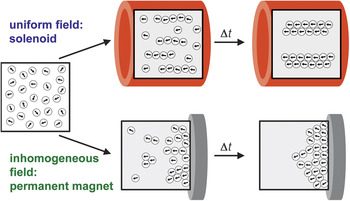
While self-assembly (SA) has been defined as “the autonomous organization of components into patterns or structures without human intervention,” Reference Whitesides and Grzybowski1 thorough human planning can go into choosing and controlling the starting conditions for SA and the fields or forces that may direct it. Many of the prefixes that have been added to “self-assembly” designate human guidance, while the material still arranges itself within the physical and thermodynamic confines of the system. For example, templated SA uses an external pattern to guide the organization. Reference Whitesides and Grzybowski1 In hierarchical SA, assembly occurs at multiple levels within a system, allowing further control, for example at multiple length scales. Reference Elemans, Rowan and Nolte2 In DNA origami, selecting a certain DNA sequence yields complex structures at a larger length scale. Reference Winfree, Liu, Wenzler and Seeman3,Reference Rothemund4 Directed SA involves the action of specific chemical moieties or fields designed to drive the assembly in a certain direction. The topic of this article, magnetic field-directed self-assembly (MFDSA), is focused specifically on using magnetic fields, created externally and by the magnetic nanomaterials themselves, to direct SA of complex materials from nansocale building blocks. We review research that has directed human intervention to allow SA to create novel materials, both of magnetic materials themselves, as well as non-magnetic materials assembled into place with the assistance of magnetic materials and fields. Figure 1 summarizes two regimes of MFDSA, in uniform fields and in magnetic field gradients, described later.
Schematic comparing magnetic field-directed self-assembly in uniform magnetic fields, such as would be obtained from a solenoid, and field gradients (i.e., inhomogeneous fields), which can be generated by permanent magnets. The uniform field drives assembly into uniform chains, but the inhomogeneous field generates attractive forces that pull the nanoparticles toward the region of the strongest field. Arrows indicate the magnetization directions of single-domain magnetic nanoparticles, and Δt indicates the passage of time in the applied field.

Physics of magnetic field-directed self-assembly
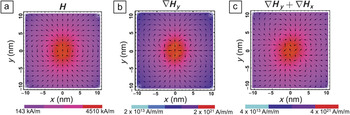
The energetics that guide SA of nanoparticles have recently been reviewed; nanoparticle SA can be dominated by either enthalpic or entropic effects. Reference Bishop, Wilmer, Soh and Grzybowski5 Applying a magnetic field to a magnetic moment at angles other than 0° or 180° generates a torque that causes the moment to precess in space, and a damping process dissipates this energy, with the moment then aligning parallel to the field, a process described by the Landau–Lifshitz–Gilbert equation. Reference Gilbert6 A uniform magnetic field therefore magnetizes a magnetic nanomaterial and creates torques that rotate and align its magnetic moment parallel to the external field, while a spatially changing field is required to exert a force on the moment and move it to a new location. A magnetic nanoparticle (MNP) behaves like a magnetic dipole and generates a highly inhomogeneous magnetic field. This field can thus magnetize nearby MNPs, and its gradient can exert forces on them. Figure 2 a shows a two-dimensional (2D) stream plot of the point dipole field for a MNP oriented along the y-axis. Reference Reitz, Milford and Christy7 Figure 2b–c shows gradients of the field in Figure 2a that create a force on a second MNP oriented along the y-axis, and at 45° to the x- and y-axes, respectively. In a homogeneous external field, alignment of the MNP moments results in attractive forces, and Figure 2b shows how end-to-end assembly (i.e., MNP chaining) can occur for MNPs with moments parallel to the external field. Interestingly, Figure 2c shows that the force on a dipole can be more complicated if the dipole moment at the origin is not parallel to the external field, which could occur if the large spatially nonuniform local field of a nearby MNP causes the MNP at the origin to change its magnetization direction. Such forces could facilitate non-linear assemblies, branching of MNP chains, or MNP chains that are multiple MNPs wide. Moreover, MNPs are finite spheres that may have unique surface spin structures. Reference Krycka, Booth, Hogg, Ijiri, Borchers, Chen, Watson, Laver, Gentile, Dedon, Harris, Rhyne and Majetich8 At room temperature, superparamagnetic MNPs have thermally fluctuating magnetic moments that may further complicate the assembly. Even if the average x-component of magnetization is zero, temporal fluctuations in the magnitude of the x-component could cause more complex 2D assembly dynamics that modify the 1D chaining process.
(a) Two-dimensional stream plot of the point dipole field for a magnetic nanoparticle (MNP) oriented along the y-axis. Reference Reitz, Milford and Christy7 Gradients of the field in (a) that create a force on a second MNP oriented along (b) the y-axis (∇H y ), and (c) at 45° to the x- and y-axes (∇H y + ∇H x ), respectively. In a homogeneous external field, alignment of the MNP moments results in attractive forces. (b) Shows how end-to-end assembly (i.e., MNP chaining) can occur for MNPs with moments parallel to the external field. (c) Shows that the force on a dipole can be more complicated if the dipole moment at the origin is not parallel to the external field, which occurs, for instance, due to the large spatially nonuniform local field of a nearby MNP.

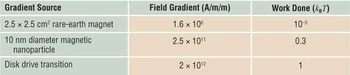
A key issue in MFDSA is the relative scale of the magnetic field gradients that induce MNP motion. Table I compares the field gradient and work done by the magnetic force to move a 10 nm diameter Fe3O4 MNP through a distance of 10 nm using different sources of field gradients. Reference Cullity9,Reference Wang and Taratorin10 Fe3O4 was chosen for this calculation because Fe3O4 MNPs are biocompatible and are chemically stable under ambient conditions. Laboratory magnets that are used in most magnetophoresis (i.e., using magnetic fields to move magnetic particles in fluids) experiments can achieve gradients of up to 109 A/m/m, Reference Lim, Tan, Lanni, Tilton and Majetich11 but these gradients do small amounts of work relative to k B T (k B, Boltzmann constant; T, temperature) at room temperature, and thus Brownian motion (see the Introductory article in this issue) and thermal fluctuations dominate magnetophoresis when using MNPs. However, the local field gradient of a MNP is much larger, approaching MT/m gradients and delivering nearly k B T of work. An even larger local source of magnetic force for MFDSA is a magnetized disk drive transition, the extremely small region (∼ 5–10 nm wide) that separates magnetized “bits” in a disk drive medium, which creates more than a 1013 A/m/m gradient and performs greater than k B T of work. For the comparison in Table I, the gradients and work done for the MNP and the disk drive transition were calculated for moving a MNP from 50 nm to 40 nm from the source along the y-axis. At 10 nm above a disk drive medium, the gradients approach 6 × 10¹³ A/m/m, and when moving a 10 nm diameter MNP from 20 to 10 nm above the surface (i.e., a 5 nm surface-to-surface separation), the work done by the field approaches 50 k B T.
Relative magnetic field gradient magnitudes and work done to move a magnetic nanoparticle.

Comparison of a magnetic field gradient and work required as a fraction of k B T to move a 10 nm diameter Fe3O4 magnetic nanoparticle (MNP) a distance of 10 nm using different gradient sources. For the NdFeB rare-earth magnet, the gradient is assumed constant over the 10 nm distance. The MNP and disk drive work calculations were performed starting at y = 50 nm above the disk surface and integrating the force until y = 40 nm. The disk drive transition does about three times the work of the MNP using a gradient nearly an order of magnitude larger. Reference Cullity9,Reference Wang and Taratorin10 Note: k B, Boltzmann constant; T, temperature.
Trapping of MNPs in fluid, described as high-gradient magnetic separation for the purposes of using magnetic fields to separate particles in a fluid, was first studied about 30 years ago. Reference Gerber, Takayasu and Friedlaender12–Reference Takayasu, Gerber and Friedlaender14 In these experiments, a magnetized Ni wire with a 0.1 mm diameter tip collected sub-µm Fe3O4 particles. Even though these field gradients were comparable to the low gradient case with work done much less than k B T, these studies led to a figure of merit comparing the relative importance of Newtonian mechanics, thermal diffusion, and Brownian motion. Brownian motion becomes significant when the product of the force times the diameter is less than thermal energy.
Missing from this figure of merit is the ratio of the relative length scale over which the magnetic field gradient changes with respect to the size of the MNP. If the field gradient does not change appreciably over multiple MNP diameters, then the force on the nanoparticle is constant, and the impact of Brownian motion involves overcoming the Stokes drag/magnetic force that would keep the MNP on a specific trajectory. However, if the field gradient is spatially localized, then the Stokes drag and the MNP velocity are not constant. Here, Newton’s Second Law must be solved to understand the resulting nanoparticle trajectory, likely combined with drift-diffusion models. For both MNP chaining and the use of ultrahigh gradient field sources such as magnetic recording media, this figure of merit needs to be revised, as Newtonian mechanics will impact the dynamics for much smaller MNP diameters. MNP trajectories have been predicted for the case of a patterned array of micromagnets at the bottom of a microfluidic channel. Reference Furlani15 Here, MNPs are predicted to oscillate vertically as they traverse a horizontal array of magnets, and most could be captured by an appropriately designed magnet array.
If MNPs are suspended in liquids, they can rotate in order to achieve low-energy configurations, such that attractive interactions are favored over short interparticle distances, and repulsive interactions are weakened by occurring over longer distances. Aligned chains of MNPs arranged side by side repel each other if they are magnetized in the same direction. Minimization of the repulsive energy results in assembly of the chains into ordered arrays (Figure 1 uniform field case). Reference Liu, Lawrence, Wu, Ivey, Flores, Javier, Bibette and Richard16 When MNPs exceed a certain size, where attractive forces become stronger than dispersive forces, they spontaneously form chains and flux closure loops Reference Tripp, Pusztay, Ribbe and Wei17,Reference Wang, Chen, Sun, Wang, Sun and Yan18 in zero applied field, when the attractive interactions between moments in MNPs that are initially misaligned are sufficiently strong to overcome viscous forces. The MNPs are consequently pulled toward each other, which drives further alignment of their magnetic moments and further increases the attractive force. Reference Thomas19–Reference Keng, Shim, Korth, Douglas and Pyun23
Another example of SA of MNPs in zero field is in magnetotactic bacteria, which synthesize magnetically coupled chains of iron oxide-based MNPs. These chains guide the bacteria to swim along the earth’s magnetic field lines and help them to find the optimal oxygen concentration in the bodies of water where they live. Reference Faivre and Schüler24,Reference Blakemore25
The premise underlying MFDSA is that magnetic forces (including those generated locally by application of uniform fields) will dominate other interparticle forces, Reference Wang, He and Yin26 which are described elsewhere in greater detail, Reference Bishop, Wilmer, Soh and Grzybowski5 including Coulomb, Keesom, Debye, and London forces. While magnetic fields need to predominate for MFDSA, adjusting these other forces can alter and enrich the diversity of structures that can be obtained through MFDSA. Reference Xu, Friedman, Humfeld, Majetich and Asher27–Reference Ge, Hu and Yin30
Examples of MFDSA and materials formed through MFDSA
Externally applied magnetic fields can drive the formation of extended linear chains of MNPs, where the MNPs may only form smaller clusters or shorter linear chain segments in zero field. Reference Butter, Bomans, Frederik, Vroege and Philipse20,Reference Klokkenburg, Erné, Meeldijk, Wiedenmann, Petukhov, Dullens and Philipse22 Applied fields can also drive the alignment of disordered MNP chains parallel to the field direction. Reference Korth, Keng, Shim, Bowles, Tang, Kowalewski, Nebesny and Pyun21,Reference Keng, Shim, Korth, Douglas and Pyun23 When solutions of ferromagnetic or superparamagnetic nanoparticles are allowed to dry under applied magnetic fields, regularly spaced linear chains result from the attractive interactions within the chains and repulsive interactions between them. Reference Lalatonne, Motte, Russier, Ngo, Bonville and Pileni29,Reference Lin, Zhou, Kumbhar, Wiemann, Fang, Carpenter and O’Connor31–Reference Alphandéry, Ding, Ngo, Wang, Wu and Pileni37 Chains of MNPs, whether obtained through MFDSA or other means, Reference Nakata, Hu, Uzun, Bakr and Stellacci38 exhibit magnetic anisotropy along the chain axis due to dipolar coupling among the MNPs. Reference Park, Jun, Choi and Cheon35,Reference Alphandéry, Ding, Ngo, Wang, Wu and Pileni37,Reference Nakata, Hu, Uzun, Bakr and Stellacci38
There is significant interest in embedding MNP chains formed through MFDSA within polymeric matrices. Reference Fragouli, Buonsanti, Bertoni, Sangregorio, Innocenti, Falqui, Gatteschi, Cozzoli, Athanassiou and Cingolani39–Reference Krommenhoek and Tracy43 Embedding chains of nanoparticles within matrices is desired for developing composites with anisotropic magnetic, mechanical, Reference Erb, Libanori, Rothfuchs and Studart44 optical, thermal, or electrical properties. Several templated SA approaches Reference Srivastava and Kotov45,Reference Tang and Kotov46 are available for forming nanoparticle chains, but MFDSA does not require a template. Furthermore, there is growing interest in using MNP chains formed through MFDSA to template the formation of lamellar phases in block copolymers, Reference Raman, Bose, Olsen and Hatton47 which may be especially useful for polymer solar cells. It should also be noted that magnetic fields can be used to obtain morphological control in some block copolymers in the absence of MNPs. Reference Gopinadhan, Majewski, Beach and Osuji48
Recently, clusters of MNPs called “colloidal nanocrystal clusters” (CNCs) have been developed as a means for obtaining larger particles that are more responsive to field gradients due to their larger moments but that remain superparamagnetic at room temperature. Reference Ge, Hu, Biasini, Beyermann and Yin49 Assemblies of CNCs formed through MFDSA have novel, tunable optical properties Reference Ge, Hu and Yin30,Reference He, Wang, Ge and Yin50 that are similar to those obtained through the MFDSA of droplets or particles obtained from microemulsions containing MNPs. Reference Xu, Friedman, Humfeld, Majetich and Asher27,Reference Xu, Friedman, Humfeld, Majetich and Asher28,Reference Bibette51,Reference Calderon, Stora, Mondain Monval, Poulin and Bibette52 CNC-based photonic sensors have also been developed. Reference Xuan, Wu, Yin and Ge53 Application of magnetic fields to CNCs embedded within polymers results in actuation that depends on how the CNCs have been micropatterned within the polymer. Reference Kim, Chung, Choi, Lee, Kim and Kwon54
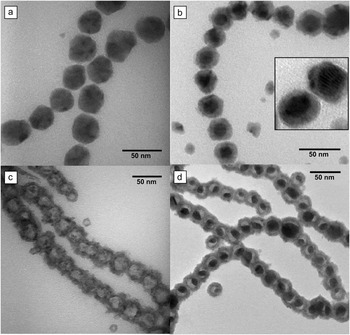
MFDSA can also be used to direct the SA of multifunctional Reference Kim, Kim, Kim, Choi, Park and Kwon55–Reference Kim, Shim, Araci, Saavedra, Monti, Armstrong, Sahoo, Srivastava and Pyun57 nanoparticles using their magnetic components, which may give rise to complex structures Reference Love, Urbach, Prentiss and Whitesides58 or may allow for other kinds of optical or electronic coupling within the chains. Furthermore, structures formed through MFDSA can be chemically transformed through conversion chemistry, Reference Vasquez, Henkes, Bauer and Schaak59 including void formation. Reference Yin, Rioux, Erdonmez, Hughes, Somorjai and Alivisatos60 Figure 3 shows the transformation of chains of Co nanoparticles into chains of CoO nanoparticles. A nascent subfield of MFDSA is in biomedical applications, where properties associated with the formation of chains of MNPs may be used for sensing, such as for MRI contrast Reference Saville, Woodward, House, Tokarev, Hammers, Qi, Shaw, Saunders, Varsani, St. Pierre and Mefford61 or for detection with microfluidics. Reference Lacharme, Vandevyver and Gijs62,Reference Gijs, Lacharme and Lehmann63 In microfluidics, MNP chains can also enhance mixing, where temporal variation of the magnetic field can cause movement of a plug of MNP chains. Reference Gijs, Lacharme and Lehmann63 The regular spacing of the chains of MNPs formed in magnetic fields has also been demonstrated as a bottom-up approach for making masks for photolithography, which may be of use for scalable nanomanufacturing. Reference Chang, Tan, Miao and Barbastathis64
Transmission electron microscopy images of chains of magnetic and multifunctional nanoparticles that spontaneously assemble in zero field: (a) Co, (b) Au/Co core–shell (inset shows higher magnification), (c) hollow CoO shells, and (d) hollow CoO shells containing smaller Au nanoparticles. Reprinted with permission from Reference 57. © 2010 American Chemical Society.

Patterned permanent magnets and electromagnets have been employed to create user-designed assemblies of MNPs. Reference Yellen, Friedman and Feinerman65–Reference Yellen, Hovorka and Friedman72 In addition, nonmagnetic materials have been assembled by combining ferrofluids, which are colloids of magnetic particles, not specifically nanoparticles (also see the Odenbach article in this issue of MRS Bulletin), and patterned electromagnets with careful control over the relative size of the ferrofluid particle diameter and the nonmagnetic particle diameter. Reference Yellen, Erb, Halverson, Hovorka and Friedman73–Reference Erb, Krebs, Alsberg, Samanta, Rotello and Yellen75 Further, non-magnetic particles have been self-assembled by using MNPs in a ferrofluid as “shepherds,” which guide non-magnetic colloidal materials into macroscopic assemblies, referred to as negative magnetophoresis. Reference Yellen, Erb, Halverson, Hovorka and Friedman73,Reference Erb, Son, Samanta, Rotello and Yellen74,Reference Krebs, Erb, Yellen, Samanta, Bajaj, Rotello and Alsberg76 By combining mixtures of different sized particles in a ferrofluid, hierarchical MFDSA has been demonstrated, with smaller particles assembling around intermediate particles, which then assemble around yet still larger particles. This technique has been adapted to form chains of cells, again by combining a variable concentration of ferrofluid and external magnetic fields; as many as three different magnetic particle sizes have been employed to achieve multiple levels of assembly. Reference Erb, Son, Samanta, Rotello and Yellen74 Finally, binary colloidal structures have been assembled through magnetic interactions to study colloidal crystallization. Reference Khalil, Sagastegui, Li, Tahir, Socolar, Wiley and Yellen77
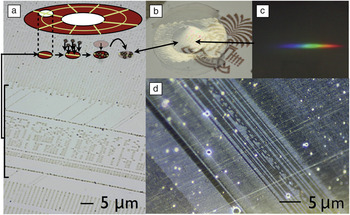
As described earlier, magnetic recording media exhibit some of the largest magnetic field gradients, even larger than those exhibited by MNPs themselves. These enormous field gradients have been used to create user-designed complex nanoparticle assemblies ( Figure 4 ). Reference Henderson and Crawford78–Reference Ye, Terry, Mefford, Rinaldi and Crawford80 Known as the “Bitter technique,” Reference Bitter81 because Bitter used iron particles dispersed in oil to visualize domains in bulk magnets, this technique has been used for visualizing domains in magnetic storage media. Reference Porthun, ten Berge and Lodder82 Because modern data storage media have grain sizes of ∼5–7 nm and transitions between field orientations of ∼10 nm, as discussed previously, the resulting field gradients approach 1013 A/m/m at the surface of the disk drive, but then fall off to 109 A/m/m by ∼500 nm above the surface. Such enormous changes in field gradient over a short distance compared to MNP size could be extremely useful in achieving better control over MFDSA, and when combined with magnetic recording could yield user-programmed structures, such as for optoelectronic devices.
Magnetic field-directed self-assembly using magnetic disk drive transitions. This approach assembles the nanoparticles on the disk drive surface and then transfers them to a transparent polymer that can be used as a standalone diffraction grating. (a) Bright field image of nanoparticles assembled onto a servo pattern on a disk drive substrate. Overlay: Cartoon that shows a ∼9 cm diameter disk drive platter diced into 1 cm circular pieces that include the uniquely patterned servo sector that keeps the recording head over a desired data track. (b) 1 cm diameter adhesive tape used to peel a cured polymer containing the assembled nanoparticles, yielding a standalone polymer nanocomposite, indicated by the arrows. (c) The rainbow pattern produced by diffraction from the nanoparticle grating. (d) Dark-field image of patterned nanoparticles embedded in the polymer film shown in (b). Reprinted with permission from Reference 79. © 2012 Institute of Physics Publishing.

Conclusions
Magnetic field-directed self-assembly (MFDSA) depends on the spatial and temporal application of the magnetic field, the composition, size, and shape of the magnetic nanoparticles (MNPs), and energy scaling in comparison with thermal energy and other forces that direct self-assembly. MFDSA can aid in understanding the complex interaction between different forces at the nanoscale. MNP interactions with surfaces and matrices can further affect the assembly process and preserve the assembled structures after the applied field has been removed. The large parameter space available in MFDSA allows for the synthesis of many materials with diverse applications, including for biomedicine, energy, optics, functional composites, and microfluidics. We foresee development and investigation of MFDSA in systems of increasing complexity, improved understanding of how to control MFDSA, and ultimately exploration of new physical regimes with MFDSA. More studies that emphasize dynamic and hierarchical MFDSA are needed to fully understand the competition of magnetic forces with other kinds of forces.
Acknowledgments
J.B.T. thanks the NSF (DMR-1056653, CBET-0967559, and the Research Triangle MRSEC, DMR-1121107), and T.M.C. thanks the NSF (CMMI-0700458 and CCMI-1130636) and ARO Grant W911NF0810299 for support of their research on MFDSA.