Hand-washing sinks, sink drains, and plumbing system components, such as P-traps, have played a role in outbreaks of carbapenem-resistant Enterobacteriaceae (CRE) in healthcare facilities. Reference Lowe, Willey and O’Shaughnessy1–Reference Palmore and Henderson7 CRE prevalence is increasing throughout the United States. CRE can cause infections with mortality rates up to 40%–50%, Reference Gupta, Limbago, Patel and Kallen8 and they are considered an urgent threat to public health by the US Centers for Disease Control and Prevention (CDC). 9 Mechanisms for the colonization, persistence, and dispersal of these organisms in sink drains and associated plumbing systems are not fully understood. Association with microbial biofilms in these environments is important. Biofilms are ubiquitous in natural and engineered systems including drinking water distribution systems and premise plumbing systems in the built environment. Biofilms are tolerant to disinfectants, biocides, and antibiotics due to the physiology of biofilm cells or features of the biofilm structure. Biofilms influence colonization of healthcare premise plumbing systems by pathogenic and antimicrobial resistant organisms. Therefore, approaches that target biofilm-associated CRE have the potential to be effectively controlled. For example, Santiago et al Reference Santiago, Burgos-Garay, Kartforosh, Mazher and Donlan10 demonstrated that a bacteriophage/surfactant treatment could reduce viable biofilm-associated carbapenemase-producing Klebsiella pneumoniae (CPKP) in a model sink-drain system. In the present study, a model sink-drain P-trap system was used to investigate the colonization of biofilms by 2 CPKP strains. K. pneumoniae is a natural human commensal and is ubiquitous in the environment, Reference Abbott11 and it has been isolated from biofilms in potable water systems. Reference Camper, McFeters, Characklis and Jones12,Reference Morin, Camper, Jones, Gatel and Goldman13 We aimed to determine whether clinical K. pneumoniae carbapenemase positive (KPC+) strains can colonize, persist, and amplify in biofilms similar to those that may form in handwashing sink P-traps in healthcare facilities.
Materials and Methods
Bacterial cultures
We obtained bla KPC-positive K. pneumoniae ST45 (ie, strain CAV1016) Reference Mathers, Cox and Bonatti14 and bla KPC-positive K. pneumoniae ST258 KPC+ (ie, strain 258) Reference Marsh, Krauland and Nelson15 clinical isolates from the CDC Division of Healthcare Quality Promotion, Clinical and Environmental Microbiology Branch (DHQP/CEMB) culture collection. Putative CPKP isolates from mEndo LES agar plates were randomly tested for the presence of carbapenemase using the modified carbapenemase inactivation method (mCIM) test Reference Pierce, Simner and Lonsway16 to assure that the KPC plasmid was not lost from the CPKP strains.
Harvesting P-trap biofilm
Two P-traps (designated PT-A and PT-B) were collected from adjacent patient rooms of an acute-care hospital, filled with tap water, shipped to the CDC by overnight courier, and processed to harvest biofilms using a modified published method. Reference Franco, Tanner, Ganim, Davy, Edwards and Donlan17 Briefly, biofilms were recovered from P-trap luminal surfaces using sponge wipes (Sponge-Stick with neutralizing buffer, 3M, St Paul, MN), and viable microorganisms were recovered from sponge wipes using a Stomacher 400 circulator (Seward Limited, West Sussex UK) and 90 mL phosphate-buffered saline containing 0.02% Tween 80 (PBST). Eluent from the sponge wipes was processed using 3 alternating 30-second vortex cycles and water bath sonication (42 kHz, Bransonic Water Bath Sonicator, Branson, MO), plated on R2A medium (7 days, 25°C) to provide a heterotrophic plate count (HPC) for the P-trap sample, and 5 mL was stored at −80°C for DNA analysis.
CBR model sink trap system
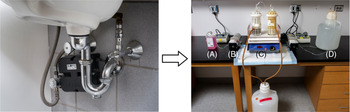
Centers for Disease Control (CDC) biofilm reactors (CBRs, Biosurface Technologies, Bozeman, MT) were configured to simulate a hand-washing sink P-trap with respect to material of construction, flow dynamics, nutrient supply, and microbial inoculum. Operation of the CBR system (Fig. 1) was based on published protocols. Reference Goeres, Loetterle, Hamilton, Murga, Kirby and Donlan18,Reference Armbruster, Forster, Donlan, O’Connell, Shams and Williams19 The CBRs contained 24-316 L stainless steel (SS) or polyvinyl chloride (PVC) coupons (Biosurface Technologies, Bozeman, MT). The CBRs were supplied with autoclaved Dekalb County, Georgia, municipal drinking water (autoclaved tap water, ATW), pH 9.2. Turbidity, total organic carbon, total phosphorus, and total organic nitrogen were all below detection. Free and total chlorine residuals were <0.02 and ≤0.02 mg/L, respectively. CBRs were attached to a 20-L carboy containing ATW and to a waste container and were operated at 22°±2°C.
Centers for Disease Control (CDC) biofilm reactor (CBR) model sink-trap system. The system was configured to simulate the material construction, flow dynamics, nutrient supply, and microbial inoculum found in handwashing sink P-traps. Hand soap (A) and autoclaved drinking water (D) were pumped (B) into CBRs (C), and connected to a waste container.

CBR system inoculation
Klebsiella pneumoniae were subcultured from frozen stock onto trypticase soy agar (TSA) and were incubated at 35°C for <18 hours. A 108 CFU/mL cell suspension was prepared in 10 mL phosphate-buffered saline (PBS) on the day of inoculation, and 1 mL was inoculated into each CBR system containing biofilms grown for 28 or 7 days. Initially, each CBR system was inoculated by adding 200 mL of the biofilm suspension collected from the original P-trap samples (designated PT-A and PT-B) and used to inoculate the CBR systems (designated CBR-A or CBR-B, respectively) and filling the reactor up to the discharge point with ATW. For subsequent experiments, each CBR system was inoculated by adding 30 mL biofilm suspension harvested from coupons containing biofilms grown for 28 days or 7 days in the preceding CBR system and filling the reactor up to the discharge point with ATW. After seeding the subsequent CBR system with cells harvested from the initial reactor runs, a known CPKP strain was added to the 7- or 28-day-old CBR system.
CBR system operation
The inoculated CBR system was operated in batch mode by mixing at 100 rpm for 18–24 hours followed by 18 hours of stagnation. ATW was pumped into the CBR for 25 minutes at 16 mL/min to replace the entire volume of ATW in the CBR system, 4 times per day, 7 days per week, throughout the experiment. To each CBR system, 2 mL Kleenex Foam Skin Cleanser hand soap (Kimberly-Clark Professional, Roswell, GA) was added concurrently with the ATW (4 times per day, 5 days per week), and CBRs were mixed (200 RPM) for 30 seconds to simulate handwashing.
CBR system coupon sampling and biofilm recovery
Coupons were collected from the CBR, rinsed in sterile Butterfield Buffer (phosphate buffer, 3 mM; pH, 7.2), transferred to 10 mL PBS, and processed through 3 alternating 30-second vortex cycles and water-bath sonication (42 kHz, Model 2510, Branson Co, Danbury, CT) to recover the biofilms. Biofilm suspension was plated on R2A, incubated, and counted as already described to provide a biofilm HPC, and 5 mL was stored at −70°C for DNA analysis. CPKP recovered from coupons were plated onto mEndo LES Agar (Becton Dickinson, Franklin Lakes, NJ) and incubated at 35–37°C for 24 hours.
Microscopy
Biofilms on SS coupons were fixed for 5 minutes in 5% w/v formaldehyde, rinsed in sterile distilled water (SDW) and stained for 15 minutes in the dark with 2 µM 4’,6-diamidino-2-phenylindole (DAPI, Molecular Probes, Carlsbad, CA) and rinsed in SDW. A coverslip was mounted with 1 drop of ProLong Gold Antifade Mounting fluid (Molecular Probes). Biofilms were imaged (345 nm excitation, 455 nm emission) using a Zeiss Axioplan epifluorescence microscope with Axiovision software. Images were exported for analysis using Image Pro Premier 3D (Meyer Instruments, Houston TX).
Statistical analysis
Mean and standard deviation of log-normalized plate counts (n = 3) were compared using a 2-tailed Student t test. P values <.05 were considered significant.
Culture-dependent biofilm community analysis
Duplicate morphologically distinct colonies from R2A plates of recovered 28-day biofilms on SS from each experiment were identified using matrix-assisted laser desorption ionization time-of-flight mass spectrometry (MALDI-TOF MS, Bruker, Billerica, MA).
Culture-independent biofilm community analysis
For the culture-independent biofilm community analysis, 4 mL biofilm suspension from P-traps and CBR coupon samples was filtered (0.2 µm polycarbonate membrane filter (Millipore Sigma, Burlington, MA)), and the filter was stored at −80°C. Bacterial genomic DNA (gDNA) was extracted using the DNeasy PowerWater kit (Qiagen, Germantown, MD) according to the manufacturer’s protocol and stored at −80°C until library preparation. Following the Illumina 16S Metagenomic Preparation Guide (Illumina, San Diego, CA), gDNA was amplified using 2X PCR master mix (Promega, Madison, WI). The V4 hypervariable region of the 16S rRNA gene was amplified (Lax et al Reference Lax, Smith and Sangwan20 ). The new 515FB-806RB primer pair was modified to include degenerate bases in both forward and reverse primers. Reference Parada, Needham and Fuhrman21,Reference Walters, Hyde and Berg-Lyons22 Samples were sequenced on the MiSeq platform (Illumina, San Diego, CA). Raw sequencing reads were placed under National Center for Biotechnology Information (NCBI) Bioproject no. PRJNA487668.
Data analysis and processing
Raw 16S rRNA gene paired-end reads were merged into V4 hypervariable region sequences using PEAR Reference Zhang, Kobert, Flouri and Stamatakis23 and were filtered by quality (Q30 over 90% of bases) and length (minimum length of 254 bp) using the FASTX-Toolkit. 24 Chimeric structures were removed from the sequences using VSEARCH. Reference Rognes, Flouri, Nichols, Quince and Mahe25 Clean sequences were analyzed with the Quantitative Insights into Microbial Ecology (QIIME) version 1.9.1 software. Reference Caporaso, Kuczynski and Stombaugh26 Sequences were clustered into operational taxonomic units (OTUs) Reference Rideout, He and Navas-Molina27 using SortMeRNA Reference Kopylova, Noe and Touzet28 and Sumaclust. 29 OTUs called by <0.1% of sequences were discarded. Next, rarefying of each sequenced sample to the same depth of 354,070 sequences was performed to eliminate sequencing bias. A representative sequence (centroid) of each accepted OTU cluster was aligned against the GreenGenes reference database Reference DeSantis, Hugenholtz and Larsen30 to determine taxonomic composition. The α and β diversity analyses were conducted using the Shannon index and weighted UniFrac distances, Reference Lozupone and Knight31 respectively.
Results
P-trap biofilm bacterial community analysis
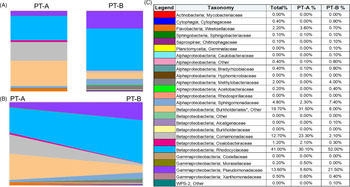
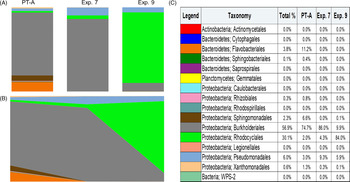
The biofilm HPCs of PT-A and PT-B were similar: 7.16 and 7.11 log10 CFU/cm Reference Chapuis, Amoureux and Bador2 , respectively. The compositions of the biofilm bacterial communities from PT-A and PT-B were substantially different from one another, as determined using culture-independent analyses (Fig. 2). Biofilms in PT-B were more diverse than PT-A biofilms, with 19 versus 12 major OTUs detected, respectively. The most abundant bacterial families in PT-A were Betaproteobacteria, including Rhodocyclaceae (30.1%), Comamonadaceae (23.3%), and an unidentified family (31.5%). Meanwhile, Betaproteobacteria-Rhodocyclaceae (52%) and Gammaproteobacteria- Pseudomonadaceae (21.5%) were predominant in PT-B. Using culture-dependent methods, similarities were observed between PT-A and PT-B, including 4 of the same families (Microccoccaceae, Flavobacteriaceae, Burkholderiaceae, Comamonadaceae), with Alcaligenaceae, Burkholderiaceae, Pseudomonadaceae, and Xanthomonadaceae only in PT-B. Although Micrococcus luteus, Elizabethkingia spp, and Delftia acidovorans were isolated from both communities, Cupriavidus pauculus and Comamonas testeroni were isolated only from PT-A and Sphingomonas spp, Achromobacter spp, Cupriavidus metallidurans, Pseudomonas aeruginosa, and Stenotrophomonas maltophilia were isolated only from PT-B. Not all isolates identified using culture-dependent methods were detected by sequencing. For example, a representative of the class Actinobacteria (Micrococcus luteus) was detected using culture-dependent methods but not by 16S microbiome sequencing of PT-A or PT-B. Enterobacteriaceae were not detected in PT-A or PT-B prior to inoculation with K. pneumoniae CAV1016 or 258, using culture-independent or culture-dependent methods.
Culture-independent community analysis (taxon-family level) of biofilms recovered from P-traps collected from patient rooms A and B (designated PT-A, PT-B) in an acute-care hospital. (A) Bar chart results of different families for each P-trap sample. (B) Composition plot comparing the amounts of different families for each P-trap sample. (C) Legend with taxon family-level identification.

Growth of biofilms in CBR system
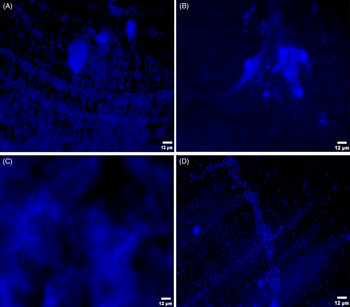
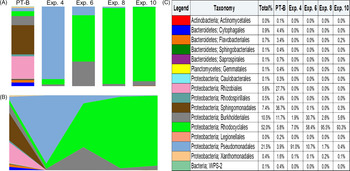
Inoculation of the CBR systems with the microbial consortia recovered from the original P-traps resulted in the formation of patchy biofilm on SS and PVC surfaces in CBR-A and CBR-B systems, as shown microscopically (Fig. 3). The HPCs of biofilms recovered from CBR-A on SS and PVC coupons were 7.63 (0.2) and 7.76 (0.11) log10 CFU/cm Reference Chapuis, Amoureux and Bador2 , respectively (P = .13). The HPCs of biofilms recovered from CBR-B on SS and PVC coupons were 6.96 (0.64) and 7.72 (0.24) log10 CFU/cm Reference Chapuis, Amoureux and Bador2 , respectively (P = .04). Biofilm microbial communities in CBR-A and CBR-B were primarily composed of Betaproteobacteria and Gammaproteobacteria and were substantially less diverse than communities in the corresponding original P-trap biofilms used as the inoculum for these model systems (Figs. 4 and 5). The community diversity of CBR-A was substantially different from the diversity of CBR-B. For both systems, the composition of the community varied over time. Culture-independent β diversity analyses using the weighted UniFrac distance metric also revealed a shift in community composition of both CBR-A and CBR-B samples from their original P-trap inoculum, which is demonstrated by the clustering of CBR samples away from PT-A and PT-B (Fig. 6).
Microscopic imaging of 28-day undefined biofilm on SS coupons stained with DAPI. The upper 2 images are CBR-A experiments and the lower 2 images are CBR-B, experiments. Images are compiled z-stacks captured through a 40× objective. Bar = 12 µm.

Culture-independent community analysis (taxonomic units, class-level) of biofilm recovered from PT-B and four CBR system replicate samples of 28d biofilms (Experiments 4, 6, 8, & 10). A, B) Each bar or colored region represents all taxonomic units that constituted >0.1% of the total number of sequences for each sample. C) Legend.

Culture-independent community analysis (taxonomic units, class-level) of biofilm recovered from PT-A and two CBR system replicate samples of 28d biofilms (Experiments 7 & 9). A, B) Each bar or colored region represents all taxonomic units that constituted >0.1% of the total number of sequences for each sample. C) Legend.

Culture-independent community analysis (Weighted Unifrac beta diversity PCoA plots) including biofilm samples recovered from PT-A and PT-B and the six, 28d CBR replicates (Experiments 4, 6, 7, 8, 9, 10). A) Each sample is represented by a point and CBR samples are colored red or blue based on inoculum origin (PT-A or PT-B). Samples plotted closer to each other are more similar than those further away. B) Legend.

Colonization of CBR system biofilms by K. pneumonia
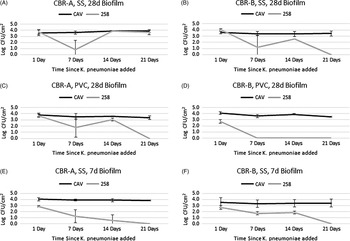
CAV1016 and 258 colonized all CBRs attaining mean log10 viable counts of 2.6–4.0 log10 CFU/cm2 within 24 hours after inoculation (Fig. 7). CAV1016 persisted 21 days after inoculation in both CBR-A and CBR-B (Fig. 7). Conversely, 258 was not detected beyond 14 days after inoculation under any conditions in CBR-B or under most conditions in CBR-A (Fig. 7). Significantly higher numbers of CAV1016 than 258 were recovered from 7-day biofilms, 21 days after inoculation in CBR-A (3.83 vs 0 log10 CFU/cm2; P < .001) and CBR-B (3.42 vs 0 log10 CFU/cm2;, P < .001), and from PVC biofilms, 21 days after inoculation in CBR-A (3.34 vs 0 log10 CFU/cm2; P < .001) and CBR-B (3.49 vs 0 log10 CFU/cm2; P < .001). Neither organism appeared to significantly amplify in either system; counts at 7–21 days in every case remained at or below the level detected at 24 hours, with the exception of CAV1016 on 28-day biofilms, which only increased from 3.58 to 3.89 log10 CFU/cm2 between 24 hours and 21 days. In all cases, CAV1016 and 258 isolates from mEndo LES agar plates contained the bla KPC plasmid.
K. pneumoniae CAV1016 and K. pneumoniae ST258 KPC+ colonization of biofilms in CBR sink trap model systems. CFUs observed on mEndo selective media where the known CPKP strain was added to different model systems. Persistence of the known CPKP organism was tested in two distinct mixed species biofilm communities (CBR-A and CBR-B) on two substratum types (SS and PVC), and in biofilms of two different ages (7d and 28d). Results are shown over time by condition tested as follows: A) CBR-A, SS, 28d biofilm; B) CBR-B, SS, 28d biofilm; C) CBR-A, PVC, 28d biofilm; D) CBR-B, PVC, 28d biofilm; E) CBR-A, SS, 7 d biofilm; F) CBR-B, SS, 7 d biofilm.

Colonization of 7-day versus 28-day biofilms by K. pneumoniae
To assess the effect of biofilm age on CPKP colonization, CAV1016 or 258 was inoculated into CBR-A and CBR-B containing biofilms grown for either 7 days or 28 days on SS coupons. Both CPKP strains colonized biofilms in both systems. There was no significant difference seen in either system in 7-day or 28-day biofilm for CAV1016 (P = .635 for CBR-A and P = .993 for CBR-B), 21d after inoculation). However, significantly higher numbers of 258 were recovered from CBR-A colonized by 28-day biofilms than by 7-day biofilms (3.88 vs 0.53 log10 CFU/cm2; P = .003) and CBR-B (2.57 vs 1.84 log10 CFU/cm2; P = .006), 14 days after inoculation (Fig. 7).
Colonization of biofilms on SS versus PVC surfaces by K. pneumoniae
CPKP CAV1016 and 258 colonized but did not amplify on PVC in either system. The pattern of colonization and persistence of CAV1016 was not significantly different on SS or PVC in either CBR System (P = .060 in CBR-A and P = .766 in CBR-B), 21 days after inoculation. Both CBR systems showed a significantly higher recovery of 258 on SS compared to PVC: 3.88 versus 3.04 log10 CFU/cm2 (P = .002) in CBR-A and 3.34 versus 0 log10 CFU/cm2 (P < .001) in CBR-B, 14 days after inoculation (Fig. 7).
Discussion
Unique microbial communities comprised P-trap biofilms from sinks in adjacent patient rooms in an acute-care hospital. Several bacterial families detected have been reported in shower heads or drinking water, Reference Feazel, Baumgartner, Peterson, Frank, Harris and Pace32,Reference Buse, Lu, Lu, Mou and Ashbolt33 including Pseudomonadaceae, Comamonadaceae, Burkholderiaceae, Bradyrhizobiaceae, Moraxellaceae, and Sphingomonadaceae. However, there was very little overlap between the phylogenetic groupings detected by McBain et al Reference McBain, Bartolo, Catrenich, Charbonneau, Ledder, Rickard, Symmons and Gilbert34 in domestic drain microbial communities and the present study; only Spingomonadaceae and Moraxellaceae were common to both studies, and the relative abundance of these organisms in the present study was very small. Differences may be due to type of P-trap or to the waste materials routinely discarded in the respective sinks. Microbial communities of P-traps would be expected to be composed of organisms commonly observed in drinking water systems. The diverse nature of P-trap communities in relative proximity to one another suggests an impact of the patient care.
One objective of this study was to develop an in vitro model system simulating the P-trap environment with respect to substratum, growth milieu, hydrodynamics, and the autochthonous microbial biofilm community, to provide translational and relevant data on the colonization and persistence of CPKP organisms in these environments.
Arguably, the most variable aspect of the CBR model was the biofilm microbial community. CBR biofilms were substantially less diverse than the original P-trap biofilms, and they varied by source (ie, CBR-A or -B) and experiment. Nonetheless, CBR communities contained multiple taxonomic groupings. Predominant organisms detected in CBR communities were Proteobacteria, as has been reported in drinking water and premise plumbing systems. Reference Feazel, Baumgartner, Peterson, Frank, Harris and Pace32,Reference Buse, Lu, Lu, Mou and Ashbolt33,Reference Henne, Kahlisch, Brettar and Hofle35 Both CPKP strains colonized P-trap biofilm communities irrespective of material, biofilm age, or community diversity. Our β diversity analyses comparing the original P-trap biofilms to CBR communities using weighted UniFrac principal coordinates analysis (PCoA) plots demonstrated that 28-day CBR biofilms were more similar to each other than to either PT-A or PT-B regardless of which inoculum was used. This indicates a convergence of CBR biofilms to a similar “CBR community” in addition to a decrease in α diversity.
Coliform bacteria, including K. pneumoniae have been isolated from drinking water systems Reference Camper, McFeters, Characklis and Jones12,Reference Morin, Camper, Jones, Gatel and Goldman13 and have been shown to grow in unamended drinking water, Reference Szabo, Rice and Bishop36 suggesting the potential for CPKP colonization in the CBR model. CAV1016 and 258 colonized but did not amplify in the biofilm beyond 4 log10/cm Reference Chapuis, Amoureux and Bador2 , suggesting the inability to compete with autochthonous organisms. Strain 258 may have been viable but not culturable, as has been reported for Enterobacteriaceae in drinking water. Reference Byrd, Xu and Colwell37 Acclimatizing these organisms in a dilute, low-nutrient medium prior to inoculation could impact colonization and persistence, as was observed with K. pneumoniae in a model drinking-water system. Reference Szabo, Rice and Bishop36 The inoculum titer could also impact colonization and persistence. Szabo et al Reference Szabo, Rice and Bishop36 found that K. pneumoniae levels ≤1.5 × 10⁵ MPN/mL declined rapidly when inoculated into a drinking water biofilm reactor, whereas persistence was significantly longer when inoculum levels were higher. The inoculum viable count used in the present study (~105 per mL) is consistent with the Szabo study.
Strains CAV1016 and 258 were selected for this study because the KPC plasmid is globally successful for patient-to-patient spread. Reference Marsh, Krauland and Nelson15 CAV1016 was the strain responsible for ongoing transmission in a US hospital where wastewater premise plumbing likely played a role in transmission. Reference Mathers, Cox and Bonatti14 Thus, CAV1016 may be better suited to the environment and 258 may be better suited to a human reservoir. This finding could have implications for managing outbreaks or transmission in hospitals with different CPKP strains.
The use of an environmental biofilm consortia in this study was a benefit, in light of its translational nature, and a drawback, due the inability to maintain the microbial diversity of the original P-traps and to control diversity from one experiment to the next. The established biofilm microbial communities would be expected to have an effect on colonization and amplification of allochthonous Enterobacteriaceae, either through competition for nutrients, oxygen, or space Reference Banning, Toze and Mee38,Reference Juhna, Birzniece and Larsson39 or by exposure to predators. Reference Sibille, Sime-Ngando, Mathieu and Block40 Results suggest that CPKP can colonize and persist under these conditions, but the elucidation of the mechanisms influencing amplification and dispersion may require use of a characterized, defined microbial community to limit the effect of variability of the community on these processes.
In summary, a model sink-drain P-trap was used to grow biofilms of organisms originally isolated from P-traps from a healthcare facility. Using this model, 2 clinically relevant strains of CPKP colonized but did not amplify in biofilms over 21 days. Neither biofilm age nor substratum for biofilm growth affected colonization by strain CAV1016 but did have a significant effect on strain 258. A significant difference in persistence was observed between the 2 CPKP strains under most conditions tested. These results suggest that CRE can colonize and persist in biofilm communities within sink-drain P-traps in healthcare facilities, with the potential to be dispersed into the patient care environment.
Acknowledgments
The use of trade names and commercial sources is for identification only and does not imply endorsement by the Public Health Service or the US Department of Health and Human Services. The findings and conclusions in this report are those of the authors and do not necessarily represent the official position of the US Centers for Disease Control and Prevention.
Financial support
No external financial support was provided for this research.
Conflicts of interest
All authors report no conflicts of interest relevant to this article.