Introduction
The Indian Thar Desert occupies 89.6% (31.7 million ha) of the hot arid zone, mainly covering the states of western Rajasthan, Gujarat, Punjab and Haryana. Approximately 81% of this area is located in the western Rajasthan and Gujarat states of India (Sharma and Tewari, Reference Sharma and Tewari2005). The nature of vegetation in the Thar Desert is mostly dominated by mixed shrubs and annual and perennial grasses with sparse/limited tree density (Kumar and Parveen, Reference Kumar and Parveen2004; Sharma and Tewari, Reference Sharma and Tewari2005). The region is endowed with multipurpose and highly useful plant species, which are all well adapted to arid agroecological habitats. Different parts of the plant species, such as the ripe fruits of Cordia sinensis, Ziziphus nummularia, Grewia tenax and Capparis decidua; the flower buds of Calligonum polygonoides and C. decidua; the unripe fruits of C. decidua and Leptadenia pyrotechnica and the seeds of Haloxylon salicornicum are harvested from the wild for food purposes in arid regions of India (Singh et al., Reference Singh, Rathore, Beniwal, Singh and Chhonkar2008). People are transitioning to be more health conscious and are trying to avoid chemical/synthetic foods, hence preferring natural therapeutic nutrition through natural products (Kumar et al., Reference Kumar, Pal, Sapra and Umrao2008).
The demand for underutilized fruit crops such as Bael is increasing daily in many parts of the world. Specifically, fruit pulp sharbat has become a popular drink in India due to its nutritional and health benefits (Kumar et al., 2008; Dhakar et al., Reference Dhakar, Das, Nath, Sarkar and Singh2019). An underutilized fruit species locally called September yellow (Stauntonia obovatifoliola Hayata subsp. urophylla) has become a new potential edible fruit crop in China due to its precious nutritional value and pleasant taste (Zou et al., Reference Zou, Yao, Zhong, Gao, Wang and Huang2020). Its fruit is rich in total sugar (40.26%), crude protein (1.28%), vitamin C (1.55 mg/100 g) and reducing sugar (Wang et al., Reference Wang, Xing, He, Duan, Huang and Gong2015) and is traditionally utilized by local villagers for medicinal purposes, such as anti-inflammatory and pain-killing properties. Ronoh et al. (2019) reported that African nightshade (Solanum scabrum Mill.) played a significant role in improving food and nutrition security in sub-Saharan Africa. In India, Singh and Meghwal (Reference Singh and Meghwal2020) emphasized the importance of underutilized Ziziphus species in the rural livelihood security of the local people of Rajasthan. Z. mauritiana is a valuable food, fodder, fuel and fencing source, thereby improving the socio-economic life of the local people. The leaves of naturally distributed Z. nummularia, a wild relative of Z. mauritiana, are excellent sources of fodder for sheep, goats, camels and cattle. Z. rotundifolia is a source of quality timber and rootstock promoting the large-scale multiplication of Z. mauritiana. The fruits of Blue honeysuckle (Lonicera caerulea L.) are sweet to sour or bitter in taste and are traditionally utilized for food purposes in Russia, China, Japan, and recently in North America (Chaovanalikit et al., Reference Chaovanalikit, Thompson and Wrolstad2004).
The genus Cordia (family Boraginaceae), with >300 species, has widely been grown in dry and hot regions of the world (Bouby et al., Reference Bouby, Bouchette and Figueiral2011). Cordia myxa and C. sinensis have grown naturally in arid regions of Rajasthan and Gujarat states (Meghwal et al., Reference Meghwal, Singh, Kumar and Morwal2014). C. sinensis is one of the most important underutilized multipurpose fruit species with high potential as a useful source of food, fodder, traditional medicine for animals and humans, fibre and wood. Its leaves are rich in dry matter (41.2%) and crude protein (13.8%), with high amounts of energy and minerals such as potassium, phosphorus, calcium, zinc and iron, whereas its fruits are rich in dietary fibre (11.6%), energy (18.9 kcal/100 g dry wt.) and crude protein (12.6%) (Kuria et al., Reference Kuria, Wanyoike, Gachuiri and Wahome2005). It is a multi-stemmed shrub or small tree, growing up to 12 m high. Leaves are opposite, ovate to obovate, and light green with pale hairs on both surfaces. Flowers are born in terminal and axillary cymes, white or cream, and are sweetly scented (Warfa, Reference Warfa1990; Orwa et al., Reference Orwa, Mutua, Kindt, Jamnadass and Anthony2009). The fruit is small, drupe and bright red or yellow-orange. One fruit contains 1–4 hard and rough seeds.
The robust tap root system and other adaptive features, such as waxy leaves, hairiness, sunken and covered stomata in leaves, water binding mechanism and tolerance to salinity, drought and heat, make this species hardier and essential in arid regions (Meghwal et al., Reference Meghwal, Singh, Kumar and Morwal2014). Although C. sinensis has become a favourable species for domestication and utilization in arid regions due to its multiple uses and drought hardiness characteristics, it has received limited research attention regarding its improvement and utilization. Thus, the present paper presents research that was an attempt to gather information on its geographical distribution, morphological diversity, multiplication and ex situ conservation and provides a preliminary evaluation regarding its use as potential food and fodder to stimulate interest and promote the sustainable utilization of the species.
Material and methods
Field survey, germplasm and passport data collection
Field surveys were conducted in five administrative talukas (is an administrative division within a district) of the Kachchh region of Gujarat during two consecutive years from June to December in 2015 and 2016 at the fruiting stage, and C. sinensis germplasm was collected (Fig. 1 and online Supplementary Table S1). The five administrative talukas and the regions surveyed are as follows: Bhuj (Tapkeshwari hill, Gangeshwar hill, Kotda Chakar region, etc.), Nakhatrana (Dhinodhar hill region, Chhari Dand region, etc.), Rapar (Pragpar, Adesar, Chitrod, etc.), Mandvi (Vijay Vilas Palace, Dahisara, Meghpar, Kera, etc.) and Bhachau (Amardi, Bhudarmora, etc.). Propagules such as fruits and hardwood cuttings were collected through a selective sampling strategy. Hardwood cuttings were kept in moist sand in a small plastic bag to avoid moisture loss. In total, 20 diverse germplasms were collected during the exploration trip, and the collector's number was allotted to each germplasm. First-hand field data on passport information (site information, global positioning system data, habitat, topography, etc.), ethnobotanical/ethnoveterinary information (traditional medicinal uses) and other important economic characteristics of species (fruit/fodder value) were collected using a semi-structured questionnaire, household survey and individual interviews of the village elders. The soil samples were collected at two depths (0–15 and 16–30 cm) from the sampling sites along with plant propagules.
The collection sites of C. sinensis in the Kachchh region (1, Kotda Ugamana/Bhuj; 2, Bhujodi/Bhuj; 3, Madhapar/Bhuj; 4, Pragpar/Rapar; 5, Pragpar/Rapar; 6, Tapkeshwari/Bhuj; 7, Tapkeshwari/Bhuj; 8, Tapkeshwari/Bhuj; 9, Madhapar/Bhuj; 10, Madhapar/Bhuj; 11, Saiyedpar/Bhuj; 12, Dahisar/Mandvi; 13, Koday/Mandvi; 14, Kodaypul/Mandvi; 15, VRTI/Mandvi; 16, Vijay Vilas Palace/Mandvi; 17, Kharoi/Bhachau; 18, Ustiya/Abdasa; 19, Kothara/Abdasa; 20, Ranara Mota/Nakhatrana).

Habitat and associated vegetation study
The climate of the Kachchh region of Gujarat is hot to semiarid, with a maximum temperature of 39–45°C during May–June and a minimum temperature of 1–8°C during December–January (Mangalassery et al., Reference Mangalassery, Dayal, Arvind, Bhatt, Nakar, Kumar, Singh and Misra2017). The average rainfall in Kachchh is 385 mm (average of 1998–2016), and most rainy days occur from July to September with high evapotranspiration (1500–2000 mm per year). Rainfall is scant, erratic and irregular with a high coefficient of variation (CV) (71.25%). The collection sites represented different habitats, including grasslands, rocky land, barren land, piedmont plain, lower hills and valleys, scrub forest and agricultural field boundaries in the Kachchh region. Data on the local habitat, associated vegetation and soils of each collection site were recorded and analysed to determine the influence of local factors on the status of the plants.
Analysis of soil samples
The collected soil samples were analysed for essential soil characteristics and micronutrient status (soil pH, EC, OC, N, P, K, Na+, Ca+ and Mg2+). Soil pH and EC (dS/m) were determined by taking the supernatant solution with a 1:2 soil/water ratio (w/v) using a laboratory pH meter and conductivity meter (Jackson, Reference Jackson1973). An atomic absorption spectrophotometer (AA500, PG instrument, UK) was used to quantify the Na+, K+ and Mg2+ concentrations in the soil samples, whereas ethylenediaminetetraacetic acid (EDTA) complexometry was used to determine the concentration of Ca+. The organic carbon (%) and available phosphorus (%) of soil samples were determined by Walkley and Black's rapid titration method (Walkley and Black, Reference Walkley and Black1934) and Olsen's method (Olsen et al., Reference Olsen, Cole, Watanabe and Dean1954), respectively.
Standardization of propagation and nursery study
Collected fruits and hardwood cuttings of C. sinensis were brought to the horticulture nursery of Regional Research Station, ICAR-Central Arid Zone Research Institute, Kukma-Bhuj, Gujarat (India), where the hardwood cuttings (1.0–1.5 cm thickness and 15–20 cm length) were washed under running water and treated with 0.2% solution of Bavistin to remove the surface impurities and then immediately planted in polythene bags. For the propagation of seeds, freshly collected ripe fruits were rubbed with sand to clear away any gummy mucilage and then dried in the shade. Dried seeds were soaked in water overnight before sowing and were disinfected using Bavistin solution (2%) for disinfection. Seeds and hardwood cuttings were sown/planted in black poly bags (15 × 10 cm height) filled with clay, sand and FYM (2:4:1) and kept under a green shade net (50% shade) where regular intercultural operations followed. Data including days to sprouting, sprouting (%), seed germination (%), days to germination and survival (%) were recorded in the nursery stage.
Transplanting and preliminary field evaluation
The 16 best germplasms were selected among one-year-old plants on the basis of the growth rate. Transplantation (pit size – 0.6 × 0.6 × 0.6 m) occurred in the field during August–September 2016 with five replications at a spacing of 6 × 6 m under a randomized complete block design. For morphological characterization, data on 15 growth parameters, including plant height (cm), plant spread (cm2), number of branches, leaves per plant, collar diameter (mm), leaf area (cm2), leaf length (cm), leaf width (cm), petiole length (mm), petiole width (mm) and fresh and dry weights (g) of the ten leaves were recorded. Furthermore, data on dry matter (%), moisture content (%) and crude protein (%) were recorded using leaf samples collected from three-year-old plants.
Statistical analysis
The collected data were subjected to statistical analysis including basic descriptive statistics and Pearson's correlation analysis with the help of the software package ‘PAST3’ (Hammer et al., Reference Hammer, Harper and Ryan2001).
Results and discussion
Collection, distribution and diversity
The distribution pattern of the collected germplasm of C. sinensis based on habitat, location (taluka), soil status (pH) and topography are presented in Fig. 2. Field surveys revealed the occurrence of C. sinensis at the range of 22°84′624–23°56′288N° latitude to 68°95′730–70°73′100E° longitude and 0–221 m altitude with maximum distribution in Bhuj (Kotda Ugamana, Bhujodi, Madhapar, Tapekshwari hill region, Saiyedpar), followed by Mandvi (Dahisar, Koday, Kodaypul, nearby VRTI and Vijay Vilas Palace), Rapar (Pragpar), Abdasa (Kothada), Nakhatrana (Ranara Mota) and Bhachau talukas. The effects of local habitat, soil status and site topography on the species existence of C. sinensis were indicated by their distribution pattern. The sites with the highest collection values belonged to taluka Bhuj (9), followed by Mandvi (5), Abdasa (2), Rapar (2), Bhachau (1) and Nakhatrana (1) of Kachchh (Gujarat). Based on habitat and topography, maximum collections came from cultivated field boundaries (8), followed by five in each of scrub forests and roadsides (online Supplementary Fig.S1(a)–(d)). Approximately 45% of germplasm collections belonged to taluka Bhuj, followed by Mandvi (25%), Rapar (10%) and Abdasa (10%), with a minimum of 5% each in Nakhatrana and Bhachau. Field surveys revealed the presence of a good amount of natural density (%) in habitats such as field boundaries (35), rainfed scrub forests (30), roadsides (25) and backyards (10). Maximum collections occurred in areas with level topography (60%) with a soil pH in the range of 8–8.5 (63%), whereas only 6% of the collections came from sites with soil pH > 8.5.
Distribution pattern of collected germplasm of C. sinensis on the basis of habitat, collection region, soil pH and topography.

C. sinensis is widely distributed in arid and semiarid regions of America, Asia and Africa, mainly in Egypt, Ethiopia, India, Israel, Jordan, Kenya, Madagascar, Mozambique, Namibia, Pakistan, Senegal, Somalia, South Africa, Sri Lanka, Sudan, Tanzania, Yemen and Zimbabwe (Orwa et al., Reference Orwa, Mutua, Kindt, Jamnadass and Anthony2009). Due to its suitable adaptive mechanism and long tap root system, the species can survive in rainfed, arid and semiarid habitats (Meghwal et al., Reference Meghwal, Singh, Kumar and Morwal2014). In India, this species is commonly found in the arid and semiarid parts of Gujarat, Rajasthan (Jaisalmer, Jodhpur, Pratapgarh), Maharashtra (Nasik, Pune, Thane), Karnataka (Bangalore, Dharwar, Chikmaglour, North Karnataka), Tamil Nadu (Coimbatore, Cuddalore, Dharamapuri, Salem, Tiruchhirapalli, Tirunelveli, Vellore) and Kerala (Idakki) (Renu et al., Reference Renu, Thilakar and Narasimhan2016). Its distribution in different parts of Gujarat was reported in earlier studies as follows: Panchmahal district (Qureshimatva et al., Reference Qureshimatva, Maurya, Gamit and Solanki2016), Ambaji forest of Banaskantha district (Patel, Reference Patel2015), Bhandaria Forest Area of Bhavnagar district (Chavda and Mehta, Reference Chavda and Mehta2015), Mehsana district (Barot et al., Reference Barot, Patel and Dabgar2017), Thol Lake Wildlife Sanctuary of Mehsana district (Vyas and Patel, Reference Vyas and Patel2015), Rampara forest in Saurashtra region (Panchal and Pandey, Reference Panchal and Pandey2004), Surat district (Gadhia et al., Reference Gadhia, Gadhia and Parabia1999) and in terrestrial areas of Ghogha, Jalapor, Jambusar, Olpad, Talja, Umbagaon, Gandevi, Jafrabad, Khambhat, Kodinar, Mahuva, Una talukas situated around the Gulf of Khambhat (Gujarat Ecology Commission, 2011) as well as in Bhachau and Mandvi talukas of the Gulf of Kachchh (Gujarat Ecology Commission, 2014).
During the field survey, wide genetic diversity was observed in natural populations of C. sinensis with respect to plant height, flowering (time and colour), fruiting (time and colour), and growth habits of plants from the inland region of Rapar, Bhuj, Bhachau to the coastal region of Mandvi and Abdasa taluka. In addition to C. sinensis, fair diversity was observed in other Cordia species, such as C. myxa L, C. monoica Roxb., C. perrottetii Wt. and C. sebestena L. The vigorous growth of plants with generous bearing capacity noted in the coastal region might be attributed to the presence of high atmospheric humidity at the collection sites. Early flowering and fruiting (February to April and May to August, respectively) were noted in the coastal talukas (Mandvi and Abdasa) compared to the other inland sites of Bhuj, Rapar and Bhachau talukas. A considerable amount of variation was observed in the fruit size (small to large), colour of ripe fruits (light orange to dark orange) and fruit-bearing potential (light to a profuse bearing) (online Supplementary Fig. S1(e)–(j)).
A tree census on non-forest areas of Gujarat by the Gujarat forest department reported the majority of the C. sinensis population was in the South Gujarat region, followed by the Kachchh and Saurashtra (315,000) regions (Khanna and Singh, Reference Khanna and Singh2010). In addition to C. sinensis, the Kachchh region of Gujarat had rich diversity of other underutilized plant species, such as G. tenax, G. villosa, G. flavescens and C. myxa. The rich diversity of Cordia species, including C. sinensis, was observed in the Kotda Chakar (Bhuj), Dahisara and Koday (Mandvi) regions of Kachchh (Dev et al., Reference Dev, Kumar, Kumar and Dayal2016). Earlier studies have reported the vast genetic diversity of C. myxa L. in natural populations regarding its morphological traits (Pareek and Sharma, Reference Pareek and Sharma1993; Saini et al., Reference Saini, Kaushik and Singh2002; Malik et al., Reference Malik, Chaudhury, Dhariwal and Bhandari2010). A morphological and RAPD marker study on 22 Cordia accessions of the Indian arid zone revealed a considerable amount of genetic diversity (Sivalingam et al., Reference Sivalingam, Singh and Chauhan2012). Wide variability has also been reported for 14 accessions of C. myxa collected from arid regions of the Rajasthan and Gujarat states in terms of fruit characteristics such as bunch weight (14.1–137.4 g), fruit weight (1.96–10.5 g), fruit numbers per bunch (4.62–14.8) and pulp: stone ratio (1.1–6.96) (Meghwal et al., Reference Meghwal, Singh, Kumar and Morwal2014).
Primary soil status, habitat and associated vegetation
The soil analysis of the surveyed sites (Bhuj, Mandvi, Nakhatarana, Rapar, Bhachau and Abdasa) represented sodic soil pH (7.1–9.2) with deficient organic carbon (0.01–0.48%). The available cations Na+, Ca+ and K+ (ppm) ranged from 65 to 437.14, 13.33 to 123.33 and 40 to 470.40, respectively (online Supplementary Table S2). High population densities were observed for C. sinensis and C. myxa at soil pH values of 8.5 and 8.2, respectively. C. sinensis can be grown on almost all types of soils but prefers clay, clay sand or alluvial soil, red loam and rocky soils (Warfa, Reference Warfa1990). Accessions collected from Mandvi taluka (CBCG-15 and CBCG-16) were identified as salt-tolerant accessions that require further study for their utilization in the future. A higher leaf Na+ ion content was reported in C. sinensis (230–920 ppm), followed by C. myxa (200–830 ppm) collected from the Kachchh region (Dev et al., Reference Dev, Sureshkumar, Singh and Dayal2019). The domestication process in this species is still not yet completed compared to C. myxa. This was evidenced by the distribution pattern and soil status of species observed during the field survey, as a high amount of the overall population (63%) belonged to habitats such as scrub forest, field boundaries and roadsides with soil pH values in the range of 8.0–8.5, whereas less of the overall lower population (6%) was found on sites near human settlements or as backyard plantations (10%) with soil pH > 8.5.
Field surveys revealed the underutilized shrub and tree species including Ingorio (Balanites aegyptica L), Nano Akado (Calotropis procera), Kair (C. decidua (Forsk.) Edgew.), Avar (Cassia auriculata L.), Tankaro (Clerodenron phlomidis L.), Guggal (Commiphora wightii (Arn.) Bhandari), Danda-thor (Euphorbia caducifolia Hains.), Gangeti (G. tenax (Forsk.) Fiori), Luska (Grewia villosa Willd.), Kundher (Premna resinosa Schau), Mithi Jar (Salvadora oleoides Dence), Khari Jar (S. persica L.) and Bordi (Z. nummularia (Burm.f.) Wight & Arn.) as close associates of C. sinensis. Its natural preference for moist habitat has been evidenced by its wide occurrence near the coastal area of the Gulf of Khambhat and Gulf of Kachchh of Gujarat (Gujarat Ecology Commission, 2011; 2014). However, its preference for dry riverine land, open bushland (Orwa et al., Reference Orwa, Mutua, Kindt, Jamnadass and Anthony2009), riverbanks, seasonally flooded areas and in-land depressions, moist grounds or sometimes gardens (Warfa, Reference Warfa1990) has also been reported in association with Balanities, Combretum, Ficus, Grewia, Salix, Salvadora, Tamarindus, Thespesia and Ziziphus species (Maundu et al., Reference Maundu, Ngugi and Kabuye1999; Eltayeib and Ishag, Reference Eltayeib and Ishag2015).
Propagation
Data on seed germination and sprouting in cuttings of C. sinensis were observed on the 12th and 17th days of sowing and planting, respectively (online Supplementary Table S3). The results showed low seed germination (28–42%) and sprouting in cuttings (17–32%). Two accessions (CBCG-12 and CBCG-13) showed early seed germination (8 d) in the nursery. Although sprouting was noted in hardwood cuttings, plants were dried subsequently due to rooting failure. Similar observations were recorded by Meghwal and Vashistha (Reference Meghwal and Vashishtha1998) in the propagation of C. decidua through hardwood cuttings. Hence, only 16 seed-propagated accessions could be used for field establishment and further study. Meghwal (Reference Meghwal2007) reported the seed as the standard propagation method of Cordia species, including C. sinensis, who also noted higher seed germination (50–60%) for C. sinenesis than for C. myxa (only 20–30%).
Preliminary field evaluation
Range of variation
The morphological characterization of 16 C. sinensis genotypes using 15 growth parameters is presented in Table 1. The mean plant survival after two and a half years of planting was 96% in the field. The morphological characterization revealed the presence of a considerable amount of variation expressed as the CV (%). The maximum CV (%) was observed for the number of leaves per plant (66.6), followed by the number of branches per plant (45.62), collar diameter (27.69), percentage of dry matter (25.34) and minimum fresh weight of 10 leaves (6.01). The range and mean values of essential characteristics such as plant height (121.67–212.0 and 166.83 cm), plant spread (118–223 and 170.5 cm2), number of branches per plant (6–24.33 and 15.16), number of leaves per plant (322.33–2991.33 and 1656.5) and collar diameter (17.53–45.99 and 27.0 mm). Accession ‘CBCG-11’ collected from Saiyedpar village of the Bhuj taluka showed maximum plant growth in terms of plant height (212 cm), canopy spread (223 cm2) and collar diameter (45.99 mm). The maximum number of branches (24.33) and leaves per plant (299.33) were recorded for the accession ‘CBCG-16’. Three accessions, CBCG-13, CBCG-16 and CBCG-8, showed higher values in leaf parameters such as leaf area, leaf length, leaf width, fresh weight of ten leaves and lateral veins per leaf. In some accessions of C. sinensis (CBCG-12, CBCG-13 and CBCG-14), flowering was noted late in the third year during the third week of February and fruiting was noted in March–April 2019. Meghwal et al. (Reference Meghwal, Singh, Kumar and Morwal2014) also reported significant variations in flowering pattern, fruiting and fruit yield among 14 on-farm conserved C. myxa genotypes collected from Rajasthan and Gujarat.
Results of the characterization of C. sinensis germplasm in the field

Variation in leaf qualitative traits
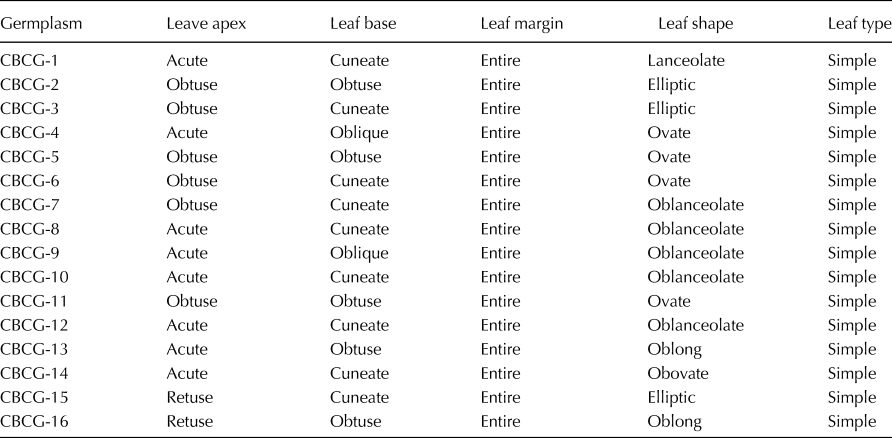
Five leaf qualitative traits of collected germplasm are presented in Table 2 and online Supplementary Fig. S2. There was considerable variation in leaf apex (acute, 8; obtuse, 6; retuse, 2), leaf base (cuneate, 9; obtuse, 5; oblique, 2) and leaf shape (lanceolate, 1; elliptic, 3; ovate, 4; oblanceolate, 5; oblong, 2; obovate, 1), whereas no variation was observed on the ‘entire’ leaf margin or ‘simple’ leaf type.
Variation in the leaf qualitative traits of collected C. sinensis germplasm

Reproductive biology
Although flowers of C. sinensis are hermaphroditic in nature, functional male flowers are also present with rare female flowers (Warfa, Reference Warfa1990). Flowering and fruiting occur twice per year, during September–October and February–March. Its flowers are entomophilous mainly by honeybees, houseflies and yellow wasps due to their sweet fragrance. Plants of this species are deciduous, as they remain in physiological dormancy for almost two months during winter (December–January) when leaf shedding occurs. The fruits are harvested upon changing colour from green to orange.
Traditional utilization
Different aspects of C. sinensis utilization, such as direct consumption of fruits, leaves as fodder and wood as timber, have been reported worldwide. Bright red or orange coloured, fully ripened fruits are edible and sold in local markets of Kenya (Maundu et al., Reference Maundu, Ngugi and Kabuye1999) and some parts of arid Rajasthan (Rathore, Reference Rathore2009). The chemical composition of fruits (online Supplementary Table S4) indicates it's good nutritive (Kuria et al., Reference Kuria, Wanyoike, Gachuiri and Wahome2005) and fodder (Murray et al., Reference Murray, Schoeninger, Bunn, Pickering and Marlett2001) value. The sweet and sticky pulps were consumed fresh and sometimes utilized in porridge as a sugar substitute. Children or adults in rural areas have consumed fruits during the fruiting season or during food shortages. In Kenya, fruits are sun-dried and stored in a wooden container for future uses (Maundu et al., Reference Maundu, Ngugi and Kabuye1999). Fresh fruit pulps are squeezed in water, mixed with tamarind (Tamarindus indica) juice and kept for fermentation to brew local beer (Orwa et al., Reference Orwa, Mutua, Kindt, Jamnadass and Anthony2009).
Generally, leaves of C. sinensis are used as browse materials by goats, sheep, cattle and camels during dry and wet seasons in arid and semiarid areas (Kuria et al., Reference Kuria, Wanyoike, Gachuiri and Wahome2005; Orwa et al., Reference Orwa, Mutua, Kindt, Jamnadass and Anthony2009; Deng et al., Reference Deng, Ondiek and Onjoro2017b). Abdullah et al. (Reference Abdullah, Rafay, Khan, Ahmad, Tahir, Rasheed, Ruby and Khalil2017) classified arid species based on their palatability as highly palatable (Prosopis cineraria and Acacia nilotica), moderately palatable (C. polygonoides, Suaeda fruticosa, Salsola baryosma, Haloxylon recurvum, C. decidua, C. procera and Tamarix aphylla) and less palatable (H. salicornicum) in the Cholistan Desert of Pakistan. Analysis of the nutrient composition of C. sinensis showed high year-round moisture and crude protein (13.8–15.93%) with high energy and mineral (potassium, phosphorus, calcium, zinc and iron) contents (Kuria et al., Reference Kuria, Wanyoike, Gachuiri and Wahome2005; Deng et al., Reference Deng, Ondiek and Onjoro2017a; Derero and Kitaw, Reference Derero and Kitaw2018).
Traditionally, C. sinensis was used to treat different ailments and for wound-healing purposes (online Supplementary Table S5). It has the potential to cure gastric disorders, malaria, rheumatism, bladder diseases, gastric ulcers and infectious diseases (Orwa et al., Reference Orwa, Mutua, Kindt, Jamnadass and Anthony2009). The use of different plant parts, such as root and bark decoction, has been reported to treat malaria, stomach disorders and chest pains; bark has been used to treat gastric and respiratory disturbances and mixtures of roots and bark have been used to treat conjunctivitis in cattle (Orwa et al., Reference Orwa, Mutua, Kindt, Jamnadass and Anthony2009; Al-Musayeib et al., Reference Al-Musayeib, Perveen, Fatima, Nasir and Hussain2011). Leaves and ripe fruits were used alone or in combination with other medicinal plants to treat fever and dry cough, respectively (Adnan et al., Reference Adnan, Ullah, Tariq, Murad, Azizullah, Khan and Ali2014). Among the ten bioactive compounds isolated from C. sinensis, two compounds [kaempferide-3-O-D-glucopyranoside (62.4%) and kaempferol-3-O-D-glucopyranoside (59.6%)] were found to have potential as diclofenac (57.6%), which also showed significant anti-inflammatory activity (Thirupathi et al., Reference Thirupathi, Kumar, Raju, Ravikumar, Krishna and Mohan2008; Nyambe, Reference Nyambe2014).
The hardwood of C. sinensis is locally used for making furniture, agricultural implements such as tool handles, walking sticks, clubs, wooden spoons, stirrers and stools as well as in the construction of local huts. Fibre from the inner bark is useful for making ropes, caulking boats, etc. An edible gum from the bark may be used to adulterate gum Arabic (Acacia senegal). Its poles are sold for construction purposes in the local markets of Pokot and Turkana town of Kenya (Maundu et al., Reference Maundu, Ngugi and Kabuye1999).
Cordia sinensis is a preferred plant species in arid regions due to its multiple uses as food, fodder, medicine, gum and timber. Despite its numerous uses, its utilization and domestication process is still minimal. Poor domestication of this species was evidenced from its high population frequency between soil pH 8.0–8.5 on level topography and in habitats such as scrub forests, field boundaries, roadsides and its low population frequency on sites near a human settlement or as backyard plantation in the present study. The extensive genetic diversity noted on natural populations of species in Bhuj and Mandvi taluka of Kachchh could be useful for future studies. Based on the preliminary evaluation, accessions selected for different purposes were as follows: fast growth and fodder (CBCG-11 and CBCG-16); early flowering and fruiting (CBCG-12, CBCG-13 and CBCG-14); most natural propagation by seeds (CBCG-12 and CBCG-13) and salt tolerance (CBCG-15 and CBCG-16). Future research works should be focused on its exploration, sole plantation, standardization of propagation techniques and characterization and conservation aspects, which still exist at the infancy stage; thus, information about this valuable species could enhance its utilization by present and future generations.
Supplementary material
To view supplementary material for this article, please visit https://doi.org/10.1017/S1479262120000453
Acknowledgements
The author is thankful to the Director of ICAR-CAZRI for providing the necessary facility for conducting research.
Funding
Not applicable.
Conflict of interest
The authors declare that they have no conflicts of interest.