INTRODUCTION
Fragmentation of tropical forests is increasing worldwide along with annual deforestation rates of about 5.8 million ha (Achard et al. Reference ACHARD, EVA, STIBIG, MAYAUX, GALLEGO, RICHARDS and MALINGREAU2002). Together with habitat loss, forest fragmentation facilitates access to hunters who strongly deplete vertebrate populations (Corlett Reference CORLETT2007). Number of vertebrate species in forest fragments is expected to be strongly area-dependent (Chiarello Reference CHIARELLO1999, Peres & Michalski Reference PERES, MICHALSKI, Laurance and Peres2006), though degree of fragment isolation, matrix type and time since isolation should also be determinant (Andrén Reference ANDRÉN1994). In extreme cases, highly fragmented landscapes have lost virtually all large vertebrate species (>1 kg) which are assumed to be regionally extinct over thousands of square kilometres (Silva & Pontes Reference SILVA and PONTES2008).
Most tropical tree species are dispersed by animals (Gentry Reference GENTRY1982, Howe & Smallwood Reference HOWE and SMALLWOOD1982) and depend on successful seed dispersal to enhance seedling recruitment and allow forest regeneration (Stoner et al. Reference STONER, RIBA-HERNANDEZ, VULINEC and LAMBERT2007). Defaunation reduces the dispersal of zoochorous tree species (Cordeiro & Howe Reference CORDEIRO and HOWE2001, Melo et al. Reference MELO, DIRZO and TABARELLI2006) and alters seed predation patterns through elimination of granivores with perceivable consequences to plant demography (Terborgh et al. Reference TERBORGH, LOPEZ, NUNEZ, RAO, SHAHABUDDIN, ORIHUELA, RIVEROS, ASCANIO, ADLER, LAMBERT and BALBAS2001). However, controversial explanations on the effects of defaunation on forest regeneration still persist. There is no consensus, for example, on whether the lack of large-bodied granivores favours large-seeded species by an ecological release from seed predators (Wright et al. Reference WRIGHT, HERNANDEZ and CONDIT2007) or whether the low seed dispersal due to lack of large-bodied seed dispersers negatively affect large-seeded species (Silva & Tabarelli Reference SILVA and TABARELLI2000). Such a divergence has led to opposite predictions on the consequences of defaunation on plant species composition in fragmented landscapes (see Cramer et al. Reference CRAMER, MESQUITA and WILLIAMSON2007 and Dirzo et al. Reference DIRZO, MENDOZA and ORTIZ2007 for contrasting conclusions).
Although non-dispersed seeds of large-seeded tree species form dense monospecific carpets of seedlings (Dirzo & Dominguez Reference DIRZO, DOMINGUEZ, Bullock, Medina and Mooney1995), seedlings have little or no probability of survival due to the attack by pathogens and herbivores (Blundell & Peart Reference BLUNDELL and PEART2004, Janzen Reference JANZEN1970). Therefore, assuming that the prevalence of large-seeded species in the forest understorey constitutes evidence of the ecological release of large vertebrates may be risky. Otherwise, if the main limiting factor to seedling recruitment is effective seed dispersal away from the parent plant (Howe & Miriti Reference HOWE and MIRITI2004), it is reasonable to expect that small forest fragments lacking large-bodied seed dispersers should present low recruitment rates of large-seeded tree species.
Following this rationale, we hypothesize that the lack of medium- to large-bodied frugivores in small forest fragments leads to significant changes in both taxonomic and functional (i.e. dispersal syndromes and seed size) composition of seedling communities driven by reduced recruitment of seedlings of large-seeded species. To address this hypothesis, we first test whether or not the occurrence of large-bodied seed dispersers is related to fragment size. Second, we asked if the functional and taxonomic composition of the seedling communities vary according to fragment size. Third, we tested if there is an effect of fragment size on the proportion of seedlings emerged from dispersed seeds according to dispersal syndrome and seed size. Finally, we discuss the possible implications of a biased seedling community within small defaunated fragments for forest regeneration and the maintenance of tree diversity.
STUDY SITE
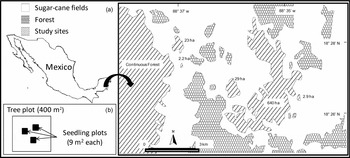
The study was carried out in the communal lands of the Ejido Palmar (18°27ʹN; 88°35ʹW), Yucatan Peninsula, southern Mexico (Figure 1a), where deforestation accompanied the establishment of sugar-cane plantations in the mid-1970s. However, a large portion of forest (>5000 ha) was left in the western zone of the Ejido (Figure 1a) that is contiguous with other communal lands of less intensive uses (e.g. small subsistence crops or archaeological sites). The remaining forest fragments are in small hills where the predominant vegetation type is semi-deciduous tropical forest, with canopy height of about 17 m (Sánchez-Sánchez & Islebe Reference SÁNCHEZ-SÁNCHEZ and ISLEBE2002). All fragments in the region suffered selective logging prior to the establishment of sugar-cane plantations and were isolated about the same time period. Wood harvest for fuel is practiced in the area, and most forest fragments receive frequent incursions by hunters.
Study site located at the Ejido Palmar, State of Quintana Roo in southern Mexico with the six forest fragments used for the experiments (a) and a demonstrative illustration of the sampling station containing adult tree and seedling plots (b).

METHODS
To test our hypotheses we selected five completely isolated forest fragments ranging from 2.3 to 640 ha plus the large forest patch of 5000 ha (Figure 1a). These areas were selected among many other isolated fragments in the landscape because they did not present signs of recent fires. In addition to area, we measured fragment isolation as the proportion of forested area in a 1-km radius from the edge of each fragment (Bender et al. Reference BENDER, TISCHENDORF and FAHRIG2003). This concept of isolation based on landscape-level forest cover is considered more realistic than the simple geographic distance among fragments (Gorresen & Willig Reference GORRESEN and WILLIG2004). We attributed the value of 1 (i.e. no isolation) to the 5000-ha forest patch because of its large size and the fact that it is not truly isolated. Since degree of isolation and fragment area were highly correlated (r = 0.83, N = 6, P < 0.01), we opted to use fragment area as explanatory variable in our analyses.
Defaunation
To evaluate if fragment size is related to the defaunation level, for each fragment we conducted faunal inventories. During the dry and wet seasons of 2006 we used linear transects that according to fragment size ranged between 200 to 1500 m as proposed by Chiarello (Reference CHIARELLO1999). We also placed five camera-traps for seven consecutive days at each experimental site arrayed 100 m apart in transect lines. We restricted our censuses to mammals greater than or equal to squirrels (Sciurus sp. > 500 g) that might act as seed dispersers as well as three of the largest birds that could be easily recognized in the field, namely Ramphastos sulfuratus (keel-billed toucan), Ortalis vetula (plain chachalaca) and Tityra semifasciata (tityra). Since sightings were rare we also recorded footprints, carcasses and reports of encounters made by local hunters. Because of the low number of records and the inability to conduct more extensive faunal surveys in our study sites we could not use abundance or density of any vertebrate group in our analyses. However, we are convinced of the accuracy of our faunal inventory because a 3-y study at the same forest sites with visits at 15-d intervals showed no new records of any vertebrate species other than those recorded by our censuses and interviews (Melo Reference MELO2009).
Tree and seedling surveys
We established five 400-m2 (20 × 20 m) sampling plots within the centre of each forest fragment ranging from 2.3 to 29 ha. In the 640-ha fragment and 5000-ha forest patch we sampled two areas separated by at least 1 km where five 400-m2 plots were located, totalling ten sampling plots for these sites. To avoid effects of sampling fragments of contrasting sizes, we standardized the arrangement of each group of five sampling plots based on the average distance among sampling stations set in the smallest forest fragment sampled (2.3 ha). We also measured the distance of each sampling plot to the nearest forest edge but this was correlated to fragment area, and therefore we did not include this variable in our analyses. Within each sampling plot, all trees larger than 5 cm diameter at breast height (dbh) were mapped and identified to species or genus. The criterion of 5 cm dbh (rather than the usual 10 cm criterion) was chosen because of the large number of tree species reaching maturity under 10 cm dbh in this forest type (Sánchez-Sánchez & Islebe Reference SÁNCHEZ-SÁNCHEZ and ISLEBE2002). Within each of the 400-m2 sampling plots we established three 9-m2 (3 × 3 m) plots centred at three equidistant points (~5 m) in which we collected all seedlings 10–50 cm height (Figure 1b).
As we did not consider life forms other than trees, we restricted our analysis to tree seedlings. Identification of botanical material was in charge of one of the authors, Esteban Martinez Salas, an expert taxonomist in Mexican tropical flora, based in the National Herbarium of México. In the analyses we only considered seedlings identified to genus and species. Based on the literature, we classified species of trees and seedlings into two contrasting dispersal modes: vertebrate-dispersed vs. abiotic-dispersed; and into three seed-size categories according to their longest length: small-, <0.6 cm; medium-, 0.6–1.4 cm; and large-seeded species, >1.4 cm. Following Silva & Tabarelli (Reference SILVA and TABARELLI2000), dispersal mode was assigned to each tree species according to fruit characteristics; whereas the categories of seed size were selected based on the frequency distribution of the specific longest length of the seeds.
Tree seedlings were also classified as immigrant seedlings or local seedlings based on whether they originated from dispersed (i.e. actively dispersed away from parent plant) or local seeds (i.e. dropped from the parent tree) respectively. For this, we compared the list of all tree species within each of the 400 m2 tree-plots with the list of tree seedlings collected within them. We considered a seedling as originating from a dispersed seed (hereafter immigrant seedling) only when no conspecific adult was present within the sampling area (Webb & Peart Reference WEBB and PEART2001). When both seedling and adult of the same species were present in the same 400-m2 sampling plot we considered seedlings of such species as local. This method is likely to be conservative if: (1) a seedling of a given species a may have not come from the seeds dropped from a conspecific adult a within the sampling area, but from seeds of another adult of species a distant from the sampling area; and if (2) we were unable to exclude males of dioecious tree species from the potential parent list. Otherwise, overestimation of seed dispersal would occur if the seedlings sampled originated from adults that have died, thus not being considered in the parent plant list. Also, seedlings of common adult species would be less likely to be considered as immigrants than seedlings of rare species but no correlation was found between species-specific abundance of trees and immigrant seedlings (r = 0.21, N = 43, P = 0.19). Therefore, our classification of seedlings as immigrant or local was not affected by species-specific abundance of adult trees. Even considering such methodological constraints, this approach has proven to be effective to assess the importance of seed dispersal in tropical forests (Martinez-Ramos & Soto-Castro Reference MARTINEZ-RAMOS and SOTO-CASTRO1993, Webb & Peart Reference WEBB and PEART2001).
Statistical analysis
Fragment area, isolation degree and average distance of sampling plots to the nearest forest edge were all positively correlated (r > 0.8; N = 6; P < 0.05). We therefore opted to use fragment area as the main predictor variable in our analyses. To know whether recorded number of medium- and large-bodied mammal species, large birds and fragment area were correlated we used Pearson's correlation. Given the small number of fragments and the absence of spatial autocorrelation of data for seedling communities (ρ = −0.05; P = 0.20), we opted to use each sampling plot (N = 40) as a replicate for our analysis (pooling the three 9-m2 seedling plots). However, a Mantel-test detected a small but significant spatial autocorrelation of data sets for adult trees (ρ = 0.19; P < 0.001) that precluded us from using sampling sites as replicates for the analyses on tree community (note degrees of freedom reported in the analyses).
Our first aim was to assess changes in the functional composition of tree and seedling assemblages across fragments. For this, mean number of trees and seedlings, as well as tree and seedling species richness were set as response variables in general linear mixed models (GLMM) where the fixed effects were: fragment area, dispersal mode and seed size categories. To control for the unavoidable pseudoreplication effect of our study design, we nested sampling plots within each fragment as a random effect in the models. Residual maximum likelihood method (REML) was used to separate variances of fixed from random effects in the models (Grafen & Hails Reference GRAFEN and HAILS2002).
Changes in composition of seedling communities were tested against two main factors. First we tested whether composition of seedling communities were correlated with adult tree communities. We used a partial Mantel-test to assess if there was a correlation between similarity matrices of adult tree and seedling communities as well as their interaction with geographical distance among surveyed plots. To test for the effects of fragment size on tree and seedling species composition we first conducted a non-metric multidimensional scaling (NMDS) based on Bray–Curtis abundance-based similarity index to generate a two-dimensional representation of adult-tree and seedling communities for all fragments studied (Dufrene & Legendre Reference DUFRENE and LEGENDRE1997). Afterwards we used NMDS dimensions as response variables in general linear mixed models (GLMM) with fragment size as fixed factor and sampling plots nested within fragments as a random factor.
Finally, generalized linear models for binomial data (Crawley Reference CRAWLEY2007) were used to assess the effect of fragment size on: (1) proportion of immigrant seedlings; (2) proportion of dispersal modes within immigrant seedlings; and (3) proportion of each seed size category within zoochorous immigrant seedlings. All response variables (except NMDS values) as well as fragment size were log10(x+1)-transformed prior to analysis. Adequacy of each GLMM was tested by checking studentized residuals against a normal distribution through the Shapiro–Wilk test. We conducted all analyses using JMP version 7 and Primer-E version 5 (Clarke & Warwick Reference CLARKE and WARWICK2001).
RESULTS
Fragmentation and seed dispersers
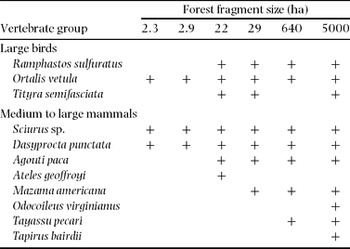
The faunal inventory showed that the incidence of medium- to large-bodied mammals and large birds that may act as seed dispersers was negatively correlated with fragment size (r = 0.86, N = 6, P = 0.02; Table 1). Specifically, fragments smaller than 30-ha lacked many of the large frugivores common to the study region, and the smallest fragments studied lacked almost all medium to large vertebrates except for a common species of large bird (Ortalis vetula; Table 1).
Faunal composition of forest fragments studied in the Ejido Palmar, Southern Mexico. Potential large-bodied seed dispersers with both terrestrial (mammals) and aerial (birds) habits are indicated. Presence is indicated with plus (+) signs.

Functional and taxonomic composition of seedling communities
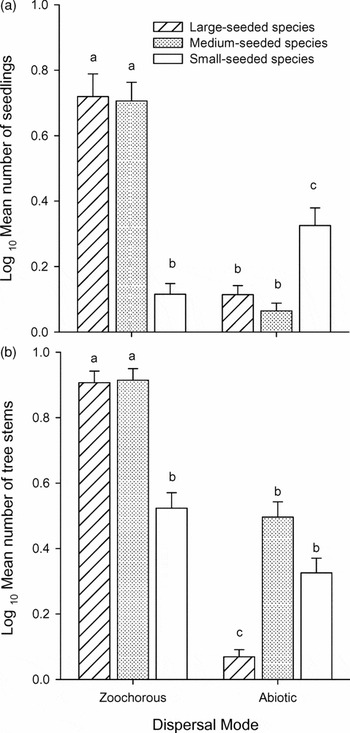
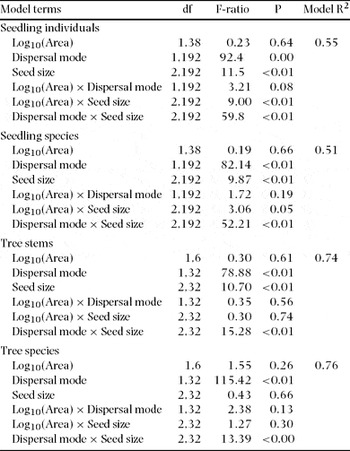
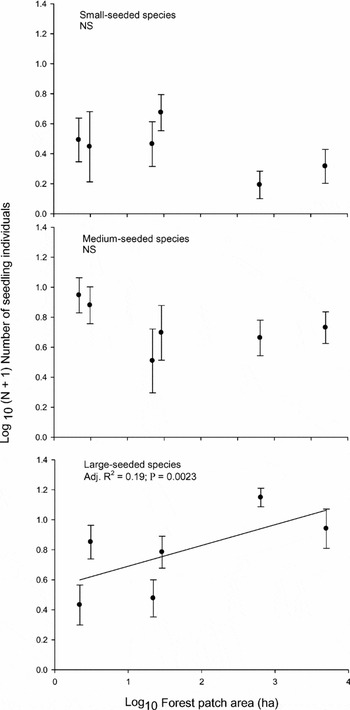
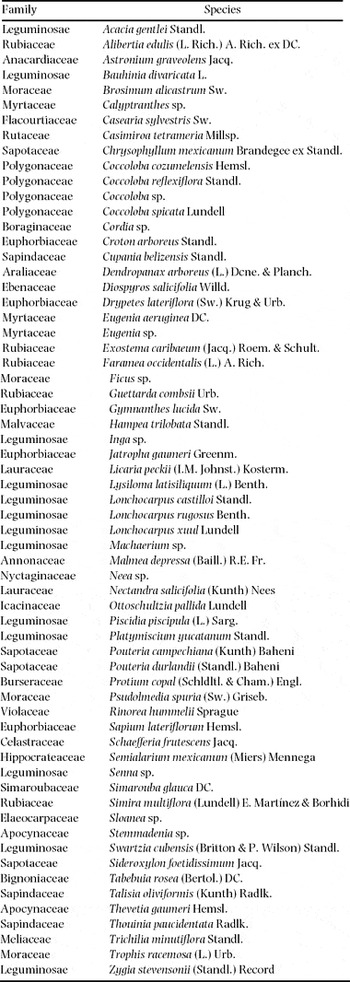
We found a total of 653 seedlings of 63 tree species in 30 families (Appendix 1). Categories of seed size and dispersal mode were strongly correlated for both seedling and tree communities (Table 1). Abiotically dispersed species were mainly small-seeded while vertebrate-dispersed species were mostly medium- to large-seeded (Figure 2). Neither seedling nor adult tree communities varied with fragment size in terms of density of individuals or dispersal mode (Table 2). In contrast, a significant interaction between fragment size and category of seed size was evident for the seedling community, but not for adult trees (Table 2). This interaction was mainly due to a marked decrease in the number of seedlings of large-seeded species with decreasing fragment size, while in the two smallest categories of seed size the average number of individuals and species were not related to fragment area (Figure 3).
Mean (± SE) number of seedlings per 27 m2 (a) and tree stems per 400 m2 (b) per category of seed size and dispersal mode at the Ejido Palmar, southern Mexico. Individual seedlings of small-seeded (<0.6 cm in the longest length); medium-seeded (0.6–1.4 cm) and large-seeded (>1.4 cm) species. A similar pattern was observed for adult trees.

General linear mixed models fitted for functional composition of both seedling and tree communities at the Ejido Palmar, southern Mexico. Random effects accounted for less than 10% of the unexplained variance of all models.

Relationship between fragment size and mean number (SE bars) of seedlings for small-seeded (<0.6 cm in the longest length); medium-size seeded (0.6–1.4 cm) and large-seeded (>1.4 cm) species at the Ejido Palmar, southern Mexico. NS = not significant. A similar pattern was observed for the mean number of species.

Adult-tree and seedling communities were not correlated in terms of species composition (Mantel's ρ = 0.003; P = 0.97), neither was their interaction with geographical distance among sampling sites (trees × seedlings/distance; ρ = 0.01; P = 0.46). Non-metric multidimensional scaling (NMDS) did not uncover any grouping pattern for tree communities among fragments (stress value = 0.20) and this was confirmed with the absence of correlation between NMDS axes of tree community with fragment size (F1,6 < 1.1, P > 0.32, in all cases). However, NMDS suggested a fragment-size-mediated shift in taxonomic composition of seedling communities (stress value = 0.14) as evidenced by the GLMM that showed that axis-2 of the NMDS negatively correlated with fragment size.
Seed dispersal and recruitment
Between 61% and 81% of all immigrant seedlings were dispersed by animals, thus activity of vertebrate seed dispersers may account for a net percentage of 35–47% of all recruits. Fragment size had no effect on the percentage of immigrant seedlings (L-R Chi-square = 0.02, df = 1, P = 0.88; Table 3) neither on the dispersal mode of immigrant seedlings (L-R Chi-square = 1.19, df = 1, P = 0.28; Table 3). Notwithstanding, percentage of LSSS (>1.4 cm length) dispersed by vertebrates decreased with diminishing fragment size (L-R Chi-square = 14.3, df = 1, P < 0.01), comprising 46% and 58% of all immigrant seedlings in the 640-ha and 5000-ha fragments respectively, while their contribution was not greater than 25% of all immigrant zoochorous seedlings within fragments < 30 ha (Table 3).
Absolute numbers and percentage values (in parentheses) of tree seedlings found within six forest fragments in the Ejido Palmar, southern Mexico. Columns refer to: the origin (i.e. whether seedlings originated from local or immigrant seeds); the dispersal mode of immigrants (i.e. whether immigrant seedling have abiotic or zoochorous dispersal mode); and seed size of zoochorous immigrants (i.e. the category of seed size of zoochorous immigrant seedlings).

DISCUSSION
According to our findings, reduced dispersal of large-seeded species may be a key driving force in shaping seedling communities within defaunated forest fragments. Shifts in the taxonomic and functional composition of the seedling communities were not related to responses of the tree communities to fragmentation and thus might be governed by different ecological processes. Despite the effects of fragmentation and defaunation being confounded in our experimental design, reduced number of seed dispersers in fragments, mainly large-bodied vertebrates, should be key to driving changes in both taxonomic and functional composition of seeding assemblages. Supporting this assertion is the seed-size-mediated response of seedling communities to fragment size. Large-seeded species tended to be poorly represented as seedlings in the small fragments.
Contrary to our findings, recent studies argued that large-seeded tree species may be favoured in defaunated forests through reduced seed predation (Dirzo et al. Reference DIRZO, MENDOZA and ORTIZ2007, Wright et al. Reference WRIGHT, HERNANDEZ and CONDIT2007). The ecological release of large-seeded species has been suggested by these authors based on the preference of small rodents for small seeds and/or on the predominance of large-seeded species within seedling communities in defaunated forests (Wright et al. Reference WRIGHT, HERNANDEZ and CONDIT2007). However, robust conclusions on whether an ecological release of large-seeded tree species exists must consider whether recruited seedlings originate from dispersed or local seed and thus are susceptible to differential survival probabilities (Terborgh et al. Reference TERBORGH, NUNEZ-ITURRI, PITMAN, VALVERDE, ALVAREZ, SWAMY, PRINGLE and PAINE2008). Our results showed that immigrant seedlings accounted for 41–61% of all recruits, as similarly reported by Webb & Peart (Reference WEBB and PEART2001) in Indonesia. This is evidence of the importance of seed dispersal to successful seedling recruitment.
The relatively recent history of forest fragmentation in the studied landscape (1970s) may be insufficient to cause changes in adult tree communities (Tabarelli et al. Reference TABARELLI, LOPES and PERES2008), although in more humid tropical forests a few years are sufficient to cause shifts in adult tree composition (Laurance et al. Reference LAURANCE, LOVEJOY, VASCONCELOS, BRUNA, DIDHAM, STOUFFER, GASCON, BIERREGAARD, LAURANCE and SAMPAIO2002). Alternatively, semi-deciduous tropical forests of this region evolved under a periodic, large-scale regime of canopy disturbance caused by hurricanes and Mayan settlements (Islebe et al. Reference ISLEBE, HOOGHIEMSTRA, BRENNER, CURTIS and HODELL1996, Sánchez-Sánchez & Islebe Reference SÁNCHEZ-SÁNCHEZ and ISLEBE2002). Hurricanes are frequent in the Yucatan Peninsula and may have hit the study area prior to forest fragmentation (Hjerpe et al. Reference HJERPE, HEDENAS and ELMQVIST2001). This may have influenced actual tree species composition, increasing taxonomic similarity of tree stands on a regional scale by promoting massive recruitment of light-demanding tree species after canopy openings. For example, Bursera simaruba (Burseraceae), a typical pioneer tree species in the region, comprised around 20% of all adult tree stems irrespective of fragment size but was never recorded in the seedling stage (Melo Reference MELO2009). In summary, there is little or no evidence to suggest that shifts in the adult tree community may have caused the observed changes in the seedling assemblage documented in this study.
Alternatively, defaunation has been proposed as an important force driving changes in the seedling communities (Cordeiro & Howe Reference CORDEIRO and HOWE2001, Rodriguez-Cabal et al. Reference RODRIGUEZ-CABAL, AIZEN and NOVARO2007). Few studies, however, have demonstrated how impoverished communities of seed dispersers (specifically lacking large-bodied frugivores) can drive community-wide changes in seedling assemblages of fragmented forests (but see Cordeiro & Howe Reference CORDEIRO and HOWE2001, Reference CORDEIRO and HOWE2003). In our study, large mammals seemed to be almost completely extirpated from fragments smaller than 30 ha, except for spider monkey (Ateles geoffroyi) recorded in a 22-ha fragment and a common large bird species, chachalaca (Ortalis vetula), recorded within the <3-ha fragments. Several tree species common to our study area produce seeds >1.4 cm in length (e.g. Manilkara zapota, Brosimum alicastrum and Vitex gaumeri), but no seedlings were found in fragments <30 ha. These and many other large-seeded tree species represent an important component in the diet of many frugivore species, including two of the largest monkey species of Central America (Alouatta palliata and Ateles geoffroyi), which are threatened with extinction in the fragmented tropical landscapes of Mexico (Cristobal-Azkarate & Arroyo-Rodriguez Reference CRISTOBAL-AZKARATE and ARROYO-RODRIGUEZ2007, Gonzalez-Zamora et al. Reference GONZALEZ-ZAMORA, ARROYO-RODRIGUEZ, CHAVEZ, SANCHEZ-LOPEZ, STONER and RIBA-HERNANDEZ2009). Therefore, the lack of large-bodied seed dispersers should contribute to the reduced plant taxonomic and functional diversity documented for other fragmented forests (Laurance et al. Reference LAURANCE, NASCIMENTO, LAURANCE, ANDRADE, FEARNSIDE, RIBEIRO and CAPRETZ2006, Oliveira et al. Reference OLIVEIRA, GRILLO and TABARELLI2004).
The patterns observed in this study claim a striking importance for conservation purposes if this biased seedling assemblage represents the future flora of this fragmented forest. The conservation and proper management of the remaining fauna in fragmented landscapes may help to maintain dispersal services and prevent the impoverishment of the flora (Silva & Tabarelli Reference SILVA and TABARELLI2000). Enhancing the area and connectivity of scattered fragments may help to promote the movement of fauna and the preservation of key ecological interactions. This should be critical for old, severely fragmented landscapes that have been subject to several synergistic disturbance pressures that accelerated the loss of species (Tabarelli et al. Reference TABARELLI, SILVA and GASCON2004). The paradigm of the empty forest (i.e. forest lacking a significant portion of the original fauna; sensu Redford Reference REDFORD1992) and the implications it brings to the maintenance of the biodiversity in tropical forest must be considered more seriously to convert fragmented forests into viable conservation units.
ACKNOWLEDGEMENTS
We thank the people of the Ejido Palmar and the staff of the Herbario Nacional de México. We also wish to thank V. Rodriguez-Arroyo, B. Santos, L. Parry, C. Peres, P. Jansen and M. Martinez-Ramos for important comments on early versions of this manuscript. This work was supported by the International Foundation for Science (D/4051–1); Rufford Small Grants for Nature Conservation; Posgrado en Ciencias Biológicas from the Universidad Nacional Autónoma de México and Coordenação para o Aperfeiçoamento de Pessoal de Nível Superior, Brasil (BEX-2087030).
List of tree species found as seedlings in five forest fragments and one continuous-forest site at Ejido Palmar, southern Mexico.