Introduction
Geriatric depression occurs frequently with cognitive dysfunction, and is thus termed as pseudodementia (Yaffe et al., Reference Yaffe, Blackwell, Gore, Sands, Reus and Browner1999). Nevertheless, a long-unsolved question remains on whether geriatric depression, including depressive pseudodementia, is associated with increased long-term risk of developing dementia.
Recent reviews demonstrate that both depression and depressive pseudodementia in old age are strong predictors of dementia, and thus increase the relative risk of dementia (Jorm, Reference Jorm2001; Kang et al., Reference Kang, Zhao, You and Giorgetta2014). Several longitudinal studies also demonstrate that a history of depression increases the risk of developing dementia (Andersen et al., Reference Andersen, Lolk, Kragh-Sørensen, Petersen and Green2005; Chen et al., Reference Chen, Hu, Wei, Qin, McCracken and Copeland2008). Pseudodementia associated with psychiatric illness was also found to increase the risk of dementia (Alexopoulos et al., Reference Alexopoulos, Meyers, Young, Mattis and Kakuma1993; Kral and Emery, Reference Kral and Emery1989; Sáez-Fonseca et al., Reference Sáez-Fonseca, Lee and Walker2007). However, other studies found that depression is independent of later development of dementia (Becker et al., Reference Becker2009; Ganguli et al., Reference Ganguli, Du, Dodge, Ratcliff and Chang2006; Mcdowell et al., Reference Mcdowell1994; Vinkers et al., Reference Vinkers, Gussekloo, Stek, Westendorp and van der Mast2004), and pseudodementia did not increase the risk of developing dementia (Pearlson et al., Reference Pearlson1989; Rabins et al., Reference Rabins, Merchant and Nestadt1984; Sachdev et al., Reference Sachdev, Smith, Angus-Lepan and Rodriguez1990). The claim that depression or pseudodementia is not related to the later development of dementia is somewhat risky, because cognitive dysfunction that accompanies depression may not receive sufficient therapeutic attention.
Dementia is an irreversible syndrome – in which medication only maintains or delays the progression of symptoms (APA, 2013). A fundamental treatment approach for dementia has not yet been developed, and thus early detection and prevention are increasingly vital. Researchers in recent years have expressed interest in the early detection of dementia. Several concepts have been developed to explain early stages, including mild cognitive impairment (MCI; Zaudig, Reference Zaudig1992), age-related mild cognitive deficits (AAMI; Levy, Reference Levy1994), and aging-associated memory impairment (AAMI; Crook et al., Reference Crook, Bartus, Ferris, Whitehouse, Cohen and Gershon1986). Studies of these early stages highlight the need for early intervention, warning that mild cognitive deficits increase the risk of developing dementia. However, when cognitive deficits occur with depression, it is referred to as pseudodementia, meaning “not really dementia,” and is often overlooked (Perini et al., Reference Perini, Ramusino, Sinforiani, Bernini, Petrachi and Costa2019). However, depression is a modifiable risk factor with implications for dementia prevention. Further, several treatments, including medication and psychotherapy, have been developed to treat depression. Lifestyle changes, alterations in thought patterns, healthy interpersonal relationships, exercise, and social activities have been shown to prevent depression (Demura and Sato, Reference Demura and Sato2003; He et al., Reference He, Tang, Tang, Kao, Zhang and Wong2012; Steger and Kashdan, Reference Steger and Kashdan2009). Thus, if a relationship between depression and dementia is confirmed, following up on patients with depression may serve as an effective strategy for dementia prevention.
Studies on depression or depressive pseudodementia have mostly focused on moderate-to-severe depression (Alexopoulos et al., Reference Alexopoulos, Meyers, Young, Mattis and Kakuma1993; Sáez-Fonseca et al., Reference Sáez-Fonseca, Lee and Walker2007; Sachdev et al., Reference Sachdev, Smith, Angus-Lepan and Rodriguez1990). Depression may change the vulnerability of the brain to dementia, but it also serves as an early warning sign of underlying brain diseases, such as dementia (Broe et al., Reference Broe1990; Sachdev et al., Reference Sachdev, Smith, Angus-Lepan and Rodriguez1990; Sheline et al., Reference Sheline, Wang, Gado, Csernansky and Vannier1996). While the exact mechanisms are unclear, severe depression tends to indicate pathologically vulnerable brain conditions or underlying brain disease. In their longitudinal study, Kral and Emery (Reference Kral and Emery1989) found that 89% of patients with moderate-to-severe depression developed dementia. This finding suggests that the brain had already been suffering from irreversible damage when a clinical diagnosis of depression is formalized. Thus, attention should be paid to symptoms of depression rather than diagnosed depression at the earlier stages, that is, at the community level.
However, depressive symptoms and cognitive dysfunction are considered characteristic in old age, and thus can be easily overlooked in community-dwelling older adults if not carefully examined. This suggests that many older adults who are at potential risk for dementia are not placed in the proper monitoring systems. If depressive symptoms are detected earlier, an intervention can also begin earlier. However, a lack of consistent and systematic knowledge is available on the effects of depressive symptoms on cognitive impairment in community-dwelling older adults.
This study aims to examine the impact of depressive symptoms on cognitive impairment in community-dwelling older adults. Depressive symptoms themselves may be a risk factor for cognitive impairment or dementia, but the effect of depressive symptoms may vary depending on whether cognitive dysfunction accompanies them. Accordingly, the current study investigated the effect of depressive symptoms on the risk of cognitive impairment in community-dwelling older adults, depending on whether cognitive dysfunction accompanied. Also, the risk of cognitive dysfunction occurring with depressive symptoms was compared to the risk of pure cognitive dysfunction without depressive symptoms to highlight the importance of the impact of depressive pseudodementia on cognitive impairment.
Methods
Study design and participants
This study analyzed data from the Korean Longitudinal Study of Aging (KLoSA; Korea Labor Institute, 2007). KLoSA is an ongoing longitudinal panel survey in South Korea that is designed to collect basic information on older adults, including their socioeconomic situation, family relations, mental health, and medical conditions. A total of 10,254 community-dwelling adults, aged 45 years or older, were recruited nationwide by random sampling methods in 2006. The survey was conducted every 2 years, and the 7th survey was completed by 2018. The sample retention rate was 77.7% at the 7th wave. All subjects underwent comprehensive surveys and assessments, including depression and cognitive function screenings at baseline, and received the same evaluations at every follow-up session. This study was exempted from review by the Ethics Committee, as it used publicly available panel data. A detailed protocol for this study can be found on the KLoSA website (https://www.%20Klosa.re.kr).
Procedure
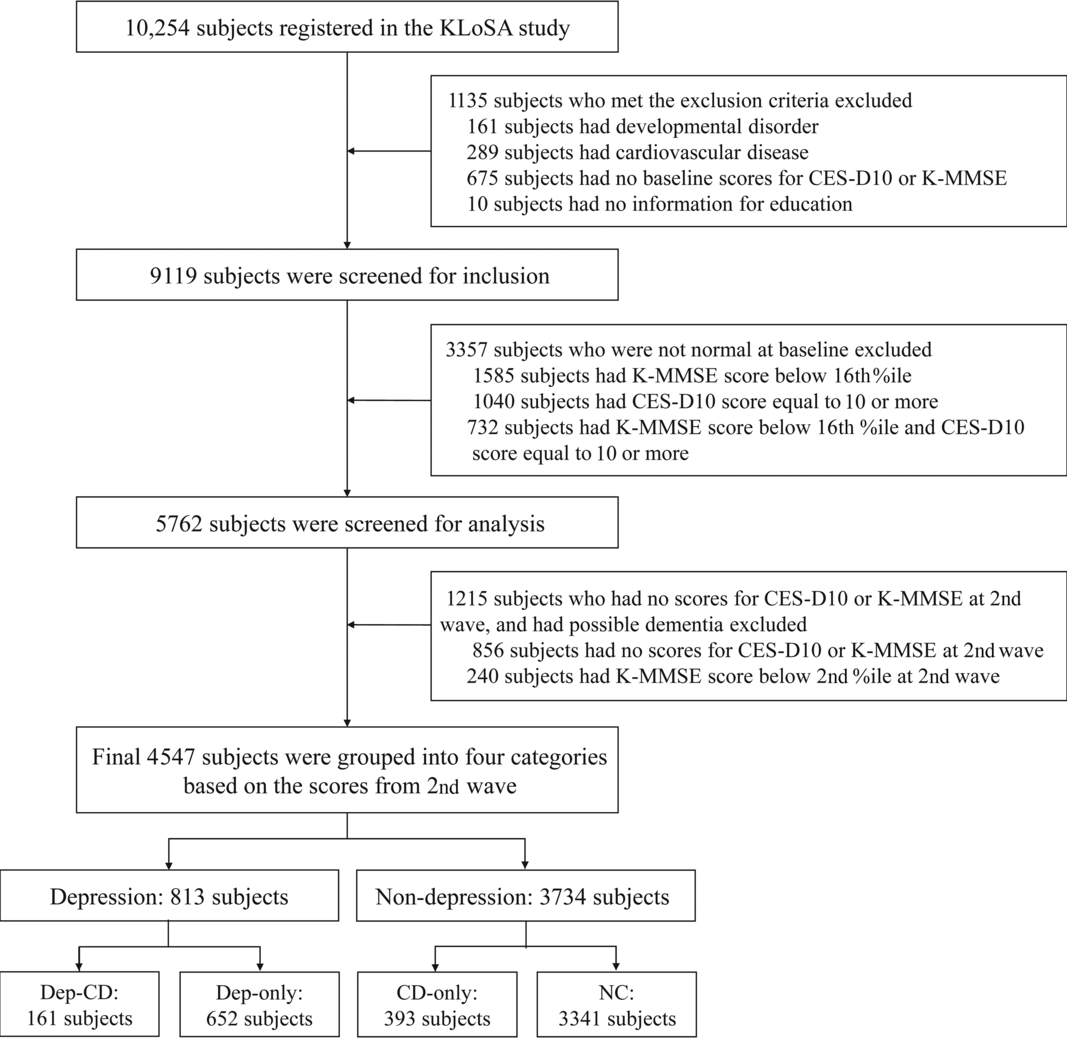
This study used data from the seven waves (baseline, 2, 4, 6, 8, 10, and 12 years) of the KLoSA. The data were screened with two-step processes to apply survival analysis. First, the subjects were screened based on the inclusion and exclusion criteria. This study included individuals who met the following criteria: (1) had available scores for a short-form version of the Center for Epidemiological Studies-Depression Scale (CES-D10) at baseline and (2) had available scores for the Korean version of the Mini-Mental State Examination (K-MMSE) at baseline. Individuals who had a developmental disorder or cardiovascular disease were excluded. Among the 10,254 subjects who were registered in the KLoSA, 450 subjects, with a developmental disorder or cardiovascular disease that could affect cognitive performance, 675 subjects, with no baseline scores for CES-D10 or K-MMSE, and 10 subjects, with no information for education, were excluded. As a result, a total of 9119 subjects were selected.
Second, the data were further screened for survival analysis. The advantage of survival analysis is that missing data, that is, the data of subjects lost to follow-up, can be included in the analysis. However, if the starting point of the variable affecting the occurrence of the event is unknown (i.e. left-censored data), the results of the analysis are unreliable. For example, when investigating the effects of depressive symptoms or cognitive dysfunction on the occurrence of an event called cognitive impairment, the duration of the depressive symptoms or cognitive dysfunction can affect the occurrence of the event. However, it is impossible to identify the starting point of depressive symptoms or cognitive dysfunction in the panel data. Therefore, when using panel data, the 1st wave is usually taken as a reference point, and data from the 2nd wave are included in the analysis (Chae, Reference Chae2018). In this study, the author selected only normal subjects with no depressive symptoms and cognitive dysfunction in the scores of the baseline assessment, that is, the 1st wave, and included their data from the 2nd to 7th waves in the analysis. Among the 9119 subjects who met the inclusion criteria, 5762 subjects were normal (K-MMSE ≥ 16th percentile and CES-D10 < 10) at baseline assessment. Among them, 856 subjects had no scores for K-MMSE or CES-D10 at 2nd wave, and 240 subjects had cognitive impairment (K-MMSE < 2nd percentile) at 2nd wave, and thus these subjects were excluded. The final 4547 subjects were included in the survival analysis.
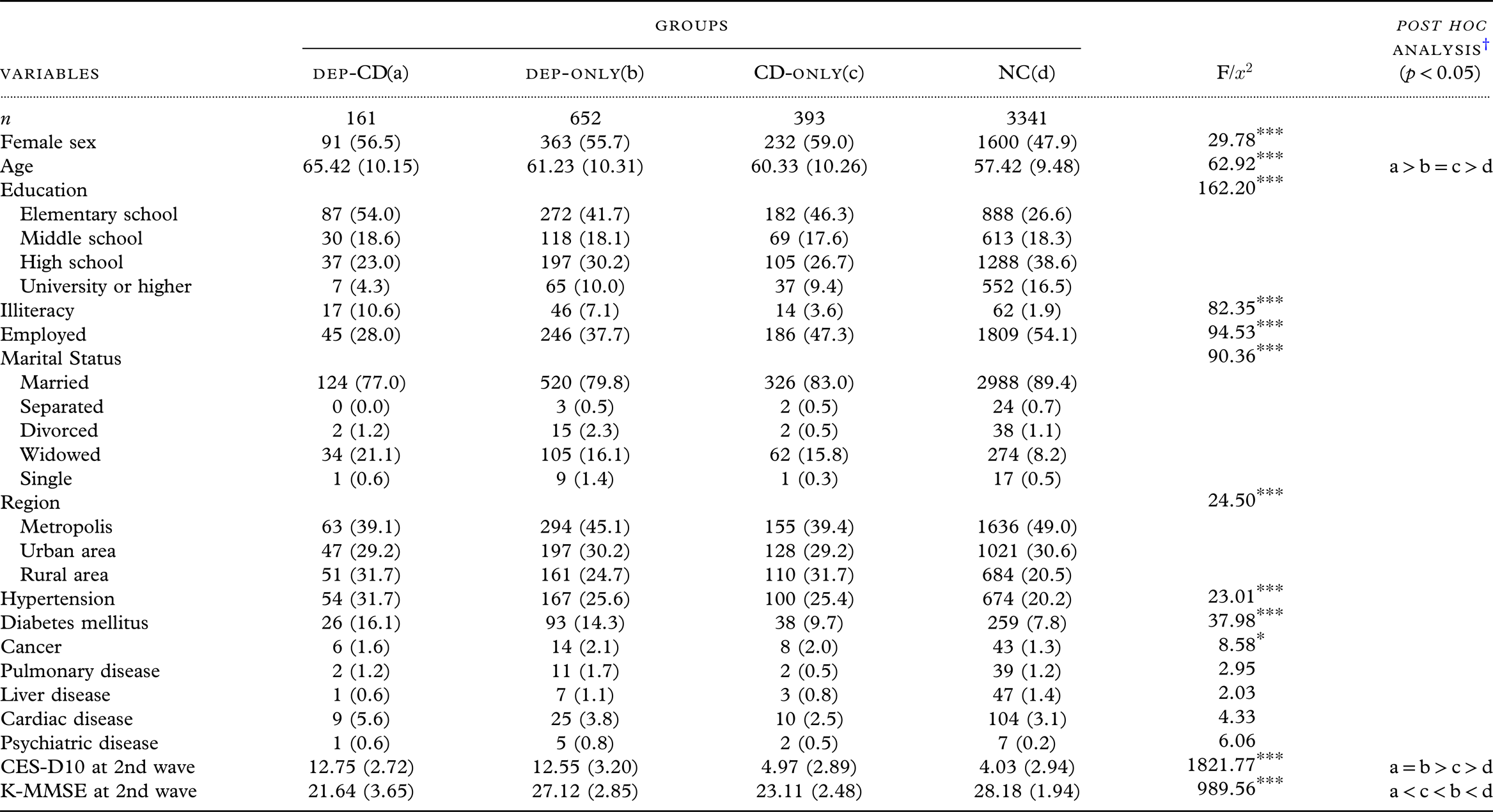
These subjects were classified into four groups based on their depressive symptoms and cognitive dysfunction status at the 2nd wave. The depressive symptoms were defined as 10 or more scores on the CES-D10 at the 2nd wave. Cognitive dysfunction was defined as ranking at the 2nd percentile or more and less than the 16th percentile for the K-MMSE scores at the 2nd wave in terms of age- and education-adjusted norms. Out of 4547 subjects, 813 subjects were classified as depressed, and the remainder were classified as not depressed. Among the depressed 813 subjects, 161 subjects exhibited cognitive dysfunction (2nd percentile≤ K-MMSE < 16th percentile; Dep-CD), with the remaining 652 subjects had normal cognitive functioning (Dep-only). Of the 3734 subjects who were not depressed, 393 subjects exhibited cognitive dysfunction (CD-only), and the remaining 3341 subjects were cognitively normal (NC). The study procedure is depicted in Figure 1. Table 1 shows the demographic variables of each group.
Flowchart of participants.

Baseline characteristics of the subjects included in the final analysis (n = 4547)

Data are shown as n (%) or mean (standard deviation).
Abbreviations: Dep-CD, Depressive symptoms with cognitive dysfunction; Dep-only, Depressive symptoms without cognitive dysfunction; CD-only, Cognitive dysfunction without depressive symptoms; NC, Normal control; CES-D, Center for Epidemiological Studies-Depression short-form; K-MMSE, Korean version of the Mini-Mental State Examination.
*p < 0.05, **p < 0.01, ***p < 0.001.
† Multiple comparisons were adjusted with the Bonferroni correction.
In this study, the cognitive dysfunction and depressive symptoms were defined as suggested in previous studies (Björgvinsson et al., Reference Björgvinsson, Kertz, Bigda-Peyton, McCoy and Aderka2013; Kang, Reference Kang2006), but short-term fluctuations of cognitive function and depressive symptoms are common. Thus, further analysis was done for stable groups. The stable groups were defined based on the consecutive first two waves, that is, the 2nd and 3rd waves. If the participants remained in the same group in the 3rd wave, they were regrouped into the four stable groups. A total of 2513 of the original 4547 subjects were classified the same in the 3rd wave. By group, 2207 subjects remained in the NC group, 156 subjects remained in the Dep-only group, 101 subjects remained in the CD-only group, and 49 subjects remained in the Dep-CD group.
Measures
The CES-D10 Scale, a self-report measure of depression, was used to evaluate depressive symptoms. This scale is a 10-item short-form version of the Center for Epidemiological Studies-Depression Scale (CES-D; Andresen et al., Reference Andresen, Malmgren, Carter and Patrick1994). It assesses depressive symptoms that are experienced during the last 1 week. The possible scores for each item range from 0 (rarely or none of the time; less than 1 day) to 3 (all of the time; 5–7 days), and the total possible score is 30 points. Ten points were used as the cut-off as had been suggested in a previous study (Björgvinsson et al., Reference Björgvinsson, Kertz, Bigda-Peyton, McCoy and Aderka2013).
The K-MMSE (Kang et al., Reference Kang, Na and Hahn1997) is a Korean version of the Mini-Mental State Examination (Folstein et al., Reference Folstein, Folstein, McHugh and Fanjiang2001), which assesses general cognitive functioning with scores for orientation, attention and concentration, memory, language, and visuo-constructional functioning. The total possible score is 30 points. Cognitive dysfunction (2nd percentile≤ K-MMSE < 16th percentile) and cognitive impairment (K-MMSE score <2nd percentile) were defined based on age- and education-adjusted norms (Kang, Reference Kang2006).
Statistical analysis
Descriptive data on the groups were compared using an analysis of variance (ANOVA) or χ 2 tests. A Bonferroni correction was performed for post hoc analyses of the ANOVA results. The survival rate was calculated using the life table method, and four groups were compared using Wilcoxon tests. There are two dependent variables in survival analysis, an event, and the time until the event happens. In this study, the event was cognitive impairment, and the time was calculated from the year of the 2nd wave to the year of the occurrence of the event. A multivariate Cox proportional hazard model was used to examine the association between groups and cognitive impairment adjusted for time-invariant covariates, including baseline age, sex, education, literacy, region, marital status, employment status, and general medical conditions with forward stepwise selection. Since general medical conditions, including hypertension, diabetes mellitus, cancer, pulmonary disease, liver disease, cardiac disease, and psychiatric disease, could affect cognitive functioning by altering hormone levels, stress levels, nutritional status, and interpersonal patterns, causing fatigue and distress, and restricting mobility (Biegler et al., Reference Biegler, Alejandro Chaoul and Cohen2009; Eggermont et al., Reference Eggermont, De Boer, Muller, Jaschke, Kamp and Scherder2012; Forton et al., Reference Forton2002; Papademetriou, Reference Papademetriou2005; Roberts et al., Reference Roberts2008; Singh et al., Reference Singh2014), these variables were also controlled for in the Cox proportional hazard model. SPSS version 26.0 software (IBM, 2019) as used for all statistical analyses.
Results
The subjects’ characteristics are presented in Table 1. The four groups differed in sex, age, education, literacy, marital status, region, hypertension, and diabetes mellitus. The subjects in the Dep-CD group were older, less educated, unemployed, less remained married, and more likely to live in rural than metropolitan areas than those in other groups. By group definition, there was a difference between groups in the initial, that is, 2nd wave, CES-D10, and K-MMSE scores.
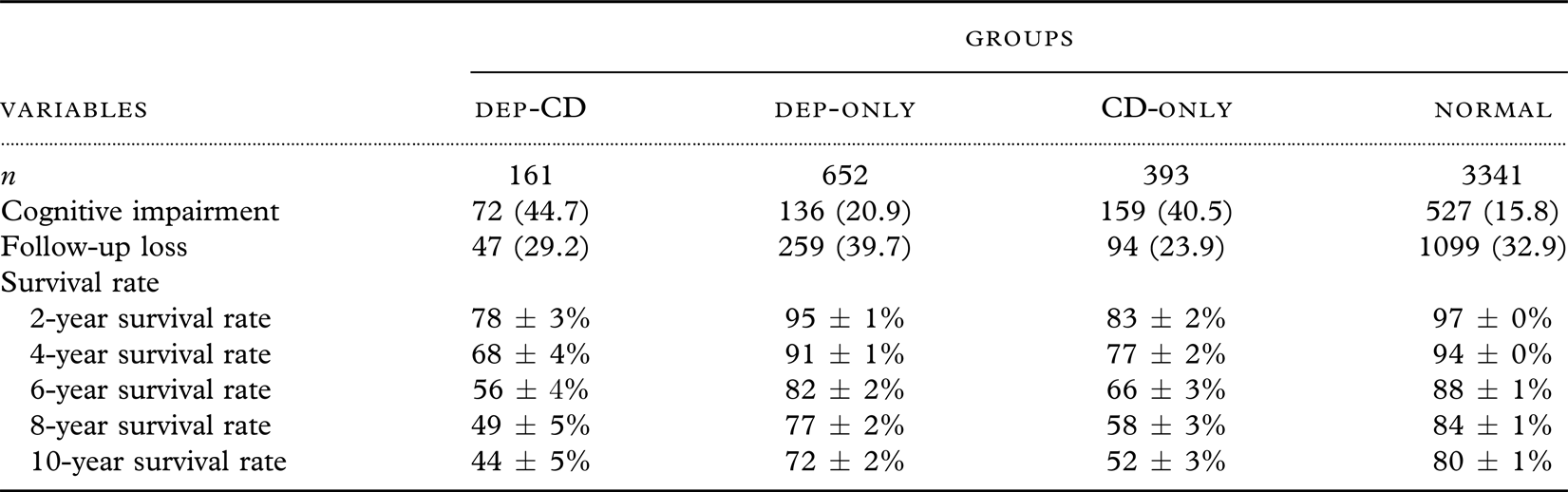
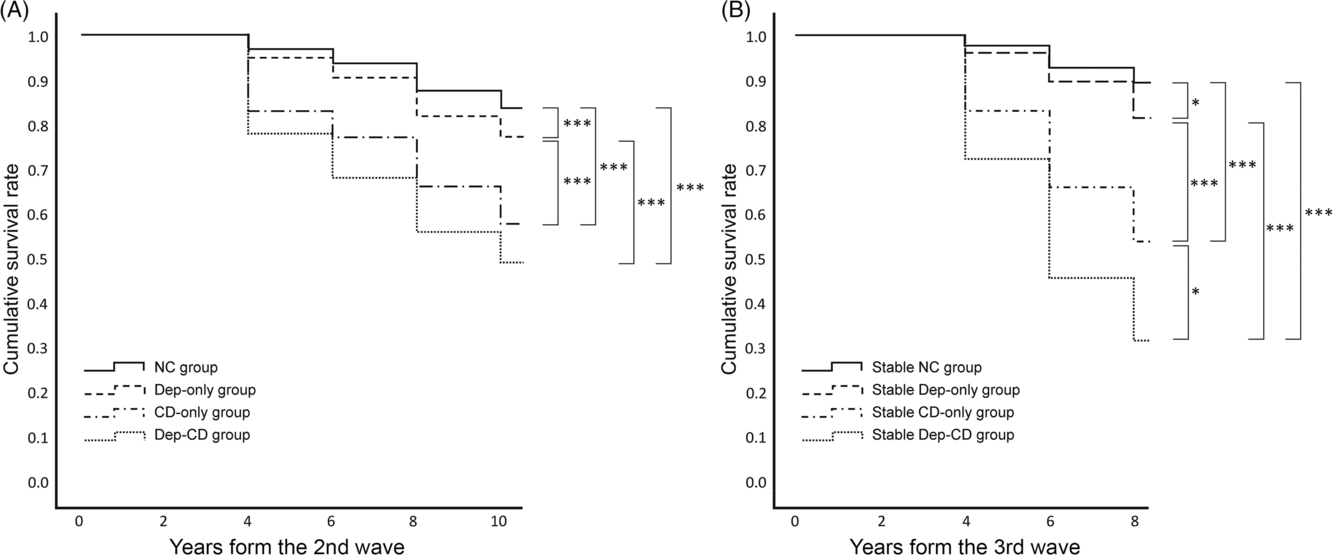
Table 2 shows the survival data. Cognitive impairment was observed in 527 of the 3341 NC subjects (15.8%), in 136 of the 652 subjects with Dep-only (20.9%), in 159 of the 393 subjects with CD-only (40.5%), and in 72 of the 161 subjects with Dep-CD (44.7%). Follow-up loss was observed in 1099 of the 3341 NC subjects (32.9%), in 259 of the 652 subjects with Dep-only (39.7%), in 94 of the 393 subjects with CD-only (23.9%), and in 47 of the 161 subjects with Dep-CD (29.2%). Ten-year survival, that is, not experiencing cognitive impairment until 10 years from the 2nd wave, was 80
 $$ \pm $$
1% in NC group, 72
 $$ \pm $$
2% in Dep-only group, 52
 $$ \pm $$
3% in CD-only group, and 44
 $$ \pm $$
5% in Dep-CD group.
Survival data

Data are shown as n (%).
Abbreviations: Dep-CD, Depressive symptoms with cognitive dysfunction; Dep-only, Depressive symptoms without cognitive dysfunction; CD-only, Cognitive dysfunction without depressive symptoms; NC, Normal control.
The survival rate was significantly different between groups (
 $${\rm{\chi }}_{\omega \;}^2$$
= 254.54, df = 3, p < 0.001). There were significant differences by Wilcoxon pairwise comparison between all four groups except between the Dep-CD group and CD-only group (
 $${\rm{\chi }}_\omega ^2$$
= 3.26, df = 1, n.s.). The survival rate was significantly different between the NC group and Dep-only group (
 $${\rm{\chi }}_\omega ^2$$
= 14.94, df = 1, p < 0.001), between the NC group and CD-only group (
 $${\rm{\chi }}_\omega ^2$$
= 173.65, df = 1, p < 0.001), between the NC group and Dep-CD group (
 $${\rm{\chi }}_\omega ^2$$
= 133.03, df = 1, p < 0.001), between the Dep-only group and CD-only group (
 $${\rm{\chi }}_\omega ^2$$
= 26.43, df = 1, p < 0.001), and between the Dep-only group and Dep-CD group (
 $${\rm{\chi }}_\omega ^2$$
= 49.55, df = 1, p < 0.001). The survival rate was highest in the NC group, followed by the Dep-only group, CD-only group, and Dep-CD group (Figure 2A).
The proportional hazard assumption was valid for all variables. The log-log survival curves for the four depressive symptoms and cognitive dysfunction groups were approximately parallel, and the parallelism of categories was also confirmed in all other covariates. In the Cox proportional hazard model (−2 log likelihood = 14,086,
 $$\nabla {{\rm{\chi }}^2}$$
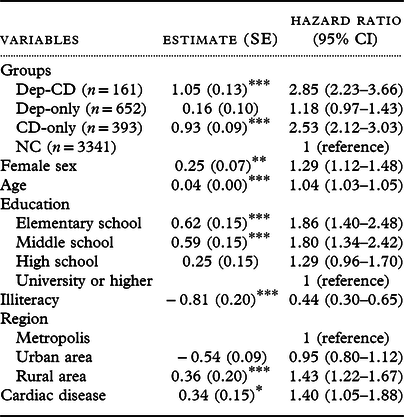
= 463.50, p < 0.001), the hazard ratio (HR) of the Dep-only group (HR = 1.18, 95% CI, 0.97–1.43, n.s.) did not differ from that of the NC group, but the HR of the Dep-CD group was significantly higher (HR = 2.85, 95% CI, 2.23–3.66, p < 0.001) than the NC group (Table 3). This result suggests that depressive symptoms can be a sign of cognitive impairment when accompanied by cognitive dysfunction. The HR of the CD-only group was similar to the Dep-CD group (HR = 2.53, 95% CI, 2.12–3.03, p < 0.001). When the Dep-CD group was compared to the CD-only group, with the CD-only group as a reference, the HR was 1.13 (95% CI, 0.85–1.49, n.s.), which indicates that it did not significantly differ from the CD-only group. This result suggests that cognitive dysfunction accompanying depressive symptoms is as much risk for cognitive impairment as is pure cognitive dysfunction (Table 3).
The hazard ratios of the four groups adjusted for background variables (n = 4547)

Background variables were controlled for in the Cox proportional hazard model with forward stepwise selection. Groups, education, and region were coded as dummy variables. NC, university or higher, and metropolis were the reference groups.
Abbreviations: Dep-CD, Depressive symptoms with cognitive dysfunction; Dep-only, Depressive symptoms without cognitive dysfunction; CD-only, Cognitive dysfunction without depressive symptoms; NC, Normal control; SE, Standard error; CI, Confidence interval.
*p < 0.05, **p < 0.01, ***p < 0.001.
Further analysis was done for stable groups. The survival rate was highest in the stable NC group, followed by the stable Dep-only group, stable CD-only group, and stable Dep-CD group (Figure 2B), which is the same as the original analysis. The survival rate was significantly different between groups (
 $${\rm{\chi }}_\omega ^2$$
= 206.94, df = 3, p < 0.001). There were significant differences under Wilcoxon pairwise comparison between all four groups. The survival rate was significantly different between the stable NC and stable Dep-only groups (
 $${\rm{\chi }}_\omega ^2$$
= 5.30, df = 1, p < 0.05), stable NC and stable CD-only groups (
 $${\rm{\chi }}_\omega ^2$$
= 116.22, df = 1, p < 0.001), stable NC and stable Dep-CD groups (
 $$\chi _\omega ^2$$
= 112.92, df = 1, p < 0.001), stable Dep-only and stable CD-only groups (
 $${\rm{\chi }}_\omega ^2$$
= 26.43, df = 1, p < 0.001), stable Dep-only and stable Dep-CD groups (
 $${\rm{\chi }}_\omega ^2$$
= 41.11, df = 1, p < 0.001), and stable Dep-CD and stable CD-only groups (
 $${\rm{\chi }}_\omega ^2$$
= 4.25, df = 1, p < 0.05).
Cumulative survival rates in the four groups with combined depressive symptoms and cognitive dysfunction. (A) Groups were defined based on the 2nd wave. (B) Stable groups were defined based on the 2nd and the 3rd waves. NC, Normal control; CD-only, Cognitive dysfunction without depressive symptoms; Dep-only, Depressive symptoms without cognitive dysfunction; Dep-CD, Depressive symptoms with cognitive dysfunction. *p < 0.05, **p < 0.01, ***p < 0.001.

Similar results were obtained in the Cox proportional hazard model (−2 log likelihood = 5695,
 $$\nabla {{\rm{\chi }}^2}$$
= 261.33, p < 0.001); the HR of the stable Dep-only group (HR = 1.19, 95% CI, 0.80–1.77, n.s.) did not differ from that of the stable NC group, but the HR of the stable Dep-CD group was significantly higher (HR = 4.25, 95% CI, 2.85–6.33, p < 0.001) than that of the stable NC group. The HR of the stable CD-only group was similar to that of the stable Dep-CD group (HR = 3.82, 95% CI, 2.81–5.19, p < 0.001). When the stable Dep-CD group was compared to the stable CD-only group, the HR was 1.11 (95% CI, 0.70–1.78, n.s.), which is not a significant difference from the CD-only group.
Discussion
The results of this study demonstrate that depressive symptoms do not increase the risk of cognitive impairment, but do increase the risk of cognitive impairment when accompanied by cognitive dysfunction. Further, cognitive dysfunction occurring with depressive symptoms is as much a risk factor for cognitive impairment as is pure cognitive dysfunction.
As such, the HR of the Dep-only group did not differ from that of the NC group. A recent review shows that many studies have found evidence of an association between late-life depression and cognitive decline or dementia (Byers and Yaffe, Reference Byers and Yaffe2011). However, other prospective studies suggest that depression is not related to cognitive decline or dementia (Becker et al., Reference Becker2009; Ganguli et al., Reference Ganguli, Du, Dodge, Ratcliff and Chang2006; Vinkers et al., Reference Vinkers, Gussekloo, Stek, Westendorp and van der Mast2004); and the results of this study support the latter framework. The proposed mechanism of how depression affects dementia includes increased glucocorticoid or amyloid plaque levels, and altered nerve growth factors, frontostriatal abnormalities, and hippocampal atrophy (Byers and Yaffe, Reference Byers and Yaffe2011). Previous studies show that the volume of the hippocampus is related to persistent major depressive disorder (Byers and Yaffe, Reference Byers and Yaffe2011; Colla et al., Reference Colla2007). Persistent and severe depression seems to render the brain vulnerable to dementia by altering the workings of the brain.
Depression may not be so crucial for the subjects in this study because this is a community-based cohort study, and depression was measured with a CES-D10, a self-reported depression scale. In the review of Byers and Yaffe (Reference Byers and Yaffe2011), almost all studies defined depression by diagnostic criteria or assessment of history, and Colla et al. (Reference Colla2007) conducted their study in unipolar depressed inpatients. Thus, the association between depression and cognitive impairment may not be found in this study due to the relatively mild depressive symptoms. The fact that subjects who exhibited cognitive dysfunction were excluded from the Dep-only group also allows the reasoning to be more plausible. Byers and Yaffe (Reference Byers and Yaffe2011) also found that studies using CES-D10 (Becker et al., Reference Becker2009) or self-administered questionnaires (Lindsay et al., Reference Lindsay2002) did not find an effect of depression on dementia risk. The studies (Becker et al., Reference Becker2009; Ganguli et al., Reference Ganguli, Du, Dodge, Ratcliff and Chang2006; Vinkers et al., Reference Vinkers, Gussekloo, Stek, Westendorp and van der Mast2004) that did not find an association between depression and dementia are all community-based studies that defined depression with self-reported rating scales, including the CES-D and Geriatric Depression Scale (GDS), and thus depression may not be so severe as to alter brain function. Some studies demonstrate that the influence of depression on dementia or cognitive impairment can be altered based on the severity of the depression (Byers et al., Reference Byers, Covinsky, Barnes and Yaffe2012; Gatz et al., Reference Gatz, Tyas, St. John and Montgomery2005). Therefore, if clinical diagnostic criteria were adopted to define depression, the results might be different.
The HR of the Dep-CD group was significantly different from that of the NC group, which suggests that depressive symptoms can be a warning sign of cognitive impairment when accompanied by cognitive dysfunction. This finding is consistent with previous studies suggesting that pseudodementia increased the risk of developing dementia (Alexopoulos et al., Reference Alexopoulos, Meyers, Young, Mattis and Kakuma1993; Kral and Emery, Reference Kral and Emery1989; Sáez-Fonseca et al., Reference Sáez-Fonseca, Lee and Walker2007). In a recent review, Kang et al. (Reference Kang, Zhao, You and Giorgetta2014) concluded that reversible cognitive impairment with moderate-to-severe geriatric depression, that is, pseudodementia, is a strong predictor of dementia. Cognitive deficits are regarded as secondary to nonorganic psychiatric illness, including depression, by the definition of pseudodementia (Kiloh, Reference Kiloh1961; Wells, Reference Wells1979). Depression increases the risk of dementia by rendering the brain vulnerable to pathology (Byers and Yaffe, Reference Byers and Yaffe2011).
On the other hand, some studies found that pseudodementia did not increase the risk of developing dementia (Pearlson et al., Reference Pearlson1989; Rabins et al., Reference Rabins, Merchant and Nestadt1984). In their longitudinal study, Sachdev et al. (Reference Sachdev, Smith, Angus-Lepan and Rodriguez1990) followed up 19 patients with pseudodementia and found that only 2 of the 19 patients developed dementia 10 years later, and they suspected that the dementia diagnosis should have been made initially. In this study, it is difficult to dispute these findings directly because cognitive impairment, not dementia, was the outcome. However, cognitive impairment can be an early stage of dementia, so depressive symptoms accompanied by cognitive dysfunction should not be overlooked.
The comparison between the Dep-CD group and the CD-only group supports this claim. The HR of the Dep-CD group was not significantly different from that of the CD-only group, which means that cognitive dysfunction occurring with depressive symptoms is as much a risk for cognitive impairment as is cognitive dysfunction without depressive symptoms. In a recent review, the authors stressed that the depression associated with cognitive impairment, that is, pseudodementia, could be the prodromal stage of dementia, and regretted that cognitive disorders associated with depression had been paid little or no attention in the past (Perini et al., Reference Perini, Ramusino, Sinforiani, Bernini, Petrachi and Costa2019). In this study, the subjects did not undergo a clinical diagnosis. However, Dep-CD conceptually corresponds to pseudodementia, and CD-only corresponds to the early stage of dementia, such as MCI. MCI has received attention as a risk factor for dementia, but pseudodementia was often overlooked because it is “not really dementia.” However, the results of this study suggest that pseudodementia may increase the risk of dementia as much as MCI, so it should receive sufficient therapeutic attention. A recent review of cognitive impairment in major depressive disorder also suggested that cognitive deficit should be the first therapeutic target because it mediates psychosocial and workplace functioning (Pan et al., Reference Pan2019).
Lastly, the HR of the Dep-CD group was higher than that of the CD-only group, though not significantly so. A previous study showed that MCI patients with co-occurring depression exhibit a twofold increased risk of developing dementia 3 years later than those without depression (Modrego and Ferrández, Reference Modrego and Ferrández2004). This result suggests that depression amplifies the risk of cognitive dysfunction in the development of dementia. If so, more attention should be paid when cognitive dysfunction occurs with depression. This study might have found no significant differences between groups because the participants’ depression was mild.
The current study has several strengths. First, previous studies have mostly highlighted the impact of moderate-to-severe depression on the development of dementia or cognitive impairments. However, this study indicates the importance of therapeutic attention to depressive symptoms in the community-dwelling elderly by demonstrating that even self-reported depressive symptoms increase the risk of cognitive impairment when they occur with cognitive dysfunction. Second, this study analyzed a 12-year community-based large cohort to demonstrate the impact of depressive symptoms on cognitive impairment. Third, there are usually many missing data points in a panel study. The advantage of survival analysis is that missing data can be included in the analysis. In this study, survival analysis was conducted to include censored data, that is, the data of subjects lost to follow-up. Fourth, both age and education are known to be significantly related to the MMSE score, with older, less-educated individuals scoring lower (Crum et al., Reference Crum, Anthony, Bassett and Folstein1993; Marcopulos et al., Reference Marcopulos, McLain and Giuliano1997). Thus, single cut-off scores decrease specificity in old individuals with low education. In this study, demographically adjusted norms were used to avoid overdiagnosing cognitive impairment in old or less-educated subjects.
However, the current study also has several limitations. First, this study was conducted for the community-dwelling elderly, and depression was defined based on the results of a self-report inventory, not using a doctor’s diagnosis. Depression of community samples is expected to be milder than those of clinical samples, and thus these results cannot be generalized to clinical samples or more severe cases. Second, the K-MMSE used in this study is known to have low sensitivity and specificity. Therefore, there may be some subjects who already have cognitive impairment or dementia at the initial stage or subjects who were misdiagnosed as having a cognitive impairment at the final assessment that was conducted 10 years later. As such, these results should be replicated in a future study with more comprehensive neuropsychological assessments. Third, the cognitive functioning of the elderly may relate to the emotional status, ApoE genotype, physical exercise, diet, and socioeconomic factors of individuals, but these variables were not controlled for in this study due to the unavailability of the data. Fourth, short-term fluctuations of cognitive function and depressive symptoms are common; therefore, they might not serve to reliably classify groups cross sectionally. To address this issue, the author conducted an additional analysis of those who remained in the same classification group in two consecutive waves and obtained similar results to those of the original groups. Nevertheless, further studies need to construct more stable groups through diagnostic procedures to illustrate the results’ robustness. Fifth, the data used in this study were collected nationwide as representative of the elderly population in Korea. However, there are limitations in the generalization of the results because many cases were excluded in the screening process, reducing the size of the sample included in the final analysis. Sixth, this study is not free from selection bias and competing risks, which are commonly found in studies using longitudinal data or survival analysis. Further studies need to make the results robust by introducing additional analyses or models. Seventh, cognitive dysfunction in depressive pseudodementia is regarded as secondary to depression, which suggests that cognitive dysfunction may change. It is a vital topic to find out whether the effect of depression on the development of dementia depends on whether the co-occurring cognitive dysfunction persists, so it is worthy of further research.
Conclusion
Our findings suggest that depressive symptoms with cognitive dysfunction were associated with a higher risk of cognitive impairment. Furthermore, cognitive dysfunction occurring with depressive symptoms is as much a risk for cognitive impairment as is pure cognitive dysfunction. Thus, healthcare providers should pay close attention to the community-dwelling elderly when depressive symptoms occur with cognitive dysfunction.
Conflict of interest
None.
Description of author’s roles
Minyoung Shin, as the sole author, contributed to the development of the research topic, suggested the analytical strategy, performed the data analysis, interpreted the results, and drafted the manuscript.