





Introduction
Advance care planning (ACP) is a proactive process that enables individuals to make informed decisions regarding their future healthcare preferences, particularly when they may no longer be able to communicate these preferences (Rietjens et al. Reference Rietjens, Sudore and Connolly2017). ACP encourages conversations among patients, family members, and healthcare providers to ensure that care aligns with patients’ values and preferences, particularly in critical and end-of-life cases (Sudore Reference Sudore2010). Engaging in ACP can reduce family anxiety, facilitate decision-making during acute illness, and promote patient-centered care by respecting individuals’ healthcare goals (Detering et al. Reference Detering, Hancock and Reade2010; Fleuren et al. Reference Fleuren, Depla and Janssen2020). However, participation in ACP remains limited, particularly within multicultural and immigrant communities, where diverse cultural norms, values, and communication styles may impede engagement (Johnstone and Kanitsaki Reference Johnstone and Kanitsaki2009; Hong et al. Reference Hong, Yi and Johnson2018).
ACP has gained increasing attention in Thailand in recent years, but uptake remains limited. Although legal and policy frameworks supporting end-of-life planning exist, awareness and implementation are still relatively low, and decision-making is often shaped by family-centered values and reluctance to discuss death openly (Pairojkul et al. Reference Pairojkul, Raksasataya and Sorasit2023). This may reflect limited public awareness, discomfort discussing death-related issues, family-centered decision-making traditions, and inconsistent integration of ACP into routine clinical practice. In Thailand, legal support for advance directives is provided under Section 12 of the National Health B.E. 2550 (2007) (National Health Commission Office, n.d.), which recognizes individual’s right to refuse life-prolonging treatment; however, practical implementation remains variable. In contrast, ACP is more formally embedded in Australian healthcare, including primary care, oncology, aged care, and palliative care settings, where national frameworks and clinical guidance encourage early discussions regarding future care preferences and patient autonomy (Tran et al. Reference Tran, Grant and Clayton2018). ACP is also increasingly recognized as an important component of cancer and palliative care planning in Australia, particularly for people with serious or life-limiting illness. However, engagement remains variable, particularly among culturally and linguistically diverse communities, where language barriers, differing cultural expectations, and limited culturally responsive approaches may affect participation in ACP discussions (Lambert et al. Reference Lambert, Strickland and Gibson2025; Chauhan et al. Reference Chauhan, Sansom-Daly and Manias2025). Engaging immigrant populations in ACP presents unique challenges (Searight and Gafford Reference Searight and Gafford2005). Cultural background, language barriers, and differing attitudes toward healthcare and end-of-life decision-making strongly influence the willingness to participate in ACP (Kwak and Haley Reference Kwak and Haley2005). Many immigrant communities maintain cultural beliefs from their countries of origin that guide family dynamics and healthcare decisions, which may differ markedly from Western healthcare practices (Blackhall et al. Reference Blackhall, Murphy and Frank1995). In some cultures, family-centered decision-making is prioritized over individual autonomy (Kagawa-Singer and Blackhall Reference Kagawa-Singer and Blackhall2001), whereas in others, discussions about end-of-life are avoided due to taboos or spiritual beliefs (McDermott and Selman Reference McDermott and Selman2018). Consequently, immigrants may feel hesitant or uncertain about engaging in ACP, particularly when navigating unfamiliar healthcare systems and cultural expectations (Peprah et al. Reference Peprah, Lloyd and Gitau2025), and may worry that healthcare providers could misunderstand or fail to respect their cultural values (Johnstone and Kanitsaki Reference Johnstone and Kanitsaki2009).
However, the attitudes and preferences of immigrants toward healthcare may shift as they adapt to a new cultural environment – a process known as acculturation (Andronic and Constantin Reference Andronic and Constantin2025). Acculturation influences immigrants’ openness to discussing end-of-life care within their host society (McLaughlin and Braun Reference McLaughlin and Braun1998). As immigrants integrate into cultures that emphasize autonomy in healthcare decision-making, they may gradually adopt similar approaches, potentially increasing their engagement with ACP (Zhu et al. Reference Zhu, Martina and van der Heide2023). Australia’s multicultural society includes a significant Thai population, with approximately 83,800 Thailand-born residents recorded in the 2021 Census (Australian Bureau of Statistics 2025). Traditional Thai culture strongly emphasizes family hierarchy (Knodel et al. Reference Knodel, Kespichayawattana and Wivatvanit2013), collective decision-making (Cultural Atlas 2016), and religious values, all of which influence attitudes toward health and end-of-life care (Burnard and Naiyapatana Reference Burnard and Naiyapatana2004). These values may conflict with the emphasis on individual autonomy within Western healthcare systems, creating potential barriers to ACP engagement (Lambert et al. Reference Lambert, Strickland and Gibson2025).
However, how Thai immigrants in Australia understand and engage with ACP remains underexplored. Although previous studies have examined ACP among culturally and linguistically diverse populations, most evidence has focused on East Asian or broader migrant populations, with limited attention given to Southeast Asian communities and almost none specifically examining Thai immigrants in Australia. Existing literature has also focused primarily on barriers to ACP engagement rather than how migration and acculturation may reshape beliefs, communication patterns, and readiness for ACP over time. Understanding these processes is important for developing culturally responsive palliative care approaches for immigrants navigating different healthcare systems and cultural expectations. Therefore, this study aimed to explore how Thai immigrants in Australia perceive and engage with ACP within a new social and healthcare context.
Methods
Design and setting
In line with the exploratory aims of this study, a descriptive phenomenological approach (Dowling Reference Dowling2007) was used to gain insights into the lived experiences, beliefs, and evolving attitudes of Thai immigrants toward ACP within Australian healthcare settings. This study was conducted in Victoria, Australia, between March and April 2025. Victoria was selected because it has one of the largest Thai immigrant populations in Australia and a well-established multicultural healthcare environment (Victorian Government 2024), making it an appropriate setting in which to explore experiences related to ACP and cultural adaptation. Ethical approval was obtained from the Human Research Ethics Committee of St. Vincent’s Hospital Melbourne (approval no. 2025/PID00034). The study adhered to the principles outlined in the Declaration of Helsinki and the ICMJE Recommendations for the Protection of Research Participants.
Participants
Eligible participants comprised Thai immigrants aged ≥18 years who were currently residing in Victoria and able to communicate in Thai or English. All participants were required to have personal or family experience with the Australian healthcare system. This criterion was included to ensure participants had some exposure to the Australian healthcare system and could reflect on how migration and healthcare experiences influenced their understanding of ACP and healthcare decision-making. Individuals with significant cognitive impairment, identified either through self-report or during initial screening conversations, were excluded. During the screening process, individuals were also informed that the interviews could involve discussions about serious illness, end-of-life care, and future healthcare planning. Those who indicated discomfort or unwillingness to engage in such discussions were not recruited. Purposive snowball sampling was used to recruit participants via Thai community networks (temples, shops, and Facebook groups). The primary investigator (P.L.) attended local cultural events, engaged with community leaders to build trust, and explained the purpose of this study. Following the recruitment of the initial participants, snowball sampling was used to expand the study population by asking participants to refer the study to friends, family members, and acquaintances who met the inclusion criteria. To ensure a range of perspectives, purposive sampling was used to ensure variations in sex, age, length of stay in Australia, and healthcare experience.
None of the invited individuals declined participation or withdrew from the study. All interviews were conducted one-on-one. Individuals interested in participation contacted P.L. via email. Subsequently, P.L. provided detailed study information and explained the participant information and consent forms. Participants who met the inclusion criteria and agreed to participate provided written informed consent electronically or in person before the interview was scheduled.
Data collection
An interview guide, informed by background literature on ACP, cultural influences on end-of-life communication, and immigrant healthcare experience (Hong et al. Reference Hong, Yi and Johnson2018; McDermott and Selman Reference McDermott and Selman2018), was developed by the research team for this study. It included questions related to participants’ healthcare experiences, cultural beliefs, family dynamics, and changes in attitudes. As some participants were expected to be unfamiliar with ACP, the guide allowed the interviewer (P.L.) to introduce the ACP concept in simple terms during the conversations. When needed, ACP was explained as planning ahead for future healthcare and expressing preferences about treatment or care if a person became seriously ill or unable to communicate their decisions. This explanation was provided conversationally in Thai to support participants’ understanding before continuing the discussion. The full interview guide is provided in the Supplemental Material.
The interview guide was refined during the first 3 interviews to improve clarity and cultural relevance. Only minor wording adjustments were made, and no changes to the overall structure or focus of the interview guide were required. As the content of these 3 interviews remained directly relevant to the research question, the interview data were retained and included in the final analysis.
All interviews were conducted by P.L. P.L.’s position as a Thai immigrant, bilingual clinician, and researcher may have influenced recruitment, rapport-building, data collection, and interpretation. Shared cultural and linguistic background may have facilitated trust and openness during interviews, while reflexive discussions and analytical memos were used throughout the study to critically consider potential assumptions and biases. Interviews were conducted in person or via Zoom/Teams, according to participant preferences, in private and comfortable environments to ensure participants’ psychological safety. The interviewer had no prior knowledge of the participants. Fourteen interviews were conducted primarily in Thai, while 3 were conducted using a combination of Thai and English, depending on participant preference and language comfort.
Each interview was conducted in a semi-structured format, lasted between 20 and 70 minutes, and was audio-recorded. Field notes were taken to document nonverbal cues. Each participant was interviewed once. Recruitment and analysis proceeded iteratively until sufficient depth and richness of data were achieved, and no substantial new insights relevant to the research aims were identified in later interviews. When appropriate, clarification was sought through validation prompts. Interviews conducted in Thai were transcribed verbatim by P.L. and translated into English for analysis. Translation accuracy was discussed with the research team during coding and quotation selection to ensure meanings were preserved across languages. Transcripts were not returned to participants to reduce burden; instead, credibility was supported through team discussions and iterative review.
Data analysis
Demographic information was summarized descriptively. An inductive thematic analysis framework (Braun and Clarke Reference Braun and Clarke2006), supported by phenomenological techniques (Dowling Reference Dowling2007), was used to identify underlying themes reflecting continuity and evolution of the expressed views. Thematic analysis followed the reflexive approach in which researchers actively constructed themes through iterative coding, comparison, and refinement (Braun and Clarke Reference Braun and Clarke2006).
Investigator triangulation was performed to ensure rigor and trustworthiness (Lincoln et al. Reference Lincoln, Lynham, Guba, Denzin and Lincoln2011). Initial coding was conducted manually by P.L. using Microsoft Word. A subset of transcripts was collaboratively coded with A.C., P.H., S.S., and J.P. – all of whom have extensive experience conducting and analyzing qualitative interviews in palliative care – to refine the coding framework before its application to the full dataset. P.L. reviewed each transcript line-by-line to generate the initial codes grounded in the data from the interview transcripts. These codes were iteratively grouped into broader subthemes and themes through discussions with 4 other members of the research team. Analytical memos were used to document the coding decisions and theme refinements. Themes and subthemes were finalized by consensus and are presented with illustrative quotations.
Results
Seventeen Thai immigrants aged 22–65 years participated; the sample included 10 women and 7 men. Most participants had lived in Australia for more than 10 years (Table 1). Participants with experience of serious illness described ACP more concretely, while others spoke more hypothetically. Earlier migrants often expressed more hybrid cultural views, whereas later migrants emphasized traditional norms. This paper focuses on ACP perceptions; other findings will be reported separately.
Characteristics of informants

Table 1 Long description
Participant characteristics are listed by sex, age in years, duration of stay in Australia in years, and marriage status, with counts in the Participants column. Sex includes male with 7 participants and female with 10. Age groups include 20 to 35 with 4 participants, 35 to 50 with 6, and over 50 with 7. Duration of stay in Australia includes less than 10 with 6 participants, 10 to 20 with 5, and more than 20 up with 6. Marriage status includes married with 9 participants, separated or divorced with 2, and single with 6.
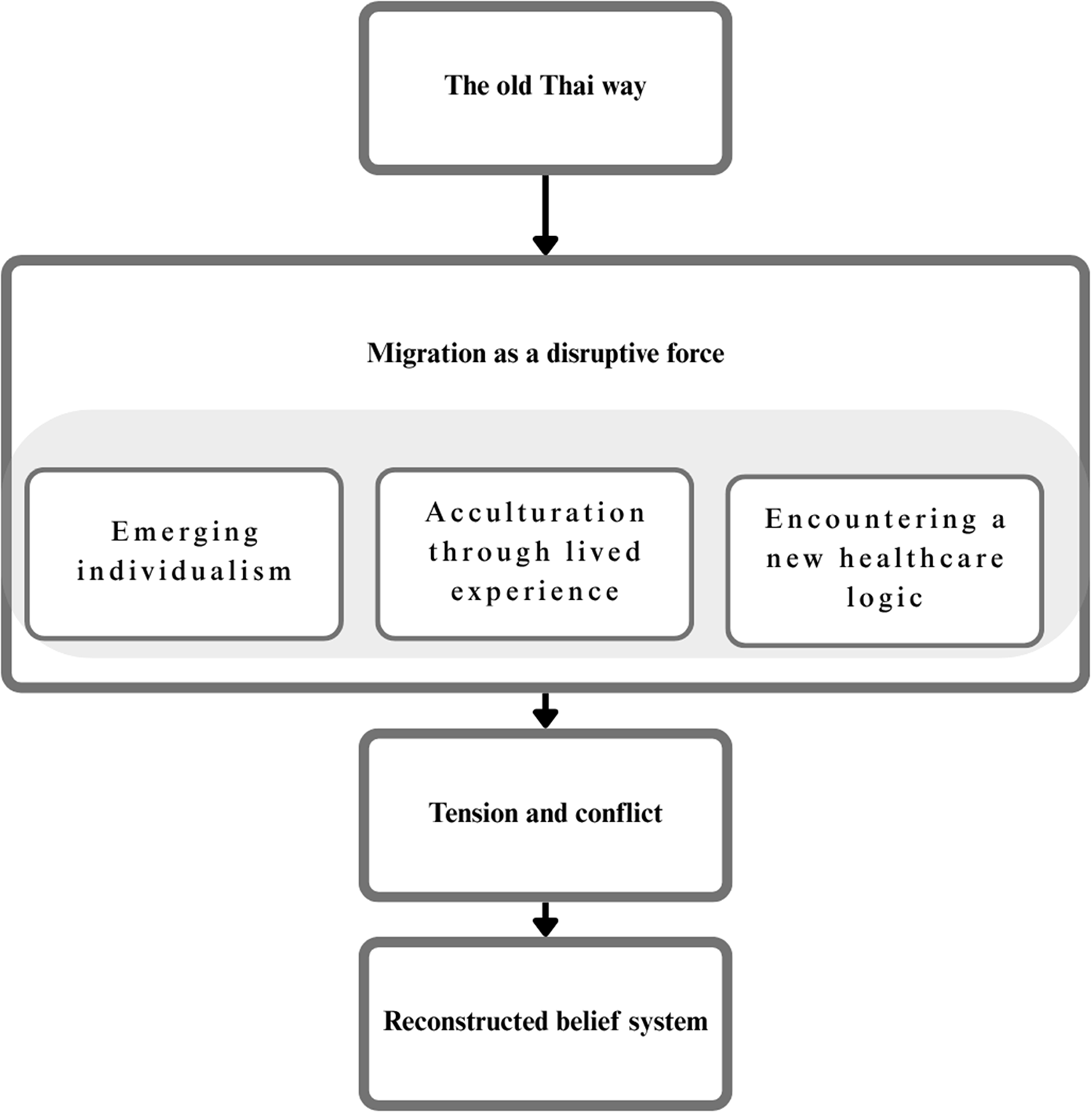
We identified 4 overarching themes and related subthemes (Table 2) that reflected the perception and engagement of Thai immigrants in ACP in the context of cultural transitions and migration (Figure 1). Figure 1 illustrates movement toward reconstructed belief systems integrating Thai and Australian values; however, not all participants reported full resolution of cultural tension – some described ongoing negotiation between competing norms.
Themes and subthemes identified in this study

Table 2 Long description
Two columns list Theme and Sub theme. Theme 1, The old Thai way, includes family centered decision making, deference to hierarchical authority, avoidance of death talk, and spiritual and karmic values. Theme 2, Migration as a disruptive force, includes emerging individualism after migration, acculturation through lived experience, and encountering a new healthcare logic. Theme 3, Tension and conflict between cultural values, includes fear of family disapproval, conflict between autonomy and family obligation, and emotional discomfort in breaking norms. Theme 4, Reconstructing belief systems in a new cultural context, includes globalizing beliefs and values, and bridging intergenerational and intercultural views.
The schematic of the framework.

Theme 1: The “old Thai way”
The deeply held traditional beliefs and practices, which participants described as the “old Thai way,” shaped their attitudes toward healthcare and end-of-life planning before migration. These beliefs reflected a shared worldview shaped by family obligation, respect for hierarchy, avoidance of death-related discussions, and spiritual reasoning. Decision-making was often family-centered, with deference to authority and moral beliefs that discouraged independent planning. In this context, ACP often felt unnecessary because decisions were expected to be made within the family rather than expressed individually.
Family-centered decision-making
Participants described decisions as collective processes rooted in family harmony and obligation. Individual wishes could be overridden by emotional needs or hopes of relatives:
The patient wanted to let go; however, the children still had hope. (Participant 1, female, 40 years, 13 years in Australia)
Multigenerational living arrangements reinforced trust in family judgment:
We live in big families. We trust each other. I trust my family will choose the best for me. (Participant 3, female, 58 years, 20 years in Australia)
Reliance on family reflected trust but also meant that decision-making was often assumed rather than explicitly discussed. As a result, formal planning such as ACP was often seen as unnecessary, as decisions were considered a family responsibility.
Deference to hierarchical authority
Cultural expectations of hierarchy extended to doctors, older adults, and family heads. Physicians were considered unquestionable experts:
Doctors assess; they understand more than we do. (Participant 1, female, 40 years, 13 years in Australia)
Within families, authority flowed to the older adults, even when younger members were more knowledgeable:
In Thai families, the head of the family decides. (Participant 2, female, 35 years, 5 years in Australia)
This deference reflected a top-down decision-making style, where questioning authority was uncommon and personal preferences were less often expressed. Younger voices were often less heard, reinforcing traditional hierarchy.
Avoidance of discussion related to death
Death-related discussions were considered taboo and inauspicious. Conversations regarding death were linked to misfortune:
Thai people believe that it is not good to talk about these things, as it is perceived as inappropriate. (Participant 6, female, 46 years, 19 years in Australia)
Older generations were particularly resistant:
Older people with traditional values would not talk about it, as they believe that it is a curse. (Participant 17, female, 65 years, 30 years in Australia)
Across the community, including highly educated families, end-of-life planning was uncommon, reflecting the perceived association between discussions of possible death and bad luck. This avoidance limited open communication, leading families to rely on unspoken understanding rather than clearly expressing preferences. As a result, discussions about future care were often delayed or avoided, even among close relatives.
Spiritual and karmic beliefs
Religious values influenced the moral reasoning of participants regarding end-of-life care. Decisions were often considered spiritually consequential:
In Thai culture, we believe in karma. If we decide to let go of someone we love, that will create bad karma for us. (Participant 1, female, 40 years, 13 years in Australia).
Some described deeper Buddhist interpretations that refer to death as liberation rather than misfortune, while others noted that superstitions and blended traditions reinforced fear and reluctance:
In Buddhism, if you look at it only on the surface, it can be scary; however, if you observe it deeply, death is not painful. What is scarier is birth. Nirvana means no more rebirths. Therefore, for me, death is not scary. Being born again is scarier. (Participant 5, male, 38 years, 13 years in Australia)
Spiritual beliefs were not always barriers; instead, they shaped nuanced and sometimes mixed views about end-of-life care. Some participants saw decision-making as carrying moral risk, while others viewed death as a natural or even liberating process.
Overall, the “old Thai way” reflects a relational worldview in which family plays a central role, authority is respected, and death is approached cautiously within a spiritual framework. In this context, ACP was not necessarily rejected but understood differently, suggesting the importance of culturally sensitive and relational approaches to ACP discussions.
Theme 2: Migration as a disruptive force
Migration to Australia disrupted traditional Thai norms and introduced new cultural perspectives on autonomy, care, and decision-making. Participants described encountering a healthcare culture that emphasized personal responsibility and open discussion of preferences. This initially created uncertainty but gradually encouraged reflection and adaptation to different expectations about decision-making.
Emerging individualism after migration
Participants described a noticeable shift toward personal responsibility and self-determination. In contrast to the collective decision-making model of Thailand, the Australian system prioritizes individual decision-making:
Here, it is 100% my decision. Back home, I have to think about how it would affect my family. (Participant 1, female, 40 years, 13 years in Australia)
This growing autonomy fostered greater confidence; however, some expressed unease at the absence of family supports:
If something happens, who will the hospital call? In Thailand, there is always someone—like parents or family—that the hospital can contact. But here, many people live alone or are not in close contact with their families. (Participant 7, female, 29 years, 4 years in Australia)
Living in a society that encourages open dialogue helped participants speak up more readily:
Living here made me more confident. I can say what I think … even when talking to doctors or making decisions about my care here in Australia. (Participant 10, male, 48 years, 21 years in Australia)
Greater independence felt both empowering and uncomfortable, as participants adjusted to taking more personal responsibility for decisions. Rather than replacing existing values, they described negotiating between individual autonomy and family involvement.
Acculturation through lived experience
Cultural adaptation appeared to be a gradual process shaped by engagement in the workplace, relationships, and daily interactions. Those working in aged care observed norms of proactive planning:
I work in aged care; the older adults here plan their lives and what they want to do. (Participant 2, female, 35 years, 5 years in Australia)
Additionally, personal relationships accelerated acculturation, particularly for those married to Australians:
My thinking changed because I married someone from here; they plan things ahead. (Participant 3, female, 58 years, 20 years in Australia)
However, participants deeply involved in Thai social circles described slower adaptation, illustrating how integration influences the evolution of viewpoints. These experiences highlight that acculturation is not uniform but shaped by the extent and nature of exposure to new social environments, suggesting that engagement with new ways of thinking occurs gradually and contextually.
Encountering a new healthcare logic
Initial interactions with the Australian healthcare system often led to confusion. The shift from physician-led care in Thailand to patient-driven responsibility in Australia was disorienting:
The doctor just gave me medication and that was it. I was really confused. (Participant 5, male, 38 years, 13 years in Australia)
Short consultations and expectations of self-management were unfamiliar:
They mostly expect us to book follow-ups ourselves. In Thailand, you would usually get a follow-up in 2 weeks. (Participant 7, female, 29 years, 4 years in Australia)
Over time, participants perceived that paperwork and signed consent reinforced their autonomy and granted them formal decision-making authority.
Anything with paperwork or your signature seems to have legal significance. This gives you more authority to decide on things. (Participant 3, female, 58 years, 20 years in Australia)
These accounts reflect a shift from doctor-led care to more active patient involvement. Over time, participants began to understand these practices as encouraging participation in decision-making, reshaping expectations about roles and responsibility.
Theme 3: Tension and conflict between cultural values
After migration, many participants described difficulty balancing traditional Thai values with the autonomy-oriented culture in Australia. Rather than fully shifting from one set of values to another, they navigated tensions between family obligations and personal autonomy, particularly in end-of-life decisions.
Fear of family disapproval
Participants hesitated to voice their preferences due to fear of judgment or rejection by their families. Despite personal convictions, many deferred to parental authority:
We might accept their wishes; however, if we try to express our preferences to our parents, they might not even listen. (Participant 13, female, 31 years, 7 years in Australia)
This fear was reinforced by social expectations:
They might say we are not taking care of our parents, and if we do not follow them, society will judge us. (Participant 14, male, 49 years, 25 years in Australia)
These concerns reflect the strong influence of family and social expectations, where decisions are not seen as purely individual. Expressing personal preferences may risk disrupting harmony or being viewed as neglectful.
Conflict between autonomy and family obligation
Internal tension emerged when participants wanted to act independently but felt obliged to uphold collective decision-making. One participant expressed a strong desire to become an organ donor; however, they acknowledged resistance due to family authority:
As soon as I step into a hospital, I want to donate. However, I need to talk with my family. If they do not agree … well, this is my personal feeling. (Participant 12, male, 50 years, 5 years in Australia)
Others highlighted the emotional weight of being the default decision-maker:
So it is my decision now, and that is it. In my family, I am usually obliged to address situations. (Participant 6, female, 46 years, 19 years in Australia)
These accounts show that decisions were rarely made independently but were shaped by family expectations. Participants described balancing personal preferences with a sense of responsibility toward their family.
Emotional discomfort in breaking norms
Even when individuals expressed support for autonomy or comfort-focused care, going against tradition caused feelings of guilt or unease. This was particularly clear in relation to aging parents. In the following quote, the daughter noted that she was likely to override the stated wishes of her mother:
Right now, I respect the decisions of others; however, when my mother is involved, I do not know … I would likely take her (for further treatment) myself. (Participant 14, male, 49 years, 25 years in Australia)
Some acknowledged adopting new perspectives but admitted that emotional ties to Thai caregiving values remained strong:
For me, it has not changed. Thai culture remains relevant. We take care of each other. (Participant 12, male, 50 years, 5 years in Australia)
Although participants became more open to autonomy, emotional ties to traditional caregiving values remained strong. Migration often intensified tension between personal preferences and family obligations, as participants balanced new expectations with enduring Thai values.
Theme 4: Reconstructing belief systems in a new cultural context
Migration reshaped participants’ traditional Thai beliefs about illness, death, and planning. Rather than abandoning these values, participants described combining Thai and Australian perspectives, leading to a more hybrid understanding of ACP.
Globalizing beliefs and values
Exposure to the Australian systems and social norms encouraged open discussions on illness and death. Younger generations, in particular, reframed ACP as rational rather than inauspicious:
Younger generations are more open to ACP. (Participant 3, female, 58 years, 20 years in Australia)
Superstitions appeared to be losing influence:
Superstitions, such as good and bad luck—people do not really hold onto them here. (Participant 8, male, 65 years, 30 years in Australia)
Religion was sometimes reinterpreted as a personal rather than cultural barrier:
For me, religion is not the reason not to do it. That is just an excuse. (Participant 10, male, 48 years, 21 years in Australia)
Several participants emphasized a practical approach:
It is not about emotion, it is about facts … You need to think ahead about what will happen, not just how you feel. (Participant 6, female, 46 years, 19 years in Australia)
Participants began to see ACP differently, shifting from something uncomfortable or taboo to a more practical way of thinking about future care. This shift did not mean abandoning cultural values but understanding them in ways that made planning more acceptable.
Bridging intergenerational and intercultural views
Participants usually mediated between older Thai traditions and the expectations of younger or Australian family members. They acted as cultural translators, helping older Thai adults understand ACP while adapting to the perspectives of younger relatives:
If it is my siblings or younger people, they are more open now. They no longer believe in the same things. (Participant 3, female, 58 years, 19 years in Australia)
Furthermore, digital tools were being increasingly used to explain concepts across generations:
These days, kids can just show something on their phones or the internet to explain things to the older people. (Participant 3, female, 58 years, 20 years in Australia)
Additionally, many participants acknowledged divergence within families:
I still feel very Thai, whereas my kids think like Australians 100%. (Participant 14, male, 49 years, 25 years in Australia)
These experiences suggest that cultural change occurs not only at the individual level but also within families, often across generations. Participants often acted as intermediaries, helping family members understand ACP in ways that fit their shared values.
Professional experiences reinforced these shifts:
Being here clarifies that we need to plan to avoid burdening others. (Participant 6, female, 46 years, 19 years in Australia)
In this context, ACP was often reframed as a way to support family while expressing personal preferences. Participants adapted new practices without abandoning traditional values, integrating both perspectives through their experiences in a new cultural environment. Engagement with ACP was therefore shaped by both individual and family considerations.
Discussion
Main findings
This study provides a novel understanding of how Thai immigrants in Australia perceive and engage in ACP, revealing the dynamic process of cultural adaptation. Migration emerged as a disruptive and transformative factor, challenging long-held norms, such as family-centered decision-making, deference to hierarchy, and avoidance of death-related discussions, while facilitating adaptation, reflection, and identity reconstruction.
What this study adds
Before migration, participants described healthcare and end-of-life decisions as collective processes guided by family consensus and shaped by spiritual beliefs (Chatrkaw et al. Reference Chatrkaw, Champunot and Riyakul2012; Knodel et al. Reference Knodel, Kespichayawattana and Wivatvanit2013). Older adults and doctors were considered moral authorities (Ko and Lee Reference Ko and Lee2010), while younger members defer out of kreng jai – the cultural norm of deference that discourages conflict (Knodel et al. Reference Knodel, Kespichayawattana and Wivatvanit2013). Conversations regarding death were usually avoided, rooted in Buddhist and karmic taboos that frame such discussions as inauspicious (Pairojkul et al. Reference Pairojkul, Raksasataya and Sorasit2023; Sripaew et al. Reference Sripaew, Assanangkornchai and Limsomwong2024). These findings echo broader Asian cultural norms, where family harmony and respect for authority outweigh individual autonomy in ACP (Kwak 2005; Yeo Reference Yeo2009).
Migration did not erase the influence of Thai cultural traditions; rather, it reshaped them in ways consistent with Berry’s acculturation framework (Berry Reference Berry1997), which recognizes 4 possible strategies: assimilation, separation, integration, and marginalization. Herein, integration was the most prominent aspect, with participants maintaining Thai values of family harmony while adopting aspects of autonomy as an additional form of care. In addition, elements of other strategies were also apparent. Some participants leaned toward Australian norms of independence (assimilation), while others maintained a stronger focus on Thai traditions (separation), and a small number of participants described a sense of disconnection between the 2 systems (marginalization). These variations indicate that acculturation is not a uniform trajectory but rather a dynamic process (Schwartz et al. Reference Schwartz, Unger and Zamboanga2010), with integration representing the most adaptive pathway for shaping readiness for ACP.
Despite this integration, tensions between family obligations and autonomy persisted, forming a continuing backdrop to decision-making. This reinforces the view that acculturation is not a linear transition but an ongoing process of negotiation between differing cultural expectations (Berry Reference Berry1997; Mori et al. Reference Mori, Chan and Lin2025). Whether such tension eases over time or changes across generations remains uncertain. Furthermore, acculturation fostered hybrid identities, with individuals mediating the relationship between the expectations of older adults and the preferences of younger relatives. Such roles illustrate how adaptation leads to compromise and the creative reconfiguration of identity, consistent with the wider literature on intercultural mediation (Karanikola and Panagiotopoulos Reference Karanikola and Panagiotopoulos2025). Thai and Australian values blended into new practical and compassionate ACP approaches. These patterns of ongoing tension and hybrid adaptation highlight the need for healthcare systems to respond in ways that acknowledge continuity and change, thereby setting the stage for the practical implications of ACP support in multicultural settings.
Migration to Australia challenged, but did not erase, Thai cultural traditions and approaches; participants described adaptation while living between the 2 systems.
Healthcare in multicultural settings should adopt culturally responsive approaches that support the family, which is central to ACP. Partnerships with Thai organizations, temples, and bilingual facilitators may create trusted spaces. Notably, clinicians require skills to respect indirect communication, recognize evolving cultural perspectives, and engage in shared decision-making, including those who may act as cultural mediators within the family.
Participants with personal or family experience of serious illness often spoke more concretely about planning and communication. Although this study was not designed to compare subgroups, those who had lived longer in Australia or migrated at a younger age appeared more comfortable with autonomy-oriented communication. This observation may reflect how lived experience and social exposure shape readiness for ACP over time.
Future studies should consider how cultural adaptation shapes ACP engagement among Thai and other Southeast Asian immigrants. Comparative and longitudinal studies can reveal shared and unique influences, including the evolving roles of second-generation family members. Exploring community-led or faith-based interventions, as well as the role of cultural mediators in bridging informal conversations and formal ACP documentation, may provide evidence to guide more culturally responsive policies and practices.
Strengths and limitations of the study
This study provides new insights into how Thai immigrants perceive and navigate ACP within the context of migration, a population often overlooked in Australian palliative care research. By foregrounding participants’ perspectives and applying a cultural lens, this study deepens our understanding of how cultural continuity, adaptation, and identity reconstruction interact.
However, this study has some limitations. The study population comprised individuals from 1 Australian state; views may differ among Thai immigrants with different migration histories or those living in other states. Participants’ reflections may have been shaped by the interviews, which included educational elements about ACP that might have acted as prompts. In addition, this study focused exclusively on Thai immigrants and did not include healthcare professionals, caregivers, or community workers who may also influence ACP engagement and communication. Finally, transcripts and findings were not returned to participants for member checking, which may have limited opportunities to validate or refine interpretations.
Conclusion
Thai immigrants in Australia navigate the complex intersection between traditional beliefs and new healthcare expectations when considering or engaging in conversations about ACP. Migration presents disruptions and opportunities that encourage participants to reflect on cultural norms and adapt to new systems and roles. Rather than discarding their heritage, the participants reinterpreted it, forming a new hybrid understanding of care, responsibility, and autonomy. Recognizing cultural and structural factors may help ensure that participants make meaningful end-of-life decisions.
Supplementary material
The supplementary material for this article can be found at https://doi.org/10.1017/S1478951526103836.
Acknowledgments
This study was supported by the Faculty of Medicine, Prince of Songkla University, Thailand, and Palliative Nexus, St Vincent’s Hospital, Melbourne, which provided research facilities and institutional support.
Author contributions
The study was conceptualized, and its methodology was developed by P.L. and J.P. Data collection, curation, and formal analysis were performed by P.L., with validation support from J.P. and S.S. J.P. provided supervision throughout the study. P.L. managed the project administration and prepared the visual materials. The original draft was written by P.L., and critical reviews and editing were provided by J.P., A.C., P.H., and S.S. All authors have reviewed and approved the final manuscript.
Funding
This research received no specific grant from any funding agency, commercial or non-profit sectors.
Competing interests
The authors declare none.




 Open access

