Introduction
In the twenty-first century, the communication of persuasive ‘strategic narratives’ has received growing attention as a way to elicit domestic and international support for foreign policy. This interest emerged out of constructivist and poststructuralist IR theories, which emphasised that international actors employ different modes of discourse to frame their policies, roles, and identities.Footnote 1 Specific focus on narratives reflected two assumptions. First, that storytelling is the most natural and persuasive form of communication, and second, that it is through narratives that individuals and collectives construct their identities.Footnote 2 Accordingly, many now consider the strategic use of narratives integral to achieving ‘buy-in’ for foreign policy – strategic narratives being a ‘means for political actors to construct a shared meaning of the past, present, and future of international politics to shape the behaviour of domestic and international actors’.Footnote 3
For enthusiasts, the ‘power of narrative’ makes strategic narratives the decisive element in political outcomes.Footnote 4 Numerous International Relations (IR) scholars are more cautious, explaining that direct strategic narrative persuasion is rare and that actors are heavily constrained by dominant discourses in what they can credibly say.Footnote 5 Alternatively, as per realism, they see material interests and relative power calculations as the primary factor explaining foreign policy choice, with strategic narratives only of secondary importance as a way of justifying those decisions.Footnote 6
Meanwhile, debate continues about why some strategic narratives successfully shape policy outcomes, while others do not.Footnote 7 Most strategic narrative theories are better at explaining continuity than change, because they assume that persuasion occurs through content ‘resonating’ with what audiences already believe.Footnote 8 We know less about strategic narratives’ role in policy change, such as when a state chooses to affiliate with another state's political project for the first time.Footnote 9 Relatively little research has traced how one actor's strategic narrative is appropriated by another, and how this process relates to policy adoption choices. A country's decision to affiliate with China's Belt and Road Initiative (BRI) is one example.
This article makes an original contribution by providing a theoretical framework to explain the role of strategic narratives in policy change. We focus especially on strategic narratives states project when they adopt the policy initiative of another. The central contention underpinning our ‘strategic narrative buy-in framework’ is that a state is more likely to accept another state's policy initiative if the former can project a strategic narrative aligning two elements: material interests and ontological security concerns. If a convincing narrative cannot be constructed explaining that policy affiliation will bring material benefit without undermining ‘who we are’, affiliation is less likely. Alternatively, if possible, they may choose more limited involvement.
The article provides a significant empirical contribution by tracing how a wide range of countries respond to China's BRI strategic narratives surrounding the Second Belt and Road Forum in April, 2019. By April 2019, ‘China ha[d] signed 173 cooperation documents on BRI with 125 countries and 29 international organizations.’Footnote 10 Such extensive affiliation suggests that plenty find China's strategic narrative convincing. Nevertheless, the BRI is contested. Some fear debt traps, land-grabbing, and colonisation; others that China is attempting to forge a Sino-centric world order.Footnote 11 With these concerns undermining the BRI ‘brand’, China sought to use the Second BRF to project a more refined strategic narrative based on ‘open, green and clean cooperation’.Footnote 12 We illustrate how states respond to this in a wide range of cases – Kazakhstan, Italy, United Kingdom, Netherlands, United States, India, and Mexico – varying from comprehensive acceptance to outright rejection.
States must decide how to respond to the BRI and how to legitimise this to target audiences. These audiences are domestic and international because it is likely that one will be communicating with both simultaneously – especially in the Digital Age.Footnote 13 Also, reflecting Putnam's idea of diplomacy being a ‘two level game’, policy shifts may need to be explained in a way that simultaneously reassures international allies and convinces domestic populations.Footnote 14 In both cases, our contention is that states will affiliate more fully with the BRI if they can project strategic narratives that anticipate future material benefits without undermining their ontological security.
The article first establishes the theoretical relationship between strategic narrative, ontological security, and policy change. It then explains the importance of states projecting strategic narratives that reconcile material and ontological security concerns. Following Lene Hansen and Ole Wæver, we see material interests and socially constructed ideas as discursively constituted in the narratives states use to explain policy choices.Footnote 15 They are both part of the story – or at least should be, if states want to provide acceptable justifications for policy choices.
Our approach differs from discourse analytic approaches to foreign policy in focusing specifically on narratives – a mode of discourse that concerns how events play out over time.Footnote 16 This temporal dimension, we argue, is integral to narratives about policy, since they concern what has happened to date, and how policy change now will achieve a better future.Footnote 17 In material terms, the narrative would typically explain how the policy enhances future security and prosperity. Strategic narratives justifying policy on ontological security grounds situate policy temporally with reference to who we are, who we have been, and how we can maintain a stable sense of self over time.Footnote 18 Examining these in combination advances the strategic narrative literature, which has not formally theorised or traced how material and ontological security concerns are combined when states appropriate the strategic narratives of others.
We employ qualitative narrative analysis, tracing the narrative-specific components of plot, actor and setting within policy speeches, official documents, and media coverage surrounding the Second Belt and Road Forum (BRF) on 25–8 April 2019 in Beijing, China. This provides a more up-to-date perspective on states’ evolving appropriation or contestation of China's BRI strategic narratives. We conclude by discussing the strategic narrative buy-in framework's broader utility, and what our findings reveal about what makes strategic narratives persuasive in International Relations.
Strategic narrative, ontological security, and policy adoption
A narrative is a temporally and causally connected sequence of events, selected and evaluated as meaningful for a particular audience.Footnote 19 A strategic narrative is a narrative deliberately constructed to achieve political objectives.Footnote 20 Following Alister Miskimmon, Ben O'Loughlin, and Laura Roselle, we conceptualise strategic narrative communication as a cyclical process of formation, projection, and reception (Figure 1).Footnote 21 Extensive research has examined strategic narrative formation, and hybrid media scholars have provided nuanced accounts of strategic narrative projection.Footnote 22 We know less about reception.Footnote 23 Some researchers have completed one cycle – starting with a state's strategic narrative formation, then examining how it is projected and received.Footnote 24 Few examine the next cycle – theorising or tracing how one state's strategic narrative is received by a target state, and how this comes to be appropriated in their subsequent strategic narratives.Footnote 25 Examining this, our study advances strategic narrative research.
Strategic narrative communication process.
Source: Reproduced with permission from Alister Miskimmon, Ben O'Loughlin, and Laura Roselle, Forging the World: Strategic Narratives and International Relations (2012), available at: {https://static1.squarespace.com/static/566d81c8d82d5ed309b2e935/t/56791d40c7e733efa42ab2eb/1326798495005/Forging+the+World+Working+Paper+2012.pdf} accessed 23 June 2020.

Our focus on whether states adopt the strategic narrative of others as they justify foreign policies sits within ongoing debates about what makes some strategic narratives more persuasive. Two notable bodies of theory contest what makes narratives uniquely persuasive. The first explains that narratives are a unique mode of communication, but actually their theories of persuasion are applicable to any discourse. Jens Ringsmose and Berit Kaja Børgesen argue that persuasive strategic narratives communicate clarity of purpose, consistency, present the prospect of success, and face few counternarratives.Footnote 26 Drawing on Aristotle, others have argued that persuasive strategic narratives require logos (rational appeal), pathos (emotional appeal) – and ethos (being narrated by a credible speaker).Footnote 27
These elements are important to strategic narratives’ persuasiveness, but they are not narrative specific. Contrastingly, a second theoretical approach focuses more on the structural constituents of narrative text such as actors, setting, and plot – assuming that greater coherence in these makes narratives more persuasive.Footnote 28 They assess how actors or story characters are evaluated, how the stage on which they act is described and how the events they participate in are selected and causally linked.
These theories share the assumption that strategic narratives persuade if they ‘resonate’ with the existing understandings of target audiences. Often explained using ‘layering’ metaphors, these theories argue that strategic narratives persuade by being congruent with the ‘deeper’ or ‘overarching’ discursive layers, comprising the ‘master narratives’ or ‘metanarratives’ or ‘myths’ audiences already use to understand the world.Footnote 29 These myths – the preferred term for our purposes – are deeply embedded storylines that shape what is seen as common sense in a particular culture.Footnote 30
Both myths and strategic narratives are stories about how events play out over time. The difference is that myths are semi-permanent within a given political community, only evolving steadily over time.Footnote 31 A strategic narrative is constructed in a given moment to achieve a political objective. Drawing on myth is one way to make a strategic narrative more persuasive. For a state self-identifying as a humanitarian actor, a reliable ally, or a military hero, strategic narratives that appeal to these will theoretically be more persuasive, for they reflect an intuitive sense of ‘who we are’ as a people. Moreover, each time a strategic narrative invokes a given myth, it reinforces it over time, to the point where it can become accepted as a social fact.Footnote 32 Thus, strategic narratives can be used in the moment to persuade others, but over time they can constitute national identities.Footnote 33 Repeated narration makes myths harder to challenge, which is why strategic narratives that ‘resonate’ with these myths are thought to be more persuasive.
Synthesising these elements, a compelling strategic narrative advocating a given policy will in theory be more persuasive if it combines rational, emotional, and moral appeal. These are necessary, but not sufficient, however. To be persuasive as a narrative, a strategic narrative must also appeal to the deeply held stories target audiences tell about who they are.
Ontological security and policy change
The assumption that strategic narratives must appeal to ‘rational’ material incentives but also reflect the myths that constitute collective identities reflects similar assumptions to ontological security theories in IR. Ontological security theorists assert that international behaviour reflects not just the desire for physical security, but also the continual desire for ontological security – to maintain a consistent sense of self over time or ‘security of being’.Footnote 34 Neither physical nor ontological security necessarily precedes the other.Footnote 35 Without a stable sense of self over time, states are thought unable to exert agency effectively, since it provides a guide to how one should act in a changing world.Footnote 36
Strategic narratives are important to ontological security because ontological security is ‘narratively constituted’. That is, ontological security is established and maintained through the repeated narration of stories about who one is – as an individual or a collective.Footnote 37 Through selective narration, states articulate ‘national biographies’ – stories explaining their past, present, and future selves.Footnote 38 These narratives, as with any other, contain actors, setting and plot. The state is typically the narrative's protagonist (actor), undertaking selected actions (plot) in a world framed in a particular way (setting). A state wishing to portray itself as humanitarian will tend to silence atrocities to help maintain this impression.Footnote 39 To admit these elements might induce shame, and thus ontological insecurity.Footnote 40
Ontological security is not just an idea of who one is, in narrative form. It is maintained continually through established norms and routine behaviours.Footnote 41 States ‘perform actions in order to underwrite their notions of who they are’.Footnote 42 These actions, and the stories through which they are understood, constitute ontological security iteratively over time. An ontological security narrative suggests certain behaviours that would reflect continuity in an actor's sense of self in a changing world. Enacting the behaviour then reinforces an actor's ontological security, and the narrative through which it is understood.Footnote 43 In this way, strategic narratives can play a vital role in the ongoing maintenance of ontological security.
To clarify, states do not possess a singular national narrative as such – ontological security narratives are contested continually.Footnote 44 While dominant narratives emerge, there will invariably be multiple interpretations of a nation's past, present, and future. Variation is limited however, for national identity narratives present only ‘a restricted array of plausible scenarios of how the world can and cannot be changed and how the future ought to look’.Footnote 45 When states communicate – as with the BRI – our main interest is the dominant narrative held by prevailing elites about their country's national identity and world role. If a given understanding is not dominant, then greater contestation of a state's strategic narrative will be observed, and the less likely a single, coherent vision of the future will be articulated.Footnote 46
Foreign policies are harder to justify with reference to ontological security when they break long-established routines – for instance when a state affiliates with the project of a former adversary. In this respect, ontological insecurity can originate from domestic conceptions of a state's self or from concern that it is departing from behaviours expected of it by others internationally.Footnote 47
We focus on the intersection of strategic narrative and ontological security theories because they share a conundrum: both struggle to explain policy change. Strategic narrative theories rely heavily on persuasion through ‘resonance’ with existing views. Ontological security theories typically assume that actors prefer the status quo rather than experiencing ontological insecurity by breaking their routines.Footnote 48 Both theories imply continuity. In contrast, explanations for policy change – such as the adoption of a new policy for the first time, are undertheorised. Consequently, our theoretical framework, at the intersection of strategic narrative theory, ontological security theory, and policy change, advances the literature.
One solution to explaining policy change, Jelena Subotić suggests, is to acknowledge that ontological security narratives possess several strands or storylines.Footnote 49 During crises or ‘critical junctures’ when major policy shifts are contemplated, one or more strands can be used to maintain ‘autobiographical continuity' while other elements change.Footnote 50 New policies can be anchored to old ontological security narratives, maintaining a sense of routine despite policy change.Footnote 51 Trine Flockhart adds that states may overcome the ontological insecurity that comes from breaking existing routines if they can frame a given policy as successful.Footnote 52 This suggests the importance of strategic narratives promising future material gain, to convince audiences that policy change is worthwhile. Moreover, it suggests the value of a theoretical approach to strategic narratives that considers both material and ontological security elements.
Theoretical framework
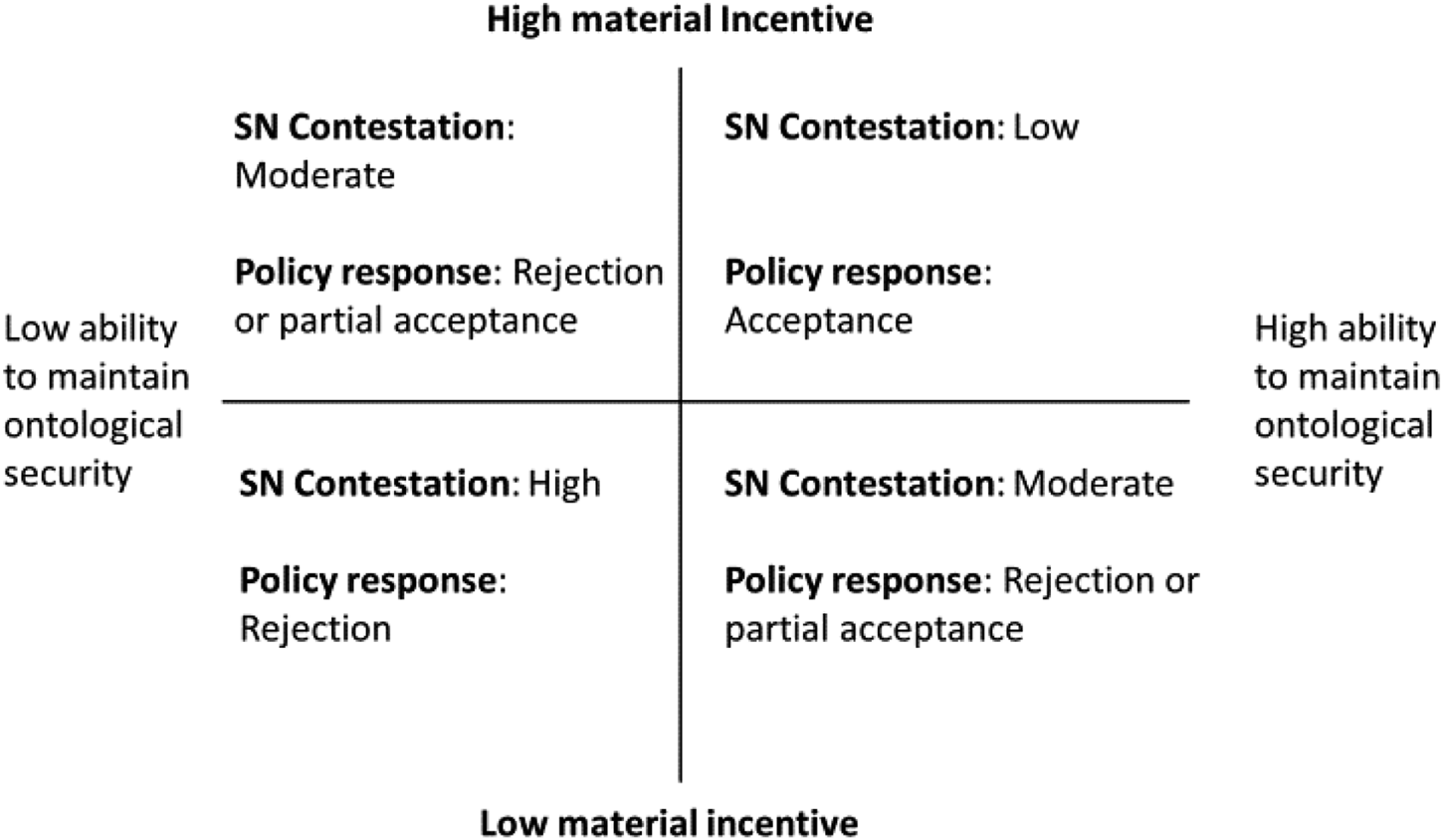
This brings us to the central premises of our theory concerning the role of strategic narratives in policy adoption. A strategic narrative justifying a new policy will be more compelling if it promises future material gain while enabling the actor to maintain its ontological security. If a state's policymakers do not feel they can construct a convincing strategic narrative to explain that a policy will be materially beneficial and maintain ontological security, they are less likely to adopt the policy.
This can be explained through an (over-)simplified narrative of the policy process. First, a state projects a strategic narrative, calling for others to change policy in line with its interests. Its projection through the media ecology will shape how coherent the strategic narrative appears upon reception. Target states’ decision-makers must decide if the initiating state's strategic narrative is convincing. They must then consider all the factors that shape policy decisions. This includes considering what is sayable about the policy, assuming they have to legitimate it to key audiences. They must feel able to narrate the policy in a way that convincingly promises material gain while maintaining their state's ontological security. Considering this alongside other factors, they make a policy choice, which they then justify with their strategic narrative about how they anticipate the future will pan out. These strategic narratives can then be analysed to identify which aspects of the original state's strategic narrative policymakers find acceptable or problematic.
To clarify, we are not arguing that policy decisions can be explained solely by the causal effect of strategic narrative. Multiple factors shape policy decisions – domestic considerations, leaders’ preferences, alliance behaviour, regime type, and the media ecology. These are context-specific. Even if a strategic narrative were decisive, it is impossible to demonstrate causation without direct access to decision-makers’ minds.Footnote 53 Following authors such as Brent Steele, David Campbell, Ole Wæver, and Ronald R. Krebs, we are not aiming to determine causal effects comprehensively.Footnote 54 We are attempting to provide a fuller account of the role of strategic narrative in the policy adoption process. We are concerned with what aspects of one state's strategic narratives are sayable by another state as the latter seeks to justify policy choices. This reflects Krebs's and Jackson's call for IR scholars to avoid ‘focusing on unanswerable questions about actors’ motives and to examine instead what actors say, in what contexts, and to what audiences’.Footnote 55 Our assumption is that policies require legitimation, and therefore policy choice is partially constrained by what can be narrated convincingly to key domestic and international audiences.Footnote 56
A key assumption underpinning our theoretical approach is that, contra realism, both material interests and ontological security concerns are narratively constituted. Janice Bially-Mattern notes significant crossover between realist and poststructuralist-informed accounts of how power shapes state action.Footnote 57 As she explains, realist accounts argue that state action is driven primarily by externally observable material interests, whereas constructivist and poststructuralist accounts argue that state actions are driven primarily by internally constructed ideas. But both follow similar logic: ideational and material power shape more or less ‘rational’ assessments of policy.Footnote 58
Rather than seeing material interests and ontological security concerns in this binary way, we follow Hansen, Wæver, and Steele in seeing both as discursively constituted in the narratives states tell to justify their policies.Footnote 59 When a state's leaders advocate a policy, they are uncertain whether other actors will keep their promises, or whether exogenous shocks might undermine anticipated material benefits. Their decisions are narratively constituted – they reflect a storyline or ‘script’ about how future events will play out.Footnote 60 We argue that this script will be more compelling if it explains convincingly how future material gain will transpire while enabling a state to maintain a stable sense of ‘who they are’.
Material and ontological security elements may also interact. A convincing promise of material gain may make decision-makers feel more able to deal with the ontological insecurity that comes from significant policy shifts. In this way, the material gains and ontological security aspects of a strategic narrative can reinforce each other, making policy adoption more likely. If states can only narrate either material or ontological benefits convincingly, target states are more likely to reject a policy or choose partial involvement if they can. If the policy appears to promise little material gain and potentially undermines ontological security, it will likely be contested discursively and rejected. This can be represented in a two-by-two framework (see Figure 2 below).
Strategic narrative buy-in framework.

Research design and methodology: China and the BRI
To test our proposed strategic narrative buy-in framework, we investigate state responses to China's strategic narratives concerning the Belt and Road Initiative (BRI). China's challenge is to convince others – through its words and actions, that the BRI reflects benign intentions and promises future prosperity. If it can, it can be said to have achieved strategic narrative ‘buy-in’. The challenge for other states is to narrate BRI affiliation in a way that credibly explains future material benefit while making the decision seem congruent with who they are. If they can marry these material and ontological security elements, they are more likely to accept fuller affiliation. If they cannot, they are likely to reject involvement or only affiliate partially.
The BRI differs from some foreign policy programmes in offering highly varied degrees of involvement. States can affiliate fully, by accepting investment projects and financing through ‘multilateral Cooperation Mechanisms under the BRF framework’, or simply sign bilateral and multilateral documents containing unenforceable promises of future cooperation.Footnote 61 Whatever states choose, they must justify their choices to domestic and international audiences. A range of possible policy responses makes it easier to link the degree of strategic narrative contestation with the policies individual states choose.
The challenge for China and potential BRI affiliates is that the material benefits of joining are hypothetical, not certain. Political leaders lack definitive knowledge of China's intentions. The BRI may bring ‘peace and prosperity’ or debt traps and insecurity. If other states feel affiliation threatens their ontological security – perhaps through association with a country with a poor human rights reputation, or through the idea of being (re)colonised, they are more likely to contest China's strategic narrative and reject involvement. Alternatively, they may select looser economic cooperation, and strategically narrate this without branding it as a BRI-project.
Sample
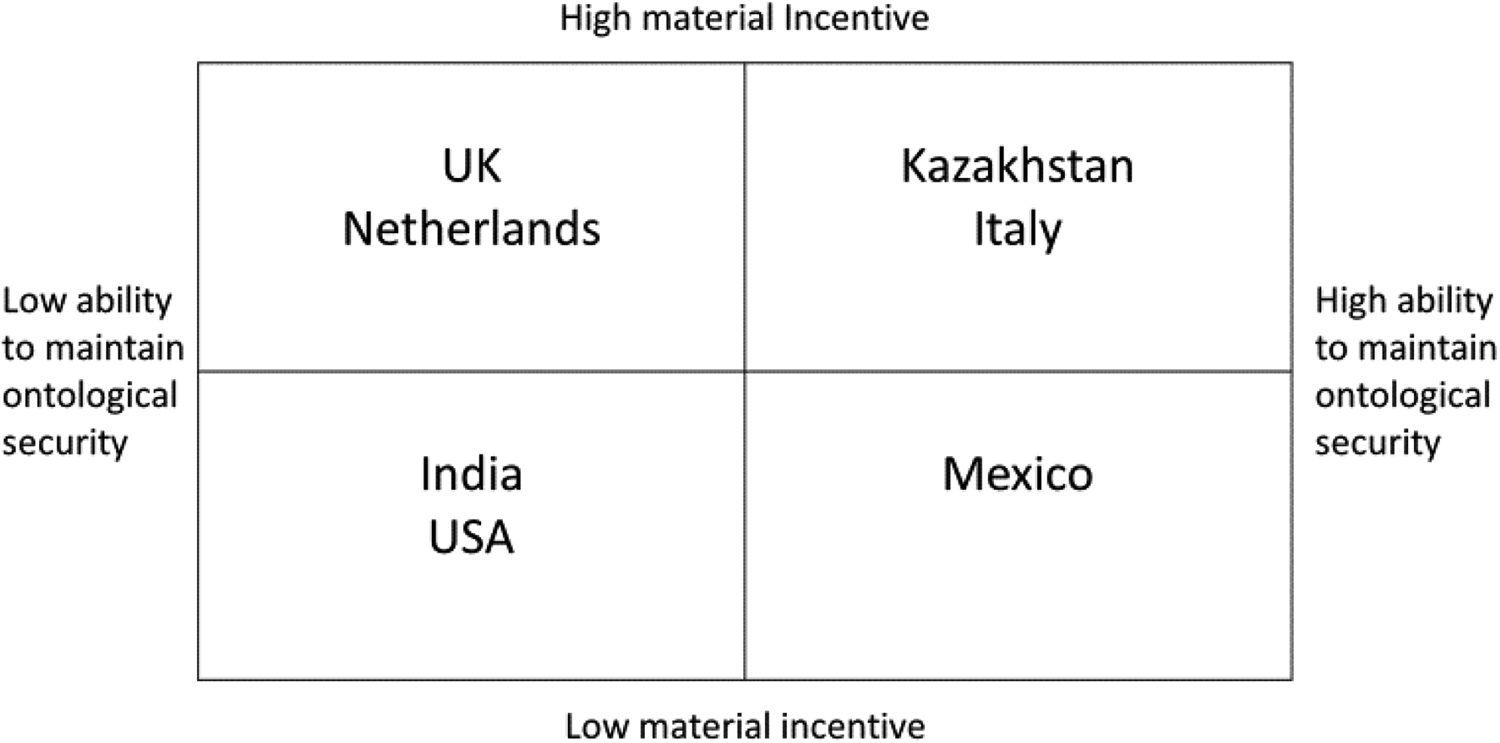
Our research design studies BRI affiliation, comparatively, during the specific time period surrounding the Second BRF in 2019. We sampled seven countries to provide the broadest possible range of perspectives on the BRI: from full embrace to full rejection (Figure 3). When choosing between countries with similar profiles, we did this pragmatically, based on which provided the richest data.
Our examples cover the four sectors of our framework – countries that:
Accept the BRI because it benefits them materially and upholds their ontological security.
Examples: Kazakhstan, Italy.
Accept the material benefits of the BRI but contest it on ontological security grounds.
Examples: UK, Netherlands.
Reject both the material benefits of the BRI and see it as undermining their ontological security.
Examples: US and India.
Accept that the BRI does not undermine their ontological security but perceive little material benefit.
Example: Mexico
Countries positioned in the BRI strategic narrative buy-in framework.

The bottom right segment was difficult to populate for the BRI – though not for other policy initiatives necessarily. With the BRI, accepting the notion that trade and investment can generate wealth meant that most countries can identify material incentives to affiliate. This made it harder to identify countries with little to gain materially from the BRI, even if a partnership with China did not undermine their ontological security. We therefore chose Mexico as the single example that illustrates this well, rather than shoehorn an additional case into the model for the sake of balance.
Countries’ positions on the framework are not fixed. Italy's decision to sign a Memorandum of Understanding with China represented a shift from the top left corner towards the top right. Mexico's position might change to the top right corner if it can hedge China and the US effectively while benefiting materially from affiliation.
Qualitative narrative analysis
We employ qualitative narrative analysis because this method has proven useful to identify the strategic narratives states construct to project their aims and identities and how others respond.Footnote 62 Covering an entire national discursive space is practically impossible.Footnote 63 Instead, we analyse political elites’ narratives as these are where major policy positions are most likely to be observed.Footnote 64 To bound the study, and provide an updated view, we focus on the Second BRF on 25–8 April 2019, in Beijing. First, we identify China's BRI strategic narrative as articulated in official forum speeches and related BRI policy documents. We include historical material to contextualise how China's BRI strategic narrative has evolved. Next, we examine speeches, policy documents, and media commentary that capture how respondent states strategically narrate about the BRI in 2019. We triangulate these to present a more comprehensive picture of which aspects of China's strategic narratives states co-opt, which they contest, and on what grounds.
References to material interests were straightforward to identify. They typically made reference to physical security or economic gain. References to ontological security were identified when states explained policy decisions in relation to accounts of who the state is. China can be said to have secured ‘buy-in’ to their strategic narrative when states repeat this strategic narrative without contestation.
China's BRI strategic narratives
China's strategic narratives for the Second BRF must be put in the context of how the programme has been previously narrated and experienced. From the outset, China has claimed that in a globalising world, affiliation with the BRI will bring increased ‘connectivity’, ‘peace’, and ‘prosperity’. During 2013 visits to Kazakhstan and Indonesia, Xi Jinping expressed its commitment to strengthening cooperation with countries along the land-based and maritime Silk Roads.Footnote 65 In 2015, Chinese authorities combined the Silk Road Economic Belt and 21st-Century Maritime Silk Road together in a Vision and Action plan ‘to promote the implementation of the Initiative, instill vigor and vitality into the ancient Silk Road, connect Asian, European and African countries more closely and promote mutually beneficial cooperation to a new high and in new forms’.Footnote 66 To that end, China launched the Asian Infrastructure Investment Bank (AIIB) in 2015, created a well-endowed Silk Road Fund, and deepened cooperation between its own financial institutions and markets.Footnote 67
The leaders attending the 1st Belt and Road Forum in 2017 reinforced a shared commitment to ‘promote a universal, rules-based, open, non-discriminatory and equitable multilateral trading system with [the] WTO at its core’.Footnote 68 With the BRI, China stated that it was ‘willing to combine the experience and foundations of its own development with the development will and comparative strengths of all countries’Footnote 69 to advance ‘a globalization that is open, inclusive and beneficial to all’.Footnote 70
Despite China's efforts, counternarratives have emerged elsewhere that the BRI is a predatory, corrupt project whose central character aims to trap countries in debt, enhancing its security at the cost of others, with the plot culminating in a new, Sino-centric world order. Evidence cited included Sri Lanka being bailed out by China – in exchange for conceding a 99-year lease for Hambantota port.Footnote 71 States cite security concerns over Chinese infrastructure such as Huawei's 5 G technology, and concerns over mass human rights violations in Xinjiang, to dispute China's benevolence.Footnote 72
In response, China has projected a more refined BRI strategic narrative. During the Second BRF in 2019, China advocated for ‘open, green and clean cooperation’, by introducing the new Beijing Initiative for Clean Silk Road (improving transparency and good governance), and the BRI International Green Development Coalition.Footnote 73 To generate ‘true benefits’ for participating states, Xi declared that China ‘will adopt widely accepted rules and standards and encourage participating companies to follow general international rules and standards in project development, operation, procurement and tendering and bidding’.Footnote 74 Simultaneously, China has been pushing back against debt trap labels.Footnote 75
The Joint Communique and Xi Jinping's keynote speech at the Second BRF outlined how the BRI supports China's domestic and foreign policies, explaining how China continues to ‘advance along the path of socialism with Chinese characteristics, deepen sweeping reforms, pursue quality development, and expand opening-up’.Footnote 76 These commitments were explained as coinciding with ambitions such as the ‘great national rejuvenation’ and the ‘China Dream’,Footnote 77 which safeguard ‘Beijing's core interests of state sovereignty, territorial integrity, access to natural resources.’Footnote 78 Internationally, China ‘remains ‘committed to peaceful development’ and to building ‘a community with a shared future for mankind’.Footnote 79 This blueprint of international cooperation reflected a Chinese view of a desirable world, but one in which ‘strengthening multilateralism remains essential in addressing global challenges’.Footnote 80 These aims are consistent with China's earlier strategic narratives of the BRI and international order.Footnote 81
For domestic audiences, China is the heroic central character – but to other countries, it portrays itself as a friendly and cooperative partner. The BRI is presented as compatible with national development strategies and multilateral frameworks such as the Eurasian Economic Union.Footnote 82 China's cooperative, partnership role is extended to developing countries (also framed under the South–South cooperation framework) and to developed countries. Chinese state media emphasises repeatedly all the countries who have affiliated, especially the ‘22 European countries [who have] inked BRI cooperation documents with China’ by 2019.Footnote 83
Concerning plot, China's BRI strategic narratives mythologise Chinese Civilisation and the Silk Road.Footnote 84 Xi's reference to a ‘Silk Road Spirit’ evokes a promise of mutual cooperation and benefit.Footnote 85 In this way, China is drawing on liberal ideology that takes for granted that trade (and the ‘connectivity’ implied by it) is inherently positive and peace bringing. The Silk Road analogy reinforces China's ontological security by implying continuity with a period when China was a dominant economic power. Meanwhile, this narrative silences its century of humiliation by imperial powers – a potential source of ontological insecurity. Alongside this, the Chinese Communist Party considers ‘historical nihilism’ (meaning denying the ‘inevitability’ of China's march towards socialism) as a political threat to the stability of society, and consequently has banned public debate about the Party's past.Footnote 86 Taken together, this presents the Chinese people with ‘a correct concept of history’, which is hard to challenge publicly.Footnote 87 Foreign audiences receive a depoliticised and simplified historical narrative designed to be emotionally appealing, that speaks to liberal ideology.
Alongside this positive future vision, China's communication also challenged negative perceptions of the BRI. At the forum, it sought to counter accusations of debt trap diplomacy by citing leaders whose countries were seen as being exploited by the BRI. For instance, Malaysia renegotiated various BRI projects as their terms were seen as unfavourable.Footnote 88 Predictably therefore, Chinese media focused on Malaysian Prime Minister Mahathir Mohamed's statement that ‘I fully support the Belt and Road Initiative. I am sure my country, Malaysia, will benefit from the projects.’Footnote 89 More broadly, Chinese officials are reported to have established more cautious communication about the BRI, publicising it less aggressively, and toughening rules on what can be associated with the initiative to prevent the brand being diluted by unsuccessful projects.Footnote 90
Together, these elements promote the BRI's material benefits while silencing risks. China-backed infrastructure presents a solution to the global infrastructure financing gap and meets states’ desire for free trade and infrastructure connectivity. Its offer of alternative multilateral diplomatic and financial institutions is aimed at making globalisation more inclusive and affiliation more attractive. The policy documents present a desirable image of China based on peace and goodwill. However, China's self-concept and view of world order presents a stumbling block in international communication because these narratives are not well aligned with how many target states see themselves, view China, and its vision of world order. BRI strategic narratives support the ontological security of Beijing, but threaten the ontological security of some other states, for whom affiliation disrupts routines and norms China is seen to challenge.
Responses to China's strategic narrative – multiple countries
At the BRI summit itself, most state communications provided little insight into how far China's BRI strategic narrative was accepted, partially embraced or rejected. They tended to be brief official statements embracing increased connectivity, multilateralism, and trade. Few statements directly challenged China's strategic narrative on material or ontological security grounds. Contestation is clearer when looking more broadly at policy documents and speeches relating to the BRI.
Most countries accept BRI's economic potential, based on the general assumption that increased trade and investment enhances wealth. Countries would narrate this using plot: typically, by highlighting a historical moment that illustrates their trading credentials, and claiming that this makes them a natural partner for China. Syria exemplifies this: ‘The connection between China and Syria dates back a thousand years, when Tadmour (Palmyra) operated as an important trade center between East and West. Therefore, China and Syria are natural partners.’Footnote 91 Emplotting the BRI this way frames cooperation as a natural continuation of a historical relationship. The US was one exception, as its trade war with China demonstrates.
For many countries, particularly liberal democracies, ontological security concerns appear more prominent. First, China's domestic ‘developmentalist’ narrative is potentially problematic. With the BRI, China promotes the country's socioeconomic development in under-developed provinces, notably Xinjiang and Tibet. However, numerous states consider China's treatment of ethnic minorities during this process to be human rights violations. Policy behaviour indicating close alignment with China thus potentially causes ontological insecurity by disrupting routines and norms for states that self-identify as promoters of human rights.
Secondly, full buy-in to the BRI requires acceptance of China's ‘Five Principles of Peaceful Coexistence’: mutual respect for each other's territorial integrity and sovereignty; mutual non-aggression; mutual non-interference in each other's internal affairs; equality and mutual benefit; and peaceful co-existence.Footnote 92 These principles privilege collective over individual rights, and a strict interpretation of state sovereignty. Simultaneously, China has established alternative multilateral diplomatic and financial institutions through which to decrease Western (largely US) influence and increase its own, including the Silk Road Fund and the AIIB. These normative and institutional building blocks of the BRI threaten the ontological security of countries that are committed to a largely US-led liberal order. Such states are more likely to contest or reject China's strategic narratives.
Full embrace – acceptance on material and ontological security grounds
Kazakhstan and Italy were chosen because they exemplify BRI's success. The BRI was first introduced in Kazakhstan, and the country embraced it fully.Footnote 93 Italy is the first G7 country to embrace the BRI. Both attended the Second BRF in 2019.Footnote 94
Kazakhstan
Bordering Western China, and providing the most direct land route to Europe, Kazakhstan has clear material incentives to embrace the BRI.Footnote 95 Its full affiliation seems both logical, and per realism, predictable. There is more to it than that, though. Kazakhstan's leaders have also employed BRI rhetoric to boost its ontological security as an important regional actor. Adopting China's connectivity rhetoric, Kazakhstan portrays itself as a ‘connector’ in Eurasia between China and Europe. This fits nicely with the multi-vector diplomacy Kazakhstan has been using to develop foreign relations with Russia and China,Footnote 96 and bolsters the country's sense of importance. In this process, Kazakhstan silences local anti-China sentiment concerning Chinese immigration and labour practices, and fears of economic dependency. These could all cause ontological insecurity if the country was seen to be over reliant or subservient to China. Instead, Kazakhstan's strategic narratives emphasise how BRI affiliation positions it as an important transit country.
Kazakh's BRI strategic narratives reflect increased economic interdependency, particularly in the energy and transport sectors. The BRI is compatible with Kazakh's own infrastructure programme – the Nurly Zhol Program (‘The Bright Road’), introduced by former President Nazarbayev Nursultan.Footnote 97 Moreover, the programmes complement each other, with Nursultan explaining how Nurly Zhol has ‘become an important part of the cooperation under the BRI’.Footnote 98 Characterising Kazakhstan as a ‘modern and competitive transit hub’ and as China's equal partner strengthens Kazakh ontological security by portraying the country as a unique and important ‘hub’ linking China and Europe.Footnote 99 Ongoing performance of this role through BRI-related diplomatic and economic activity thus has the potential to reinforce Kazakhstan's ontological security over time.
Kazakhstan's strategic narrative mirrors China's view of world order based on inclusivity, peace, and cooperation. Though officially retired, Nursultan attended the Second BRF, claiming that:
It is clear that the world is already tired of conflicting geopolitical concepts and strives for geo-economics and joint development. The Belt and Road displays much more than a complex of new opportunities for economic cooperation. The initiative reflects a strong historical demand for security, trade and prosperity of more than 120 countries.Footnote 100
In this plot, the past is characterised by counterproductive geopolitical competition, but more enlightened states now realise that future ‘security, trade, and prosperity’ necessitates greater cooperation. Material gains are the main focus.
Kazakhstan's buy-in to the BRI remains consistent after the president's resignation months prior to the Second BRF. When attending the joint meeting at the Second BRF, Nursultan said that ‘Kazakhstan will remain consistent and stable in its internal and foreign policies after my resignation.’Footnote 101 Nursultan's attendance was not surprising, as he remains the ‘de facto leader’.Footnote 102 Nursultan's concentration of power is based on a neo-patrimonial system.Footnote 103 As the ‘father’ of the nation, his presence and statement suggests a continuation of BRI legitimation, based on the anticipation of material gains from infrastructure connectivity and Kazakh's sense of self as an equal partner to China.
Taken together, Kazakh authorities openly embrace BRI strategic narratives. Policy adoption represents continuity as regards to economic interdependency, suggests the anticipation of material gains, and that ongoing affiliation boosts their significance in the regional and global order. For China, this is a case of successful strategic narrative buy-in.
Italy
Italy created controversy as the first G7 country to affiliate with the BRI, signing a Memorandum of Understanding in March 2019.Footnote 104 This was non-binding, but contentious, splitting the ruling coalition. The left-wing Five Star Movement supported affiliation; the far-right League opposed it. This, combined with US and EU opposition, failed to deter the government, however. Still, this contestation indicated that the purported material and ontological security benefits of the BRI were less clear for Italy than Kazakhstan.
Italy's BRI embrace focuses mainly on its material benefits, through projects in Italy and collaboration with China in third markets. The Italian Joint Statement of 2019 reiterates China's calls for improved connectivity and partnership.Footnote 105 Under the heading of economic diplomacy, Italy seeks to help its small- and medium-sized enterprises recognise ‘the cooperation opportunities in projects either under way or being developed by China in Egypt, Kazakhstan and Georgia’.Footnote 106 Italy has sought to connect their local infrastructure with the BRI and the Trans-European Transport Networks to ‘enhanc[e] cooperation in the sector of ports, logistics and maritime transport’.Footnote 107 The infrastructure synergy is communicated as beneficial and apolitical, concealing the operational and political complications likely to arise from China's growing role in Italy's infrastructure network.
The projected material benefits are countered by concerns about national security, partly from Chinese digital infrastructure, but more importantly the risk of Italy becoming even more indebted.Footnote 108 Ontological security issues also emerge from other members of the administration. Matteo Salvini, The League's leader, expressed imperialism-related concerns: ‘If it's a matter of helping Italian companies to invest abroad we are willing to talk to anyone’, Salvini said. ‘If it's a question of colonising Italy and its firms by foreign powers, no.’Footnote 109 The idea of ‘colonisation’ implies subservience, suggesting exploitation rather than material gain. It is also potentially a source of ontological insecurity if over time Italy were seen as performing a role that undermines its sovereignty.
The Italian government sought to address domestic contestation of China's strategic narrative in several ways. First, they claimed that any relationship would only be ‘economic and commercial’, without changing ‘the framework of our political relations and the Euro-Atlantic placement of our country’.Footnote 110 The latter point was likely designed to alleviate US concerns. Contention about China's human rights record was largely silenced. Human rights were mentioned in Italy and China's Joint Statement, but it only anticipated non-committal ‘dialogue’. This ‘dialogue’ makes justifying affiliation easier without undermining Italy's ontological security as a liberal democracy committed to human rights. Contrastingly, connectivity in economic terms is explained through a clear set of action plans.Footnote 111
Second, the government drew on historical narratives to stabilise its intended future relationship with China. Contradicting Salvini's concern about colonisation, Michele Geraci, Italy's Junior Industry Minister, explained that ‘[w]e are at the heart of the Mediterranean, yet the Chinese are everywhere in the region except here.’Footnote 112 Geraci draws on the mythology of the Mediterranean as the centre of the Roman Empire, linked to China by the Silk Roads, making its partnership with an economy such as China appear as a natural progression of the past. This reinforces Italy's ontological security over time by bridging back to a period when Italy was at the centre of the Mediterranean and the world's leading civilisation. Ontological security is further reinforced through recurrent behaviours, with the joint statement anticipating the ‘celebration of the 50th anniversary of the establishment of Italy-China diplomatic relations (“Road-to-Fifty”) in 2020’.Footnote 113 This makes affiliation with China appear routine. This contrasts with observers who portrayed affiliation as a disruption of routines by distancing Italy from its historical allies, the US, and Europe.Footnote 114
Italy exhibits domestic contestation of China's strategic narrative. However, the combination of sufficient material incentives, and the ability to narrate affiliation in a way grounded in Italian nationalist myth, made policymakers feel that they could explain BRI affiliation acceptably to their target audiences. This represents a considerable success of China's strategic narrative in securing buy-in from a large, Western-orientated economy.
Partial embrace – material acceptance, ontological rejection
The easiest sector of our framework to populate for the BRI consists of states that acknowledge material incentives of the BRI, but express concern about China's adoption of international rules and standards and its human rights record. These are common arguments of liberal democracies contemplating closer affiliation. Both the United Kingdom and the Netherlands have not affiliated, partly because they appear unable to project a convincing strategic narrative for domestic citizens and international allies (especially the US), which maintains their ontological security.
United Kingdom
The UK exemplifies a country recognising the BRI's material incentives, while harbouring clear ontological security concerns. Then-Chancellor Philip Hammond's forum speech explained that ‘none of us doubts that the Belt and Road Initiative has tremendous potential to spread prosperity and sustainable development – touching, as it does, potentially 70% of the world's population’.Footnote 115 Like other countries, he suggested that the UK and China are ‘natural partners’ experiencing a ‘golden era’ of relations.Footnote 116 These points make the material benefits of BRI affiliation appear obvious. They also uphold British ontological security, as affiliation might enable Britain to maintain its sense of self as a nation actively committed to promoting development and a ‘force for good’ worldwide.Footnote 117
Hammond's speech hints at concerns about ‘fair standards’ and upholding the ‘rules-based international system’.Footnote 118 More explicit material and ontological security concerns are outlined in a parliamentary document shortly before the Second BRF:
China is a force for order – but not liberal order. China wants rules to be enforced – but not rules which encroach on what it sees as its core interests. Protecting core interests is what all states try to do in foreign policy, but what makes China different is that those interests are inextricably linked with the interests and perceived legitimacy of the Communist Party. This makes China a viable partner for the UK on some issues, but an active challenger on others. On the positive side … the Party's requirement to deliver economic growth in order to maintain legitimacy makes China an advocate, like the UK, for a stable trading order. … On the negative side, the Party's need to maintain domestic control leads China to oppose global initiatives, supported by the UK, which promote free societies and protect human rights.Footnote 119
This statement reflects two recognised elements of British national identity and ontological security. The first is Britain as a ‘global trader’ – an idea underpinned by imperial mythology, on the basis that only a uniquely capable trading nation could maintain such a vast empire.Footnote 120 The second element is commitment to promoting human rights and liberal democratic values worldwide – to which the document alludes further in expressing concerns about the treatment of Uighurs in Xinjiang. Closer trade with China in itself does not undermine British ontological security, and in this respect the narrative of Britain as a ‘global trader’ could maintain ontological security by providing ‘autobiographical continuity’ for Britain were it to affiliate with the BRI.Footnote 121 However, aligning closely with a country with a poor human rights record would undermine British ontological security, as would shifting away from its major ally, the US.
Britain therefore provides a relatively straightforward case of a country accepting the BRI's economic incentives but only partially, due to ontological security concerns. Hence the parliamentary committee's recommendation that Britain ‘continue to refrain from signing a Memorandum of Understanding’.Footnote 122
Instead, Britain has focused more on ‘helping China’ to raise standards of BRI projects. This includes legal or financial expertise, noting that Britain was ‘the first major Western country to express its support for the Asian Infrastructure Investment Bank (AIIB)’.Footnote 123 That this multilateral institution appears to abide by the ‘rules based international system’ makes it easier for the UK to construct a convincing strategic narrative about AIIB affiliation. Positioning itself as China's helper further bolsters British ontological security by implying superiority over China in this area (if not in others).
The Netherlands
Like the UK, the Netherlands has not affiliated officially with the BRI. Instead it has produced a policy document suggesting the need for ‘a new balance’ between the countries.Footnote 124 The document stipulates that Dutch ‘openness means that [they] have to carefully consider whether the benefits of taking advantage of opportunities outweigh the need to protect [their] security, [their] earnings potential and values such as the rule of law and human rights’.Footnote 125 The Dutch policy is aligned with the EU strategy: ‘The Netherlands and China have common ground in pursuing connectivity, as long as it is sustainable and compatible with the EU's parameters and offers tangible opportunities and projects for both parties. In that spirit, the Netherlands has concluded an MoU with China on cooperation (by companies) in third markets’.Footnote 126 When combined with Prime Ministerial speeches, it reveals BRI-applicable material incentives and ontological security concerns.
Dutch government rhetoric endorses many aspects of China's strategic narrative while contesting others. The ‘new balance’ document describes the Dutch position towards China as ‘constructive and critical. It seeks to pursue cooperation on the basis of shared interests, with due regard for ideological differences.’Footnote 127 This tension is reflected in polarised debate on China in the Netherlands, captured by the aphorism that ‘China is heaven for merchants, but hell for idealists.’Footnote 128 The challenge is that being an outward-looking ‘merchant’ and a liberal democratic ‘idealist’ are both key elements of the Dutch national story through which its ontological security is maintained over time.
Boosting trade through working closer with China can be justified by the Dutch government on material and ontological security grounds. Prime Minister Mark Rutte, at the Boao Forum in 2018, explains the material benefits of ‘connectivity’ in a way that mimics China's BRI strategic narrative: ‘The Netherlands has always been an open economy and a connective logistics hub. And it always will be. For many Asian companies, the port of Rotterdam is the gateway to Europe.’Footnote 129 Rutte endorses China's emphasis on improving trade and ‘connectivity’ on ontological security grounds too:
Connectivity is the theme of this trade mission, and it's part of my country's DNA. As a small coastal nation we simply can't afford to shut ourselves off from the outside world. We've always been outward-looking. The first Dutch ships reached China back in the seventeenth century, and we've been enjoying mutual trade, knowledge exchange and partnerships ever since.Footnote 130
Here Rutte adds narrativity to his statement by suggesting that supporting closer trade with China is a continuation of historical behaviour. Rutte explains that trade and connectivity are integral to the Dutch character – part of their ‘DNA’ as a ‘small’ and ‘outward-looking’ coastal nation.
Rutte also suggests that a relationship with China upholds his country's sense of identity because both countries are inherently creative and have an ‘innovative mindset’.Footnote 131 These statements show how the ‘connectivity’ aspect of China's strategic narrative is persuasive in the Dutch case as the government could explain its benefits on material and ontological security grounds. Given that it can, one might wonder why the Netherlands has not embraced the BRI more formally.
As with the UK, though, concerns emerge in the Netherlands’ China strategy that ‘the Chinese Communist Party (CCP) and the Netherlands disagree mainly when it comes to freedom, particularly individual freedoms’. Moreover, ‘the CCP is calling into question the universality of human rights, and not without some success’.Footnote 132 Like the UK, the Netherlands’ reticence towards BRI affiliation is not expressed through countering the content of China's BRI strategic narrative, but on behaviours it silences, especially its human rights record. These countries can readily promote free (and fair) trade materially, but their leaders feel unable to advocate aligning formally with a country seen as undermining liberal values without undermining their ontological security. This explains their partial embrace.
Rejection on both material and ontological security grounds
The United States and India express both material and ontological security concerns about the BRI. Their economies may be closely intertwined with China, but policy statements in both countries around the Second BRF express grave concerns about the institutional and normative building blocks associated with the BRI, and fears of geopolitical power shifts in China's favour.
United States
Before and during the Second BRF, US government opposition was clear. A Department of Defense (DoD) report in December 2018 frames China as a national security threat seeking ‘to displace the United States in the Indo-Pacific region, expand the reaches of its state-driven economic model, and reorder the region in its favor as the preeminent power’.Footnote 133 The same report expresses concern about the BRI providing ‘military advantage’ to Beijing, access to foreign ports, and coercive leverage over other countries through debt-trap diplomacy.Footnote 134
US responses have low narrativity. There is little attempt to situate the BRI historically. The plot mainly raises examples of states whose economies, sovereignty, and/or security the BRI undermines. The US narrates on behalf of these countries, characterising itself as the defender of international norms and state sovereignty. The BRI is not considered entirely malignant, with the DoD acknowledging that ‘many countries have genuine economic development needs, particularly for infrastructure’.Footnote 135 Nevertheless, the report specifies 17 examples where it claims Chinese investment has harmed host countries.Footnote 136 The US rejects China's claims that the BRI promises benevolent partnership. It frames China as using economic dependency to make other countries align politically with it.Footnote 137
During the forum, Secretary of State Mike Pompeo repeatedly criticised China for promoting ‘corrupt infrastructure deals in exchange for political influence’ and using ‘bribe-fuelled debt-trap diplomacy’.Footnote 138 Commenting on Italy's prospective affiliation, the National Security Council tweeted that ‘endorsing BRI lends legitimacy to China's predatory approach to investment and will bring no benefits to the Italian people’.Footnote 139
These critiques combine material and ontological security concerns. They reflect US threat perceptions of an increasingly assertive China – challenging the primacy and exceptionalism of a country whose recent history – before the Trump administration at least – has been routinely narrated as that of the ‘leader of the free world’. Together, these elements make it hard for the US to justify pro-BRI policies, even if in general terms improved connectivity and trade between the US and China would bring economic benefits. Consequently, the US rejects China's strategic narratives and BRI affiliation.
India
Bordering China, India could benefit significantly from BRI affiliation. As the Indian Ambassador to China explained in March 2019, ‘India shares the global aspiration to strengthen connectivity and it is an integral part of our economic and diplomatic initiatives.’Footnote 140 However, India harbours sovereignty and national security concerns, leading it to reject BRF attendance for a second time. Specifically, a prominent trade route of the BRI, the Chinese-Pakistan Economic Corridor (CPEC) linking Xinjiang to the Pakistani port of Gwadar, routes through Pakistan-controlled Kashmir, which India has claimed since independence in 1947. This is seen as violating Indian sovereignty, boosting economically its long-term competitor, Pakistan. These concerns are not just material – they challenge ideas about what constitutes the territorial integrity of the Indian nation. Consequently, the BRI can be interpreted as undermining both Indian physical and ontological security, despite potential economic gains from affiliation. This explains India's BRI opposition and its forum non-attendance.
An additional ontological security concern for India is its status in the Indo-Pacific. Subservience to a Chinese regional order is a potential source of ontological insecurity for the nationalist Modi regime. As an article in the Hindu Times claimed during the forum, the BRI is not just ‘a branding exercise for China's mega Belt and Road Initiative (BRI) of transnational connectivity’; it is ‘actually being used by Beijing to project power. It wants to emerge as a countervailing force to the US, particularly in the Indo-Pacific.’ Because of this ‘the Chinese worldview directly clashes with India's interests. China wants India to remain subservient to it in the region’.Footnote 141 Using similar language to the US, India also emphasises that connectivity initiatives must be ‘based on universally recognised international norms, good governance and rule of law’, and ‘follow principles of openness, transparency and financial sustainability’.Footnote 142 Again these concerns are material and ontological, with India wanting to be seen as upholding these values internationally through both words and routine behaviours.
The Chinese response to India is illustrative, in that it seeks to downplay India's physical and ontological security concerns by emphasising that the BRI is ‘only an economic initiative’ that ‘has nothing to do with the sovereign and territorial disputes left from history between any two countries’.Footnote 143 However, enmity with others, and past conflicts, are often important constituents of ontological security narratives, and not something nations can easily drop on request. In addition to ongoing tensions with Pakistan, India and China have fought a border conflict in 1962 over Kashmir/Aksai Chin, and border skirmishes have erupted again at the time of writing. India cannot dismiss these aspects of history as irrelevant. Consequently, India appears unable to formulate a strategic narrative to legitimise BRI affiliation.
Partial embrace – limited material interests, ontological security maintained
As it is relatively straightforward to argue that increased trade and connectivity can enhance wealth, it is easy for most countries to identify economic material incentives for BRI affiliation. More difficult is to find countries whose strategic narrative responses suggest they would not benefit materially, even if they have no ontological security concerns. Countries matching these criteria would be those that rely heavily on China's economic competitors (in this case, the United States), which risks undermining these relationships through affiliation. Mexico is one such example.
Mexico
China has invited Mexico to join the BRI.Footnote 144 As of yet, Mexico has not ratified a Memorandum of Understanding with it. Mexico's rhetoric suggests openness to engagement. President Andrés Manuel López Obrador advocated in November 2018 for a ‘new chapter’ with China.Footnote 145 The Second BRF document states how Mexico signed up to the International Commercial Dispute Prevention and Settlement Organization and signed cooperation documents in science, technology, and innovation.Footnote 146 The latter includes scholarships for Mexican students at Chinese institutes of higher learning.Footnote 147
Undersecretary of Foreign Trade Luz Maria De la Mora told Chinese officials at a Mexico-China economic forum in 2019 that ‘Mexico is a friend and partner to China. We know that with China, Mexico can be stronger, and with Mexico, China can be a stronger country too.’Footnote 148 This implies that Mexico's ontological security might not be undermined by affiliation provided it can continue to engage in routines associated with its close economic relationship with the US. Moreover, the commercial interests of Mexico and China potentially overlap. De la Mora explained that ‘[w]e do not have any doubt that the approach with China through the commercial path and investment will allow us to approach Mexico's commercial policy, which is based on the three axes of inclusion, innovation, and diversification.’Footnote 149 Rhetorical promises such as ‘inclusion’ and ‘innovation’ resemble China's strategic narratives about inclusive globalisation and sustainable growth.
Mexico's partial BRI embrace is made more complex by ontological security and material issues, however. Buy-in would not explicitly undermine their sense of self. Mexico welcomes trade and foreign investment from diversified partners. This is not the full story, though. Mexico has a history of Sinophobia and anti-China campaigns, with Chinese immigrants having faced discrimination and violence in the nineteenth and twentieth centuries.Footnote 150 If Mexico deepens economic collaboration with China, the authorities will need to consider how to legitimise this policy change with regard to the stories through which Mexican ontological security is maintained.
Narrating material benefits is difficult for Mexico, which explains their partial embrace of the BRI. Mexico-China relations are defined by the United States, and the United States-Mexico-Canada Agreement (USMCA), which is only ratified by Mexico.Footnote 151 In fact, ‘Mexico will be limited in its ability to make separate agreements with China as this has been built into the USMCA deal.’Footnote 152 Also, any hedging strategies available to Mexico would need to navigate its reliance on US remittances.
The unfavourable trade balance between Mexico and China is another issue. Marcelo Ebrard, the Mexican foreign minister, declares ‘that from an economic point of view, the bilateral relationship is increasingly important but we are looking for greater trade, more investment and better economic relation[s]’.Footnote 153 Finally, Mexico has also experienced failed Chinese infrastructure projects. Former President Enrique Peña Nieto had to scrap a contract awarded to a consortium led by China Railway Construction Corporation, to build a rail link between Mexico City and Querétaro after an outcry over transparency.Footnote 154
Overall, Mexico's BRI strategic narratives suggest no significant ontological security concerns about working with China. However, material concerns limit the viability of affiliation. Consequently, a partial embrace is the most that can be expected from Mexico. Its discourse articulates no concrete policy goals, merely that both sides ‘are working on a road map “for the next five years”, for which they must “intensify political dialogue”’.Footnote 155
Affiliation may become more viable in future, especially if Mexico's US relationship declines. Positions on our strategic narrative buy-in framework can shift. At the point of analysis, it was difficult to identify countries that have little material incentive to affiliate with the BRI, even if they have minimal ontological security concerns. However, evidence is emerging from affiliates that the costs of BRI affiliation are greater than anticipated. The Maldives government, which had been a strong BRI affiliate, was recently voted out in favour of a new administration on an anti-BRI platform.Footnote 156 Both the Maldives and the Malaysian governments have sought to renegotiate contracts and debts with China, fearing ever-worsening debt traps.Footnote 157 How easy the bottom right of our framework will be to populate will change depending on how countries experience the material and ontological consequences of the BRI in the future and on local fluctuations in politics.
Discussion
Theoretical and empirical contribution
This article has sought to explain how one actor's strategic narrative is appropriated by another, and how this process relates to policy adoption choices. We have argued that two factors combine to make ‘buy-in’ to a policy initiative more likely: whether policymakers feel they can explain policy change in a way that promises material benefits and upholds their country's ontological security. If they can do both, they will be more likely to enact the policy.
We examined this proposition through original empirical research into states’ responses to China's strategic narratives on the BRI in the updated context of the Second BRF in April 2019. First, we presented a strategic narrative buy-in framework, illustrating in a two-by-two grid how the combination of material incentives and ontological security concerns affect strategic narrative contestation and policy responses. We then illustrated this by examining seven diverse states’ strategic narratives regarding the BRI, and how the extent of contestation of China's strategic narrative aligned with policy choices.
Kazakhstan and Italy have affiliated officially with the BRI, albeit with more contestation in Italy. Both reiterated China's strategic narrative promises of ‘connectivity’ and ‘partnership’ and increased trade. Kazakhstan positioned itself as a modernising transit hub connecting Europe and Asia. Italy, meanwhile, drew on the Silk Road mythology and the country's historical centrality in the Mediterranean to make affiliation seem like a routine continuation of past behaviour, rather than a significant and controversial policy shift. This helped to justify the policy change without undermining their ontological security. In this way, they used narrative plot strategically to make routine what was far from routine.
Britain and the Netherlands’ responses were similar. Both identified positively with China's calls to improve connectivity and trade, seeing these as important elements of their contemporary and historical influence. But both rejected direct affiliation due to concerns over China's values and behaviour. Each sought to derive ontological security from being seen to help China with aspects of the BRI, but without feeling able to argue for full involvement due to China's approach to international rules and standards and human rights.
The US and India might benefit economically from the BRI but reject it because they cannot reconcile physical or ontological security concerns. The US perceives a threat to its leading position in international order. India shares similar concerns in the Indo-Pacific, and considers that the BRI routing through Pakistani-controlled Kashmir undermines their sovereignty and territorial integrity. Without sufficient material incentives or their ontological security concerns being addressed, neither feels that they can argue in favour of affiliation, even if their economies are more closely intertwined with China's than their rhetoric suggests.
Finally, the hardest segment to populate concerned countries that see limited material benefit from the BRI, even though they accept it on ontological security grounds. We used Mexico to show how the BRI is less appealing for countries that possess alternative economic relationships to the BRI, even if affiliation does not undermine their ontological security.
Advancing Belt and Road Initiative research
As well as demonstrating our theory's utility, the article contributes empirically by bringing up to date analysis of how countries are responding to the evolving BRI. Some countries have moved from hesitancy to a full embrace. Others persistently contest the BRI and see ulterior motives behind it. How strategic narratives and policies concerning the BRI shift over time would be a useful avenue for further research. Studies regarding the effect of the COVID-19 pandemic on state responses and policies on the BRI would be worthwhile.
Examining a broader range of cases would also be helpful. Our sample, while geographically dispersed, over-represents Western liberal democracies and wealthier countries. However, as the Italy case shows, liberal democracies’ BRI responses are mixed. These nuances, along with perspectives from a greater range of countries in the Global South, would be useful to explore.
A further area requiring more research concerns subnational variation in responses to China's BRI strategic narratives. Cases such as California (US) and Victoria (Australia) show how domestic tensions can cause subnational states to adopt different BRI affiliation from the country overall. California's Lieutenant Governor Eleni Kounalakis attended the Belt and Road CEO Conference in China to promote action on climate change – something that China's BRI strategic narrative promotes.Footnote 158 Contrary to national apprehension of the BRI, Kounalakis presents California as a logical partner due to its commitment to reducing its environmental footprint. California's BRI response reflects tensions with the Trump administration, against which it has been described as being ‘at war’.Footnote 159 In this way, responses to China's strategic narrative reflect existing domestic tensions in US politics.
Similarly, Victoria in Australia has embraced aspects of the BRI independent of their national government, signing a Memorandum of Understanding on the BRI in October 2018.Footnote 160 These examples illustrate the importance of moving beyond state-centric approaches to examining regional and subnational responses to the BRI. These remind us that ontological security can be contested nationally, and strategic narrative analysis should reflect this.
Taking the strategic narrative buy-in framework forward
Beyond the BRI, it would be useful to examine our buy-in framework's utility in a broader range of cases. Not all cases will provide as clear a material case as the BRI. In other cases, ontological security concerns might be the main driver of policy choice. Consider strategic narratives on irregular migration, for example. The material cost of welcoming large numbers of refugees may outweigh material benefits, but states justify doing so on ontological security grounds, as a behaviour that maintains their ontological security as states committed to human rights.
To conclude, we contend that our strategic narrative buy-in framework provides an important theoretical contribution to explaining what makes some strategic narratives more likely to persuade international actors to adopt new policies. States should formulate strategic narratives in a way that anticipates material gain but without undermining the ontological security of others. In particular, narrating the policy in a way that implies it is a continuation of historical behaviour appears to be a useful way of maintaining ontological security even if the policy represents a significant shift in routines.
If a recipient of a policy strategic narrative sees limited material benefit or ontological security concerns, they are more likely to pursue more moderate policy options. They will feel uncomfortable about advocating and ultimately adopting a policy that contradicts who they are and which breaks established routines, particularly if they deem the policy unethical. They will calculate that a policy that doesn't bring material benefit is not worthwhile. A strategic narrative that convinces target audiences that they will benefit materially while staying true to who they are, will achieve buy-in.
Acknowledgements
This article was derived from ideas developed out of an International Studies Association panel, 'Stickiness and Silence: Explaining the Failures and Successes of Strategic Narrative' in Toronto, 2019. We would like to thank the conveners, Alister Miskimmon and Ben O'Loughlin, and the panel members for their feedback as our ideas developed.