Introduction
People with anxiety disorders may suffer from impairments across a range of functional domains, such as social, family and close relationships, educational attainment and occupational roles, or the overall quality of life (Mendlowicz & Stein, Reference Mendlowicz and Stein2000; Rubin et al. Reference Rubin, Rapaport, Levine, Gladsjo, Rabin, Auerbach, Judd and Kaplan2000; Kessler, Reference Kessler2003; Lochner et al. Reference Lochner, Mogotsi, du Toit, Kaminer, Niehaus and Stein2003; Alonso et al. Reference Alonso, Angermeyer, Bernert, Bruffaerts, Brugha, Bryson, de Girolamo, Graaf, Demyttenaere, Gasquet, Haro, Katz, Kessler, Kovess, Lepine, Ormel, Polidori, Russo, Vilagut, Almansa, Arbabzadeh-Bouchez, Autonell, Bernal, Buist-Bouwman, Codony, Domingo-Salvany, Ferrer, Joo, Martinez-Alonso, Matschinger, Mazzi, Morgan, Morosini, Palacin, Romera, Taub and Vollebergh2004a ; Eguchi et al. Reference Eguchi, Noda, Nakano, Kanai, Yamamoto, Watanabe, Lee, Ogawa, Ietsugu, Sasaki, Chen and Furukawa2005; Fehm et al. Reference Fehm, Pelissolo, Furmark and Wittchen2005; Goodwin et al. Reference Goodwin, Faravelli, Rosi, Cosci, Truglia, de Graaf and Wittchen2005; Waghorn et al. Reference Waghorn, Chant, White and Whiteford2005; Olatunji et al. Reference Olatunji, Cisler and Tolin2007; Tenorio-Martinez et al. Reference Tenorio-Martinez, del Carmen Lara-Munoz and Elena Medina-Mora2009; Beard et al. Reference Beard, Weisberg and Keller2010b ; Comer et al. Reference Comer, Blanco, Hasin, Liu, Grant, Turner and Olfson2011). Anxiety disorders are among the five most burdensome disorders in countries across the world (Melse et al. Reference Melse, Essink-Bot, Kramers and Hoeymans2000; Jorm et al. Reference Jorm, Griffiths, Christensen and Medway2002; Saarni et al. Reference Saarni, Harkanen, Sintonen, Suvisaari, Koskinen, Aromaa and Lonnqvist2006, Reference Saarni, Suvisaari, Sintonen, Pirkola, Koskinen, Aromaa and Lonnqvist2007) because of high prevalence rates (Wittchen & Jacobi, Reference Wittchen and Jacobi2005; Wittchen et al. Reference Wittchen, Jacobi, Rehm, Gustavsson, Svensson, Jonsson, Olesen, Allgulander, Alonso, Faravelli, Fratiglioni, Jennum, Lieb, Maercker, van Os, Preisig, Salvador-Carulla, Simon and Steinhausen2011), chronic course (Keller, Reference Keller2003, Reference Keller2006; Wittchen & Fehm, Reference Wittchen and Fehm2003; Yonkers et al. Reference Yonkers, Bruce, Dyck and Keller2003; Fehm et al. Reference Fehm, Pelissolo, Furmark and Wittchen2005; Goodwin et al. Reference Goodwin, Faravelli, Rosi, Cosci, Truglia, de Graaf and Wittchen2005; Lieb et al. Reference Lieb, Becker and Altamura2005) and consequences of impaired functioning (Leon et al. Reference Leon, Portera and Weissman1995; Greenberg et al. Reference Greenberg, Sisitsky, Kessler, Finkelstein, Berndt, Davidson, Ballenger and Fyer1999; Batelaan et al. Reference Batelaan, Smit, de Graaf, van Balkom, Vollebergh and Beekman2007b ; Acarturk et al. Reference Acarturk, Smit, de Graaf, van Straten, ten Have and Cuijpers2009; Gustavsson et al. Reference Gustavsson, Svensson, Jacobi, Allgulander, Alonso, Beghi, Dodel, Ekman, Faravelli, Fratiglioni, Gannon, Jones, Jennum, Jordanova, Jonsson, Karampampa, Knapp, Kobelt, Kurth, Lieb, Linde, Ljungcrantz, Maercker, Melin, Moscarelli, Musayev, Norwood, Preisig, Pugliatti, Rehm, Salvador-Carulla, Schlehofer, Simon, Steinhausen, Stovner, Vallat, van den Bergh, van Os, Vos, Xu, Wittchen, Jonsson and Olesen2011). Post-morbid functioning is also a relevant outcome when considering that it impacts quality of life and predicts the recurrence of anxiety disorders (Rodriguez et al. Reference Rodriguez, Bruce, Pagano and Keller2005; Scholten et al. Reference Scholten, Batelaan, van Balkom, Penninx, Smit and van Oppen2013). Therefore, there is growing consensus that efforts to curb the toll of anxiety disorders should focus not only on symptom remission but also on functional recovery (Ballenger, Reference Ballenger1999, Reference Ballenger2001; Bandelow, Reference Bandelow2006), thus aiming for a complete clinical and functional recovery.
Despite growing interest, studies on the relationship between symptom remission and functional recovery in anxiety disorders are scarce (Sheehan et al. Reference Sheehan, Harnett-Sheehan, Spann, Thompson and Prakash2011) and have produced inconsistent results. Short-term treatment studies suggest that pharmacological treatments induce symptom remission and improve functioning (Lecrubier & Judge, Reference Lecrubier and Judge1997; Mavissakalian et al. Reference Mavissakalian, Perel, Talbott-Green and Sloan1998; Michelson et al. Reference Michelson, Lydiard, Pollack, Tamura, Hoog, Tepner, Demitrack and Tollefson1998; Pollack et al. Reference Pollack, Otto, Worthington, Manfro and Wolkow1998; Hartford et al. Reference Hartford, Kornstein, Liebowitz, Pigott, Russell, Detke, Walker, Ball, Dunayevich, Dinkel and Erickson2007), but the design of such studies does not enable assessment of whether functioning returns to pre-morbid levels. One early naturalistic study including a small sample of participants with anxiety disorders in primary care found that symptom remission and normalization of functioning occur synchronously (Ormel et al. Reference Ormel, Vonkorff, Vandenbrink, Katon, Brilman and Oldehinkel1993). However, two later studies on the natural course of panic disorder failed to reproduce these results; although participants who achieved symptom remission also experienced significant improvements in functioning, they remained significantly impaired compared to healthy controls (Scheibe & Albus, Reference Scheibe and Albus1997; Stout et al. Reference Stout, Dolan, Dyck, Eisen and Keller2001).
In this context, it remains unclear whether people who reach symptom remission continue to experience functional impairments, and for how long. Under current practice, it is expected that treating symptoms until remission is accomplished allows patients to resume normal lives. According to the International Classification of Functioning, Disability and Health (ICF), however, impaired functioning results not only from illness but also from its interaction with contextual factors, such as age, gender, education, personality or the availability of social support (WHO, 2001). Therefore, levels of post-morbid functioning might vary among people who reach remission. Knowing which factors influence post-morbid functioning, beyond and above symptom remission, would permit the timely identification of patients with higher risk of persistent impairments. To date, such insights are not available.
The aim of the present study was twofold. First, the study investigated the relationship between symptom remission from anxiety disorders and level of functioning. We hypothesized that participants who reached clinical remission would report better functioning than those who did not. Based on prior research, we also investigated whether those who achieve remission reach the level of functioning found in healthy controls. We therefore analysed the trajectories of total and domain-specific functioning in participants with 2-year chronic anxiety disorders and in those remitting during a 2-year follow-up, and compared them to healthy controls. The second aim was to identify predictors of functioning in participants who achieved symptom remission from anxiety disorders. To this end, we considered a large number of sociodemographic, clinical and vulnerability variables, in line with the ICF definition of impaired functioning (WHO, 2001).
Method
Study sample
Data were derived from the Netherlands Study of Depression and Anxiety (NESDA), an ongoing longitudinal cohort study of the long-term course and consequences of depressive and anxiety disorders. At baseline, a total of 2981 adults were recruited from community, primary and secondary care, consisting of participants with a current or remitted depressive and/or anxiety disorder (78%), and healthy controls (22%). The presence of current or remitted depressive and anxiety disorders was established at baseline and at a 2-year follow-up using the Composite International Diagnostic Interview (CIDI), version 2.1. Data were collected by specially trained research staff, and covered a wide range of domains, such as demographics, psychopathology, public health consequences of mental disorders, biological and genetic measures. The study was approved by the Ethical Review Boards of all participating centres. All participants provided written informed consent. A more detailed description of the NESDA is provided elsewhere (Penninx et al. Reference Penninx, Beekman, Smit, Zitman, Nolen, Spinhoven, Cuijpers, de Jong, van Marwijk, Assendelft, van der Meer, Verhaak, Wensing, de Graaf, Hoogendijk, Ormel and van Dyck2008).
The present study drew on the first three waves of the NESDA: baseline (T0) and 1- and 2-year follow-ups (T1 and T2 respectively). For this study, we selected participants who completed both T0 and T2 regardless of whether or not they completed T1. The 1556 participants who fulfilled these criteria were divided into three groups: chronic anxiety disorder (6-month diagnosis of anxiety disorders at both T0 and T2; n = 586); remitting anxiety disorder (6-month diagnosis of anxiety disorders at T0 but no 6-month diagnosis at T2; n = 385); and a control group of healthy participants (without history or current anxiety or depressive disorders at T0, n = 585).
Measures
Diagnosis of anxiety disorders
Anxiety disorders included social phobia, panic disorder (with or without agoraphobia), agoraphobia and generalized anxiety disorder. Diagnoses were based on the CIDI, a structured interview with high inter-rater reliability (Wittchen et al. Reference Wittchen, Robins, Cottler, Sartorius, Burke and Regier1991), high test–retest reliability (Wacker et al. Reference Wacker, Battegay, Mullejans and Schlosser2006) and high validity for anxiety and depressive disorders (Wittchen et al. Reference Wittchen, Burke, Semler, Pfister, Von Cranach and Zaudig1989; Wittchen, Reference Wittchen1994).
Functioning
Functioning was assessed using the World Health Organization Disability Assessment Schedule II (WHO DAS II), a 36-item generic measurement that queries difficulties in functioning encountered during the 30 days prior to the interview (Chwastiak & Von Korff, Reference Chwastiak and Von Korff2003). Functioning was assessed over six life domains (using seven outcome variables): communication and understanding (cognition), getting around (mobility), self-care, getting along with people (interpersonal functioning), life activities (household and work functioning) and participation in society. Items were measured on a five-point Likert scale, ranging from 1 (no difficulties) to 5 (extreme difficulties/cannot do). Total WHO DAS scores were obtained using a complex scoring method that makes use of the full information of the response categories, thus allowing more detailed analyses (Üstün et al. 2010). The method involves three steps: calculation of the domain-specific scores by adding the recoded item scores within each domain; calculation of the summary score by summing the domain-specific scores; and conversion of the summary score into a total WHO DAS score, a metric ranging from 0 (no disability) to 100 (full disability) (Üstün et al. 2010). The WHO DAS II has shown high sensitivity to symptom change in social phobia, panic disorder and agoraphobia (Perini et al. Reference Perini, Slade and Andrews2006) and substantial test–retest reliability (Chopra et al. Reference Chopra, Couper and Herrman2004). Within the NESDA, WHO DAS II was applied to participants in all three waves, as a self-report questionnaire. The internal consistency for the WHO DAS II scale in the current sample was high (α = 0.95).
Predictors of functioning
Putative predictors were assessed at baseline and included sociodemographic, clinical and psychosocial vulnerability variables, all based on self-report.
Sociodemographic variables included age (in years), gender, education (in years) and presence of a partner (yes/no).
Clinical variables included age of onset of anxiety disorders, duration of anxiety episode, type of anxiety disorders, severity of anxiety and avoidance symptoms, receiving psychiatric treatment (yes/no), presence of co-morbid anxiety or depressive disorders (yes/no), presence of history of anxiety or depressive disorders (yes/no), presence of lifetime alcohol dependence (yes/no) and number of co-morbid somatic diseases. Age of onset of anxiety disorders and duration of anxiety episode, determined by the CIDI, was recorded in years; for participants with co-morbid anxiety disorder(s), the earliest age of onset was used. The type of anxiety disorder, also determined by the CIDI, referred to the presence of social phobia, panic disorder (with or without agoraphobia), agoraphobia or generalized anxiety disorder during the 6 months prior to the baseline measurement. Severity of anxiety symptoms was measured using the 21-item Beck Anxiety Inventory (BAI; Beck et al. Reference Beck, Brown, Epstein and Steer1988), a valid and reliable instrument (Fydrich et al. Reference Fydrich, Dowdall and Chambless1992). Avoidance was measured with the 15-item Fear Questionnaire (Fear Q; Marks & Mathews, Reference Marks and Mathews1979), which has been found to be valid in a Dutch population (Van Zuuren, Reference Verboom, Sentse, Sijtsema, Nolen, Ormel and Penninx1988).
Psychiatric treatment included both medication and psychological treatment. Current medication use referred to use of antidepressants [serotonin reuptake inhibitors, Anatomical Therapeutic Chemical (ATC) code N06AB; tricyclic antidepressants, ATC N06AA; and other antidepressants, ATC N06AF/N06AX] and to use of benzodiazepines (ATC N05BA). Use of medication was considered when taken at least 50% of the time. Psychological treatment included formal psychotherapy, counselling or skills training. The presence of current (6-month recency) co-morbid depressive disorders was diagnosed with the CIDI, and included major depressive disorder and dysthymia. A prior history of depressive disorders referred to a baseline CIDI diagnosis of lifetime but not current depressive disorder. Alcohol dependence was diagnosed with the CIDI at baseline, and referred to a lifetime diagnosis. Somatic illness was assessed using a comprehensive, self-reported inventory of 20 chronic conditions, including cardiovascular diseases, diabetes, stroke, arthritis, cancer, hypertension, intestinal problems, liver disease, epilepsy, chronic lung problems, allergy, injuries and other severe somatic diseases. The presence of somatic illness was operationalized as the number of chronic somatic diseases under medical treatment.
Psychosocial vulnerability variables included five personality factors and the degree of support received from partner. Personality was assessed using the Neuroticism–Extroversion–Openness (NEO) personality self-report questionnaire, a 60-item questionnaire measuring five personality domains: neuroticism, extraversion, agreeableness, conscientiousness, and openness to experience (Costa & McCrae, Reference Costa and McCrae1995). Social support from a partner was evaluated through the Close Persons Inventory (Stansfeld & Marmot, Reference Stansfeld and Marmot1992) and referred to both emotional (four items) and practical support (two items). All six items were measured on a Likert scale ranging from 1 (never) to 5 (very often). As not all participants were married or living as married, support from partner was operationalized into a categorical variable: no partner, low partner support (< –1 s.d.), moderate partner support (–1 s.d. to +1 s.d.) and high partner support (> +1 s.d.).
Statistical analysis
Data analysis was performed with SPSS version 20.0 (IBM Corp., USA). The baseline characteristics of the three groups were described using two-tailed χ 2 tests for categorical variables and one-way ANOVAs for continuous variables.
To investigate the relationship between course trajectories of symptoms and functioning of anxiety disorders, the 2-year course trajectories of functioning were analysed for those with chronic or remitting anxiety disorders and for healthy controls. We used linear mixed models (LMMs), as this method allows for analysis of samples with missing data and with unequal time intervals (Twisk, Reference Twisk2007). To correct for the correlation in data due to the repeated measure design, ‘participant’ was introduced as a random factor. Group, time and group × time interaction were entered as fixed factors. The group × time interaction term was added to examine whether changes in functioning over time differed across the three groups. Given that depressive disorders, alcohol dependence and somatic illness are strongly associated with functional impairments (Wells et al. Reference Wells, Stewart, Hays, Burnam, Rogers, Daniels, Berry, Greenfield and Ware1989; Spak et al. Reference Spak, Hensing and Allebeck1998; Alonso et al. Reference Alonso, Ferrer, Gandek, Ware, Aaronson, Mosconi, Rasmussen, Bullinger, Fukuhara, Kaasa and Leplege2004b ), we conducted the initial analysis by adjusting for the presence of baseline co-morbid depressive disorders and alcohol dependence. Thereafter, we conducted two subsequent analyses, adjusting first for the presence of baseline co-morbid depressive disorders, alcohol dependence and number of somatic illnesses, and then for the presence of baseline co-morbid depressive disorders, alcohol dependence and past depressive disorders. All potential confounders were entered as fixed factors.
The magnitude of change in total and domain-specific functioning scores from baseline to the 2-year follow-up in the anxiety disorder groups, compared to healthy controls, was quantified using Cohen's d (Cohen, Reference Cohen1988). Cohen's d was calculated as the standardized mean difference in changes in functioning scores from baseline to the 2-year follow-up in the chronic anxiety disorder group and in the remitting anxiety disorder group, both compared to controls. All d values were calculated using Comprehensive Meta-Analysis software, version 2.2.064 (Biostat Inc., USA).
To identify predictors of functioning in participants who remitted during follow-up, additional LMM analyses were performed, assessing the strength of associations between a large number of sociodemographics, clinical variables and vulnerability variables and functioning through bivariate analysis. To test whether the relationship between functioning and the putative predictors changed over time, we included in the analysis the relevant interaction terms with time. A positive significant interaction term with time indicated that the relationship between functioning and the putative predictor became stronger over time, whereas a negative significant interaction term indicated that the relationship became weaker over time. All predictor variables and their interaction terms with time were introduced as fixed factors. Given the exploratory nature of the prediction analysis, we aimed to reduce the possibility of false negatives by setting the p value at 0.1 in the bivariate analysis. To account for multiple testing in the bivariate analysis, Bonferroni correction was used; corrected p values are reported. For multivariate analysis, statistical significance was set at p ⩽ 0.05. Multi-collinearity was not an issue (largest Spearman correlation coefficient: 0.44).
Results
Study sample
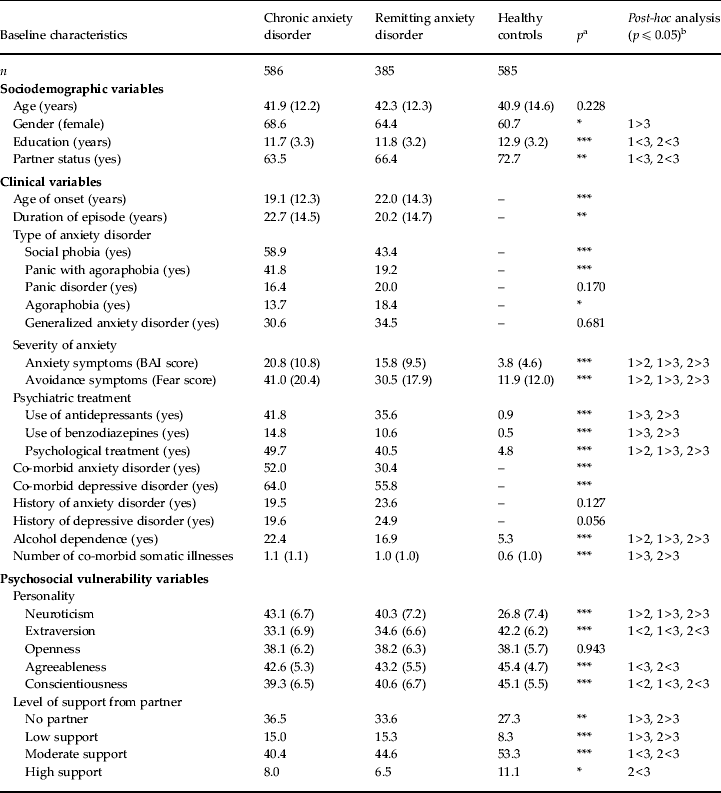
The sample consisted of 1556 participants divided into three groups: chronic anxiety disorder (n = 586), remitting anxiety disorder (n = 385) and healthy controls (n = 585). Their baseline characteristics are presented in Table 1. The sample had a mean age of 41.6 years (s.d. = 13.2) and the majority were women (64.6%). On average, participants were fairly well educated, with an average 12.2 years of education (s.d. = 3.3); 68.8% had a partner. Compared to participants with chronic anxiety disorder, those with remitting anxiety disorder reported later onset of anxiety disorders and were less severely ill, as illustrated by a lower severity score, less co-morbid anxiety and depressive disorders and less alcohol dependence (see Table 1).
Baseline characteristics of participants with chronic or remitting anxiety disorders and healthy controls

BAI, Beck Anxiety Inventory.
Values given as mean (standard deviation) or percentage.
a Overall group differences, based on ANOVA for continuous variables and χ 2 statistics for categorical variables.
b Groups in post-hoc analysis noted as: 1 = chronic anxiety disorder; 2 = remitted anxiety disorder; 3 = healthy controls.
* p ⩽ 0.05, ** p ⩽ 0.01, *** p ⩽ 0.001.
Two-year course trajectories of total functioning
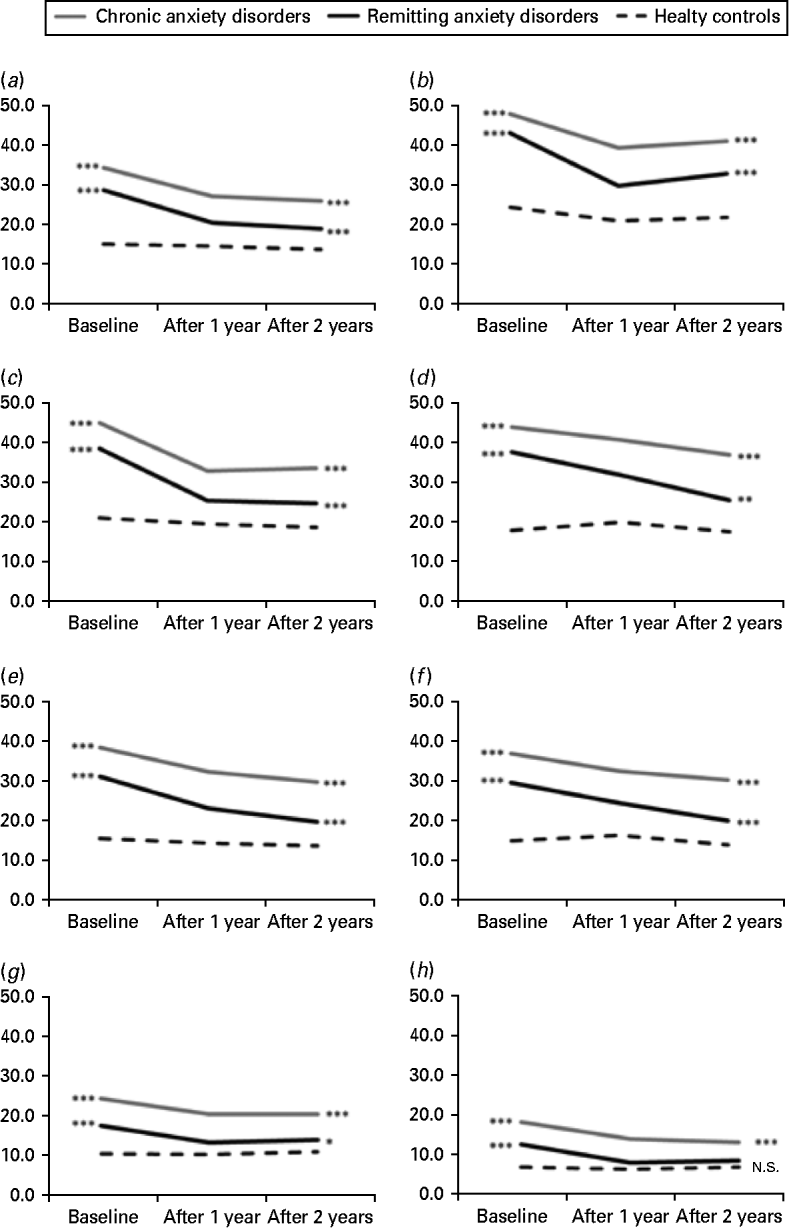
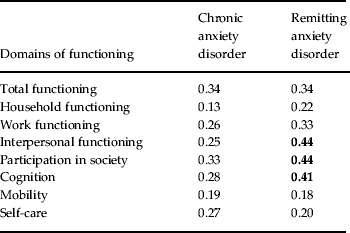
Course trajectories of total functioning, adjusted for the presence of current depressive disorder at T0 and for alcohol dependence, are presented in Fig. 1 a. At baseline, worse total functioning was reported by participants with chronic anxiety disorder [β (s.e.) = 18.8 (1.1), p ⩽ 0.001], followed by those with remitting anxiety disorder [β (s.e.) = 13.3 (1.2), p ⩽ 0.001] and by healthy controls (reference group). During the 2-year follow-up (T0T2), a significant interaction with time was found for both anxiety disorder groups, indicating that participants with chronic and remitting anxiety disorders experienced improved functioning over the follow-up period, compared to healthy controls [chronic anxiety disorder × T0T2: β (s.e.) = –6.9 (0.9), p ⩽ 0.001; remitting anxiety disorder × T0T2: β (s.e.) = –8.4 (1.0), p ⩽ 0.001; reference group: healthy controls]. The magnitude of the changes in total functioning from baseline to the 2-year follow-up in each of the two anxiety disorder groups, compared to controls, is presented in Table 2. Improvements were small to moderate in both anxiety disorder groups (d = 0.34). Considering the yearly trajectories, interaction with time was significant for the first year of follow-up (T0T1) but not for the second year (T1T2), indicating that most improvement occurred during the first year of follow-up (data not shown). Despite these improvements, however, both chronic and remitting anxiety disorder groups reported significantly worse functioning at the end of follow-up, compared to the control group (p ⩽ 0.001). Thus, those with remitted anxiety disorders remained significantly impaired at the end of the follow-up period, compared to healthy controls.
Two-year trajectories of total and domain-specific functioning in participants with chronic anxiety disorder, remitting anxiety disorders and in healthy controls (adjusted for current depression at baseline and lifetime alcohol dependence). (a) Total functioning. (b) Household functioning. (c) Work functioning. (d) Interpersonal functioning. (e) Participation in society. (f) Cognition. (g) Mobility. (h) Self-care. All group × time interactions are significant at p ⩽ 0.05. Asterisks mark significant differences from healthy controls at baseline and at the 2-year follow-up: * p ⩽ 0.05, ** p ⩽ 0.01, *** p ⩽ 0.001; n.s. p > 0.05.

Effect sizes (Cohen's d) comparing changes in functioning in chronic anxiety disorders and in remitting anxiety disorders compared to controls

Bold values indicate the domains of functioning for which moderate improvements were found.
The comparative analysis of participants in the remitting and chronic anxiety disorder groups showed that differences in functioning scores between the two groups increased over time [at T0: β (s.e.) = –5.5 (1.1), p ⩽ 0.001; at T1: β (s.e.) = –6.5 (1.1), p ⩽ 0.001; at T2: β (s.e.) = –6.9 (1.1), p ⩽ 0.001; reference group: chronic anxiety disorders]. However, the chronic versus remitting anxiety group × time interaction terms did not reach statistical significance [T0T1: β (s.e.) = –1.0 (1.1), p = 0.38; T1T2: β (s.e.) = –0.5 (1.1), p = 0.66; T0T2: β (s.e.) = –1.5 (1.1), p = 0.17]. This indicates that the improvements in functioning over time were similar in the two groups.
At baseline, co-morbid somatic illnesses and history of depressive disorder were significantly more prevalent in participants with remitting anxiety disorders compared to healthy controls, suggesting a possible confounding effect (Table 1). Adjusting for co-morbid somatic illness (additional to co-morbid depressive disorder and alcohol dependence) slightly reduced the differences in functioning between participants with remitting anxiety disorders and healthy controls [at T0: β (s.e.) = 12.8 (1.1), p ⩽ 0.001; at T1: β (s.e.) = 5.3 (1.2), p ⩽ 0.001; at T2: β (s.e.) = 4.5 (1.2), p ⩽ 0.001; reference group: healthy controls]. However, adjusting for history of depressive disorder (additional to co-morbid depressive disorder and alcohol dependence) resulted in a non-significant difference between the two groups [at T0: β (s.e.) = 10.6 (1.4), p ⩽ 0.001; at T1: β (s.e.) = 3.1 (1.4), p ⩽ 0.05; at T2: β (s.e.) = 2.2 (1.4), p = 0.11; reference group: healthy controls]. These results confirmed the confounding effects of co-morbid somatic illnesses and history of depressive disorder, of which only the latter seemed to fully explain the differences in 2-year trajectories of functioning between participants with remitting anxiety disorders and healthy controls.
Two-year course trajectories across domains of functioning
Trajectories of domain-specific functioning are presented in Fig. 1 (b–h). At baseline, participants with chronic and remitting anxiety disorders were significantly impaired across all domains of functioning compared to controls. Most impairment was found in household and work functioning, followed by interpersonal functioning, participation in society, cognition, mobility and self-care. This gradient across domains was found in both anxiety disorder groups, with participants with chronic anxiety disorders being significantly more impaired than those with remitting anxiety disorders (all p ⩽ 0.01). During the 2-year follow-up, functioning scores dropped significantly across all domains. The domain-specific improvements in the chronic anxiety disorder group were small (all d ⩽ 0.34). In the remitting anxiety disorder group, moderate improvements were found in three domains: interpersonal functioning (d = 0.44), participation in society (d = 0.44) and cognition (d = 0.41). The effect sizes for the remainder of the domains were small (d ⩽ 0.34). At the end of follow-up, significant impairments in functioning persisted in both anxiety disorder groups compared to controls. The only exception was self-care, where participants in the remitting anxiety disorder group had reached levels of functioning comparable to those of the healthy controls (p = 0.158).
Predictors of functioning in participants with remitting anxiety disorders
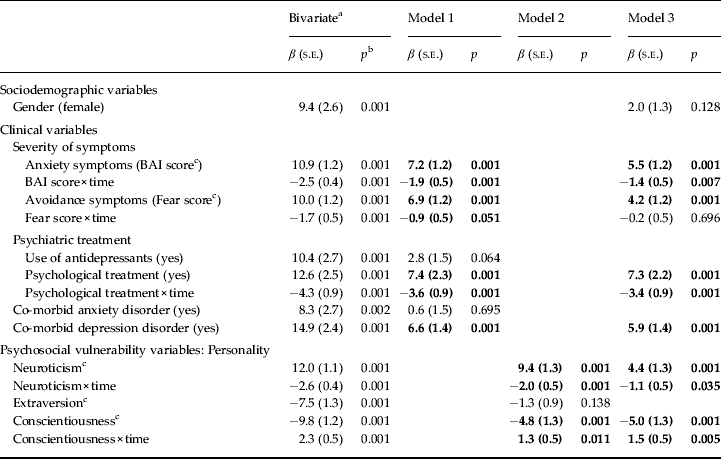
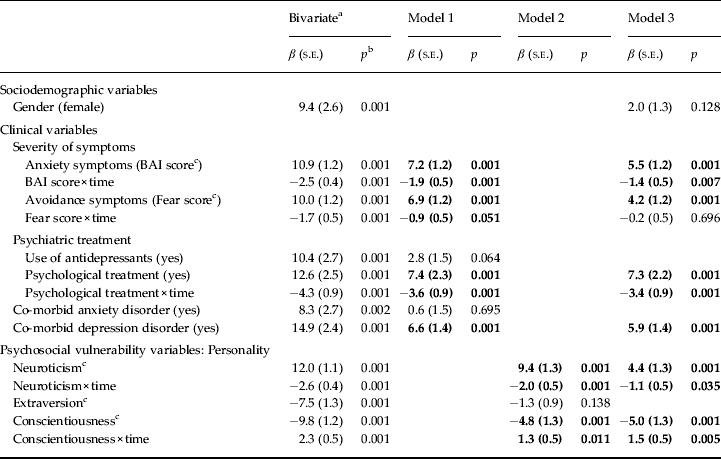
Participants who achieved symptom remission at the end of the follow-up period reported mean functioning scores of 19.0 (s.d. = 15.5, range 0–75.5) (Fig. 1 a). This large range indicates that, although all participants in this group had achieved symptom remission, considerable heterogeneity in functioning persisted, with some participants functioning within normal ranges and others remaining significantly impaired. Indeed, at the 2-year follow-up, 45.8% of participants who remitted reported scores similar to the average scores of healthy controls (i.e. ⩽ 14), and 28.5% reported scores similar to the average scores of participants with chronic anxiety disorders (i.e. ⩾ 26.2). To identify the putative predictors of functioning in participants who achieved symptom remission, we further inspected a large number of sociodemographic, clinical and vulnerability variables. Significant predictors are presented in Table 3, along with the significant interactions with time.
Bivariate and multivariate predictors of functioning at 2-year follow-up in participants with remitting anxiety disorders
BAI, Beck Anxiety Inventory; s.e., standard error.
Model 1: clinical variables; model 2: psychosocial vulnerability variables; model 3: final model.
Bold values in models 1–3 indicate values of p ⩽ 0.05.
a For the bivariate analysis, the following variables were tested but are not shown because of the p values: age, education, partner status, age of onset, duration of episode, type of anxiety disorder, use of benzodiazepines, history of anxiety disorders, history of depressive disorders, alcohol dependence, number of co-morbid somatic illnesses, openness, agreeableness, and level of support from partner.
b Bonferroni-corrected p value.
c Score per standard deviation (s.d.) increase.
Bivariate analyses demonstrated that worse functioning at T2 was significantly associated with female gender, higher baseline severity of anxiety or avoidance symptoms, receiving antidepressant or psychological treatment, the presence of co-morbid anxiety or depressive disorders, higher neuroticism, lower extraversion and lower conscientiousness.
Among the sociodemographic variables, only female gender was predictive of worse functioning. To identify the independent predictors of functioning among the clinical and vulnerability variables, we constructed two separate multivariate models. Among the clinical variables (model 1), worse functioning was significantly associated with more severe anxiety and avoidance symptoms, receiving psychological treatment and the presence of baseline co-morbid depressive disorders. Among the personality factors (model 2), significant predictors were higher neuroticism and lower conscientiousness.
The significant sociodemographic, clinical and vulnerability predictors obtained from the analysis were assessed together in the final model (model 3). Six of the variables remained significant predictors of low functioning: more severe anxiety and avoidance symptoms, receiving psychological treatment, presence of co-morbid depressive disorders, higher neuroticism and lower conscientiousness. We found a significant negative interaction with time for severity of anxiety symptoms, use of psychological treatment and neuroticism, and a significant positive interaction with time for conscientiousness, suggesting that improvements in functioning were larger for those with higher severity of symptoms, receiving psychological treatment, higher neuroticism and lower conscientiousness.
Discussion
Given the importance of functional limitations in anxiety disorders, this research was conducted to investigate the relationship between symptom remission and level of functioning in anxiety disorders. Our results indicate that symptom remission is accompanied by improvements in functioning, but that significant functional impairments may persist. Participants who achieved remission during the 2-year follow-up reported significantly better functioning at the end of this period, compared to those who did not remit. However, improvements were small, and functioning remained significantly impaired compared to healthy controls.
In the remitting anxiety disorder group, the persistence of significant post-morbid functional limitations (after controlling for co-morbid depressive disorders and alcohol dependence) can be explained through three different scenarios. One scenario that we investigated in our analysis regarded the potential influence of co-morbid somatic illness and past depressive disorder, both associated with considerable debilitating effects (Wells et al. Reference Wells, Stewart, Hays, Burnam, Rogers, Daniels, Berry, Greenfield and Ware1989; Alonso et al. Reference Alonso, Ferrer, Gandek, Ware, Aaronson, Mosconi, Rasmussen, Bullinger, Fukuhara, Kaasa and Leplege2004b ). The two subsequent adjusted analyses that we conducted confirmed the confounding effects of co-morbid somatic illnesses and a history of depressive disorder. However, only the latter seemed to fully explain the differences in 2-year trajectories of functioning between participants with remitting anxiety disorders and healthy controls. This suggests that the influence of past depressive disorders on the levels of functioning extends beyond the clinical remission of depressive symptoms, and can play an important role in the functioning of people with remitting anxiety disorders.
As a second scenario, it is possible that the persistence of post-morbid functional limitations in the remitting anxiety group could be explained by the fact that participants with remitted anxiety disorders had worse functioning than controls even before the onset of anxiety disorders. This hypothesis is supported by the fact that onset or recurrence of anxiety disorders is best predicted by impaired functioning (Rodriguez et al. Reference Rodriguez, Bruce, Pagano and Keller2005), a finding that was also replicated in this data set (Scholten et al. Reference Scholten, Batelaan, van Balkom, Penninx, Smit and van Oppen2013). In the same vein, research on depression has found that prior to the onset of depressive disorders, functioning is already impaired (Ormel et al. Reference Ormel, Oldehinkel, Nolen and Vollebergh2004), and that although post-morbid levels of functioning were similar to pre-morbid levels of functioning, they differed from those of non-depressed persons (Buist-Bouwman et al. Reference Buist-Bouwman, Ormel, de Graaf and Vollebergh2004), suggesting that the functional limitations we found in remitted participants may be part of a pre-existing vulnerability. Finally, it is possible that those who achieved symptom remission may still suffer from subthreshold symptoms. Subthreshold symptoms may be persistent (Batelaan et al. Reference Batelaan, de Graaf, Penninx, van Balkom, Vollebergh and Beekman2010a ,Reference Batelaan, de Graaf, Spijker, Smit, van Balkom, Vollebergh and Beekman b ) and may cause functional limitations (Rucci et al. Reference Rucci, Gherardi, Tansella, Piccinelli, Berardi, Bisoffi, Corsino and Pini2003; Batelaan et al. Reference Batelaan, de Graaf, van Balkom, Vollebergh and Beekman2007a ; Skapinakis et al. Reference Skapinakis, Lewis, Davies, Brugha, Prince and Singleton2011).
At baseline, both anxiety disorder groups were significantly impaired compared to healthy controls across all domains of functioning, with most impairments experienced in household and work functioning, interpersonal functioning, participation in society and cognition. In participants who remitted during the follow-up, moderate improvements were found in interpersonal functioning, participation in society and cognition, but not in household and work functioning. This suggests that people with anxiety disorders who achieve symptom remission might also experience some improvements in social functioning and cognition, but not in occupational functioning. Nevertheless, none of the domain-specific functioning returned to normal levels, except for self-care, where impairments had been minimal from the beginning.
Remarkably, functioning improved not only in participants who reached symptom remission during the 2-year follow-up but also in those who did not (i.e. the chronic anxiety disorder group), although improvements in this group were small to moderate. At baseline, 68.9% of participants in the chronic anxiety disorder group received psychiatric treatment (antidepressants, benzodiazepines or psychological treatment; data not shown). Therefore, improvements during the 2-year follow-up were to be expected, at least in a subsample of this group. Indeed, at the end of the follow-up, BAI and Fear scores had dropped significantly in this group [mean BAI scores fell from 20.5 (s.d. = 10.7) at T0 to 15.7 (s.d. = 10.0) at T2, p ⩽ 0.001; mean Fear scores fell from 40.8 (s.d. = 20.0) at T0 to 35.2 (s.d. = 20.4) at T2, p ⩽ 0.001], suggesting that anxiety symptoms had significantly alleviated during the follow-up, although not enough to render the diagnosis of anxiety disorders unnecessary.
A second aim of the study was to assess the influence of baseline sociodemographic, clinical and vulnerability characteristics on post-morbid functioning. The sociodemographic characteristics seemed to have no predictive value for the functional impairments reported at the end of the follow-up period. Among clinical predictors, co-morbid depressive disorders, more severe anxiety and avoidance symptoms, and receiving psychological treatment predicted higher functional impairments after symptom remission. Among these, receiving psychological treatment was the strongest predictor of poor functioning after symptom remission. Although counterintuitive, this result is common in naturalistic studies, where treatment is not assigned randomly, but is more frequent in participants who are more severely ill (Beard et al. Reference Beard, Moitra, Weisberg and Keller2010a ). Co-morbidity and maladaptive personality traits, known predictors for functioning in mental disorders (Wiebe & Christensen, Reference Wiebe and Christensen1996; Konrad et al. Reference Konrad, Stanisława and Joanna2010; Verboom et al. Reference Verboom, Sentse, Sijtsema, Nolen, Ormel and Penninx2011), were also predictive of functioning after symptom remission, suggesting that their influence extends beyond the morbid period.
Our study addressed important gaps in the literature. We extended previous research of Scheibe & Albus (Reference Scheibe and Albus1997) and Stout et al. (Reference Stout, Dolan, Dyck, Eisen and Keller2001) by providing insights into several types of anxiety disorders and by including a healthy control group. Although Bijl & Ravelli (Reference Bijl and Ravelli2000) chose a similar approach, their research was community based, rendering their results generalizable only to the general population. The availability of data on participants from the community, and also from primary and secondary care, therefore represents a strong point in our study. Additional strengths include the large sample size, the structured diagnostic procedures, the longitudinal design and the exploration of a large number of potential predictors.
We acknowledge several limitations. The most important limitations reside in the lack of insights regarding the reasons for the persistence of differences in functioning between the remitting anxiety disorders group and healthy controls. The first scenario we discussed here suggested that past depressive disorders, and not somatic illness, play a role in the persistence of functional impairments between the two groups. Although we controlled for this potential confounding effect of somatic illness on functioning, it would have been useful to assess separately the influence of anxiety disorders and that of somatic illness on functioning, for example by including separate WHO DAS assessments for somatic illness and for mental disorders, or by adding to the interview a disorder-specific role impairment measure, such as the Sheehan Disability Scale. However, this was not possible because the information was not available in the NESDA dataset. Similarly, lack of adequate data prevented us from further investigating the second scenario, namely whether or not the persistence of differences in functioning between remitting anxiety disorders group and healthy controls reflected lower functioning in the former group, before the onset of the anxiety disorders. Additional limitations relate to the retrospective, self-reported assessment of functioning, with no triangulation of the data (for example from family members or friends). It is therefore possible that functioning scores of participants with anxiety disorders were increased erroneously by information-processing biases, such as negative interpretations of social events (Stopa & Clark, Reference Stopa and Clark2000; Wilson & Rapee, Reference Wilson and Rapee2005a ,Reference Wilson and Rapee b ), or (the still disputed) negative memory bias for one's own performances compared to others (Cody & Teachman, Reference Cody and Teachman2010). Furthermore, the design of the NESDA did not include all types of anxiety disorders. Therefore, our results cannot be generalized to other anxiety disorders, such as obsessive compulsive disorders or post-traumatic stress disorders. Likewise, as not all mental disorders have been assessed in NESDA, we could not control for these disorders.
In sum, we illustrate that anxiety disorders are associated with significant limitations in functioning. Although functioning improves after symptom remission, significant functional limitations persist within a 2-year follow-up period, probably because of co-morbid disorders, lower functioning prior to the onset of the anxiety disorder or residual subthreshold anxiety symptoms. Mental health care providers should be aware that, in people with remitting anxiety disorders, severe anxiety disorders, co-morbid depressive disorders and maladaptive personality traits predict worse functioning. Future research could focus on elucidating the mechanisms underlying the persistence of significant post-morbid functional limitations in participants with remitting anxiety disorders, and on developing interventions that can facilitate better outcomes in this group.
Acknowledgements
This study was supported by funds provided by Athena Institute at VU University Amsterdam (www.athenainstituut.nl). The infrastructure for the NESDA (www.nesda.nl) is funded through the Geestkracht programme of the Netherlands Organization for Health Research and Development (Zon-Mw, grant no. 10-000-1002) and is supported by participating universities and mental health care organizations (VU University Medical Centre, GGZ inGeest, Arkin, Leiden University Medical Centre, GGZ Rivierduinen, University Medical Centre Groningen, Lentis, GGZ Friesland, GGZ Drenthe, Scientific Institute for Quality of Healthcare (IQ healthcare), Netherlands Institute for Health Services Research (NIVEL) and Netherlands Institute of Mental Health and Addiction (Trimbos Institute).
Declaration of Interest
None.