Introduction
Autonomous vehicles (AVs) are a new type of motor vehicle that use internal sensing and computing equipment (instead of a human driver) to operate all functions as the vehicle moves on public roadways. AVs can take the form of passenger cars, trucks, buses, or other modes of ground transportation.Reference Glancy, Peterson and Graham 1 A range of terms have been used for AVs, including “driverless vehicles,” “self-driving cars,” and “automated vehicles,” among others. While there is currently no universally accepted approach to naming AVs,Reference Shladover 2 the United States has adopted a classification system created by the Society of Automotive Engineers (SAE) which defines different levels of vehicle automation. 3 The scale ranges from 0 (no automation) to 5 (full automation). Vehicles operating at Level 1, 2, or 3 may include limited forms of automation such as automatic emergency braking or adaptive cruise control. Vehicles operating at SAE Level 4 or 5 represent the highest levels of automation and can perform all the driving tasks without a human operator.
In 2020, motor vehicle crashes were responsible for an estimated 38,680 deaths and close to 3 million injuries in the United States. 4 Crashes persist as a leading cause of death throughout the life span, with young people disproportionately affected. 5 Human errors, caused by impairment, fatigue, and distraction, are present in over 90% of crashes.Reference Dingus, Guo, Lee, Antin, Perez, Buchanan-King and Hankey 6 Therefore, the possibility that vehicles could drive without human involvement suggests that AVs have the potential to save thousands of lives. In spite of this, recent public opinion surveys indicate a growing majority of Americans are reluctant to use AVs.Reference Hassol, Perlman, Chajka-Cadin and Shaw 7 While current data, based on the relatively low numbers of AVs being tested, suggest that AVs have fewer and less severe crashes than human drivers,Reference Blanco, Atwood, Russell, Trimble, McClafferty and Perez 8 many millions and perhaps hundreds of billions of miles of driving experience will be needed to definitively demonstrate their reliability in terms of fatalities and injuries from crashes.Reference Kalra and Paddock 9 Experience with conventional human-driven motor vehicles has shown that the public confidence benefits from effective safety regulation.Reference Venkatraman, Richard, Magee and Johnson 10 Given the significance of safety in building trust in new technologies, an understanding of existing safety legislation for AVs could identify the current best practices as well as potential gaps in regulation.
Automobile insurance is another important consideration in the deployment of AVs, as it plays a complementary role to safety regulation in increasing consumer confidence in new technologies.Reference Anderson, Kalra, Stanley and Morikawa 11 In the US, automobile insurance is governed by states, with each state establishing specific coverage requirements and some states regulating rates.Reference Bajtelsmit and Bouzouita 12 While the impact of AVs on insurance is still unclear, some experts believe changes may be needed to the US auto insurance system as vehicles incorporate higher levels of automation. These changes may depend on the ownership model for these vehicles (i.e., AVs owned and operated as a fleet compared to AVs that are owned and operated by individuals).Reference Stanley, Grisé and Anderson 13 Understanding current requirements for AV insurance and the amount of coverage currently required by states may help guide efforts to reform the insurance system to accommodate AVs.
Since the prevalence of AVs is still extremely low relative to other motor vehicles, little evaluation has been conducted on the range of AV laws that have been enacted. Further, most research on AV laws has focused on issues of liability and privacy, overlooking laws related to safety or equity. Developing a solid evidence base for AV laws is critical to motivate policy development and converge legislation around proven strategies and best practices. The purpose of this paper was to identify and analyze the range of state laws governing the safety and equity of AVs to facilitate the identification of evaluation opportunities.
In addition to addressing the safety and liability issues of AVs, policy can also be used to address disparities in transportation equity and access. Transportation is a social determinant of health because it facilitates access to education, employment, fresh food, health care, social services, and recreation.Reference Bell, Cohen and Malekafzali 14 Transportation also forms an essential component of a functioning society because it impacts how individuals spend their time, where families decide to live, and places for communities to gather. The impact of transportation as a place-based source of health disparities among minorities and vulnerable groups has been extensively documented.Reference Allen 15 Strategic deployment of AVs could extend and enhance mobility, especially among populations that have been under-served by the existing transportation system.Reference Fleetwood 16 For example, analysts estimate AVs could facilitate new employment opportunities for approximately two million individuals with disabilities, and save $19 billion annually in health care expenditures from missed medical appointments.Reference Claypool, Bin-Nun and Gerlach 17
Over the last decade, AV legislation has been considered by the majority of US states, 18 which has allowed over 1,400 driverless vehicles to be tested and deployed across the US.Reference Etherington 19 While this has enabled state-level testing and deployment of AVs, it has resulted in a patchwork of laws and regulations, which has constrained inter-state coordination. In 2019, the Uniform Law Commission proposed the Uniform Automated Operation of Vehicles Act. 20 While this act included a framework that could reconcile the deployment of AVs within existing motor vehicle registration codes, it did not address the issue of equitable access to transportation, nor did it propose a harmonized approach to AV insurance. Federal policymakers have also attempted to pass legislation related to AV testing and deployment such as the AV Start Act. However, no federal legislation has yet been enacted at the time of this writing.Reference Miller 21
Since the prevalence of AVs is still extremely low relative to other motor vehicles, little evaluation has been conducted on the range of AV laws that have been enacted. Further, most research on AV laws has focused on issues of liability and privacy, overlooking laws related to safety or equity.Reference Stanley, Partridge, Douma, Meyer and Beiker 22 Developing a solid evidence base for AV laws is critical to motivate policy development and converge legislation around proven strategies and best practices. The purpose of this paper was to identify and analyze the range of state laws governing the safety and equity of AVs to facilitate the identification of evaluation opportunities.
Methods
We sought to identify US states with AV laws and abstract elements of those laws. The full text of state AV legislation and regulations were identified using standard legal research databases, including Westlaw and LexisNexis. A text search of these databases was conducted using the terms “autonomous vehicles,” “self-driving,” and “automated driving system” — as well as variations of these terms — for all 50 states and the District of Columbia. In addition, state-specific general internet searches were conducted for gubernatorial executive orders related to AVs, as the Westlaw and LexisNexis databases do not routinely index executive orders. As a reliability check, we compared our findings with existing compilations of a subset of AV laws, regulations, and executive orders by the National Conference of State Legislatures 23 and the Insurance Institute for Highway Safety. 24 The searches were conducted between October 2019 and February 2021. Discrepancies were resolved by reference to the text of the laws and via discussion among the authors.
We limited the scope of this review to laws related to AV testing and deployment. Legislation, regulation, or executive orders related to the use of autonomous commercial semi-trucks or laws that were not directly applicable to AV use by the public (e.g., pilot testing projects for autonomous delivery vehicles) were also excluded. Each law was abstracted by at least two members of the study team. Once the abstraction was complete, a comprehensive table of the laws was developed. We then used the table to identify essential elements of such laws — lacking in many states — that relate to safety, equity, and insurance in the deployment of AVs. Detailed explanations were provided in cases where states with relevant laws differed from the other states in nuanced ways.
Results
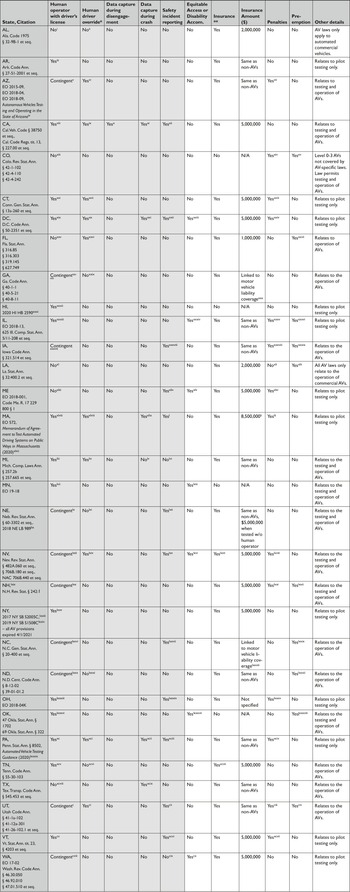
As of February 2021, 30 states and the District of Columbia had relevant legislation, executive order(s), or regulation(s) related to AV testing or deployment (see Table 1). Links to the laws themselves have been posted to the website of the Johns Hopkins Center for Law and the Public’s Health: https://www.jhsph.edu/research/centers-and-institutes/center-for-law-and-the-publics-health/resources/autonomous-vehicles.html. Additional detail regarding the laws is provided in the footnotes to the table.
State Autonomous Vehicle Legislation as of February 2021

* Whether a human operator must be capable of taking control of the AV in the event of an ADS failure.
** Whether the AV is required to be covered by some form of liability insurance.
Table References
i Alabama law states that the AV is licensed to operate itself and that the owner is the designated operator of the vehicle. It does not specify that the owner must have a valid driver’s license.
ii Alabama requires automated commercial vehicles to achieve a minimal risk condition but does not require an alert system allowing the operator to take over.
iii Arkansas law does not specify whether a human operator with a license is required to operate an AV, so the assumption is that the default driver’s license requirements apply.
iv Arizona Department of Transportation, Autonomous Vehicles Testing and Operating in the State of Arizona, Arizona Department of Transportation W
v Arizona law allows testing of fully autonomous vehicles without a human operator present but requires a physical or remote human operator for testing of all other AVs.
vi Arizona law requires operators to be able to take control of the AV if required during pilot program testing.
vii Arizona law specifies that testing permits can be suspended or revoked for violations of state testing requirements. Arizona law also describes that AV operators can be penalized for violations of state motor vehicle or traffic laws.
viii California allows AVs which meet the SAE J3016 definition of a level 4 or 5 AV to be tested without a human operator physically present in the vehicle, but in these cases, a remote human operator with a valid driver’s license must monitor the AV. California requires operators of all other AVs to hold a valid driver’s license and be seated in the driver’s seat.
ix California law requires AVs to alert the human operator after a failure of the automated driving system. The AV must then either transfer control of the vehicle to the human operator or come to a complete stop.
x California requires AV testers to collect data regarding ADS disengagements and report this data annually.
xi California requires AVs to store and capture sensor data for a minimum of 30 seconds before and after a collision occurs. Data must be downloadable and must be preserved for up to 3 years after the collision date.
xii California requires AV testers to report crashes that result in injury or property damage within ten days.
xiii Colorado law exempts AVs from driver’s license requirements.
xiv Colorado law states that vehicles violating the AV approval process may be impounded or immobilized until they obtain proper approval.
xv Colorado law prohibits local governments from passing AV regulations that are different from those which apply to human drivers.
xvi Connecticut law requires a human operator with a driver’s license to be physically present in the AV during testing.
xvii Connecticut requires that AV operators must be able to take immediate control of the vehicle at any time.
xviii Connecticut’s secretary can terminate AV testing if it endangers public safety or fails to comply with the AV pilot program rules.
xix DC law requires a physical or remote human operator to oversee the AV during testing. DC does not specify whether the operator is required to hold a valid driver’s license, but DC law requires AV test operators to undergo training that meets minimum standards established by the DC Department of Transportation. DC specifies that an AV may be tested with a remote operator only if the AV has previously been tested with a physical human operator and has demonstrated that it can operate without a physical operator.
xx DC requires AVs to alert the test driver when the automated driving system fails or when the AV reaches an area outside its operational design domain. If the test driver is physically present in the vehicle, the AV must either achieve a minimal risk condition or transfer control of the vehicle to the test driver. If the test driver is not physically present, the AV must achieve a minimal risk condition.
xxi DC law requires AVs to record sensor data before a crash occurs.
xxii DC law requires AV testers to report any crash involving their AV within 12 hours of the crash. DC also requires a more detailed crash report to be submitted within five business days of the crash.
xxiii DC outlines non-enforceable ‘principles’ for equitable testing of AVs across the city’s four quadrants.
xxiv DC law provides a penalty of $1,000 per offense per day for AVs which violate the testing laws. DC law also allows the DC Department of Transportation to suspend or revoke a testing permit after a violation occurs.
xxv Florida considers the automated driving system to be the vehicle operator, so a licensed driver is not required to operate an AV.
xxvi Florida requires AVs that are not fully autonomous to alert the human operator after a failure of the automated driving system. Then, the AV must either transfer control to the human operator or achieve a minimal risk condition. Florida requires fully autonomous vehicles to be capable of achieving a minimal risk condition after a failure of the automated driving system.
xxvii Florida prohibits local governments from implementing taxes, fees, or additional requirements on autonomous vehicles.
xxviii Georgia exempts fully autonomous vehicles from driver’s license requirements when the automated driving system is engaged.
xxix Georgia only requires that the AV must be able to achieve a minimal risk condition.
xxx Georgia liability insurance linkage laid out in Code Section 40-1-166.
xxxi H. Aquino, T. Brower, T. Cullen, M. Hashem, T. Hashimoto, C. Lee, S. Matayoshi, J. Woodson, R. Yamane, and V. Okimoto, HB2590 (September 15, 2020), Hawaii State Legislature Website, available at <https://www.capitol.hawaii.gov/Archives/measure_indiv_Archives.aspx?billtype=HB&billnumber=2590&year=2020> (last visited August 4, 2022).
xxxii Hawaii law requires a human operator to be physically present while testing an AV.
xxxiii Illinois law requires a human operator with a driver’s license to be physically present in the AV.
xxxiv Illinois law mandates the Illinois Department of Transportation to explore the use of AVs to improve safety for “elderly, disabled, and underserved populations.”
xxxv Illinois law gives the Illinois Department of Transportation the ability to suspend an AV tester from the state testing program if the tester violates the program rules.
xxxvi Illinois local governments cannot prohibit the use of AVs but can regulate AVs for traffic control.
xxxvii Iowa does not require a human operator physically present in the vehicle or a valid driver’s license if the AV can achieve a minimal risk condition while completing the dynamic task.
xxxviii Iowa provides penalties for AV vehicle owners if their vehicle fails to remain on the scene of a crash and report the crash to authorities.
xxxix Iowa law prevents political subdivisions from passing any additional AV requirements or taxes.
xl Louisiana allows commercial AVs to operate without a human operator present in the vehicle.
xli Louisiana’s penalties for AVs that violate the law are the same as penalties for any other motor vehicle.
xlii Louisiana Department of Transportation and Development is the sole and exclusive agency with jurisdiction over autonomous vehicles.
xliii Maine allows AVs to operate without a human operator present in the vehicle.
xliv Maine requires AV testers to report a crash to the Maine Department of Transportation within five days if the crash causes damage to property, serious injury, or death.
xlv Maine law establishes an AV advisory committee which must include representation from the state Office of Aging and Disability Services.
xlvi Maine law specifies that a testing permit may be suspended or revoked if the AV being tested violates the testing rules or endangers public safety.
xlvii Massachusetts Department of Transportation, Memorandum of Agreement to Test Automated Driving Systems on Public Ways in Massachusetts (February 2020), Massachusetts Department of Transportation Website, available at <https://www.mass.gov/doc/memorandum-of-agreement-to-test-automated-driving-systems-on-public-ways-in-massachusetts/download> (last visited August 4, 2022).
xlviii Massachusetts law requires a human operator with a driver’s license to be physically present in the AV and able to take control of the vehicle if necessary.
xlix Massachusetts law requires AV test vehicles to be equipped with a device that records sensor data for the five seconds leading up to a crash.
l Massachusetts law requires people who test AVs to notify the Massachusetts Department of Transportation and submit a “Crash Report” to the Massachusetts Registry of Motor Vehicles after any crash involving an AV.
li Massachusetts law requires the following insurance for AVs that are being tested: $2,000,000 commercial general liability insurance, $1,000,000 automobile liability insurance, $500,000 employers liability insurance per crash, and $5,000,000 umbrella liability insurance. The sum of these insurance requirements is $8,500,000.
lii Massachusetts law gives the Massachusetts Department of Transportation the authority to suspend or revoke an AV testing permit for violating testing terms.
liii Michigan law requires a human operator with a driver’s license to be physically present in the AV during testing.
liv Michigan requires the AV operator to be able to take control of the vehicle at any time.
lv Michigan only requires data capture for AVs if operators are part of a voluntary AV pilot project named SAVE.
lvi Michigan only requires safety incident reporting if operators are part of a voluntary AV pilot project named SAVE.
lvii Minnesota law does not specify whether a human operator with a license is required to operate an AV, so the assumption is that the default driver’s license requirements apply.
lviii Minnesota law establishes an AV council which includes the Executive Director of the Minnesota Council on Disability. The AV council is mandated to work with people who have trouble accessing transportation options.
lix A. Wishart, LB989 (April 23, 2018), Nebraska Legislature Website, available at <https://nebraskalegislature.gov/bills/view_bill.php?DocumentID=34326> (last visited August 4, 2022).
lx Nebraska does not require a human operator physically present in the vehicle or a valid driver’s license if the AV can achieve a minimal risk condition while completing the dynamic task. Nebraska allows AVs to be tested without a human operator physically present in the vehicle, only if such AVs are insured for at least $5,000,000, remain in a testing area determined by the city where the testing occurs, and comply with NHTSA’s AV guidance specified in Automated Driving Systems 2.0: A Vision For Safety.
lxi Nebraska requires AVs to achieve a minimal risk condition.
lxii Nebraska requires AV testers to report crashes that result in injury or property damage within ten days. Nebraska also requires AV testers to report a summary of disengagement events annually.
lxiii Nevada allows AVs to be operated without a human physically present in the vehicle if the automated driving system is fully engaged and capable of achieving a minimal risk condition.
lxiv Nevada law specifies that if a human operator is required to be physically present in the AV, the operator must be able to take immediate control of the vehicle at any time.
lxv Nevada requires operators to report crashes that result in personal injury or property damage greater than $750.
lxvi Nevada mandates that passengers using an AV network must have the ability to indicate whether they require a wheelchair-accessible vehicle. If the company does not have a wheelchair-accessible vehicle available, they must direct the passenger to an alternative wheelchair-accessible transportation provider. Nevada also provides a discounted annual regulatory assessment fee for AV companies that pledge only to serve elderly people and people with disabilities.
lxvii Nevada only requires insurance for AV testing.
lxviii Nevada may penalize an AV network company by suspending or revoking the company’s AV operation permit and fining the company up to $100,000 per incident.
lxix Additional relevant AV legislation takes effect in New Hampshire as of July 1, 2021.
lxx New Hampshire law allows testing of AVs without a human driver present if the vehicle can achieve a minimal risk condition and comply with New Hampshire traffic laws. Otherwise, the AV must be operated by a test driver with a driver’s license.
lxxi New Hampshire law allows testing permits to be suspended or revoked if the testing application contains inaccurate information or if the AV violates testing rules or endangers public safety. If an AV does not remain on the scene of a crash or does not report the crash to law enforcement, New Hampshire may charge the AV owner with a violation, unless the violation is caused by an error in the AV’s automated driving system, in which case the AV manufacturer may be charged with a violation.
lxxii New Hampshire’s AV statute asserts exclusive authority over AV requirements and prohibits other state agencies or local jurisdictions from passing any additional AV requirements or taxes.
lxxiii The New York State Senate, Senate Bill S2005C (April 20, 2017), The New York State Senate Website, available at <https://www.nysenate.gov/legislation/bills/2017/s2005/amendment/c> (last visited August 4, 2022).
lxxiv The New York State Senate, Senate Bill S1508C (April 12, 2019), The New York State Senate Website, available at <https://www.nysenate.gov/legislation/bills/2019/S1508> (last visited August 4, 2022).
lxxv New York law requires a human operator with a driver’s license physically present in the AV during testing.
lxxvi North Carolina does not require a human operator or a valid driver’s license for fully autonomous vehicles that can achieve a minimal risk condition.
lxxvii North Carolina law requires AVs or their operator to report crashes to law enforcement but suggests nonreportable crashes are not subject to this requirement.
lxxviii North Carolina liability insurance linkage laid out in General Statutes Section 20-279.21.
lxxix North Carolina pre-empts local governments from passing laws or ordinances which regulate AVs.
lxxx North Dakota does not require a human operator physically present in the vehicle or a valid driver’s license if the AV can achieve a minimal risk condition while completing the dynamic task.
lxxxi North Dakota only requires AVs to achieve a minimal risk condition.
lxxxii North Dakota prohibits state agencies or local jurisdictions from passing additional AV requirements or taxes.
lxxxiii Ohio law requires a human operator to monitor any AV tested in Ohio. The human operator does not need to be physically present in the vehicle, but they must hold a driver’s license and be able to take control of the vehicle if necessary.
lxxxiv Ohio law requires the AV testing organization to share any crash data recorded by the AV with law enforcement, and requires the AV test driver to report any crashes to DriveOhio (part of the Ohio Department of Transportation).
lxxxv Ohio law allows the governor to suspend AV testing if the AV endangers public safety.
lxxxvi Oklahoma law does not specify whether a human operator with a license is required to operate an AV, so the assumption is that the default driver’s license requirements apply.
lxxxvii Oklahoma’s AV pilot plan mandates collaboration with the Departments of Veterans Affairs, Rehabilitation Services, and Mental Health and the Association of Centers for Independent Living.
lxxxviii Oklahoma pre-empts any local government from passing AV restrictions or regulations and supersedes any existing restrictions or regulations regarding the operation or testing of AVs.
lxxxix Pennsylvania Department of Transportation, Automated Vehicle Testing Guidance (September 2020), Pennsylvania Department of Transportation Website, available at <https://www.penndot.gov/ProjectAndPrograms/ResearchandTesting/Autonomous%20_Vehicles/Documents/PUB_950_9-20.pdf> (last visited August 4, 2022).
xc Pennsylvania law requires a human operator with a driver’s license to be physically present in the AV during testing.
xci Pennsylvania law requires AV test vehicles to be capable of notifying the human operator when the operator must regain manual control of the vehicle.
xcii Pennsylvania law requires AV test vehicles to record data immediately before a crash occurs.
xciii Pennsylvania law requires AV testers to file an initial crash report within two hours of being informed of the crash and also requires AV testers to submit any data recorded by the AV during a crash.
xciv Pennsylvania law gives the Pennsylvania Department of Transportation the authority to suspend or revoke a testing permit if the application for the testing permit contains inaccurate information or if the AV endangers public safety.
xcv Tennessee law does not specify whether a human operator with a license is required to operate an AV, so the assumption is that the default driver’s license requirements apply.
xcvi Tennessee only requires that the AV must be able to achieve a minimal risk condition.
xcvii Tennessee requires insurance to cover up to $5,000,000 and comply with Tenn. Code 56-7-1201.
xcviii Texas does not require a valid driver’s license if the automated driving system is engaged.
xcix Texas law requires AVs to be equipped with a device that records vehicle details such as speed and brake usage during a crash.
c Utah law specifies that a remote or physical human operator with a driver’s license must be available to take control of a level 3 AV. Utah law also describes that level 4 or 5 AVs that can reach a minimal risk condition do not require a human operator.
ci Utah law requires level 3 AVs to achieve a minimal risk condition or ask the human operator to intervene in cases when the automated driving system fails.
cii Utah requires AVs to comply with crash reporting measures specified in Section 41-6a-401 and may require additional information in the crash report, such as whether the automated driving system was enabled.
ciii Utah may revoke an AV’s registration and permission for the AV to operate on roadways if the AV is operating unsafely.
civ Utah law prohibits other state agencies or local jurisdictions from passing any additional AV requirements or taxes.
cv Vermont law does not specify whether a human operator with a license is required to operate an AV, so the assumption is that the default driver’s license requirements apply.
cvi Vermont requires AV testers to report any crash involving their AV that causes injury or property damage.
cvii Vermont law specifies that operating an AV in violation of testing guidelines will result in a traffic violation that cannot exceed $1000.
cviii Washington law specifies that AVs which can reach a safe condition after an automated driving system failure may be operated without a human driver, but all other AVs are required to be monitored or operated by a person with a valid driver’s license.
cix Washington has a new AV law effective October 1, 2021 that includes provisions related to safety incident reporting.
cx Washington describes that a working group, including representatives from the state Aging and Long-Term Support Administration, will explore the impact of AVs on social services.
Relevant administrative regulations were identified in Arizona, California, Maine, Massachusetts, Nevada, and Pennsylvania. Executive orders related to AVs were identified in Arizona, Illinois, Maine, Massachusetts, Minnesota, Ohio, and Washington state.
Relevant variables for each law, executive order, or regulation were identified and abstracted, each of which fell into one of the following categories: 1) safety requirements; 2) equity and accessibility; 3) insurance and liability; 4) penalties for non-compliance; and 5) pre-emption of local laws.
Some state requirements vary according to the level of automation in the vehicle. For example, Nebraska does not require a human operator physically present in the AV if the vehicle’s automated driving system (ADS) can achieve a minimal risk condition while driving. In their widely used J3016 standards for AVs, SAE defines a minimal risk condition as “a stable, stopped condition to which a user or an ADS may bring a vehicle … to reduce the risk of a crash when a given trip cannot or should not be continued.” 25
1. Safety Requirements
Five elements were abstracted related to AV safety, including requirements for: (1) a human operator of the AV with a driver’s license; (2) a human driver to be able to override the AV system; (3) data capture during disengagement of the autonomous functioning of the vehicle; (4) data capture during a crash; and (5) safety incident reporting. Columns corresponding to these five elements are shaded grey in Table 1.
No jurisdiction had legislation that addressed all five safety-related elements. In the District of Columbia, Massachusetts, Michigan, and Pennsylvania, AV legislation covered four elements (requirements for a human operator, human driver override, data capture during a crash, and safety incident reporting). Three states (CA, NV, and UT) covered three elements, but these differed among each state. Another twelve states (AL, AZ, CT, FL, GA, IA, ME, NE, NC, ND, OH, and TX) addressed two elements. Nine states (CO, HI, IL, LA, NH, NY, TN, VT, and WA) addressed only a single safety requirement; for seven of these nine states, this was the human operator with a driver’s license requirement. Three states (AR, MN, and OK) did not address any safety-related elements.
Human Operator with a Driver’s License: Six states require that AVs must have a human operator and that this individual must have a driver’s license and be physically present in the vehicle during its operation (CT, IL, MA, MI, NY, and PA). Two states require a human operator with a driver’s license but do not require the operator to be physically present in the vehicle in all cases (CA and OH). Two jurisdictions require a physical human operator but do not specify whether this operator must hold a valid driver’s license (DC and HI). Laws in ten states (AZ, GA, IA, NE, NV, NH, NC, ND, UT, and WA) do not require a human operator for certain classes of AVs (e.g., fully autonomous vehicles) but still require a human operator for AVs with more limited capabilities. Six states (AL, CO, FL, LA, ME, and TX) do not require a human operator for any AV, and five states (AR, MN, OK, TN, and VT) do not specify whether a human operator with a license is required to operate an AV.
Human Driver Override: In the event of an emergency or failure of the ADS, four jurisdictions (CA, DC, FL, and PA) require the AV to notify the human operator and either transfer control of the vehicle to the human operator or achieve a minimal risk condition. Six states have provisions that only require a human operator to take control of the AV after an ADS failure (AZ, CT, MA, MI, NV, and UT). Five states only require that the AV be able to achieve a minimal risk condition without the use of a human driver (AL, GA, NE, ND, and TN). The remaining sixteen states did not address this topic.
Data Capture During AV Disengagement: An AV disengagement occurs when a human operator takes manual control of the vehicle. These events occur due to technology failure or situations in which the human operator judged that the AV system could not operate safely. California was the only jurisdiction that required AVs to store and capture data when an AV disengagement occurs. This California law specifies that these data should be summarized and reported to the California DMV annually. Disengagement data is intended to provide safety agencies with a better understanding of the operational limits of AVs and the circumstances where human intervention was needed.
Data Capture During AV Crash: Seven jurisdictions (CA, DC, MA, MI, NE, PA, and TX) required incident data to be captured and reported in the event of an AV crash. California requires sensor data to be captured for a minimum of 30 seconds before and after a collision occurs. These data must also be downloadable and preserved for up to three years after the collision date. Texas requires AVs to record data, including vehicle speed, location, and use of the steering wheel and brakes. Generally, the availability of AV sensor data before and during crashes is intended to assist safety agencies in understanding factors contributing to a crash.
Safety Incident Reporting: In twelve jurisdictions (DC, IA, ME, MA, MI, NE, NV, NC, OH, PA, UT, and VT), AVs are held to stricter reporting requirements than human-operated vehicles are. Iowa imposes penalties for AV vehicle owners if their vehicle fails to remain on the scene of a crash and report the crash to authorities. The District of Columbia requires AV operators to report any crash within 12 hours, while Nevada requires AV operators to report crashes that result in personal injury or property damage greater than $750.
2. Equity and Accessibility
One element was abstracted related to equity and accessibility.
Equitable Access or Disability Accommodations: Eight jurisdictions had laws related to equitable access or disability accommodations (CO, DC, IL, ME, MN, NV, OK, and WA). The District of Columbia outlines non-enforceable “principles” for equitable testing of AVs across the city’s four quadrants. Washington state mandates that a working group must explore the impacts of AVs on social services, and Minnesota specifies that an AV council must work with people who have trouble accessing transportation options. In Nevada, AV passengers must have the ability to indicate whether they require a wheelchair-accessible vehicle. If the AV company does not have a wheelchair-accessible vehicle available, they must direct the passenger to an alternative wheelchair-accessible transportation provider. Oklahoma law requires AV pilot programs to collaborate with the Departments of Veterans Affairs, Rehabilitation Services, and Mental Health, and the Association of Centers for Independent Living. Maine law requires the state AV advisory committee to include representation from the state Office of Aging and Disability Services.
3. Insurance and Liability
Two elements were abstracted related to insurance: an insurance requirement for AVs and the insurance amount required.
Insurance Requirement: Insurance was required for AVs that are tested or deployed in 27 jurisdictions (AL, AR, AZ, CA, CT, DC, FL, GA, IL, IA, LA, ME, MA, MI, NE, NV, NH, NY, NC, ND, OH, PA, TN, TX, UT, VT, and WA).
Insurance Amount: Fourteen jurisdictions set the amount of insurance coverage that the AV operator must provide (AL, CA, CT, DC, FL, LA, ME, MA, NV, NH, NY, TN, VT, and WA). These amounts ranged between one and eight and a half million dollars, with the most common requirement being five million dollars. Ohio was the only state to require insurance without specifying the amount of insurance coverage required. Eleven states (AR, AZ, GA, IL, IA, MI, NC, ND, PA, TX, and UT) set an insurance amount equivalent to the amount required for human-operated vehicles. Nebraska set a specific insurance amount for AVs tested without a human operator but required all other AVs to be covered by the same amount as human-operated vehicles.
4. Penalties for Non-Compliance
Penalties for Non-Compliance: Fourteen jurisdictions (AZ, CO, CT, DC, IL, IA, ME, MA, NV, NH, OH, PA, UT, and VT) included penalties for AV operators that failed to comply with the laws required for testing and deployment. These ranged from financial penalties to suspension or termination of permission to operate AVs within the state.
State laws related to the safety, equity, and insurance requirements of AVs have the potential to advance public health as well as increase public confidence in this new technology. This review found that there was wide variability in state laws on these issues, and that most states had only one or two such laws in place.
5. Pre-Emption
Pre-Emption: This refers to the ability of a higher level of government to supersede or prevent specific actions at lower levels.Reference Rutkow, Vernick, Hodge and Teret 26 This element indicates whether state laws prohibit local AV laws or regulations from being enacted or enforced. Ten states explicitly pre-empted local AV laws (CO, FL, IL, IA, LA, NH, NC, ND, OK, and UT). In Illinois, local governments can only pass AV traffic control regulations. Oklahoma pre-empts any local government from passing AV restrictions or regulations and prohibits any existing local AV laws from being enforced; however, Oklahoma has not enacted any other meaningful AV legislation at the state level. This nearly ensures that AVs will not be regulated anywhere in Oklahoma until the state legislature takes further action.
Discussion
State laws related to the safety, equity, and insurance requirements of AVs have the potential to advance public health as well as increase public confidence in this new technology. This review found that there was wide variability in state laws on these issues, and that most states had only one or two such laws in place. While most states were silent on the equity issue, insurance requirements appeared in 27 jurisdictions. Ten states explicitly pre-empted local laws on AVs, and penalties for AV operators who do not comply with AV laws were present in 14 jurisdictions.
Innovations in transportation are often accompanied by the need for legislation and regulation to ensure an adequate level of safety. Historically, legislation has typically emerged following incidents involving a loss of life or highly publicized events. 27 This reactive approach allows policies to be informed by examination of the actual circumstances surrounding the event and therefore based on objective empirical evidence. However, this evidence comes at the cost of severe injury and death, particularly if safety incidents are ignored or there is a protracted period between these events and relevant legislation. A more proactive approach to policy development could be based on a combination of prediction models, simulation, and engineering analysis and has the potential to prevent crashes before they occur, avoiding loss of life. The development of policy based on theoretical information rather than empirical evidence still comes with risk, such as loss of life that followed the introduction of passenger-side airbags in the 1990s and their tragic implications for child safety.Reference Arbogast and Kallan 28 Legal scholars have argued that proactive legislation presumes a problem that may not yet or ever exist, and balances the well-aligned interests of buyers and sellers against those of individual victims who have yet to be identified.Reference Smith 29 A further concern is that well-intended proactive regulations could unnecessarily impede innovation and delay the introduction of technologies that have the potential for widespread safety and equity benefits.
Experience with Federal Motor Vehicle Safety Standards suggests that regulations are likely to serve a critical role in determining the public benefits resulting from AV deployment. 30 The need for a balance between proactive and reactive approaches further suggests that a deliberate, thoughtful, and coordinated strategy to guide the initiatives of city, state, and federal regulators is far more likely to yield a favorable outcome than will an array of independent efforts. Identifying a focal point and process for a coordinated national approach is an essential step but is technically and politically challenging. Conducting and disseminating AV policy evaluations and research is a prerequisite that could facilitate progress and provide a foundation for a coordinated national regulatory approach. Such an approach to AV policy could recognize the value of empirical evidence and encourage the initiation of policy evaluations as soon as outcome data are available. As the scale of AV deployments is still modest, and fatality and injury data will be slow to accumulate, near-term evaluations may need to be based on other criteria such as near-crash events. Safety advocates have argued that such a proactive approach should include mandatory data capture requirements in the event of crashes or AV system disengagements.Reference Krompier 31 NHTSA has launched a voluntary program for data sharing, 32 and recently required reporting of critical safety events. 33
Another important focus of a coordinated national regulatory approach should be equitable access for vulnerable communities or populations. The deployment of AVs can be influenced by public policy and should be considered as a public health intervention. Because of their potential to deliver mobility with minimal cost, AVs may be able to improve access by underserved communities to social determinants of health such as health care, education, employment, and nutritious food. Policy development is lagging in this area and should be stimulated through public health leadership. 34
Some legal scholars have argued that AVs are such a dramatic departure from existing vehicles that they require a distinct process for establishing safety standards.Reference Roth 35 Others suggest AVs could be integrated into existing legal conventions and state legislation.Reference Smith 36 A new process should be comprehensive, ensuring control of safety and equity by placing authority for vehicle safety, use of the roads, and equitable access at the levels of government that provide the greatest effectiveness and efficiency. The regulatory system for conventional vehicles has evolved over 100 years and is distributed across different levels and sectors of government. The system for AVs will be at least as complex. A coordinated national approach supported by a comprehensive body of evidence-based policy is most likely be effective.
By its very nature, any review of state laws is limited in time and scope. Laws and regulations are subject to change, meaning that the findings of this analysis and the summary of laws presented in the table will not remain accurate over time. Ongoing research is needed to maintain an updated landscape analysis of existing AV legislation, and further research is needed to determine which elements of these state laws would constitute model legislation for AV testing and deployment.Reference Smith 37 Additional data are also needed to understand how these laws are implemented and enforced and how they impact AV testing and deployment. This effort to review state laws for AV safety, equity, and insurance is a step toward identifying opportunities for state AV legislation that promotes the public benefit and increases consumer confidence in this new technology.
Note
The authors have no conflicts of interest to disclose.