Implications
At the young slaughter age of around 12 months, high protein level in the diet (16.8%, DM basis) does not only improve carcass quality of steers from a dairy breed, as previously found, but also acceptability after consumption, especially in late castrated animals. However, there is no evidence in the improvement of beef acceptability to support the addition of protected methionine in the diet to reach the recommended lys/met ratio of 3.0.
Introduction
Several elements can influence meat quality and the consumer choice. To produce high-quality meat, attention has to be paid to factors associated with the animal and the production system, such as management practices and animal nutrition, which influence muscle development, and factors associated with the processing of the meat (Short et al., Reference Short, Grings, MacNeil, Heitschmidt, Williams and Benett1999). Thus, genetic group, nutrition, finishing system, slaughter weight, transportation, sex, castration, storage method and ageing contribute to differences in meat quality (Vestergaard et al., Reference Vestergaard, Therkildsen, Henckel, Jensen, Andersen and Sejrsen2000; French et al., Reference French, O’Riordan, Monahan, Caffrey, Mooney, Troy and Moloney2001; Bretschneider, Reference Bretschneider2005; Wood et al., Reference Wood, Enser, Fisher, Nute, Sheard, Richardson, Hughes and Whittington2008).
The effect of castration has been largely studied (Bretschneider, Reference Bretschneider2005), mostly in beef breeds or their crosses. Studies that have compared the quality of the meat from steers have been equivocal. Some have found that steers produced meat that received higher sensory scores, particularly for tenderness (Gregory et al., Reference Gregory, Seideman and Ford1983; Dikeman et al., Reference Dikeman, Reddy, Arthaud, Tuma, Koch, Mandigo and Axe1986), whereas others found little or no differences (Morgan et al., Reference Morgan, Wheeler, Koohmaraie, Savell and Crouse1993). Boccard and Bordes (Reference Boccard and Bordes1986) did not detect a significant effect of early or late castration on the shear force values of the longissimus thoracis muscle, although the pectoralis profundus was tougher in late castrated Friesian animals compared with entire bulls. Diets with a relatively low protein level would not compromise feedlot performance or carcass characteristics of Holstein steers reared and finished over a prolonged period (266 days) (Hussein and Beger, Reference Hussein and Berger1995), even in double-muscled animals (Schiavon et al., Reference Schiavon, De Marchi, Tagliapietra, Bailoni, Cecchinato and Bittante2011). In the same way, diets with 13% CP and supplemented with various levels of lysine and methionine might not enhance the feedlot performance or carcass characteristics (Hussein and Berger, Reference Hussein and Berger1995).
In animals slaughtered at about 12 months of age, castration at 5 months of age increases muscle moisture in comparison with earlier castration, whereas low lysine/methionine ratio together with high dietary protein levels seem to increase the amount of intramuscular lipids (Prado et al., Reference Prado, Campo, Muela, Valero, Catalan, Olleta and Sañudo2014). These changes in muscle composition might lead to differences in meat quality that could affect consumer acceptability due to changes in colour during the display period or in the eating quality of beef. Owing to the scarce number of studies on meat from Friesian animals, in relation to other beef breeds, in a production system where 75% of the animals are slaughtered before 15 months of age (as happens in Spain), the objective of this study was to determine whether early (15-days old) or late pre-pubertal castration (5-months old), dietary protein level (14.6% v. 16.8%; DM basis) and lysine/methionine ratio (3.0 v. 3.4) affect the meat quality traits of Friesian steers finished intensively on concentrates, which is the most common rearing system in Mediterranean areas.
Material and methods
Animals and treatments
A total of 64 Friesian steers were used in a complete factorial design. Half of the animals were castrated at 15 days of age by the short scrotum method using a rubber ring. The rest of the animals were castrated under anaesthesia at 5 months of age using a standard Burdizzo instrument (La Burdizzo, Corso Sebastopoli 187, Turin, Italy). All castrations were performed under local anaesthesia and analgesia (2% lidocaine, (Xilocaina Ovejero, Laboratorios Ovejero, León, Spain) followed by treatment with a non-steroidal anti-inflammatory drug (Flunixin Meglumine, Laboratorios Karizoo S.A., Barcelona, Spain)). Animals were weighed at 90 days of age and assigned to one of eight similar pens, based on their age of castration (15 days old v. 5 months old), the level of protein (14.6% v. 16.8%) and the lysine/methionine ratio (lys/met) (3.0 v. 3.4) in their diets, following NRC (2001) for protein and INRA (2007) for lys and met requirements. The average initial live weight (LW), balanced within treatments at the beginning of the experiment, was 92.9±0.65 kg. Animals were fed concentrate and barley straw ad libitum in separate feeders by batch. For additional details of diets, animal performance and meat characteristics, see Prado et al. (Reference Prado, Campo, Muela, Valero, Catalan, Olleta and Sañudo2014).
Sampling
The animals were slaughtered in an EU-licensed commercial slaughterhouse at a LW of 443.5±26.2 kg. A captive bolt pistol was used to stun the steers, and the carcasses were not subjected to electrical stimulation. Twenty-four hours postmortem, the longissimus thoracis and lumborum muscle (T6-L2 section) were removed from the left carcass and sliced into either 2.0-cm-thick (for the assessments of visual acceptability and consumer test) or 3.5-cm-thick steaks (for the assessments of instrumental colour and lipid oxidation).
The samples used for the analyses of colour and lipid oxidation were packaged individually with a modified atmosphere (80% O2/20% CO2) and displayed at 4°C±1°C under simulated retail conditions using fluorescent light (1200 lx, 12 h on) in a commercial expositor (Zafrío S.L., Zaragoza, Spain) until analysed. The two samples used for the visual evaluation and consumer test were individually vacuum packaged, aged for 7 days by refrigeration in the dark at 4°C±1°C and frozen and stored at −18°C±2°C until the analyses were performed within a month. Consumers evaluated all treatments by comparison at the same time, which required frozen storage. Although lipid oxidation increases throughout preservation, and this can affect consumer appraisal, no significant differences could be observed between fresh meat and meat kept frozen up to a month (Muela et al., Reference Muela, Sañudo, Campo, Medel and Beltrán2010).
Meat colour
The lightness (L*), redness (a*) and yellowness (b*) of the muscle were assessed using a Minolta CR-200b spectrophotometer (Konica Minolta Holdings Inc., Osaka, Japan) in the CIELab space (CIE, 1986) with 0º viewing angle and D65 illuminant after 0 and 1 h, 3, 7, 10 and 14 days of blooming under simulated display. The analysis was based on the average of three measurements.
Lipid oxidation analysis (TBARS)
Samples used for the lipid oxidation analysis were those that had been previously used for the colour analysis. Lipid oxidation was quantified using the Thiobarbituric Acid Reactive Substances (TBARS) method following Pfalzgraf et al. (Reference Pfalzgraf, Frigg and Steinhart1995). Values were expressed as mg of malonaldehyde (MDA) per kg of meat.
Visual acceptability of the meat
After the samples were thawed for 24 h at 0°C to 4°C, they were individually placed in trays with a modified atmosphere (MAP; 80% O2/20% CO2), induced using an Ulma Smart 500 machine (ULMA CyE S.Coop.Ltda, Guipuzcoa, Spain), and displayed under commercial conditions in an expositor at 2°C to 4°C with 12 h of light exposure (1200 lx). The trays were evaluated daily for 9 days by 17 consumers using a 9-point structured hedonic scale (one=dislike extremely to nine=like extremely) to assess the visual acceptability of the meat. Every 2 days, the individual codes of the samples and the positions of the trays inside the expositor (in the same display conditions as for the evaluation of physical colour and lipid oxidation) were randomly changed to avoid sample recognition.
Consumer eating test
The test involved a total of 120 consumers. They were selected based on the Spanish demographic characteristics (INE, 2011) regarding gender (55% males, 45% females) and age (25.0% of the individuals were <30 years old, 31.3% were between 31 and 44 years old, 21.3% were between 45 to 59 years old and 22.4% were >60 years old). The day before each session, the frozen samples previously aged for 7 days were thawed for 24 h at 0°C to 4°C. To achieve an internal muscle temperature of 13°C to 15°C, the steaks were kept at ambient temperature (20°C) for ∼1 h before they were cooked at 200°C on a pre-heated, double-grill hotplate (SAMMIC GRD10, SAMMIC S.L., Guipuzcoa, Spain) until the internal temperature reached 70°C, which was monitored using a JENWAY 2000 (Bibby Scientific Ltd, Stone, UK) internal thermocouple. Subsequently, 10 homogeneous cubes per steak were obtained, wrapped individually in aluminium foil, marked with a unique three-digit code and kept warm at 50°C for <10 min until they were served.
Consumers were given instructions before the test and were supervised to ensure that the proper procedures were followed. Each consumer was presented with eight samples, one from each treatment group, which were tasted in a random order to avoid the effect of sample order presentation, first-order or carry-over effects (MacFie et al., Reference MacFie, Bratchell, Greenhoff and Vallis1989). To help standardise the condition of the palate before each sample tasting, the consumers were instructed to eat a small piece of bread and drink some mineral water at the beginning of the sensory evaluation and between samples. Consumers evaluated overall tenderness and flavour acceptability using a 9-point structured hedonic scale (one=dislike extremely to nine=like extremely), which does not have a neutral central point (neither like nor dislike) and obliges the consumer to make either a positive or a negative decision (Font i Furnols et al., Reference Font i Furnols, Realini, Guerrero, Oliver, Sañudo, Campo, Nute, Cañeque, Álvarez, San Julián, Luzardo, Brito and Montossi2009).
Statistical analyses
For the analyses of colour development and lipid oxidation, the effects of castration age, dietary protein level and lys/met ratio were assessed with SPSS (19.0) and ANOVA with repeated measures. Due to the interactions between colour variables and the high significance of the day of display, separate ANOVAs were performed within day of display and within treatment. For visual acceptability, a mixed model was used adding consumer as a random effect to the previous analysis.
For the consumer test, a mixed model was used with castration age, dietary protein level and lys/met ratio as fixed effects and consumer as a random effect. When the main effect was significant, Duncan’s Multiple Range test was used to assess differences between means (P⩽0.05). Pearson correlations were also performed in consumer assessments.
Results and discussion
Meat colour
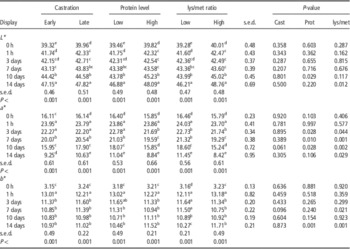
The age of castration of intensively reared Friesian steers did not have an effect (P>0.05) on the lightness (L*), redness (a*) or yellowness (b*) of the meat displayed up to 14 days (Table 1). All L*, a* and b* were typical of the meat from beef reared intensively, characterised by a lower physical activity and fed a diet that is low in roughage and high in concentrate (Guerrero et al., Reference Guerrero, Sañudo, Alberti, Ripoll, Campo, Olleta, Panea, Khliji and Santolaria2013). The increased production of anabolic hormones by the testes (Adams et al., Reference Adams, Daley, Adams and Sakurai1996) after the onset of puberty, which occurs at 9 months of age in Holstein bulls (Lunstra et al., Reference Lunstra, Ford and Echternkamp1978), is the main factor that creates differences in the characteristics of the meat from bulls and steers (Seideman et al., Reference Seideman, Cross, Oltjen and Schanbacher1982). In our study, the animals were castrated at either 15 days of age or at 5 months of age, and slaughtered at about 12 months of age. Thus, the hormonal changes did not occur. In addition, the excitable temperament and, therefore, the greater rates of antemortem glycolysis with slower pH decrease contribute to the darker colour of bull meat (Mach et al., Reference Mach, Bach, Realini, Font i Furnols, Velarde and Devant2009). However, ultimate meat pH was <5.6 and did not differ significantly among treatment groups (Prado et al., Reference Prado, Campo, Muela, Valero, Catalan, Olleta and Sañudo2014), which supports the lack of differences in lightness due to castration age.
Effects of castration age (cast; early v. late), dietary protein level (prot; 14.6% v. 16.8%) and dietary lys/met ratio (3.0 v. 3.4) on L*, a* and b* values of meat from intensively reared Friesian steers packaged under modified atmosphere and displayed for 14 days at 2ºC to 4ºC with 1200 lx light exposure

a,b,c,d,eMeans with different upper case letters are significantly different within column (P<0.05).
No significant interactions were found except for cast×lys/met at 7 days of display (P=0.049) in L* and prot×lys/met at 7 days of display (P=0.045) and 10 days of display (P=0.004) in a*.
Dietary protein level and lysine/methionine ratio had a significant effect on a* from day 3 of display onwards. However, they had little effect on the L* and b* values of the meat, except from day 10 of display onwards, when high dietary protein level showed higher L* and b* values, respectively, and after 14 days of display when high lys/met ratio also provoked higher values of both L* and b* (Table 1). Other authors have found darker meat in the low protein diet group after 1 h of blooming (Schiavon et al., Reference Schiavon, De Marchi, Tagliapietra, Bailoni, Cecchinato and Bittante2011) in meat aged in vacuum conditions for 10 days. We have also found the darker meat in animals fed the low protein diet, but only after 10 days of display. At 0 and 1 h of blooming, a* values were similar between treatments. However, after that and up to 10 days of display, they were lower in the meat from steers that had high protein level in their diet. In addition, from day 3 of display onwards, a* values were lower in the meat from steers fed a high lys/met ratio diet. Both groups of animals (high protein and high lys/met) had in common a higher muscle deposition (Prado et al., Reference Prado, Campo, Muela, Valero, Catalan, Olleta and Sañudo2014). The lower a* values could be caused by a greater percentage of glycolytic myofibres, which can be observed in animals with greater muscle deposition (Hocquette et al., Reference Hocquette, Cassar-Malek, Jurie, Bauchart, Picard and Renand2012b).
In all treatments, display time had a significant effect on L*, a* and b* (Table 1). The low a* (15.79 to 16.46) and b* (3.15 to 3.24) values at time zero with no blooming were expected because the meat had not yet been in contact with oxygen to change its colour. In addition, a* and b* values after 1 h of blooming (23.70 to 24.03; 12.11 to 13.18, respectively) were similar to those reported by Page et al. (Reference Page, Wulf and Schwotzer2001). The L* increased from day 1 to day 14 of the display period (39.28 to 40.01 v. 46.21 to 48.76), a phenomenon that has been observed in beef steaks that were displayed under high levels of oxygen (Resconi et al., Reference Resconi, Escudero, Beltrán, Olleta, Sañudo and Campo2012). Chemical changes in myoglobin did not influence L* (McKenna et al., Reference McKenna, Mies, Baird, Pfeiffer, Ellebracht and Savell2005), but the protein structures that changed with ageing due to proteolysis influenced lightness (Renerre, Reference Renerre1982). After 1 h of blooming, a* increased but decreased thereafter. Rodas-González et al. (Reference Rodas-González, Narváez-Bravo, Brashears, Rogers, Tedford, Clark, Brooks, Johnson, Rathmann and Miller2011) reported that the red colour of meat diminished over time even in vacuum conditions. On the other hand, the b* values increased between zero and 1 h of blooming, then declined for 3 days before remaining stable until the end of the display period.
Lipid oxidation (TBARS)
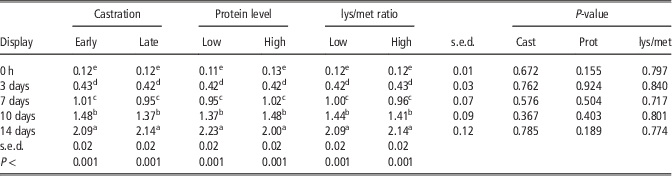
Castration age, dietary protein level and lys/met ratio did not affect TBARS values of the meat (P>0.05) at any point during the display period (Table 2). All treatments had the same levels of antioxidants in the diet, and this level was low (Prado et al., Reference Prado, Campo, Muela, Valero, Catalan, Olleta and Sañudo2014), as occurs in concentrate diets based on cereals. Lipid oxidation, which is influenced by intramuscular fatty acid composition, particularly polyunsaturated fatty acids, is one of the most important causes of meat deterioration (Wood et al., Reference Wood, Enser, Fisher, Nute, Sheard, Richardson, Hughes and Whittington2008) and can lead to increased drip losses, the development of off-odours and off-flavours, the production of potentially toxic compounds and myoglobin oxidation (Faustman et al., Reference Faustman, Sun, Mancini and Suman2010). In our study, the oxidation levels in the meat were typical of young animals that have been fed concentrates (Campo et al., Reference Campo, Nute, Hughes, Enser, Wood and Richardson2006). Furthermore, the polyunsaturated fatty acid composition of the meat was similar among castration age and dietary treatments (Prado et al., Reference Prado, Campo, Muela, Valero, Catalan, Olleta and Sañudo2014), which supports the lack of differences in the oxidation.
Effects of castration age (cast; early v. late), dietary protein level (prot; 14.6% v. 16.8%) and dietary lys/met ratio (3.0 v. 3.4) on TBARS (mg of malonaldehyde/kg meat) of meat from intensively reared Friesian steers packaged under modified atmosphere and displayed for 14 days at 2°C to 4°C with 1200 lx light exposure

a,b,c,d,eMeans with different letters are significantly different within column (P<0.05).
No significant interactions between cast×prot×lys/met were found.
The most influential factor was day of display, especially due to the presence of high atmospheric oxygen, which accelerates the process. At 0 h and after 1 h of blooming, the meat from steers had low TBARS (0.12 and 0.14 mg MDA/kg meat, respectively), which was expected because the meat had been kept intact in cold storage after slaughtering. Nevertheless, TBARS values increased significantly during the display period. At day 3 of display, all samples had values below 0.5 mg MDA/kg meat, and after 14 days all treatments had TBARS close to 2 mg MDA/kg meat, probably because the vitamin E content of the diet was relatively low (Prado et al., Reference Prado, Campo, Muela, Valero, Catalan, Olleta and Sañudo2014), which would render the samples oxidatively unstable. In any case, the MDA levels after 14 days of display were close (2 to 2.23) to the threshold for acceptability in beef (2.28; Campo et al., Reference Campo, Nute, Hughes, Enser, Wood and Richardson2006).
Visual acceptability of the meat
The sensory attributes of meat are important to consumers. Carpenter et al. (Reference Carpenter, Cornforth and Whittier2001) found a strong relationship between the colour preferences and consumer purchasing decisions, as consumers discriminated against beef that was not red (e.g., purple or brown). Therefore, visual assessments are a gold standard for estimating consumer perception (Mancini and Hunt, Reference Mancini and Hunt2005).
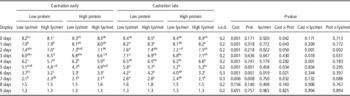
Throughout the 9-day display period, consumer acceptance of the appearance of the meat decreased exponentially (Table 3). From day 1 of display onwards, with the exception of days 8 and 9 where the values of acceptability were already below two (on a 9-point scale), the treatments differed significantly in the visual acceptability of the meat throughout the display period. The gradual decline in visual acceptability was expected because oxidative processes cause meat to deteriorate, which is particularly relevant in meat from concentrate-fed animals (Warren et al., Reference Warren, Scollan, Nute, Hughes, Wood and Richardson2008) due to the lower composition in natural antioxidants of the diet. Early castrated animals were less appreciated than late castrated animals, especially those fed a diet that had a low protein level and a high lys/met ratio. In general, the meat from animals that were late castrated and fed a diet that had low protein level received the highest scores. This coincides with the lower inter-muscular fat content (P=0.1) of the late castrated animals (Prado et al., Reference Prado, Campo, Muela, Valero, Catalan, Olleta and Sañudo2014) and would agree with the preference of Spanish consumers towards lean meat (Realini et al., Reference Realini, Kallas, Perez-Juan, Gomez, Olleta, Beriain, Alberti and Sañudo2014). Nevertheless, from day 6 of display and beyond (5 days in the case of early castrated animals fed high protein, or low protein and high lys/met diets), all the samples received scores below five. In our evaluation, this reflects rejection of the meat, although the relationship between colour and acceptability is not always evident, as there are other components such as drip loss that can cause consumer rejection. As thawing deteriorates the colour of meat previously frozen faster (Muela et al., Reference Muela, Sañudo, Campo, Medel and Beltrán2010), longer display could have been expected before the samples received scores below five. However, this preservation method was necessary in order to have all treatments assessed by comparison at the same time by the same consumer.
Effects of castration age (cast; early v. late), dietary protein level (prot; 14.6% v. 16.8%) and dietary lys/met ratio (3.0 v. 3.4) on consumer visual assessment of thawed meat from intensively reared Friesian steers packaged under modified atmosphere and displayed for 9 days at 2°C to 4°C with 1200 lx light exposure (n=17 consumers)

Scale: 1 (dislike extremely) to 9 (like extremely).
a,b,c,d,eMeans with different lower case letters are significantly different within row (P<0.05).
No significant interactions between cast×prot×lys/met were found.
Consumer eating test
All the samples had high acceptability in all attributes, with the lowest score of 6.5 on a 9-points scale. Age of castration did not have a significant effect on consumer acceptability of the meat aged for 7 days from Friesian steers. In general, the meat from bulls and steers often differ in tenderness (Rotta et al., Reference Rotta, Prado, Prado, Valero, Visentainer and Silva2009), which might lead to differences in acceptability. High calpastatin activity in the longissimus muscle (Morgan et al., Reference Morgan, Wheeler, Koohmaraie, Savell and Crouse1993) might cause the meat from bulls to be less tender than the meat from steers. Nevertheless, all animals had been castrated and no differences have been found in shear force values between treatments (Prado et al., Reference Prado, Campo, Muela, Valero, Catalan, Olleta and Sañudo2014). Therefore, no effect was expected in tenderness acceptability due to the age of castration, as castration especially affects meat quality after the onset of puberty (Knight et al., Reference Knight, Cosgrove, Lambert and Death1999). Although the effect of the level of protein in the diet was significant, a castration time×dietary protein level×lys/met ratio interaction (P=0.023) occurred in overall acceptability. The meat from steers fed a diet with high protein level and high lys/met ratio showed higher overall acceptability, especially in late castrated animals than the meat from animals that were fed a diet with a low protein level (Table 4). This could be related to the lower saturation of the intramuscular fat (Prado et al., Reference Prado, Campo, Muela, Valero, Catalan, Olleta and Sañudo2014) that could have been perceived by consumers and affected the palatability of the meat.
Effects of castration age (cast; early v. late), dietary protein level (prot; 14.6% v. 16.8%) and dietary lys/met ratio (3.0 v. 3.4) on overall acceptability (overall), tenderness acceptability (tend) and flavour acceptability (flavour) of meat from intensively reared Friesian aged for 7 days under vacuum conditions (n=120 consumers)

Scale: 1 (dislike extremely) to 9 (like extremely).
Interactions between cast×prot or cast×lys/met were not significant.
a,b,cMeans with different letters in the same row are statistically different (P<0.05).
Tenderness is one of the most important factors in beef quality, and consumers are willing to pay a higher price once they have been assured that the beef is tender (Hocquette et al., Reference Hocquette, Botreau, Picard, Jacquet, Pethick and Scollan2012a). In our study, tenderness acceptability was higher (P=0.034) in meat from late castrated steers that had been fed a diet containing high protein and a high lys/met ratio compared with the meat from other treatments, especially from those of early and late castrated animals that had been fed a diet containing low protein. Differences in beef tenderness might be associated with variations in the rate and extent of muscle proteolysis that occurs during postmortem storage (Shackelford et al., Reference Shackelford, Koohmaraie, Wheeler, Cundiff and Dikeman1994; Wulf et al., Reference Wulf, Morgan, Tatum and Smith1996). However, Schiavon et al. (Reference Schiavon, De Marchi, Tagliapietra, Bailoni, Cecchinato and Bittante2011) and Prado et al. (Reference Prado, Campo, Muela, Valero, Catalan, Olleta and Sañudo2014) did not detect differences in shear force values between dietary protein levels in entire bulls and castrated animals, respectively. However, the overall acceptability of the consumers was highly associated with tenderness acceptability (r=0.83, P<0.001).
The flavour acceptability scores of late castrated steers fed a diet that had both high protein levels and high lys/met ratio were also higher than those from late castrated steers fed a diet with low protein levels and high lys/met ratio and early castrated animals fed a diet with both low protein levels and low lys/met ratio. However, the difference in flavour acceptability was smaller than the difference in tenderness acceptability, probably because it is an organoleptic attribute, which is more difficult to assess than tenderness, and consumers were not trained for it. Typically, differences in flavour are attributed to differences in the fat content (Mandell et al., Reference Mandell, Gullet, Wilton, Kemp and Allen1997) and composition (Resconi et al., Reference Resconi, Campo, Font, Furnols, Montossi and Sañudo2010). In our study, there were no differences in the amount of intramuscular fat between the best and worst accepted treatments (Prado et al., Reference Prado, Campo, Muela, Valero, Catalan, Olleta and Sañudo2014). Therefore, small differences in the fatty acid composition might have influenced the results of our study, as high protein level and high lys/met treatments resulted in higher monounsaturated and lower saturated intramuscular fatty acid percentage (Prado et al., Reference Prado, Campo, Muela, Valero, Catalan, Olleta and Sañudo2014). Diet can also affect the reducing sugar content of the muscle (Koutsidis et al., Reference Koutsidis, Elmore, Oruna-Concha, Campo, Wood and Mottram2008), which is an important part of flavour development through Maillard reactions (Resconi et al., Reference Resconi, Escudero and Campo2013). Probably the amino acid composition (another component of Maillard reaction during cooking) in the highest flavour acceptability treatment was different due to the diet, as diet can have a significant effect on the composition of free amino acids (Koutsidis et al., Reference Koutsidis, Elmore, Oruna-Concha, Campo, Wood and Mottram2008) and on the rate of protein synthesis, higher in animals fed amino acids supplements (Wessels et al., Reference Wessels, Titgemeyer and St. Jean1997). Nevertheless, this aspect has not been measured and remains unknown.
Conclusions
Age of castration in steers slaughtered at around 12 months of age does not affect colour or oxidation in meat. High levels of protein (16.8%) and a low lys/met ratio (3.0) in the diet will increase meat redness throughout display. However, this increase in redness is not positive enough to achieve a higher visual consumer acceptability of the meat. Nevertheless, after 6 days of display, the rejection of this meat is clear, independent of the treatment. After consumption, meat from late castrated animals fed a high protein and a high lys/met ratio is preferred, especially compared with a low protein diet. Together with the previous findings in carcass quality and meat production, a high protein diet is recommended at this early slaughter age for consumer eating satisfaction; however, the addition of protected methionine to reach the recommended ratio lys/met of 3.0 in the diet does not improve meat acceptability.
Acknowledgements
The authors thank Agrícola Mas Jonquer and CDTI for their financial support, and Ivanna Moraes de Oliveira, Paula Monge, Marta Barahona, Ana Guerrero and Julia Pomed for their technical assistance.