Natural disasters such as earthquakes often involve substantial physical and mental impacts on affected populations and lead to public health challenges.Reference Burke, Bethel and Britt 1 In a recent World Disaster Report, Iran was noted to have the world’s highest number of major earthquakes (magnitude higher than 5.5 Richter) and was cited among the countries that have suffered the highest number of casualties from earthquakes. 2 The country is located in the Alpine-Himalayan seismic belt, which is one of the most active tectonic regions of the world. In past centuries, Iran has endured a few large and destructive earthquakes.Reference Jahangiri, Izadkhah and Montazeri 3
Eisenman et alReference Eisenman, Glik and Gonzalez 4 suggested that community engagement, culturally competent approaches, participatory methods, and partnerships among universities, public health agencies, and community-based organizations are broadly recommended over risk-communication practices. The participatory research approach focuses on shared cultural values of family, community, and their social networks rather than individual response to reach the goals of preparedness intervention programs.Reference Shiu-Thornton, Balabis and Senturia 5 , Reference Carter-Pokras, Zambrana and Mora 6 Although a substantial amount of effort is put into using participatory research methodology in the area of disasters,Reference Chen, Liu and Chan 7 - Reference Farquhar and Dobson 19 much of this research is qualitative and is presented in a theoretical framework. Also, an analysis of participatory interventions in different programs such as an avalanche prevention and preparedness program in Switzerland, flood management in the United Kingdom, and hurricane management approaches in the United States revealed that, although those interventions can lead fairly to improved disaster risk reduction outcomes, the circumstances of each case (that is, the context) appear to be important in effect size.Reference Kornakova and March 20
Thus, taking into account the contextual role in the effectiveness of disaster management and preparedness, applying a participatory approach can help to identify a series of criteria to deal with disasters. For the case of Tehran, owing to its natural disaster-proneness and the less attention paid toward community participation, a need to design and evaluate the effectiveness of participatory interventions is evident, as was shown in a case study.Reference Jahangiri, Izadkhah and Montazeri 3
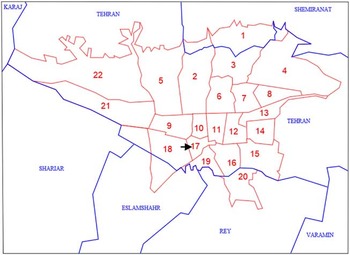
Tehran is the capital city of Iran with a population of around 8.3 million. This city has an average population density of about 146 people per hectare in the built-up area, making it a dense city by world standards.Reference Bertaud 21 In line with the 2012–2025 Islamic Republic of Iran road map for disaster health management, a need exists to focus on the most socioeconomically vulnerable people in high-risk areas as an opportunity for disaster risk reduction programs.Reference Ardalan, Rajaei and Masoumi 22 , Reference Taghizadeh, Hosseini and Navidi 23 Henceforth, we piloted a participatory intervention in zone 17 of Tehran. This zone with an area of 8.2209 km2, which is about 1.1% of Tehran’s area, and a population of 256,022 is located in southwest Tehran. 24 The area is among the zones with the lowest socioeconomic status and is ranked as the second oldest urban texture of the 22 zones of Tehran.Reference Habibi and Hourcade 25 In this regard, the zone is vulnerable to earthquakes. The estimated value of the total relative seismic risk index in zone 17 is the highest of all zones in Tehran affected by the fault north and south of Tehran and the Ray Kahrizak fault.Reference Hajibabaee, Amini-Hosseini and Reza 26 The location of zone 17 among the 22 zones of Tehran City is shown in Figure 1. The aim of the present study was to evaluate the effectiveness of a community-based participatory intervention on people’s earthquake preparedness in a pilot area of Tehran.
The Location of Zone 17 in Tehran City, Iran.

Methods
A community-engaged research project was conducted during 2012 through 2013. First, neighborhoods were selected on the basis of their vulnerability to earthquakes by use of seismology specialists’ considerations of urban distressed areas in Tehran considering the population, population density, and stability.Reference Asgari and Ghadiri 27 With the participation of the community advisory board in coordination with the neighborhood council of western Aboozar neighborhood, the history of community participation in development programs was discussed and criteria for selecting neighborhoods were considered. The intervention and control neighborhoods had similar seismic vulnerability and socioeconomic characteristics; furthermore, they had a 25-minute walking distance to limit the interaction among participants. Moreover, we tried to choose neighborhoods where current programs for disaster preparedness were not being carried out to avoid interfering with other ongoing disaster preparedness programs.
An exhibition on earthquake preparedness was held in the area with various stakeholders. The stakeholders were from the municipality, disaster mitigation, the management headquarters of zone 17, the hospital, firefighting organizations, and other relevant organizations. The exhibition aimed at justifying the need to carry out the programs and motivating voluntary participation. Because earthquake preparedness was not a priority of people, the exhibition caused their normative needs to be close to their needs. To obtain basic information as a baseline for comparing the effects of the intervention, a quantitative survey was designed to assess people’s knowledge, attitude, and practice for earthquake preparedness.
Sampling Method and Procedures
The study population involved all households living in 2 neighborhoods, an intervention and a control neighborhood, of zone 17 of Tehran. In collaboration with the deputy of worn-out urban textures of zone 17, houses available in the intervention and control neighborhoods were considered as a sampling frame. Systematic cluster sampling was performed, and households that had lived in the neighborhood for at least 5 years were enrolled in the study. From each intervention and control area, 305 and 314 households were sampled, respectively, and interviewed through use of a validated questionnaire by trained local volunteers. The participation rate of approached households was 89.7% and 99.3% for the intervention and control groups, respectively.
In each household, a responsible person over 18 years of age was interviewed. Informed consent forms were obtained from the participants before the interviews and the participants were assured about the confidentiality of the interviews. The community advisory board supervised the process of data gathering by using a quality monitoring checklist. Data were codified by the academic research team and analyzed through descriptive statistical tests by use of SPSS software (version 18; IBM Corp, Armonk, NY). Six months after implementation of the intervention program, a post-assessment survey was conducted and the same questionnaires were completed in both neighborhoods for comparison.
Intervention Program
On the basis of the results of the initial survey, the educational content of the intervention was prepared by participants who were culled from experts in disaster medicine, experts in disaster management, and health education and promotion specialists as well as through the consultations with the community advisory board. Educational content from the Education Deputy of Disaster Mitigation and Management headquarters in Tehran was made locally relevant and simplified by the community advisory board. Afterwards, community volunteers were trained on earthquake preparedness in educational sessions that lasted 1 to 3 days for the workshop and 10 days for the field work.
A 3-day workshop was designed around 3 modules of earthquake preparedness: before, during, and after an earthquake. In the workshop, the consequences of earthquakes for individuals and households, teamwork skills, communication skills, participatory earthquake risk mapping, drawing a plan for vulnerable target groups, holding preparedness meetings, preparing a safe location map, emergency kits, personal information cards, and appropriate emergency response were taught.
The earthquake risk map was expected to illustrate the space of a house, highlighting the safe and risky places. The personal information card consisted of information such as blood group, special diseases, and medical considerations.
Participants shared the training with the rest of volunteers in the workshop through role playing and received feedback on their teaching. Financial management of the project was done in collaboration with the community advisory board. The contents of the earthquake kit and emergency cards for training households were also prepared by the advisory board. Relevant practical training and earthquake maneuver training were presented by trainers from the headquarters of the Red Crescent Society of disaster mitigation and management of Tehran in the Shahriar region.
Trained volunteers provided face-to-face training to the households in the intervention neighborhoods. The volunteers were equipped with an emergency kit and card, checklists of teaching items, and educational booklets and pamphlets prepared in a simple and comprehensible way.
Instrument
In our study, the survey questionnaire was prepared in consultation with the Department of Disaster & Emergency Health of the School of Public Health and the National Institute of Health Research.Reference Ardalan, Mowafi and Malekafzali Ardakani 28 The questionnaire content and face validity were confirmed. To assess the reliability of the data collection tool, the test-retest method was used, during which 30 questionnaires were completed by eligible households. Two weeks after the initial completion of the questionnaires, they were given to the same people to be completed again. Each interview lasted 35 minutes. Interviewees were informed persons aged more than 18 years.
Knowledge About Earthquake Preparedness
Six questions were asked to evaluate the participants’ knowledge about the earthquake risk map, emergency information card, and taking shelter in a safe place; their awareness of those in need of special attention; their knowledge of the contents of the earthquake kit; and their knowledge of earthquake maneuvers. Participants obtained a score equal to 1 for each correct answer and 0 for an incorrect answer. The total score of the knowledge section including the main questions and subquestions was 43.
Attitude Toward Earthquake Preparedness
Two questions were asked to evaluate the participants’ attitude toward earthquake preparedness. Statements including “mortality will be reduced through earthquake preparedness” and “preparing people against earthquakes is an easy task” were evaluated on a 3-point Likert scale scored from 1 to 4 with 1 standing for the lowest attitude and 4 for the highest. The sum of these two questions was assumed as the attitude score (total score=7).
Practice
Nine questions were asked to evaluate the practice of the participants. Practice was measured by the following: preparing an earthquake preparedness session, providing a risk map, providing an emergency card, practicing taking refuge in a safe location, the existence of a specific plan for earthquake preparedness, installation of a first aid box at home, providing an earthquake preparedness kit, tightening furniture, and implementing earthquake engineering. Each “yes,” “to some extent,” and “no” responses received a score of 2, 1, and 0, respectively. The overall practice score totaled 18.
Statistical Analysis
Data analysis was done with the aid of SPSS version 18. Pearson’s chi-square test and covariance regression were used to evaluate the effectiveness of the intervention, which was measured by comparing relative changes in the intervention neighborhood with relative changes in the control. P values of less than 0.05 were considered statistically significant.
Ethical Considerations
The Ethics Committee of Tehran University of Medical Sciences approved the project. Written informed consent was obtained from participants and the Declaration of Helsinki was followed throughout the study.
Results
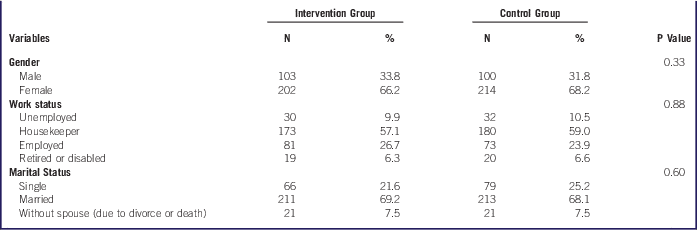
The reliability of the earthquake preparedness questionnaire was verified for each of the knowledge, attitude, and practice sections with Cronbach’s alpha over 0.7. The mean age of the respondents was 37.4±14.7 years in the intervention group and 40.4±17.2 years in the control group. Most of the respondents were women (66.2% in the intervention group and 68.2% in the control group), housekeepers (57.1% in the intervention group and 59.0% in the control group), and married (69.2% in the intervention group and 68.1% in the control group).
Analysis of characteristics in both the intervention and control groups showed no significant differences in either group before the intervention (Table 1). In the descriptive analysis, 69.2% of the intervention group and 79.0% of the control group had earthquake experience. Most of the research subjects believed that the earthquake threat was serious for the household (control, 80.3%; intervention, 77.1%) and that the occurrence of an earthquake could cause harm to the health of the household and their property to a large scale (control, 87%; intervention, 83.6%). In case of the risk of earthquake occurrence in the neighborhood, most participants would leave their houses (control, 73.1%; intervention, 60.5%). In a mild earthquake, the participants would take refuge in a safe location (control, 73.6%; intervention, 67.5%).
Characteristics of the Study Participants

In this study, the majority of the research subjects showed a moderate to high tendency toward participating in earthquake preparedness sessions (69.2% of the intervention group and 77.3% of the control group). The results of the covariance analysis showed that the mean difference in knowledge scores between the intervention and control groups after adjustment according to baseline (pre-intervention) was statistically significant (P<0.001). It should be noted that, before the intervention phase, the difference in the knowledge score between the intervention and the control group was statistically significant (P=0.04).
Regarding people’s attitudes toward preparing for earthquakes, the mean difference in attitude scores between the intervention and the control group after adjustment for pre-intervention score was statistically significant (P<0.001). In the analysis of people’s practice toward earthquake preparedness, the mean difference between the intervention and the control group after adjustment for pre-intervention score was also statistically significant (P<0.001; Table 2).
Differences in Knowledge, Attitudes, and Practice Among Participants

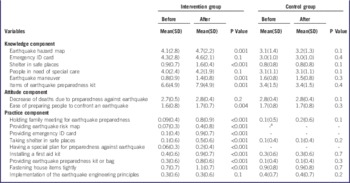
Specific details of improvements in terms of knowledge, attitude, and practice subquestions are shown in Table 3. The intervention changed all knowledge components except the “emergency ID card” and “people in need of special care.” For attitude components, the intervention caused a significant change in attitude toward “ease of preparing people to confront an earthquake,” whereas attitude toward “decrease in deaths due to preparedness against earthquake” showed no significant statistical differences before and after the intervention. Participatory intervention revealed a statistically significant effect on behavioral dimensions of practice in preparing for earthquakes. However, this effect was not found in the structural dimension in terms of implementing earthquake engineering principles.
Comparison of Knowledge, Attitudes, and Practice Mean Scores Before and After the Intervention Among the Intervention and Control Groups

a Mean score was less than reportable, so it was not presented in the table.
Discussion
The results showed that a participatory intervention is an effective strategy in preparedness against earthquakes. Participatory approaches endeavor to consider local communities’ assets, building mutual trust, ownership, and commitments.Reference Minkler, Vásquez and Tajik 29 , Reference Wilson, Minkler and Dasho 30 Participation also empowers the local community and helps them to institutionalize efforts while the experts gradually give up the community.Reference Jahangiri, Izadkhah and Montazeri 3 Furthermore, participatory approaches toward preparedness against earthquakes allow planners to apply methods that are well-suited to the culture of the local communities.Reference Burke, Bethel and Britt 1 , Reference Benson, Twigg and Myers 31 , Reference Jahangiri, Izadkhah and Tabibi 32 This helps to make safer, disaster-resilient communities.Reference Victoria 33
The descriptive results showed that most of the research subjects believed that earthquakes are a serious threat for households to a large degree and that their occurrence can cause a lot of damage to the household’s health and property. Participants declared that if they were aware of the risk of occurrence of an earthquake in the neighborhood, they would leave their houses, and that if a mild earthquake happened they would take refuge in a safe place.
These results are consistent with a study by Uprety and PoudelReference Uprety and Poudel 34 in Nepal demonstrating that most (91.1%) participants had experienced an earthquake in their lifetime. Also in that study, 92.6% were concerned about upcoming earthquake damage.Reference Uprety and Poudel 34 In a study by YesilReference Yesil 35 in Turkey, 70% of respondents were worried about earthquake threats in their daily lives. Studies have shown that the expected response to this level of concern and experience would be preparing against earthquakes.Reference Jahangiri, Izadkhah and Montazeri 3 In this regard, Uprety and PoudelReference Uprety and Poudel 34 and Ardalan et alReference Ardalan, Mowafi and Malekafzali Ardakani 28 demonstrated a significant relationship between earthquake damage or risk perception and preparedness. However, the results of the present study in the pre-intervention phase showed that knowledge and practice assessments scored less than half of the total available points. Thus, despite understanding the risk, people were not prepared to confront an earthquake.
Our results are consistent with a study by Jahangiri et alReference Jahangiri, Mohammad and Rahimi Forushani 36 that showed 31.4% of Tehran residents to have poor knowledge of earthquake preparedness. In that study, the knowledge was at a “moderate” level in 31.4% and was appropriate in the remaining 37.2%. Therefore, in a study carried out in Tehran, designing an intervention program has been suggested from the people’s point of view in order to promote public awareness and earthquake preparedness.Reference Jahangiri, Izadkhah and Montazeri 3
In our study, an interactive, participatory approach was carried out to enhance people’s level of preparedness. According to our results, people’s awareness about earthquake preparedness increased after the intervention program apart from the knowledge of emergency ID cards and people in need of special care. This might have been a result of a shortage in the education program and more reinforcement on the other items. In this regard, a study by Ardalan et alReference Ardalan, Mowafi and Malekafzali Ardakani 28 showed that applying a training program in collaboration with community health volunteers led by primary health care staff could increase disaster awareness and readiness among households. This level of awareness and preparedness was associated with previous experience with disasters and risk perception.Reference Ardalan, Mowafi and Malekafzali Ardakani 28
Chen et alReference Chen, Liu and Chan 7 also showed that using a participatory evaluation approach could promote communication between professionals and the community to increase awareness and planning to reduce the damage caused by disasters. The results of our study are in agreement with the RADUS initiative, which benefited from the participation approach and involved people in disaster risk management,Reference Stanojevska, Penov and Milutinovic 37 , Reference Villacis 38 and with those of another study performed at the school level.Reference Soffer, Goldberg and Avisar-Shohat 39
It should be noted that the use of participatory approaches for community-based flood risk communication led to enhancement of community awareness and flood risk mitigation. A study by Troy et alReference Troy, Carson and Vanderbeek 40 revealed that using a local resource database as a component of community-based disaster preparedness led to mobilizing resources and raising awareness within the community. Both of these participatory projects which built on strengths and resources within the community revealed results similar to those of the current study.
In addition to knowledge, the results of the current study showed that people’s attitudes toward earthquake preparedness improved after participatory intervention in terms of ease of preparing people in confronting earthquake. In a study by YesilReference Yesil 35 in Turkey, people believed that it is possible to mitigate damage by carrying out simple measures. A study by Jahangiri et alReference Jahangiri, Mohammad and Rahimi Forushani 36 in Tehran revealed that 25.6% of people had poor, 32.5% moderate, and 41.9% acceptable attitudes toward preparedness against earthquakes.
Improvements in public attitudes is an expected consequence of a participatory program in which interaction and dialogue result in modification of attitudes and beliefs and movement toward the desired changes.Reference Castelloe, Watson and White 41 The current study also supports the positive impact of local volunteers’ participation on people’s attitudes toward earthquake preparedness, with the exception of the attitude toward “decrease in deaths due to preparedness against earthquake,” which was not changed statistically. This might be rooted in some religious beliefs that preparedness cannot change destiny, because events and death are assumed to be controlled by God. Changing these beliefs is not easy in a short time. Implementation of similar interventions in other communities might yield different results.
In this study, the mean of people’s practice toward earthquake preparedness in the intervention group changed in all behavioral components; the people did not have proper practices before the intervention. Although change in “implementation of the earthquake engineering principles” was not achieved, it seems that this is not an easy goal to access and requires structural prerequisites. The results of a study conducted in Tehran revealed that 25.7% of the study subjects had poor, 25.7% moderate, and 45.3% acceptable practice against earthquakes.Reference Jahangiri, Mohammad and Rahimi Forushani 36 Taghizadeh et alReference Taghizadeh, Hosseini and Navidi 23 showed that 41.0% of Tehran inhabitants achieved half of the possible scores for the practice components. In this study, more than one-third of the respondents claimed that they had a plan about what to do at the time of an earthquake.
Impact assessment of the intervention program in collaboration with village disaster task forces and training of village disaster task forces and community by Ardalan et alReference Ardalan, Naieni and Mahmoodi 9 revealed that local community preparedness for flash floods led to improved outcomes. This was possible through preparedness actions that included meetings, risk mapping, preparation of emergency supplies, assisting vulnerable people, and evacuation drills.Reference Ardalan, Naieni and Mahmoodi 9 Also, in other community-based research in which the educational role of community health volunteers in promoting the household preparation level toward disasters was assessed, similar findings were obtained, which thus far confirm the results of this study.
The results of the present study were discussed in several meetings at Tehran crisis headquarters and by Tehran zone 17 authorities. What is important to mention is that the role of people in disaster preparedness programs throughout was stressed. In general, the complexity of managing and sustaining participation, as well as resistance of the community to scientific methodology that may not directly lead to short-term benefits, is a challenge in community-based participatory interventions. Strengthening the scientific basis of the study while not losing the benefits of participation may be important to ensure more meaningful impacts. Furthermore, it seems that this field of study may not yield similar results in another country, because the external validity is limited by the context in which the study took place.
Conclusions
A participatory intervention effectively improved disaster preparedness at a community level. The capacity to apply appropriate, culturally tailored methods based on the needs of the local communities makes such an intervention suitable for making safe and disaster-resilient communities. Considering that, on average, every 2.5 years there is a severe earthquake in Iran, and considering that Iran is a disaster-prone countries, participatory planning on earthquake preparedness can increase the efficacy of interventions. Currently, the disaster mitigation and management headquarters and the Iranian Red Crescent Society are responsible for preparing people against earthquakes. To ensure sustainability, these organizations should integrate a participatory approach into public health disaster planning.
Acknowledgment
We declare our gratitude for the sincere cooperation of the people in the zone 17 neighborhoods. We are also grateful to the secretary of the neighborhood councils in zone 17, Mr Aghajani, Mrs Mirzaee, Dr Zonoobi, Mr Salimi, Mrs Akbari, Mr Shabani, and Mr Safi.
Funding
This project was funded by the Community Based Participatory Research Center of Tehran University of Medical Sciences, under project no. 86-02-62-5850.