Social science historians have long recognized that the growing intensity of wars among early modern European states gave rise to a military revolution.Footnote 1 This literature also argues that states frequently relied on private forces in interstate contests, be they mercenary armies on land or privateers in maritime warfare.Footnote 2 A contemporary legal source defines privateering as “the expeditions of private individuals during war, who, being provided with a special permission from one of the belligerent powers, fit out at their own expense, one or more vessels, with the principal design of attacking the enemy, and preventing neutral subjects or friends from carrying on with the enemy a commerce regarded as illicit.”Footnote 3 Privateers thus differed from mere pirates because maritime law and the regulations of their sovereign's admiralty bound their predatory activities.
Privateering suited rulers' economic and political interests in the ferocious international competition of early modern Europe. Central to the mercantilist doctrine of the time was the idea that a country's economic wealth stemmed primarily from a balance of trade that favored exports over imports. The same doctrine viewed the overall volume of world trade as limited and commercial expansion as a zero-sum game wherein states gained a competitive advantage if they increased their trade at the expense of other countries. In such a mercantilist world, privateering proved to be a useful instrument of naval warfare because it effectively undermined an opponent's trade and provided a much-needed inflow of resources.Footnote 4 The historical evidence reveals that the business of prize-taking was also attractive for the individual merchants who organized and sponsored it. Consequently, privateering was a strategy that both opened up promising business opportunities during wars and contributed to the economic and political power of states at little additional cost for their governments.Footnote 5
The substantive question of this article is why privateering declined so dramatically in Britain at the end of the eighteenth century despite its apparent benefits for both the state and the merchants who undertook it.Footnote 6 The usual answer is that the improved fiscal capacity of the English Crown eventually enabled the emergence of a professional navy.Footnote 7 With its growing professionalization, so the argument goes, the navy simply became better at maritime warfare than merchant privateers. Consequently, the navy crowded out privateering over time. Such an interpretation seems misleading to us. On the supply side, merchants had to invest in privateering voyages just as much as governments encouraged them. Hence, we argue that the decline of privateering had as much to do with long-term changes in the maritime economy as with the concerns of the state's sea power. Our central argument is that the increasing profitability of overseas trade lured merchants away from investing in privateering. Both the rise of new markets and the increasing ability of the Royal Navy to protect merchant shipping from seizure by Britain's enemies contributed to this long-term development.
We focus on the “second One Hundred Years' War” (1689 to 1815) that pitted Britain against France in a conflict fought on a worldwide scale.Footnote 8 The British case is ideally suited to study both privateering and its decline.Footnote 9 First, during this period, Britain emerged as the world's leading sea power and trading nation, a dominance that would last into the twentieth century. Second, privateering was a popular activity among British merchants, many of them prominent members in their communities. Finally, the quality of archival and published sources on privateering ventures, merchant trade, and the organization of naval forces allows us to put our argument to a quantitative test.
Our empirical analysis uses data on the incidence and organization of 2,483 privateering cruises between 1689 and 1815 that we collected from British archival sources. Our data consist of a 10 percent random sample of all commissioned privateering cruises in this period, including systematic information on the vessels, their crew, and weaponry, as well as the number and origin of prize ships they seized. We complement this information with a large set of prize values of British privateers that we assembled from primary and secondary sources. We supplement those data with quantitative information on British and French trade as well as the strength of the British and French navies, all collected from published sources.
The empirical analysis supports the mechanism outlined in our argument. We offer quantitative evidence that privateering was systematically related to the volume of potential prize ships and to the legal trade opportunities for British merchants during wars. We document that, despite its popularity and effectiveness, the number of privateering ships fell off steeply in Bristol and Britain during the French Revolutionary and Napoleonic Wars. Expected revenues from privateering declined sharply, largely because the probability of seizing a prize ship fell from 50 percent in the American Revolutionary War to 10 percent in the Napoleonic Wars. This late eighteenth-century decline of British privateering coincided with a significant expansion of overseas trade both in absolute terms and relative to Britain's main adversary, France.Footnote 10 We identify one important mechanism responsible for this development: the increased security of trade routes, especially those traditionally infested with pirates and enemy privateers. We provide evidence that the rising strength of the Royal Navy and its presence in overseas ports reduced the chance that enemy vessels captured British shipping after 1783, but not before. Expanded trade opportunities and reduced profits from prize-taking account for more than half of the decline in privateering activity over our period.
The contribution of this article, then, is twofold. First, we employ new quantitative data to document the popularity and effectiveness of British privateering over the course of the long eighteenth century. While we are not the first to highlight the effectiveness of commerce raiding, previous studies were often restricted to evidence on a shorter time period or to a single port.Footnote 11 More generally, we present quantitative evidence of the determinants of privateering that allows us to move beyond the largely qualitative analyses in earlier studies. Second, drawing on this systematic evidence, we also move beyond debates over the strategic value or imperfection of privateering in naval warfare. Instead, we identify an economic mechanism whereby the increase in overseas trade opportunities facilitated the decline of British privateering by the end of the eighteenth century.
ORGANIZATION AND REGULATION OF PRIVATEERING IN BRITAIN
Privateering was financed and organized by local merchant groups. Investors in ventures from the Channel Island, for example, were predominantly residents of Guernsey or Jersey, and not, say, London. Undertakers came from across all ranks of the merchant community, and few barriers to entry seem to have existed. Our data from Bristol reveal that about 80 percent of the leading transatlantic slave, sugar, and tobacco traders in Bristol organized and invested in privateering voyages during our period of interest.Footnote 12
The merchant owners formed partnerships for fitting out their vessels for privateering cruises. The owning merchants were responsible for bearing all fitting costs, including food supplies, typically for the length of six to seven months. The owners appointed the captain, who received lengthy orders that regulated expected behavior on board and the proceedings of prize-taking during the privateering campaign.Footnote 13
The captain and owners received their privateering commissions from the High Court of Admiralty and they were supposed to follow its regulations. In the instance of severe misconduct, the privateer's commission could be revoked, and the crew and owners held responsible for any reparations to be paid. What distinguished privateers from mere pirates was that their governments had authorized them to seize or destroy enemy shipping and to intercept contraband shipping and smuggling by neutral or allied vessels during wartime.Footnote 14
Privateers were expected to bring their captures and a few members of the prize ship's crew as witnesses into English ports to have the goods judged as fair prizes by the High Court of Admiralty. They were expected to be able to demonstrate that the prize was lawful and that the rights of neutral and allied ships engaged in legal trade had not been harmed.Footnote 15 Once condemned as legal prizes, and in the absence of other claimants, the valuables could be liquidated and the resulting revenues distributed among the owners, officers, and crew of the privateer.Footnote 16
Not all privateering vessels set out with the primary aim of commerce raiding. Two broad types of commissioned enterprises can be distinguished.Footnote 17 Private men-of-war constituted the first type. They specialized in the business of seizing enemy vessels and their cargo. Compared to regular trade ships of the same size, their ships had a heavier frame to support a larger number of guns. In addition, private men-of-war required a larger crew than merchantmen to operate the guns and to sail any prize into port. Additional costs for outfitting the ship and victualing a larger crew were in part offset because wages were uncommon on genuine private ships of war. The share in captured prizes was the main attraction for crew members on board of private men-of-war. Smaller private men-of-war such as the Channel Islands privateers primarily chased the coastal traders of nearby France. The larger “deepwater” vessels carried substantial weaponry and cruised along the routes of long-distance trades. Their targets were the rich East Indiamen and French and Spanish convoys returning from the West Indies.
The second type of privateering ventures consisted of armed merchant vessels, so-called letter of marque ships, whose primary objective was trade, with prize-taking a secondary aim. A letter of marque ship did boast heavier armament and a larger crew than a merchant ship but less than a private man-of-war. Because letter of marque ships paid seamen's wages, the larger crew size raised their costs relative to regular merchant ships.Footnote 18 One reason for obtaining letters of marque was that only a valid commission entitled the crew and owners of a merchantman to the prize money should the opportunity arise to capture an enemy vessel during their trading voyage. Further, letter of marque ships were exempt from sailing in convoys during the Napoleonic War, which may have given them a substantial market advantage over competitors that specialized in trade.
DATA AND DESCRIPTIVE EVIDENCE
Data Sources
For our empirical analysis, we collected a new data set on British privateering from primary sources. Our first data set is a 10 percent sample (N = 2,483) of all letters of marque (privateering commissions) granted by the Court of Admiralty in Britain between 1689 and 1815.Footnote 19 Although letters of marque could also be obtained in the British colonies, we focus on commerce raiding from British ports. The declarations specify the date the commission was issued, shipowner(s), the captain, the ship's name and characteristics (home port, tonnage, crew size, number and types of guns). Because a commission was a legal authorization, it does not necessarily imply that a privateering ship actually left port to capture prizes. The letters of marque thus provide an upper bound on the scale of British privateering activity.Footnote 20
Our second data set is a census of all surviving prize ship records in the Court of Admiralty between 1689 and 1815.Footnote 21 These prize sentence data contain the name of the captured ship and its master, the port the prize was taken to, and the date of the court sentence. We also know the name of the captor ship, its home port, and the name of the captain. Because the names of the captor ship and its captain are known, we can merge the prize ship information to our sample of British privateers.Footnote 22
Our data from the letter of marque declarations and prize accounts do not distinguish consistently between “Private Ships of War” and “Ships Employed in Trade.” In a given bound volume of letter of marque declarations, such detailed labeling appears only in the very first letter of marque and is absent in subsequent declarations. For example, volumes of declarations recorded in the early nineteenth century often identify letter of marque ships, but do not offer the same detail for genuine private ships of war. David J. Starkey, however, outlined an approach to identify private men-of-war based on their tonnage and crew size.Footnote 23 Local private men-of-war were typically small because they operated mostly in the Channel to capture French coastal traders or ships returning from overseas voyages. Starkey subsumes all vessels under 100 tons and with a ton-per-man ratio of 2.5 or less under these local privateers. The second type of private men-of-war consists of larger vessels that sailed overseas in search for prizes. These deepwater private men-of-war are identified as vessels of 100 tons and above, and manned with a ton-per-man ratio of 2.5 or less, or, alternatively, as vessels with a crew size of 100 or more, but excluding all vessels operated by the East India Company. The classification certainly has limitations, but it provides a consistent method to identify first private men-of-war in our commission data and then to classify all remaining vessels as letter of marque ships.
The data on prize sentences we collected do not contain values of prizes. Therefore, we collected a set of gross values of seized prizes and their cargo (N = 1,080), which span the whole time period from 1689 to 1815.Footnote 24 Because prize values were not systematically recorded in the Court of Admiralty, our data are not obviously a representative sample of the values of prizes caught by British privateers and must be interpreted with some caution. It is, however, reassuring that the time pattern of mean prize values in our data is similar to those others have collected.Footnote 25 We use averages in each war to assess the evolution of revenues from privateering (because the prize records do not consistently report the captor ship).Footnote 26
We complement our archival data with secondary sources. To measure the attractiveness of privateering, we rely on time series of total French imports and exports, Britain's main adversary.Footnote 27 To measure the opportunity costs of private men-of-war, we assembled several measures of legal trade opportunities. We use annual time series of total British imports, exports, and re-exports (official values) for the period from 1700 to 1815 and the number of slave voyages by ships registered in Britain.Footnote 28
We supplement our sample of British privateers with data from the port of Bristol. For most of our period of interest, Bristol was the prime slave trading port and second only to London in its overall significance for British overseas trade. For raiding ventures, we coded the complete list of individual Bristolian privateers who were active between 1699 and 1812.Footnote 29 Like the broader British sample, the Bristol data contain detailed characteristics of the ship, the names of its owner(s) and captain, and the date the letter of marque was issued. For each commissioned ship, we also know the number of prizes taken and the date of capture.
Finally, to assess the risks involved in merchant trade and privateering, we control for the strength of naval forces of Britain and its main rivals, France, Spain, and the Netherlands, using the annual number and total tonnage of navy ships between 1689 and 1815.Footnote 30
POPULARITY AND EFFECTIVENESS OF PRIVATEERING
Privateers were extremely numerous during the late seventeenth- and eighteenth-century wars. In the recurrent conflicts between the two major powers, Britain and France, the British Admiralty issued about 25,000 letters of marque between 1689 and 1815, while French privateers captured over 7,000 British merchant ships just between 1702 and 1712 alone.Footnote 31 Over the entire 1689–1815 period, British privateers accounted for an average of 23 percent of all ships in the merchant fleet during periods of war.
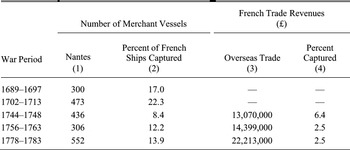
But was privateering also effective in disrupting the enemy's inflow of resources, as desired by mercantilist policies?Footnote 32 For much of our period of interest, France was Britain's main opponent. Accordingly, Table 1 reports the number of captured French prizes and selected data on the volume of French overseas trade between 1689 and 1783. Because consistent statistics on French trade and the size of its merchant fleet are difficult to obtain, the reported values should be treated as estimates.
In the absence of reliable data on the French merchant fleet, we use data for Nantes, which was the premier French port for the Atlantic triangular trade in slaves, sugar, and tobacco.Footnote 33 Using comparative French trade statistics for 1730, 1753, 1766, and 1776, we calculate that Nantes accounted for about 10 percent of the total of French overseas trade.Footnote 34 Column 1 in Table 1 shows the number of merchant vessels fitted out in Nantes. Column 2 reports the fraction of captured French merchant ships. On average, British privateers intercepted about 15 percent of all French merchant ships during periods of war.Footnote 35
Given that a sizeable fraction of merchant vessels was caught, does this also translate into a large monetary loss of French revenues from trade? To address this question, we rely on estimates of the total value of prize goods.Footnote 36 Column 3 reports the revenues from France's overall overseas trade during a selected number of conflicts for which sufficient data are available. Using the total value of British prize goods in each war period, column 4 presents estimates of the fraction of French trade in these periods that fell prey to British privateers. The results suggest that British privateers intercepted on average 4 percent of French overseas trade during the wars of 1744–1748, 1756–1763, and 1778–1783. The overall conclusion, then, is that British privateering was indeed effective and substantially reduced French merchant shipping, and therefore taxable income for the French government to finance wars.
IMPACT OF BRITISH PRIVATEERING ON FRENCH TRADE

Notes:
Column 1 shows the number of merchant ships leaving the port of Nantes. Column 2 lists the fraction of French trade vessels captured by British privateers. The fraction is based on the number of French prizes reported in the Admiralty Court records, divided by the size of the French merchant fleet. The size of the French merchant fleet is estimated based on the assumption that Nantes made up about 10 percent of all French trade (Dardel, Navires). French overseas trade revenues in column 3 are converted from livres turnois, using the exchange rate of 1 pound sterling = 23 livre tournois. Column 4 estimates the percentage of French trade revenues captured by British privateers from the total value of prize goods divided by French trade revenues.
Sources:
For French prizes captured by British privateers, see PRO HCA34; for Nantes merchant ships, see Meyer, L'armament; for total value of prize goods, see Schumpeter, English Overseas Trade; for French Colonial and overseas trade, see Romano, “Documenti”; and Tarade, Commerce Colonial.
EMPIRICAL RESULTS
Scope of British Privateering
During a military conflict, a merchant investor had to decide whether to continue his regular trade, to abandon trade in favor of sponsoring private ships of war, or to combine trading and privateering by fitting out a letter of marque vessel. A merchant's incentive to invest in a letter of marque should grow with the number of potential prizes, irrespective of the particular type of privateering. The overall response of privateers to changes in opportunities for regular trade is a priori ambiguous. Better trading opportunities during war should have discouraged the outfitting of private men-of-war, whose primary source of revenue was prize-taking. In contrast, sponsors and crew on letter of marque ships were attracted to both trade and prize-taking. We argue, however, that regular trade opportunities also imposed costs on letter of marque ships. They carried more guns than regular trade ships (at the expense of cargo) and seizing potential prizes prolonged voyages (increasing the ship's running costs and possibly foregone trade revenues). More important, privateers carried a substantially larger crew to board a potential prize ship, and thus they incurred much higher labor costs than regular trade ships. Consequently, growing opportunities for regular trade probably discouraged both the outfitting of men-of-war and letter of marque ships.
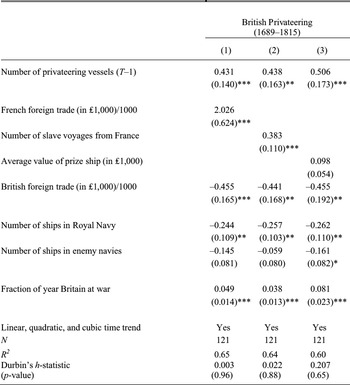
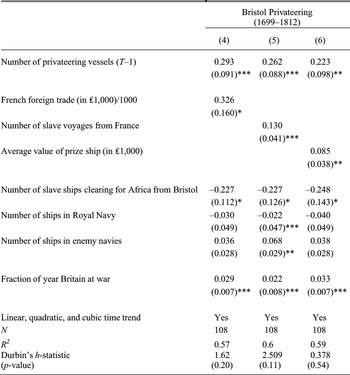
Tables 2a and 2b show how privateering in Bristol and Britain at large was related to economic incentives and the strength of naval forces. The dependent variable is the number of privateering vessels in each year of war. To measure the potential gains from investing in such ventures, we use the volume of French trade, the number of slave voyages originating from France, and the average prize value in a given year. The opportunity costs of privateering ventures are measured by the total value of British trade or, alternatively, by the number of British registered slave voyages. The strength of naval forces is measured by the total number of vessels in the service of the Royal Navy and its main adversaries. All reduced-form specifications include a third-order polynomial of time to adjust for aggregate shifts in world trade, for example, and the fraction of a year that Britain was at war to control for the intensity of conflict.Footnote 37 To address serial correlation in the dependent variable, we include a lagged dependent variable. Durbin's h-statistic shows that residual autocorrelation is negligible.
Our results confirm that privateering increased with the volume of potential prizes (French trade) and declined with opportunity costs (British trade) during war. The latter result indicates that merchant trade and privateering were substitute activities, suggesting that opportunity costs may have increased for both private men-of-war and letter of marque ships (although these costs were probably lower for the latter). We also find that a larger Royal Navy reduced privateering activity: each additional Royal Navy ship reduced the number of vessels armed by merchants by about one-quarter. In contrast, the naval strength of Britain's main adversaries does not seem to have deterred British privateers.
SUPPLY OF PRIVATEERING VESSELS

* denotes significance at the 10 percent level.
** denotes significance at the 5 percent level.
*** denotes significance at the 1 percent level.
Notes:
The table reports results from a regression model with a lagged dependent variable. The dependent variable is the annual number of unique letters of marque commissioned in Britain (columns 1–3) and Bristol (columns 4–6 in Table 2b). Number of ships in enemy navies sums all vessels in the service of the Spanish, French, and Dutch navies. French foreign trade is calculated as the sum of the values of French imports and exports (in 1,000 pounds sterling). Each specification also includes a constant as well as a third-order polynomial time trend (not reported). Robust standard errors are reported in parentheses. Durbin's h-statistic and its associated p-value reported in the last row show that residual autocorrelation is negligible.
Sources:
See the main text.
SUPPLY OF PRIVATEERING VESSELS

* denotes significance at the 10 percent level.
** denotes significance at the 5 percent level.
*** denotes significance at the 1 percent level.
Notes:
See the notes to Table 2a
Sources:
See the main text.
Privateering is systematically related to economic opportunities in our data on Bristol as well (columns 4 to 6). Here, our measure of opportunity costs is the number of slave ships leaving Bristol for Africa. For the potential benefits from privateering, we use France's total trade volume, the number of slave voyages from France, and the average value of prizes captured. As for Britain at large, Bristol's privateering activity increased with its expected revenues and declined with regular trade opportunities. The estimated effects are large. Indeed, an increase in British trade by one standard deviation was associated with 16.3 fewer privateering licenses per year (a 50 percent decline).Footnote 38
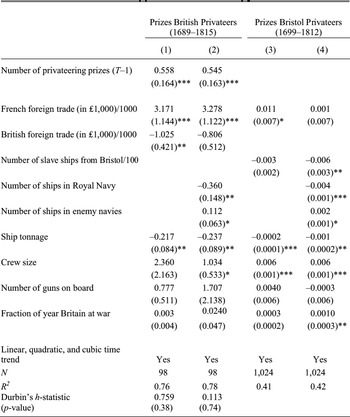
An alternative margin to evaluate privateering is the number of prize ships reported in the Admiralty Court records.Footnote 39 The number of prize ships measures the extent to which the success of some privateers increased the incentives of other merchants to undertake privateering ventures. The dependent variable in Table 3 is the number of prizes seized by British privateers, and, locally for Bristol, whether or not a privateer captured a prize. In addition to the earlier controls, we include the ship's tonnage, number of guns, and crew size. As before, the volume of French trade has a strong and significant positive effect on the success of privateering. Better trade opportunities for British merchants during war had a negative effect on the number of prizes taken, and a larger Royal Navy reduced the number of prizes seized by Bristol privateers, reflecting their ongoing competition for prizes.
THE DECLINE OF PRIVATEERING IN BRITAIN
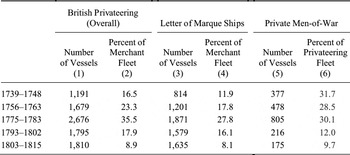
Despite its popularity, privateering activity in Britain declined at the end of the eighteenth century as Table 4 shows. Column 1 documents that privateering in Britain was far less popular in the French Revolutionary and Napoleonic Wars (1793–1815) than during the American Revolutionary War (1775–1783). Once we account for the growth of the merchant fleet, this is even more pronounced: whereas privateers constituted 41 percent of all merchant vessels during the War of the Spanish Succession (1702–1713), the share dropped to 18 percent during the French Revolutionary War and eventually to just 9 percent during the Napoleonic War.Footnote 40
We find a similar decline for letter of marque ships, which supports our argument that opportunity costs rose for both private-men-of-war and letter of marque ships.Footnote 41 Whereas 28 percent of all merchant vessels took out a letter of marque during the American Revolutionary War, that share declined to 16 percent during the French Revolutionary War and to 8 percent during the Napoleonic War (columns 3 and 4). Further, the share of private men-of-war in the privateering fleet declined at the end of the eighteenth century (columns 5 and 6). Whereas such specialized ships made up 30 percent of all privateering vessels in the American Revolutionary War, their share dropped to 12 percent in the French Revolutionary War and to 9.7 percent in the Napoleonic War.Footnote 42 That private men-of-war experienced a faster decline than letter of marque ships supports our argument that increasing trade opportunities changed the decision making of privateering merchants.
DETERMINANTS OF PRIVATEERING SUCCESS

* denotes significance at the 10 percent level.
** denotes significance at the 5 percent level.
*** denotes significance at the 1 percent level.
Notes:
The table reports results from a model with lagged dependent variable in the first two columns and marginal effects from a probit model in the last two columns. The dependent variable is the number of prizes caught by British privateers between 1689 and 1815 (columns 1 and 2) and whether a Bristol privateer captured a prize ship in a given year between 1699 and 1812 (columns 3 and 4). The last row shows that Durbin's h-statistic suggests no residual autocorrelation. Tonnage, crew size, and guns refer to the average ship characteristics of all British privateers in columns 1 and 2 and to the individual Bristol privateering ship (in columns 3 and 4). All specifications include a constant, a linear, quadratic, and cubic time trend. Robust standard errors are reported in parentheses.
Sources:
See the main text.
PRIVATE MEN-OF-WAR AND LETTER OF MARQUE SHIPS

Notes:
Column 1 shows the number of vessels that took out a letter of marque. Column 2 reports the number of privateering vessels as a percentage of the number of British merchant ships. The number of private men-of-war in column 5 is calculated from the Letter of Marque Declarations as follows: all vessels below 100 tons and a ton-per-man ratio of 2.5 or vessels above 100 tons and a ton-per-man ratio of 2.5 or less excluding the ships operated by the East India Company (see Starkey, 1990b, p. 294 for details). The percentage in column 6 is calculated as column 5/column 1. The number of letter of marque ships in column 3 is calculated as column 1–column 5. Column 4 is calculated by dividing column 5 by the size of the merchant fleet (net of private men-of-war).
Sources:
PRO, HCA 25 and 26; Meyer, “English Privateering in the War of 1688–1697” and “English Privateering in the War of Spanish Succession”; and Starkey, British Privateering and “Restless Spirit”; for trade ships in Britain, see Usher, “Growth.”
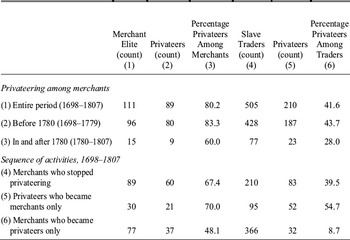
The same trends recur in Bristol. To compare the importance of privateering and trade activities, we collected the names of Bristol's merchant elite and their revenues from trade in three key commodities: tobacco, sugar, and slaves.Footnote 43 After merging this information with our data on Bristol privateers, we have information on 111 Bristol merchants engaged in regular commerce, privateering, or both activities. We complemented these data with information on slave voyages sponsored by Bristol merchants. From the Transatlantic slave trade database, we extracted all voyages departing from Bristol between 1698 and 1807.Footnote 44 These data include the year of the voyage and a list of all owners and captains and provide us with 505 Bristol investors in the slave trade. We merged this information to our data on privateering using the names of slave shipowners.
The first data set covers a broader set of trade activities while the second includes the population of Bristol merchants engaged in the slave trade. Each contains the years when a merchant first and last engaged in trading activities as well as the first and last year he sponsored raiding ventures. Using the sequencing of both activities, this information allows us to document the decline of privateering. The top rows of Table 5 show that investment in privateering was widespread among the older generation of Bristol merchants. Eighty-three percent of the merchant elite and 44 percent of all slave traders who traded prior to 1780 took out letters of marque (row 2).Footnote 45 These percentages are substantially lower among merchants who started their trading activities after 1779. By then, only 60 percent of the merchant elite and merely 28 percent of all slave traders participated in privateering ventures (row 3). The decline is statistically significant in both cases.
If commerce raiding truly became less attractive, then we should observe that Bristol merchants turned to regular commerce. To consider this change, we first calculated the fraction of merchant privateers who ceased to apply for letters of marque but continued their regular trade activities. We find that 67 percent of the merchant elite and almost 40 percent of slave traders in Bristol gave up privateering in favor of trade (row 4).Footnote 46 Further, we considered whether or not those who started out as privateers stopped taking out letters of marque and turned to regular trades instead. We find that between 55 and 70 percent of former privateers eventually specialized in trade (row 5). The reverse pattern, merchants who gave up regular trade in favor of privateering, was far less common (row 6).
DECREASING IMPORTANCE OF PRIVATEERING IN BRISTOL, 1698–1807

Notes:
The left-hand side of the table (columns 1 through 3) reports privateering activities among the Bristol merchant elite engaged in the sugar trade (covering activities in 1728–1800), tobacco trade (covering 1728–1799), and slave trade (covering 1698–1807). The right-hand side (columns 4 through 6) reports privateering among all Bristol merchants engaged in the slave trade (covering 1698–1807). The first three rows show that privateering declined relative to merchant activities in Bristol over time. The fourth row shows the number (columns 1–2 and 4–5) and fraction (columns 3 and 6) of merchants whose privateering activity is known to have ended before their trade investments. The fifth row shows the number and fraction of merchants who started out as privateers and ended as merchant traders. The final row 6 calculates the number and fraction of merchants who switched completely from regular trades to privateering.
Sources:
Eltis et al., Transatlantic Slave Trade; Morgan, Bristol; Powell, Bristol Privateers; and Richardson, Bristol Slave Traders.
RISING OPPORTUNITY COSTS AND DECLINING REVENUES
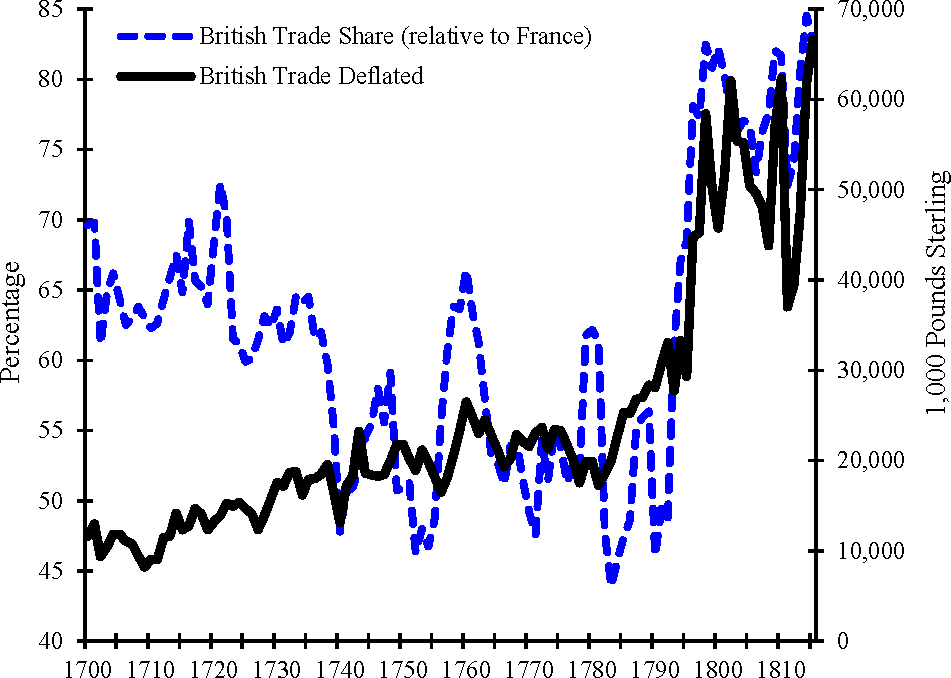
The eighteenth century, especially in its latter half, witnessed an unprecedented increase in international trade. By the beginning of the nineteenth century, Britain's international trade grew at an annual rate of 3 percent, three times faster than a century earlier.Footnote 47 This growth was largely driven by overseas expansion, especially the exchange of valuable goods with the colonies. The percentage of imports coming from overseas destinations (North America, the West Indies, and Asia) into Britain grew substantially from 33.6 percent in 1700 to 58.5 percent in 1816.Footnote 48 British trade expansion could have reduced incentives for privateering only if it grew faster than the trade of states whose merchant ships were the primary targets for British privateers. If the commerce of Britain's adversaries expanded just as much, they would have provided more targets and possibly higher profits for privateers. Figure 1 traces the evolution of British trade over our sample period. The solid line documents that British trade (the sum of imports, exports, and re-exports) was growing continuously during the eighteenth century and rapidly so after the American Revolutionary War. The dashed line traces British trade relative to French trade over the same period. Between 1700 and 1784 Britain's trade share shows a long-term decline from 70 percent to 45 percent.Footnote 49 After 1783 the trend is reversed: Britain's trade share increased and even jumped to over 80 percent at the end of the century.Footnote 50 That British trade expanded relative to France is also visible from evidence on trade disruption during the French Revolutionary and Napoleonic Wars: “What is particularly noticeable in the French case is the enormous decline in trade between the eve of the Revolution, 1787–1789, and the first post-Revolutionary year for which we have data, 1797. Export volumes in the latter year were a mere 36 percent of their pre-Revolution level; import volumes had declined by 55 percent. This collapse was largely due to the collapse in trade with France's overseas colonies, particularly Santo Domingo.”Footnote 51
THE EXPANSION OF BRITISH TRADE, 1700–1815
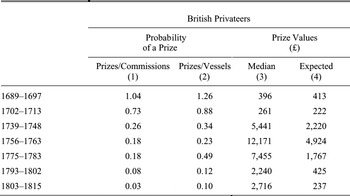
The decline in French trade coincided with falling privateering revenues. Table 6 shows that British privateers' probability of catching a prize decreased sharply after 1793. The average probability, calculated as the total number of prizes divided by the total number of privateering commissions in a given war, fell from 0.73 prizes per commission in the 1702–1713 war to less than 0.10 prizes per commission at the end of the eighteenth century. Likewise, the median value of prizes condemned in the Admiralty Court declined over the same period (column 3).Footnote 52 The expected revenue of a privateering commission fell from its peak of £4,924 during the Seven Years' War to just £237 during the Napoleonic War (all values are reported in real terms). In contrast, average proceeds from the slave and sugar trades rose continuously of the eighteenth century (except for the period just before the abolition of the slave trade in Britain in 1807).Footnote 53
Nevertheless, privateering could have remained valuable if the costs for undertaking privateering cruises declined faster than those for fitting out merchant ships. The available evidence, however, suggests that both outfitting and running costs were quite similar for privateering and regular trade ships.Footnote 54 For example, real wages for seamen were very similar on merchant and letter of marque ships. Wage costs accounted for about one-third of overall costs and more than doubled (from 38s to 98s in real terms per month and man) between the War of Spanish Succession and the French Revolutionary and Napoleonic Wars. Although crew sizes fell in the first half of the eighteenth century (on both trade and privateering ships), we find little change in the number of seamen on board of privateers in Britain and Bristol after 1750.Footnote 55 Hence, a decline in privateering revenues relative to trade revenues implied a decline in the profitability of privateers relative to merchant trade.
DECLINE OF EXPECTED REVENUES FOR BRITISH PRIVATEERS

Notes:
The probability of taking a prize is calculated as the number of prizes divided either by the number of commissions (column 1), or by the number of privateering vessels (column 2). The number of privateering vessels is calculated by counting the number of distinct vessels (based on the name of the ship, its home port, and tonnage). Prize values are deflated using 1700 as the base year. Expected prize values in column 4 are calculated as the mean prize value times the probability of a prize for a British vessel (column 2) in the respective war.
Sources:
For British privateering data, see PRO HCA records; and Starkey, British Privateering.
Overall, we find a strong association between the rising attractiveness of trade and the documented decline in privateering activities after 1783. Can the expansion of trade opportunities and the declining proceeds from prize-taking account for the observed reduction in British privateering at the end of the eighteenth century? In our 10 percent sample, the mean number of privateering vessels per year at war declined from 65 vessels between 1760 and 1783 to 35 vessels between 1784 and 1815. Using the regression results in Table 2a (column 1), changes in British and French trade together account for 61 percent of the observed decline in British privateering ventures after 1783.Footnote 56
ALTERNATIVE EXPLANATIONS
Trade Protection and Productivity
The rapid growth in British overseas trade and its rapid expansion relative to French trade clearly preceded the decline in privateering, which occurred only after the American Revolutionary War.Footnote 57 Our argument thus seems to contradict the findings of Douglass North, James Shepherd, and Gary Walton. In their view, the decline in piracy and privateering was a prime source of productivity growth in British shipping during the first half of the eighteenth century.Footnote 58 A closer look reveals that the two stories complement rather than contradict each other. First, we focus on the incentives for British merchants to sponsor their own privateering cruises against Britain's enemies, and not on the external threats of pirates and enemy privateers to the British merchant marine. Second, we consider trade expansion after about 1780 and its effect on British privateering thereafter, and not the role of the navy in protecting trade before 1750.Footnote 59
TRADE PROTECTION BY THE ROYAL NAVY IN THE WEST INDIES, 1689–1807

* denotes significance at the 10 percent level.
** denotes significance at the 5 percent level.
*** denotes significance at the 1 percent level.
Notes:
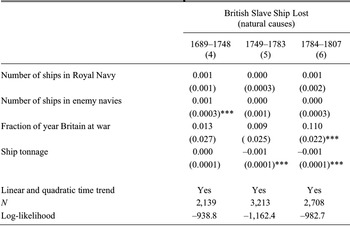
The table reports marginal effects from a probit model in three different time periods: 1689–1748, 1749–1783, and 1784–1807. The dependent variable in columns 1–3 is whether or not a British slave ship was taken during a voyage or sunk due to enemy action. In Table 7b columns 4–6, the dependent variable is whether or not a British slave ship was lost due to natural hazards (e.g., storms). All specifications also include a linear and quadratic time trend. Robust standard errors clustered at the year level are reported in parentheses.
Sources:
See the main text.
The navy's protection along many overseas routes was far from fully effective by 1750. Even after 1750 British slave ships, for example, still faced a 9 percent higher probability of being captured or sunk through enemy action during periods of war (when privateers were cruising for prizes) than during periods of peace.Footnote 60 Clearly then, the slave trade was still vulnerable to pirates and enemy privateers.
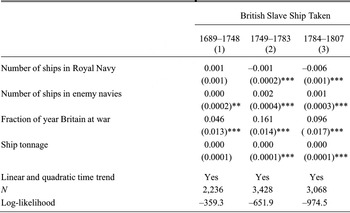
Tables 7a and 7b consider to what extent the Royal Navy lowered the risk of capture for British slave ships during three periods: 1689–1748, 1749–1783, and 1784–1807. The reported coefficients are marginal effects from a probit model. Table 7a reveals that the Royal Navy's protection of British slave ships improved over time. While there is no relationship between the size of the Royal Navy and the probability of being captured before 1749, the relationship is significantly negative after 1748 and especially after 1783. The estimates suggest that an increase in navy size by 15 ships (one-fifth of a standard deviation) reduced the probability of being caught by 9 percent in the period 1784–1807.
TRADE PROTECTION BY THE ROYAL NAVY IN THE WEST INDIES, 1689–1807

* denotes significance at the 10 percent level.
** denotes significance at the 5 percent level.
*** denotes significance at the 1 percent level.
Notes:
See the notes for Table 7a.
Sources:
See the main text.
Certainly, the correlation between risk of capture and navy size could be an artifact of other developments that were correlated with navy growth. However, Table 7b shows that ship losses due to natural hazards like storms were unrelated to the size of the Royal Navy in all three periods. This test suggests that it was indeed the strength of the Royal Navy that made Britain's slave trade more secure after 1783. A lower risk of capture reduced the cost of slave voyages, and increased their profitability even after 1750.
British ships engaged in the slave trade or owned by the East India Company still carried guns after 1750, which suggests that trade routes were either not entirely secure, or that these same merchant ships were employed as letter of marque vessels during periods of conflict. While guns and guns-per-man declined prior to 1750, both indicators also continue to fall in the second half of the eighteenth century.Footnote 61 Hence, a reduction of piracy and enemy privateering as identified by North, Shepherd, and Walton is one plausible mechanism why trade expanded and reduced incentives to engage in commerce raiding. In our view, however, this process was not complete by 1750 and continued until the end of the eighteenth century.
COMPETITION WITH THE ROYAL NAVY
An important alternative cause of the decline of privateering may have been the competition between commissioned and Royal Navy ships. It might be that navy interests used political means to curb this competition. These political pressures might have limited privateering enterprise to such an extent that it lost its profitability, and consequently its attraction for the merchants.Footnote 62 There is however little conclusive evidence that lobbying by the naval interest reduced the availability of commissions.Footnote 63
We first turn to the competition for able seamen. Solving the manning problem was a perennial issue for the Royal Navy.Footnote 64 The continued reliance on press gangs alone attests the difficulty the Royal Navy often had in recruiting adequate crew numbers for their ships. Competition by privateers that lured seamen away with promises of lucrative prizes certainly did not help.Footnote 65 For instance, in the years of war 1744, 1757, and 1781, between 11 and 14 percent of the maritime workforce was employed on privateering vessels.Footnote 66 That privateers drained manpower from the Royal Navy therefore cannot be denied.Footnote 67 However, did excess demand for seamen become so severe toward the end of the eighteenth century that the Royal Navy tried to curb the recruitment of seamen by privateers (which then led to the observed decline in privateering)?
THE NUMBER OF SEAMEN ON ROYAL NAVY SHIPS, MERCHANT VESSELS AND PRIVATE MEN-OF-WAR

Notes:
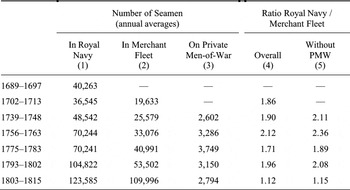
The table reports the annual average of seamen employed in the Royal Navy (column 1) and in the merchant fleet (column 2). The number of seamen on private men-of-war in column 3 is calculated from letter of marque documents using Starkey's definition of a private men-of-war (below 100 tons and ton-per-man ratio below 2.5, or above 100 tons and ton-per-man ratio above 2.5). Columns 4 and 5 show the ratio of seamen employed in the Royal Navy relative to the merchant fleet (including private men-of-war): column 4 = column 1/column 2 and (excluding private men-of-war): column 5 = column 1/(column 2 – column 3).
Sources:
For the Royal Navy, see Rodger, Command; for the merchant fleet, see Davis, “Seamen's Sixpences”; for private men-of-war, see PRO HCA 25 and HCA 26, and Starkey; “War and Market.”
To address this question, Table 8 compares levels of seamen enlisted in the Royal Navy with those employed on merchant and privateering vessels between 1739 and 1815. Information on manning in the Royal Navy comes from the 1859 Hardwicke Commission. The data series include annual numbers of officers and men in the naval service that were entered on a ship's books. We estimate the corresponding number of seamen in the merchant fleet from the seamen's sixpences.Footnote 68 The sixpence accounts can be read as annual records of employment in the merchant marine. The reason we begin our comparison with the War of the Austrian Succession and not earlier is that privateering crews were exempt from payment before 1746. The number of seamen employed in the merchant fleet also contains the number of seamen employed on private men-of-war (and not just genuine merchantmen and letter of marque vessels) whose primary goal was commerce raiding and not regular trade. To separate manning levels in trade from those of privateers, we use Starkey's definition of private men-of-war (see the data section above).
Table 8 shows two noteworthy patterns. If the navy's manning problem was indeed responsible for the decline of privateering, then the manning requirement of the Royal Navy should have increased substantially relative to the merchant fleet (including and excluding private men-of-war) during the 1793–1815 wars, compared to earlier conflicts.Footnote 69 While the number of seamen enlisted in the Royal Navy increased more than threefold over the period (column 1), so did the number of merchant and privateering seamen (column 2). Most important, the ratio of average navy over average merchant and privateering crew numbers did not rise systematically over time. It did indeed grow from 1.90 in 1739–1748 to 2.12 in 1756–1763 (column 4). The ratio fell to 1.71 during the American Revolutionary War (1775–1783), then rose again to 1.96 during the French Revolutionary War (1793–1802), and finally became much more balanced again (1.12) during the Napoleonic War (1803–1815).
The second pattern that emerges from Table 8 is that employment in the merchant fleet grew overall, but fell for private ships of war that specialized in raiding. For example, the number of seamen on private men-of-war fell from an average of 3,749 during the American Revolutionary War to 2,794 in the Napoleonic War (column 2). This pattern suggests that private men-of-war ventures became much less attractive than either pure trade or letter of marque voyages after 1783.
Hence, enlistment data indicate that the navy interest failed to curb the recruitment of seamen by merchant ships and privateers. Another important challenge to our argument is that it was the improved effectiveness and professionalization of the Royal Navy that led to the decline of privateering. Yet, the argument that the Royal Navy crowded out privateers rests on the assumption that privateers and naval forces were substitutes for each other (since both pursued prize-taking).Footnote 70 But the historical record also suggests specialization. Unlike navy ships, privateers were poorly equipped to attack enemy warships or large Spanish register ships (joining forces as in the Royal Family privateering fleet seems to have been the exception).Footnote 71 Privateers were also of limited use for commercial blockades or convoying trade ships, two of the central services performed by the navy.Footnote 72
Despite these caveats, is there any indication that the navy simply became better at performing the tasks of maritime warfare, and prize-taking in particular, compared to privateers?Footnote 73 Our results on trade and privateering indicate the contrary. The estimates in Tables 2a and 2b provide a basis to compare the role of trade to the direct crowding out by the Royal Navy. As discussed above, the rise in British trade and the decline in French trade together account for 54 percent of the decline in British privateering activity between 1783 and 1815. In comparison, the growth of the Royal Navy accounts for just 13 percent of the decline in privateering within the same period.Footnote 74
Finally, we find strong evidence that the level of activities (in Table 4) and employment (in Table 8) for private ships of war declined strongly, both in absolute terms and relative to letter of marque ships. If the professionalization of the Royal Navy was indeed primarily responsible for the demise of privateering, then it remains puzzling why the Royal Navy successfully crowded out private men-of-war but not letter of marque ships as well. Instead, the declining employment share in specialized commerce raiding, together with employment growth in regular trade adds support to our argument that expanding trade opportunities made privateering in Britain less attractive.
CONCLUSION
As we have seen, a more professional navy did not simply substitute for privateers over time. We certainly do not mean to suggest that advances in the technology, organization, and financing of the Royal Navy did not happen. But our findings suggest that the substantial decline of privateering enterprise occurred before the onset of a Pax Britannica on the seas in 1815, namely just after the American Revolutionary War. We further show that this decline was driven by the growth in overseas trading opportunities. The mechanism we stress in this article is that the expansion of British trade, both in absolute terms and relative to French trade, increased the opportunity costs for those who remained wedded to privateering and did not specialize in long-distance commerce. The Royal Navy played its own critical part in this development because of its rising effectiveness in protecting overseas trade.
Some historians likewise question the argument that competition with the navy and the privateers' strategic ineffectiveness in maritime warfare were primarily responsible for their decline. For the government, it was not so much a question of how privateering could be contained, but rather how state navies and privateers could be combined into an effective attacking force.Footnote 75 The important general point here is that much has been made of the strategic military role of privateers for a state's sea power, while the existing evidence indicates that the mercantile classes who invested in privateering ventures did so primarily in pursuit of business interests. As Daniel Baugh put it, “war conceived as war for trade and profit is little more than a business enterprise.”Footnote 76 Our findings thus support the view that the decline of privateering had just as much to do with changes in the maritime economy and in the economic organization of merchant enterprises as with concerns of the state's sea power.