Why do you want to study “these” children? They are not like ours.
– a white, public Pre-K teacher speaking to Dr. Cynthia García Coll in Providence, RI
It should be recognized that children of the poor do not represent a homogeneous group. Rather, these children differ greatly in the diverse patterns of strengths and weaknesses which characterize their behavior.
– Dr. Robert E. Cooke, Chairman, Head Start Planning Committee, hearing before U.S. Senate Committee on Labor and Public Welfare, 1970
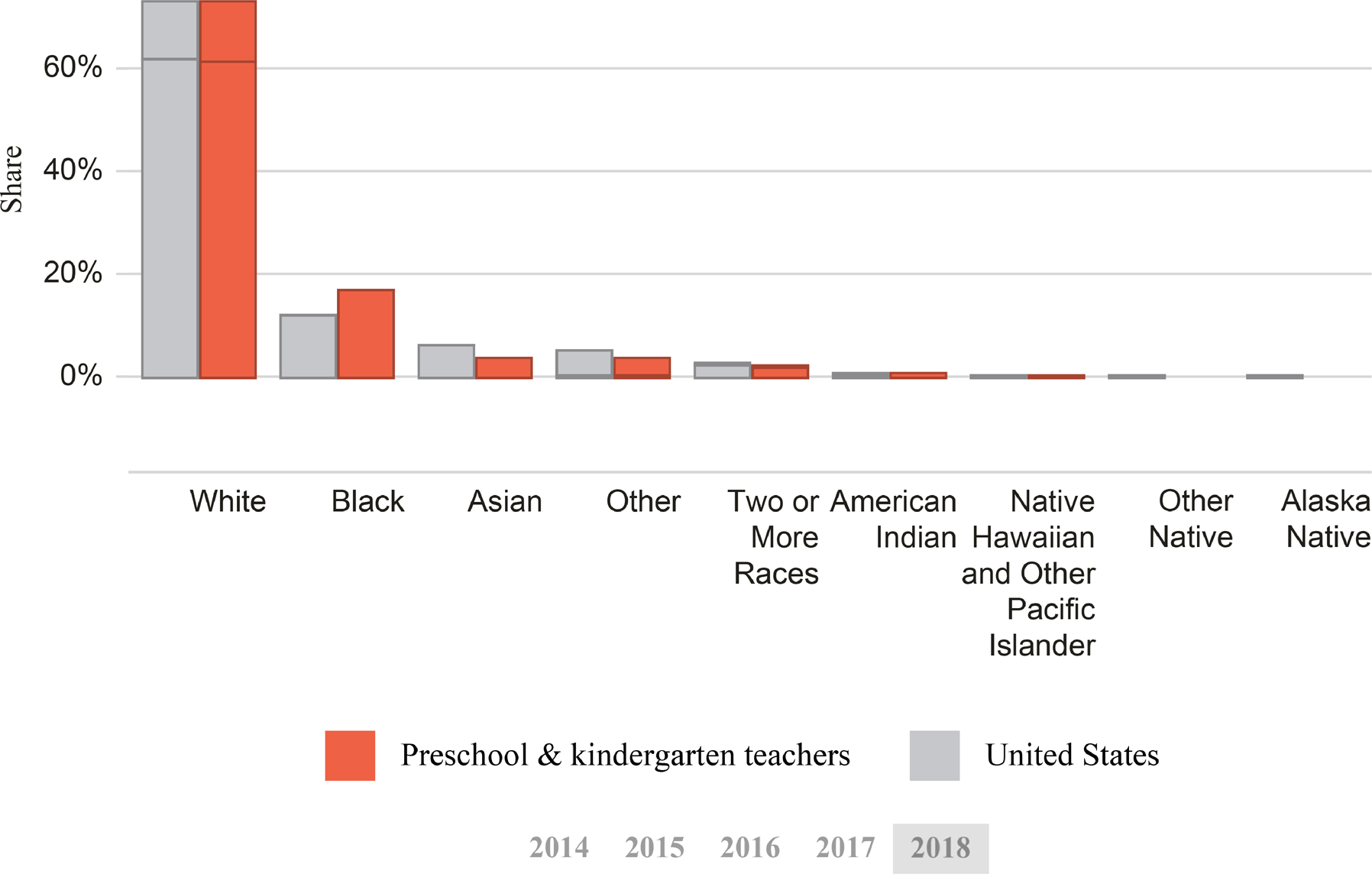
On April 6, 2011, a New York Times headline announced, “Numbers of Children of Whites Falling Fast” (Tavernise, Reference Tavernise2011; as cited in Frey, Reference Frey2015). As it turns out, 2011 became the first year in American history that more babies were born to non-white populations than to white populations. We observe that in 2014, this demographic shift was accompanied by another important demographic trend. The American Community Survey (ACS) and Public Use Microdata Sample (PUMS) files showed us that 72.8% of preschool and kindergarten teachers in the United States classified themselves as “white,” making this the most common “race” in the occupation (USDE, 2018; see Figure 1.). Why are these two demographic trends important? Gilliam, Maupin, Reyes, Accavitti, and Shic (Reference Gilliam, Maupin, Reyes, Accavitti and Shic2016) used eye-tracking technology to observe preschool teachers, and the data showed that such teachers tended to base classroom observation on the gender and race of the child. Findings suggested that when the preschool teacher and child were of the same race, knowing about family stressors led to an increased amount of empathy shown by the teacher toward the preschooler and a decrease in the severity of the behaviors as observed by the teacher (Gilliam et al., Reference Gilliam, Maupin, Reyes, Accavitti and Shic2016; Hathaway, Reference Hathaway2016; Linker, Reference Linker2019).
This chart shows the racial and ethnic breakdown of preschool and kindergarten teachers in a public use sample from the Census Bureau and ACS PUMS 1-Year Estimate. Source: US Department of Education, The American Community Survey (ACS) and Public use microdata sample (PUMS) ACS-PUMS 1-year data. US Department of Education, Institute of Education Sciences, National Center for Education Statistics. This table was prepared on June 15, 2019. (USDE, Reference Peters, Margolin, Fragnoli and Bloom2016).

However, when the teacher and child were of a different race, the same family information seemed to overwhelm the teachers, and the behaviors were perceived to be more severe. This perceptual bias might explain why those children were “more frequently identified as misbehaving and hence why there is a racial disparity in discipline” (Gilliam et al., Reference Gilliam, Maupin, Reyes, Accavitti and Shic2016; Hathaway, Reference Hathaway2016, p. 1; Linker, Reference Linker2019).
In addition, during the last 30 years, research on discriminatory behavior (racism) has shown to be a pervasive and daily stressor in the lives of people of color with serious consequences for children's development (Causadias & Umaña-Taylor, Reference Causadias and Umaña-Taylor2018; García Coll et al., Reference García Coll, Lamberty, Jenkins, McAdoo, Crnic, Wasik and Vázquez García1996). Research demonstrates that children's awareness of racial differences and the effects of internalized racism within environmental structures (e.g., school, hospital, home, and community) begins in early childhood (Marks & Garcia Coll, Reference Marks and Garcia Coll2018; NAEYC, 2018; Tatum, Reference Tatum2003; Winkler, Reference Winkler2009). Multiple studies also document the ways that young children learn and think about racial differences and note that, as early as preschool, children feel the effects of personal, institutional, and structural racism after becoming conscious of the differences in their own physical characteristics and the physical characteristics and behaviors of the professionals in the environment (García Coll et al., Reference García Coll, Lamberty, Jenkins, McAdoo, Crnic, Wasik and Vázquez García1996; Marks & Garcia Coll, Reference Marks and Garcia Coll2018; Trent, Dooley, & Dougé, Reference Trent, Dooley and Dougé2019; Winkler, Reference Winkler2009).
Implementing culturally conscious practices is especially important for children in the 3- to 5-year-old range who are preparing for kindergarten, as their developmental understanding of their skin color in contrast to their white teachers is a core component of their identity development (Derman-Sparks, Reference Derman-Sparks2019). Based on this evidence, interdisciplinary services supporting children's early learning experiences run the risk of condoning structural racism if they fail to proactively engage in strategies to optimize clinical care, workforce development, professional education, systems engagement, and research “in a manner designed to reduce the health effects of structural, personally mediated, and internalized racism and improve the health and well-being of all children” (Trent et al., Reference Trent, Dooley and Dougé2019, p. 1).
Thus, our approach to Edward Zigler's contribution to early childhood development (ECD) is informed by the demographic shifts outlined above, our historical analyses of the prevalent notions of diversity at that time, and our emerging knowledge about how racism affects children's development. As the principal architect of Head Start, what was Zigler's understanding and vision of the role of culture in children's development? How was this knowledge incorporated in ECD personnel training programs? What are the limitations of this approach for the daunting task of educating the most diverse population of schoolers in this country? We will end with recommendations for professional development for the ECD field.
Zigler and Head Start
Over 50 years ago, President Lyndon Johnson announced the launch of a federally funded experiment for 5- and 6-year-olds who, he believed, were the “inheritors of poverty's curse” (Johnson, Reference Johnson1965). Established in 1965 as part of Johnson's “war on poverty,” the goal of this experiment was to promote school readiness by providing health, educational, nutritional, and social services. For the first time in American history, the US government-funded education and health services for children living in poverty in the form of a public preschool program called “Head Start.” During the first summer of its implementation, according to several documents about the initiatives of social programming in the 1960s, the Head Start program served 530,000 children in 11,000 centers at the cost of $112 million, or $857 million in today's dollars (Mongeau, Reference Mongeau2016). “This program this year means that 30 million man-years – the combined lifespan of these youngsters – will be spent productively and rewardingly, rather than wasted in tax-supported institutions or in welfare-supported lethargy,” President Johnson promised to the American People in a public speech on May 18, 1965 (Johnson, Reference Johnson1965). What began as a summer program implemented for preschool children by the president's Office of Child Development was later expanded to serve families year-round. There was a long history of intervention programs for poor children before the inception of Head Start; nevertheless, even in the 1970s, only 42% of 5-year-olds were entering kindergarten, and the majority were from middle-class families (Rioux, Reference Rioux1967; Vinovskis, Reference Vinovskis2005; Zigler & Styfco, Reference Zigler and Styfco2010).
In 1970, President Nixon appointed Dr. Edward Zigler, a developmental psychologist, social policy expert, and head of the Yale Child Center at the time, as the first full-time director of the US Office of Child Development, the predecessor to the institution now known as the US Administration for Children and Families (Zigler & Muenchow, Reference Zigler and Muenchow1992). Zigler became the principal architect of Head Start and social programming for “poor” preschoolers across the United States and turned his attention to the discrepancies in access to public education between families living in poverty and those from more affluent communities (Zigler & Muenchow, Reference Zigler and Muenchow1992). Zigler commented on why he believed this was the case:
Head Start is far from perfect, and the reality has often not measured up to the possibility, but there was something about Head Start that was able to bring together diverse people for the sake of the children, and, more than 25 years later has the capacity to inspire people. (Zigler & Muenchow, Reference Zigler and Muenchow1992, p. 1)
Throughout several of his narratives, Zigler mentions that his social programming engendered hope, inspiring many “to believe once more that it is possible to set the next generation of American children and families on a course toward a better life” (Zigler & Muenchow, Reference Zigler and Muenchow1992, p. 30).
These services were themselves forward-thinking and progressive for their time:
[The] rapid implementation [of Head Start] was taking place in a nation that, at the time, had very little experience with early childhood programs. Kindergartens did not even exist in 32 states, and prekindergarten programs for four-year-olds were unheard of. (Zigler & Muenchow, Reference Zigler and Muenchow1992, p. 30)
There were many small-scale early intervention programs targeted at disadvantaged children, “or those at risk of mental retardation” (Zigler & Muenchow, Reference Zigler and Muenchow1992, p. 31). However, many of these programs were being carried out independently with little sharing of knowledge or information between them until Head Start gave them a focal point that linked them together. As an associate professor at Yale, Zigler focused his attention on the program's initial planning and implementation during President Johnson's “war on poverty.” Sensitive to the fact that women were entering the workforce in greater numbers and the percentage of single-parent households was rising, he called for schools to act as neighborhood social service centers providing daycare, medical services, and recreation, as well as academic training (Zigler & Muenchow, Reference Zigler and Muenchow1992).
During the period from the 1960s to 1990s Zigler developed performance standards for measuring the effectiveness of Head Start, and independent studies have generally found that the program has had beneficial effects on children, making them more productive in school and less likely to become “burdens” on society. Since its inception, Head Start has reached over 10 billion children and disseminated its compensatory education all over the nation. More than 35 million have gone through Head Start programs, which now serves more than 1 million children each year (Vinovskis, Reference Vinovskis2005).
Zigler's Ideas and Visions on Diversity
It comes as no surprise that the investment in children at an early age is critical for every child's cognitive and social–emotional development. For children in need of early intervention preschool programs, which are considered “high risk,” early intervention programs such as Head Start help level the playing field and ensure that every child is given the opportunity to make a healthy start. However, we must ask if Head Start and other quality preschool programs are actually the grand equalizers of our society as they are often presented to be. All too often, the difference between a life of promise and life in peril hinges not on a student's potential but on the quality of the child's school (Duncan, Reference Duncan2018).
We also consider that, as the diversity of the young population in the US increases and surpasses that of white children, the underlying conceptualizations of culture, ethnicity, and racial differences, what is now called “diversity,” needs to be ascertained. How were these differences conceptualized by Zigler and reflected in Head Start practices? What are the legacies of these conceptualizations today?
In order to thoroughly document Zigler's conceptualization and use of cultural “diversity” in shaping Head Start, we elected to engage a content analysis of his use of various terms. Using a library database in addition to PsychLit, we identified a total of 10 books and 10 articles written by or about Zigler describing the development of Head Start programming. Data were categorized using keywords, such as “culture,” “race,” and “diversity,” in order to examine how such terms have been used within the literature to describe non-white populations, their needs, and programming in Head Start. We conducted searches for the terms “diversity,” “ethnicity,” and “culture” in all tables of contents, indexes, and in the content of the literature. Then, we entered this data set in NVivo's data analysis software. These keyword searches were then coded and organized, and several themes emerged. By using a historical–comparative approach to disambiguate the notion of culture throughout Zigler's narratives, we critically interpreted these documents in order to present pertinent aspects both of the progressiveness, and limitations, of his thought and approach.
Cultural deprivation
Zigler's initial conceptualization of diversity was based on the notion of culture as a deprivation, the most prevalent model of culture used in the 1960s (García Coll, Akerman, & Cicchetti, Reference García Coll, Akerman and Cicchetti2000). This notion was used to suggest that children's intellectual deficits were not due to genetic differences, but to marginalized cultural family processes, a rather progressive theoretical position for its time. In their analyses of the research literature on children's development in the 1960s, García Coll et al. (Reference García Coll, Akerman and Cicchetti2000) found that this model of culture was the most prevalent, as “cultural deprivation could be invoked as a key explanation for developmental deviations” (García Coll et al., Reference García Coll, Akerman and Cicchetti2000, p. 335). This cultural deprivation model served as the foundation for many programs implemented by President Johnson under the auspices of his “war on poverty,” including Head Start. One of the foundations on which this model is based is the assumption that social programs were a pathway for poor children and families to rise out of poverty. In fact, in one of Zigler's first publications on American childcare, Childcare Choices (Zigler & Lang, Reference Zigler and Lang1990), he explained the need for high-quality childcare as “a long-awaited definitive anatomy of the American childcare system… to meet the needs of a changing society” (p. 1). He goes on to explain that the problem is that while the mother works, children are cared for by others, “all too often in environments that compromise the children's cognitive and social development” (Singer, Golinkoff, & Hirsh-Pasek, Reference Singer, Golinkoff and Hirsh-Pasek2006). Built into these statements is the assumption that children in low-income families are deprived of the cultural resources available to children in more affluent circumstances because they lacked supportive environments and adequate access to education, proper dietary nutrition, and social services. Implicit in these assumptions is the privileging of white middle- and upper-middle-class culture and the view that other cultures that did not afford the same opportunities were deprived and needed remediation.
As such, culture is seldom mentioned throughout Childcare Choices, apart from a short discussion in Chapter 7, entitled “The challenge of providing child care for children with special needs.” Zigler and Lang (Reference Zigler and Lang1990) define children with special needs as those who are “physically, or mentally handicapped, chronically ill, bilingual, from migrant families, and/or emotionally disturbed” (p. 144). The authors examine how these special populations often confront barriers to having “special childcare needs met.” Being “bilingual” or an “immigrant” was explicitly conceptualized by Zigler and Lang as a source of deficits, and such children are grouped with and are suggested to be considered analogous to other “deficient” groups of children such as those who are physically and emotionally ill or “handicapped” (Reference Zigler and Lang1990, p. 144).
Zigler and Lang go on to explain that the majority of bilingual American children are of Hispanic origin and are immigrants who are trying to establish a new home and place in American society. They explain that the majority have minimal skills adaptable to the American workplace, so they are relegated to entry-level and low-paying jobs (PEW, 2016; Zigler & Lang, Reference Zigler and Lang1990). Zigler and Lang (Reference Zigler and Lang1990) posit that these families are “attempting to become ‘Americanized,’ so their children should be exposed to the mainstream language and practices” (p. 148). American childcare settings are further explained as “hosts” for “migrant families,” denoting that middle-class daycare institutions should function as “host families,” who are themselves in need of “bilingual caregivers sensitive to the cultural needs and values of these children” (Zigler & Lang, Reference Zigler and Lang1990, p. 148).
Thus, Head Start was seen, in part, as an acculturation vehicle, through which children would learn the dominant culture and language and advance up the US socioeconomic ladder (Zigler, Reference Zigler1996). This goal was clearly stated, two years later in the book Head Start: The inside story of America's most successful educational experiment, in which Zigler and Muenchow (Reference Zigler and Muenchow1992) proclaimed that Head Start helped the next generation of “American children and families on a course toward a better life” (Preface). The value judgment inscribed in Head Start's mission is thus explicit and unambiguous.
The “Pushback”
Research in the 1960s on the figure of the young “disadvantaged” child was woven into the long history of school education for poor children and research documenting poor children's problems (Beatty & Zigler, Reference Beatty and Zigler2012; García Coll et al., Reference García Coll, Akerman and Cicchetti2000). Beatty and Zigler (Reference Beatty and Zigler2012) states, however, that, in the late 1960s and early 1970s, “the ground under preschool intervention and compensatory education shifted rapidly as critique upon critique followed in rapid succession” (p. 16). The notion of early intervention came into question as some psychologists, sociologists, and educators rejected the concept of cultural deprivation as “scientifically unsound” and “racially biased” (Beatty & Zigler, Reference Beatty and Zigler2012, p. 16).
The criticisms and debate within and regarding Head Start were acknowledged in Zigler's book on the inside history of Head Start (Zigler & Muenchow, Reference Zigler and Muenchow1992, Preface). In this work, one of the first mentions of culture appeared in the story of one of the Head Start committee members, Mamie Clark, who Zigler and Muenchow (Reference Zigler and Muenchow1992) explain “shot down” the suggestion to screen children for retardation because she felt IQ testing would discriminate against minority children (p. 3). Zigler and Muenchow's opinion was that she showed “keen foresight” because the heated controversy over the cultural fairness of IQ tests was gaining popularity at the time. The debate spread into the realm of parent education:
James Hymes Jr., a committee member who was then a professor of early childhood education at the University of Maryland, wanted a much more professional early childhood program, taught exclusively by staff with degrees in early childhood education. At the other extreme, Mamie Clark, one of the black scholars on the committee, initially opposed the whole ideal of parent education in Head Start because she feared it might disparage black culture or attenuate its strength. Clark was reacting against the ‘deficit model,’ which was popular in the sixties and which equated poverty with ‘cultural deprivation” (p. 3.)
In response to this debate, Zigler and Muenchow (Reference Zigler and Muenchow1992) emphasized Urie Bronfenbrenner's 1976 ecological model, stating that their approach “was never tied to overcoming some alleged cultural deficit,” and continued to argue that, in light of Bronfenbrenner's theory, Head Start “can't help the child without helping the family and building a social policy hospitable to families” (p. 101).
It was Urie Bronfenbrenner who offered an approach to parent involvement that was not tied to overcoming some alleged cultural deficit. Bronfenbrenner was already beginning to formulate his ecological approach to child development- the idea that you can't help the child without helping the family and building a social policy hospitable to families.” (Zigler & Muenchow, Reference Zigler and Muenchow1992, p. 101)
Although they attempted to distance themselves from the model, Zigler and Muenchow (Reference Zigler and Muenchow1992), nevertheless, perpetuated the conceptualization of culture in terms of a deficit by stating that if children served by Head Start had not suffered any deprivation, then there would be no real rationale for the existence of the program. Conversely, Zigler and Muenchow understood to some degree the predicament they were in, asserting that they “had to admit that the very term ‘cultural deprivation’ was a misnomer. How could anyone be deprived of a culture? All one could be deprived of was the culture that someone else thought should be the norm” (Zigler & Muenchow, Reference Zigler and Muenchow1992, p. 21).
A year later, in Head Start and Beyond (1993), Zigler and Styfco described that Head Start's mission was to enhance “socioemotional traits” and “social competence” and focus on “disadvantaged populations,” hardly mentioning culture at all. Clearly, it was easier to leave cultural diversity aside and concentrate on other deficits as the prevalent models of acculturation were far removed from bilingualism and biculturalism as developmental goals (García Coll et al., Reference García Coll, Akerman and Cicchetti2000).
The Evolution of Zigler's Notion of Diversity
Almost two decades later, in The Hidden History of Head Start, we see Zigler and Styfco (Reference Zigler and Styfco2010) and his colleagues grappling with the complexities of a culturally diverse population and their goal of lifting those children out of poverty.
The planners’ first order of business was to determine what children living in poverty need to get ready for school. This seemingly practical task immediately became a theoretical one in which we had to think about whether poverty was a cause or an effect of individual attributes. The language of the 1960s emphasized the inadequacies of the poor. People lacked money because they were lazy, unintelligent, or immoral. (Zigler & Styfco, Reference Zigler and Styfco2010, p. 32)
In the passage above, Zigler admitted that the conceptualization of poverty prevalent in the 1960s was flawed because it characterized poverty as a result of character flaws and indiscretions. Furthermore, in the same work, Zigler and Styfco (Reference Zigler and Styfco2010) also admitted that the notion of cultural deprivation, envisioned through the lens of a deficit model and routinely used to approach and understand diverse populations, was also flawed:
Three years before the birth of Head Start, the book, The Culturally Deprived Child, by Frank Riessman (1962) was published. Unfortunately, the title of this book had an impact that was in total opposition to its purpose, which was to demonstrate the strengths of children living in poverty. (p. 32)
Zigler and Styfco (Reference Zigler and Styfco2010) argued that the "language of the 1960s emphasized the inadequacies) of the poor" as those who “lacked money because they were lazy, unintelligent, or immoral” (p. 32).
The notion of cultural deprivation carried the implicit assumption that the culture of the poor was inferior to that of the middle-class—as if the latter were the only culture, and poor people didn't have it. Yet sociologists have shown that no human group can exist without a culture. All cultures must have positive features for the members to stay together and the group to continue. The problem was that in the 1960s many failed to distinguish between the environment or conditions of life of a group and its culture. The culture actually evolves as a means to cope with the environmental conditions that confront the group. Thus, “culture” includes traditions, values, morals, and adjustment mechanisms that members pass on as tools of survival and identity. (Zigler & Styfco, Reference Zigler and Styfco2010, p. 32)
There is no question that in this passage, Zigler admits that the prevalent view of the 1960s was errant. As García Coll et al. (Reference García Coll, Akerman and Cicchetti2000) document in Cultural influences on developmental processes and outcomes, nearly all research in the field of child development and psychology during the first two decades of the implementation of Head Start (the 1960s–1970s) was based solely on Western cultures and their populations. Cicchetti and Toth (Reference Cicchetti and Toth1998 show that studies during this era failed to elucidate the many diverse paths research must follow to include the unique factors that contribute to maladaptive behaviors and the varied definitions of “typical” child development across cultures. It is therefore understandable, and even to be expected, that Head Start, during the 1960s and 1970s, would utilize and reflect the notions of diversity prevalent at that time, both in the population at large as well as in the science of child development.
Implications for ECD Diversity Training
The implementation of the Head Start program in the early 1960s was based largely upon a cultural deficit model, which held that the deleterious effects of the home environments of low-income, disadvantaged children could be offset by providing those children stimulating, enriching experiences (Lynn & McGeary, Reference Lynn and McGeary1990). Kindergarten readiness and the path to “a better life,” explicitly stated goals of Head Start described in Zigler's narratives, were approached in the early evaluative studies of the program from the conceptualization of children of diverse backgrounds being deprived of a better life because they were not of the mainstream culture. Throughout Zigler's narratives, however, it is clear that, over time, he began to recognize the historical limitations of his original conceptualization of diversity, discussing the necessity to find a balance between the cultural deficit model and serving children and families in need.
Despite these initial shortcomings, Head Start served as an important national laboratory taking the lead on such efforts as home-visit programming, competency-based education, and the pioneering of comprehensive services in family-centered contexts (Zigler & Muenchow, Reference Zigler and Muenchow1992). It has also fostered early intervention programming, funding, and research devoted almost exclusively to low-income, “disadvantaged” children.
Zigler admits that the discrepancy between ECD personnel's diversity attributes (culture, race, ethnicity, social class, etc. ) and those of the children they serve is problematic. Zigler expresses these concerns in reference to health care settings:
The disparity in cultural attributes between health care professionals and their patients and patients’ families or guardians will require educational interventions to ensure that pediatricians and other health care professionals are able to provide culturally effective care to a diverse patient population. (Trent et al., Reference Trent, Dooley and Dougé2019; Zigler & Hodapp, Reference Zigler and Hodapp1986)
Zigler also acknowledged that the original views of cultural deficits espoused by Head Start and ECD personnel (such as health care professionals) providing services to young children could be detrimental to the child's development and well-being. Referring to the pioneering work of Clark and Clark (Reference Clark and Clark1950) which was used to argue for the desegregation of schools, he asserted:
In a shocking demonstration, they had shown that the continuous denigration of poor black children led many of them to prefer white over black dolls. These findings were noted in the Brown desegregation decision in 1954. They were living proof that the deficit model and words surrounding it such as “cultural deprivation” were hurtful. They hurt the children whom we were trying to help by conveying the message that they were somehow inherently defective. (Zigler & Styfco, Reference Zigler and Styfco2010, p. 35)
This leads us to pose the following questions. How has the ECD field navigated the implicit cultural deprivation model inscribed in Head Start's early conceptualization? How has the field of ECD accounted for, and taken steps to mitigate, the ubiquitous presence of racism in our assumptions and constructions of “diverse” children?
Our examination of the prevalent models and methods of diversity training suggests that none of these important shifts (a movement away from the cultural deprivation and deficit models to a strength-based model, taking racism into account) have been adequately accomplished even today. The operationalization of the term “diversity” presented throughout current descriptions of professional preparation programs for the ECD workforce omit critical issues such as the implicit bias of teachers, the recognition of white privilege, and historical knowledge of post-slavery and post-colonial sources of oppression.
In order to document the cultural constructions found in training descriptions across ECD social programming instituted for providers working with children under 5-years-old in the United States, we compared and contrasted Zigler's evolving conceptualizations of diversity to the conceptualizations found in three prominent cultural standards across the ECD field: the American Academy of Pediatrics (AAP), the National Association for the Care and Education of Young Children (NAEYC), and the US Department of Education (USDE). We found that most proposed solutions, such as “diversity training” and “cultural competency” modules, still employ a deficit model to conceptualize marginalized children's cultural processes. For example, in one of NAEYC's position statements on cultural competency, they explain how to serve children and families and be “inclusive” of “their” cultural needs (NAEYC, 2009). These comments serve to “Other” the children and families in question and perpetuate ethnocentric views and values. Similarly, a statement on the racial diversity workforce and professional training provided by the USDE discusses current efforts to increase diversity through professional training that involves “actively taking steps to bring students together from all backgrounds, including students from different racial, ethnic, backgrounds, and students with disabilities” (NAEYC, 2009). Although this statement attempts to define what diversity means in a specified context, “diverse learners” are identified with groups of children exhibiting developmental delays. As discussed above, in Chapter 17 of Childcare Choices, children who were “culturally deprived” were often seen as children with developmental delays if their behavior deviated from the cultural norm.
The USDE's statement on racial and ethnic diversity suggests improving teacher diversity:
Inviting teachers of color as positive role models for all students in breaking down negative stereotypes and preparing students to live and work in a multiracial society. A more diverse teacher workforce can also supplement training in the culturally sensitive teaching practices most effective with today's student populations. (USDE, 2016, p. 1)
The term “improving diversity” is a goal that is often followed by a statement of the need to increase the percentage of teachers of color, a suggestion that clearly shows the ethnocentric definition of diversity as that which is different from the white middle-class norm. USDE (2016) recommends professional diversity training for educators to “invest in” and “support” students of color to help them “obtain a degree or credential” (p. 31). The document also states, however, that these efforts are “not nearly sufficient,” and invites stakeholders to do more to “support teachers of color throughout the teacher pipeline… in order to reap the benefits of a diverse teaching force, and improving each step in the process can help capitalize on the diversity of our nation” (USDE, 2016, p. 32).
Lastly, Head Start teacher preparation materials state that, as a professional organization, the program seeks to “move beyond merely valuing diversity to building an inclusive, high-performing organization. In the process, diversity ceases to be merely a human resource initiative and becomes a fundamental competency. Diversity and inclusiveness become the responsibility of everyone in the organization” (Norris & Lofton, Reference Norris and Lofton1995, p. 2). The document accentuates the need for qualified personnel of “different” cultures, values, and languages, and highlights a study, which found that “even with the increasing number of non-white, non-Anglo-European children and their families being served in EI (Early Intervention), there is still a disproportionately low representation of workers of non-Anglo-European cultures being prepared to serve these children and families” (Division for Early Childhood, 2010). Lastly, the Head Start documents on cultural competency standards recognize diversity training's limitations, inviting professionals to become aware of the dangers of perpetuating a dominant culture, and states that access occurs without diversity being viewed from a deficit perspective (Division for Early Childhood, 2010).
As we saw above, this approach to evaluating children's education, health, and well-being compares all children to white middle-class standards. Thus, diversity training aims to teach how to appreciate cultural differences, as if all cultures had equal access to all of the critical resources to support families, and their children's development. Diversity training has eclipsed the crucial tasks of examining and understanding how racism affects developmental processes of minority children (García Coll et al., Reference García Coll, Lamberty, Jenkins, McAdoo, Crnic, Wasik and Vázquez García1996) in the formulation of solution models aimed to work effectively for marginalized students. This oversight is all the more troubling at this time of increased demographic shifts and the burgeoning understanding of racism's effects on a child's mental and physical health.
There is little to no evidence of the successful implementation of curricula designed to train professionals, “in a manner designed to reduce the health effects of structural, personally mediated, and internalized racism and improve the health and well-being of all children,” as suggested by the American Academy of Pediatrics, discussed above. While the benefits of early intervention in preschool programs have been documented, little attention has been paid to the significant historical limitations that, we believe, will greatly affect the long-term health and well-being of children longitudinally. If Head Start teachers, child care professionals, and health care providers are not attuned to the social and emotional toll their students experience daily, how can they adequately respond to their needs and their challenges, identify their strengths, and assess the areas in which additional support is needed?
In many of the Head Start reports, it is clear that program activities were calibrated to children's individual rates of development and that instruction was determined to be linguistically appropriate; however, it remains unclear as to exactly how services were provided in ways that took into account and respected differences in students’ cultures, ethnicities, and racial compositions. Although Head Start teachers must affirm that their service includes “respecting difference,” confirmed by checking the requisite box on the Head Start teacher implementation checklist, there is limited information about how the conceptualization of diversity, as it pertains to race, ethnicity, and socioeconomic status, is implemented in professional training (Love et al., Reference Love, Kisker, Ross, Raikes, Constantine, Boller and Vogel2005). Therefore, we inquire how Head Start trains its teachers to provide developmental services in a manner that not only respects families’ cultural and ethnic traditions but is also tailored to families’ and children's unique historical and contemporary circumstances and backgrounds.
The current director of The Edward Zigler Center in Child Development and Social Policy at Yale University, Dr. Walter Gilliam, recently released a briefing that shows his research found “white educators may be stereotyping,” which, we should note, is a form of racism, and that “black preschoolers are more likely to misbehave in the first place, so they judge them against a different, more lenient standard than what they're applying to white children” (Gilliam et al., Reference Gilliam, Maupin, Reyes, Accavitti and Shic2016, p. 2). Gilliam et al. (Reference Gilliam, Maupin, Reyes, Accavitti and Shic2016) demonstrated the usage of deficit models in contemporary preschool programs, apart from Head Start, across the nation. They identified the uneven or biased implementation of disciplinary policies and practices, unhealthy school racial climates, under-resourced programs, and inadequate education and training for teachers, especially in the area of self-reflective strategies that could be used to identify and correct potential biases in perceptions and practice.
We do not have data to assess how these differential treatments, which seem, in some ways, both culturally sensitive and racially biased, affect children of various racial and ethnic backgrounds.
We forecast that the failure of child development and early childhood education infrastructures to train teachers to authentically engage with culturally marginalized children adequately will cause the affected children to internalize racism by the time they enter kindergarten and that this will lead to several deleterious effects, including poor educational outcomes and the presentation of maladaptive behaviors throughout the lifespan. We believe that the lack of depth in the empirical consideration of diversity, and the resultant inadequacies in diversity training, have stunted the influence that the field of child development can have on ECD professionals.
Possible Solutions
The notion of diversity training for ECD professionals needs to be augmented to include the various ways racism is expressed and experienced by diverse populations of children. There is growing recognition that children in this population are survivors of multiple oppressive life processes. As such, they bring with them alternative developmental competencies that ECD professionals can acknowledge and build from. Reframing and re-conceptualizing diversity training is critical to address the needs of all children, and authentically engage all child life situations. We suggest that all professional organizations responsible for early child life, education, and health should craft ongoing training that promotes resilience in children and their families through serious consideration of how social stratification has impacted each particular family and community (Garcia Coll et al., Reference García Coll, Lamberty, Jenkins, McAdoo, Crnic, Wasik and Vázquez García1996). In turn, this would bring about inquiry and research that would authentically engage all children in their specific life situations and contexts. We also recommend that a well-integrated curriculum needs to include, at its core, the historical information on oppressive events in America (e.g., slavery and colonization) and how they, in turn, have perpetuated the racial determinants of children's health and education in the United States today (Trent et al., Reference Trent, Dooley and Dougé2019).
Lastly, reflective practices for ECD professionals must be implemented to examine their own professional experiences and narratives and those of their racially marginalized colleagues. This internalization process is critical to counteract the flaws of existing diversity training methods; we must, as individuals and as a field, become proficient at looking inward and identifying our own positionality, shortcomings, and areas of strength to utilize in building a more equitable foundation for administering education and social services for all children. Thus, the reforms we must make as individuals, and as an ECD field, must include not only the implementation of alternative methods of education but also a deeper and more thoroughgoing development of people's critical awareness of how they are in the world and with the world (Freire, Reference Freire2018). Although these prescriptions may appear formulaic in nature, they involve, in reality, deeply personal and transformative processes that challenge and invite all members of the ECD infrastructure (higher education, workforce, and professionals in training) to engage what can be an emancipatory process that is aimed at producing positive change in many areas through the utilization of critical literacies in thoughtful and reflective ways.
Professional Training Recommendations
There is a conspicuous lack of abundant empirical documentation, evidence-based research, and a robust body of literature concerning race, ethnicity, andculture in early childhood settings (McRae & Short, Reference McRae and Short2010). This disturbing and unfortunate state of affairs should concern everyone in the ECD field. We feel this situation should be viewed as an opportunity to expand on existing theories and create new diversity training methods for the ECD field. The goal of our recommendations are threefold: (a) to make suggestions toward forming an integrated conceptual framework for understanding diversity and developmental processes in ECD; and (b) to identify implicit bias, racism, and white privilege as integral aspects of the life experiences of ECD professionals and children, of the systems, policies, and programs in the ECD field, and (c) engage in crucially important self-reflexive processes.
Diversify course content
Understanding the history of our education and health system and the people it serves will help us create more effective programs and build new institutions that will better meet their needs.
Although there have been attempts to diversify course content, we found many racial justice courses across the ECD field rely heavily on reading academic articles or books. Unfortunately, many American textbooks deliver a version of history that de-emphasizes, for example, the importance and wide-ranging effects of slavery, whereas, in other countries, students of history are required to confront the uncomfortable truths of past events, not merely sanitized versions of historical narratives. For instance, schools in Germany are legally mandated to teach details about the Holocaust (PBS, Frontline Interview for 60 Minutes). Moreover, in this realm, books should not be the only source of knowledge. In a study on the usage of multiple instructional practices to enhance intercultural competence, it was suggested that context-driven, theoretical readings, and discussions are necessary but only as an antecedent to mundane diversity training (Nganga, Reference Nganga2016).
Critical racial literacy can also include analyzing (auto-) biographical narratives, which contain diverse human experiences (Delano-Oriaran & Parks, Reference Delano-Oriaran and Parks2015; Winans, Reference Winans2005). For example, the 1619 project developed by The New York Times Magazine in 2019 reexamined the legacy of slavery in the United States in an interactive project through social media, web clips, podcasts, and short stories. The New York Times writers contributed essays on the history of different aspects of contemporary American life which, the authors’ state has “roots in slavery and its aftermath” (Silverstein, Reference Silverstein2019).
Examples such as these show how diversifying content would help set the conditions for the overwhelmingly homogenous group of ECD professionals to understand racism and historical oppression – in order to deepen their understandings and support new behavioral patterns that can be “transferred to those who literally make the social world by transforming nature and themselves” (Freire, Reference Freire2018, p. 9).
Study yourself
The National Association of the Education of Young Children (NAEYC) suggests that by examining their own cultural background, educators come to see how young children's culture and language influence interactions (NAEYC, 2018). Are teachers aware of their biases and values, and cognizant of how these “influence their expectations for behavior and their interactions with students” (Weinstein, Tomlinson-Clarke, & Curran, Reference Weinstein, Tomlinson-Clarke and Curran2004, p. 27)? One of the most significant challenges white teachers face is being aware of their own white middle-class identity; and that perpetuating classroom practices shaped by ethnocentric values (Weinstein et al., Reference Weinstein, Tomlinson-Clarke and Curran2004, p. 26). Studying oneself is a process in which ECD professionals initiate conversations about similarities and differences in their identities, such as race, ethnicity, gender, sexuality, spirituality, and socioeconomic circumstances, and how these dimensions may (directly or indirectly) influence the teacher–student relationship (Hernández & Blazer, Reference Hernández and Blazer2006). Unexpected exposure to biases, as in the typical diversity training methods examined throughout our research, however, exposes these biases and does not present any tangible guidelines for delivering anti-racist behaviors once this information is known.
The mindful practice of studying oneself can impact the educator's behaviors towards children, although cultural and racial “awareness and acknowledgment usually doesn't happen on its own. No miracle occurs, no night-time apparition haunts us into revelation, but usually something does happen to force us to face our deficits” (Anderson, Reference Anderson2010, p. 138), rather than focusing attention on the deficits of students.
To investigate this same issue further, a group of professors at Wharton Business School of the University of Pennsylvania conducted a large field experiment with over 3,000 participants in one global organization (61.5% male; 38.5% located in the United States; 63 countries represented) (Chang et al., Reference Chang, Milkman, Gromet, Rebele, Massey, Duckworth and Grant2019). They wanted to test “whether a brief science-based online diversity training can change attitudes and behaviors toward women in the workplace” (Chang et al., Reference Chang, Milkman, Gromet, Rebele, Massey, Duckworth and Grant2019, p. 1). The training itself included individual feedback on their own (participants) biases, and actionable strategies to counteract them. Findings showed the training was more likely to lead to a change in attitudes than a change in behaviors (i.e., awareness did not immediately translate into action) (Chang et al., Reference Chang, Milkman, Gromet, Rebele, Massey, Duckworth and Grant2019). It was clear that such a short training intervention was insufficient to change participants’ long-held beliefs and behavioral patterns.
Although many sources recommend ECD professionals use self-examination, none of them provide concrete examples of how to engage in such a process. Studies show white privilege, historical oppression, discrimination, and institutional racism all play a part in today's classroom. In What's race got to do with it? Preservice teachers and white racial identity, the authors acknowledge the imperative to “explore the effects of institutionalized education on those who have historically been marginalized in light of the origins and evolution of American education” (Peters, Margolin, Fragnoli, & Bloom, Reference Peters, Margolin, Fragnoli and Bloom2016, p. 14). An investigation into the vicissitudes of institutionalized education must be accompanied by self-exploration to understand how a teacher is perceived by their students and, therefore, how the ethnocentric foundations of early child development must be reformed. Reflecting is not the inner work of only white teachers – “all teachers need to become aware of their unconscious assumptions” (Weinstein et al., Reference Weinstein, Tomlinson-Clarke and Curran2004, p. 29).
Conclusion
The teaching force in the United States is still predominantly white and monolingual, yet the US population of children is rapidly becoming ever more culturally and ethnically diverse. White teachers, as a result, have begun to express doubt in their efficacy in teaching students whose cultures are different from their own (Helfrich & Bean, Reference Helfrich and Bean2011; Nganga, Reference Nganga2016). In retrospect, it can be seen that the initial models on which Head Start's programming was built, the deficit model and cultural deprivation, were themselves progressive positions at the time, used by the program's architects to offer a corrective for the biological essentialism prevalent in the 1960s, utilized, in part, to explain IQ differences among human populations.
Head Start was implemented based on the hypothesis that the course of a child's development can be changed with early intervention, that intelligence is not innate, and develops in response to the demands and stimulation in one's environment. Education opportunities can be equalized for all children if proper interventions are instituted before formal education.
These were radical and progressive ideas in their time; nevertheless, they supported uninspected and deleterious assumptions about culture. As García Coll et al. (Reference García Coll, Akerman and Cicchetti2000) found, research in the field of child development around the time of Head Start's inception (1960s–1970s) was based almost exclusively on Western cultures and their populations as standards. “Cultural deprivation,” although an advancement over “genetic inferiority,” starkly presented the wide variances between white middle-class parenting and instruction and those of families of diverse backgrounds. Similarly, as we have seen, Cicchetti and Toth (Reference Cicchetti and Toth1998) showed that studies during this period did not account for the many factors unique to non-white cultures that contribute to the development of maladaptive behaviors in children of diverse backgrounds.
Zigler's notions of diversity evolved, as reflected in his writings, as he and his colleagues responded to developing research on the inadequacies of the deficit and cultural deprivation models. However, we do not find such an evolution in the approach to culture among current professional development materials used by ECD personnel. We feel it is of utmost importance to investigate the inadequacies of the deficit model, as it continues to be the basis for cultural training across the ECD workforce. Recognition of the pervasiveness of racism in all its expressions and the alternative or complementary competencies and compensations it promotes or causes requires a very different type of diversity training for professionals working with children of color. The developers and evaluators of ECD preparation material need to shift the curricula's theoretical orientation and include, as a core principle, education about the personal, institutional and systemic racism that children of color and their families endure on a daily basis. This will help counteract the adverse effects of racism on the health, education and “life success” of America's next generation. Although well-intentioned and humanitarian in spirit, diversity trainings currently aim to facilitate culturally effective practices with non-white populations and use undertones of racial bias and deficit thinking.
Historical understandings of children, families, and the institutions that serve them are vital to early care and education policy and practice. It is imperative for educators, parents, government leaders and all society members to see what has and has not worked in the past. A deeper understanding of the history of our education system and the people it serves will help us create more effective programs and build new institutions that will better meet their needs. Furthermore, seeing and comprehending the changes that children and families are undergoing may help us predict future trends and struggles. In so doing, we will progressively better address the needs of all of society's children.
Acknowledgments
I (Kia Ferrer) want to acknowledge four of my professors and mentors at Erikson Institute, Barbara Bowman, Louisiana Meléndez, PhD, Tonya Bibbs, PhD, and my Faculty Advisor, Cassandra Mc-Kay Jackson PhD, who taught me about social and cultural contexts of child development, the historical importance of critical race theory and the anthropology of child life. To my fellow women of color, I am so appreciative of your recognition of my voice. Tonya, thank you for always encouraging me to “just keep writing.”
Thank you to my best friend and peer, Andrea Evans, for your unconditional love and friendship throughout my research. Thank you to my parents and teachers, Nancy Silva and Edgar Ferrer, for sharing the history of our Puerto Rican heritage and the resiliency of our people. Thank you all, for caring for my sons, Diego and Marco, during the late-night “virtual” writing and reading sessions with my incredible mentor and co-author Dr. Cynthia Garcia Coll.
Lastly, this paper and the research behind it would not have been possible without the exceptional support of my editor, partner, and best friend, Jeremy G. Morse, PhD, and his grandparents Berenice “Sunny” Morse and child psychologist William Morse, PhD. Thank you to the entire Morse family for your knowledge, loving feedback, and light throughout my doctoral studies, and sharing the archives of the late Dr. William Morse's brilliant work on children and behavior in the classroom.
You all helped me tremendously, and for this, I will be forever grateful. Thank you!
Financial Statement
This research received no specific grant from any funding agency, commercial or not-for-profit sectors.
Conflicts of Interest
None