INTRODUCTION
Acquired brain injury (ABI) is a non-degenerative injury to the brain occurring after birth and can be caused by traumatic (e.g., road traffic accidents) or non-traumatic (e.g., stroke, infection) events. Prevalence rates vary internationally (e.g., 280 children per 100,000 in the United Kingdom (UK), Hawley, Ward, Long, Owen, & Magnay, Reference Hawley, Ward, Long, Owen and Magnay2003; 500 children per 100,000 in the United States of America (USA), Langlois, Rutland-Brown, & Thomas, Reference Langlois, Rutland-Brown and Thomas2006; 566 adults per 100,000 in the UK; Headway, 2015; 468 adults per 100,000 in the USA, Corando et al., Reference Coronado, Xu, Basavaraju, McGuire, Wald, Faul and Hemphill2011), however, mild traumatic brain injury (TBI) is consistently found to be the most common type of ABI.
The frontal lobes, specifically the prefrontal cortex (PFC), are thought to be most vulnerable to damage as a consequence of ABI (Ylvisaker, Reference Ylvisaker1998). Accordingly, among the most common and debilitating deficits following ABI are impairments relating to executive functioning (EF), which refers to higher-order cognitive processes thought to be largely localized to the frontal lobes and their networks (Simons, Schölvinck, Gilbert, Frith, & Burgess, Reference Simons, Schölvinck, Gilbert, Frith and Burgess2006; Stuss & Alexander, Reference Stuss and Alexander2000).
EF refers to the integration of cognitive processes that support goal-directed, purposeful behavior that are vital for the execution of many daily living tasks (McCauley & Levin, Reference McCauley and Levin2004). This includes the ability to anticipate the consequences of actions, the ability to formulate plans, and the ability to monitor, adapt and organize behavior depending upon the task or context (Burgess, Scott, & Frith, Reference Burgess, Scott and Frith2003; Duncan, Emslie, Williams, Johnson, & Freer, Reference Duncan, Emslie, Williams, Johnson and Freer1996). Prospective memory (PM) is not a distinct construct, but rather the outcome of a series of cognitive processes, primarily memory and EF (Fish, Wilson, & Manly, Reference Fish, Wilson and Manly2010). It refers to the ability to remember to carry out a planned action in the future (Ellis, Reference Ellis1996); this can refer to an event-based action (e.g., remembering to pass on a message), a time-based action (e.g., remembering an appointment), or an activity-based action (e.g., remembering to charge your phone at the end of the day; Kvavilashvili & Ellis, Reference Kvavilashvili and Ellis1996).
To successfully engage in a PM task, it is theorized that an individual must initially encode and remember the action required. Second, an individual is required to recall the action at the necessary time, which involves a dependence on cognitive abilities such as attention and intact executive functioning. An individual must then execute the action, and finally evaluate the outcome of the action so as to avoid unnecessary repetition of the PM task (Fish et al., Reference Fish, Evans, Nimmo, Martin, Kersel, Bateman and Manly2007).
THE REHABILITATION OF PROSPECTIVE MEMORY
Compensatory interventions are commonly used in brain injury rehabilitation to alleviate the impact of cognitive deficits on an individual’s daily life (Wilson, Reference Wilson2004). They often involve the use of external, prompting memory aids to alleviate the experience of PM deficits, and thus, an individual’s dependence on others to remember daily tasks. These memory aids are often considered as either being passive or active aids (Herrman, Brubaker, Yoder, Sheets, & Tio, Reference Herrman, Brubaker, Yoder, Sheets and Tio1999; Schaffer & Geva, Reference Schaffer and Geva2016). Passive aids are methods of recording the content of a PM task (for example, a “to-do” list). Although passive aids can be useful, individuals who experience memory complaints may struggle to successfully use these aids. For example, users of passive aids need to be able to independently remember to self-monitor and amend the content within the aid as necessary, which can impact upon the successful completion of the PM task (Thöne-Otto & Walther, Reference Thöne-Otto and Walther2008).
Conversely, the advantages of using active memory aids are that they prompt the user about a PM task or goal, by either alerting the individual using a content-specific cue (e.g., an audio-visual message alert on a smartphone) or alerting the individual about a task using a content-free cue (e.g., an alarm tone). The advantage of content-free cues, where no specific detail of the PM task is provided, is that the individual needs to only set a standard reminder, rather than input content-specific reminders. Numerous content-specific reminders have the potential to be overwhelming for the recipient, in addition to being laborious for the user to set multiple content-specific reminders every day.
Conversely, a disadvantage of content-free memory aids may be that an alarm sounds and the user may forget what it was for. Within rehabilitation, other approaches, such as skill training, aim to remediate (rather than compensate for) a lost or, in the case of children, a potentially under-developed skill in the context of an injury (Krasny-Pacini, Chevignard, & Evans, Reference Krasny-Pacini, Chevignard and Evans2014). In the context of rehabilitation for PM, the remediation of PM as a skill per se has not been reported; underpinning skills such as metacognition to improve awareness and self-monitoring, however, have been incorporated in to interventions.
RATIONALE AND OBJECTIVE
Evidence is available to suggest that memory and EF systems rarely fully recover following an ABI sustained in childhood or adulthood (Middleton, Reference Middleton2001; Roozenbeek, Maas, & Menon, Reference Roozenbeek, Maas and Menon2013). In context of pediatric ABI (pABI), it is often considered that higher-level cognitive deficits, such as PM, may only become apparent over time when these abilities are expected to develop and mature in a typically developing child. Moreover, PM difficulties will potentially become more noticeable as the child matures, due to children and adolescents being expected to become more independent at home and at school with increasing age (Gamino & Chapman, Reference Gamino and Chapman2007; Ross et al., Reference Ross, Dorris and McMillan2011). Consequently, interventions supporting PM following ABI in both adults and children have the potential to increase independence and enhance social participation.
The objective of this systematic literature review was to examine the rehabilitation approaches for PM impairments as a consequence of ABI in both adults and children. If evidence for interventions for children was lacking, this review also aimed to identify interventions from the adult literature that could be adapted to support children with these deficits. To achieve this, the review aims to answer the following questions: What are effective rehabilitation approaches for PM difficulties in individuals with ABIs? Can these interventions be applied to a pediatric population?
METHOD
The study received a favorable opinion from the NRES ethics committee (IRAS 150366) and the University of Exeter ethics committee (Reference Number 2015/639). This systematic review was conducted using the PRISMA reporting protocol (Moher, Liberati, Tetzlaff, Altman, & the PRISMA Group, 2009) as this allows for a standardized non-biased approach to the review.
Eligibility Criteria
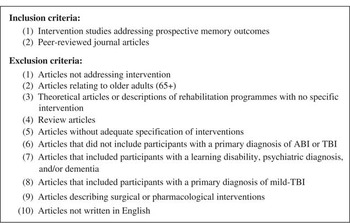
Peer-reviewed journal articles, both group and single-case designs, were included. These journal articles investigated interventions and rehabilitation programs addressing PM outcomes with adult (aged 18–65 years) and/or child and adolescent participants (aged 0–17 years) with a primary diagnosis of ABI. Eligibility criteria for the systematic review are detailed in Figure 1.
The eligibility (inclusion and exclusion) criteria employed for the systematic review

Information Sources
Studies were identified by searching electronic databases, visually scanning reference lists of relevant articles, and searching key journals. The electronic databases PsycARTICLES (1894 to present), PsycINFO (1880 to present), the Cochrane Library (1972 to present), and MEDLINE PubMed (1966 to present) were searched between November 2013 and May 2016. In addition, searches were conducted on selected references from relevant journal articles and from key journals, including “Neuropsychologia”, the “Journal of the International Neuropsychological Society”, “Developmental Medicine and Child Neurology”, “Brain Injury”, “Brain Impairment”, and “Child Neuropsychology and Developmental Neurorehabilitation”, until May 2016.
Search Terms
The following search-terms were used for the systematic review: (1) (“acquired brain injur*” or “acquired head injur*” or “traumatic brain injur*” or “traumatic head injur*” or “brain injur*” or “head injur*” or “stroke” or “cerebral vascular accident*” or “cerebral vascular incident*” or “encephalitis” or “meningitis” or “tumour*” or “tumor*”); (2) (“intervention*” or “rehabilitat*” or “train*” or “therap*” or “strateg*” or “treatment*”); (3) (“prospective memory”). The symbol * relates to database operators, which permit the search of possible extra letters in the term to be included within the search (for example, searching “head injur*” will permit the search of the terms “head injury” and “head injuries”). The three searches were then combined with the database operator “AND”.
Study Selection and Data Collection Process
The selection for screening eligible records was conducted by the lead author. A data extraction sheet was developed based on Cochrane Consumers and Communication Review Group’s data extraction template, so that each report could be critiqued, presented and summarized in a clear and concise manner.
Data Items
Information was extracted from each record based on: (1) characteristics of study participants (including age and primary diagnosis); (2) the description of the intervention or rehabilitation program; (3) the outcome measures used to assess the efficacy of the intervention for alleviating PM difficulties, and; (4) the effect sizes of the intervention, where possible; where it was not possible to determine effect sizes (if mean and standard deviation were not reported), results were provided in the way they were reported in the record. If possible, a meta-analysis will be conducted to synthesize the data extracted across multiple studies
Risk of Bias in Individual Studies and Across Studies
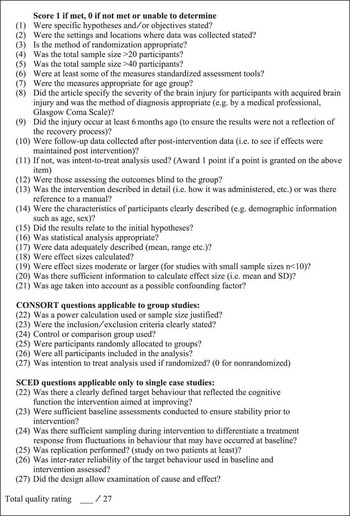
To ascertain the validity of eligible records, an appraisal criteria (illustrated in Figure 2) was developed based on Consolidated Standards of Reporting Trials (CONSORT) guidelines, with items added that are specific to ABI (consistent with Ross et al., Reference Ross, Dorris and McMillan2011) and cognitive rehabilitation (consistent with Krasny-Pacini et al., Reference Krasny-Pacini, Chevignard and Evans2014). As this systematic review also included single-case studies, the six CONSORT items that only related to group studies were substituted with items from the SCED rating scale (www.psycbite.com). The SCED scale is used for the evaluation of articles reporting single-case interventions, or intervention studies with small sample sizes (Krasny-Pacini et al., Reference Krasny-Pacini, Chevignard and Evans2014). Each of the 27 items was awarded a score of 1 (if the criterion was met) or 0 (if not met or if was not possible ascertain from information within the article).
The appraisal criteria applied to each record for screening of quality and risk of bias

In line with Ross et al. (Reference Ross, Dorris and McMillan2011) and Krasny-Pacini et al. (Reference Krasny-Pacini, Chevignard and Evans2014), articles that met 75% of the criteria specified were considered to be of “high” quality. Articles that were rated between 50% and 74% were deemed to have “moderate” quality, and those achieving less than 50% were “lower” quality (Krasny-Pacini et al., Reference Krasny-Pacini, Chevignard and Evans2014; Ross et al., Reference Ross, Dorris and McMillan2011). The authors of these articles reported that this quality rating was created following a faculty research meeting, due to the lack of available guidance about precise methods of determining the quality and consequent risk of bias in journal articles. Moher et al. (Reference Moher, Liberati, Tetzlaff and Altman2009) state that it is important to assess the risk of bias within journal articles, and thus, papers with “high” quality ratings (consistent with Krasny-Pacini et al., Reference Krasny-Pacini, Chevignard and Evans2014; Ross et al., Reference Ross, Dorris and McMillan2011), were deemed to have a reduced risk of bias and, consequently, the findings more empirically sound. Results from records were also examined for information that suggested there may be missing data (publication bias) or missing data from included records (selective recording bias). To determine the reliability of this tool, a second reviewer rated three (27%) of the reports independently. Ratings were identical across all papers (100%).
Summary Measures and Planned Method of Analysis
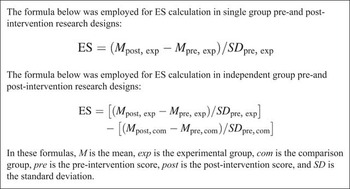
A reduction in PM memory failures was the primary outcome measure of interest in this systematic review. Where possible, Cohen’s g (Cohen, Reference Cohen1988) effect sizes (ES) of pre- and post-intervention PM memory failures were calculated as a standard difference between means, using Hedges g (Hedges & Vevea, Reference Hedges and Vevea1998), which was adapted by Morris and DeShon (Reference Morris and DeShon2002). This approach has been used (or recommended) in prominent review articles (Cicerone et al., Reference Cicerone, Dahlberg, Malec, Langenbahn, Felicetti, Kneipp and Catanese2005; Krasny-Pacini et al., Reference Krasny-Pacini, Chevignard and Evans2014; Rohling, Faust, Beverly, & Demakis, Reference Rohling, Faust, Beverly and Demakis2009; Ross et al., Reference Ross, Dorris and McMillan2011) that investigated the efficacy of cognitive intervention, and thus it was deemed appropriate for employment within the current systematic review. Calculating effect size enables researchers to analyze the magnitude of effects that exist between experimental groups; significance levels simply state if an experimental effect is present rather than the magnitude of effects (Gravetter & Forzano, Reference Gravetter and Forzano2006). ES is separated into boundaries as being a small (0<g<0.2), medium (0.2<g<0.5) or large effect (g>0.8). Figure 3 illustrates the formulas for calculating ES. If it was not possible to calculate ES, the record would be analyzed based on the results reported within the study.
The formulas for calculating ES for records included within the systematic review

RESULTS
Study Selection
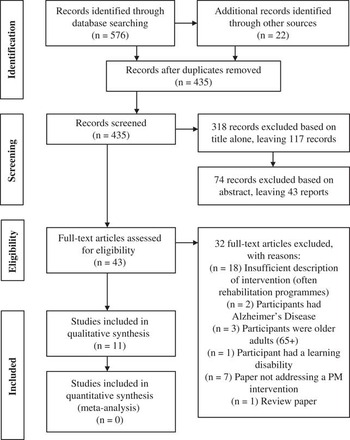
Figure 4 provides a flow diagram of the search strategy and study selection. The study selection took place in stages, with articles initially being screened by reading the title alone, then by reading the abstract, and then by reading the full-text article. Hiroyoshi et al. (Reference Hiroyoshi, Shinagawa, Komori, Toyota, Mori, Matsumoto and Ikeda2013) is an example of a paper screened by title alone; the title clearly demonstrated that the sample within the study had a diagnosis of dementia. Clune-Ryberg et al. (Reference Clune-Ryberg, Blanco-Campal, Carton, Pender, Obrien, Phillips and Burke2011) is an example of a paper screened by abstract, which demonstrated no evidence of rehabilitation approaches in the abstract.
A PRISMA flow diagram detailing the exclusion of papers at each search stage

Study Characteristics
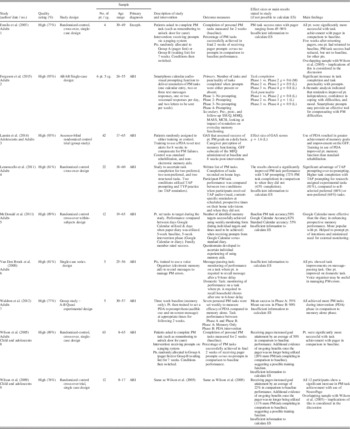
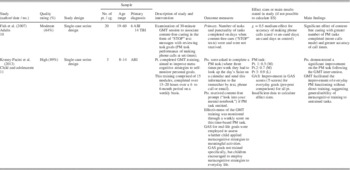
Table 1 summarizes and describes the main findings of the studies included in this systematic review pertaining to content-specific compensatory strategies. Table 2 summaries and describes the main findings of the studies included in the review pertaining to content-free and metacognitive strategies. Eight studies (studies 1, 2, 4, 5, 6, 7, and 10) included in the review recruited adult participants (aged 18 to 65 years), two studies (studies 9 and 11) recruited pediatric and adolescent participants (aged 8 to 17 years), and two studies (studies 3 and 8) recruited child, adolescent and adult participants (aged 8 to 65 years). Of these 11 studies, 7 studies (studies 1, 2, 6, 8, 9, 10, and 11) used a single-case design and 4 studies (studies 3, 4, 5, and 7) used a group-design. Studies 1 to 9 (six studies with adult participants aged 18 to 65 years, and three with child, adolescent, and adult participants aged 8 to 65 years) included in the qualitative synthesis pertained to compensatory interventions only to alleviate PM difficulties in individuals with ABI. Studies 10 and 11 (one study with adult participants aged 19 to 60 years, and one with pediatric participants aged 8 to 14 years) used a hybrid approach; both studies used a meta-cognitive, remediation training strategy (Goal Management Training; GMT; Duncan, Reference Duncan1986; Levine et al., Reference Levine, Robertson, Clare, Carter, Hong and Wilson2007) and a compensatory strategy (content-free cueing) aimed at facilitating the self-monitoring, evaluation and regulation of personal goals. Ten studies achieved a “high quality” rating (77% to 93%); one study (Fish et al., Reference Fish, Evans, Nimmo, Martin, Kersel, Bateman and Manly2007) achieved a “moderate quality” rating (64%).
Summary of studies pertaining to content-specific compensatory strategies included in the systematic review

Note. All reference to study numbers in text relate to the numbers in first column of table.
Sample: cg.=caregivers; pt.=participants; Primary diagnosis: ABI=acquired brain injury; Enceph.=encephalitis; TBI=traumatic brain injury, Hyd=hydrocephalus; SB=spina bifida; Description of study and intervention: ATC=Assistive technologies for cognition; GMT=Goal Management Training, PDA=personal digital assistant; PM=prospective memory; TAP=television assistive prompting; Outcomes measures: GAS=goal attainment scaling; GFF=general frequency of forgetting; MASS=Memory Awareness and Strategies Scale; M-CSI=Modified-Caregiver Strain Index; MFQ=Memory Functioning Questionnaire; MMQ=Memory Mistakes Questionnaire; SSUQ=Strategies of Smartphones Use Questionnaire; Effect sizes: (M)=medium; (L)=large.
Summary of studies pertaining to content-free and metacognitive strategies included in the systematic review

Note. All reference to study numbers in text relate to the numbers in first column of table. Sample: cg. = caregivers; pt. = participants; Primary diagnosis: ABI=acquired brain injury; TBI=traumatic brain injury; Description of study and intervention: GMT=Goal Management Training; Outcomes measures: GAS=goal attainment scaling; PM=prospective memory. Effect sizes: (M)=medium; (L)=large.
Content-Specific Cues
Studies 1 to 9 investigated the efficacy of devices that deliver content-specific cues to alleviate PM task errors in individuals with ABI (six studies with adult participants aged 18 to 65 years, and three studies with child, adolescent, and adult participants aged 8 to 65 years). These included prompts delivered by a pager, a personal digital assistant (PDA), a Television Assistive Prompting (TAP) device, the use of Google Calendar, the calendar function on a smartphone, and a device to record voice memos.
Three papers demonstrated that a paging system could be used to reduce PM deficits in individuals with TBI. Emslie, Wilson, Quirk, Evans, and Watson (Reference Emslie, Wilson, Quirk, Evans and Watson2007) demonstrated this with adult participants (aged 30 to 49 years). Wilson, Emslie, Quirk, Evans, & Watson (Reference Wilson, Emslie, Quirk, Evans and Watson2005) and Wilson et al. (Reference Wilson, Emslie, Evans, Quirk, Watson and Fish2009) demonstrated this with child, adolescent and adult participants (aged 8 to 65 years). All three studies showed evidence to suggest that PM task performance improved when receiving content-specific pager prompts.
An increase in PM task success has also been demonstrated in studies with adolescent and adult participants (aged 17 to 65 years) using PDA devices as external memory aids (Lannin et al., Reference Lannin, Carr, Allaous, Mackenzie, Falcon and Tate2014; Waldron, Grimson, Carton, & Blanco-Campal, Reference Waldron, Grimson, Carton and Blanco-Campal2012). Lannin et al. demonstrated that PDA devices with an alerting function facilitate memory functioning better than non-electronic memory aids. A TAP system has also been shown to be a unique compensatory strategy for PM failures in adult participants aged 18 to 60 years (Lemoncello, Sohlberg, Fickas, & Prideaux, Reference Lemoncello, Sohlberg, Fickas and Prideaux2011). This study demonstrated some task-novelty effects with higher task completion with TAP prompting for research-assigned experimental tasks, compared to self-selected preferred or non-preferred tasks.
The use of digital calendars on smartphones has provided a novel method of recording PM tasks and enabling the user to set alerts to deliver content-specific prompts at the appropriate times for everyday memory tasks (Ferguson, Friedland, & Woodberry, Reference Ferguson, Friedland and Woodberry2015; McDonald et al., Reference McDonald, Haslam, Yates, Gurr, Leeder and Sayers2011). Ferguson et al. demonstrated a significant increase in task completion and task punctuality when prompts were received (participants were adults aged 24 to 55 years). Furthermore, thematic analysis revealed that reminders improved participants’ sense of independence, their confidence in coping with PM difficulties, and their general mood. Research conducted by McDonald et al. with adult participants (aged 19 to 65 years) provides further evidence that digital calendar prompts provide an effective tool for compensating for PM difficulties; Google Calendar was shown to be more effective than a standard diary, and was preferred by the participants.
The use of a voice-recording device as an external memory aid has also been investigated with adult participants (aged 30 to 57 years). Van Den Broek, Downes, Johnson, Dayus, and Hilton (Reference Van Den Broek, Downes, Johnson, Dayus and Hilton2000) demonstrated that all participants showed improvements on a message-passing task, and four participants showed improvements on a domestic task when they used voice organizer prompts.
Content-Free Cues and Metacognitive Methods
Two studies investigated the efficacy of content-free cueing and metacognitive GMT to alleviate PM task errors. Fish et al. (Reference Fish, Evans, Nimmo, Martin, Kersel, Bateman and Manly2007) and Krasny-Pacini et al. (Reference Krasny-Pacini, Limond, Evans, Hiebel, Bendjelida and Chevgnard2013) examined the effects of GMT and external content-free cueing (in the form of text messages) on PM task performance. Fish et al. found a significant effect of content-free cueing with adults with ABI (aged 19 to 60 years) with a greater number, and more accurate, calls on days when content-free “STOP” cues were received by participants. Krasny-Pacini et al. (Reference Krasny-Pacini, Limond, Evans, Hiebel, Bendjelida and Chevgnard2013) investigated the efficacy of an adapted version of GMT that was tailored to a pediatric population and external content free cueing (in the form of alerts reading “Look into your mental notebook”). Participants demonstrated a significant improvement on the PM task following the GMT intervention and receiving content-free cues.
Evidence for the Possible Remediation of Prospective Memory Functioning
The majority of interventions included in this review surround external memory aids that were used to prompt and consequently offer compensatory methods (either by content-specific or content-free cueing) for reducing PM failures. These studies provide evidence to suggest that various interventions can be used to compensate for PM failures. Three of these studies, however, demonstrated a remediation of PM functioning with participants continuing to demonstrate improvements (when compared to their baseline performance) in their PM function even after their compensatory aid had been removed (Emslie et al., Reference Emslie, Wilson, Quirk, Evans and Watson2007; Wilson et al., Reference Wilson, Emslie, Quirk, Evans and Watson2005, Reference Wilson, Emslie, Evans, Quirk, Watson and Fish2009). Furthermore, Lannin et al. (Reference Lannin, Carr, Allaous, Mackenzie, Falcon and Tate2014) found that the use of a PDA device resulted in an improvement on the psychometric measure, the General Frequency of Forgetting (GFF; Gilewski, Zelinski, & Shaie, Reference Gilewski, Zelinski and Shaie1990) in comparison to standard rehabilitation using passive memory aids. This suggests a general subjective memory improvement separate to the PM tasks. Krasny-Pacini et al. (Reference Krasny-Pacini, Limond, Evans, Hiebel, Bendjelida and Chevgnard2013) also demonstrated that metacognitive GMT training and content-free cueing facilitated the improvement of everyday PM functioning for goals separate to the training task.
DISCUSSION
The studies outlined in this systematic review demonstrate that several varying rehabilitation methods are available to alleviate PM deficits following ABI, and support a patient’s EF skills for planning and organizing. These include compensatory strategies in the form of external memory aids, which provide either content-specific or content-free cueing, and training programs aimed at facilitating meta-cognitive skills (e.g., self-monitoring and self-evaluating personal goals). This review has also highlighted that there is a greater availability of research pertaining to adult rehabilitation and only two studies involving pediatric participants. This limited evidence-base for pediatric rehabilitation has also been highlighted in previously published reviews (Fish et al., Reference Fish, Wilson and Manly2010; Laatsch et al., Reference Laatsch, Harrington, Hotz, Marcantuono, Mozzoni, Walsh and Pike-Hersey2007; Limond & Leeke, Reference Limond and Leeke2005; Ross et al., Reference Ross, Dorris and McMillan2011). Overall, research in the field of PM interventions following ABI is, however, arguably limited relative to other disorders.
Critique of Research Included in the Review
Ten of the 11 studies achieved a high quality rating and one received a moderate quality rating, according to the appraisal criteria used in the review (see Figure 2). This suggests that the risk of bias in individual studies and across studies was low, and the eligible records in the review were largely valid. They were deemed to have appropriate research methods, an adequate description of the intervention, and used appropriate statistical analysis, for example.
Although all literature included in this review demonstrated promising findings in favor of a variety of PM interventions, it was only possible to report the ES for four of the studies included in the review (studies 2, 3, 10, and 11). It was not possible to calculate the ES for the remaining studies, because the means and standard deviations were not reported. Consequently, for seven of the studies (studies 1, 4, 5, 6, 7, 8, and 9), it is only possible to state that the interventions resulted in a significant improvement in PM performance, and not the magnitude of the effect of the intervention. Although this does not mean that a large effect size for the intervention was not present in these studies, it is not possible to reliably state this.
Five of the studies (studies 3, 4, 5, 6, and 7) included in the review did not examine the effects of removing the content-specific strategies on PM task performance. It is, therefore, possible that the improved PM performance reflect the cumulative effect of the ongoing, novel intervention rather than the specific strategy (e.g., pager, PDA) itself. An alternative research design, therefore, may have been to use an A-B-A-B approach. Future studies, however, would need to carefully consider the ethical dilemma of withdrawing a compensatory strategy that is proving helpful to participants.
A further limitation of seven of the studies (studies 2, 3, 4, 6, 7, 8, and 10) used in this review is that they did not compare contrasting compensatory external memory strategies for PM task performance. Consequently, knowledge surrounding the superiority of one strategy over another is limited which, therefore, limits the evidence-base regarding the efficacy of a certain compensatory strategy for a certain presentation or age group. Each of the studies included in this review used different outcome measures, which further limits comparison between the efficacies of contrasting external memory strategies. Future research could focus on comparing multiple compensatory strategies using the same, standardized PM outcome measures.
Critique of Review
Although Fish et al. (Reference Fish, Wilson and Manly2010) conducted a review looking at the assessment and rehabilitation of PM deficits in people with neurological disorders, to the author’s knowledge, this is the first systematic review looking solely at PM interventions following ABI. This review, therefore, offers a unique opportunity to consider the theoretical and clinical implications of the available literature for this patient group.
A further advantage of this review is that both single-case and group studies were included. It has, however, been argued that single-case studies are less valid than group studies due to external validity limitations (Cicerone, Azulay, & Trott, Reference Cicerone, Azulay and Trott2009). Tate et al. (Reference Tate, McDonald, Perdices, Togher, Schultz and Savage2008), conversely, report that single-case methods are readily applicable to clinical practice, in addition to providing a unique method of documenting individualized outcomes and thus providing empirical evidence in support of rehabilitation approaches. Nonetheless, a possible direction for future research could be to conduct randomized control trials using interventions that have proof-of-principle (based on findings from single-case designs) to further explore the effectiveness of the interventions and establish the generalizability to large sample sizes.
A limitation of the current review is that 16 records were excluded due to inadequate description of rehabilitation programs. It was, therefore, not possible to critique the efficacy of these programs for rehabilitating PM functioning.
Three of the studies (studies 1, 8, and 9) included in this systematic review contained overlapping samples. They cannot, therefore, be considered as three independent studies when evaluating the strengths and limitations of the evidence and drawing conclusions across the literature.
Implications for Clinical Practice
This review has highlighted a variety of contrasting methods of rehabilitating PM deficits; however, clinicians should remain mindful that eight of the 11 studies included in the review investigated the efficacy of PM interventions with adult participants only. Given the limited availability of research evidence to support the efficacy of PM interventions in a pediatric population, it is imperative that future research focuses on contributing to this evidence-base. Although very few studies exist for the pediatric population, it could be argued that all of the interventions shown to be effective in adults could be adapted for a pediatric population, providing that the age and developmental level of the child is considered when designing the intervention (Limond, Adlam, & Cormack, Reference Limond, Adlam and Cormack2014).
Wilson et al. (Reference Wilson, Emslie, Evans, Quirk, Watson and Fish2009) successfully used a paging system in both adults and children, and demonstrated PM improvements. Krasny-Pacini et al. (Reference Krasny-Pacini, Limond, Evans, Hiebel, Bendjelida and Chevgnard2013) demonstrated the efficacy of a memory rehabilitation program and content-free cueing for improving PM deficits in children with ABI, which used an adapted GMT intervention previously used with adults (Fish et al., Reference Fish, Evans, Nimmo, Martin, Kersel, Bateman and Manly2007). This suggests that interventions used with adults can be effective; however, important adaptations may be necessary, as evidenced by Krasny-Pacini et al. (Reference Krasny-Pacini, Limond, Evans, Hiebel, Bendjelida and Chevgnard2013). Pediatric rehabilitation needs to consider cognitive function in the context of on-going maturation (rather than the loss of function, as is often the case in adult interventions).
Limond et al. (Reference Limond, Adlam and Cormack2014) suggest a sequential approach to intervention and they state that lower-level cognitive processes “must be optimized to facilitate rehabilitation of higher-order specific processes” (p. 183). They have proposed a theoretical model to help guide pediatric interventions, which consider the cognitive maturation of the child/adolescent. The model proposes a hierarchy for different rehabilitation approaches dependent upon the cognitive capabilities necessary for the intervention to be effective. Clinicians must, therefore, be mindful of this model when adapting interventions from an adult population.
Implications for Theory and Research
Several studies in this review have shown evidence of the strategies having transfer effects; Wilson et al. (Reference Wilson, Emslie, Quirk, Evans and Watson2005, Reference Wilson, Emslie, Evans, Quirk, Watson and Fish2009) and Emslie et al. (Reference Emslie, Wilson, Quirk, Evans and Watson2007) found that, even after a pager system was removed, participants continued to achieve more of their PM tasks in comparison to their baseline performance; Krasny-Pacini et al. (Reference Krasny-Pacini, Limond, Evans, Hiebel, Bendjelida and Chevgnard2013) also demonstrated that a hybrid approach of metacognitive GMT training and content-free cueing can facilitate the improvement of everyday PM functioning for goals separate to the training, and; Lannin et al. (Reference Lannin, Carr, Allaous, Mackenzie, Falcon and Tate2014) found that participants reported a general subjective memory improvement separate to the PM tasks. These findings, therefore, raise an interesting theoretical question: can external memory strategies designed to compensate for PM deficits facilitate the remediation of PM functioning?
Unfortunately, these findings were not discussed in detail within these papers. It is, therefore, unclear if the participant internalized a memory strategy to support PM, developed a habit or routine and thus minimized the PM demands, or developed PM skills, as a result of the repeated use of an external memory aid. Although it may not be possible to definitively answer these queries within this review, the findings are, nonetheless, interesting toward the debate of whether PM is a skill that can be taught or whether it can only be facilitated through external strategies.
Regardless, this review highlights that external strategies aimed to improve PM task performance can be generalized to facilitate everyday PM functioning for participants. This, therefore, offers the potential for prompting memory aids to alleviate the experience of PM deficits, and thus, reduces an individual’s dependence on others to remember daily tasks. This in turn may increase an individual’s sense of independence and increase social participation.
CONCLUSIONS
This review has summarized and critiqued the findings of studies that investigate the efficacy of PM interventions in individuals with ABI. The literature demonstrated the efficacy of varying rehabilitation methods to alleviate PM deficits following ABI; more PM tasks were completed when participants received either content-free or content-specific cues or took part in a metacognitive training program. This suggests that PM abilities can be improved following ABI by using simple reminder systems. The review has also highlighted that interventions used with adults can be effective; however, pediatric rehabilitation might benefit from considering the influence of on-going cognitive maturation when contemplating which adult interventions might be effective with children. The theoretical model of Limond et al. (Reference Limond, Adlam and Cormack2014) might provide a useful framework to guide future research in this area. The review has also highlighted that external strategies aimed to facilitate PM task performance can be generalized to facilitate everyday PM functioning. A major finding of this review is that there is an extreme lack of research of PM interventions conducted in children with ABI, and future research is needed to improve this evidence base.
ACKNOWLEDGMENTS
No conflict of interest to report. This critical review received no funding or financial support.