Introduction
Executive functions (EF) are required for independent, purposive, self-directed behavior and include processes of initiation, planning, purposive action, volition, inhibition, flexibility, as well as self-monitoring and self-regulation (Lezak, Reference Lezak1995; Stuss, Reference Stuss2011). A division between “cold” and “hot” components of EF has been suggested, with “cold” EF corresponding closely to cognitive and logical processes, and the “hot” aspects of EF involving regulation of emotion and motivation (Chan, Shum, Toulopoulou, & Chen, Reference Chan, Shum, Toulopoulou and Chen2008). Thus, EF is an umbrella term for a set of interrelated capacities resulting from activity in anatomically and functionally independent, but interconnected networks subserved by widespread brain regions, the prefrontal cortex playing a central role (Stuss & Alexander, Reference Stuss and Levine2007).
Executive dysfunction (ED) is common following acquired brain injury (ABI) (Stuss & Levine, Reference Stuss and Alexander2002; Novakovic-Agopian et al., Reference Novakovic-Agopian, Chen, Rome, Abrams, Castelli, Rossi and D’Esposito2011), and may disrupt the ability to effectively use intact functions or compensatory strategies, undermine efficient self-management (Lewis, Babbage, & Leathem, Reference Lewis, Babbage and Leathem2011), hamper the rehabilitation process (Robertson & Murre, Reference Robertson and Murre1999), and is also associated with long-term negative psychosocial and vocational outcome (Draper & Ponsford, Reference Draper and Ponsford2008; Ylvisaker & Feeney, Reference Ylvisaker and Feeney2000). Thus, techniques for reducing ED might significantly impact functional outcome (Manly & Murphy, Reference Manly and Murphy2012).
Most theories describe EF as top–down controlled processes involved in the control and direction of self-regulatory cognition, emotion and behavior (Cicerone, Levin, Malec, Stuss, & Whyte, Reference Cicerone, Levin, Malec, Stuss and Whyte2006; Stuss, Reference Stuss2011). Current theories of cognitive EF bear close resemblance to dominant models of attention (Norman & Shallice, Reference Norman and Shallice1986; Petersen & Posner, Reference Petersen and Posner2012; Posner & Petersen, Reference Posner and Petersen1990) and working memory (Baddeley, Reference Baddeley2010), placing attentional control at the cornerstone of the cognitive and anatomical infrastructure underlying EF (Chiesa, Calati, & Serretti, Reference Chiesa, Calati and Serretti2011; Miyake et al., Reference Miyake, Friedman, Emerson, Witzki, Howerter and Wager2000).
Since EF is a heterogeneous capacity, there is a need for multifaceted interventions covering a wide range of EFs (Spikman, Boelen, Lamberts, & Fasotti, Reference Spikman, Boelen, Lamberts and Fasotti2010). However, there are methodological challenges in identifying the “active ingredients” of treatments, their unique contributions, and the specific targets of the interventions (Cicerone et al., Reference Cicerone, Levin, Malec, Stuss and Whyte2006). The level and precision of outcome measurement constitutes a related challenge, as scores on neuropsychological tests may not accurately reflect ED in everyday life (Manchester, Priestley, & Jackson, Reference Manchester, Priestley and Jackson2004), and subjective evaluation of cognitive functioning does not necessarily predict test performance (Spencer, Draq, Walker, & Bieliauskas, Reference Spencer, Drag, Walker and Bieliauskas2010).
The International Classification of Functioning, Disability, and Health model is one approach to classify the targeted level of functioning for interventions and outcome measurements (Bilbao et al., Reference Bilbao, Kennedy, Chatterji, Ustün, Barquero and Barth2003). Consequences of disease and disability are described at the impairment- (e.g., recall numbers), activity- (e.g., pay bills), and/or participation-level (e.g., work as a banker), the latter two being the ultimate end-goals of rehabilitation (Peterson, Reference Peterson2005). The model provides a standardized analytical framework, acknowledging that different levels of the taxonomy are interrelated in complex ways, and might be difficult to separate in real-life (Whyte et al., 2014).
Cognitive rehabilitation interventions may focus on restoring or re-training cognitive functions, compensation by the use of internal/external strategies, environmental modifications, and/or pharmacological treatment (Cicerone et al., Reference Cicerone, Levin, Malec, Stuss and Whyte2006). Although the effectiveness of cognitive rehabilitation is documented within some domains following ABI, there is still a paucity of empirical evidence for the efficacy of interventions for rehabilitation of EF (Cicerone et al., Reference Cicerone, Langenbahn, Braden, Malec, Kalmar, Fraas and Ashman2011; Rees, Marshall, Hartridge, Mackie, & Weiser, Reference Rees, Marshall, Hartridge, Mackie and Weiser2007; Wilson, Reference Wilson2008). Reviews recommend metacognitive strategy training including self-monitoring and self-regulation as practice standard following ED due to traumatic brain injury (TBI) (Cicerone et al., Reference Cicerone, Langenbahn, Braden, Malec, Kalmar, Fraas and Ashman2011; Kennedy et al., Reference Kennedy, Coelho, Turkstra, Ylvisaker, Sohlberg, Yorkston and Kan2008). Promising results have been reported for interventions such as problem solving therapy (Miotto, Evans, de Lucia, & Scaff, 2008; Rath, Simon, Langenbahn, & Sherr, Reference Rath, Simon, Langenbahn and Sherr2003; von Cramon, Matthes-von Cramon, & Mai, Reference von Cramon, Matthes-von Cramon and Mai1991) and goal management training (GMT; e.g., Levine et al., Reference Levine, Schweizer, O’Connor, Turner, Gillingham, Stuss and Robertson2011), incorporating self-instructions aimed at strengthening the individual’s ability to interrupt and control ongoing behavior. Interventions for ED also need to include motivational, attitudinal, and affective processes (Dams-O’Connor & Gordon, 2013; Rath et al., Reference Rath, Simon, Langenbahn and Sherr2003), otherwise negative affect and avoidance can impede or disrupt implementation of cognitive problem-solving skills (D’Zurilla & Nezu, Reference D’Zurilla and Nezu2001).
Goal Management Training (GMT) is a structured, interactive, manual-based rehabilitation protocol, originally developed by Robertson (Reference Robertson1996). It was based on the Theory by Duncan, Emslie, Williams, Johnson, and Freer (Reference Duncan, Emslie, Williams, Johnson and Freer1996) of “goal neglect,” emphasizing impaired construction and use of goal lists as an important cause of dysexecutive behavior. Recent versions of GMT have increasingly emphasized the role of sustained attention, because it is required to actively maintain neural representations of goals in working memory (Levine et al., Reference Levine, Schweizer, O’Connor, Turner, Gillingham, Stuss and Robertson2011; Robertson & Garavan, Reference Robertson and Garavan2000). This is in line with Stuss’s (Reference Stuss2011) update on the anterior attentional system, suggesting two cognitive EF processes in addition to energization (initiation and sustaining); one supporting monitoring of ongoing performance, the other related to task setting. Thus, executive attention requires both stable maintenance of attentional focus, and top-down modulation. Similarly, other hierarchical models of cognitive functioning suggest that both arousal and sustained attention underlie and support higher-order functions (Dams-O’Connor & Gordon, 2013).
Habits or environmental triggers may oppose and displace higher-order goals, resulting in cue-dependent or distracted behavior, when the attention system is compromised (Fernandez-Duque, Baird, & Posner, Reference Fernandez-Duque, Baird and Posner2000; Levine et al., Reference Levine, Schweizer, O’Connor, Turner, Gillingham, Stuss and Robertson2011). The capacity to allocate processing resources selectively to a particular stimulus (Blake, Heiser, Caywood, & Merzenich, Reference Blake, Heiser, Caywood and Merzenich2006), presupposes an adequate level of arousal (Coull, Reference Coull1995; Smith & Nutt, Reference Smith and Nutt1996). Thus, low-level deficits in arousal or arousal regulation, a common complication of brain injury (Baumann, Werth, Stocker, Ludwig, & Bassetti, 2007), can contribute to high-level executive and attentional deficits (Coull, Reference Coull1995; Greene, Bellgrove, Gill, & Robertson, Reference Greene, Bellgrove, Gill and Robertson2009; Smith & Nutt, Reference Smith and Nutt1996). Arousal can be manipulated by external and internal alerts (Robertson, Mattingley, Rorden, & Driver, Reference Robertson, Mattingley, Rorden and Driver1998). External alerts (tones) combined with metacognitive strategy training has been associated with improved task performance (Manly, Hawkins, Evans, Woldt, & Robertson, Reference Manly, Hawkins, Evans, Woldt and Robertson2002), and enhanced management of current and future goals (Fish et al., Reference Fish, Evans, Nimmo, Martin, Kersel, Bateman and Manly2007), suggesting that content-free cueing increases arousal, and draws attention back to relevant goals. The use of alerting and mindfulness techniques (Kabat-Zinn, Reference Kabat-Zinn1990; Segal, Williams, & Teasdale, Reference Segal, Willams and Teasdale2002) to support the maintenance of attentional focus is embedded in GMT. Internalization of such prompts is promoted through training of a self-cueing process “to stop ongoing behavior in order to define goal hierarchies and monitor performance” (Levine et al., Reference Levine, Schweizer, O’Connor, Turner, Gillingham, Stuss and Robertson2011, p. 2).
GMT has received empirical support in studies of patients with neurological conditions (e.g., ABI) and in healthy elderly adults (e.g., Grant, Ponsford, & Bennett, 2012; Levine et al., Reference Levine, Robertson, Clare, Carter, Hong, Wilson and Stuss2000, Reference Levine, Stuss, Winocur, Binns, Fahy, Mandic and Robertson2007, Reference Levine, Schweizer, O’Connor, Turner, Gillingham, Stuss and Robertson2011; Miotto et al., Reference Miotto, Evans, de Lucia and Scaff2009; Novakovic-Agopian et al., Reference Novakovic-Agopian, Chen, Rome, Abrams, Castelli, Rossi and D’Esposito2011; Stubberud, Langenbahn, Levine, Stanghelle, & Schanke, Reference Stubberud, Langenbahn, Levine, Stanghelle and Schanke2013; van Hooren et al., Reference van Hooren, Valentijn, Bosma, Ponds, van Boxtel, Levine and Jolles2007). Studies of GMT for patients with ABI have reported improved sustained and executive attention (error reduction, planning and time allocation) (Levine et al., Reference Levine, Robertson, Clare, Carter, Hong, Wilson and Stuss2000, Reference Levine, Schweizer, O’Connor, Turner, Gillingham, Stuss and Robertson2011; Metzler-Baddeley and Jones, Reference Metzler-Baddeley and Jones2010; Novakovic-Agopian et al., Reference Novakovic-Agopian, Chen, Rome, Abrams, Castelli, Rossi and D’Esposito2011; Schweitzer et al., 2008), and reduction of ED in daily life (Miotto et al., Reference Miotto, Evans, de Lucia and Scaff2009; Spikman et al., Reference Spikman, Boelen, Lamberts and Fasotti2010). Imaging studies have suggested that GMT results in functional changes in brain networks supporting sustained attention (Chen et al., Reference Chen, Novakovic-Agopian, Nycum, Song, Turner, Hills and D’Esposito2011; Robertson & Levine, Reference Robertson and Levine2013), which in turn may lead to functional improvements that generalize to broader domains of goal-directed behaviors.
A review of the effectiveness of GMT for patients with ABI (Krasny-Pacini, Chevignard, & Evans, Reference Krasny-Pacini, Chevignard and Evans2013) emphasize the lack of clarity in explaining positive treatment-effects in the literature, that is what constitutes the “active treatment ingredients,” and what characterize those who benefit from GMT. Furthermore, GMT appears to be more effective in studies measuring outcomes of improvement in everyday activities rather than test-performance. In strategy-oriented cognitive training, one does not necessarily expect changes to be observed at the impairment-level as assessed by neuropsychological tests, but improvement should be evident on functional measures.
Previous GMT studies of ABI have some important methodological limitations; crossover designs making long-term follow up difficult (Chen et al., Reference Chen, Novakovic-Agopian, Nycum, Song, Turner, Hills and D’Esposito2011; Novakovic-Agopian et al., Reference Novakovic-Agopian, Chen, Rome, Abrams, Castelli, Rossi and D’Esposito2011); GMT combined with other interventions (problem solving therapy, Miotto et al., Reference Miotto, Evans, de Lucia and Scaff2009; multifaceted treatment, Spikman et al., Reference Spikman, Boelen, Lamberts and Fasotti2010), making it difficult to isolate the unique effects of GMT. Other studies are single case-studies (Levine et al., Reference Levine, Robertson, Clare, Carter, Hong, Wilson and Stuss2000; Metzler-Baddeley et al., Reference Metzler-Baddeley and Jones2010; Schweitzer et al., 2008), or include small samples and are only partially randomized (Levine et al., Reference Levine, Schweizer, O’Connor, Turner, Gillingham, Stuss and Robertson2011). Only two group-based GMT studies (Levine et al., Reference Levine, Schweizer, O’Connor, Turner, Gillingham, Stuss and Robertson2011; Novakovic-Agopian et al., Reference Novakovic-Agopian, Chen, Rome, Abrams, Castelli, Rossi and D’Esposito2011) have reported follow-up analyses more than 3 months post-intervention, limiting the evidence for long-term effects.
The present study addresses the methodological weaknesses of prior studies by having a robust randomized controlled trial design, an active control group, long-term follow-up, blinded assessments, and radiological injury descriptions. The study also included a new module addressing emotional dysregulation, and both groups received external cueing by text messages to facilitate effective goal management in everyday life.
The overall aim was to investigate the efficacy of GMT on cognitive aspects of EF in patients with chronic ABI, compared to a control treatment that was matched to GMT with regard to non-specific factors including therapist contact and social facilitative processes associated with group treatment. Based on findings from previous GMT-studies, we hypothesized that patients receiving GMT would experience improved attention through changes in executive (shifting, inhibition, and time allocation) and sustained attention, as measured in daily life (questionnaires) and neuropsychological tests, immediately after training and at six months follow-up. Data from questionnaires with a specific focus on emotional and psychological function will be reported elsewhere.
Methods
Participants and Procedures
A total of 178 patients with verified ABI, and a documented history of ED were invited to participate. An information letter was sent to 153 former patients at Sunnaas rehabilitation hospital, and 2 were recruited through their primary physician. Finally, 23 contacted the research-group following presentation of the study in a user organization’s magazine. Participants had to have a documented non-progressive ABI, be minimum 6 months post-injury, experience ongoing ED (by self-report and/or neuropsychological assessment), and between 18 and 67 years. Major psychiatric diseases, ongoing substance abuse, neurodegenerative disorders, and severe cognitive problems interfering with the capacity to participate in the program, were set as exclusion criteria.
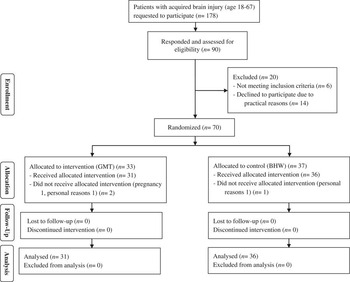
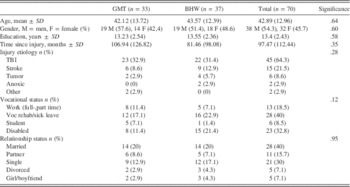
Ninety persons responded by giving written informed consent, and underwent a comprehensive screening interview examining medical, cognitive, and psychological issues. Six did not meet the inclusion criteria, 14 reconsidered participation due to practical reasons, resulting in a final sample of 70 participants (Figure 1; Schulz, Altman, & Moher, Reference Schulz, Altman and Moher2010). A slight majority were males (52.9%), TBI being the dominant cause of injury (64.3%), mean time since injury was 97.4 months (SD=112.4), age ranged from 19 to 66 years (M=42.9; SD=13), and mean length of education was 13.4 years (SD=2.4) (Table 1).
Consort diagram.

Demographic and brain injury characteristics of the participants

Note. Percentage totals may not add to 100% due to rounding.
GMT=Goal Management Training; BHW=Brain Health Workshop; Voc rehab=Vocational vocational rehabilitation.
The goal was to recruit 80 participants, with 40 in each group. Hence, 40 A’s (GMT) and 40 B’s (Brain Health Workshop; BHW) were drawn from a lot and put in enclosed envelopes. Following baseline assessment of enrolled persons, an envelope was drawn for each participant, determining group allocation. The person responsible for randomization was not involved in the study, the groups were not stratified. Groups of five to seven participants were established, resulting in five GMT and seven BHW groups. The participants were informed that the study investigated two different approaches to cognitive training of EF; but not informed of the randomization outcome, thus blinded to the condition considered to be the active treatment.
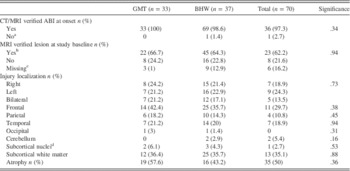
Magnetic resonance imaging (MRI) for lesion characterization was obtained for 56 of the participants at baseline with a 3 Tesla scanner (Achieva 3.0T, Philips Medical System, Best, The Netherlands) at the Intervention Center at Oslo University Hospital. For five participants, previous MRI/Computed tomography scans were collected from other hospitals. Nine participants had missing data as scanning could not be performed due to various reasons. All scans were interpreted by an experienced radiologist (author P.K.H.). There were no significant group differences regarding brain injury characteristics. The frontal lobes were the most frequent cortical location of damage, followed by temporal and parietal lobe damage. Approximately 50% of the total sample had signs of brain atrophy (Table 2).
Radiological description of the brain injuries

a Verified by neurological and neuropsychological evaluation.
b MR/CT scans were collected from other hospitals for five participants due to practical or medical reasons; the images were interpreted by the same radiologist. All five scans were performed between 2011 and 2013.
c MRI was not possible to conduct due to practical reasons for four participants, medical reasons for four, and one participant refused to undergo repeated scanning.
d Striatum, basal ganglia, and/or thalamus.
GMT=Goal Management Training; BHW=Brain Health Workshop; CT=computer tomography; MRI=magnetic resonance imaging.
The study was approved by the Regional Committee for Medical Research Ethics (2012/1436), South-Eastern Norway. The research was conducted in accordance with the Helsinki Declaration.
Intervention and External Cuing
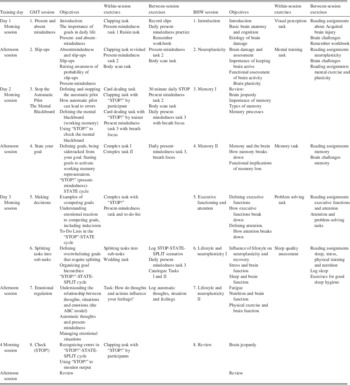
GMT and BHW protocols were based on a Norwegian translation and adaptation of Levine and colleagues’ (Reference Levine, Schweizer, O’Connor, Turner, Gillingham, Stuss and Robertson2011) protocol, administered following a script with accompanying Powerpoint slides and participant workbooks. Minor adjustments made to the GMT protocol after 2011 (www.goalmanagementtraining.com) were made available through personal communication with Dr. Levine. Participants received the same amount of training, support from trainer, and homework assignments. Each group met for 1 day every second week, a total of 8 two-hr sessions distributed over 4 days (Table 3). All sessions followed the same procedure; introduction to key-concepts, practical exercises, and discussion of examples from the participants’ daily life. The primary investigator (author S.T.) led all groups, with assistance of a skilled co-therapist. Following the fourth session, all participants received a daily text-message stating “STOP” (a key instruction in GMT), for the remaining duration of treatment (28 per participant), to cue goal management in their daily living. The cuing time was between 9 a.m. and 5 p.m., and changed every second or third day to prevent habituation.
Description of the modules and objectives in GMT and BHW

GMT=Goal Management Training, BHW=Brain Health Workshop.
Missed attendance was minimal. One participant in the BHW-group missed two sessions. Participants refrained participating in other cognitive rehabilitation programs during the study.
Goal Management Training
The GMT intervention (Levine et al., Reference Levine, Schweizer, O’Connor, Turner, Gillingham, Stuss and Robertson2011) comprises introduction to key concepts, discussions and exercises to explore and relate the concepts to the participants’ daily life. Core concepts included the distinction between absentmindedness and presentmindedness (awareness of the internal and external states), slip-ups in daily life, habitual responding (the “autopilot”), stopping and thinking, working memory (the “mental blackboard”), the importance of goals, defining and splitting goals into subtasks, and checking. Mindfulness-based exercises were introduced to enhance awareness toward current feelings, behaviors and goal states (Kabat-Zinn, Reference Kabat-Zinn1990; Segal et al., Reference Segal, Willams and Teasdale2002). The emotional-regulation module introduced how thoughts, just like behavior, can be “automatic” through use of the “the automatic pilot” metaphor which is a core concept in GMT, and the relationship between thoughts, situations and emotions (Beck & Alford, Reference Beck and Alford2009). The participants explored how the “STOP”-technique and present-mindedness could assist in managing negative emotions through demonstrations, and discussions of examples from daily life. Homework assignments included practical exercises and logging of activity, with special attention given to mindfulness exercises throughout the entire intervention.
Active Control Condition
BHW is a psychoeducational protocol matched to GMT for therapist contact, quantity of educational material, homework, and group participation (Levine et al., Reference Levine, Schweizer, O’Connor, Turner, Gillingham, Stuss and Robertson2011). It comprises educational materials and various lifestyle interventions that are typically part of psycho-educative programs delivered at brain rehabilitation centers (e.g., Becker, Kirmess, Tornas, & Lovstad, 2014). The sessions addressed brain function and dysfunction, brain plasticity, memory, EF, and attention. Stress, physical exercise, sleep, nutrition, and energy management were given particular attention. Homework and within-session activities included reading assignments, brain-games and puzzles, testing of acquired knowledge, and practical exercises like keeping a sleep log. The seven original BHW sessions (Levine et al., Reference Levine, Schweizer, O’Connor, Turner, Gillingham, Stuss and Robertson2011) were delivered over eight sessions. Some of the reading assignments were replaced with comparable Norwegian information-booklets.
Baseline Measures
Tests of general intellectual capacity (Wechsler Abbreviated Scale of Intelligence, WASI; Wechsler, Reference Wechsler1999), digit span (Wechsler Adult Intelligence Scale III, WAIS III; Psychological Corporation, 1997), visuospatial attention and memory (Brief Visuospatial Memory Test Revised [BVMT-R]; Benedict, Reference Benedict1997), and verbal learning and memory (California Verbal Learning Test - II, Standard Form [CVLT-II]; Delis, Kaplan, Kramer, & Ober, Reference Delis, Kaplan, Kramer and Ober2000), were included to describe cognitive functioning at baseline. The Hopkins Symptom Checklist, HSCL-25, (Derogatis, Lipman Rickels, Uhlenhuth, & Covi, Reference Derogatis, Lipman, Rickels, Uhlenhuth and Covi1974), a self-report questionnaire, was included to describe symptoms of anxiety and depression.
Outcome Measures
In line with the hypothesized changes in executive and sustained attention, the following outcome measures were applied at baseline, immediately after the end of training, and at 6 months follow-up. Measures of EF in daily living included index and subscale scores from the Behavior Rating Inventory of Executive Function - Adult version (BRIEF-A; Gioia, Isquith, Guy, & Kenworthy, Reference Gioia, Isquith, Guy and Kenworthy2000), total scores from the Cognitive Failures Questionnaire (CFQ; Broadbent, FitzGerald, & Parkes, Reference Broadbent, FitzGerald and Parkes1982), and the Dysexecutive Questionnaire (DEX; Burgess, Alderman, Wilson, Evans, & Emslie, Reference Burgess, Alderman, Wilson, Evans and Emslie1996).
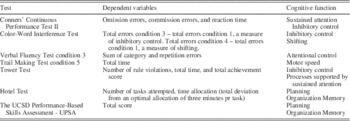
Neuropsychological outcome measures included Conners’ Continuous Performance Test II (CPT-II; Conners, Reference Conners2000), Color-Word Interference Test (CWI), Verbal Fluency Test (VFT), the Tower Test, and the Trail Making Test (TMT) from the Delis-Kaplan Executive Function System (D-KEFS; Delis, Kaplan, & Kramer, Reference Delis, Kaplan and Kramer2001). The Hotel Task (Manly et al., Reference Manly, Hawkins, Evans, Woldt and Robertson2002) was included to increase ecological validity of test measures, as it mimics real-life multitasking situations, demonstrating acceptable ecological validity, and sensitivity in detecting ED in various disorders (Roca et al., Reference Roca, Torralva, Meli, Fiol, Calcagno, Carpintiero and Correale2008, Reference Roca, Parr, Thompson, Woolgar, Torralva, Antoun and Duncan2010; Torralva et al., Reference Torralva, Strejilevich, Gleichgerrcht, Roca, Martino, Cetkocivh and Manes2012). Similarly, the UCSD Performance-Based Skills Assessment (UPSA) (Patterson, Goldman, McKibbin, Hughs, & Jeste, Reference Patterson, Goldman, McKibbin, Hughs and Jeste2001), originally developed for studies of schizophrenia (Mausbach, Harvey, Goldman, Jeste, & Patterson, Reference Mausbach, Harvey, Goldman, Jeste and Patterson2007; Patterson et al., Reference Patterson, Goldman, McKibbin, Hughs and Jeste2001), was included because it targets “real-life” multitasking situations, as subjects role-play with the examiner in three functional domains (communication, finance, and transportation). Motor speed (TMT5), a cognitive domain often affected by ABI but not targeted by the intervention, was included as a marker of non-specific change (Table 4).
Overview of dependent neuropsychological test variables, and cognitive functions

Participants completed a custom made questionnaire evaluating their satisfaction with the treatment at the end of training, and at 6 months follow-up. The assessors were blinded for group allocation at all assessment points.
Statistical Analysis
Data analysis was performed using SPSS version 21.0 for Windows. Frequency distributions, means, and standard deviations (SD) were calculated for demographic, medical, neuropsychological, and questionnaire variables. Differences between groups were analyzed using t tests for continuous variables and Chi-square for dichotomous variables. A general linear model with repeated measures analysis of variance (RM ANOVA) was used to examine group-related treatment effects. A 2 × 3 mixed-design was applied, with Group (GMT, BHW) as between-subjects factor, and Time [baseline (T1), post-intervention (T2), and 6 months follow-up (T3)] as within-subjects factor, using a multivariate approach to avoid the more stringent univariate model assumptions. Analyses used intention-to-treat principle, including all randomized subjects, regardsless of whether they completed treatment. t Tests were used to explore change scores (T1–T2, T1–T3) within each group. The strength of experimental effects was interpreted with effect-size statistics, including partial eta-squared for ANOVA results and eta-squared (ƞ2) for t tests. According to Cohen (Reference Cohen1988), thresholds for interpreting ƞ2 are <.06 (small), .06–.14 (medium), and >.14 (large). Due to the high number of comparisons performed, findings with a significance level of <.01 are described as effects, findings in the p < .01–.05 range considered to represent tendencies.
Results
Baseline Functioning
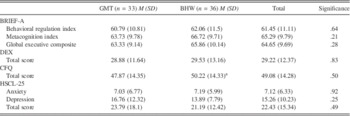
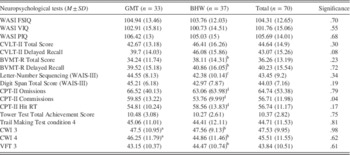
The groups did not deviate from each other at baseline with regard to demographic and medical variables (Table 1), or self-reported symptoms (Table 5; BRIEF-A, DEX, HSCL-25, and CFQ). The groups performed comparably on neuropsychological measures (WASI, CVLT-II, BVMT-R, Digit-Span, Letter-Number Sequencing, CPT-II, Tower test, TMT, CWI, VFT), except that GMT made more commission errors on the CPT-II (p<.035). With the exception of CVLT-II delayed recall, BVMT-R, and CPT-II omissions, both groups performed within 1 SD from the normative mean on the neuropsychological measures, indicating mild to moderate cognitive impairments (Table 6).
Scores on self-report questionnaires at baseline; BRIEF-A, DEX, CFQ, and HSCL-25

Note. DEX scales, CFQ total scores, and HSCL-25 are raw scores, with higher scores indicating greater impairment. BRIEF-A scores are norm-referenced T scores (M=50, SD=10), with higher scores indicating greater impairment.
GMT=Goal Management Training; BHW=Brain Health Workshop; BRIEF-A=Behavior Rating Inventory of Executive Function Adult version; DEX=Dysexecutive Questionnaire; CFQ=Cognitive Failures Questionnaire; HSCL-25=Hopkins Symptom Checklist 25.
a N=35.
Standardized neuropsychological test scores at baseline

Note. All scores reported are standardized scores. Higher scores represent better performance, except for scores on the CPT-II where T scores above 60 indicate poor performance.
GMT=Goal Management Training; BHW=Brain Health Workshop; WASI FSIQ=Wechsler Abbreviated Scale of Intelligence Full Scale Intelligence Quotient (M=100, SD=15); WASI VIQ=Wechsler Abbreviated Scale of Intelligence Verbal Intelligence Quotient (M=100, SD=15); WASI PIQ=Wechsler Abbreviated Scale of Intelligence Performance Intelligence Quotient (M=100, SD=15); CVLT-II=California Verbal Learning Test II (M=50, SD=10); BVMT-R=Brief Visuospatial Memory Test Revised (M=50, SD=10); WAIS-III=Wechsler Adult Intelligence Scale III (M=10, SD=3); CPT-II=Conners Continuous Performance Test II (M=50, SD=10); RT=reaction time; Subtests from Delis–Kaplan Executive Function System (M=10, SD=3); CWI 3=Color Word Interference Test condition 3, CWI 4=Color Word Interference Test condition 4, VFT 3=Verbal Fluency Test condition 3, Category switching.
a N=32.
b N=36.
c N=34.
d N=35.
Treatment Effects
Self-reported executive functioning in daily living
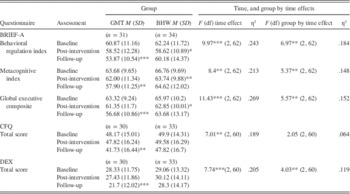
Table 7 provides mean scores on the outcome measures of EF in daily life for GMT and BHW, with time-, group by time effects, and intra-group change over time. There was a significant improvement over time on all three BRIEF-A indexes, as well as time by group interactions. The effect-size estimates indicate large training effects. The GMT group showed significant reductions in self-reported executive problems from T1 to T3 on all indexes, the BHW group on the Metacognitive index from T1 to T2. The CFQ showed a significant main-effect of time, but no group-interaction. Significant change across time on the DEX total score was found, as well as time by group interactions. t Test analyses showed a significant reduction in self-reported dysexecutive symptoms from T1 to T3 for GMT, with the effect-size estimate indicating medium training effect.
Mean scores on outcome measures by time for the GMT and the BHW group, with time and group by time effects

GMT=Goal Management Training; BHW=Brain Health Workshop; BRIEF-A=Behavior Rating Inventory of Executive Function Adult version; DEX=Dysexecutive Questionnaire; CFQ=Cognitive Failures Questionnaire.
Note. BRIEF-A scores are norm-referenced T scores (M=50. SD=10), with higher scores indicating greater impairment. DEX total score and CFQ total scores are total raw scores, with higher scores indicating greater impairment. Significant effects are in comparison to baseline: *p<.05; **p<.01; ***p<.001. All F-tests use Wilks’ lambda statistic. N’s are provided as data were missing for certain measurements.
Neuropsychological tests
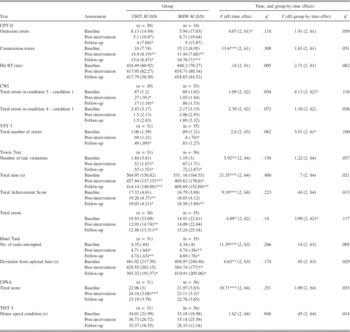
Table 8 displays mean GMT and BHW scores on neuropsychological measures, with time-, group-by-time effects, and intra-group change. There was significant improvement across time for commission errors (CPT-II). t Tests analysis demonstrated a significant reduction in commissions in both groups from T1 to T2, and for BHW from T1 to T3. There was a tendency toward significant improvement of omissions errors across time, and t tests approached significance for reduction of omissions in GMT at T3.
Mean scores on outcome data by time for GMT group and BHW group, with time and group by time effects.

GMT=Goal Management Training; BHW=Brain Health Workshop;. CPT-II=Conners’ Continuous Performance Test; CWI=Color Word Interference Test; VFT 3=Verbal Fluency Test condition 3; TMT=Trail Making Test condition 5; Total Errors=Ssum of errors CPT-II, TMT1-4, VFT1-3; CWI1-4, number of rule violations Tower Test; UPSA=UCSD Performance-Based Skills Assessment;. Mms=milliseconds; s=seconds.
Note. All scores are raw scores. Time is reported in milliseconds (CPT-II), and seconds (Tower test, Hotel Task, and Trail Making Test condition 5). Significant effects are in comparison to baseline *p<.05; **p<.01; ***p<.001. All F-tests use Wilks’ lambda statistic. N’s are provided as data were missing for certain measurements.
There was significant improvement across time on all Tower Test variables. t Tests showed significant improvements of total time from T1 to T2 in both groups, from T1 to T3 for GMT, significant improvement of the total achievement score for GMT from T1 to T2, and from T1 to T3 for BHW. Performance on the Hotel task variables demonstrated a significant time-effect. t Tests showed significant improvement in both groups on the number of tasks attempted and time allocation at T3. Total UPSA-scores improved over time, with t tests demonstrating a significant improvement for GMT from T1 to T2. No significant differences over time were found on the motor speed test (TMT5).
Group by time interactions approaching significance were seen for CWI total errors condition 3 minus 1, and for VFT3 total errors, showing a reduction in errors across time maintained at T3 for GMT only, with medium effect-size estimates. A sum-score for all errors on neuropsychological tests was calculated to explore treatment-related change in errors (CPT-II omissions and commissions, TMT1-4, VFT1-3, and CWI1-4, and rule violations in the Tower test). This measure showed a tendency toward significant time by group interaction, with t tests displaying significant reduction of errors for GMT from T1 to T2 and T1 to T3, effect-size indicating medium training effects. The participants were comparably satisfied with the training at T2 and T3.
Discussion
The main aim of this randomized controlled trial was to examine the efficacy of GMT compared to an active control-condition for patients with chronic ABI and ED in daily life, with an emphasis on improving cognitive aspects of EF. Patients receiving GMT showed significant improvement in self-reported cognitive EF in daily life, with the greatest improvements evident after 6 months. A general trend toward improved neuropsychological functioning was found. There was a tendency toward improved performance on attention demanding tasks for GMT, with error reduction indicating improved executive attention. The overall pattern of results confirmed that GMT had a more favorable effect on cognitive EF than an active psycho-educative control condition. The minimal attrition speaks to the feasibility and lends social validity to the intervention.
GMT-related improvement of daily life cognitive EF was evidenced by decreased symptom burden at T3 on GEC of the BRIEF-A, as well as the Behavioral regulation (BRI) and Metacognition indexes. The BHW-group improved on the Metacognition index at T2, but regressed toward baseline levels at T3, possibly indicating non-specific treatment effects. The GMT participants reported a reduction of daily life ED (DEX), and less cognitive failures (CFQ) at T3. These findings suggest that GMT reduces cognitive ED through better goal management in daily life. Although the majority of the items of the BRIEF-A and DEX relate to cognitive EF, these questionnaires have a broader scope than CFQ, also covering emotional aspects of ED. As such, this might explain the stronger treatment effects seen on BRIEF-A and DEX, compared to CFQ.
The core of GMT is to stop ongoing behavior periodically to monitor and adjust goals. This supports the maintenance of goal-related information essential to managing the sequence of stages needed to accomplish one’s goals, and illustrates the top-down approach of GMT, where stages of goal management are trained to be applied to a variety of situations (Levine et al., Reference Levine, Robertson, Clare, Carter, Hong, Wilson and Stuss2000). The greatest GMT-related improvements were seen after 6 months, indicating that participants continued to use the learned strategies and established new habits, possibly reflecting consolidation of the strategies in everyday life (Novakovic-Agopian et al., Reference Novakovic-Agopian, Chen, Rome, Abrams, Castelli, Rossi and D’Esposito2011; Spikman et al., Reference Spikman, Boelen, Lamberts and Fasotti2010). It could also reflect increased perceived self-efficacy over time, as metacognitive strategy-training targeting patients’ cognitive and emotional self-regulation of cognitive and emotional processes is associated with increased confidence in symptom management (Cicerone, Reference Cicerone2012).
Krasny-Pacini et al. (Reference Krasny-Pacini, Chevignard and Evans2013) reported that studies finding an intervention effect of GMT at the participation-level (e.g., questionnaires), failed to detect a unique intervention effect at the impairment-level (e.g., tests). Miotto et al. (Reference Miotto, Evans, de Lucia and Scaff2009) and Spikman et al. (Reference Spikman, Boelen, Lamberts and Fasotti2010) showed comparable progress on neuropsychological tests in both GMT- and control groups. Similarly, the present study found a general trend toward improvement in cognitive test-performance, probably reflecting a combination of test–retest and non-specific treatment-effects.
The use of neuropsychological tests as outcome measures raises several issues. Response variability is a key symptom of frontal brain damage (Stuss et al., 2003). The relationship between tests and assumed cognitive domains, furthermore, has varying levels of validity (Burgess et al., 2006), tests of EF typically tap multiple cognitive functions (Chan et al., Reference Chan, Shum, Toulopoulou and Chen2008), and repeated administrations raises the issue of practice effects (Sohlberg et al., 2000). Since EF is crucial in managing new situations, and a test can only be new once, tests of EF might face particular test–retest reliability issues (Burgess, Alderman, Evans, Emslie, & Wilson, 1998). Neuropsychological measures typically capture only certain aspects of EF, and may thus not accurately reflect dysfunction in everyday life (Lewis et al., Reference Lewis, Babbage and Leathem2011; Spikman et al., Reference Spikman, Boelen, Lamberts and Fasotti2010). It has been suggested that performance-based measures and subjective ratings of EF assess different aspects of cognitive and behavioral functioning that independently contribute to clinical problems (Toplak et al., 2013). In summary, establishing adequate outcome measures in EF-interventions is very challenging.
As the inclusion of an active comparison group is assumed to control for non-specific treatment-effects, smaller treatment effects are to be expected compared to observational studies. Still, several measures of error-reduction approached significance in the GMT group at T3, suggesting improved inhibition of automatic responding (Levine et al., Reference Levine, Robertson, Clare, Carter, Hong, Wilson and Stuss2000, Reference Levine, Schweizer, O’Connor, Turner, Gillingham, Stuss and Robertson2011; Miotto et al., Reference Miotto, Evans, de Lucia and Scaff2009). Improving the awareness of attentional errors is crucial to GMT, rehearsed throughout the sessions by means of noticing attentional slips, stopping the autopilot, and improving present-mindedness. These tendencies are consistent with the theoretical assumptions that GMT targets executive attention (Robertson & Levine, Reference Robertson and Levine2013). This result can be seen as a contribution to disentangle the non-specific from the GMT-specific training-effects, resulting in fewer but theoretically more important findings, such as GMT possibly being associated with distinct improvement of inhibitory control. Supporting this notion, no changes were seen on the non-specific control measure of motor speed.
Since all participants received “STOP” messages, it is not possible to isolate the cuing-effect. Still, the significance of “STOP” was different for the groups, considering “STOP” a key-concept in GMT, and non-present in BHW. As such, this cuing was not “content-free”, and might have augmented treatment-effects in the GMT group specifically (Fish et al., Reference Fish, Evans, Nimmo, Martin, Kersel, Bateman and Manly2007; Manly et al., Reference Manly, Hawkins, Evans, Woldt and Robertson2002).
GMT attempts to address underlying deficits in sustained attention (Robertson & Levine, Reference Robertson and Levine2013) and could thus be conceptualized as a “bottom-up” intervention targeting the impairment-level. However, as a metacognitive strategy intervention aiming at improved “top-down” control, GMT also targets the activity- and participation-level (Bilbao et al., Reference Bilbao, Kennedy, Chatterji, Ustün, Barquero and Barth2003). Carrying out the intervention in real life, this distinction proves very challenging to up-hold as a clear-cut distinction. “Training” attention (impairment) without simultaneously practicing any task (activity) is difficult to conceive. When practice is an important treatment ingredient, it will usually be practice of a task rather than a function (Whyte et al., 2014), mirroring the overall goals of rehabilitation in improving the individuals’ capacity for activity and participation. As such, this challenge is not only methodological, but taps into the real challenge facing all rehabilitation efforts. More research is needed to further describe and clarify the level that should be the target of GMT.
Strengths and Limitations
The strong design of this study, being a randomized controlled trial including an active control group with blinded assessors at all assessment-points, as well as including the largest study sample so far, counters many of the methodological challenges of previous GMT studies. However, some significant limitations should be noted. Implementation of the module for emotional regulation and external cuing hampers identification of the unique contributions of GMT-intervention, and the external cuing can be considered to not be equivalent in the two groups. The sample heterogeneity makes it difficult to explore the interaction between outcomes and patient characteristics in detail.
Since EF is crucial in managing new situations, the lack of new EF tests post-training makes it challenging to explore generalization effects. Split-half administrations for some tests, for example, Tower test, could have circumvented this to some extent. Factors like awareness, demand characteristics, cognitive deficits, social desirability bias, acquiescent responding and extreme responding, may affect the accuracy and validity of self-report (Cantor et al., Reference Cantor, Ashman, Dams-O’Connor, Dijkers, Gordon, Spielman, Tsaousides and Oswald2014; Fischer, Trexler, & Gauggel, Reference Fischer, Trexler and Gauggel2004; Hart, Whyte, Kim, & Vaccaro, Reference Hart, Whyte, Kim and Vaccaro2005; Logan, Claar, & Scharff, Reference Logan, Claar and Scharff2008; McCambridge, de Bruin, & Witton, Reference McCambridge, de Bruin and Witton2012; Prigatano & Altman, Reference Prigatano and Altman1990), contributing to a tenuous relationship between self-report and “real life” activity-limitations. Furthermore, the lack of objective measures of actual goal management makes it difficult to conclude whether the reported improvements relates to improved self-perceived mastery of daily activities or actual improvements. Future studies might add collateral information from other sources (e.g., family members).
Conclusions
The present study on the efficacy of GMT for ameliorating ED in daily life following chronic ABI, supports the use of GMT combined with external cuing. GMT led to significant improvement of self-perceived EF in daily life, and a tendency toward improved of performance on attention demanding tasks. The strongest effects were seen after 6 months, suggesting that strategies learned in GMT are applicable and consolidated in everyday life after training cessation. Importantly, these findings show that ED can be improved even years after ABI. Future studies should make efforts to enhance the understanding of what patient characteristics predict treatment outcome following GMT.
Acknowledgments
This study was funded by the Norwegian ExtraFoundation for Health and Rehabilitation through EXTRA funds (grant number 2011/2/0204). The authors thank the participants, and the staff at the Cognitive Rehabilitation Unit Sunnaas Rehabilitation Hospital. In particular, we want to thank Brian Levine for providing the BHW material and for valuable advice throughout. We also thank Kari Agnete Lilleby, Liva Jones, Andreas Schillinger, Gina Hjort-Larsen, Per Anders Gulberg, Daniel Loeke, Eva McCarthy, Lilly-An Austad, whom helped carry out the study, and Grethe Loevland, and Svein Are Vatnehol for organizing the MRIs. The authors report no conflict of interest.