But the working rural world, where the physical experiences are most commonly found, is decisively altering. The labourer's options are very firmly for change. A fault can then occur, in the whole ordering of a mind. Defense of a ‘vanishing countryside’ — ‘the open air’, ‘the life of the fields’ — can become deeply confused with that defense of the old rural order which is in any case being expressed by the landlords, the rentiers, and their literary sympathisers.
Raymond Williams, The country and the city Footnote 1Whether lamented, celebrated, or a subject of dispassionate observation, the ‘working rural world’ of modern Southeast Asia is decisively altering. Such change is observable fact for those who study the rural political economy of Thailand. Production, consumption, social relations, livelihoods, and political interactions with the state — key markers of agrarian change — have transformed more completely over the past fifty years than over any comparable period in the country's long agrarian history.Footnote 2 For a variety of reasons observable along diverse pathways ranging from the individual to the structural, this empirically verifiable change has rendered ‘the old rural order’ no longer. A new order is emerging — one that scholars actively seek to define. In this endeavour, the editors of an impressive set of restudies spanning three decades of field research in Southeast Asia conclude that ‘[r]ural people (old and new) are combining livelihoods in new ways across sectors and developmental spaces, they embody new desires and aspirations, and their values are often different from those of past peasant generations'.Footnote 3 Similarly, another authority on Thailand's rural society forcefully affirms that
Rural politics in contemporary Thailand is not the old rebellious or resistant politics of the rural poor, rather, it is a new middle-income politics …. [where] livelihoods are relatively secure … [and] a new ‘political society’ is energized by a fundamental desire to be productively connected to sources of power.Footnote 4
Yet, even as the rural order evolves, and we gain increasing clarity of it from the empirical and theoretical work of those who examine it, certain conceptual frames remain. In particular, inertia tied to the notion of ‘peasant’ lives on even as observers awkwardly seek to reconcile this once useful class category with actual changes on the ground. Such conceptual sclerosis matters a great deal given that the classic problématique of agrarian studies — the ‘agrarian question’ — focuses squarely on the processes by which agrarian classes are remade by capitalist production.Footnote 5 To the extent it is observable, the remaking of Thailand's agrarian society may be impossible to fully document until the conceptual categories we use to describe that remaking evolve correspondingly. Should rural people who benefit from relative security and middle incomes — who exhibit new desires, aspirations and diverse livelihoods, and enjoy productive connections to society's power structures — remain classified as peasants? Are such markers useful in helping us understand a remade peasant society in the twenty-first century? Can the peasant concept be reasonably stretched over time and across generations while retaining its analytical integrity?
Outside of academia such static terminological usage may matter with even greater consequence, especially when actual political actors imagine rural citizens as unenlightened peasants in a country where a classic peasant society no longer exists. The wholly pernicious idea bandied about by certain Thai elites that rural voters are ‘stupid’ and ‘not ready for democracy’ remains intimately tied to the oft-abused, culturally-romantic stereotype of ‘chaona’ (peasant-farmer).Footnote 6 Arguably, the much belated deconstruction of caste-based perceptions of peasant and chaona in actual Thai political discourse is effectively inhibited when those who write about rural society remain analytically wedded to anachronistic terms. However unintentional, analytically imprecise terminology can be doubly harmful if it becomes politically consequential. Any debate over the veracity of the ‘Thai peasant’ concept thus not only exists as an analytical concern but also as a substantive matter connected to actual Thai political discord and the discursive power of aristocratic-minded elites.
It is within this milieu of intellectual debate and potential political consequence we submit the argument that the peasant concept is no longer useful to describe or interpret contemporary rural Thailand. Through careful examination of the peasant concept, and its rough Thai equivalent chaona, the sections below demonstrate the widening gap between the country's rural dynamism and the static concepts which fail to describe it. After reflecting on the claim of an ageing Thai peasant made during a research interview, we analyse classic definitions of the peasant concept and compare uses and meanings of the concept in past and present studies of Thailand. The result of this investigation affirms the disutility of the peasant concept to understand present-day rural Thailand. By implication, it also points to the hazards of the term chaona in popular discourse related to the country's deep political cleavages. We further conclude that any search for a substitute term for peasant (or chaona) is futile because the remaking of Thailand's peasant class exhibits differentiation, atomisation, and evolution rather than uniform transition, class persistence, or re-peasantisation.
‘Pho’ Singchai — the last peasant?
We begin our investigation with an anecdote from rural Thailand — a seemingly straightforward story about a farmer, his village, and agrarian change. The story's details are sourced from the farmer himself, supplemented with historical context about local conditions, national trends, and agricultural trade.Footnote 7 Despite its somewhat typical outlines, we find the anecdote to be both analytically troubling and substantively provocative. The story demonstrates how the ruminations of an old-time farmer reveal the liabilities of employing static concepts to describe rural Thailand in the twenty-first century.
Amidst the tracts of longan orchards that cover much of Northern Thailand's Lamphun province, in a comfortable rural home near the Ping River, lives an ageing man who has made a thought-provoking claim. Still strong in body but suffering from deteriorating eyesight, 74-year-old Singchai Thamping contends that he is the only chaona remaining in his village. ‘Nobody else in my village is a peasant anymore’, he says. ‘In my heart though, I'm still chaona.’
As a Thai peasant, ‘Pho’ Singchai bears full credibility. In the 1950s and ‘60s he prepared rice fields using khwai (water buffalo) and participated annually in communal harvesting within his village. He walked wherever he needed to go and paced life's rhythms on the seasonal rituals at the local Buddhist temple. Like many impoverished peasants in the Ping River Valley at the time, Singchai farmed on rented land. Half of the harvest was dedicated for subsistence; the other half was taken by the landlord. Commenting on these excessive and unjust tenancy rates he recalls, ‘We just followed what we were told to do. We respected those with power and would simply wai those above us'.Footnote 8
When radical students arrived in his village in the mid-1970s spreading the message of equality, rights, and democracy, Singchai developed a political consciousness and grew indignant about his peasant condition. Taking cues from younger student leaders and activists, he and other tenant farmers from Lamphun and Chiang Mai began contesting for land rights. Imbued with a sense of injustice and duty, Singchai became a local leader of the Farmers' Federation of Thailand (FFT) and found common cause with a larger peasant society. At its peak in the mid-1970s the FFT included dissatisfied peasants from 41 of the country's 72 provinces. It was the first non-government farmer's association of its kind in Thailand.Footnote 9 After publically advocating for a new law to control land rents, peasant leaders like Singchai found themselves in face-to-face battles with incredulous local elites, uncooperative state officials, and right-wing vigilante militias such as Nawaphon and Krathing Daeng.
After the murder of his activist father-in-law and the assassinations of other FFT leaders, Singchai fled to the hills with his wife, two daughters, and some fellow villagers, and committed his future to the success of a fledgling people's revolution led by the Communist Party of Thailand (CPT).Footnote 10 In the CPT's jungle redoubt in the Phetchabun Mountain Range, Singchai attempted to contribute to revolutionary goals, but spent much of his time confused about the insurgency's direction. After three years in the forest he grew disillusioned by the incessant factional infighting between the movement's Maoists and their Vietnamese-backed rivals and chose to return home to Lamphun under government amnesty provisions. Singchai struggled over the next decade to get back on his feet as a tenant farmer even as authorities suspiciously tracked his movements. Around the time of his return the Crown Property Bureau began to take control of agricultural land in the area under new leasing arrangements. Though the terms were less harsh than in the past, Singchai and many of Lamphun's other poor farming families nevertheless remained excluded from the benefits of genuine land reform. Landownership, collateral, low interest loans, and full dignity remained out of reach.
Still, even as tenant farmers, new opportunities emerged in the Ping River Valley. Over the next three decades Singchai watched his fellow villagers move into cash crops and longan orchards — entangling their labour, investments, and economic fates with competitive markets, price instability, and the fickle tastes of Thai and foreign consumers. Gradually, longan trees spread across much of the area. The rice paddies and khwai of the past began to disappear. By the late 1990s, Singchai's village had become part of a US$200 million export industry. Rising demand for longans came largely from a booming China and wealthy overseas Chinese communities in Asia and the West. According to Singchai, the introduction of potassium fertilisers generated off-season cropping and more income opportunities for villagers each passing year. By 2005, the agro-industry processing of fresh, dried, frozen, and canned longans produced over 241,000 tons of longan products for the export market, second only to pineapple in raw volume among all Thai fruit exports.Footnote 11 Over time Lamphun's tenant longan growers benefitted from all of this expansion and boasted nearly half of the country's longan orchards.Footnote 12 Lamphun's landowners, of course, benefitted more. As land values climbed higher, they profited by increasing rents and from buying and selling valuable land.
Throughout rural Lamphun income streams changed for other reasons as well. Increasingly, new agricultural income combined with remittance monies sent by children working in Bangkok, Chiang Mai, or Lamphun's ever-expanding industrial estates.Footnote 13 Like others in the area, Singchai's village began to experience higher living standards and changing demands. Motorbikes, televisions, mobile phones, washing machines, and pickup trucks became the material objects of everyday interest among his fellow villagers. Decades of broader improvements in public health care, education, and transportation also worked to ameliorate the harsh poverty of the village's past. Meanwhile, the generation gap within village families grew ever wider. The village community dissipated. Far beyond the traditional rhythms of local temple festivals, village youth and young adults paraded in step with national fashion trends, the latest digital gadgets, and Bangkok-based pop acts and TV soap operas. Few young people held ambitions that would confine their futures to an agrarian lifestyle within the village. Most sought opportunity away from home. As observed elsewhere regarding Thai village life then and now, ‘the bustle of the village … had given way to a much quieter place’.Footnote 14
Today, according to Singchai, only a minority of growers in his village physically harvest their own longans. With their children off at school or pursuing wage work elsewhere, the former practice of reciprocal communal harvesting is now unimaginable. In fact, when it comes to longans, many village growers, before a single tree is picked, sell their produce to buyers who then shoulder worries about collecting the fruit and getting it to market. The remaining growers who still manage their own harvests must now hire wage workers to do what was a communal affair in the past. Regardless of who is paying, Lamphun's longan trees are commonly picked by day labourers trucked in from elsewhere. Singchai observes that the labourers in the area are increasingly khon isaan (Northeasterners) and thai yai (migrant Burmese Shan) rather than local khon muang (Northern Thai).
Throughout all these transformations Singchai has remained politically active. NGO leaders in the area affectionately refer to the septuagenarian as ‘Pho’ (Father) Singchai. He is consulted frequently. ‘Pho’ Singchai stands as a veteran figure in the Northern Farmers' Network, one of the nine NGOs that form the Northern Peasants' Federation (NPF). Rather than the idle landlords of the distant past, rural activists of the NPF oppose aggressive agri-business corporations and nouveau riche orchard owners.Footnote 15 In addition to NGOs, many of Lamphun's land-poor residents also pin their hopes more warily on electoral representation. Thaksin-based political parties, the United Front of Democracy against Dictatorship (UDD) and the Red Shirt coalition, have had solid support throughout the largely rural province.
Singchai reluctantly admits that he too joined the longan market more than a decade ago. ‘But’, he is quick to clarify, ‘I have preserved three rai of land to grow my own rice’.Footnote 16 Unlike most others living in his village Singchai proudly pursues self-sufficiency in the manner of chaona from the past: ‘I collect my own seeds for use … [and] still grow vegetables and herbs around my house’. He cynically remarks that his remaining neighbours who continue to grow rice simply sell it off for profit, and then go buy cheaper grades for their own consumption: ‘They don't even eat the rice they grow!’ To ‘Pho’ Singchai, such corruptions are important evidence supporting his contention that he remains the last authentic peasant in his village.
What is a peasant?
In some respects the rural changes experienced by Singchai and his village over the past seven decades are all too familiar: the transition from subsistence and tenancy to commercialised farming, from reciprocated communal labour to wage-based contracting, and from the demands of landlords to the demands of the global market, to name a few. Singchai's village predictably experienced rising living standards over time, as well as an overall shift toward material consumption in tandem with a growing generation gap. Politically, the story is also generally recognisable. Singchai's rural experience evolved from peasant passivity to Cold War-era radicalism, followed then by globalisation-era collective action, NGO activism, and legal battles. Arguably, to observers of rural Thailand, the patterns of agricultural, social, and political–economic change experienced by Singchai and his village, though not identical, are similar to cases of agrarian change documented elsewhere in Thailand (and referenced elsewhere in this article).
What troubles us analytically is not the common experience of ‘Pho’ Singchai and his rural village. Rather, our difficulty relates to interpreting his own claim that he is ‘the last peasant’ of his village. We believe that Singchai's claim of being the last peasant (chaona) possesses provocative implications. For if ‘Pho’ Singchai is truly the last peasant in his village, what do we call all the other people living in his village? And if we extend Singchai's logic beyond his village, where do authentic chaona still live in Thailand if not among the longan tracts of Lamphun? Do they exist elsewhere in Pitsanulok, Uthai Thani, and Kalasin but not Lamphun? Analytically, by what means would we identify authentic chaona assuming we can find them? Can a single peasant exist in the absence of a peasant society? Does Thailand still have a peasant society? Does Thailand still have peasants?
Given the context of his life history, and the markers he used to explicitly self-identify as chaona, we are convinced that Singchai's claim is a statement of political identity — a statement about a disappearing social class and lost rural identity; a claim that ‘peasant-ness’, at least in its authentic Thai form, no longer meaningfully exists in his village. It is this claim and its political implications which are of greatest interest to us. To fully explore it, and to determine whether Thailand still has peasants or a peasant society, we evaluate conceptual understandings of these constructs against current observations and existing data. We first turn to the founding literature in peasant studies as a baseline and then compare the use of the peasant concept in Thai Studies literature.
Barrington Moore Jr., the renowned author of Social origins of dictatorship and democracy: Lord and peasant in the making of the modern world, argues that it is ‘impossible to define the word peasantry with absolute precision’.Footnote 17 Nevertheless, Moore reluctantly defines the elusive term out of analytical necessity:
The main distinguishing features of a peasantry [include] … a history of subordination to a landed upper class recognized and enforced in the laws, which, however, need not always prohibit movement out of this class, sharp cultural distinctions [between lord and peasant], and a considerable degree of de facto possession of land.Footnote 18
To Moore, peasant societies may be ‘highly stratified’, ‘feudal’, or characterised by ‘an agrarian bureaucracy’, but in all cases peasants are subordinate, exploited rural cultivators who lack institutionalised means to participate in making rules that affect their livelihood or to check society's powerful actors (i.e. ‘overlords’, ‘bureaucrats’, ‘rulers’, ‘warlord gangsters’).Footnote 19
Following Moore, the eminent anthropologist Eric Wolf usefully stipulates that peasants, as a conceptual category, must be distinguished politically and economically from two other categories: ‘primitives’ and ‘farmers’.Footnote 20 To Wolf, a primitive is a rural dweller who lives outside the dictates of a superordinate state or broader political structure. A peasant, by contrast, lives within such structures. He further defines peasants as ‘populations that are existentially involved in cultivation and make autonomous decisions regarding the processes of cultivation’.Footnote 21 Wolf contends that ‘tenants and sharecroppers as well as owner-operators, as long as they are in the position to make relevant decisions on how their crops are grown’ are indeed peasants; but ‘artisans, fisherman, and itinerant merchants’, as well as ‘landless laborers’ are not.Footnote 22 Economically, peasants predictably seek subsistence, keep the market at arm's length, and maintain social status within a narrow range of social relationships. Restricted by relatively immobile factors of production (i.e. untitled or rented land, community labour, and shared equipment), peasants only engage with markets to sell produce at marginal returns, or when they need to buy goods that they ‘do not produce on the homestead’.Footnote 23
Wolf contends that farmers, as opposed to peasants, ‘participate fully in the market and commit themselves to a status game set within a wide social network’.Footnote 24 The land, labour, and equipment of farmers are relatively mobile factors capable of being traded, bartered, and rented through open competition in an unrestricted market. Unlike peasants, farmers willingly go beyond local markets and seek alternative uses for factors of production — including forms of capital — for maximal returns. The farmer ‘favors the more profitable product over the one entailing the smaller risk’.Footnote 25 Following Wolf, others clarify that farmers are ‘market-oriented and entrepreneurial’ risk-takers, whereas peasants are not.Footnote 26 Peasants, by definition, are those who live with ‘extreme scarcity’ and have limited access to ‘technology, capital, marketing information, and credit’; they have ‘few other outlets for productive labour employment’.Footnote 27
Further definition of the essentialist constructs of ‘peasant-ness’ and ‘peasant society’ stems from another pioneer of peasant studies: George Rosen.Footnote 28 Derived from his review of historical and anthropological literature on peasants in Asia, Rosen usefully identifies peasant societies as inclusive of the following: (i) family-operated farms constituted of several generations; (ii) interrelations with nonfamily cultivators in a village structure where cooperation in planting and harvesting is common and only minor specialisation for certain communal tasks such as village leader, priest, blacksmith, or merchant; (iii) a subsistence-oriented economic system with the goal to ‘minimise losses’ rather than to ‘maximise output’; (iv) hierarchical patron–client relations where poverty is ‘shared’ by wealthier villagers who assume responsibilities to protect poorer clients; and (v) a ‘complex mutual relationship with an urban superstructure’ that governs the village through political and religious structures.Footnote 29
With respect to social mores within the peasant economy there is generally ‘a repugnance on the part of peasants to such economic behaviour as holding surplus cash or investing savings outside farming and other rural activities’.Footnote 30 The conspicuous improvement of somebody's position within the village, agrees anthropologist George Foster, is often ‘viewed as a threat to the entire community’.Footnote 31 Peasants use a similar political logic regarding relations outside the community. Ever conscious of their subordinate status vis-à-vis the urban superstructure and non-food producing elites, ‘peasants often harbor a deep sense of injustice’, claims Wolf.Footnote 32 Yet such attitudes must be organised before emerging as collective action in the political realm.Footnote 33
The idea that peasant behaviour is driven by a sense of injustice is, of course, a main theme running through James Scott's prolific work on rural Southeast Asia. Scott famously defines the peasant condition as ‘insecure poverty’ and ‘normal exploitation’ at the hands of state elites and capitalist markets.Footnote 34 To Scott, peasants are uniformly risk-averse in their search for reliable subsistence and minimal income. Importantly, they demonstrate ‘little scope for the profit maximisation calculus of traditional neoclassical economics’.Footnote 35 Organised around this minimal income imperative, peasant societies thus depend on reciprocity, communal redistribution, and patron–client relationships to achieve subsistence goals. This ‘moral economy’ is not ‘radically egalitarian’, but provides support to even the poorest villagers when times get rough.Footnote 36 Samuel Popkin, of course, took issue with Scott's notion of a ‘safety-first’ peasant culture, arguing instead that rural cultivators in fact desire new market opportunities, access to credit, and control over marketing arrangements.Footnote 37 Peasants, he said, observe the world around them and begin to employ an ‘investment logic’ when making economic decisions. They similarly weigh expected benefits from the costs of collective action. For Popkin, this calculus operates at the individual level no differently than with other political actors in other contexts — that is, he contends there is no particular ‘peasant culture’ per se.
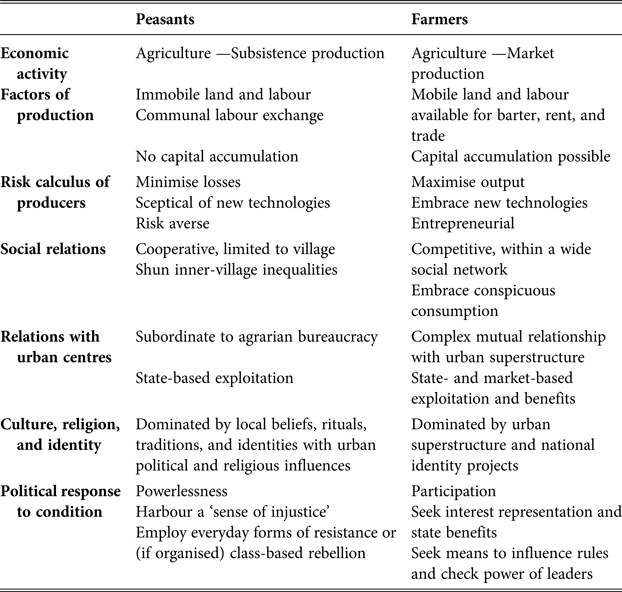
Running through the so-called Scott–Popkin debate, as well as the founding literature of peasant studies before it, is an implicit common assumption: the idea that peasants exist in a political milieu where subordination and exploitation produce antipathy and a desire for remedy. Whether through passive resistance, rebellion, revolution, or reactionary defensiveness, peasants are always consigned to confrontational, subversive, and anti-systemic political strategies. Unlike Wolf's market-oriented and entrepreneurial farmers who enjoy greater access to markets, technology, and policymakers, peasants are defined by their limited access to factors of production and society's political institutions. In effect, whether conceived through the lens of Moore, Wolf, Rosen, Foster, moral economists, or rational choice theorists, the essentialised category of ‘peasant’ is constructed around an implicit consensus view: Peasants are economically exploited, subsistence-oriented cultivators consigned to confrontational means of resolving grievances due to underdeveloped institutional links that would otherwise grant them a role in the making of rules or an ability to check rulers and powerful actors in society. So, however impossible the term peasant is to define precisely, we adopt the above as our definitional point of departure. Table 1 summarises the key general distinctions between peasants and farmers as derived usefully from classic literature in peasant studies.
Distinguishing peasants and farmers

Sources: Authors; summary of characteristics described in peasant studies literature.
What is a Thai peasant?
How well do the above general definitions of the peasant concept hold up against recognised interpretations of rural Thailand? How have scholars of Thai society characterised Thailand's chaona? What distinguishes Thai peasants and Thai peasant society? As demonstrated in this section, the most prominent accounts of rural Thailand offer descriptions of agricultural society consistent with the definitions of peasant and peasant society advanced by the leading theorists discussed above. Even across a broad spectrum of intellectual approaches, the standard works on rural Thailand by both Thai and foreign scholars reflexively assume that peasants exist and that Thai peasant behaviour is predictably uniform due to some shared cognitive modality, decision-making calculus, common structural context, or political ideology.
Within Thailand, standard conceptions of chaona tend to lump together all those who cultivate and harvest crops as a single, homogenised people. However, before the modern era the word ‘chaona’ was understood in Thai society quite differently than it is today. The word ‘chao’ was used to group people who shared certain characteristics in order to classify them according to their relationship with the state: chaona (those who dwell in the fields), chaoban (those who dwell in the villages), chaomueang (those who dwell in the towns or cities), and chaophranakorn (those who dwell in the capital city). Because many people grew rice for subsistence consumption in the past, various ‘chao’ were distinguished using other markers. For example, in the First Enacted Thai Code of Law, promulgated during the reign of Rama I (1782–1809), dispute settlement procedures designed to arbitrate between quarrelling neighbours distinguished chaona from other rural categories including chaoban (villagers), chaorua (those who dwell on boats) and chaotalad (those who dwell near markets).Footnote 38
The generic use of chaona — meaning all ruralites who farm — did not effectively emerge until recently. This subsequent and broader meaning of chaona resulted from socioeconomic changes related to the expansion of rice cultivation for the specific purpose of selling rather than consuming. During the post-Second World War expansion of agriculture, the contemporary meanings of both chaona and sangkhom chaona (peasant society) emerged alongside three concurrent changes. First, there was an expansion of farming as an occupation or livelihood. This expansion was affected by the decision of many Chinese immigrants to live in Thailand rather than return to China. Many agricultural brokers and middlemen during the expansion of market agriculture were Sino–Thai. The second factor was the influence of postwar American researchers who came to Thailand to study rural society under policies aimed to prevent the spread of communism.Footnote 39 From such research came images of unadulterated, idyllic rural simplicity parallel to visions of rural life in other countries. The third and final change was Thai intellectuals acknowledging and distinguishing chaona from other groups in society. This differentiation included a constructed version of the chaona lifestyle and sangkhom chaona.
One person who significantly influenced the development of the modern chaona construct was Phraya Anuman Rajadhon, the highly regarded scholar and authority on Thai culture. Phraya Anuman Rajadhon published many writings on chaona with particular attention to the close and cohesive relationships he found among chaona. His work also placed great emphasis on how both agricultural production and the centrality of the wat (temple) fostered relational ties and created a cohesive society through practices, customs, and traditions.Footnote 40 One such influential work, titled ‘Chiwit khong chaona’ (The life of chaona), was produced by Phraya Anuman Rajadhon after he observed:
Nobody has much interest in knowing about chaona beyond the fact that rice farming initially contributed to civilization and its progress … As for the everyday life of chaochonabot [country folk] … it seems nobody really cares too much at all.Footnote 41
In this widely-read account, Phraya Anuman Rajadhon then offers a narrative and explanation of ‘the life of chaona’ by separately examining various subjects such as the farm activities of preparing, ploughing, and planting; propagation and maximising yield; communal harvesting and threshing; animal husbandry and horticulture; merit-making, social relations, and other miscellanea of ‘sangkhom chaona’.Footnote 42
By acknowledging and distinguishing chaona and sangkhom chaona, and by highlighting idyllic social relations and customs, Phraya Anuman Rajadhon left his readers with romanticised images of rural life that became embedded in Thai society for a long time.Footnote 43 Such a constructed imaginaire of back-country innocence and simplicity was also cultivated in the popular literary work during the same era. Kukrit Pramoj's acclaimed novel Red Bamboo,Footnote 44 for instance, painted chaona and their village leaders as clownish dimwits, easily lured by communist propaganda. By contrast, in the same novel, Kukrit portrayed the monks of the Buddhist sangha as articulate, quick-thinking mentors, rhetorically capable of turning communism into a joke. Thus, Thailand's scholar–bureaucrats and emergent literati tended to pigeonhole all of the country's rice growers together, as some rural breed of chonabot (back country) simpletons, bounded by wat-centred rituals and properly corralled by tradition and sagacious monks. Consequently, in the early postwar period, Thailand's chaona were rarely classified as a political threat to the establishment, but instead as victims of sinister external influences that endangered susceptible peasant minds; namely, dark influences stemming from dangerous communist ideas and mischief spilling in from neighbouring countries.
As attention on rural Thailand increased among foreign scholars during the Cold War, the essentialised category of ‘peasant’ (in English) calcified as an analytical constant over time. Relying initially on ethnographic fieldwork, behaviouralist methodologies, and the fixed assumptions of grand theory, cadres of determined postwar researchers from the United States and Europe set out to discover the Thai peasant. Irrespective of approach, most of these scholars presumed that Thai peasants were essentially cut from a single mould — one that was uniform and generalisable. As scholarly literature on rural Thailand proliferated in English, ‘the Thai peasant’ became an axiomatic unit of analysis — a self-evident categorical entity of classification comparable to any other social group, political institution, or a species of flora and fauna.
From the postwar period to the present, the study of ‘the Thai peasant’ has moved largely around four intellectual pivots, or foci of inquiry and debate: (i) John Embree's ‘loose structure’ thesis; (ii) Marxist interpretations of the Thai rural experience; (iii) Chatthip Nartsupha's neo-paleo concept of ‘community culture’; and, more recently, (iv) globalisation-driven agrarian change and rural transformation. The following sketch of select literature associated with these four pivots provides a skeleton overview of how the Thai peasant concept evolved as conceptual category and unit of analysis over time.
The first pivot: Embree's ‘loose structure’ thesis
Although Carle Zimmerman's Siam: Rural economic survey, 1930–31, and Kenneth Landon's 1939 study Siam in transition constitute early scholarly descriptions of prewar rural Thailand, the first real pivot in Thai peasant studies revolved around the postwar culturalist conclusions of John Embree.Footnote 45 It was Embree who famously described Thai peasants as individualistic, unregimented, and ‘loosely structured’.Footnote 46 By loosely structured Embree meant that economic, social, and political attachments between Thais were not well-defined or durable, but instead ritualistic, variable, and lacking in emotional commitment. According to Embree, even relations among kin failed to produce the levels of structure or filial resilience he had observed in other Asian cultures. Consequently, he claimed, Thai peasants lack interest in politics and political parties, eschew organisations, and shift patrons and loyalties when ‘circumstances warrant’.Footnote 47
Embree's conception of the Thai peasant led to subsequent studies and a spirited debate about how to interpret Thai peasant society generally. Researchers associated with Cornell University's project at Bang Chan village, for example, further developed Embree's ‘loose structure’ idea by adding greater detail, thicker description, and a rich etic-based perspective.Footnote 48 At Bang Chan and other Thai villages, various scholars sought to uncover the cognitive sources of ‘loose structure’ even by audaciously attempting to map ‘the Thai peasant personality’,Footnote 49 explain ‘Thai political passivity’,Footnote 50 and why Thai peasants prefer ‘agriculture over paid employment or participation in commerce and industry’.Footnote 51 Employing behaviouralist methodologies including an elaborate survey of a single Thai village, Herbert Phillips, for instance, assumed a priori that the ‘dominant personality traits of the adult members’ of this single village not only represented a homogenised composite of personality traits within that village, but deductively revealed a ‘characteristically Thai’ peasant personality with ‘distinctive and expectable psychological characteristics’.Footnote 52 Irrespective of the methodologies used, other conclusions orbiting the Embree pivot were similar: Thai peasants were individualists, politically passive, and lacking in social structure — or, as acerbically put by one convinced scholar, Thai peasants were close to ‘the realm of complete nescience’.Footnote 53 Where reports of political discontent among villagers did emerge from early postwar studies, a sense of injustice was found only among the ‘educated and better-off’.Footnote 54
In Embree's wake a second wave of researchers conducting field studies in the 1960s and ‘70s derived alternative conclusions about Thai peasants. Challenging Embree's ‘loose structure’ thesis, these scholars provided different depictions of ‘the Thai peasantry’.Footnote 55 Although some of this new literature was also derived from village studies in Central Thailand,Footnote 56 much of it emerged from research further afield. Michael Moerman's studies of Ban Ping village in Northern Thailand, for instance, documented a stratified ‘village corporateness’ and structures of ‘synaptic leadership’ that forced village headmen to navigate between demands from villagers and national officials.Footnote 57 Others looking beyond the presumably apolitical peasants found in the Isan and the North a strata of village elders, monks, commune councils, farmers’ groups, irrigation associations, temple committees, cooperatives, and other groups which cultivated reciprocal–hierarchic structures and patron–client networks.Footnote 58 Moreover, for his part, Jack Potter countered Embree's ‘loose structure’ hypothesis as a result of his own ethnographic work conducted in rural Chiang Mai. Potter produced evidence of ‘tightly knit and intricately structured’ villages where ‘cooperation is the dominant ideology of village social relations’ as opposed to communal dissonance.Footnote 59 Nevertheless, even as fieldwork across Thailand's regions moved collective understanding of the Thai peasant further away from the Embree pivot, the fundamental ‘peasant-ness’ of rural cultivators remained a given.
The second pivot: Marxist interpretations of the Thai rural experience
A second pivot around which Thai peasant studies circled relates to Marxist and neo-Marxist inspired research on Thai historiography, peasant consciousness, and interpretations of hegemony. Ever conceived as a homogenised political actor rather than individuals with distinct cognition, preferences, or motives, Thai peasants in these writings are nevertheless characterised as anything but nescient Embree-esque apoliticals or ahistorical agents entangled in networks of village corporateness. Instead, radical analyses focused on the ‘Thai peasant class’ as an exploited social formation embedded in linear history, victimised by structural violence, and latently capable (perhaps) of full-scale revolution. The key problématique for scholars using the radical approach was not the unravelling of the peasant personality through inductive fieldwork, but deductively employing ‘epistemological theories of the formation of social consciousness’ for ‘defining and describing the sequence of social formations in Thai history’ as well as the ‘problems and issues of peasant culture, ideology, and consciousness’.Footnote 60
An influential articulation in response to this analytical challenge was Chom na saktina thai nai padchuban (The face of Thai feudalism today) written in 1957 by the highly regarded leftist intellectual Jit Phumisak.Footnote 61 In this famous work, Jit pitted the peasant class squarely against private capital. He defined Thai peasants as an ‘agricultural slave class or phrai’ with no rights to land.Footnote 62 His contributions to the linguistic development of a radical discourse of the Thai peasant experience are especially notable. In particular, Jit reinterpreted the saktina system of old Siam as an exploitive ‘backward agrarian order’. Jit effectively turned the term saktina, a noun, into a pejorative adjective used to describe a modern feudal system still governing rural areas.Footnote 63
Amidst the many strands of debate circling Jit's work and the Marxist pivot it is difficult to identify much consensus about the Thai rural experience from the full scope of ‘social formation analyses’. Struggles with (i) reconciling Thai history with Marx's Asiatic Mode of Production (AMP); (ii) varied class-analytic interpretations of the saktina system and its post-1932 legacy; and (iii) disagreements over emic interpretations and translations of both Marxist and Thai terms, created a ‘map of contrasting positions’ more than any shared conceptions of the Thai peasant among radical scholars.Footnote 64 Some Marxist critics of Jit, for example, labelled his approach too ‘mechanical’ and dismissive of the exploitive role that monarchs, royalists, and government officials play in forming Thailand's ‘indigenous capitalist class’.Footnote 65
Regardless of the internecine debates among scholars employing Marxist-inspired frameworks, radical scholars — like those circling other pivots — tended to give little thought to ‘the utility of the category “peasant” itself’.Footnote 66 It was taken as a self-evident fact in the Thai experience (past or present) that an existential peasant class suffered as a result of an exploitive mode of production. As the founding theorists might predict, Thai peasants were consequently defined by the dearth of formal mechanisms through which their grievances could find remedy. With his focus on non-class forms of consciousness among rural producers, Andrew Turton's work is a possible exception among radical scholarship along these lines.Footnote 67 Yet even with his departure from strict Marxist assumptions, the peasant-ness of Thailand's rural cultivators was taken as a self-evident fact in much of Turton's work. Thus, whether formed as a cohesive class or as non-class economic agents variably subject to hegemonic forces, the assumption of peasant consciousness served as a definitional imperative before scholars formally explored the possibilities of collective action or peasant revolution.
The third pivot: Chatthip's neo-paleo ‘community culture’
Chatthip Nartsupha is perhaps another notable exception among the progressive theorists who began to question European assumptions about a ‘peasant class’. Using a neo-Marxist historiography — but emphasising archival sources and interviews with septuagenarians and octogenarians ‘to strengthen the theoretical scaffolding’Footnote 68 — Chatthip's scholarship took an atavist cultural turn when he famously introduced the neo-paleo concept of wattanatham chumchon, or ‘community culture’. Chatthip advanced this concept in Sethakit muban thai nai adid (The Thai village economy of the past), published in 1984.Footnote 69 The community culture concept defines the Thai peasant experience in historical terms as a sort of Thai-styled state of nature. Here the Thai peasant becomes indistinguishable from his local chumchon, or community; peasants are peasants but conceived primarily in relational terms as ‘villagers’. Where peasant personality and class consciousness occupied the central curiosity of scholars before Chatthip's seminal work, the ‘muban thai’ (the Thai village) became the hub of all useful inquiry on rural Thailand thereafter, at least for those influenced by Chatthip. Reified as an anthropomorphic construct in its own right, Chattip's muban thai constituted an economic logic unto itself — autonomous, free, and undefiled; a place where a subsistence economy was combined with a ‘spirit of common humanity’ to create a ‘primordial socialist community’; a social formation with ‘no class division’.Footnote 70 In his writings on the Thai village, Chatthip ‘never divided the village up into rich peasants, middle peasants, or poor peasants’ and ‘always rested on a binary division’ between peasants in the village and the wealthy outside it.Footnote 71
Just as ‘the peasant’ had been conceived as a homogenised unit of analysis elsewhere in the literature, ‘the village’ became expressly homogenised in Chatthip's view. Using his framework, separate villages are hardly distinguishable one from another beyond their localised ancestral spirits and phi (malevolent ghosts) or their respective Central, Northern, Southern, or Isan regional contexts which, Chatthip contends, variably affected the timing and manner of state and market penetration.Footnote 72 Because the community culture concept ‘sees rural areas as static … [and] is easily applied to understand every locality in Thai society’, it displaces the value of particularistic or local community histories.Footnote 73 In this manner, the concept offers analysts a sort of one-size-fits-all micro-history of the peasant for every agrarian settlement in Thai history. Simultaneously ‘Thai’ and ‘local’, Chatthip's village also normatively set the standard of cultural ‘goodness’ where ‘the community is the villagers’ strongest institution’.Footnote 74 In this model of Thai peasant-ness, the village heroically doubles as the ‘leading agent’ of Thai history and as society's greatest defence against ‘parasitic capitalism’.Footnote 75
With muban thai at its core, the community culture concept proved so intellectually powerful that it became its own school of thought. It then morphed into a movement of social practice championed by anti-globalisation NGOs and was ultimately coopted by state elites, Buddhist fundamentalists, and others to promote static notions of Thainess, sufficiency economy, and a Thai agrarian myth.Footnote 76 Its promotion, in fact, contributed to the growing gap between how some Thai intellectuals and Bangkok elites imagined the countryside as a normative construct versus the reality of profound fundamental change rural areas and provincial towns were actually experiencing during Thailand's economic boom. Ironically, even from the perspective of community culture advocates, the assumed corporeality of the peasant in Chatthip's idealised Thai village could only be found in Thailand's past, or (perhaps) as a hoped-for reality in the country's future. A Chatthipian interpretation of present-day rural society consequently only sees the Thai village as something that is penetrated, contaminated, and exploited. Contemporary rural Thailand is rife with bourgeois influences and a growing subclass of landless and indebted peasant cultivators who are, in Chattip's words, uniformly ‘bitter’, ‘angry’, ‘dumbfounded’, and ‘deeply dissatisfied’ with capitalism and the monopoly powers of the state.Footnote 77 Contrasting with this interpretation, however, emerged a new generation of scholarship revealing that Thailand's rural dwellers under globalisation are not only far more differentiated than ever before, but are far less bitter, disconcerted, or fixated on the past than community culture theorists presume.
The fourth pivot: Globalisation-driven agrarian change and rural transformation
Recalling the definition of peasant cited above, we conclude that the characterisations of Thai peasants associated with the three pivots discussed above fall within a range consistent with the definition of peasant used in classic peasant studies literature. In the first three decades of postwar Thai studies literature, the Thai peasant was consistently characterised as a subsistence-oriented cultivator, economically exploited by state and market, and politically subordinate due to a lack of institutionalised mechanisms that could check powerful actors or allow popular participation in the making of rules. Leaving aside disagreements over how loose or tight Thai peasant society may have been in the 1950s, whether Marx's AMP fits the Thai case or not, or if the undefiled Chatthipian village was indeed the default state of nature prior to state and market, it is arguable that ‘peasants’ — so defined above — did exist in Thailand's past. Nevertheless, as is shown below, evidence of peasant persistence is evaporating. If we maintain the integrity of the peasant construct as it has been employed in past scholarship, it becomes apparent that a peasant society no longer meaningfully exists in Thailand.
The breathtaking changes in rural Thailand and the political consequences of these changes to the overall urban–rural power structure in a new globalised Thailand have been comprehensively documented.Footnote 78 Yet, the most significant research pointing to the de facto evaporation of Thailand's peasant society comes less from political evaluations of urban–rural power balance than it does from ethnographies and scholarly studies focused more narrowly on agrarian change and rural transformation. Guided by disciplinary approaches sensitive to studying micro-level change in the globalisation era (i.e. geography, political economy, agricultural science, and environmental studies), a plethora of studies emerged in the 1990s and 2000s that described the authentic and lived experiences of rural Thais. From these studies, a fourth pivot of Thai peasant studies incrementally formed — a pivot that implicitly and explicitly points to a common empirical conclusion: that communities, livelihoods, and identities in Thailand's rural society today no longer resemble the peasant society of the past. Indeed, the central debates surrounding this final pivot seek to reconcile varied interpretations of how to best explain such change and draw useful implications from it.
Documenting the vast changes to rural society in every region of the country are multiple studies that deconstruct assumed realities about the Thai village, rural life, and the processes of development.Footnote 79 A number of similar studies organised by Jonathan Rigg positively affirm extensive evidence of de-agrarianisation, rural industrialisation, and increasing non-farm employment in rural areas.Footnote 80 Other researchers provide impressive evidence of a ‘post-agrarian society’ by documenting widespread commercialisation; the active selling of owned land and declining land rents; extensive technological change; the development of administrative, financial, and private sector institutions supporting production and export marketing; as well as diversification of the rural economy driven by agribusiness, downstream food industries, organic production, and even the internationalisation of Thai cuisine and ingredients.Footnote 81
Implicit among the most comprehensive indictments of the disutility of the peasant concept in the study of contemporary Thailand, however, are studies focused more narrowly on agricultural diversity, production, and market demand than specifically on ‘the peasantry’, ‘the peasant class’, or ‘the village’ as a primary unit of analysis. Lindsay Falvey's Thai agriculture: Golden cradle of millennia, a tome inclusive of over 900 cited works, lays out a sweeping account of agricultural change in Thailand's past and present.Footnote 82 Falvey, an agricultural scientist, traces how the ‘spoils of agriculture’ that once occupied the ‘central interest’ of exploitive Thai authorities has been replaced by the market interest of public and private institutions which broadly support producers.Footnote 83 Agriculture in Thailand, he emphasises, ‘is the most internationalised sector of the Thai economy’ and feeds 250 million people with its produce.Footnote 84 Like cohort cultivators in other large agricultural-exporting countries, Falvey shows that today's Thai farmers routinely employ technical advice, advances in agricultural science, biotechnologies, sophisticated financial instruments, and state subsidisation and advantageous regulation in a manner their subsistent-peasant ancestors could have never imagined. Similarly, Roland Poupon's recent work, The Thai food complex: From the rice fields to industrial and organic foods, documents the transformative effects of virtually every dimension of the agriculturally-embedded food industry: mass consumption, infrastructure development, intensive production, contract farming, MNC supply chains, SMEs, growing agro-export markets in Asia, and the blending of clientelist and post-Fordist production structures.Footnote 85 Amidst these rapid changes, Poupon notes that some smallholder farms do remain on the margins, but many others have begun taking advantage of new opportunities in the ‘“alternative green” revolution’ by producing organic and niche products in responding to a ‘global consumer demand that is becoming more and more fragmented’.Footnote 86 Poupon's research tacitly supports the view that ‘re-agrarianisation’ — or the revitalisation of agrarian livelihoods through alternative agriculture markets — is hardly the same process as class persistence or ‘re-peasantisation’, unless the peasant concept is stretched far beyond its original meaning.Footnote 87
Lastly, even contemporary studies attempting to defend the persistence of a Thai peasant class provide evidence of its transformative evolution. In Thailand's political peasants: Power in the modern rural economy, Andrew Walker argues that a ‘middle-class peasantry’ has emerged in rural Thailand to form a Chatterjee-style ‘political society’ — that is, a peasantry ‘not concerned with limiting the state's impositions but with maximising its largesse’.Footnote 88 Walker, citing extensive fieldwork in a rural Chiang Mai village, defends his use of the ‘peasant concept’ by maintaining that ‘Thailand's middle-income peasants stand up well’ to ‘classic definitions of peasant’.Footnote 89 We disagree.
We find that Walker's account in fact provides much evidence that Thailand's rural producers no longer measure up to classic definitions of peasant and standard conceptions of a Thai peasantry. In Walker's own words ‘middle-income peasants’ ‘are, for the most part, no longer poor’; ‘have a diversified economy’ which has ‘experienced a dramatic increase in cash crop production for local and international markets’; earn ‘a substantial proportion of income … off-farm from private sector and government employment’; rely on the local community ‘less as a source of subsistence security and social insurance than as a foundation for engagement with the state and development programs’; and relate to the state no longer through ‘taxation’ but through ‘subsidy’ as ‘surplus extraction has given way to subsidisation’.Footnote 90
Using evidence-based research, Walker convincingly argues that ‘the most fundamental change in the character of the peasantry has been the relation between rural people and the wider political system’.Footnote 91 Unfortunately, Walker sells his own observations short by remaining wedded to the peasant concept and by contending that Thailand's ‘peasant community has been refashioned, but certainly not dissolved’.Footnote 92
Compared to the classic definitions of peasants we have outlined above, as well as the corresponding previous work on peasant society in Thailand, we argue that Walker's middle-income peasants are wholly unrecognisable as peasants. Indeed, modifying the assumed ‘peasant-ness’ of his subjects is far more than their ‘middle-income’ status, as suggested by the ‘middle-income peasant’ label. The book's seven chapters demonstrate just how far removed the rural livelihoods and agrarian production of today are from the expected features of a ‘Thai peasant society’. Among other changes, Walker comprehensively documents rural income gains, modern infrastructure, cash cropping, the introduction of new crops, market sensitivity, credit and debt structures, contract farming, non-farm employment, wage labour, state subsidisation, rural protest, as well as a preference for experimentation over nostalgia, competitive elections, and expectations that representative leaders will financially support their constituents. Such dramatic changes are not indicative of the persistence of a peasantry or re-peasantisation without again stretching the concept into unrecognisable form.
Evolutionary change: There is no ‘them’
With the questionably veracity of a Thai peasant class lying at the heart of the fourth pivot in Thai peasant studies, debate often turns to the question about substitute terminology: ‘What else do we call them?’ it is asked. Among the proposed alternatives are ‘post-peasants’, ‘polybians’, ‘cosmopolitan villagers’, ‘urbanised villagers’, or ‘toproots’.Footnote 93 We agree with Walker that replacing ‘peasant’ with such labels is both inadequate and undesirable.Footnote 94 Yet ‘middle-income peasants’, his preferred term, is lacking as well for reasons we have detailed above. Arguably, many of Walker's middle-income peasants fit within Wolf's notion of market-oriented and entrepreneurial farmers. So, one option is to just call them ‘farmers’. Farmers — recalling Wolf's definition — participate fully in the market as they trade, barter, and rent relatively mobile factors of land, labour, and equipment. They embrace open competition and go beyond local markets to seek alternative uses for factors of production (including capital) for maximal returns. Farmers also commit themselves to a status game set within a wide social network and seek state subsidy. Commenting on the agricultural-producing stakeholders in Thailand today, the respected Thai economist Ammar Siamwalla ‘has suggested that this layer of Thai society ought to be called “farm entrepreneurs” rather than farmers … phujatkan na (literally, rice farm managers), not chao na’.Footnote 95
The term farmer, or even farm entrepreneur, may indeed appropriately capture some of the transformed peasant households who still engage principally in cultivation. However, these terms are narrow occupational concepts which fail to capture all who may cultivate crops but labour elsewhere in the modern rural economy. Many rural Thais may farm, but are they truly farmers if the larger share of their income is derived from non-farm labour, employment, or remittances? In rural Thai society, it seems the line between farmer, part-time farmer, and home gardener is ever more blurred. To assign the label of ‘farmer’ to all who may grow rice, who work in a rice field at some time during the year, or who come from a peasant background distorts reality. Part-time farmers who migrate between rural and urban residence and live lower-middle income lives defy the farmer classification as well. To identify them, scholars have ascribed new labels such as ‘urbanised villagers’, ‘return migrants’, or ‘cosmopolitan villagers’.Footnote 96 Moreover, the term ‘farmer’ itself, in many contexts, implies landownership or management control and thus inadequately summarises the full diversity of labour, contract arrangements, and other identities in Thailand's complex rural economy. Lastly, it goes without saying that ‘farmer’ is an inadequate umbrella term to refer to those residing in rural or provincial areas who do not farm at all. So, again, if not the above terms, then what is the preferred term to describe transformed peasants? What do we call them?
We answer these questions with the follow conclusion: There is no ‘them’. That is, there is no ‘them’ to label any longer. Thai peasants, as individuals, as households, as a class, or as a unit of analysis no longer meaningfully exist. As illustrated anecdotally so beautifully by ‘Pho’ Singchai and his village, Lamphun's peasants did not transform into a new homogenous class or social formation, but evolved to take up wholly new and multiple occupational, social, group, and generational identities. As elsewhere, ‘[l]ivelihood trajectories … were not unidirectional’.Footnote 97 Today, rural Lamphun's longan growers persist alongside industrial factory workers, labour contractors, service employees, health care workers, educators, businesspeople, real estate developers, educators, public employees, and workers in the informal sector. Sometimes these identities overlap within the same family or even in the individual experience. ‘Pho’ Singchai, the self-identified ‘last peasant’ of his village, no longer lives in a peasant society. He grows longans for the market while he simultaneously cultivates a home garden of rice, vegetables, and spices for his own utility. He uses modern technology to make this happen. His children and grandchildren fancy pop culture, new pickup trucks, education, and economic opportunity elsewhere. And though he maintains a political life and remains committed to issues of justice, the revolutionary means of his past have given way to legal action, lobbying politicians, and NGO work. The peasantry's weapons of the weak and latent revolutionary potential no longer occupy the centre-stage of rural political struggles. Today, the targets of discontent are far more diverse than just landlords and include business corporations, corrupt officials, venture capitalists, factory managers, trade associations, foreign governments, fickle consumers, and so forth. Moreover, state resources are not feared but sought after. Singchai's personal and political sensibilities may attach him to a peasant identity, but there is no meaningful peasant village, no peasant economy, and no peasant class of which he is a part. This is not to argue that exploitation, income stratification, or social and political prejudices in provincial Lamphun do not exist. But inequalities and exploitive structures alone do not constitute a peasant society in the absence of other essential characteristics tied to the peasant construct.
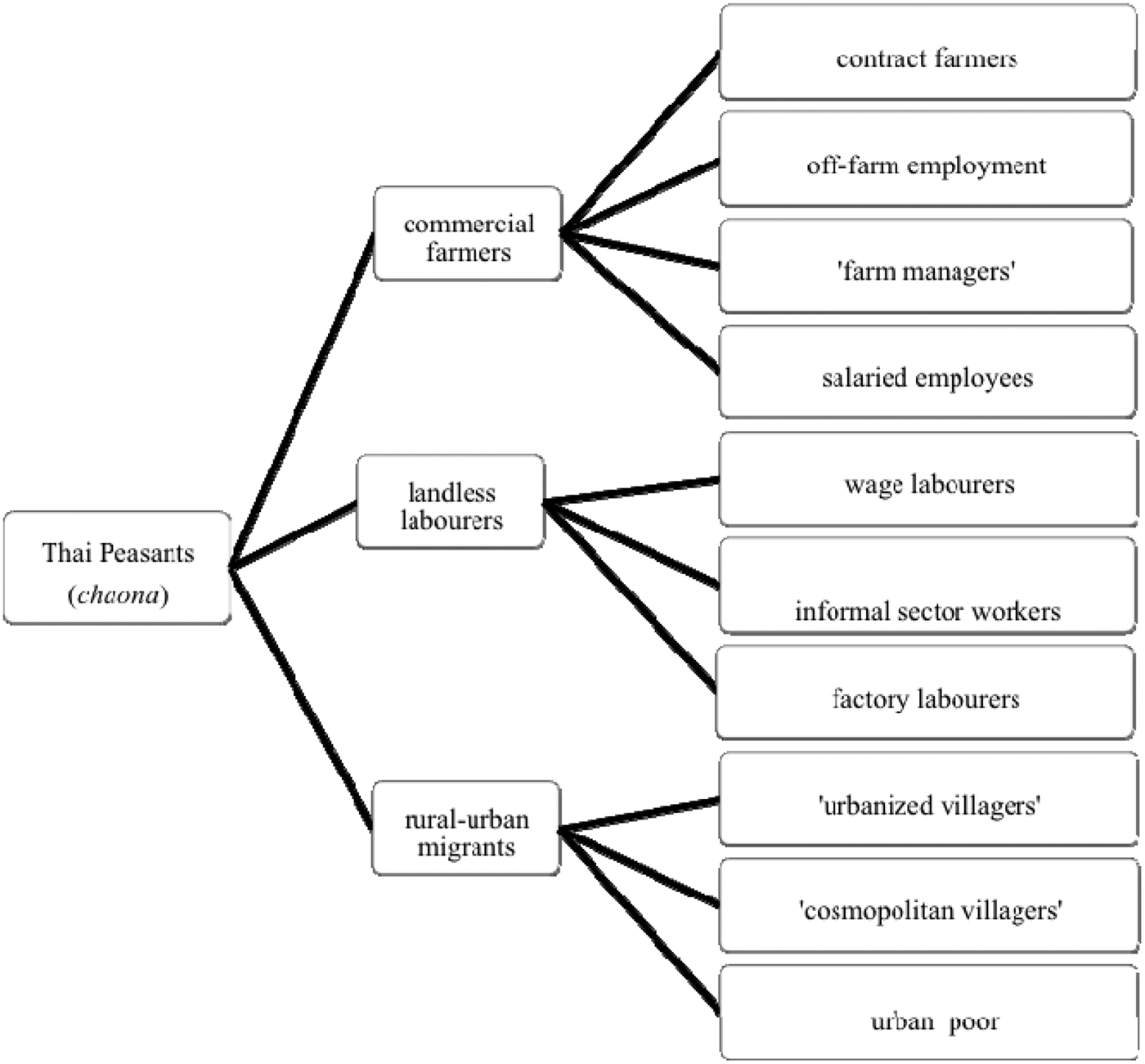
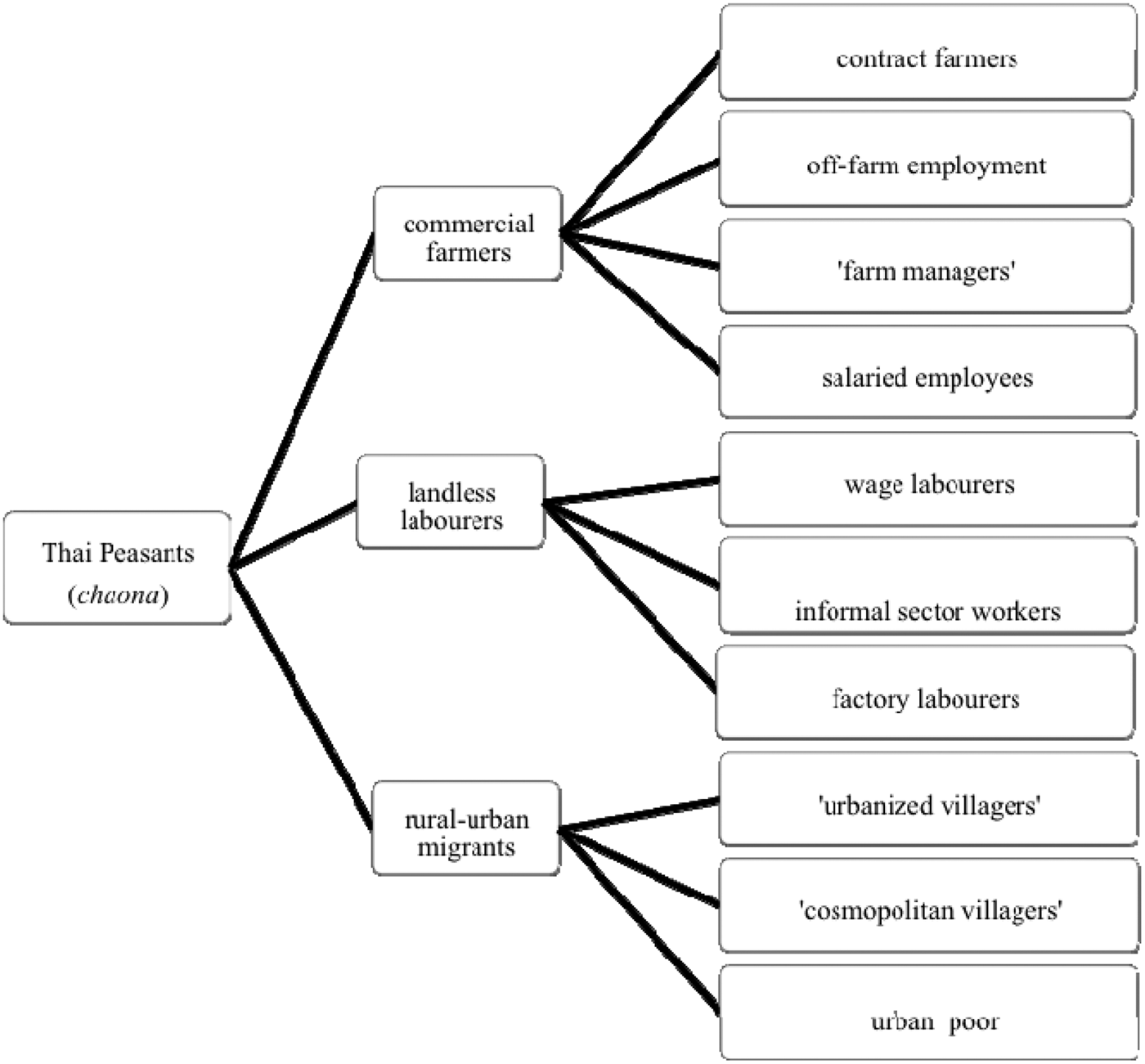
Figure 1 heuristically diagrams the evolutionary diversity that stems from the traditionally understood Thai peasant, or chaona. Over the past four to five decades the country's rural diversity incrementally evolved with greater differentiation. In this dynamic manner, Thai rural society creates, adapts, adjusts, and evolves. It is not fixed. But the static nature of concepts such as ‘the peasant’, chaona, ‘the village’, class, community culture, and even the pronoun ‘them’ itself, can obstruct our view of what is in fact a dynamic and evolving provincial Thailand. Such staid concepts erroneously shape analysis by presuming categorical sameness, symmetry, and authenticity. They are imbued with a conceptual chauvinism and discursive power that manipulates investigation and inhibits empirical observation.
Evolution of rural Thailand over time and across generations (heuristic)
Conclusion
The old rural order is no longer. As Raymond Williams years ago noted in a parallel context, the rural world is ‘decisively altering’ and the ‘labourer's options are very firmly for change’.Footnote 98 ‘Pho’ Singchai, confident about his authentic identity, thus not only represents the last peasant of his village, but perhaps all of rural Thailand's ageing chaona. Symbolically, he is ‘Thailand's last peasant’. Bereft of the peasant society that once surrounded him, his claim begs for close scrutiny and serious analytical reflection.
As first understood by the founding theorists of peasant studies, peasant societies are characterised by economically exploited, subsistence-oriented cultivators who are politically subordinate and who lack effective means to change societal rules or check the rule-makers in power. By all indications, such a peasant society no longer exists in Thailand because it has long since differentiated, atomised, and evolved. The descendants of the old peasantry now form a myriad blend of individuals, groups, and identities that contribute to a dynamic rural political economy. For better and for worse this political economy is fully integrated with metropolitan poles, global markets and supply chains, and a still-developing politics of participation. Although remnants of bureaucratic agrarianism linger, top-down rural uniformity is a thing of the past. The rule-makers who once exploited peasants now court modern farmers with guaranteed subsidies and pledges of state support. Private capital now competes for farmer clients and entices rural risk-takers with sophisticated technologies and potential profits. Endogenous adaptation to economic expansion and globalised markets has led to new forms of production, new opportunities, new markets, and new expectations among the children and grandchildren of yesterday's peasant radicals. Where adaptation has proven difficult or unsatisfactory, new forms of locally-based collective action, community responses, and legal action have emerged. As documented so forcefully by scholars cited above, the shift in relations between farmers and those in power has been especially transformative. Today, a diverse mix of rural actors influence rule-making and outcomes in ways Thailand's peasant progenitors could have never imagined. Participatory politics through intermittent elections, legal grievances, and pluralistic channels of civil society enjoys widened political space. The extent to which Thailand's post-coup, post-reform political structure will continue to block or inhibit this trend remains an open but important question. But, regardless of the yet unknown long-term effects of the May 2014 coup, documented change to date is observable. The task for analysts is to thus employ the theories, conceptual frameworks, and vocabularies sensitive to explaining observed rural change.
Static and essentialised concepts such as peasant, chaona, the village, chaoban, and community culture not only inadequately describe the current blending of rural and urban life, but can hazardously cultivate extant urban–rural dichotomies and stereotypes. In this manner they serve to perpetuate an agrarian myth of a homogenous peasant population guided normatively by idyllic cultural purity and constructed notions of Thainess.Footnote 99 When combined with romanticism for the countryside such static terms — in Williams’ words — merely help reactionary elites mount ‘a defense of the old rural order’.Footnote 100 Many of Thailand's political actors, including Bangkok's pro-coup aristocratic elites, would do well to fully recognise the evolution, diversity, and fundamental changes of rural Thailand and adapt their own understandings, behaviours, and attitudes accordingly. For if there are no more peasants in Thailand, then there should be no more lords.