Introduction
Dementia is currently one of the most burdensome disorders of late life, with the worldwide prevalence estimated to increase four-fold and reach 81.1 million by 2040 (Ferri et al., Reference Ferri2005). While current pharmacological approaches targeting dementia, particularly Alzheimer's disease, offer some symptomatic relief, they are unable to alter the course of disease. Thus, current dementia reduction strategies focus on secondary prevention in individuals determined to be “at risk” of dementia (Middleton and Yaffe, Reference Middleton, Yaffe and 2009). It is well established that individuals with subjective memory complaints (Reisberg et al., Reference Reisberg2008), cerebrovascular disease (Onyike, Reference Onyike2006), and depression (Hickie et al., Reference Hickie, Scott, Wilhelm and Brodaty1997) are more likely to progress to dementia. Additionally, the literature suggests those with mild cognitive impairment (MCI), particularly the amnestic subtype, are at an elevated risk of progression to dementia (Gauthier et al., Reference Gauthier2006), with an annual conversion rate to dementia at around 12% (Petersen, Reference Petersen2004). Even for those with the non-amnestic subtype, rates of progression to dementia are significantly increased in comparison to cognitively intact older adults (Petersen, Reference Petersen2004). However, for a clinical diagnosis of MCI to be made, detailed neuropsychological testing is required, and such services can be costly, time-consuming, and/or difficult to access.
For large-scale public health dementia reduction strategies to be feasible, sensitive and effective screening tools must be established. However, many of the tools currently available are inadequately sensitive or specific for this particular purpose (Wright et al., Reference Wright, Hall, Matthews and Brayne2009). The use of gross cognitive screening tools in primary care is one option, although in general, these tools may be inappropriate, especially in highly educated people (O'Bryant et al., Reference O'Bryant2008; Komadina et al., Reference Komadina, Terpening, Huang, Halliday, Naismith and Lewis2011). Data have also shown that cognitive screening tools are enhanced considerably by the use of informant report (Brodaty and Pond, Reference Brodaty, Pond and 2005), a finding which suggests that informants may be better utilized in the cognitive screening process.
To date, however, only a few studies have examined the utility of informant reports in the detection of MCI, and even fewer studies have examined how informant ratings might compare to objective measures of neuropsychological functioning. Of those that have examined these associations in neurodegenerative disease, emerging data support the utility of this method (Schinka et al., Reference Schinka, Raj, Loewenstein, Small, Duara and Potter2010; Naismith et al., Reference Naismith, Pereira, Shine and Lewis2011). For instance, in Parkinson's disease, informant ratings on the Cambridge Behavioral Inventory-Revised (CBI-R; Wear et al., Reference Wear2008) were significantly greater in those meeting criteria for MCI and higher ratings on the CBI-R total and memory scores were correlated with poorer psychomotor speed, learning/memory, language, and executive functioning (Naismith et al., Reference Naismith, Pereira, Shine and Lewis2011). Similarly, in a sample of elderly individuals with cognitive status ranging from normal to early-stage dementia, informant ratings on the Cognitive Change Checklist (3CL) were associated with measures of working memory, verbal and visual learning/memory, language, visuospatial ability, and executive functioning (Schinka et al., Reference Schinka, Raj, Loewenstein, Small, Duara and Potter2010). In addition to utility for cognitive change, data have also shown that informant ratings of cognitive and behavioral changes on the CBI-R reflect differential behavioral profiles associated with a range of neurodegenerative disorders, including behavioral variant frontotemporal dementia, Alzheimer's disease, Parkinson's disease, and Huntington's disease (Wear et al., Reference Wear2008). Thus, such detailed assessment of cognition and behavior from an informant's perspective appears to be a viable method of detecting even mild cognitive and behavioral change.
The principal aim of this study was to determine whether informant ratings of cognitive and behavioral change are greater in health-seeking older adults with a clinical diagnosis of MCI, compared with those who do not demonstrate objective cognitive decline. The secondary aim was to examine the extent to which informant ratings relate to objective performance on neuropsychological tests.
Methods
Participants
One hundred and nine patients and their significant others were recruited from the Ageing Brain Centre at the Brain and Mind Research Institute, University of Sydney. All patients were attending a specialist research clinic targeting healthy brain aging and were reporting mood and/or cognitive symptoms. They were required to be aged 50 or above and to have adequate English proficiency for neuropsychological assessment. Exclusion criteria were: history of stroke, head injury with loss of consciousness for more than 30 minutes, neurological disorder, medical condition known to affect cognition (e.g. cancer), psychiatric disorder other than an affective disorder, Mini-Mental State Examination (MMSE) score below 24, and/or diagnosis of dementia. Since the presence of a current full-threshold mood disorder is associated with cognitive decline (Naismith et al., Reference Naismith2003), individuals fulfilling the Diagnostic and Statistical Manual of Mental Disorders, fourth edition (DSM-IV; American Psychiatric Association, 1994) criteria for major depressive disorder were also excluded.
MCI ratings were conducted by consensus of an old age psychiatrist and two clinical neuropsychologists. In accordance with Petersen's (2004) criteria, individuals were classified as having MCI if upon neuropsychological testing they scored at least 1.5 standard deviations below their predicted level of intellectual functioning in at least one cognitive domain, while daily functioning remained intact. They were further classified as either amnestic or non-amnestic depending on whether their impairments affected the memory domain. Note that the amnestic subtype was required to exhibit a memory deficit of the “hippocampal-type,” as demonstrated by evidence of dysfunction on tests of delayed memory recall (i.e. not merely encoding deficits). Conversely, participants were classified as being “cognitively intact” if they did not meet MCI criteria. This study was approved by the University of Sydney Human Research Ethics Committee, and written informed consent was obtained from all patients and their significant others.
Clinical and neuropsychological assessments
All participants were seen initially by an old age psychiatrist to screen for any medical or psychiatric history according to the inclusion and exclusion criteria. Severity of depressive symptoms was rated on the 17-item Hamilton Depression Rating Scale (HAM-D; Hamilton, Reference Hamilton1960; scores 0–7, normal; 8–13, mild; 14–18, moderate; 19–22, severe; 23 and above, extremely severe). Daily functioning was assessed by a psychiatrist and a neuropsychologist, with reference to additional informant-based interviews where warranted. All participants were rated on the Global Assessment of Functioning Scale (American Psychiatric Association, 1994) and obtained scores greater than 60, suggesting no greater than mild functional decline. A neuropsychologist administered a battery of standardized tests to patients to assess cognition. For descriptive purposes, premorbid intelligence was estimated using the Wechsler Test of Adult Reading (Wechsler, Reference Wechsler2001) and global cognitive functioning was measured using the MMSE (Folstein et al., Reference Folstein, Folstein and McHugh1975). Neuropsychological domains assessed included:
(a) Working memory: This was assessed using the Digit Span subtest total score (maximum = 30) of the Wechsler Adult Intelligence Scale-III (Wechsler, Reference Wechsler1997a). Age-scaled scores were computed using normative data.
(b) Visual memory: The Rey Complex Figure Test 3-minute recall (RCFT; Meyers and Meyers, Reference Meyers and Meyers1995) was used to assess visual memory. This task requires the participant to draw from memory a complex geometric figure that they had copied 3 minutes earlier (maximum = 36). Percentile scores were computed using normative data.
(c) Verbal learning and memory: The Logical Memory subtest of the Wechsler Memory Scale-III (Wechsler, Reference Wechsler1997b) was used to assess verbal learning and memory. This prose passage task assesses both learning (maximum = 75) and retention following a 25- to 35-minute delay (% retention). Age-scaled scores were computed using normative data.
(d) Language: This was assessed by phonemic fluency (letters F, A, S), semantic fluency (animal names; Benton et al., Reference Benton, Hamsher and Sivan1983) and the Boston Naming Test (BNT; Kaplan et al., Reference Kaplan, Goodglass and Weintraub1983). z-scores and age-scaled scores were computed using normative data (see Spreen and Strauss, Reference Spreen, Strauss and 1998).
(e) Psychomotor speed: This was measured using Part A of the Trailmaking Test (Reitan, Reference Reitan1979). z-scores were computed using normative data (see Tombaugh et al., in Spreen and Strauss, Reference Spreen, Strauss and 1998).
(f) Executive functioning: This was assessed using Part B of the Trailmaking Test (Reitan, Reference Reitan1979). This task assesses set-shifting under timed conditions. z-scores were computed using normative data (see Tombaugh et al., in Spreen and Strauss, Reference Spreen, Strauss and 1998).
Informant ratings
Informant ratings of cognitive and behavioral change were obtained using the CBI-R (Wear et al., Reference Wear2008). The CBI-R is a 45-item questionnaire that assesses changes in functional and behavioral domains including memory and orientation (8 items), everyday skills (5 items), self care (4 items), abnormal behavior (6 items), mood (4 items), beliefs (3 items), eating habits (4 items), sleep (2 items), stereotypic and motor behaviors (4 items), and motivation (5 items). A total score was obtained by summing all domain scores. The frequency of symptoms present over the past month is rated on a scale from 0 to 4. Score 0 indicates no impairment; 1, a few times per month; 2, a few times per week; 3, a daily occurrence; and 4, constant occurrence.
Statistical analysis
Statistical analyses were conducted using SPSS version 19. Analysis of variance or Mann–Whitney U tests were used for between-group comparisons depending on homogeneity of variance and normality. A χ2 test was used for the categorical variable. Pearson and partial correlation coefficients were used for correlation analyses. All analyses were two-tailed with an α level of 0.05.
Results
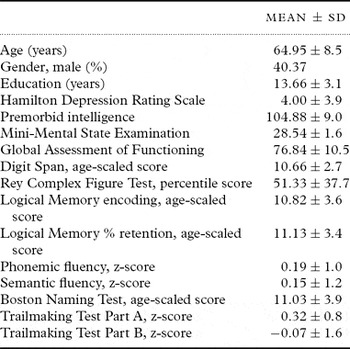
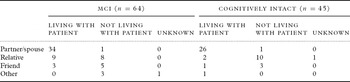
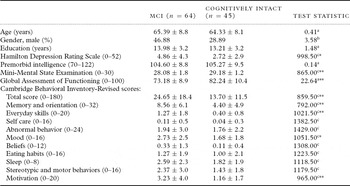
Descriptive data of the sample are presented in Table 1. Of the current sample, 64 patients (58.7%) were classified as having MCI, among whom 24 (37.5%) were amnestic. Informant characteristics are presented in Table 2. For those with MCI versus those who were cognitively intact, there were no significant differences in the proportion of informants who lived with and were also the partner/spouse of the patient (53% and 58% respectively). Table 3 shows that the MCI and cognitively intact groups did not differ on age, gender balance, education, or premorbid intelligence. However, individuals with MCI displayed significantly more severe depressive symptoms and poorer daily functioning.
Demographic and neuropsychological data for the entire sample (n = 109)

Informants’ relationship with patients and living arrangements

Demographic and CBI-R data for MCI and cognitively intact patients (mean ± SD)

a Analysis of variance.
b χ2 test.
c Mann–Whitney U test due to violation of homoscedasticity or normality assumptions.
*p < 0.05 (2-tailed).
**p < 0.01 (2-tailed).
Informant ratings on the CBI-R
It can be seen in Table 3 that for the patients with MCI, their informants rated significantly more overall cognitive and behavioral change, and specifically in the domains of memory and orientation, everyday skills, mood, and motivation; this is unsurprising as the types of behavioral disturbance probed by the other CBI-R subscales would not be anticipated in individuals with MCI. After controlling for severity of depressive symptoms, significant differences in the total CBI-R score (F = 6.53, p < 0.05) as well as in the domains of memory and orientation (F = 10.33, p < 0.01), everyday skills (F = 5.60, p < 0.05), and motivation (F = 5.29, p < 0.05) were still observed. In further analyses comparing informant ratings between the subtypes of MCI, individuals with non-amnestic MCI were found to have higher ratings only on the CBI-R mood subscale (U = 291.00, p < 0.01).
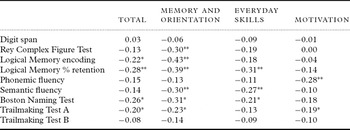
For those CBI-R scores which differed between MCI patients and cognitively intact individuals, correlations with neuropsychological performance were conducted on the entire sample. These results showed that CBI-R ratings of more severe cognitive change were associated with poorer performance on several neuropsychological measures, even after controlling for estimated premorbid intelligence (see Table 4). Specifically, CBI-R total scores correlated with performance on verbal tasks including verbal learning, memory consolidation, and confrontation naming, as well as psychomotor speed. Higher informant ratings on the memory and orientation subscale were associated with poorer performance in the domains of visual memory, verbal learning, memory consolidation, verbal generativity, confrontation naming, and psychomotor speed. Informant ratings of everyday skills were associated with memory consolidation, verbal generativity, and confrontation naming. Motivation ratings correlated with verbal generativity and psychomotor speed. Higher informant ratings on the mood subscale were also correlated with greater depression severity, as rated by the psychiatrist (HAM-D: r = 0.43, p < 0.001).
Correlations between CBI-R ratings and neuropsychological test performance

*p < 0.05 (2-tailed).
**p < 0.01 (2-tailed).
Discussion
This study has shown that using a detailed instrument, which specifically probes for multiple components of cognitive and behavioral change, informants rated greater changes in older adults with MCI, in comparison to those who are cognitively intact. This suggests that informants are indeed sensitive to the subtle early cognitive and behavioral changes associated with MCI. These early changes were rated primarily in the domains of memory and orientation, everyday skills, mood, and motivation. Notably, this sample had MMSE scores in the normal range, suggesting that the CBI-R is superior to such an instrument in screening for early cognitive decline. These findings are aligned with those obtained from primary care research, which demonstrates that cognitive screening tools are enhanced by the addition of informant questions (Brodaty and Pond, Reference Brodaty, Pond and 2005).
Importantly, informant ratings on the CBI-R were associated with objective cognitive performance, as determined by neuropsychological testing. The results are also consistent with a prior study in Parkinson's disease patients in the early disease stages (Naismith et al., Reference Naismith, Pereira, Shine and Lewis2011), whereby small to moderate correlations were observed between CBI-R scores and neuropsychological performance. In the current study, the most pronounced correlations between informant ratings of changes in overall functioning or memory and orientation and neuropsychological performance were evident for tasks with a verbal component, including verbal memory encoding, consolidation and word-finding (verbal generativity and naming). The specific CBI-R items addressing changes in memory and orientation include poor day-to-day memory, forgetting names of people and objects, and poor concentration and orientation; it is unsurprising that informants detect these changes as these are more readily recognized in everyday life. Changes in everyday skills refer to difficulties with using electrical appliances, writing, and managing finances, and were likewise related to verbal memory encoding, consolidation and word-finding. Changes in motivation include showing less enthusiasm for usual interests and new things and reduced affect, which were shown to be related to poorer verbal fluency and psychomotor speed. Indeed, motivation changes have been linked to fronto-subcortical circuitry as well as the integrity of the dorsolateral prefrontal cortex, which are areas also implicated in these cognitive processes (Cummings, Reference Cummings1993). Overall, these findings are in line with the expected early cognitive changes in MCI, with forgetfulness and word-finding difficulties being common complaints. In addition, informant ratings of mood disturbance on the CBI-R were also related to clinician ratings of mood. This is a particularly significant finding since depression is commonly associated with cognitive decline (Naismith et al., Reference Naismith2003) as well as increased rates of progression to dementia (Hickie et al., Reference Hickie, Scott, Wilhelm and Brodaty1997). It is noted, however, that in this study, informant reports of cognitive change in MCI were not merely attributable to mood symptoms. This suggests that informant ratings of cognitive decline are not simply due to increased depressive symptoms in MCI.
In summary, these results suggest that the CBI-R is a useful screening instrument for early cognitive decline. It is simple to administer and score, and is inexpensive. Moreover, use of the CBI-R could be implemented where the older patient is unable to access formal neuropsychological services, which can be time-intensive and costly. In interpreting these findings, however, we acknowledge that the correlations between CBI-R scores and various domains of cognition were only small to moderate, hence a large proportion of variance in the neuropsychological data was unexplained. This may be due to several factors. First, the CBI-R was not designed to probe the specific cognitive impairments associated with MCI, which is demonstrated in its limited ability to discern informant ratings between amnestic versus non-amnestic MCI cases in this sample. Secondly, patients may use compensatory strategies (e.g. use of diaries, mnemonic techniques) in carrying out day-to-day tasks (Dixon and Bäckman, Reference Dixon, Bäckman and 1995) and/or may utilize cognitive reserve (Stern, Reference Stern2009), particularly if they are highly educated, such as in this sample. Furthermore, neuropsychological tests are conducted in a structured environment and may not necessarily reflect the older adult's functioning in the “real-world” environment; therefore, they may lack ecological validity in certain contexts. Finally, a variety of factors may influence the accuracy of informant ratings. For instance, informants may normalize the degree of cognitive change in the patient or may be inclined to attribute the cognitive and behavioral changes to other factors (e.g. old age). Informants in this sample may have been particularly aware of cognitive deficits, due to the nature of the sample being health-seeking. Some personally-protective factors may also be operative (e.g. denial). The presence of cognitive impairment or neuropsychiatric symptoms in the informant, informant personality characteristics, and the nature of the relationship with, or burden on the informant, may also influence their detection of cognitive change in the patient (Schinka, Reference Schinka2010).
The approach of using the CBI-R to detect early cognitive decline appears promising, but several limitations warrant acknowledgment. Although the sample size is relatively large and well-characterized clinically, only 59% had MCI. Since MCI is a rather heterogeneous disorder and this study employed a cross-sectional design, we are unable to determine the predictive capacity of informant ratings to detect cognitive decline longitudinally. In this regard, the age of the MCI sample was relatively young (around 65 years). Thus, multiple cognitive trajectories might occur and not all patients will progress to neurodegenerative disease. Additionally, since this study was exploratory in nature, the correlations between CBI-R scores and neuropsychological performance were not evaluated using a stringent α level; the level of Type I error may thus be inflated. Further studies could aim to address the predictive capacity of informant ratings for cognitive decline as well as examine factors affecting the accuracy of informant ratings to determine how informant-based tools, such as the CBI-R, can be best utilized in clinical practice.
Conflict of interest
None.
Description of authors' roles
R. S. M. Tsang integrated the literature, conducted the statistical analysis and wrote the paper. Dr K. Diamond and L. Mowszowski carried out the neuropsychological assessments and critically reviewed the paper. Dr. K. Diamond also assisted with the statistical analysis. Dr S. J. G. Lewis critically reviewed the paper. Associate Professor S. L. Naismith designed the study, provided guidance on the structuring of the paper and the statistical analysis, contributed to the content, and revised several drafts of the paper.
Acknowledgments
The authors thank Dr. Louisa Norrie, Dr. Matt Paradise, and Dr. Zoë Terpening for their assistance with patient assessments.