Introduction
Every year, more than 300 000 patients are diagnosed worldwide with oral carcinoma.Reference Poh, MacAulay, Laronde, Williams, Zhang and Rosin1 Oral cancers account for 14 per cent of all head and neck cancers excluding lip cancers.Reference Hoffman, Karnell and Funk2 Squamous cell carcinoma (SCC) is the most common type, accounting for 86.3 per cent of these types of cancers.Reference Funk, Karnell, Robinson, Zhen, Trask and Hoffman3
Smoking and alcohol consumption are the most common aetiological factors, while dietary factors, occupational activities, socioeconomic status, human papilloma virus infection and genetic predisposition further contribute to the development of oral cancers.Reference Da Silva, Ferlito, Takes, Brakenhoff, Valentin and Woolgar4 The underlying mechanism may involve oxidative stress and free radical generation, which are known to be involved in the aetiology of many other different cancers.Reference Sun5 Increased oxidative stress is well known to damage biological molecules such as DNA and to lead to carcinogenesis. The extent of oxidative stress is strongly correlated with the generation and detoxification of reactive oxygen molecules, which are believed to cause cancer in humans.Reference Fang, Fan, Ji, Qi, Li and Wang6 Lipid peroxidation, the cellular status of total antioxidants, and the oxidation of unsaturated fatty acids by free radicals are considered to be risk factors for oral cancers.Reference Patel, Rawal, Dave, Rawal, Shukla and Shah7–Reference Subapriya, Kumaraguruparan, Ramachandran and Nagini9
The role of cellular antioxidants in cancer prevention is to eliminate liposoluble carcinogenic radicals produced by lipid peroxidation.Reference Manoharan, Baskar, Manivasagam and Subramanian10 The serum paraoxonase 1 enzyme,Reference Martínez, Molina, Alonso-Navarro, Jiménez-Jiménez, Agúndez and García-Martín11 which destroys carcinogenic liposoluble radicals, belongs to a family of endogenous free radical antioxidant systems in the body. Serum paraoxonase 1 is synthesised in the liver and attaches to high-density lipoprotein.Reference Manoharan, Kolanjiappan, Suresh and Panjamurthy8 In humans, the serum paraoxonase gene family is located in the q21.3 region of the long arm of chromosome 7. Serum paraoxonase 1 has two major well-known polymorphisms arising from amino acid substitution at position 55 (leucine vs methionine) and at position 192 (glutamine vs arginine).Reference Martínez, Molina, Alonso-Navarro, Jiménez-Jiménez, Agúndez and García-Martín11 Serum paraoxonase 1 is able to hydrolyse toxic organic molecules such as organophosphate neurotoxins, aromatic carboxylic acids esters, and fatal insecticides such as sarin and soman.Reference Costa, Giordano and Furlong12
Serum paraoxonase 1 concentration and activity level may vary between individuals due to consumption of dietary antioxidants, alcohol and/or medication (e.g. statins and fibrates).Reference Costa, Giordano and Furlong12 Smoking is another factor that can irreversibly decrease the serum paraoxonase 1 concentration and activity level. Serum paraoxonase 1 concentration and polymorphisms have been associated with several forms of cancer, including non-Hodgkin's lymphoma,Reference De Roos, Gold, Wang, Hartge, Cerhan and Cozen13 multiple myeloma,Reference Lincz, Kerridge, Scorgie, Bailey, Enno and Spencer14 glioma and meningioma,Reference Martínez, Molina, Alonso-Navarro, Jiménez-Jiménez, Agúndez and García-Martín11 gastroesophageal malignancy,Reference Krzystek-Korpacka, Boehm, Matusiewicz, Diakowska, Grabowski and Gamian15 ovarian epithelial carcinoma,Reference Camuzcuoglu, Arioz, Toy, Kurt, Celik and Erel16 prostate cancer,Reference Antognelli, Mearini, Talesa, Giannantoni and Mearini17 pancreatic cancer,Reference Akcay, Polat, Yilmaz and Akcay18 stomach cancer,Reference Akcay, Yilmaz, Polat and Akcay19 lung cancer,Reference Lee, Lee, Choe, Hong, Kim and Kang20 and breast cancer.Reference Stevens, Rodriguez, Pavluck, Thun and Calle21 As noted already, smoking and alcohol consumption are associated with a reduction in serum paraoxonase 1 activity. Thus, it is possible that serum paraoxonase 1 may play a role in SCC carcinogenesis via its antioxidant effects.
The aim of this study was to investigate the relationship between oral SCC, serum paraoxonase 1 activity levels, and the presence of serum paraoxonase 1 55 and 192 gene polymorphisms.
Materials and methods
Study design
The study was approved by the Research Ethics Committee of the Istanbul Medicine Faculty.
We enrolled in the study patients who were admitted to the otolaryngology department, Istanbul Faculty of Medicine, Istanbul University, or to the oral surgery and medicine department, Faculty of Dentistry, Istanbul University, and who volunteered to participate. Patients included in the study group had no other malignancies other than oral SCC. A total of 116 subjects were included: 57 in the patient group (31 men and 26 women) and 59 in the control group (25 men and 34 women, recruited from the polyclinic of the oral health department). Serum paraoxonase 1 activity and 55 and 192 gene polymorphism prevalence were compared between these two groups, using results from peripheral blood samples. Patients' smoking habits, alcohol consumption, histopathological findings and tumour–node–metastasis stage were evaluated and recorded in patients' follow-up documents.
Isolation of DNA
Blood specimens were collected into tubes containing ethylene diamine tetra-acetate. Leukocyte pellets underwent sodium dodecyl sulphate lysis, ammonium acetate extraction and ethanol precipitation, in order to isolate DNA.Reference Miller, Dykes and Polesky22
Paraoxonase genotyping
Paraoxonase 1 genotypes were determined using polymerase chain reaction conducted according to previously published protocols.Reference Adkins, Gan, Mody and La Du23, Reference Humbert, Adler, Disteche, Hassett, Omiecinski and Furlong24
The serum paraoxonase 1 192 polymorphism sense primer was 5′ TAT TGT TGC TGT GGG ACC TGA G 3′ (where T = thymine, A = adenine, G = guanine and C = cytosine), and the antisense primer was 5′ CAC GCT AAA CCC AAA TAC ATC TC 3′, which encompassed the 192 polymorphic region of the human serum paraoxonase 1 gene. The serum paraoxonase 1 55 polymorphism sense primer was 5′ GAA GAG TGA TGT ATA GCC CCA G 3′, and the antisense primer was 5′ TTT AAT CCA GAG CTA ATG AAA GCC 3′.
The polymerase chain reaction mixture contained 100 ng of DNA template, 0.5 µM of each primer, 1.5 mM MgCl2, 200 µM 2′-deoxynucleotide triphosphates (also termed 4dNTP) and 1 U Taq DNA polymerase (MBI Fermentas, St Leon-Rot, Germany).
In order to identify the serum paraoxonase 1 192 polymorphism, after denaturing the DNA for 5 minutes at 94°C, the reaction mixture was subjected to 35 cycles of denaturing for 1 minute at 95°C, 1 minute annealing at 60°C and 1 minute extension at 72°C. The 99 base-pair polymerase chain reaction product was digested with 8 U AlwI (BspPI) restriction endonuclease enzyme (which recognises GGATC(4/5)^ sites) (MBI Fermentas), overnight at 55°C. The digested products were separated by electrophoresis on 4 per cent MetaPhor agarose gel (Lonza, Basel, Switzerland) and visualised using ethidium bromide. The arginine genotype contains a unique BspPI restriction site, which results in 66 and 33 base-pair products, whereas the glutamine genotype is not cleaved by this restriction enzyme, thereby allowing determination of the serum paraoxonase 1 192 genotype.Reference Adkins, Gan, Mody and La Du23
To identify the serum paraoxonase 1 55 polymorphism, polymerase chain reaction and cycling were performed as described above. The polymerase chain reaction product (170 base-pairs) was digested with NlaIII (Hsp92II) (a restriction enzyme recognising CATG sites) (Promega, Madison, Wisconsin, USA) in the presence of bovine serum albumin (0.1 µg/μl final concentration) (37°C, overnight), and the digested products were separated and identified as above. The leucine allele did not contain the Hsp92II site, whereas the methionine allele did contain this site, giving rise to 126 and 44 base-pair products.Reference Humbert, Adler, Disteche, Hassett, Omiecinski and Furlong24
Quantification of paraoxonase activity
Paraoxonase 1 activity was measured according to the method of Furlong et al. Reference Furlong, Richter, Seidel, Costa and Motulsky25 The assay buffer contained 0.132 M trisaminomethane (Tris) HCl (pH 8.5), 1.32 mM CaCl2 and 2.63 mM NaCl. The addition of 200 µl of 6 mM freshly prepared paraoxon (0,0-diethyl-0-p-nitrophenylphosphate; Sigma, Poole, UK) and 40 µl of serum was used to initiate the assay. The rate of generation of p-nitrophenol was determined at 37°C using a continuously recording spectrophotometer at 405 nm. A molar extinction coefficient of 18.05 × 10³ was used for the calculation, using paraoxon as the substrate. The serum paraoxonase 1 activity was expressed as units/litre (where 1 unit = 1 µmol paraoxon hydrolysed/minute).
Statistical analysis
The Number Cruncher Statistical System 2007 (NCSS LLC, Kaysville, Utah, USA) and the Power Analysis and Sample Size 2008 (PASS, NCSS LLC) statistical software programs were used for the statistical analysis. For the data evaluation, in addition to the use of complementary statistical methods (calculating the median, standard deviation (SD), median, frequency and ratio), logarithmic conversion was applied when the serum paraoxonase 1 levels showed an abnormal distribution pattern. The one-way analysis of variance test was used when comparing the parameters in two or more groups, and the independent Student's t-test was used when comparing the parameters in three or more groups. Gender, smoking and alcohol parameters were evaluated with a chi-square test, comparing the patient and control groups. Results were evaluated utilising confidence intervals of 95 per cent and a level of significance of p less than 0.05.
Results
One hundred and sixteen individuals were included in this study, 57 (49.1 per cent) in the patient group and 59 (50.9 per cent) in the control group. The mean subject age was 57.4 years in the control group and 57.8 years in the patient group. There were no statistically significant differences (i.e. p values were 0.05 or greater) in gender, age or smoking between the two groups; however, the rate of alcohol consumption was significantly higher (p < 0.01) in the patient group compared with the control group.
Investigations aiming to localise patients' oral SCC revealed that 30 cases (52.6 per cent) had lesions of the tongue, 8 (14.0 per cent) had lesions on the gingival-alveolar crest, 7 (12.3 per cent) had lesions on the base of the mouth, 5 (8.8 per cent) had lesions in the retromolar trigon, 3 (5.3 per cent) had lip lesions, 2 (3.5 per cent) had hard palate lesions and 2 (3.5 per cent) had lesions in the buccal area. According to the classification system of the American Joint Cancer Committee, 14 per cent of these oral SCC cases were in stage 1, 10 per cent were in stage 2, 13 per cent were in stage 3 and 20 per cent were in stage 4. Twenty-four of the patients had early-stage disease (i.e. stage 1 or 2) and 33 had late-stage disease (i.e. stage 3 or 4). Of the 57 oral SCC patients, 19 (33.3 per cent) had histologically well-differentiated tumours, 31 (54.4 per cent) had moderately differentiated tumours and 7 (12.3 per cent) had poorly differentiated tumours.
In the total subject group, the mean serum paraoxonase 1 activity level ± SD was 96.7 ± 8 units/l (range, 0.7–331.3 units/l).
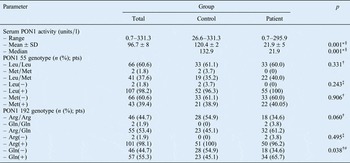
In the total subject group, the serum paraoxonase 1 position 55 leucine/leucine polymorphism was present in 60.6 per cent (n = 66), the methionine/methionine polymorphism in 1.8 per cent (n = 2) and the leucine/methionine polymorphism in 37.6 per cent (n = 41). The serum paraoxonase 1 position 55 leucine(+) polymorphism was found in 98.2 per cent (n = 107) of subjects, while the methionine(+) polymorphism was found in 39.4 per cent (n = 43). Regarding serum paraoxonase 1 position 192 polymorphism, 98.1 per cent (n = 101) of subjects had an arginine(+) polymorphism and 55.3 per cent (n = 57) had a glutamine(+) polymorphism. Table I shows the serum paraoxonase 1 activity level in the control and patient groups, together with the distribution of serum paraoxonase 1 55 and 192 genotypes and alleles. There was a statistically significant difference in serum paraoxonase 1 activity levels between the study and control groups (p < 0.01), with a significantly lower median serum paraoxonase 1 activity level in the patients (Figure 1). There was no significant difference between the frequency of the serum paraoxonase 1 position 55 and 192 genotypes and alleles, comparing the two groups (p > 0.05), except that the serum paraoxonase 1 192 glutamine(−) polymorphism was more frequent in the control group and the 192 glutamine(+) polymorphism was more frequent in the patient group (p < 0.05).
Box and whisker plot showing distribution of serum paraoxonase 1 (PON1) activity in the control and patient groups. Central box rule = median; lower and upper box borders = first and third quartiles, respectively; whiskers = 95% confidence interval; circles = outliers

Serum paraoxonase 1 activity and genotype distribution

*Student's t-test; †chi-square test; ‡Fisher's exact test. §p < 0.01; #p < 0.05. PON1 = paraoxonase 1; SD = standard deviation; pts = patients; Leu = leucine; Met = methionine; Arg = arginine; Gln = glutamine
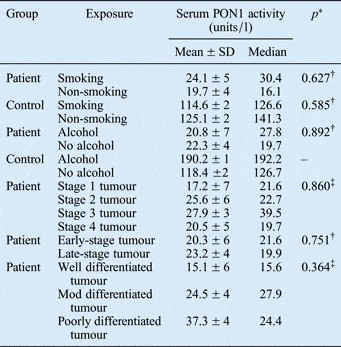
There was no significant association between serum paraoxonase 1 activity level and smoking status in either group (p > 0.05), as shown in Table II. As only two members of the control group consumed alcohol, its association with serum paraoxonase 1 activity could not be properly evaluated in this group. In the patient group, there was no significant association between serum paraoxonase 1 activity level and alcohol consumption (p > 0.05). No significant association was identified between serum paraoxonase 1 activity level and oral SCC tumour stage (comparing patients with early- versus late-stage carcinoma) (p > 0.05).
Serum paraoxonase 1 activity by group, smoking, alcohol, and tumour stage and differentiation

Patient numbers: stage 1 = 14; stage 2 = 10; stage 3 = 13; stage 4 = 20; early stage (stage 1 or 2) = 24; late stage (stage 3 or 4) = 33; well differentiated tumour = 19; moderately (mod) differentiated tumour = 31; poorly differentiated tumour = 7. *Comparing mean values. †Student's t-test; ‡one-way analysis of variance. PON1 = paraoxonase 1; SD = standard deviation; – = too few data for meaningful calculation
The mean serum paraoxonase 1 activity level was significantly lower both in smoking patients compared with smoking controls (p < 0.01), and in non-smoking patients compared with non-smoking controls (p < 0.01). The mean serum paraoxonase 1 activity level amongst patients who did not drink alcohol was significantly lower compared with non-drinking controls (p < 0.01). As only two control subjects consumed alcohol, we could make no meaningful comparison between serum paraoxonase 1 activity levels in alcohol-consuming patients versus alcohol-consuming controls.
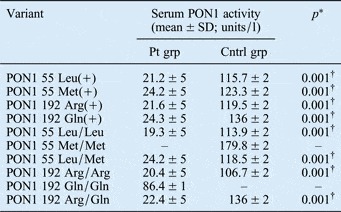
A significant difference was observed between mean serum paraoxonase 1 activity levels in the patient versus control groups, for almost all the serum paraoxonase 1 position 55 and position 192 genotype and allele categories investigated (p 0.001) (Table III). None of the patients had the serum paraoxonase 1 55 methionine/methionine genotype, and none of the control subjects had the serum paraoxonase 1 192 glutamine/glutamine genotype, so comparisons of serum paraoxonase 1 activity could not be performed within these genotype groups.
Serum paraoxonase 1 activity by genotype and allele

*Student's t-test. †p < 0.01. PON1 = paraoxonase 1; SD = standard deviation; Pt = patient; grp = group; Cntrl = control; Leu = leucine; Met = methionine; Arg = arginine; Gln = glutamine
Discussion
Serum paraoxonase 1 is an antioxidant enzyme which destroys endogenous free radicals.Reference Manoharan, Baskar, Manivasagam and Subramanian10 Due to its antioxidant activity against free radicals and oxidative stress, a relationship exists between malignancies and serum paraoxonase 1 genotypes.Reference Klaunig and Kamendulis26 Although many studies have investigated this relationship, to the best of our knowledge the present study is the first to investigate serum paraoxonase 1 activity levels and genotypes within oral cancer patients.
Lincz et al. Reference Lincz, Kerridge, Scorgie, Bailey, Enno and Spencer14 found a higher prevalence of the paraoxonase 1 position 192 glutamine/glutamine genotype in patients with multiple myeloma, compared with controls, whereas Van der Logt et al. Reference Van Der Logt, Janssen, Van Hooijdonk, Roelofs, Wobbes and Nagengast27 found no difference in genotype prevalence in colorectal cancer patients versus controls. Antognelli et al. reported that the risk of developing prostate cancer was greater in individuals with the serum paraoxonase 1 192 arginine/glutamine, 55 leucine/methionine and 55 methionine/methionine genotypes.Reference Antognelli, Mearini, Talesa, Giannantoni and Mearini17 De Roos et al. found that the serum paraoxonase 1 methionine/methionine genotype was associated with an increased risk of non-Hodgkin's lymphoma.Reference De Roos, Gold, Wang, Hartge, Cerhan and Cozen13 Lurie et al. reported that the serum paraoxonase 1 192 arginine and 55 leucine alleles were associated with an increased risk of ovarian epithelial carcinoma.Reference Lurie, Wilkens, Thompson, McDuffie, Carney and Terada28 In the present study, the prevalence of the serum paraoxonase 1 position 192 glutamine(+) genotype was high in the patient group and low in the control group, but there were no other statistically significant differences for other genotypes or alleles.
Several studies have reported significantly lower serum paraoxonase 1 activity levels in patients with malignancies of the stomach,Reference Akcay, Yilmaz, Polat and Akcay19 pancreas,Reference Akcay, Polat, Yilmaz and Akcay18 lung,Reference Lee, Lee, Choe, Hong, Kim and Kang20 gastroesophagusReference Krzystek-Korpacka, Boehm, Matusiewicz, Diakowska, Grabowski and Gamian15 or ovaries,Reference Camuzcuoglu, Arioz, Toy, Kurt, Celik and Erel16 compared with controls. In the present study, the mean serum paraoxonase 1 activity ± SD was 120.4 ± 2 units/l in the control group but only 21.9 ± 5 units/l in the patient group; this difference was statistically significant (p = 0.001).
• Serum paraoxonase 1 protects cells from oxidative stress damage
• It may play a role in carcinogenesis
• In this study, serum paraoxonase 1 activity was lower in oral squamous cell carcinoma (SCC) patients than controls
• Serum paraoxonase 1 may play a role in the aetiology of oral SCC
As noted above, smoking and alcohol consumption are well-known risk factors for the development of oral carcinoma, and both are known to decrease the serum paraoxonase 1 activity levels.Reference Costa, Vitalone, Cole and Furlong29 Elkiran et al. reported that smoking had no effect on serum paraoxonase 1 activity levels in patients with lung cancer.Reference Elkiran, Mar, Aygen, Gursu, Karaoglu and Koca30 In the current study, there was no significant difference in serum paraoxonase 1 activity levels between smokers and non-smokers, either in the patient group or the control group. Alcohol consumption was not associated with reduced serum paraoxonase 1 activity in the patient group, and no meaningful calculation was possible in the control group because of the small number of control subjects who consumed alcohol. Therefore, the decreased serum paraoxonase 1 activity level observed in patients with oral SCC was thought to be independent of smoking or alcohol consumption.
Krzystek-Korpacka et al. found no association between serum paraoxonase 1 activity level and tumour size or stage, in patients with gastroesophageal malignancy.Reference Krzystek-Korpacka, Boehm, Matusiewicz, Diakowska, Grabowski and Gamian15 In our study, serum paraoxonase 1 activity level did not differ in patients with early-stage (stage 1 or 2) versus late-stage (stage 3 or 4) tumour, as determined by tumour–node–metastasis staging.
Conclusion
The present study identified significantly lower serum paraoxonase 1 activity levels in oral SCC patients compared with controls, independent of age and smoking habits. There was no significant difference in the prevalence of the various serum paraoxonase 1 genotypes and alleles in patients versus controls, except that the patient group had an increased prevalence of the serum paraoxonase 1 position 192 glutamine(+) polymorphism.