1. Introduction
This paper presents a legal-economic analysis of the report of the World Trade Organization (WTO) panel in United States – Anti-Dumping Measures Applying Differential Pricing Methodology to Softwood Lumber from Canada, which was released on 9 April 2019 (WTO, 2019a). The report considers the application by the US Department of Commerce (USDOC) of the differential pricing methodology (DPM) and ‘zeroing’ to identify and address alleged targeted dumping of softwood lumber products from Canada.
Targeted dumping occurs when foreign exporters mask dumping by selectively selling some products at non-dumped (normal or high) prices, while selling other products at dumped (lower than normal) prices to particular customers, regions, or during particular time frames. To address targeted dumping, the USDOC has used zeroing in its calculations – setting non-dumped sales prices to zero and basing the calculation partly on non-dumped sales. Hoekman and Wauters (Reference Hoekman and Wauters2011) note that the United States is the only country to adopt the practice of zeroing and is also a major user of anti-dumping duties (ADD). The effect of zeroing can be to raise dumping margins, drawing the objections of other WTO members. Bown and Prusa (Reference Bown, Prusa, Martin and Mattoo2011) analyze information on WTO disputes based on zeroing and find that zeroing increases dumping margins between 5 and 10 percentage points.
In this dispute, Canada challenged the USDOC's affirmative final determination in the anti-dumping investigation of softwood lumber products from Canada (Underlying Investigation). Canada disputed USDOC's use of the weighted average-to-transaction (W-T) methodology provided for in Section 2.4.2 of the Anti-Dumping Agreement. Specifically, Canada claimed that: (a) the conditions for use of the W-T methodology were not met in the Underlying Investigation; and (b) the USDOC's use of zeroing under the W-T methodology, when applying the DPM, was inconsistent with the second sentence of Article 2.4.2.
The panel issued mixed findings, accepting some of Canada's arguments, but rejecting others. It agreed with Canada that, in applying the DPM, the USDOC had erroneously aggregated export price differences to find a single pattern of export prices. The panel, however, rejected Canada's other claims, including its assertion – relying on the Appellate Body's ruling in US–Washing Machines – that the ‘pattern’ of differential prices under Article 2.4.2 of the Anti-Dumping Agreement can only include export prices which ‘differ significantly’ because they are significantly lower than prices to other purchasers, regions, or time periods. The panel also rejected Canada's claim that zeroing is not permitted when using the W-T methodology envisaged under the second sentence of Article 2.4.2 of the Anti-Dumping Agreement.
The US–Canada lumber dispute is the oldest-standing and ongoing trade dispute, but this case represents a major departure from previous chapters. Notably, until now, the softwood lumber dispute has involved subsidies and countervailing duties – this case adds ADD to the trade remedies at issue.
This ADD softwood lumber dispute reflects a recent US trend to increase the scope of its trade actions by both targeting a broader set of products (such as newsprint) and expanding the type of complaints it is pursuing (such as extending the softwood lumber dispute to include ADD).
This case also requires close scrutiny because the panel's ruling on ‘zeroing’ explicitly departs from the WTO's Appellate Body's established findings on calculating ADD.
Finally, it is important to put this case into the context of how the United States administers ADDs and its impact on WTO disputes. The United States is the only country to practice zeroing and a key user of ADD. Bown and Prusa (Reference Bown, Prusa, Martin and Mattoo2011) assert that, without zeroing, 50% of the United States’ contested cases at the WTO would not exist and the remaining cases would yield only negligible anti-dumping margins. Experts also argue that zeroing creates uncertainty when export prices vary and can lead to a significant chilling effect on trade (Vandenbussche and Zanardi, Reference Vandenbussche and Zanardi2010).
2. History of the Dispute
The US–Canada Anti-Dumping in Softwood Lumber dispute reflects one of the most recent stages in the softwood lumber trade disputes between the United States and Canada, which have been ongoing for decades.Footnote 1 The panel's report marks the third time in three decades that the USDOC and USITC have determined that Canadian producers are dumping softwood lumber in the US market and causing material injury to US softwood lumber producers.
It is beyond the scope of this paper to examine and analyze the complete history of the softwood lumber dispute, but it is important to put this ADD dispute into that broader context. The recent history of the dispute that originated in 1982, when US softwood lumber producers claimed that Canada had subsidized lumber exports by charging low stumpage fees to cut timber on crown-owned land. Since then, the dispute has been managed through a series of restrictive trade measures such as a Memorandum of Understanding (MOU) from 1987 to 1991, extensive legal proceedings and arbitration rulings at the WTO and under NAFTA, several Softwood Lumber Agreements (SLAs), including an SLA from 1996 to 2001 and an SLA from 2006 to 2015.Footnote 2 However, a long-term solution to this trade issue remains elusive.Footnote 3
The complication in resolving the dispute stems from differences in the two countries’ forest management policies. According to Natural Resource Canada (2020), approximately 94% of forest lands are publicly owned in Canada, supplying 90% of Canada's lumber. By contrast, according to the American Forest and Paper Association (2020), 60% of US forest land is privately owned, supplying 91% of US lumber. US lumber producers pay private landowners market-determined prices for the lumber that they harvest, as compared with non-market determined stumpage fees (the fee a company pays to harvest trees) paid by Canadian producers to provincial or federal governments. US producers claim that the production of lumber is being subsidized non-competitively, justifying countervailing lawsuits against Canadian lumber exports to the United States.
Canada typically supplies about 30% of US softwood lumber, although its share of the US market fluctuates depending on market conditions, including the applicable exchange rate. After the most recent SLA expired in October 2015, the trade dispute re-emerged when Canadian lumber exports to the US surged by 16% and reached about a 32% share of the US market with no trade restrictions in place. The two sides failed to come up with a new agreement and the USDOC announced a preliminary countervailing duty of about 20% and anti-dumping rates averaging 6.87% (USDOC, 2017). Johnston and Parajulib (Reference Johnston and Parajulib2017) evaluate the regional welfare impact of those tariffs and find that they reduced Canadian lumber exports to the United States by 4.4 million cubic metres (m3) and Canada's market share in the United States by almost 5%, whereas US domestic lumber production increased by 2.6 million m3. This launched the current round of disputes known as Lumber V.
Figure 1 shows that lumber exports decreased until 2003 and then sharply increased until 2004 before flattening out by 2005. Exports then slowly decreased until 2006, followed by a sharp decline until 2009. The decline after 2006 is partly attributable to the SLA and significantly reduced US lumber demand due to the housing crisis.Footnote 4 After 2009, Canadian lumber exports to the United States increased until 2014 – likely due to increased US demand to construct new homes.Footnote 5 Then it moderately declined, followed by an increase from 2015 to 2017, and then another decline. During 2015–2017, exports increased because of the lack of trade barriers; however, from 2017, exports declined because the United States imposed CVD and ADD averaging 26.25% on Canadian lumber (Johnston and Parajulib, Reference Johnston and Parajulib2017).
Canadian Lumber Exports to the United States 2000–2019
Source: Authors’ calculation using data from Trade Data Online database.

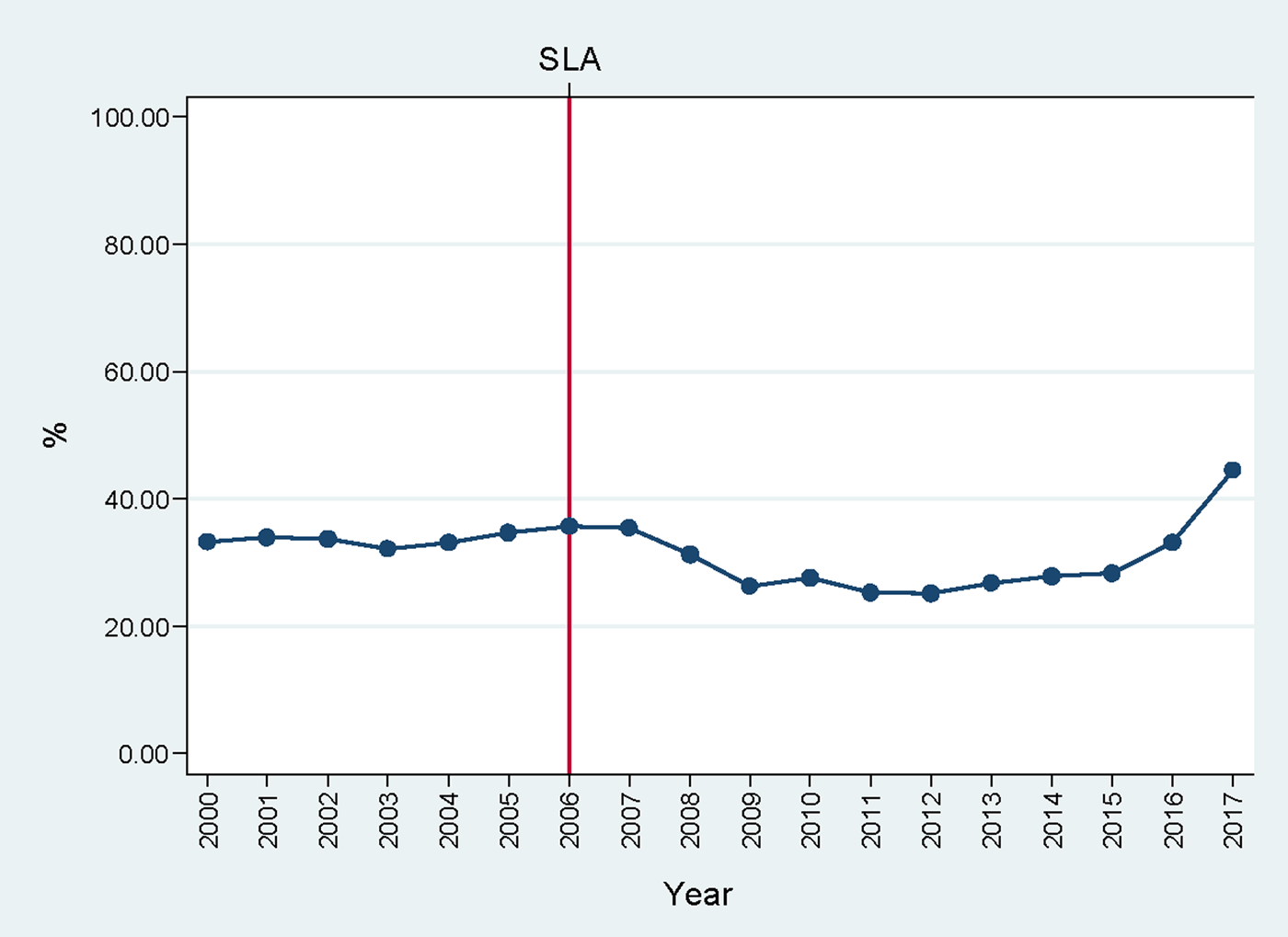
The extent of variation observed in Figure 1 in Canadian lumber exports to the United States from 2000 to 2019 is not apparent when we plot Canada's share of the US lumber market in Figure 2. The figure shows that the Canadian share of the US market fluctuated around 33% until 2007 and then decreased to 26.19% in 2009. After that, the share remained flat until 2015, followed by a sharp increase to 44.46% in 2017.
Canadian Share of US Lumber Consumption 2000–2017
Source: Authors’ calculation based on US Timber Production, Trade, Consumption, and Price Statistics 1965–2017.

Several studies have examined the welfare implications of the Canada–US lumber trade policy regimes and have found net welfare losses to Canada under them all. Following the expiry of the most recent SLA, Canada's exports of softwood lumber to the United States surged in 2017, increasing by 16 percentage points and prompting the United States to impose AD and CV duties. Johnston and Parajuli (Reference Johnston and Parajulib2017) evaluate the economic impact of the US tariffs imposed on Canada in early 2017. The average tariff imposed was 26.75%. They found that Canadian lumber producers incurred a welfare loss of $252 million, which more than nullified the Canadian consumers’ welfare gain of $105 million and implied a net welfare loss to Canada of $143 million. US consumers’ (mostly homebuilders) suffered a welfare loss of $594 million, while US lumber producers gained $380 million and the US government gained $1.2 billion in tax revenues – amounting to a net welfare gain in the United States of $986 million.
This represents textbook international economics at play, where the terms of trade effect from a large country applying import duties creates an import price reduction (net of tariffs) known as a terms of trade improvement. The tariff-inclusive import prices for Canadian softwood lumber products are higher with the tariffs when they enter the US market, but the terms of trade improvement represent a welfare gain for the United States. Although there is a net positive outcome for the United States, including significant tariff revenues for its government and sales revenue for domestic firms, this welfare gain comes at the expense of US domestic consumers and Canadian lumber producers.
The lumber dispute is just one example where the United States ramped up protectionist policies during the Trump Administration. There was a 62% jump in the number of anti-dumping and countervailing duty investigations initiated in the first year of the Trump Administration compared to the previous year. In addition to lumber, of note are the national security tariffs imposed by the President on steel and aluminium imports from Canada and Mexico, despite renegotiating NAFTA with those countries and replacing it with the United States–Mexico–Canada (USMCA) agreement in September 2018.
3. Canada's Challenges to the US Methodology for Calculating Anti-Dumping Duties
3.1 The Methodology Prescribed in the Second Sentence of Article 2.4.2 of the Anti-Dumping Agreement
The second sentence of Article 2.4.2 of the Anti-Dumping Agreement is a methodology designed to enable a Member to unmask and address targeted dumping by an exporter. It allows an investigating authority to use the W-T methodology if the investigating authority finds a ‘pattern of export prices which differ significantly among different purchasers, regions or time periods’.
The Appellate Body has confirmed that the ordinary meaning of the term ‘pattern’ is that it constitutes a regular and intelligible form or sequence discernible in certain actions or situations.
3.2 The Underlying Investigation Found Dumping Using the Weighted Average-to-Transaction Methodology
The USDOC uses a two-stage process in assessing targeted dumping under the DPM. At the first stage of the DPM, the USDOC uses two tests, namely, the ‘Cohen's d’ test and the ‘ratio test’ to assess whether there is a pattern of prices that differ significantly. The Cohen's d coefficient is used to assess the extent to which the net prices of a product to a particular purchaser, region, or time period differ significantly from the net prices of other sales of comparable products. The USDOC includes both higher and lower prices in assessing whether there is a price difference. The Department then uses a ‘ratio test’ to assess the extent of the price differences for all sales as measured by the Cohen's d test.Footnote 6 If both the Cohen's d test and the ratio test indicate the existence of a pattern of prices that differ significantly such that an alternative comparison method should be considered, then in the second stage of the differential pricing analysis, the USDOC examines whether using the weighted average-to-weighted average (W-W) method can effectively account for such differences or whether the W-T methodology established under the second sentence of Article 2.4.2 of the Anti-Dumping Agreement should be used.
In the Underlying Investigation, the USDOC announced its affirmative final determinations regarding imports of softwood lumber from Canada on 2 November 2017.Footnote 7 The USDOC used the DPM to examine whether the export prices of the Canadian producers showed ‘a pattern of export prices which differ[ed] significantly among different producers, regions or time periods’. The USDOC found that the export prices of three Canadian producers revealed such a pattern and proceeded to examine whether the W-W methodology could take into account those price differences; it asserted that it could not. Accordingly, the USDOC applied the W-T methodology described in the second sentence of Article 2.4.2 of the Anti-Dumping Agreement to the export transactions of the three Canadian producers and used zeroing in the process.
The USDOC found that certain mandatory respondents were dumping at margins of 8.89%, 3.20%, 7.22%, and 5.57%, and established a final dumping margin of 6.58% for all other producers and exporters of softwood lumber from Canada. The USDOC also calculated final subsidy rates of 3.34%, 13.24%, 14.70%, and 14.85% for certain respondents, and established a final subsidy rate of 14.25% for all other Canadian producers and exporters.
On 7 December 2017, the United States International Trade Commission determined that US industry was materially injured by the imports of Canadian softwood lumber that the USDOC had determined were subsidized and sold in the United States at less than fair value.
3.3 Canada Challenged the US Findings as Inconsistent with the Anti-Dumping Agreement and Other Provisions
On 28 November 2017, Canada requested consultations with the United States regarding its anti-dumping measures applying the DMP to softwood lumber products from Canada (Request).Footnote 8 Canada alleged that the United Stated had acted inconsistently with its obligations under both the Anti-Dumping Agreement and the GATT 1994.
Consultations on 17 January 2018 failed to settle the dispute. On 15 March 2018, Canada requested the establishment of a panel.Footnote 9 On 9 April2018, the Dispute Settlement Body (DSB) established the panel in accordance with Article 6 of the Dispute Settlement Understanding (DSU).Footnote 10
In its Request, Canada requested the panel to find that the United States’ application of the DPM was inconsistent with the Anti-Dumping Agreement, including:Footnote 11
1. Article 2.4.2 of the Anti-Dumping Agreement as the United States, in applying the weighted-average-to-transaction (W-T) calculation methodology, improperly aggregated random and unrelated price variations and therefore failed to identify a pattern of export prices as required by the second sentence of this provision;
2. Articles 2.4 and 2.4.2 of the Anti-Dumping Agreement as the United States applied zeroing in its W-T calculation methodology when:
a. zeroing is not permitted when applying the W-T methodology;
b. zeroing in the W-T methodology does not account for all of the purported pattern transactions in calculating the margin of dumping; and
2. The USDOC acted inconsistently with Article 2.4 of the ADA by applying zeroing under the W-T methodology when using the DPM.
Canada also claimed that the alleged inconsistencies resulted in the application of anti-dumping measures that were inconsistent with Articles 1 and 2.1 of the Anti-Dumping Agreement and Articles VI:1 and VI:2 of the GATT 1994. The United States requested the panel reject Canada's claims (WTO, 2019a, p. 9).
4. The Panel's Findings
On 9 April 2019, the panel's report was circulated to Members. The panel's report made determinations regarding (1) what must be shown in order to use the W-T methodology in the second sentence of Section 2.4.2 of the Anti-Dumping Agreement, and (2) the United States’ use of zeroing under the W-T methodology.
4.1 The Requirement of a Pattern of Significantly Different Export Prices
The pattern clause in the second sentence of Article 2.4.2 of the Anti-Dumping Agreement requires as a condition of use of the methodology that the national authority find a pattern of export price differences.
Canada asserted that the USDOC did not meet the conditions for use of the W-T methodology. In particular, in applying the DPM, USDOC ‘improperly aggregated both high priced and low-priced transactions and combined transactions that passed the Cohen's d test based on purchasers, regions, and time periods’. Canada claimed that ‘[t]he use of this process to justify the application of the exceptional W-T methodology was therefore improperly based on both high priced and low priced transactions and ignored the requirement set out in Article 2.4.2 to identify a pattern among purchasers, regions or time periods’ (WTO, 2019b, Addendum: Annex B-1). Canada also alleged that the USDOC's finding of a pattern of export prices which differed significantly among ‘different purchasers, regions, and time periods’ (WTO, 2019b, Addendum: Annex B-2) was inconsistent with the textual requirement in the second sentence of Article 2.4.2 to find a pattern of export prices ‘with respect to certain purchasers, or to certain time periods, or to certain regions, as confirmed by the Appellate Body Report in US–Washing Machines’ (WTO, 2019b, Addendum: Annex B-1).
The United States disputed Canada's understanding of the text. In particular, the United States alleged that
[n]othing in the text of the ‘pattern clause’ of the second sentence of Article 2.4.2 of the AD Agreement suggests that the significant export price differences among each category (i.e., purchasers, regions, or time periods) cannot be considered together when assessing whether there exists ‘a pattern of export prices which differ significantly among different purchasers, regions or time periods’. To the contrary, the text of the ‘pattern clause’, on its face, contemplates a pattern of export prices that would transcend multiple purchasers, regions, or time periods. (WTO, 2019b, Addendum: Annex B-3)
The United States also disputed the Appellate Body's ‘exceedingly narrow’ reading of the text of Section 2.4.2 (WTO, 2019b, Addendum: Annex B-3), arguing that
[a] more plausible reading of the text of the ‘pattern clause’ of the second sentence of Article 2.4.2 contemplates a holistic analysis of the exporter's pricing behavior for the product as a whole, which is consistent with the Appellate Body's guidance in prior reports that a dumping margin must be exporter-specific and determined for the product as a whole. That is what the USDOC sought to accomplish by applying a differential pricing analysis in the antidumping investigation of softwood lumber from Canada. (WTO, 2019b, Addendum: Annex B-3)
The panel upheld this aspect of Canada's claim.
Examining the text of the pattern clause, the panel found that ‘[t]he preposition “among” may be defined, inter alia, as “in relation to the rest of the group [it belongs to]”’ – suggesting ‘a relationship between one thing, i.e. purchasers, regions or time periods and other things of the same type, i.e. other purchasers, regions or time periods’ (WTO, 2019a,b, p. 19).
The panel also noted that ‘the pattern clause does not preclude an investigating authority from finding more than one pattern’ (WTO, 2019a, pp. 20–21). According to the panel, its interpretation was
consistent with that of the Appellate Body in US–Washing Machines, in which the Appellate Body indicated that ‘its interpretation of the pattern clause did not exclude the possibility that a foreign producer or exporter could be practising more than one type of targeted dumping (that is dumping targeted to purchasers, regions and time periods), or that an investigating authority could find more than one type of pattern. However, like us, the Appellate Body found that the text of the pattern clause did not support the United States’ view that an investigating authority could find a single pattern of export prices, which includes variations in export prices across purchasers, regions and time periods.’Footnote 12
4.2 A Pattern Under Article 2.4.2 Can Include Significantly Higher Prices Relative to Export Prices to Other Purchasers, Regions, or Time Periods
Canada claimed, referring to the Appellate Body report in US–Washing Machines, that a ‘pattern’ identified by the investigating authority can only include export prices to purchasers, regions or time periods which ‘differ significantly’ because they are significantly lower relative to export price to other purchasers, regions, or time periods. In Canada's view, the USDOC had acted inconsistently with Article 2.4.2 by ‘improperly aggregate[ing] both high priced and low-priced transactions’ (WTO, 2019b, Addendum: Annex B-1).
The United States responded that consideration of both low and high prices was consistent ‘with the express terms of the pattern clause’ of the second sentence of Article 2.4.2 of the Anti-Dumping Agreement, which calls upon investigating authorities to find ‘export prices that differ significantly’, but which does not require or foreclose a focus either on lower-priced or higher-priced export sales (WTO, 2019b, Addendum: Annex B-3). The United States argued that the Appellate Body's finding in US–Washing Machines that ‘the relevant “pattern” for the purposes of the second sentence of Article 2.4.2 is comprised of the export prices to one or more particular purchasers which differ significantly from the prices to the other purchasers because they are lower than those other prices (with the same applying to regions and time periods, respectively)’, and ‘the relevant “pattern” … cannot be identified by considering prices that are higher than other prices’ was inconsistent with the plain terms of the ‘pattern clause’ of Article 2.4.2 (WTO, 2019b, Addendum: Annex B-3).
Also, the Appellate Body's requirement that ‘an investigating authority would analyse the prices of all export sales made by the relevant exporter or producer to identify a pattern’ necessarily involved ‘consideration of both higher- and lower-priced sales,’ contrary to the Appellate Body's interpretation (WTO, 2019, Addendum: Annex B-3).
The panel found that the silence of the pattern clause about whether export prices that differ significantly must be lower or can be higher relative to export prices to other purchasers, regions, or time periods was not dispositive (WTO, 2019a, p. 22). In US–Washing Machines, the panel had concluded that prices that are too high and prices that are too low do not belong in the same pattern; the Appellate Body had agreed, noting that a pattern cannot comprise export prices that differ significantly because they are significantly higher. The panel here reached a different conclusion, stating that
[t]o us, the silence of the text … is explained by the function of the second sentence of Article 2.4.2, which is to unmask dumping targeted to certain purchasers, regions, or time periods. The text of the pattern clause supports the view that targeted dumping is masked when significantly lower prices to certain purchasers, or certain regions, or in certain time periods are masked by significantly higher export prices to certain other purchasers, or to certain other regions, or in certain other time periods. (WTO, 2019a, pp. 22–23)
Rejecting Canada's claim, the panel determined that the text permits an investigating authority to find a pattern comprising prices ‘that are (a) significantly lower and thus may be masked; and (b) significantly higher and thus may be masking those lower-priced export sales’ (WTO, 2019a, pp. 22–23). The panel expressly disagreed with the contextual considerations referenced by the Appellate Body in US–Washing Machines (WTO, 2019a, p. 23), as well as with the panel's finding in US–Washing Machines that prices that are too high and prices that are too low do not belong in the same pattern. Instead, it found that ‘[e]xport prices which “differ significantly” because they are significantly higher or significantly lower could form such a sequence’ (WTO, 2019a, pp. 23–24).
4.3 The USDOC's Use of Zeroing Under the W-T Methodology
The use of zeroing as a methodology for calculating dumping margins has been a hot button issue for many years in WTO disputes and the subject of many panel and Appellate Body reports. It has been widely discussed in the literature and is even the topic of a very popular podcast.Footnote 13
‘Zeroing’ refers to the way in which dumping margins are calculated in the context of anti-dumping measures. In the simplest terms, dumping margins are the difference between the export price of a product and the normal domestic price of the product. However, the comparison typically involves many transactions, and the investigating authority needs to aggregate the large number of prices across transactions, entailing averaging over large numbers of export prices and normal prices. Zeroing refers to the practice of dropping observations from the averaging calculation (assigning zero weight) to transactions where dumping margins are negative. The standard objection to this approach is that the impact of zeroing the negative margin cases is to overstate both the existence of dumping and the size of the dumping margins, thereby increasing the chances of finding dumping. Additionally, critics complain that the practice increases the duty remedy because the size of the computed margins determines the size of the ADD. Bown and Prusa (Reference Bown, Prusa, Martin and Mattoo2011) provide a helpful numerical example of how zeroing works and empirically find that zeroing increases dumping margins between 5 and 10 percentage points.
The Anti-Dumping Agreement provides rules for how dumping margins can be computed. According to Bown and Prusa (Reference Bown, Prusa, Martin and Mattoo2011, p. 356) ‘[o]ver the past decade the WTO Appellate Body (AB) has heard more than a dozen disputes involving zeroing and each time has found that the practice violates the WTO Antidumping Agreement (ADA)’. The United States, however, remains a vigorous defender of the practice of ‘zeroing’, asserting that the WTO rules do not prohibit zeroing. Prusa and Vermulst (Reference Prusa and Vermulst2009) explain how dumping margins are inflated by zeroing and report on how the different types of zeroing methodologies used by the USDOC operate. They observe that zeroing fails to meet the standard set in the ADA for fair comparison, and applying standard econometric methods in the presence of zeroing fails to produce unbiased estimates.
In this dispute – relying heavily on the findings of the Appellate Body in US–Washing Machines – Canada argued that the USDOC's use of zeroing under the W-T methodology was inconsistent with the second sentence of Article 2.4.2. The United States asked the panel not to follow the Appellate Body's findings in US–Washing Machines. It claimed that, because the W-T methodology is exceptional, its use should produce a dumping margin different to that determined under the W-W or T-T methodologies (WTO, 2019b, Addendum: Annex B-3). However, if zeroing is prohibited under the W-T methodology, there would be ‘mathematical equivalence’ between the dumping margins determined under the W-W methodology and the W-T methodology (WTO, 2019b, Addendum: Annex B-3). This mathematical equivalence would have the effect of rendering the second sentence of Article 2.4.2 inutile (ineffective) (WTO, 2019, p. 27).
The panel acknowledged at the outset that ‘[t]he panels in US–Washing Machines and US–Anti-Dumping Methodologies (China) and the Appellate Body in US–Washing Machines concluded that the second sentence of Article 2.4.2 does not permit the use of zeroing under the W-T methodology’ (WTO, 2019a, pp. 25–26). The panel continued that ‘[w]hile these panels and the Appellate Body found zeroing to be impermissible under the second sentence, they acknowledged that the W-T methodology is an exceptional methodology which is designed to unmask targeted dumping. However, … the second sentence of Article 2.4.2 permits an investigating authority to unmask targeted dumping without using zeroing’ (WTO, 2019a, pp. 25–26).
In addressing the zeroing issue, the panel confirmed that – if the conditions in the second sentence of Article 2.4.2 are met – the W-T methodology may only be applied to pattern transactions, and the ‘normal’ W-W or T-T methodology must be applied to the non-pattern transactions (WTO, 2019a, pp. 31, 34–35).
The panel asked whether ‘[h]aving identified the higher-priced export transactions within the pattern that are masking lower-priced export transactions in that pattern, is an investigating authority permitted to unmask such higher-priced export transactions by treating their value as zero?’ (WTO, 2019a, p. 35) In the panel's view, the silence of the text of the second sentence was not dispositive on this issue. ‘Instead, to determine whether an investigating authority is permitted to zero such higher-priced export transactions, we must interpret the text of the second sentence in context and in light of the function of the second sentence of Article 2.4.2’ (WTO, 2019a, p. 35).
The panel examined the contextual elements, concluding that they supported its view that ‘having identified through the application of the W-T methodology the individual export transactions that mask other export transactions, and those individual export transactions that are being masked, an investigating authority is not required to re-mask the individual export transactions above the weighted average normal value but may instead treat them as zero’ (WTO, 2019a, p. 35). The panel distinguished the W-T methodology from the ‘normal’ methodologies outlined in the first sentence of Article 2.4.2 on grounds that its function is to unmask targeted dumping (WTO, 2019a, p. 35). Accordingly, ‘if one of the two normal methodologies … systemically and in every case gives a result that is mathematically equivalent to the dumping margin determined pursuant to the second sentence of Article 2.4.2, this would suggest that the W-T methodology is unable to function’ (WTO, 2019a, p. 36). Agreeing with the United States, the panel concluded that as the ‘raison d'être of the W-T methodology is to unmask targeted dumping, the inability of this methodology to do so will render this methodology inutile. … Therefore, contextual considerations also support our view, that the second sentence of Article 2.4.2 does not prohibit zeroing under the W-T methodology’ (WTO, 2019a, p. 36).
Accordingly, the panel rejected Canada's claim that the USDOC had acted inconsistently with the second sentence of Article 2.4.2 by using zeroing under the W-T methodology in the Underlying Investigation. In a rare departure from established findings, the panel explicitly acknowledged that its conclusions differed from those of the panel and the Appellate Body in US–Washing Machines, as well as the panel in US–Anti-Dumping Methodologies (China). The panel noted that ‘[t]his is the result of our objective assessment of the facts of this case, and the applicability of, and conformity with, the relevant covered agreements. We have carefully considered these reports of the panels and the Appellate Body, and found convincing or cogent reasons to arrive at [different] conclusions’ (WTO, 2019a, p. 36)
4.4 Canada's Appeal of Certain Aspects of the Panel's Report
On 4 June 2019, Canada appealed certain aspects of the panel's Report.Footnote 14 Notably, Canada:
(a) Appealed the panel's findings and conclusions arising from its interpretation of the term ‘pattern’ in the second sentence of Article 2.4.2. of the Anti-Dumping Agreement to permit the inclusion of prices that are significantly higher than other export prices;
(b) Requested a review of the panel's finding that the second sentence of Article 2.4.2 requires an investigating authority to use the W-T methodology for ‘pattern’ transactions and a ‘symmetrical comparison methodology for non-pattern transactions;’
(c) Requested a review of the panel's findings permitting zeroing;Footnote 15 and
(d) Requested the Appellate Body to find that the panel had acted inconsistently with the function of panels under Article 11 of the DSU and, specifically, that ‘the [P]anel erred by departing, without cogent reasons, from the legal interpretations and reasoning contained in the adopted Appellate Body report in US–Washing Machines’.Footnote 16
On 2 August 2019, the Chair of the Appellate Body informed the DSB that the Appellate Body would not be able to circulate a report in this case within the required 90 days.Footnote 17 On 10 December 2019, the Appellate Body ceased to function and the appeal remains pending.Footnote 18
5. Implications of the panel's Findings
There are several reasons why this is an important case and why we should care about the Report.
5.1 Ratcheting the Pressure in the Softwood Lumber Dispute
This current softwood lumber dispute represents an important departure from previous cycles of the softwood lumber dispute. For the first time, the United States hit the Canadian industry with both ADDs and CVDs – previous disputes involved only alleged subsidies. Additionally, in a separate trade action during this period, the United States extended the softwood lumber dispute to include paper. According to Beaulieu (Reference Beaulieu2018), the United States extended trade actions from softwood lumber to include paper producers as Canadian paper producers had gained a larger share of the shrinking paper market. Canadian paper production expanded from 60% of combined US and Canadian production in 1990 to 69% in 2016, while developing new products and innovating to maintain a sustainable industry. US trade complaints about subsidies and dumping from US competitors were intended to halt and possibly reverse that trend.
The newsprint subsidy complaint is important because it expanded longstanding US arguments about the market distortion caused by the Canadian government's role in the softwood lumber industry, through public ownership of forest lands. New complaints challenge government programs that were not included in previous subsidy complaints, such as government programs to help the industry manage pine beetle infestations, provincial school tax-credit programs, local municipal revitalization programs, and even the construction and repair of public access roads and bridges. It is hard to see how many of the dozens of programs identified by the United States as subsidies fit the traditional definition of a trade subsidy.
5.2 An Unlikely Win for Zeroing
This case also represents the first time that the United States has won on the issue of zeroing following a series of WTO disputes challenging the practice.
The panel's findings approving a limited context in which zeroing can be used was welcome news to the United States. The panel interpreted the second sentence of Article 2.4.2 to permit zeroing where a required pattern is established and to combat targeted dumping.
In statements about the Report, Ambassador Robert Lighthizer stated that: ‘The WTO rules do not prohibit “zeroing.” The United States never agreed to any such rule in the WTO negotiations, and never would. WTO Appellate Body reports to the contrary are wrong, and reflect overreaching by that body. The United States commends this panel for doing its own interpretive analysis, and for having the courage to stand up to the undue pressure that the appellate body has been putting on panels for many years’ (United States Trade Representative-USTR, 2019).
However, it is unlikely to be the final word on zeroing, which continues to provoke heated debate. At root, the question that the United States and other Member States cannot agree on is whether the framers of the Uruguay Round agreed to permit zeroing or not? In light of the current legislative stalemate at the WTO – as well as the strident support for zeroing from the United States and fierce opposition by other WTO Member States – it is unlikely that agreement will be reached in the near term on whether and when zeroing can be used.
5.3 The Panel Explicitly Departed from Prior Rulings of the Appellate Body
One of the most striking aspects of the panel Report is the panel's unusual and express departure from many prior, contrary rulings of the Appellate Body and previous panels on the issue of zeroing (WTO, 2019a, p. 36). In fact, the panel explicitly called out its disagreement with the Appellate Body in US–Washing Machines in several respects. For example, the panel: ‘recall[ed] that the Appellate Body in US–Washing Machines relied primarily on contextual considerations in concluding that the pattern could comprise export prices which differ significantly because they are significantly lower’ (WTO, 2019a, p. 23); ‘disagree[d] with the panel in US–Washing Machines insofar as it concluded that prices that are too high and prices that are too low do not belong in the same pattern’ (WTO, 2019a, pp. 23–24); and ‘found our understanding of [the text of the second sentence of Article 2.4.2] to differ from certain aspects of the panel's and the Appellate Body's interpretation in US–Washing Machines’ (WTO, 2019a, p. 18). The panel explained that it had ‘carefully considered’ earlier panel and Appellate Body reports but disagreed with those reports and had cogent reasons to arrive at different conclusions.Footnote 19
This departure is noteworthy in light of the ongoing debate over reform of the WTO dispute settlement system and, in particular, what – if any – precedential value attaches to Appellate Body findings. A key US complaint about the Appellate Body is the Appellate Body's standpoint that dispute settlement panels must treat the Appellate Body's legal interpretations as binding precedent, unless there are ‘cogent reasons’ for departing from them.Footnote 20 The United States claims in USTR (2020) that, by purporting to set binding precedent, the Appellate Body has redefined WTO Members’ rights and obligations without their consent and curbed the incentive for Members to negotiate new agreements at the WTO. In this case, the United States commended the panel's willingness to depart from the prior rulings. In a statement, the US Trade Representative stated that: ‘[t]he United States commends this panel for doing its own interpretive analysis, and for having the courage to stand up to the undue pressure that the Appellate Body has been putting on panels for many years. Appellate Body reports are not binding precedent, and where the Appellate Body's reasoning is erroneous and unpersuasive, a WTO panel has an obligation not to follow such flawed reasoning’ (USTR, 2020).
Other WTO Members and commentators, such as Crowley and Howse (Reference Crowley and Howse2010) take a different view. They assert that the fundamental structure and practices of the WTO as an institution necessitate that panel decisions should be based on precedent. Costs can arise, however, from an inflexible stance based on initial cases, which might not reflect important aspects that develop from legal challenges in later cases. On the other hand, precedents can moderate uncertainty and provide predictability to the international trading system.
The stark divergence in viewpoints about the precedential value of Appellate Body decisions lies at the core of differences about the function of WTO dispute settlement. As discussions continue about WTO dispute settlement reform, it will essential to reach a common understanding about what WTO Members have agreed or now agree that it should be.
6. Conclusions
Although the United States and Canada have had access to dispute settlement institutions through bilateral and multilateral arrangements such as under CUFTA, NAFTA, and the WTO, until now they have fallen short of resolving the lumber dispute. According to Anderson (Reference Anderson2006), the intractability of this dispute can be traced back to the different approaches of the United States and Canada in remedying trade disputes. Without a trade-related resolution in sight, a potential long-term solution proposed by McKinney (2004) is to make the lumber industry more regionally integrated by increasing cross-border investment.
It remains to be seen what happens in this specific dispute on appeal – if, and when, the WTO Appellate Body starts to function again. It will also be interesting to see whether this panel decision will encourage parties to argue for, and future panels to permit departures from Appellate Body rulings that they disagree with. Notably, to-date, it does not appear that the panel's readiness to adopt a different interpretation of a WTO agreement and reach different conclusions from the Appellate Body has changed the US position on making new appointments to the Appellate Body.