INTRODUCTION
In recent years, a new multiracial church (MRC) movement has begun to blossom in the complex and politically influential milieu that is American conservative evangelicalism.Footnote 1 This movement employs faith-based perspectives to challenge longstanding patterns of racial homogeneity in evangelical culture. It expressly advocates social change, antiracism, and civic engagement guided by a “biblical mandate” for diversity in Christian community. The powerful resources of shared belief structure (religion), civic engagement resources (bodies, buildings, networks, money), and passionate commitments (to multiracial community) that have fueled other American race-related political movements also motivate the MRC movement. Yet, significantly, most, although not all, movement practitioners currently resist framing their mission in directly political terms. Despite this seeming political avoidance, it behooves scholars of race, religion, social capital, and politics — and those interested in the understudied intersection of those areas — to attend to this movement's development and the distinctive subculture that shapes it.Footnote 2
This article, then, pursues the following, related inquiries: How does the MRC movement as a whole orient itself politically toward race and related issues, and what factors — theological framings, daily practices, and social expectations — inform that orientation? Do those involved in advocating racial diversity in evangelical congregations individually mirror the larger movement's political perspective, especially as articulated by movement leaders, or do they challenge it? Answering these questions involves examining how people in these particular religious contexts navigate the perceived “costs” of building multiracial organizations, and what resources propel such organizations toward — and sometimes away from — political engagement.
In 2008, I conducted research within the evangelical MRC settings with the aim of exploring how and whether the broad movement and its individual participants conceive of political, or potentially political, dimensions resulting from the faith-based, cross-racial community building work they do. I relied on three main MRC data sources: the growing cottage industry of “how to” books and materials from within the movement; live lectures and workshops on MRC-building; and interviews with participants at MRC conferences and workshops. These participants represented member churches of a national network of MRC-builders called Mosaix Global Network, the first umbrella group of MRC. This initial stage of investigation revealed several notable patterns, summarized below.
This article proceeds in two parts. The first briefly contextualizes the MRC movement vis a vis United States Protestant race history. I then weave findings from the MRC-building “how to” literature with relevant secular scholarship to frame a discussion of the risks MRC participants are taking and how the assumption of those risks seems to orient the movement in general toward an ambivalent political orientation. This discussion generates hypotheses explored below through interviews. These data reveal two predominant orientations toward what we might call a politics of MRC-building. The first, expressed by the majority of participants interviewed, is a nervously interested orientation to politics in the MRC context that mostly (although not entirely) tends to imagine racial change through interpersonal frameworks. The second is a more politically sophisticated justice-oriented perspective that advocates linking MRC efforts to structural and systemic change. I also speculate, based on a few outlier interviews, on the existence of a third, more resistant political orientation among a minority of participants. I conclude by discussing implications of these findings for understanding shifting racial dynamics in American evangelical communities.
FRACTURED FAITH
Space prohibits a detailed accounting of the history of evangelical Protestant race relations in the United States, which others have chronicled (Cf. Boles Reference Boles1988; Carwardine Reference Carwardine1993; Emerson Reference Emerson2001, chaps. 2–3; Gilbreath Reference Gilbreath2006, chaps. 4, 7). However, some contextualizing of the MRC movement relative to this past is necessary.
Before the mid-20th century, the story of race in American evangelicalism is a story of inequality, turmoil, and prolonged segregation, albeit interrupted with moments of what Harvey (Reference Harvey2005) calls racial interchange — cross-racial interactions and sharing of cultural practices like worship and revivals, which could only temporarily (if at all) override the race-based structural divisions that characterized Christian churches. In the country's first century, most African-Americans and indigenous people were either forcibly converted under slavery, relegated to third-class status inside white churches, or prevented from autonomously practicing their own religions, Christian or otherwise (Harvey Reference Harvey1997; Loescher Reference Loescher1948; Manis Reference Manis1987; Marsden Reference Marsden1980; Nelson Reference Nelson1981; Ammerman Reference Ammerman1990; Luker Reference Luker1991). The Civil War and its aftermath divided the vast majority of evangelicals into separate denominations defined according to racial make-up or positions on slavery, emancipation, and other race issues (Harvey Reference Harvey2005). The Southern Baptist Convention, for instance, was born through its defense of slavery, while the National Baptist Convention, the African Methodist Episcopalian church, the Church of God in Christ, and other denominations were created by blacks exercising their hard-won freedom. Although some white evangelicals did build racially progressive churches, with few exceptions (the early Pentecostal movement being one) the de facto racial segregation of American Christianity, in both Northern and Southern regions, was rarely challenged at the institutional (denominational) level until the Civil Rights Movement (Lincoln Reference Lincoln1999; MacRobert Reference MacRobert1988).
The Civil Rights and Black Power movements produced Christian leaders of color who confronted white racism and racial apartheid in evangelical communities.Footnote 3 One was a young, black, Harlem-based preacher named Tom Skinner (Reference Skinner1970a, Reference Skinner1970b) who delivered a famous keynote at a large national youth gathering called Urbana 70.Footnote 4 In “The United States Racial Crisis and World Evangelism,” Skinner critiqued the American Christian community's failure to address and reconcile the “sad state of race relations” in and beyond the church (Gilbreath Reference Gilbreath2006, 67). Other black Christian activists like Dr. John Perkins, the prophet of Christian community development, and Jamaican-American preacher Samuel Hines became champions of racism education and reconciliation (framed as consciously overcoming “unchristian” racial divisions and prejudice) in the evangelical world (Emerson and Smith Reference Emerson and Smith2000, 54). These early advocates brought the reconciliation message especially to black and white evangelical communities from the mid-1960s to the 1990s through speaking, preaching, and writing (Emerson and Smith Reference Emerson and Smith2000, 55).
In the wake of, or in response to, the Civil Rights Movement, most mainline and liberal evangelical denominations developed faith-based orientations to racial politics (Alumkal forthcoming). A few white evangelical vanguardists, like Jim Wallis of Sojourners, built organizations advocating faith-based antiracism from the 1970s on (Wallis Reference Wallis1983). However, theologically conservative white evangelicals did not consistently or seriously take-up calls to address racism, segregation, and Christian racial history in general until the 1990s. In that decade, and for complicated reasons I discuss elsewhere, a vocal minority of white evangelicals finally began to respond, and gradually words like “reconciliation” and “racial diversity” became mainstream refrains within white evangelicalism (Wadsworth Reference Wadsworth1997, Reference Wadsworth, Novkov, Lowndes and Warren2008, Reference Wadsworth, Robin and Wadsworth2010). This occurred through four main trends: formal and/or institutional recognitions and apologies for racism at denominational and organizational levels like the Southern Baptist Convention; stories on race, racism, and reconciliation efforts in evangelical magazines like Christianity Today (2000); the emergence of a niche literature on “how to” engage in racial reconciliation and build more racially diverse Christian communities; and the promotion of racial reconciliation and healing frameworks through the men's organization Promise Keepers.
Despite such developments, the long legacy of racial separation in the evangelical church is reflected by the fact that even today more than 90% of churches remain populated almost exclusively by members of one racial group (DeYoung et al. Reference DeYoung, Emerson, Yancey and Kim2003; Chaves 1999; Emerson and Smith Reference Emerson and Smith2000, 74). In this context, the MRC movement is something of a rebel strain inside a larger evangelical church culture that has long produced, and in fact advocated, demographically homogeneous churches.
A multiracial (or, alternately, “multiethnic”; participants use both terms) church is typically defined as a congregation in which less than 80% of the members are from the majority racial or ethnic group in that church. Twenty percent non-majority members is a threshold that, proponents suggest, requires all members to substantively interact across difference (Emerson and Kim Reference Emerson and Kim2003, 217). Such a congregation might be comprised of whites and people of color, or different ethnic or national-origin groups within one racial category (as race is defined in the United States), such as Latinos. MRCs pursue various models of MRC-building, from fully integrated congregations expressing a variety of cultural styles, to two or more language groups holding different services under the same roof (Emerson and Kim Reference Emerson and Kim2003; Ortiz Reference Ortiz1996; DeYoung et al. Reference DeYoung, Emerson, Yancey and Kim2003; Garces-Foley Reference Garces-Foley2007a, 211–217).
Multiracial evangelical churches began cropping up in noticeable numbers in the early 1990s but have gained steam and begun to pool resources since the early 2000s.Footnote 5 MRC advocates aim to grow churches that pursue what practitioners see as a theological command: to build a “unified Body of Christ” that, like the first century church, crosses all varieties of sociological boundaries to draw people into the religion.
IS RELIGIOUS BRIDGING POLITICAL BRIDGING?
Although a few scholars have tracked the rise of and models for MRC-building in evangelical communities, they have not, to my knowledge, studied the movement's political orientation (Emerson and Kim Reference Emerson and Kim2003, 217–227; Emerson and Woo Reference Emerson and Woo2006; Emerson Reference Emerson2001; Marti Reference Marti2005; DeYoung et al. Reference DeYoung, Emerson, Yancey and Kim2003; Yancey Reference Yancey2003). Pioneered by Michael Emerson's groundbreaking work on evangelicals and race, most researchers of the MRC movement have been Christian sociologists.Footnote 6 These scholars have produced two distinct literatures: a growing scholarship on diverse congregations; and usually co-authored books (written with pastors) geared toward practitioners, which advocate and urge diversification.
It is significant, as I will later elaborate, that both literatures have been influential among MRC participants. For instance, Emerson and Smith's academically oriented Divided by Faith was widely discussed in the evangelical world and generated a two-part special section in Christianity Today, evangelicalism's flagship magazine (Emerson and Smith Reference Emerson and Smith2000, 34–65). In MRC settings, I frequently heard proponents refer to the book as a “turning point” that helped clarify their mission. It and United by Faith (Emerson and Kim Reference Emerson and Kim2003), a theology-based endorsement of MRC-building efforts, co-authored by Emerson and three other Christian scholars, have become key guidebooks for many in the MRC movement.
As a movement outsider and political scientist, I hope to bring other perspectives to bear on it by considering the movement's potential for generating social capital across race and religion simultaneously (See also Garces-Foley Reference Garces-Foley2007a).
Scholars of social capital observe that religious communities are one potential space through which people can bridge differences through access to a shared identity (e.g., religion) or operating framework (e.g., the military) (Putnam Reference Putnam2007; Lichterman, Carter and Lamont Reference Lichterman, Carter and Lamont2008; Smidt Reference Smidt2003). But while faith-based bridging might facilitate civic engagement, in the form of activities like volunteering and organizing for charitable causes, common political activity, discussions of societal power structures, even open discussions of political issues as basic as presidential voting, are likely to be approached more cautiously in many churches, particularly multiracial evangelical congregations. Churches may be wary of losing their tax-exempt status, or simply of alienating members, but racial diversity in a church ups the ante considerably. Collective political engagement requires trust beyond forms of civic engagement familiar to church groups.
Almost by definition, conservative evangelical church and parachurch organizations tend to be “bonding social capital” groups, which are based heavily on trust among members. Their typically orthodox interpretations of scripture and their orientation as pursuers of biblical righteousness in a threatening, sinful world cultivate a strong sense of unity among members (Hunter Reference Hunter1987; Smith Reference Smith and Emerson1998). The primary basis for trust among evangelicals is shared faith; thus, they tend to distrust “non-believers,” or even Christians from denominations they differ with theologically (e.g., Catholics or mainline Protestant denominations). Like other bonding groups, they often nurse what the social capital literature calls “out-group antagonisms” — the out-group being what evangelicals commonly call “the world” (a world they hope to “save” through “sharing the gospel”). Therefore, when conservative evangelical groups organize to contribute to some social good (say, feeding the poor); they tend to do so through intra-group networks inside the church, perhaps in association with like-minded churches. “Bridging social capital” happens when some groups engage or cooperate with other groups, and in the process “generate broader identities and reciprocity” beyond the original bonding groups (Putnam Reference Putnam2000, 23). This may be challenging for churches disinclined to trust non-evangelicals and secular remedies to what they see as spiritual problems. Pursuing the even higher-trust activity of political engagement through bridging social capital would, for conservative evangelicals, require very strong forms of bonding.Footnote 7
Another confounding factor is that race has influenced faith-based political engagement in different directions, especially for evangelical Christians. Put bluntly, the white evangelical tradition has pursued a different definition of “morality politics” than have evangelicals of color. Through the Religious Right, some (mainly white) conservative evangelicals have crossed high bonding and bridging thresholds in pursuit of “moral values”-related goals such as restricting abortion, protecting traditional family structures, and defending school prayer. However, they have mostly not done so in response to American racial and economic equality issues. For evangelicals of color, the faith-based political morality tradition, so to speak, has usually encompassed the political problems of racism, poverty, civil rights, and other social equality issues (Noll Reference Noll2008; Lincoln Reference Lincoln1999; Harvey Reference Harvey2005). Some prominent white conservative evangelicals leaders have admitted that their churches have historically been apathetic toward or on “the wrong side” of such initiatives (Reed Reference Reed1996).
A legacy of these different traditions is that evangelicals tend to have divergent political leanings across race on general measures like party identity and orientation. For example, in 2004, 71% of black Protestants identified as Democrats in a national survey, as did 43% of Latino Protestants, but only 27% of white evangelicals (Green Reference Green2004). To further complicate the picture, Christians of color have themselves produced different kinds of social capital. The varying power structures within African-American Protestant and Latino Catholic churches, for example, generate distinct approaches to political organizing (Warren Reference Warren2003; Wilson Reference Wilson2008). So when multiracial churches try to attract and retain members from such sociologically and politically varied groups into one faith-based community, bridging difference is inherent to the process of bonding in a way that is not true in more homogeneous settings. In the simplest terms, in multiracial churches religious bonding entails racial bridging. MRC participants have to first relate across their racial and/or cultural differences before they can hope to breach the potentially more fraught topic of their political orientations.
There are further obstacles to evangelicals discussing certain kinds of politics, particularly race-related matters, in racially mixed settings. In Divided by Faith, Emerson and Smith (Reference Emerson and Smith2000) explain the obstacles within the black-white context. White and black evangelicals, they find, draw from practically irreconcilable resource frameworks (Swidler's (Reference Swidler1986) “tool kits”) to understand race. White evangelicals (like many perhaps well-meaning whites) lean toward conservative “color blind” approaches to race, favoring individualistic and uni-dimensional, rather than collective and multi-dimensional approaches to combating racism. African-American evangelicals, in contrast, are distinctly aware of racism and have drawn on theology to support political and systemic change efforts. Because most white evangelicals are attached to the individualist precepts of liberal capitalism, which support the myth of equal opportunity, they tend to see racial inequality as separate from systemic structures and policies, to hold blacks accountable for their problems, and to believe that, if blacks are subordinated, it is because they suffer from relational dysfunction and a lack of responsibility (Emerson and Smith Reference Emerson and Smith2000, 101). Recognizing the systemic roots of racism and advocating for politicized approaches to racial problems would challenge the “voluntaristic absolutism” to which white evangelicals tend to be theologically and practically more attached than other Americans (Emerson and Smith Reference Emerson and Smith2000, 97). The historically constituted racial homogeneity of evangelical congregations further exacerbates the divergent racial perspectives of blacks (as well as others of color) and whites. “Despite devoting considerable time and energy to solving the problem of racial division,” Emerson and Smith (Reference Emerson and Smith2000, 170) conclude, “white evangelicalism likely does more to perpetuate the racialized society than to reduce it.”
THE “COST” CHALLENGE
When members of a congregation come from the same racial, ethnic, and class backgrounds, as the lion's share of evangelical congregations do, they can, to some degree, take political orientation for granted and pursue shared political interests without much conflict, or what the civic engagement literature calls social “cost” (Chaves et al. Reference Chaves, Konieczny, Beyerlien and Barman1999). Cost defines the degree to which people feel the organizations they belong to (here churches) reflect, or do not reflect, their own identity, values, symbols, and practices (Christerson and Emerson Reference Christerson and Emerson2003, 165). Emerson and Smith (Reference Emerson and Smith2000, 145) found that “internally homogeneous congregations more often provide what draws people to religious groups for a lower cost than do internally diverse congregations.” The lower cost of internal church homogeneity fosters faith-based volunteer organizations — and likewise political initiatives — as racially segregated as the churches that feed them.
Therefore, to put it mildly, multiracial congregations are in relatively untracked territory, especially for conservative evangelical communities. A MRC, especially if it includes whites or Asians together with Latinos or African-Americans, will house different, even opposing, political persuasions under the same roof, all arguing that theology mandates their political worldview. Becker (Reference Becker1998) finds that the creation of successful racially inclusive church communities often depends on how congregations “mine their traditions for metaphors of community” and find ways to institutionalize new inclusive spaces. Venturing into substantive political discussion in many multiracial settings, much less mobilizing politicized social capital would require peeling away sedimented layers of social history influencing groups' contemporary positioning. Such challenges may be good reason to steer clear of it and “focus on ‘The Word’” — that is, stick to the religious context. From this perspective, the right inquiry might not be, “why don't multiracial churches engage politically?” but rather, “why would they ever want to ‘go there’?”
CHALLENGING THE HOMOGENEOUS UNIT PRINCIPLE
MRC proponents ask, and answer, that very question. Church planters themselves recognize demographic diversity inside churches as a high-cost venture. Although not their primary objective (that objective being to create healthy multiracial churches), they critique contemporary evangelicalism by positioning multiracial churches as a theologically urgent antidote to the “homogeneous unit principle” (HUP) promoted by the Church Growth Movement. Founded by Christian missionary Donald McGavran and extended by Fuller School of World Mission leader C. Peter Wagner, the Church Growth Movement developed an influential set of principles designed to foster international missions and, later, domestic churches (Valleskey Reference Valleskey1991). Put simply, the HUP holds that churches will grow and people will more readily become Christians when they don't have to cross racial, linguistic or class lines to do so (Valleskey Reference Valleskey1991, 10). Although Wagner defended the HUP as “the opposite of racist,” the back cover blurb of his signature book Our Kind of People described it in interesting terms:
Wagner attacks the Christian guilt complex arising from the civil rights movement and puts it to rest with a skillful mixture of scriptural precedent and human psychology. In doing so, Wagner transforms the statement that ‘11 a.m. on Sunday is the most segregated hour in America’ from a millstone around Christian necks into a dynamic tool for assuring church growth (quoted in DeYoung et al. Reference DeYoung, Emerson, Yancey and Kim2003, 124).
Where racial homogeneity is promoted as a staple of church growth, mono-ethnic churches and therefore racial and ethnic segregation become normative. The sociological impact of this demonstrates to MRC proponents just how much work has been cut-out for them.
Thus, for MRC advocates, challenging the HUP has often been a starting point and a kind of political stance inside the larger evangelical community. In 1996, for example, Manuel Ortiz, a Christian researcher and early proponent of multiethnic church-building, argued against Wagner's assertion that the HUP would not promote segregated and racist churches. “I disagree with his conclusions. I believe HUP has been a hindrance to race relations and to racial and ethnic reconciliation in the Christian community” (Ortiz Reference Ortiz1996, 45). In 2003, Christian sociologist George Yancey argued that data on multiracial churches under-cut HUP-based assumptions that multiracial churches would grow less rapidly and be more riddled with conflict (Yancey Reference Yancey2003, 30–38).Footnote 8 Keynote lecturers at MRC conferences in 2008 also challenged the HUP as effectively racist. “We must no longer allow the homogeneous unit principle to inform church growth and development,” urged Mark DeYmaz, a movement architect based in Little Rock. “This [multiracial church movement] is an intentional step, to reject that teaching … There is nowhere in Scripture that gives us a mandate to plant specific ethno-centric churches. And the question should never have been how fast you can grow a church; it should have been how biblically you can grow a church” (MGN PC 4).
Such critiques of the HUP by MRC practitioners challenge the value of the high-cost argument about sociologically diverse churches, and by rejecting what they frame as the “too easy” model of homogeneous church-building they advocate for social transformation in American evangelicalism. Working against the grain, Mosaix Global Network leaders cast a vision of a church culture that is “20/20/20”: at least 20% of churches becoming at least 20% multiethnic by 2020” and even 50% multiethnic by 2050 (http://www.mosaix.info/). In social capital terms, they see the HUP as an obstacle to bridging racial divides in order to unify (bond) as a diverse body of Christians.
This is a significant social risk and something of a political risk inside the evangelical world because it impugns existing assumptions. By challenging a dominant paradigm that has made many mega-churches and their pastors rich, influential, and loved by their congregations, the MRC counter-stand casts doubt on a popular model in which a measure of status and success, particularly for lead pastors, is the rapid growth and size of a congregation (Miller Reference Miller1997).Footnote 9 Moreover, their claim that multiethnic churches are a sounder blueprint for Christian community than most mono-ethnic churches (no matter their racial make-up) potentially casts suspicion not just on white, but also on African-American, Latino, Asian, and other one-culture churches — not a stand that will endear them to many. They take this risk even while acknowledging, and readily enumerating, the higher “costs” of membership in racially diverse congregations, as we will see.Footnote 10
THE DIVERSITY ‘MANDATE’
MRC proponents justify such a choice through the idea of a “biblical mandate” for multiracial churches. This is perhaps a necessary move in the context of a faith culture that measures credibility according to biblical accuracy. United by Faith authors (Emerson and Kim Reference Emerson and Kim2003, chap. 2) developed what is perhaps the first full interpretation of MRC-building as biblical mandate, and practitioner DeYmaz (Reference DeYmaz2007) authored a currently popular theological defense of the MRC as a scriptural imperative. The first third of his manual, Building a Healthy Multi-Ethnic Church delineates, in passages laced with scripture, the biblical call of multiethnic witness and worship as a lighthouse to the world. “In order to build a healthy multiethnic church,” he maintains,
planters [of new churches] and reformers [of monocultural churches] alike must be rooted in an understanding of God's word and his revealed will for the local church. We must find our inspiration in none other than Christ himself, who calls us to be one so that the world would know God's love and believe (John 17:23). The very success of our efforts and, indeed, the emerging Multi-Ethnic Church Movement, depends upon passionate individuals getting this right (DeYmaz (Reference DeYmaz2007, xxviii, my emphasis).Footnote 11
Space prohibits a thorough deconstruction here of the theological hermeneutic currently anchoring the MRC movement. But it is important to clarify what the biblical mandate is and is not. The claim is not that Christians should fight for racial or social justice in “the world” in order to be better Christians (although MRC proponents would say individuals should do so), or in order to attract multiracial congregations by being justice-oriented. Rather, the call is to build multiethnic/MRC communities because (1) Christ promoted a Christian community undivided by cultural differences, and (2) multi-ethnic Christian communities will inspire others to become Christians. “The World,” many MRC participants argue, can't achieve racial unity because of its lack of a Christian framework. “Racism is not a social problem; it's a sin problem,” is an oft-repeated phrase in the movement. “Christian,” through this interpretation, is the goal that precedes “justice” in any secular sense.
As a theological anchor to MRC-building, the biblical mandate concept seems to justify the political risk of critiquing the American evangelical mainstream. Proponents insist that the benefits and rewards of MRC-building outweigh whatever difficulties (cost) the process entails. For if crossing cultural lines, through faith is a divine mission, the reward is in fulfilling the commandment to create diverse community in the church “as it is in Heaven.” In this spirit, United by Faith authors strike down common pragmatic, theological, activist, cultural, and sociological defenses of uniracial churches with a mixture of theology and scholarship (DeYoung et al. 2003, chap. 8). They conclude,
We have held the high standard of what it means to be an authentic multiracial congregation. We do not apologize for this. We do recognize that multiracial congregations are a result of a commitment to take a long and difficult journey toward authenticity. So we call for a movement toward more multiracial congregations (DeYoung et al. 2003, 143, my emphasis).
Difficulty, even intense discomfort, is framed here as a natural and valuable part of the MRC process. Indeed, it is required in the sense that discomfort reflects that people are engaging substantively with others from outside their home culture. DeYmaz put it bluntly at an MRC conference, in the context of incorporating multiple music styles in a MRC: “If you're doing it right, 30% of folks in your church will be uncomfortable 30% of the time. And that's good!” MRC advocates argue that the outcome of a process done right will be deep growth, for individuals and for a community.
What the biblical mandate idea combined with an embrace of cost and discomfort together provides is a strong sense of what we might call kindred outsider community among MRC movement participants. By that term I mean a sense of collectively resisting the homogeneous traditions of church community that other Christians largely take for granted. Of the dozens of MRC participants I've met, to a person each saw him/herself as participating in something that was non-normative in evangelical church culture. People spoke of the “relief” they felt just being in a forum in which they could share their experiences and hear from others who could relate. They spoke about pursuing a vision that they did not get much tangible support for, from other churches and denominational organizations — even, sometimes, from members of their own church who resisted the changes brought by the MRC approach. Like kin, they sometimes argued over approaches to or priorities within MRC-building. But the perception and reinforcement of the messages that they were being faithful to scriptural authority and engaged in a righteous, though sometimes painful, struggle helped fortify their identity as outsiders working to create positive change in the Christian community.
In short, MRC participants take the risk to engage across various types of difference (race, ethnicity, and frequently class) despite the relative cost. But their primary operating framework (a biblical multiracial mandate), at least as they articulate it, does not offer clear guidance for engaging in higher cost discussions of political matters. This combination surfaced as a puzzle related to my overarching research interest in the politics of MRC-building. Might such bonding incline MRC toward an activist political orientation, at least toward race issues? Having chosen to embrace certain “costs” in order to create social change in their church milieu, and adopted the attendant identity as outsiders that choice entails, are ordinary MRC participants beginning to see their mission in at least partly political terms? Or instead, does successful MRC-building require reducing the already high cost of cross-racial engagement by avoiding further confrontations with difference or conflict that even the most preliminary sorts of political discussion might entail? Rationale for both options clearly exists in MRC subculture.
I employed interviews to more deeply explore these areas of inquiry, expressed below as hypotheses:
Hypothesis 1:
Given the bridging challenges of multiracial churches, some MRC participants will avoid discussion in church settings of matters they see as “overtly” political, such as personal party affiliation, voting, and liberal and conservative political ideology.
Hypothesis 2:
The positive experience of social bonding across race, and the sense of kindred outsider community against the homogeneous unit principle, will lead some participants to identify race-related issues of power, inequality, and justice (discursive proxies for politics) as relevant, or potentially relevant, to their church's mission.
Hypothesis 3:
Following Emerson and Smith's (Reference Emerson and Smith2000) theory of evangelicals' different “tool kits” for understanding racial dynamics, MRC participants of color will be more likely than whites to identify political or policy issues with which multiracial congregations might engage.
METHODS
My main entry into the MRC world was through Mosaix Global Network (MGN), the national network organized in 2004. Mosaix functions both as a clearinghouse of information and resource materials, and as an organizer of local, regional, and national MRC forums, two of which I attended in 2008. Through it, members (who lead, belong to, or hope to start multiracial churches) share theological frameworks, practical strategies, experiences, lessons, and advice for creating successful MRC within a larger evangelical subculture that offers them little guidance. I know of no other such national (or even regional) networks of MRC participants; MGN was explicitly set up by Mark DeYmaz, Dr. George Yancey, and other individual practitioners to address the lack of cross-pollination between MRC (http://www.mosaix.info/visitors/history.cfm). Members seem to join primarily through world-of-mouth and through discovering the MGN booth at larger Christian conference forums such as the annual Exponential Church Growth Conference in Orlando. Most participants I met at Mosaix-sponsored conferences had not previously met each other.
I attended one 4-day national and one 2-day regional (northeast) MRC forum sponsored by MGN. At these forums I sat in on lectures, workshops, discussion circles, worship (prayer and singing) events, and communal meals. I conducted recorded interviews with 21 participants in these forums, all of whom were actively engaged in a MRC or in the larger movement (even if their home church was not yet mono-ethnic) at the time. Because MRC participants more often used the terms “justice,” “inequality,” and “social change” to refer to matters related to racial or socio-economic inequality beyond the immediate MRC church setting (e.g., politics-related matters), I used these terms as well as “politics,” “activism,” or “political engagement” in my questions.
Given my broad inquiry into the potential politics of the MRC movement, I paid special attention to whether movement participants were inclined toward, and MRC forums were likely to sponsor or encourage (even outside church settings), any of the following forms of what I'll here broadly define as political engagement:
• discussion of political and socio-economic equality issues, such as immigration and education policy, that might surface in churches through their impact on members;
• collective action on such matters as an outgrowth of MRC philosophy;
• discussion or promotion, at the congregational level, of political party platforms or particular policies;
• support for or critique of political officeholders;
• alliance building or collaboration with other political organizations.
Interview length ran 30–90 minutes. Participants represented six United States regions, 10 states, 12 cities, 17 men, four women, and five racial groups (including multiracial). Because these MRC networking forums were geared toward pastors and lay leaders, my interview set is leadership heavy; all but five respondents were leaders in their local churches or the MRC movement (a few were interested parishioners who did not identify as leaders). As pastoral and ministry staff tends to be male in conservative evangelical settings, I had fewer chances to interview women. Either live or after the event, I listened to 13 speakers or workshop leaders, five of whom I interviewed, and some of whose perspectives I include in the quotations below.
RESULTS
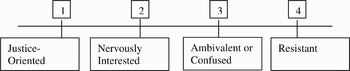
The size of my initial interview set and ethnographic data limits my ability to render sweeping conclusions at this stage.Footnote 12 I speculate, preliminarily, that a spectrum of positions reflecting MRC participants' perspectives on the political implications of their MRC activity exists, as represented in Figure 1. However, the most robust data so far collected captures the perspectives of people in positions 1 and 2, which I will illustrate through representative quotations and then link back to the three hypotheses.
Perspectives on political engagement as an outcome of the MRC.

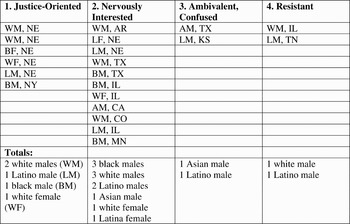
Participants were categorized on the spectrum based on a close analysis of individual perspective statements related to the bulleted items listed above, as well as other statements related to politics raised independently by participants. (For example, “I don't believe it is the church's place to address immigration policy,” would be a distinct individual statement in a larger transcript.) In some cases, individuals made comments consistent with more than one of the positions, but the dominant thrust of their perspectives generally revealed their primary position. The majority fell in the second position, nervously interested. A notable minority occupied the first, justice-oriented. Outliers expressed the third and fourth positions, which here I'll only summarize as “resistant” to political MRC approaches. Participants who articulated the first and fourth positions drew from clearly defined idea/belief frameworks to justify their viewpoints, whereas the remainder of subjects did not explain or elaborate their viewpoints through any particular framework. Figure 2 shows the breakdown of interviews by race, gender.
Race, gender, and state groupings.

JUSTICE-ORIENTED PARTICIPANTS
People in Position 1 clearly articulated the idea that at least a natural, and possibly a necessary, outcome of a healthy theologically grounded MRC should be some level of church-based political engagement in matters of racial and/or socio-economic equality. These participants expressed a significant variation on the “biblical mandate” described above. Their belief was that MRC-building entails a “call” to apply the gospel to social injustice, whether or not local church congregants have such issues on their radar. That call to engagement, they argued, legitimates church members' — or the church as a body's — advocacy or challenge of political policies, especially local policies, that impact race and class issues and is likely affect church members. Three of the advocates for the activist perspective were African-American and consciously drew from the African-American church tradition of civic engagement, consistent with Emerson and Smith's discussion of the distinct analytical and theological “tool kits” of blacks and whites. However, one white pastor (married to an African-American woman) and a multiracial contingent he brought with him also framed their mission in this light, challenging Hypothesis 3. These pastors were already engaged in “bridging social capital” forms of political engagement through their MRC.
Pastor B., who attended the national MRC conference, leads a church in a gentrifying neighborhood of New York City. His congregation used to be entirely African-American, but now is comprised of mostly Caribbean-Americans, African-Americans, “young white people,” and Latinos. He came to an MRC workshop series (his first time attending) to gather ideas and resources for leading his changing church, while recognizing that as a left-leaning pastor drawing from a “liberal” framework, he was a political minority at this particular conference:
I'm liberal. What that means for me is I have a deep concern for the poor and for the oppressed, and for those who have been left on the margins of society. I think the government should have a role in helping people have a strong leg up.
Pastor B. identified a host of social justice issues relevant to the church, including “racism, poverty, environmental issues, peace, housing, education; many things.” Such matters, he said in his interview, “are at the heart of the gospel; people can't be whole unless they have access to those things, and the gospel speaks very clearly to that.” Pastor B. maintained (against the MRC grain, he knew) that churches must find ways to engage in political topics, even if it involves conflict:
We have to have a prophetic voice that's not compromised by the political process, although I think the church needs to be engaged in the political process. We need to be bringing people together to have conversations and to have fights around these issues. The church can be a safe place for conflict and to push people toward power. Because I think it's important for poor and working people to have power. What that means for the churches is that we have to challenge those, nonviolently, who are in the corridors of power.
From this perspective, church-sponsored conversational space about potentially loaded issues is a path from religious bonding to bridging social capital.
The white justice-oriented pastor I interviewed at the same conference, Pastor J., who leads an MRC in Nebraska, voiced a similar interest in the church being willing to create safe space for “healthy discussion”:
Even though it's going to be very messy, the process of bringing together, let's say Democrats and Republicans to talk about issues, it can be very healthy if you see all the contributing pieces as being helpful to the ultimate solution, knowing that the solution is what you have to keep in your focus. But if you don't keep that solution in your focus, your process can get (too messy).
Pastor J. asserted that white evangelicals probably have a “steep learning curve” as far as being willing to take a social justice stand, so his organization seeks to create forums for helping them learn:
Right now I think the evangelical church as a general rule has not been very social justice oriented. And so the first step is, in this network we have in Omaha, we start with racial reconciliation. We call it “A journey from Reconciliation to Justice.” So it's this movement that starts with reconciliation, relationships, but gets to justice.
This pastor was explicitly attuned both to the fear of some pastors that outright politicization will split churches along racial lines, and to the reality that white and black evangelicals draw from different religious racial traditions. He nevertheless advocated for political engagements beyond the church:
You talk to black Christians, they want to talk about justice; you talk to white evangelicals, they want to talk about reconciliation. And so when I think about the church that we will be building … we will start taking real stands in the area of justice, in the area of change — which is real different from the white evangelical church.
Both Pastors B. and J. saw church-based engagements with political matters as something of a “no brainer,” in that, for them, political realities create social realities. In Pastor J.'s words, “We definitely wouldn't take a political stand (to support a political party), but we think it's important to talk about politics and race and to take on those issues … because it's life!”
At a regional MRC conference in Lancaster, Pennsylvania, a young African-American in his early 20s, Pastor D.H., led a workshop that advocated a Position 1 framework in the clearest terms I have heard any MRC participant use. In his talk, “From Behind the Curtains to Beyond the Front Porch,” this Associate Pastor of a small urban church in Pennsylvania urged participants to become “unofficial sociologists” — observers of what's happening in their local communities — and “unofficial theologians” who can interpret the relevance of the gospel in light of immediate sociological dynamics in their midst. Then, he urged, multiracial churches must engage on the ground. D.H. modeled this process for workshop participants, explicitly drawing from Divided by Faith and other academic literature to offer a structural analysis of social injustice in the United States, and then pairing scholarship with theological grounding. An MRC culture attuned to structural injustices, he argued,
means careful consideration for both organized and organic parts of our society that harm a segment of the community through their decisions. Regardless of whether it's done consciously, the decisions of the dominant culture can still harm those who are socially, politically, and economically powerless.
He used the examples of substandard schools in low-income neighborhoods, and communities of color being “terrorized by over-incarceration and police brutality.” He then suggested ways churches can “partner to influence justice in communities” — effectively, bridging social capital. For example, a Philadelphia church he works with partnered with other organizations to challenge Temple University's purchase of real estate in poor neighborhoods that effectively drove out low-income people. D.H. suggested that MRC pursue the “felt needs” of the local community, and use those as a bridge (in his words) to minister to other (spiritual) needs.
Because they felt passionate about a social justice mission and drew from a tangible framework to connect theology to that mission, people in Position 1 offered the clearest articulation of the relevance of politics to MRC-building. Most MRC participants did not express such clarity.
NERVOUSLY INTERESTED
In Position 2 were the majority of MRC participants I interviewed. They often saw the relevance of political engagement to the MRC, and noticed that as people learned about race, class, ethnicity, and the realities of each other's lives, the political obstacles people faced became more real and relevant. They then saw reasons for the church to become involved. For example, as one white pastor of a successful MRC in the south put it:
My (MRC-building framework) gives proper attention to the reason for doing this and that is for the gospel, not for social justice, social agenda, racial reconciliation. All those are wonderful by-products, if we get the mission right, and then reconcile with the churches, all that other stuff's gonna flow from that … I've got strong Republicans, strong Democrats (in my church), so I love them all, in the name of Christ. So I can't just come out and go, hey, we're all for Barack Obama, or we're all for this. And so then I have to step back and say, what in a positively constructive way, how can we begin to address situations of social justice, that being education, in a way that is really elevating conversation and not, um, taking a side, if you will, and making people think, “here's what we think.” (Pastor D., white male, Little Rock, AR)
Even as they leaned toward it, people in Position 2 were nevertheless simultaneously nervous about such kinds of engagement. Most commonly, they testified that nurturing “unity” across all kinds of difference in an MRC was already tough enough; to add the risky (high cost) topic of politics to the plate might just be too much. They worried about what it meant for church members as church members, or their church as a body, to talk about or “take a stand on” politics — especially on political party platforms or specific candidates. In other words, they worried about the costs of political discourse in the church to cross-racial bonding, at the level of interpersonal relationships. They did not simply fear their church losing its tax-exempt status (though some claimed to). They also feared that the pursuit of a “social justice agenda” risked moving Christians away from theology or “God's will for us,” and toward secular concerns. Some had trouble identifying what contemporary political structures or policies might be relevant to the MRC context. Others interpreted “structural” inequalities only in the context of church and denominational power structures, so they focused their “social justice” efforts on challenging those (mainly through the call to hire racially diverse leaders in MRC) and did not engage much beyond them. In short, Position 2 people tended to regard politics as a potentially dangerous realm, external and yet dangerous to the church and the new relationships MRC encourage and nurture.
Some representative expressions of these aspects of Position 2:
• For me to raise the (political) questions in the church right now … it's too much. Because they're all overwhelmed; they're mostly immigrants. We can't ask them to do any more (than they already do). But it's us becoming aware; how can we help? (White female, IL)
• I do think there's a danger about politics in the multiracial setting because it's so charged, and I just — personally I feel that our politics today have gotten so hostile to each other; both sides. And to bring that to a setting (race) where, you know, there's a history of being hostile and rude to each other … So you've got plenty of things, why bring in politics? (African-American male, TX)
• I'm concerned with the gospel being so tied into a political party that sometimes it dilutes the impact of what the gospel is about … I think there are issues that are far more important than political issues. (Korean American male, CA)
• (Social justice) is part of, you know, what — at least in terms of practical applications, what the gospel is supposed to do. I think the problem has been, among evangelicals, when you combine social justice with the gospel that becomes the gospel. In other words, the whole liberalism, the reason that became — people shied away from those issues because social justice issues ate up the church. (Asian male, TX)
This last idea that “social justice issues ate up the church,” was an undercurrent that occasionally surfaced in interviews with white and Asian-MRC participants. It seemed to refer to the notion that the Civil Rights tradition eventually led some Christians (primarily blacks, but the reference likely also included liberal/mainline whites) away from theological commitments these critics believed should have remained central. No interviewees were more explicit than that, but when the idea was also subtly raised in lectures it was never challenged. This idea linked up with worries that the MRC movement should not veer into dangerous (that is secular political) territory. Unlike the Position 1 stance, people in Position 2 did not model their movement after the Civil Rights Movement; they saw it as more spiritually, less politically focused. Although they explicitly acknowledged churches “standing up for justice” as morally right and appropriate to “that (earlier) time,” they did not, for the most part, identify material inequalities that might merit the same degree or tenor of politicized, faith-based response today.
Another idea that surfaced repeatedly from people in Position 2 is that politics should not be a primary focus of MRC efforts because racial/social change will be a “natural” outcome of successful MRC culture. This viewpoint, consistent with the main biblical mandate idea, had two variations: (1) successful MRC “model” structural transformation for the outside world through churches socially integrated from top to bottom; or (2) as people experience the “new culture” of successful MRC community, they build cross-cultural relationships that help them recognize the necessity of social change and get involved in such efforts (beyond the church). The underpinning of these viewpoints is that true social change will only happen through relationships, and that truly “reconciling” relationships will only come from a Christian perspective — all of which is consistent with the relational orientation Emerson and Smith identified with a white evangelical perspective on race. Thus, Position 2 people ask, why should MRC participants put so much energy into political engagement when they're already pursuing a deeper model that will have a greater impact in the long run? It's not that these respondents are entirely resistant to politicized social change efforts as an outgrowth of the MRC; they're just not convinced that the daunting challenges entailed are worth the risk when the church is creating change anyway.
Despite their nervousness, people in Position 2 did often identify individual issues, or sets of issues, they could imagine multiracial churches politically engaging around. They tended to recognize these issues through sympathy with the local experiences of members of their churches. People from MRC with congregants of diverse national origins frequently named immigration policy as an issue they could see their church possibly taking a stand on. As a white female pastor of an immigrant-filled MRC in Chicago put it,
I'm not sure how to (address immigration policy). But more and more I interact with people who are going through struggles with their visas, and there's a HUGE injustice, not only in our system, but in the way their (countries of origin) handle them, to help them or to hinder them … That's an issue on our table: What's our next step?
Another white pastor said that after leading his MRC for a couple of years he became attuned to the racial inequalities in death penalty policy and ultimately decided to participate on a panel of mostly “liberal” pastors to discuss the churches advocating for change. Others registered increasing awareness of how health care policy, public education, institutionalized racism, and racial profiling impacted members of their MRC communities. While many weren't sure how their church could begin to address these issues, they expressed interest in doing so.
RESISTANT
As only four interview transcripts fit squarely into Positions 3 or 4, I will only briefly review what I speculate to be distinctive perspectives relative to other MRC participants. Position 3 participants expressed deeper ambivalence or confusion about the potential connections between MRC efforts and politics than those in Position 2. They either saw politics as a suspicious or dangerous arena for the church to involve itself with, or didn't see why politics would be relevant to MRC efforts. Position 4 articulated outright resistance to any kind of church-based political activism, either because it detracted from the MRC mission or because it would be a futile pathway to change. Three of these four of politically “resistant” participants were Latino or Asian; one was white. The Latinos expressed particular attention of the dangers of churches becoming politicized if they contained undocumented or otherwise politically vulnerable immigrant members. This racial diversity of resistant perspectives may indicate ways that more attention to evangelical racial “tool kits” of racial groups outside the black/white binary is needed.
DISCUSSION
Consistent with the first hypothesis, many MRC participants (in Positions 2–4) seemed to lack a clear framework through which they could comfortably link their MRC-building efforts to issues they regard as “overtly” political without feeling that their social bonds would be threatened. Race alone, however, does not seem determinative of avoidance of a political orientation toward race (Hypothesis 1) or an embrace of a faith-based racial politics (Hypothesis 2). People most inclined toward investment in some sort of on-the-ground engagement with issues they defined as having political aspects were, consistent with Hypothesis 3, African-Americans raised in the black church tradition. However, other African-Americans interviewed fell in Positions 2 or 3, and some activist-leaning folks were non-African-American. Those who did tap into social change oriented frameworks weren't particularly worried about people being uncomfortable or the danger of crossing some minefield between church and state. In otherwise, rather than focusing on the “cost” to bonding, they saw more politicized, bridging pursuits of racial justice as a means to increased bonding as Christians. But without such a framework for bridging social capital, other MRC participants expressed anxiety about such things.
Regarding Hypothesis 2, the question of whether the kindred outsider identity of MRC participants relative to the (mono-ethnic) evangelical mainstream would lead some to embrace a more politicized advocacy of racial justice with the MRC mission, interviews supported this for people in both Position 1 and Position 2. Issues that arise organically from within the congregation, such as immigration policy, generated the most interest in bridging to some kind of political activity, and participants (especially in Position 2) did articulate that their MRC brought such issues to their awareness for the first time.
But the ability to recognize structural and systemic inequalities as a result of participation in an MRC does not automatically give people the resources to engage such issues outside of already familiar church-based approaches. Multiracial churches can and do staff homeless shelters, organize food drives, and challenge individual racism when they see it — all forms of bonding-based civic engagement. They also regard such efforts as promoting a vision of social change, which they can do. But if getting to know and learning to trust racially or ethnically different fellow church members is challenging enough, trying to find a safe forum to even broach political topics among them feels overwhelming and perhaps unnecessary (Hypothesis 1). Despite their convictions about creating deeply multiracial communities in which power and leadership are equitably shared, most MRC participants were wary of the potential cost of moving church culture — organized church activity — across the political line. This seemed to be either because they lacked a clear framework for bridging social capital, or because they espoused a biblical mandate concept that prioritized the religious mission (converting others) over a secular mission (fighting for justice/equality).
Emerson and Smith's racial tool kits analysis (Hypothesis 3) was, at best, unevenly represented in these interviews. People of color often expressed more awareness than whites of structural inequalities on the ground, for instance in the realms of public education, racial profiling, health care policy, and immigration policy, and could readily identify such issues as relevant to their church's mission when prompted. But that did not mean they were ready to advocate for their church to get involved, or to try to direct the church's priorities. Some folks of color, particularly Latinos and Asians, were often more resistant to the church engaging in these issues than their white or black counterparts were. Especially if they were connected to immigrant communities, they may have believed that the risks were too high. Again, the degree to which people were willing to “take on” the high risk of political engagement at the MRC church level seemed to depend on the belief framework they embraced.
CONCLUSION
This study is only a preliminary examination of political (or pre-political) dynamics in MRC settings. Further research is needed in a number of areas. Opinion surveys examining whether MRC participants' opinions on race-related policy matters change over time could better reflect whether MRC culture increases the likelihood of churches bridging social capital in political ways. It will also be helpful to know whether, when bonding increases as MRC become more successful, individuals feel safer raising the kinds of political issues they raised in interviews in their churches. We also need to know more about what avenues activist MRC are pursuing in terms of their political activity, what reactions they get from other MRC, and whether they feel comfortable in the conservative evangelical movement.
Overall, these findings suggest that more than one paradigm of race-related social change exists inside the MRC movement, leading to a possible spectrum of political orientations among participants. The movement as a whole, at least as reflected by the books, lecturers, and conferences it is producing, still seems to advocate diversity and social change in the Christian community through a theological and cultural framework of relationalism; this is a model of building personal relationships across forms of difference that have historically (and “sinfully”) divided the Church. While the majority of people I interviewed largely mirrored this perspective, they also saw a more political orientation to race issues as relevant, although perhaps dangerous. Others embraced MRC-building as part of a larger social justice mission, which they saw as relevant to the church.
These varying orientations may shed light not only on the different kinds of social networks developing within the MRC movement, but also on the potential tensions, clashes, and opportunities gestating in diverse evangelical communities. It is possible that the more justice-oriented actors in the movement will continue to articulate, and begin to execute, a biblical mandate mission for more politicized forms of engagement related to race and class policy issues, such as immigration and police profiling. As we have seen, MRC forums, particularly “how to” books and teaching venues, are beginning to include informed discussions of how structural and systemic realities influence dynamics of race and ethnicity, and to contextualize the MRC movement in terms of “justice.” Such conversations open a path, which a few leaders are pursuing, to forms of faith-based political engagement, particularly local activity, as outcomes of the MRC framework. Some may resist that path as dangerous or irrelevant.
The MRC participants identified here as nervously interested have opportunities to choose either path, but it seems possible that as more churches make good on their intent of creating truly multiracial, multiethnic, and/or multilingual congregations, they will begin to more clearly identify how racial and other inequalities impact their own members, and ask for the church to have a more public voice in such matters. Justice-oriented participants in the MRC movement seem to be chomping at the bit to apply their MRC mission to the real political world. Time will tell if these activist churches influence their more world-weary counterparts to activities that help them use their MRC mission to bridge social capital, or whether fears that politicization will “eat up the church” will rule the day.