1 Introduction
Diagnosis-related groups (DRGs), as a case-based funding system, have become the principal means of hospital payments in most countries (Busse et al., Reference Busse, Geissler, Aaviksoo, Cots, Häkkinen, Kobel, Mateus, Zeynep, O’Reilly, Serdén, Street, Swan Tan and Quentin2013). DRGs basically serve two main purposes: first, DRGs should give insight in the provision of health services in hospitals; second, DRG-based payment systems arguably provide incentives for the efficient use of resources within hospitals by paying hospitals on the basis of the number and type of cases treated (Busse et al., Reference Busse, Geissler, Aaviksoo, Cots, Häkkinen, Kobel, Mateus, Zeynep, O’Reilly, Serdén, Street, Swan Tan and Quentin2013; Tan et al., Reference Tan, Geissler, Serdén, Heurgren, van Ineveld, Redekop and Hakkaart-van Roijen2014b). National DRG systems, however, play different roles in hospital remuneration, reflecting institutionalised finance schemes and national policy goals (Tan et al., Reference Tan, Geissler, Serdén, Heurgren, van Ineveld, Redekop and Hakkaart-van Roijen2014b). The Netherlands, on which this study is based, has adopted the diagnosis treatment combinations (DTCs) system, which differs from most other national DRG systems in the sense that DTCs include outpatient care and entail a separate fee for medical specialists (Kerpershoek et al., Reference Kerpershoek, Groenleer and de Bruijn2016). The system was introduced in the wake of a major health care reform in the mid-2000s, shifting from a fixed hospital payment system to an internal market of competing hospitals and health insurers (Helderman et al., Reference Helderman, Schut, van der Grinten and van de Ven2005). DTCs act as a key mechanism for the (regulated) Dutch health care market as they provide insight in the costs of health services (‘products’) in hospitals.
In the Netherlands, as in other countries using DRGs, upcoding is a major policy concern. Upcoding encompasses the strategic behaviour of health care providers of shifting the DRG to another, yielding a higher payment (Steinbusch et al., Reference Steinbusch, Oostenbrink, Zuurbier and Schaepkens2007; Barros and Braun, Reference Barros and Braun2016). This inflated production ‘on paper’ – and not in the real world – is also referred to as ‘DRG-creep’ (Simborg, Reference Simborg1981; Silverman and Skinner, Reference Silverman and Skinner2004). A growing body of academic literature discusses this DRG-creep. In a recent publication, Barros and Braun (Reference Barros and Braun2016) review the literature on DRGs and upcoding. They reveal how in both private markets and National Health Service systems DRGs embark on providers’ behaviour; higher prices generate higher manipulative efforts and higher outputs for the more lucrative clinical treatments. In a similar vein, other studies show how changes in reimbursement affect treatment episodes, increasing the number of hospital admissions when reimbursement is increased (cf. Januleviciute et al., Reference Januleviciute, Askilden, Kaarboe, Siciliani and Sutton2016; Melberg et al., Reference Melberg, Beck Olsen and Pedersen2016). These studies have in common a strong focus on providers’ behaviours and outcomes, highlighting providers’ strategic behaviour while leaving unnoticed the underlying metrics that make up the payments system and set into motion certain reimbursement behaviours.
In this paper, we aim to open up the technical ‘black box’ of the Dutch DTC system by unpacking the so-called grouper – an algorithm that determines a billable care product for a patient based on the characteristics of the provided treatment. Although the grouper is not black boxed in the sense that its decision-making features are rendered invisible or remain hidden from practitioners and health care executives, we argue that its algorithmic nature makes reimbursing a highly technical endeavour that not only happens outside the direct control of physicians but also yields governing features that may impact decision-making and reimbursement. Grouper software has been introduced in the Netherlands (as well as in other countries, yet with different decision rules due to variations in national systems) to standardise and facilitate hospital payments and to reduce the opportunities for upcoding, aiming for more ‘outside’ control on hospital payments. Physicians and hospital administrators, however, have stated that the grouper software has rendered the payment process too complex and error-sensitive, leading to remuneration errors and subsequent loss of income (van Erp et al., Reference van Erp, Wallenburg and Bal2018). In this paper, we unpack the Dutch grouper system to gain insight into the incentives and possibilities for ‘creative bookkeeping’, as well as risks of income loss for both health insurers and health care providers in the Dutch grouper system. That is, we are interested in the technical particularities of the Dutch grouper software that may guide coding behaviour or affect remuneration in unexpected ways. The following questions guide this paper: Which incentives and risks for upcoding and income loss are embedded in the technical features of the DTC system, and what coding behaviour may these technical features produce?
The paper proceeds as follows. Section 2 provides a background account of the Dutch health care system, briefly outlining the origins and design of its DTC system and the discussions surrounding it. Section 3 explains our methodological approach in researching the grouper algorithm and the effects it produces. Section 4 describes the results, both outlining the technical features of the grouper system and the incentives and opportunities for creative bookkeeping. Furthermore, some evidence is provided on how hospitals in the Netherlands respond to the incentives embedded in the grouper system. The paper ends with a critical reflection on the current DTC system and suggestions for further research in this area.
2 The Dutch DTC system
The DTC system, the Dutch version of the DRG, was introduced in the wake of the introduction of an internal market in 2005. While in other countries (e.g. the United States, Austria, Germany) DRGs were mainly introduced to curb costs, in the Netherlands the DTC system pursued the aim of an internal market as it enabled health insurer–hospital negotiations to take place over a ‘packaged’ version of care, and provided an infrastructure for hospital competition. Furthermore, DTCs create a stronger link between funding and performance, fostering hospital efficiency (cf. Oostenbrink and Rutten, Reference Oostenbrink and Rutten2006; van der Ven and Schut, Reference van der Ven and Schut2009). The DTC system serves as a classification and reimbursement scheme, assigning prices to predefined care products. Driven by negotiations with the medical associations, and very much reflecting a professional rather than an administrative logic, over 30,000 different DTCs were created. As this was unworkable in actual negotiations between hospitals and insurers though, only ~200 were actively used in practice (Bal and Zuiderent-Jerak, Reference Bal and Zuiderent-Jerak2011). Initially, most prices were set by the Dutch Healthcare Authority (Nederlandse Zorgautoriteit, NZa). From 2005 onwards, freely negotiable prices have expanded stepwise to 70% in 2013.Footnote 1
In 2012, as a result of increasing dissatisfaction with the complexity of the created system, the DTC/DOT system was introduced. DOT literarily means ‘DTCs on their way to transparency’, exemplifying that the DTCs had not lived up to their transparency expectations. The transition encompassed a sharp reduction of the number of DTCs (from over 30,000 to ~5000), a shift to the International Classification of Diseases-10 coding scheme to bring DTCs in line with, and enable, international exchange of data. Furthermore, a web-based grouper system was introduced to calculate billable care products, also used in many other countries (albeit with different decision rules). The grouper uses information on diagnosis, as well as the health services provided to a patient, coded by a physician, clinical psychologists, advanced nurse practitioners and/or physician assistants (as these are the authorised vocational groups) in the hospital coding system (usually an electronic patient record, which feeds into the grouper software). As we will show in more detail below, ‘misfits’ between the diagnosis and subsequent coded health services, and coding by unauthorised professionals, can lead to an outfall of DRGs, and hence loss on hospital income. The Dutch Healthcare Authority (NZa) is the regulating authority, stipulating rules and signalling possible cases of upcoding or fraudulent behaviour. In addition, health insurers control the billings sent in by the hospitals. Hence, the introduction of the DTC/DOT system, and with that the grouper, not so much changed the nature of hospital billing but changed the system of billing and reimbursement, as well as the knowledge and instruments needed for doing so, bringing in new incentives and governing instruments (van Erp et al., Reference van Erp, Wallenburg and Bal2018).
Grouper software functions in a political environment in which cost containment, fraud and practice variation are high on the public agenda. Since the introduction of the internal market, costs for hospital care have increased sharply, especially for elective treatments. Moreover, upcoding, practice variation and a lack of transparency of the DTC (and later, the DOT) system have sparked public debate on the extent to which providers and professionals use the system to further their own interest. The latter debates have led to a series of measures from the regulator – including tighter controls and training programmes for DTC specialists. To contain costs, moreover, the Ministry of Health has negotiated an ‘administrative agreement’ with providers and insurers, including a maximum growth percentage for hospital care. As a result, upcoding not only has become more difficult, the incentives to do so have also changed as more income for the hospitals or medical specialists will be met with budget cuts to stay within the negotiated growth percentage – although different specialist groups in a hospital can have diverging interests here depending on the distribution of the budget within the hospital. Grouper software is embedded within these political debates and measures and is supposed to sustain correct care coding. At the same time, however, there are many complaints about the technical specificities of the grouper system, which is said to be opaque to health practitioners and patients (Wester, Reference Wester2016). Unpacking the grouper, as we attempt to do in this paper, can thus help to gain more insight in how actors in health care practice can use the system, and how it is used in practice. In a way, our study can thus also be seen as an empirical analysis of a care classification system and the political consequences of classifying, in which we deconstruct the incentives within the classification scheme (cf. Bowker & Star, Reference Bowker and Star1999).
2.1 The Dutch grouper
Coding and billing of health services encapsulates a complex technical process in which a treatment trajectory is coded by assigned health care providers. A treatment trajectory encodes information about a patient and clinical treatment: the applicable medical speciality, the patient’s diagnosis, the health care activities provided and some other characteristics like age. The diagnosis code contains the code of the medical speciality. For practical purposes, we can consider a treatment trajectory to consist of diagnosis plus health care activities. However, the amount of final remuneration (‘charges’) is set by the health care provider in negotiation with the health insurer, with the exception of the charges (‘fixed prices’) of some products set by the Dutch Healthcare Authority (which encompasses 30% of the volume, as pointed out above).
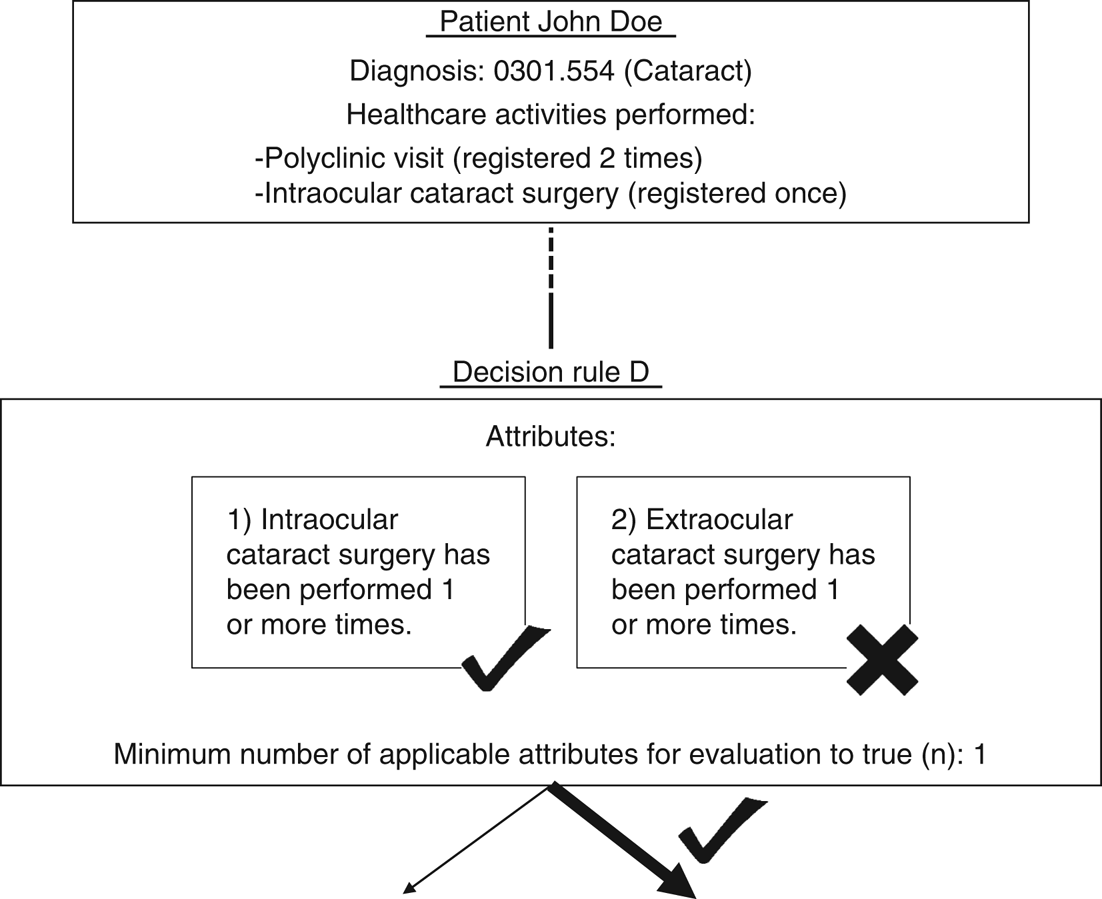
To determine the amount of remuneration the health care provider receives in the DTC/DOT system, the treatment trajectory is taken through a large formal (software-based) decision tree – the grouper. The grouper consists of thousands of decision rules, each evaluating to either true or false, and by traversing these decision rules a care product is defined and determined. A decision rule in the tree tests for one or more attributes of the treatment trajectory. Such an attribute describes a property of the treatment trajectory. The most common attributes relate to (1) the medical speciality treating the patient; (2) the patient’s diagnosis; and (3) a subset of health care activities, of which a certain number must have been performed on a patient to evaluate to true. For each decision rule, there is additionally a number (n), such that the decision rule evaluates to true for a treatment trajectory if and only if at least n of the attributes are applicable to this treatment trajectory. To illustrate the grouper’s decision rules’ systematics, Figure 1 shows an (excerpt of an) example of a decision rule and how it is evaluated.
An example decision rule and patient. Note: To test the decision rule, the grouper goes through its attributes one by one. Attribute 1 is applicable, attribute 2 is not because no extraocular cataract surgery has been performed. Hence, we have one applicable attribute, and 1≥n, so the decision rule as a whole evaluates as ‘true’.

One further detail to note is that the grouper is divided in two levels. The first level is the ‘top-tree’, which determines the care product group (ZPG, zorgproductgroep) to which the treatment trajectory belongs. Each ZPG in turn has another decision tree, which is used to determine the exact care product (ZP, zorgproduct). For every care product, the remuneration received by the health care provider is fixed, although for different health care providers the remuneration for a particular care product need not necessarily be the same as charges depend on the outcomes of negotiations between an insurer and a health care provider.
3 Methods
The results described in this paper are generated from two data sources: a digital version of the grouper and a large database of treatment trajectories. The structure of the grouper is freely available. The database contains codes from different health care providers, covering multiple health insurance providers, and different years, and is managed by Intelligence to Integrity (i2i), a Dutch health care data analytics firm where the first and third authors were based during the study. The methods we describe in this section were implemented as scripts/programs in different programming languages (Haskell, Python, SQL).
Our analysis consists of three parts in which we unravel and ‘test’ the grouper system: (1) estimation of health care activity charges, (2) simulating the effects of changes in coding and (3) investigating actual coding behaviour. The results of (1) and (2) are used to accomplish (3). As stated above, the overall goal of this paper is to investigate the sensitivities of the grouper system that may lead to adaptations in coding behaviour, changes in diagnosis or changes in the set of health care activities in a treatment trajectory.
3.1 Cost estimation of health care activities
The first step in our approach is calculating approximately how much it costs to change a treatment profile. Changing the diagnosis is without cost, but performing more or fewer health care activities (so, not only changing the coding administratively only, but actually adapting the clinical treatment to pursue a certain code) increases or reduces the cost of a treatment profile. Hence, we need to know the approximate cost of a particular health care activity or a set of activities. This section describes how we estimate these costs.
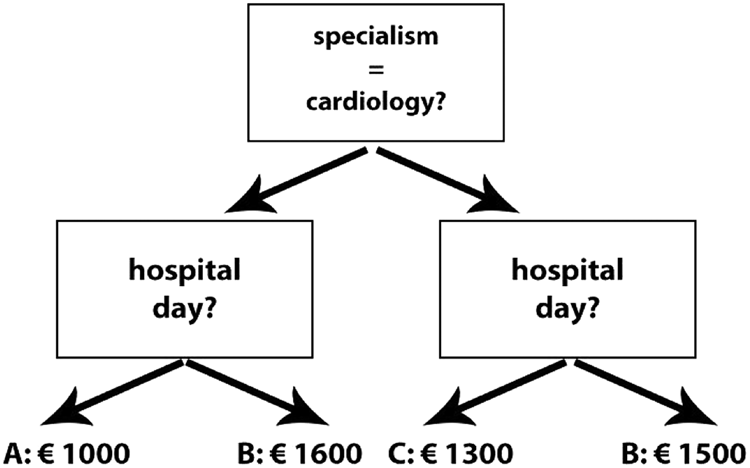
As was described earlier, the amount of remuneration received by a health care provider is determined by traversing the grouper decision tree, rather than calculated as a sum of charges for the components of the treatment trajectory. This can be illustrated with the hypothetical decision tree in Figure 2 (clearly this is only for illustration; it is too small to be meaningful).
Illustrating the difficulty with determining prices. Note: When a decision rule holds, the decision is made to the right.

Suppose we have the following treatment trajectories (TTs):
∙ TT i: specialism non-cardiology
∙ TT ii: specialism cardiology
∙ TT i+: specialism non-cardiology + hospital day
∙ TT ii+: specialism cardiology + hospital day
In this hypothetical case, adding a hospital day to TT i results in €600 extra remuneration, while adding a hospital day to TT ii results in €200 extra remuneration, even though it is supposedly the same activity. In fact, TT i and TT ii differ only in specialism but also differ by €300 in remuneration. There is not even a guarantee that for any such tree care product B would be more valuable than care product A, even though it is clearly more expensive for the health care provider to provide, which is also described elsewhere, pointing at the problematic relationship between cost accounting and ‘real’ costs (Tan et al., Reference Tan, Boumans and Hakkaart2014a). This tree is hypothetical, yet these kinds of issues can be seen in the real grouper as well.
Because of the structure of the grouper, it is not straightforward to estimate the costs of individual health care activities. Still, we can assume that in the DOT system the aim is to on average reward health care providers in accordance with work performed. So, for a certain care product, the cost of the average treatment trajectory should be approximately equal to the compensation received. This is what motivates the health care activity cost model that we describe next. There are a number of steps involved, which we describe in order.
3.1.1 Clustering health care activities
There are around 4000 different health care activities in the DTC/DOT system, and to estimate a charge for each specific health care activity is quite error-prone, not least because many are uncommon. For this reason, our first step is to simplify the model. One can expect that if a certain health care activity is significantly more or less expensive than another, these two health care activities will be treated differently in the grouper, and hence result in different reimbursement. However, there are many health care activities that are treated identically in the grouper: for a combination of two health care activities, it can (and often does) occur that when an attribute relates to one of the two it also relates to the other. If health care activities are in this sense indistinguishable, they are clustered together in healthcare activity (HA) clusters, and instead of estimating the cost of each health care activity separately we assume that health care activities in such a HA cluster have the same cost. By performing this simplification, while starting off with ~4000 health care activities, only ~1200 HA clusters remain. This makes the cost estimation much more tractable. The assumption made for this simplification does affect our results as health care activities in the same HA cluster are forced to have the same price, but we believe this assumption is reasonable.
3.1.2 Health care activity cost estimation
We model the cost of a treatment trajectory exactly as the sum of the costs of its constituent health care activities. We assume that on average the treatment trajectory price is equal to the care product remuneration defined by the grouper. We know that on a case-by-case basis this does not hold – treatment trajectories that differ in the health care activities they contain can end up in the same care product – but by assuming on average we can use this to estimate health care activity costs. Formally we can state this model as follows:
 $$P_{{{\rm TT}}} {\equals}\Sigma _{{{\rm HA}}} {\rm }N_{{{\rm HA}}} \cdot P_{{\rm C}},$$
where  $P_{{{\rm TT}}} $
is the cost of the treatment trajectory,
 $N_{{{\rm HA}}} $
is the number of times a given health care activity has been performed in this treatment trajectory and
 $P_{{\rm C}} $
is the price of the health care activity in the corresponding HA cluster as described above.
This leads to the following linear model:
 $$Ax{\plus}\epsilon {\equals}y,$$
where A is the matrix of codes (each row represents a treatment trajectory, each column an HA cluster), x the vector describing the price assigned to each HA cluster (this is what we will estimate),  ${\epsilon}$
the error term (because our assumption is that it is true on average, but we already know case-by-case it does not hold) and y the vector describing the compensation received for the care product assigned to that particular treatment trajectory. This is essentially a least-squares model, which can be solved for x such that
 $\,\mid{\epsilon}\mid\,_{2} $
is minimised (so
 $\,\mid{\epsilon}\mid\,_{2} $
is the cost function). We impose the additional requirement that every element of x is non-negative (the cost of performing a health care activity is always>0). This makes it a non-negative least squares problem.
3.2 Sensitivity to changes in treatment trajectory
As described, there are two main components to a treatment trajectory: a diagnosis and a number of health care activities. Therefore, there are two main ways in which a treatment trajectory can be ‘mutated’: by changing the diagnosis or by changing the set of health care activities – that is, performing an extra health care activity or avoiding to perform a certain health care activity (or even just avoiding to code it).
Because the number of possible treatment trajectories is infinite, it does not make sense to simply try every possible treatment trajectory. However, we had access to a database containing millions of actual treatment trajectories. By using actual coding as the basis for the simulation, the results are automatically focused on coding behaviour that can be expected (or, indeed, seen) to occur, and less on behaviour that is in theory possible, but improbable.
To generate our data, we systematically simulated each of the ‘mutation’ approaches described above on every unique treatment trajectory in our database, keeping track of how the change affected the resulting care product. To limit our search space, we confined our investigations to care products in the same ZPG as the original treatment trajectory: this roughly corresponds to assuming that there is no freedom to change the medical speciality in which a patient is treated, which actually is in line with what would be realistic coding behaviour by a health care provider.
3.2.1 Altering the registered diagnosis
For each ZPG, we simulated the effect of coding different diagnoses that can be attached to a treatment trajectory. For a health care provider, changing the diagnosis would be a purely administrative action, and in fact it is not uncommon that a diagnosis is coded not at the start but at the end of a patient’s treatment, or that codes are changed at some point during treatment. Whilst one may object that it is not reasonable to consider all diagnoses, in fact practice shows that wildly different diagnoses do sometimes end up in coding compared with the actual medical diagnosis (Kerpershoek, Reference Kerpershoek2015), and, additionally, that our purpose is not just to inspect which diagnoses could be reasonably switched, but also to investigate the internal consistency of the grouper framework. If we find that two treatment trajectories, differing only in diagnosis, result in vastly different compensations, this indicates a potential problem with the system because it incentivises strategic coding, and it could be considered unfair if the same work package results in different remuneration for different specialities.
3.2.2 Adding and removing health care activities
We also simulated the effect of adding and removing health care activities. Given a treatment trajectory from our database, for each of the health care activities registered in the treatment trajectory, we simulated the effect on remuneration by dropping a certain health care activity (i.e. either not coding or not performing it). In addition, for any health care activity that is relevant to the current ZPG (i.e. that occurs in a decision rule somewhere in the sub-tree), we simulated the effect of adding it to the treatment trajectory. This allows us to inspect the sensitivity of care product determination to the choice of treatment.
3.3 Investigating actual coding behaviour
With estimated health care activity prices available, and information on the effect of modifying treatment trajectories, we can check actual coding data to see if the incentives affect behaviour. To do this, we use results from both of the previous two research steps. We find care products between which there is a certain mobility – that is groups of care products where we know that we can steer the outcome of the grouper for a treatment trajectory by modifying it a bit (e.g. by using different diagnoses). Then, for different health care providers, we can consider the coding distributions between these care products. We can find outliers by comparing these individual distributions to market averages. If we then see that these outliers are significantly different, this may lead to further investigation (Taal and Rypkema, Reference Taal and Rypkema2014).
It is important to note, however, that if we observe differences in coding, this does not necessarily mean that a health care provider is fraudulent – it might also have a different coding profile because of specialisation or other types of practice variation. For example, there are many smaller clinics in the Netherlands specialising in certain procedures, and in this case larger numbers of coding in their specialisation procedures are to be expected.
4 Results
This section presents some of our findings. The structure of this section is the same as the previous one, presenting the health care activity cost estimation results first, followed by observed sensitivity to changes in treatment trajectory and finally some results of actual coding behaviour.
4.1 Health care activity cost estimation
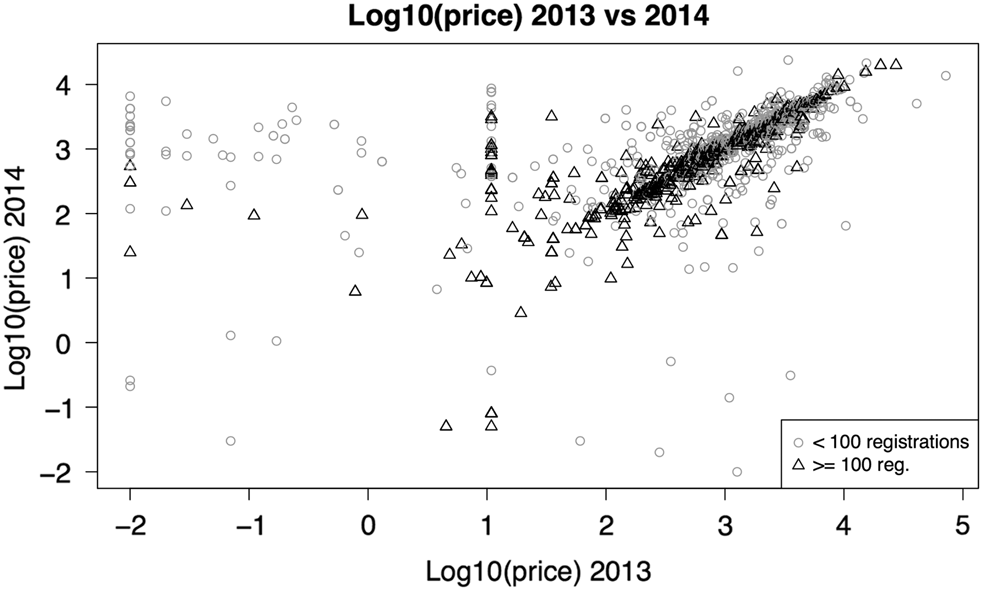
As actual costs are unknown, we cannot test if our model is successful on this basis. Something we can do, however, is investigate the consistency of our model over time. Although the structure of the grouper system changes from one year to the next, the way most health care activities are coded stays the same, or almost the same (sometimes from one year to the next a number of health care activities are grouped together, or split up, but many of them either stay the same – even keeping the same code – or only the code is changed). If we can match health care activities between years, and show that the estimates of the charges are consistent, this provides some confidence that the model performs well. Figure 3 illustrates such a comparison for 2013 and 2014, where an attempt has been made to match health care activities between these years. Note that such a matching is for a large part done manually, and there might still be small differences between health care activities that have been matched, which affect the presented results.
The logarithm is taken because prices can differ in various orders of magnitude. Note: Black points represent health care activities that occur in more than 100 treatment trajectories, grey points represent health care activities occurring in fewer than 100 treatment trajectories. Health care activities with an estimate of 0 in either year are not displayed.

The range of price estimates displayed in Figure 3 is quite wide (as is expected: compare the price of a consult to that of a stem-cell transplant). Overall, the observations do tend to group around the diagonal (indicating similar estimates for 2013 and 2014), which means that the results are fairly consistent from year to year, yet there are quite some outliers. Still, when we investigate these outliers a bit more thoroughly, it turns out that these are often uncommon health care activities, as can also be seen in the figure: price estimates for common health care activities are more stable than those for uncommon ones, as is to be expected.
To quantify the consistency between the two years, we can use the values estimated for 2013 as predictors for the values in 2014, and calculate the coefficient of determination ( $R^{2} $
) for an indication of the agreement between the estimates (if
 $R^{2} $
=0 the predictor has no predictive value, if
 $R^{2} $
=1 it is perfect). If we consider all health care activities,
 $R^{2} $
=0.487, which is not very high. If we limit the estimates to health care activities with>100 codes,
 $R^{2} $
=0.779, which is clearly a big improvement. Therefore, it can be concluded that for more common health care activities the price estimates are fairly consistent.
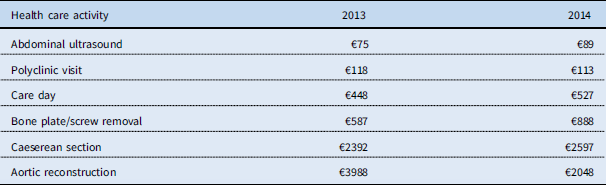
Finally, it is interesting to inspect the estimated prices. Table 1 shows some example price estimates of relatively common clinical treatments. As mentioned before, there is no base truth we can compare these prices to, and for less common procedures the estimates vary more than those displayed here. When using these results for subsequent analyses, we limit the use of data to common procedures where the prices estimated in 2013 and 2014 are relatively consistent, and we keep in mind that the error of a particular estimate could well be an order of magnitude. Still, with prices ranging over several orders of magnitude, this can give a good impression of approximately how expensive a certain health care activity is to perform: if the addition of a health care activity results in €1000 or more remuneration, it does not matter if the cost of the health care activity is €10 or €100. By verifying that prices are more or less consistent across different years, we can convince ourselves that the prices are usable at least as an order of magnitude indication of the real cost.
Some example price estimates as output by the model

4.2 Sensitivity to changes in treatment trajectory
The output of this analysis is essentially a large table with the following four pieces of information for every simulation: a treatment trajectory identifier, the original care product, the applied modification (either to diagnosis or coded health care activities) and the resulting alternative care product. By itself this is not very interesting to display in this paper, but there are a number of derivative analyses that can be performed.
Something we can do with the full data set is to quantify the financial risk on the side of the health insurers given possible changes. We can look at all coded treatment trajectories, and choose the optimal diagnosis to label it in terms of remuneration. By comparing the maximum possible remuneration with the actual remuneration, we can quantify the sensitivity of the grouper to creative coding. We did this for every treatment trajectory in the database for 2014 for one health insurer, and calculated that the amount of extra money that would have to be turned out would be €575 million. This is a more than 10% increase of the amount turned out in 2014 by this health insurer. To put it differently, if all medical professionals would have changed their coding to choose the diagnosis for maximum return, this health insurer would have had to fund €575 million more in 2014 (without any extra health care activities performed) than they have actually done. We can use the same approach to calculate what would happen if coding was optimised for minimal return. In this case, €331 million less would have been funded by this particular health insurer (a more than 5% decrease).
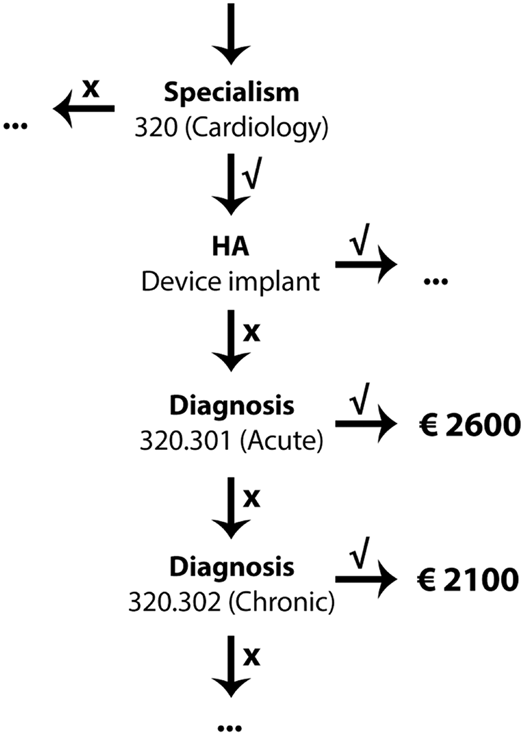
As one example of a situation where a diagnosis can be changed for a higher reward, consider the situation depicted in Figure 4. We consider a patient with heart failure, who has been admitted to the hospital for 1–5 days. By changing the diagnosis from chronic heart failure to acute heart failure (a purely administrative procedure), the health care provider receives €500 more. The difference makes sense: acute treatment requires more expensive logistics than treatment that can be planned, even though technically the treatment might be the same. However, for the administrative system it is very hard to check if a case was actually acute, because also chronic heart failure patients may go through acute episodes, so in this case it is easy to ‘game’ the system.
Simplified decision procedure assuming a patient with heart failure who has received one to five care days. Note: A checkmark indicates the next step when the decision rule evaluates to true, a cross indicates the next step when it evaluates to false. Changing the diagnosis from chronic to acute results in higher remuneration, with no further requirements.

Something that was very surprising to encounter in the data is that in some cases a health care provider receives less compensation after performing an extra health care activity. For example, in the 2014 grouper there are the care products 029099009 and 029099056 (both relate to malign neoplasms in the respiratory system), where it can occur that if a health care provider provides chemotherapy to a patient (health care activity 039141) the health care provider actually receives several thousand euros less than if the provider did not provide chemotherapy. Such instances are rare, but certainly surprising and worth further exploration.
4.3 Investigating actual coding behaviour
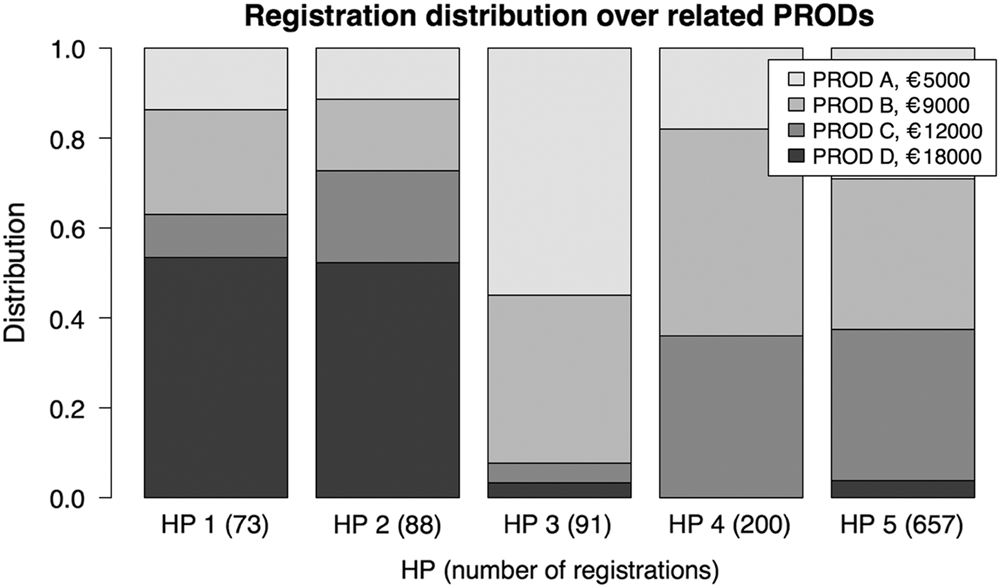
As described in Section 3.3, we check for differences in coding behaviour by finding groups of care products where treatment trajectories can be easily modified to change from one care product to another. For one such group, results are visualised in Figure 5.Footnote 2 For the particular care products displayed in this figure, prices vary because the diagnoses leading to them describe a degree of severity. It is therefore up to the health care provider to determine for each patient how severe the diagnosis actually is. Clearly, the distribution of codes is very different from one health care provider to the next. As mentioned before, this could indicate that there is a difference in specialisation, but it is certainly worth investigating what causes the differences, because it could also indicate strategic coding.
Distribution of product (PROD) registration for five health care providers (HP) in 2014. Note: The value below the bar indicates the total number of registrations over all these products for that health care provider, the bars indicate the distribution of these registration over four products, which differ by the severity of the diagnosis.

Although the example pointed out in Figure 5 is rather extreme (note that in 2015 the grouper was changed so that the products no longer differ only by diagnosis, but also by health care activity contents), it is still quite illustrative. The labels in the legend correspond to the compensation received for that product.
We can perform a similar analysis on the chronic vs acute case mentioned in the previous section, limiting ourselves to top clinical hospitals with more than 100 patients in these products in 2014 for a quick but reasonable comparison. We then see that the ratio of chronic to acute registrations varies among health care providers from 1:3 to 10:1 (not graphed due to space considerations). Again, we note that this does not immediately imply creative registration or gaming, but it warrants further investigation.
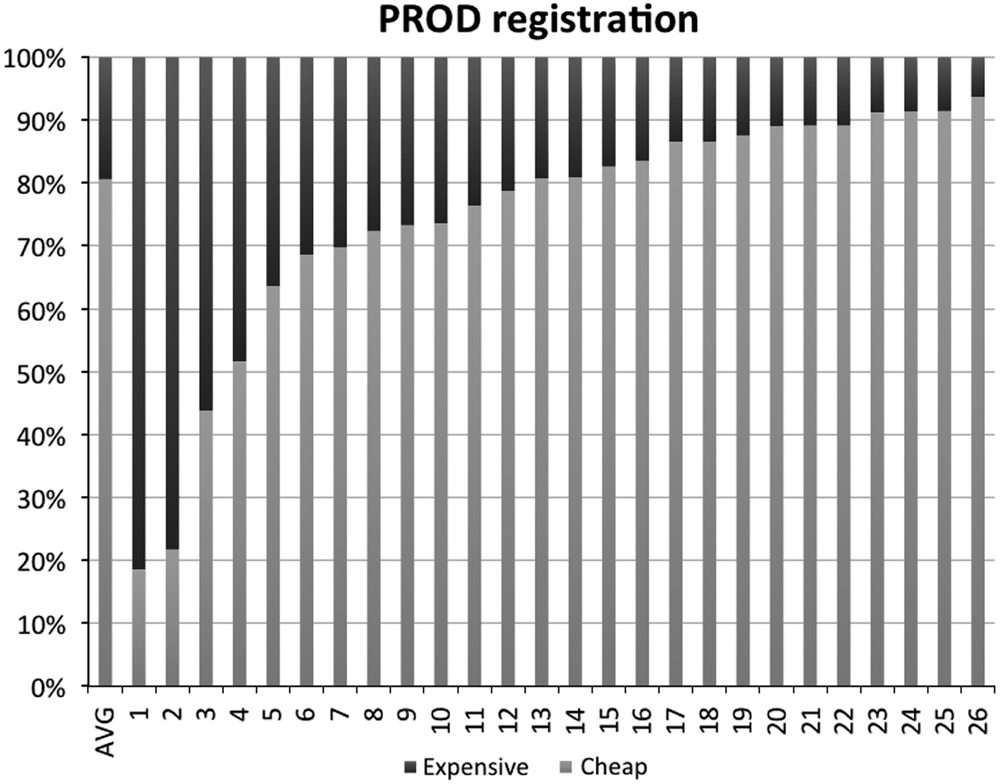
Similarly, we can look for care products where the addition of a particular health care activity can increase the remuneration by shifting coding to another care product. Then we can investigate per health care provider the distribution of codes in such a pair of care products. Figure 6 shows such results for a particular pair, where the addition of a hospital day can make a big difference in the level of remuneration (much bigger than the estimated cost of a hospital day).
Distribution of product (PROD) registration compared over 26 health care providers, ordered by the frequency with which they register the expensive product. Average (AVG).

In Figure 6, the average bar represents the market average over all registrations. The expensive product is ~€4000 more expensive than the other, and a care day can change treatment trajectories from the cheap product to the expensive product. This indicates that there is a financial incentive to provide day care to patients (we estimate the cost of one care day at €527), and as can be seen in the figure there are a number of health care providers that code the expensive product a lot more often than the rest of the market.
5 Discussion
In this paper, we have (at least partly) unpacked the Dutch grouper system, systematically analysing the incentives and possibilities for influencing hospital remuneration, as well as the pitfalls in the system that may cause loss of hospital income. Our research has provided detailed insight in the technical specificities of the DTC system, insights that often remain invisible to practitioners and hospital executives due to their highly technical nature. These technical specificities, we have shown, impact health care spending and hospital reimbursement. Small changes in treatment and coding can have substantive consequences for how a treatment is ‘valued’ by the grouper – leading to lower or higher reimbursement. We have also quantified at a market level how much universal, extreme upcoding (or downcoding) would impact required funding by insurers. With this, we have provided qualitative and quantitative insight in the potential effects of coding behaviour. We have shown various examples of clinical treatments in which slight adaptations of the care process increase rewards, and situations in which performing an extra health care activity (e.g. providing chemotherapy in case of malign neoplasms in the respiratory system) decrease rewards. It is important to envision those issues; the grouper system has been introduced as a system to distribute resources fairly, and when rewards are not fully aligned with the work performed this clearly is not the case. The grouper is also a tool to guide the market and to limit insurer exposure to risk, and our method of systematically scrutinising the DTC framework enables to render its shortcomings visible – and make them prone for revision. Furthermore, it enables hospital managers and regulatory agencies alike to govern the coding of clinical treatment and to signal wrongful coding behaviour, which, we like to stress here, may both be intentional and unintentional as the highly technical and complex features of the DTC system also sow the seeds for unanticipated coding errors. Also, differences in coding behaviour can of course reflect real differences in care provision. The simple fact that we have shown variation in coding behaviour could thus both point at differences in case mix and differences in coding. Furthermore, given the continuous changes in medical care and medical technologies, it is not expected that the DTC system will ever be ‘perfect’, that is, without any incentives or possibilities for upcoding or income loss. Instead, our research suggests that ongoing reflexivity on the technical aspects of the DTC system and its ‘workings’ are necessary to make the DTC system fit in with, and facilitate, ‘real life’ hospital practices. The change in the Dutch DTC system, resulting in a reduction of 30,000–5000 codes, also exemplifies this. Although this reduction has arguably decreased the possibilities for upcoding (many previous separate codes are now clustered), it also leads to a growing distance between care and coding practices, thus necessitating regular updates. In fact, the NZa facilitates this by having close contacts with professional and hospital associations in which the design of the system is discussed (van Erp et al., Reference van Erp, Wallenburg and Bal2018).
The extent to which possibilities for upcoding are realised in practice also depends on the further administrative system in which DTCs are embedded. As described earlier, the recent (2012) ‘administrative agreements’ of the Dutch Ministry of Health with providers and insurers has effectively put a cap on total hospital expenditures (van Erp et al., Reference van Erp, Wallenburg and Bal2018), which makes that upcoding may affect the distribution of costs over and within hospitals but not total expenditures. As insurers in this system prefer to procure care through block contracts, the effect of this administrative environment is further strengthened, albeit that different specialist groups within hospitals still have diverging interests. Even within such an administrative system, however, it can be argued that fair distribution of resources – that is, a distribution that more or less reflects actual work – is warranted. Moreover, as pay-for-performance schemes are becoming more popular, also in Dutch health care (Eijkenaar, Reference Eijkenaar2013), incentives for upcoding might also change, potentially leading to a further incentivisation of upcoding processes.
This research contains some shortcomings. First, and this fits in with the much wider critique on DRG frameworks (Busse et al., Reference Busse, Geissler, Aaviksoo, Cots, Häkkinen, Kobel, Mateus, Zeynep, O’Reilly, Serdén, Street, Swan Tan and Quentin2013; Tan et al., Reference Tan, Boumans and Hakkaart2014a), charges assigned to health care activities often do not align with real costs nor with prices. Furthermore, charges are determined at care product level, but these are not necessarily consistent with each other in terms of how different health care activities are valued. Furthermore, we have made a number of assumptions that may have influenced the findings. First, we have assumed that health care activities that are treated equally by the grouper have the same price. Given that hospitals and insurers negotiate over prices, this is clearly not the case in practice. Second, we have assumed that codes are not changed such that the care product changes to another ZPG. Yet, we do not believe these assumptions have jeopardised the usefulness of the study’s results. Other limitations, however, are more structural. The approach of this paper follows the logical structure of the grouper. Little attention has been paid to the reasons behind certain examples of creative coding behaviour or professional practices. The analysis can identify many weaknesses, but not necessarily all of them are relevant in real practice. Furthermore, when applying the results to actual coding behaviour, discrepancies are identified but not necessarily all of them are relevant. Still, with these limitations in mind, we are confident that our results can play a useful role in making the grouper system fairer and more robust. Nevertheless, follow-up research could delve more deeply in actual coding processes.
6 Conclusion
Although it is no news that strategic coding happens and affects hospital costs, both on a macro level (total health care spending) and a micro level (health insurers or state agencies that falsely pay for inadequate or not provided care, or hospitals facing non-reimbursable care) (e.g. Barros and Braun, Reference Barros and Braun2016; Kerpershoek et al., Reference Kerpershoek, Groenleer and de Bruijn2016), to our knowledge this is the first study unravelling the technical features of the DRG system that lay the basis for upcoding and hospital income loss. Through unravelling the technical structure of the grouper and aligning this with actual coding data, financial incentives for (up)coding have been identified in the Dutch DTC system. This research has identified several weaknesses in the technical structure of the grouper system. It has shown how changing the treatment profile can result in net financial gain, and how performing extra health care activities can also negatively affect remuneration, hence resulting in income loss. Through aligning the methods presented in this paper with actual coding behaviour, pitfalls in the DTC system can be made visible, and possible system improvements can be identified to improve the consistency and robustness of the grouper in the (near) future. This not only involves technical updates, however, but also room for reflexivity to strengthen the system’s relationship with actual and hence dynamic hospital practices. As many countries work with grouper-type systems, our analysis can provide for some tools to extend our analysis to other health care systems.
These conclusions lead to suggestions for future research. Future research should focus more on actual coding behaviour in hospital practices, which could provide more information – both qualitatively and quantitatively – on coding and coding variation. Such insight might help to further develop the grouper software, and with that the DRG system. Another interesting follow-up would be to use a method like the one we have used for estimating costs when setting care product prices. This could enhance the internal consistency of the reward structure, as the method enables to provide feedback on whether particular care product charges are set too high or too low. Finally, in our analyses we have mainly been concerned with unpacking incentives for changes in coding, and how these may embark on actual coding. What we did not consider is the influence the grouper has on actual care delivery. There are some indications from qualitative research (van Erp et al., Reference van Erp, Wallenburg and Bal2018) that the health products as defined in the grouper elicit changes in care pathways in hospitals. Further research on this issue is necessary.
Acknowledgements
The original idea of studying incentives in the Dutch grouper came from Michel Taal, Esmée Schelling and Alwyn Vleesch Dubois at Intelligence to Integrity (i2i), who also provided valuable input throughout this project. The authors are also grateful to the editor and two anonymous reviewers of this journal for their comments and insights that helped us to improve the paper. An earlier version of the paper was presented in the governance group at the Erasmus School of Health Policy; we thank the participants and especially Martin van Ineveld and Richard Janssen for their valuable input.