Introduction
Alzheimer's disease (AD) is a worldwide neurological condition that is often associated with decline in memory and daily functioning (Leifer, Reference Leifer2003). New and innovative treatments indicate promising ability in slowing disease progression and improving cognitive function and behavioral and psychological symptoms. These treatments have the potential to generate health care savings and improve patient quality of life; however, they are most effective when accessed early (Omerovic et al., Reference Omerovic, Hampel, Teipel and Buerger2008). Earlier recognition may also allow patients to exercise more autonomy in regard to making health care decisions (Adams et al., Reference Adams, McClendon and Smyth2008) and delay institutionalization, which may be viewed more negatively among some ethnic minorities (Mausbach et al., Reference Mausbach2004).
Studies have shown that AD is more prevalent among ethnic minorities and it is more likely to be diagnosed in later stages (Tang et al., Reference Tang1998; Gallagher-Thompson et al., Reference Gallagher-Thompson and Shultz2000). Thus, ethnic minorities are less likely to access interventions early, possibly contributing to poorer patient outcomes. Early recognition of AD is important and for this to be possible, all subpopulations need to be aware of AD characteristics. Although AD information is supposedly widely available, it has been suggested that ethnic minorities may use folk or traditional models to understand and explain the behavioural and cognitive changes associated with AD (Ayalon and Areán, Reference Ayalon and Areán2004).
Our study focuses on the Latin American senior subpopulation in Canada. Since 1956, Latin Americans have migrated to Canada in four demographic currents. The Andean wave, composed of Ecuadorian, Colombian and Peruvian migrants arrived between 1973 and 1975. The Coup wave, arriving from 1974 to 1979, consisted of Argentineans, Chileans and Uruguayans. The Mayan Central American wave, composed of Hondurans, Salvadorians, Guatemalans, Nicaraguans and Mexicans migrants, arrived around 1983–1989. The most recent wave is the Technological Wave, which is composed primarily of young Latin Americans who arrived in Canada from 1995 to 2002 (Mata, Reference Mata1985). Our search of the scientific literature produced a very limited number of studies investigating knowledge levels of AD among Latin American seniors, especially in the Canadian literature. This study investigates the level of AD knowledge within a Canadian subpopulation living in an ethnically diverse urban area using subjective and objective measures. The purposes of this study were to: (a) examine knowledge levels of AD in a sample of Latin American seniors attending AD educational sessions in an urban Canadian city; and (b) investigate the relationship between knowledge of AD, demographic variables, education level, acculturation level (years living in Canada), subjective memory complaint and objective memory impairment. Based upon the limited literature, we hypothesize that (a) knowledge levels of AD will be relatively low among Latin American seniors; and (b) that years living in Canada and education will be positively correlated with knowledge of AD.
Methods
Sample and procedure
The sample consisted of 125 Spanish-speaking adults living independently in the Greater Toronto Area. All participants were 55 years of age or older and were recruited during educational sessions in relation to aging and dementia given by the principle investigator to the “Asociación de Seniors de Habla Hispana de Toronto” (ASHTOR). As part of the study, consent was obtained using standardized written informed consent procedures. The questionnaires including the four tests (see below) were administered personally to each participant. To avoid possible literacy and vision issues, all questions were read aloud to the participants. In addition, all the validated measures were harmonized in Spanish. The data were analyzed using SPSS to compute the descriptive statistics.
Measures
Knowledge of AD (KAD) was evaluated using a questionnaire developed in the Ayalon and Areán (Reference Ayalon and Areán2004) study. The KAD questionnaire consisted of 17 true-false questions related to the causes, cure and the nature of AD. The maximum score possible on the quiz was 17. Correct answers were determined based on scientific and clinical evidence.
Mood was assessed using the short form; validated five-item Geriatric Depression Scale (GDS) (Yesavage et al., Reference Yesavage1983).
Subjective memory was assessed using the Memory Complaint Questionnaire (MCQ) (Crook et al., Reference Crook, Feher and Larrabee1992). The six-item MCQ required participants to compare current memory function to memory function at earlier ages in daily scenarios. The five possible answers to each scenario ranged from “much better now” to “much worse now”.
Objective memory was evaluated using the 10-item Short Portable Mental Status Questionnaire (SPMSQ) (Pfeiffer, Reference Pfeiffer1975). The SPMSQ tested participants’ orientation (in time and place), memory function (semantic and episodic) and working memory, and required them to perform a basic calculation.
Results
Characteristics of the sample
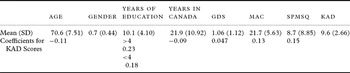
The participants were 70.6 ± 7.5 years old, had an average education level of 10.1 ± 4.7 years and were primarily labor workers (41%) and housewives (24%). The majority of the participants were women (72%) and reported living in Canada for 21.9 ± 10.9 years. The majority of the sample immigrated during the Andean and Coup migratory streams, followed by the Technological and Central American streams (37%, 34%, 17% and 12%, respectively). Overall, the sample was not well informed about AD and reported a knowledge level (KAD score) of 9.6 ± 2.6. The participants had a relatively high level of cognitive complaints (MAC: 21.7 ± 5.6), low depressive symptoms (GDS: 1.06 ± 1.1) and scored within normal limits on cognitive testing (SPMSQ: 8.7 ± 8.8). Knowledge about Alzheimer's disease was very weakly correlated with level of education (R = 0.18 for less than four years of education; R = 0.23 for four or more years of education), age (R = −0.11) and years living in Canada (R = −0.003). There was no correlation between knowledge level and gender or subjective memory complaints (R = 0.13). However, subjective memory complaints showed a correlation with low levels of formal education (R = −0.5). The sample demographics and the correlation coefficients for the KAD scores are summarized in Table 1. All statistics were computed using SPSS software.
Population Demographics of the Latin American Seniors and Correlation Coefficients for KAD Scores

(GDS = geriatric Depression Scale, MAC = Memory Complaints Questioner, SPMSQ = Short Portable Mental Status Questioner, KAD = Knowledge of Alzheimer's disease).
Discussion
Our findings suggest that lack of knowledge about AD is not correlated with level of education. The KAD questionnaire indicated that the concept of AD is normalized (e.g. AD is believed to be non-fatal or a normal part of aging) and is still stigmatized (e.g. the belief that AD is contagious or a form of insanity). Stigmatization and normalization may act as barriers to accessing health care services and contribute to later diagnoses resulting in lower patient outcomes (Ayalon and Areán, Reference Ayalon and Areán2004).
Contrary to our hypothesis, the results demonstrate that years in Canada are not associated with lack of knowledge about AD. Although years in Canada are a relevant measure, it is a poor indicator of English language ability among participants. Results reported by Neary and Mahoney (Reference Neary and Mahoney2005) suggest that information disseminated in Spanish about Alzheimer's disease may be more informative to Latin American populations than information presented in English. Thus the problem may be that there is a lack of AD information translated into Spanish or that information is not widely accessible. Indeed, when communities become aware of the causes and the clinical presentation of diseases through education they tend to seek early diagnosis and treatment (Zimmerman et al., Reference Zimmerman, Safer, Leventhal and Bauman1986; Toro-Alfonso et al., Reference Toro-Alfonso, Varas Diaz and Andujar-Bello2002). Other communities, such as African American, Asian and Latino, are also not well informed about AD, and stigmatization and normalization are the main causes of barriers for early access to services (Guo et al., Reference Guo, Levy, Hinton, Weitzman and Levkoff2000; Hinton et al., Reference Hinton, Guo, Hillygus and Levkoff2000) In the European Community stigma is also noted as a barrier to the diagnosis and treatment of dementia (Watson, Reference Watson2005). Targeted community education programs may promote early intervention resulting in better management of AD (Desai and Grossberg, Reference Desai and Grossberg2005). Culture sensitive strategies to promote public knowledge and destigmatize dementia are essential (Waldemar et al., Reference Waldemar2007). This advice also includes health care professionals: stigma associated with dementia by health care professionals is the over-riding factor in delaying timely diagnosis regardless of available resources (Vernooij-Dassen et al., Reference Vernooij-Dassen2005). Investing in awareness may be beneficial if society's goals are to contain costs. European studies have shown that the costs of care of Alzheimer's disease increase exponentially with dementia severity (Jonsson, Reference Jonsson2004). Johnson et al. (Reference Johnson, Davis and Bosanquet2000) reported the societal costs per patient in Canada in 1996 to be (in Canadian dollars) $9451, $25,724 and $36,794 for mild, moderate and severe Alzheimer's disease patients, respectively. Total societal cost of AD has been rising and is expected to increase substantially as the number AD patients increases nationally and internationally (Johnson et al., Reference Johnson, Davis and Bosanquet2000).
Despite heterogeneity in country of origin, the sample population was clinically homogenous and was cognitively normal and not depressed. Our findings indicated that subjective memory impairment and memory complaints are negatively correlated with low education. However, as a whole, the sample population reported subjective memory impairment. In other words, they may perceive themselves to be vulnerable to the disease, but they were not aware of the principal cause of their symptoms (Werner, Reference Werner2003). Subjective memory impairments may also indicate mild cognitive impairment (MCI) which is a transition in normal functioning to AD or other dementia (Desai and Grossberg, Reference Desai and Grossberg2005). Awareness is an integral component to slowing cognitive impairment, disease duration and disturbances. Targeted educational programs may greatly benefit populations such as our sample who may be at risk of developing AD but lack the ability to recognize AD symptoms and subsequently to access interventions. More research is needed to elucidate why there is a lack of knowledge of AD in Latin American seniors and further research is needed to resolve these knowledge gaps. In addition, more community-based research is needed since this study was limited by a selective sample. Our sample only included participants aged 55 years of age or more who had voluntarily attended the ASHTOR educational seminars. Therefore these data may not generalize to other populations. Another limitation to this study was that it only provided a cross-section of the sample and therefore did not follow patients prospectively over time.
Conclusion
This sample population showed that Latin American seniors, in the Toronto community, are not knowledgeable about AD. Additional research is needed to develop better-focused and specifically directed health promotion initiatives for the Latin American seniors living in the Toronto community. Culturally sensitive programs are needed to target Latin American seniors to create awareness about the nature of AD. Lastly, longitudinal studies are needed to determine the level of correlation between educational programs and the maintenance of patients at earlier stages of the disease.
Conflict of interest
None.
Description of authors’ roles
L. Fornazzari designed the research study and collected data. T. Hansen wrote the final manuscript. L. Ringer performed the statistical analysis. C. Fischer assisted with the research design and statistical design.