INTRODUCTION
This paper outlines how a team in one mental health trust in the United Kingdom (Dorset Healthcare NHS Foundation Trust) reviewed their practice in order to improve the management, training and reporting of the use of physical interventions in response to violent and aggressive situations. It details how using a seven step model for promoting patient safety (National Patient Safety Agency, 2008) helped to give a wider individual and organisational view on this area of care. Using these guidelines the Trust's staff were helped to improve their focus on all aspects of safety. Information was collected on the number of occasions where restraint was used, before and after the introduction of a new training programme. Details of the content of the training programme, which was provided for all staff, are included. Members of staff were also invited to provide reflective comments on their priorities in using physical interventions and were involved in the preparation of this article as an additional learning opportunity.
BACKGROUND
Physical intervention (PI) describes approaches to physical restraint used to prevent harm and can be defined as:
‘Direct physical contact between persons where reasonable force is positively applied against resistance, either to restrict movement or mobility or to disengage from harmful behaviour displayed by an individual’ (Welsh Assembly, 2005, p. 2).
In addition, a range of approaches are used in mental health care to manage actual or potentially dangerous or unacceptable situations. These can range from using skills to diffuse or ‘de-escalate’ a potentially volatile situation through to the use of restraint, forced medication and seclusion. Interventions must be timely, judicious, appropriate and proportionate. They should reflect an integrated approach based on extensive training and an organisational approach which values and promotes patient safety. The terms ‘control and (or) restraint’ i.e. ‘restricting movement or liberty’ (Royal College of Nursing, 2008, p. 2) or ‘the intentional restriction of a person's voluntary movement or behaviour’ (Counsel and Care UK, 2002) have also previously been utilised to describe the more serious type of intervention. This places an overemphasis on merely using physical restraint to contain the situation. The purpose of PI as described in the Mental Health Act 1983 Code of Practice is ‘to take immediate control of a situation; to contain or limit the patient's freedom for no longer than necessary; to end or reduce significantly the danger to the patient or others’ (Department of Health, 2008). In achieving this, the code further specifies the need to take account of:
• The need for individual care planning
• The physical condition of the patient
• The physical environment of the ward or unit
• The need to maintain adequate staffing levels.
Physical restraint should be reasonable, apply the minimum force necessary, be used only for as long as is absolutely necessary and be sensitive to gender and race issues (Mind, 2005).
IDENTIFIED PROBLEMS
Several high profile cases in the media have been critical of the nature and degree of control and restraint used to contain a situation. The enquiry following the death by suffocation of David ‘Rocky’ Bennett in 1998, following a period of restraint lasting twenty five minutes, recommended that patients should not be restrained in a prone position for longer than three minutes. The need for better training was also emphasised. A mental health charity (Mind) has drawn particular attention to the fact that there is neither systematic training across the United Kingdom nor an agreed accreditation scheme for trainers of PI. There is also little or no agreement on what should be recommended or banned as procedures (Mind, 2005). It also suggested that few records of incidents where PI is necessary are accurately kept, resulting in over and under reporting of audit data. More emphasis on ‘de-escalation’ or preventative techniques in training programmes was further recommended, as well as recognising that the environment can be a key contributory factor. The importance of staff attitudes, ward or unit culture, including the importance of therapeutic relationships, have also been cited as important elements. Indeed there is a view that physical restraint is ethically unacceptable in all but the most extreme circumstances (Duxbury & Wright, Reference Duxbury and Wright2011) or that there is a ‘need to consider why the nurse-patient relationship can deteriorate so far that restraint is deemed necessary’ (Kenny, Reference Kenny2004). These considerations were highlighted in improved guidance on patient restraint (National Institute for Clinical Excellence, 2005) which guided the developments outlined in this paper.
PROJECT OUTLINE
Prior to the project, the Trust (in keeping with many others) had recognised that it had a high incidence of situations where physical restraint was required. There was a prevailing culture that the use of restraint was accepted as an often routine aspect of mental health care and management of behaviour. Training was only included as part of an initial staff induction and was focused on restraint techniques to manage situations. There was limited or inadequate reporting of incidents. Planned responses to violence or aggression as part of a care plan was limited. Similarly, there were limited formal opportunities for team de-briefing or learning from incidents.
With the appointment of a new team leader a more strategic and planned approach to developing PI was introduced in the acute in-patient wards with the view that it would then be introduced across the whole Trust. This involved promoting better recognition, management and control of situations and promoting the use of restraint techniques in such a way as to provide a more holistic and therapeutic approach. Previous work had focused on reducing the number of falls by elderly patients and the learning that had been gained by having a ‘Falls Incident’ group assisted in the blueprint for the PI approach. This included an acceptance that whilst early intervention in a potentially difficult situation would remain a key therapeutic strategy, the emphasis should move to a model of safer application of restraint only as a last resort. Allied to this change in approach were other wider organisational changes and initiatives including revised ‘Model of Clinical Risk and Governance’ priorities for the Trust. This emphasised the need to:
• Have better structures to support patient safety
• Foster learning from incident reporting
• Encourage learning from serious adverse incidents
• Provide comprehensive training
• Implement practice and information from national guidance.
The project's principal aim was to engage everyone in thinking differently about the use of PI. This would involve improved training, introducing a model of patient safety, improving the reporting of use of restraint and to offer better ongoing support for staff.
EMPHASIS ON TRAINING AND INSTRUCTORS
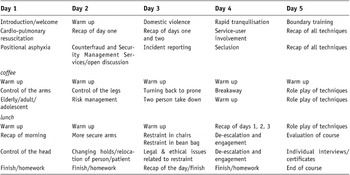
A particular strand of this integrated approach was to develop a team of competent and accredited trainers who would take responsibility for the initial training, updating and support of staff in the use of PI. The training programme content (see Table 1) details the theoretical, attitudinal and practical education and training that was developed and delivered. It sought to promote the improved use of PI in order to meet the stated aim of the programme:
On successful completion of the PI course the candidate will possess the skills, knowledge, understanding and confidence to maintain the safety of patients, colleagues, visitors and themselves in order to allow maximum therapeutic benefit of in-patient admissions for patients.
Detail of session content of the Physical Intervention Training Programme

All existing and new staff within the in-patient services including ‘bank’ (or occasional) staff were given this training. It was a requirement that newly appointed staff undertook the programme prior to commencing their new job in order to better equip them from day one. This training has been maintained and extended to all areas of the Trust and there is a further requirement that all staff and instructors are updated annually.
As the emphasis was also on providing continuing support by the PI team, regular additional sessions were provided. These included ‘refresher sessions’, annual re-training and assessment of competence, structured team ‘de-briefing’ sessions and periodic critical reviews of PI case studies. These elements proved to be a crucial part of the ongoing development of the programme.
MEASURING IMPACT
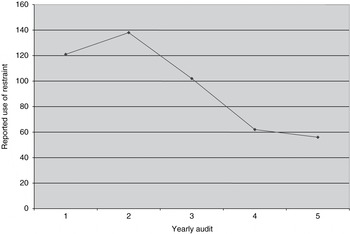
It is difficult to accurately measure the extent to which these developments have produced improvements or the degree to which the improved training and creation of a dedicated PI team are responsible for those results. The Trust routinely collects ‘serious incident’ data which showed that there has been a reduction in the number of reported situations where physical restraint was required. Following the introduction of the training programme there was a dramatic reduction across the in-patient wards in the number of recorded incidents where aggressive behaviour had required the team to consider the possible use of restraint to contain a situation; for example there were 134 incidents in the three months following the programme compared with 261 in the corresponding period of the previous year. The number of staff assaults also halved during the period (41 compared to 75 prior to the training). Whilst there may be other contributory factors, this appears to demonstrate that there was an increased use of de-escalation skills. Of particular note is the reduced use of actual physical restraint over a four year period (see Fig. 1) which suggests a continuing pattern of a reduction of need for these types of more serious physical intervention. These incidents are likely to have also included the use of forced medication, rapid tranquilisation or seclusion for some patients. Following the training initiative there was an initial unexplained increase in reported incidents in the following year but the number of reported uses of restraint showed a marked decrease in subsequent years.
Recorded use of restraint in the acute in-patient services following the introduction of PI training programme

Continued and improved collection of this data show that these improvements have been sustained and in the last period for data collection, to end 2009, patient to patient assaults had also reduced from 8 to 1 incidents compared with the previous year. Patient to staff assaults also reduced from 45 to 17. In addition, the PI team reported that there was an increased awareness amongst staff of the key guidelines in the use of PI which may have had an influence on these findings. These are illustrated later in this paper.
FURTHER DEVELOPMENTS AND THE USE OF PATIENT SAFETY STANDARDS
The team responsible for PI training and development decided to review their progress, not just in terms of reported incidents but within the context of the whole Trust's integrated approach. This involved benchmarking Trust practice against recognised guidelines. The review was guided by considering all aspects of PI in a wider context of safety promotion using the ‘seven steps to patient safety’ standards (National Patient Safety Agency, 2008) which were being adopted across a range of the Trust's activities to promote a safety culture:
• Build a safety culture
• Lead and support staff
• Integrate risk management activity
• Strengthen reporting in mental health care
• Involve and communicate with service users/public
• Learn and share safety lessons
• Implement solutions to prevent harm.
These acted as a useful framework to consider PI practice and allowed the developments to be considered against the benchmarks. All team members were asked to write a short paragraph on what their primary message regarding PI should be, in order to ascertain a range of values considered important. These were used to capture and clarify the elements of PI which should be further emphasised and developed in the training programme. These reflected views from the perspectives of different team members and their roles and are included within the seven step standards below. In this way they would specifically consider areas of PI practice against the safety guidelines and illustrate the ways in which the standards are or can be applied to promote a safety culture in the use of PI.
Build a safety culture
‘A safety culture is where staff within an organisation have a constant and active awareness of the potential for things to go wrong and both staff and the organisation are able to acknowledge mistakes, learn from them and take action to put things right’ (National Patient Safety Agency, 2008, p. 6).
The key elements identified by the team to develop this standard for PI included emphasising the importance of risk assessment, assessing dangerousness and risk management. This includes a focus on physical safety, awareness of the environment and recognising warning signs for potential violent incidents. It also emphasises the importance of de-escalation, prevention and distraction techniques. These elements were illustrated in the following priorities identified by participants:
‘Throughout the five day course I try to stress certain points to the participants such as awareness of their environment and the patient group within it as well as warning signs to potentially violent situations and how to de-escalate them and how staff present themselves, the things they say and the way they say them.’ (PI tutor)
‘Due to having a general background in nursing I first aimed to put across to the students the paramount safety of the patient. I introduced basic life support and risk factors related to PI into the training course.’ (Senior tutor)
Lead and support staff
‘Building a safer culture depends on strong leadership with clear policies in relation to safety and a willingness to implement best practice at service level.’ (National Patient Safety Agency, 2008, p. 8)
The promotion of an accepting, supportive and ‘no-blame’ culture emphasising the importance of a team approach was considered to be the priority for this standard. This required effective clinical risk training and regular updates as a vital element to guide practice. Co-operation with the NHS Security Management Service, the police and the Criminal Prosecution Service was seen as important, along with a ‘Whole Trust’ approach. This was thought useful to promote clearly understood responsibilities.
‘…the issue of safe and competent practice coupled with sound risk assessment principles is paramount. I believe this is of major importance because we ultimately set the standard and minimum expectations that we as an organisation expect of the staff.’ (Ward Manager)
There was also a recognised need for readily available help and guidance, sharing and learning from incidents and a co-ordinated lead from the Trust Clinical Governance Committee. This promoted the prioritisation of key safety areas, particularly physical assault by one patient on another patient and situations where there is a physical assault on a member of staff by a patient.
Integrate risk management activity
‘A mental health organisation's risk management system is designed to help the organisation manage incidents effectively and reduce the chances of them happening again.’ (National Patient Safety Agency, 2008, p. 10)
These were identified as being linked very closely to the need to be a ‘high reliability organisation’ (as defined by the NPSA) with a ‘high reporting culture’, i.e. being prepared to identify both negative and positive aspects of care provision. This included accepting that this can also emphasise negative perceptions of the Trust due to unfair comparisons with other settings where data is less well recorded. A series of Trust initiatives and risk assessment strategies had been introduced at the time of the project and may have contributed to the reduction in the need for restraint. These included wards having a specialist focus with fewer patients on each ward. Also there was an emphasis on improving the ward environment. More opportunities for staff to develop specialist skills, for example through the use of the Tidal model (Barker & Buchanan-Barker, Reference Barker and Buchanan-Barker2005) had been initiated as well as introducing a Local Security Management Specialist role:
‘I provide an overview of NHS Security Management Service particularly the process that our trust follows to support a member of staff should they be physically assaulted at work by a service user. This covers the Trust's actions, our relationship with the police and Crown Prosecution Service. Physical assault data (national and local) is shared and discussed.’ (Local Security Management Specialist)
Strengthen reporting in mental health care
‘A high level of reporting within an organisation indicates a better safety culture: the more aware staff are of safety problems, the more likely they are to report.’ (National Patient Safety Agency, 2008, p.12)
In addition to being a ‘high reporting organisation’ the team recognised the requirement to improve the quality of recorded information. In particular to emphasise factual recording (which is both accurate and precise)
‘An important part of the training is to highlight the importance of accurate, precise and factual details to be recorded on the form without personal opinions…so risk assessments, careplans, clinical risk reviews etc. can be formulated in the best interests of all patients, staff visitors and family…’ (Clinical Risk Adviser)
‘(we are) primarily focused on evidence-based ‘physical skills’, we deliver training to all new entrant nurses. I think we should capture the outcomes and effectiveness of the workforce as it is a powerful position to be in.’ (Ward Manager)
This was assisted by the adoption of the Seven Steps approach and capturing Incidents and Physical Assault data in a more detailed way. The Trust had also established a Serious Adverse Incident Panel which reports its findings to the National Reporting and Learning System. This assists in the sharing of data and there are plans for a system of national reporting of data to NPSA in the future. Specialist software for reporting (Ulysses) had also been introduced which had improved the collation of information.
Involve and communicate with service users/public
‘Involving and communicating openly with service users, their relatives/carers and the public is essential to improving safety’. (NPSA, 2008, p. 14)
The Trust had developed a very strong model of service user engagement and service-user involvement and it was a key part of the five day training programme. There was an emphasis on the experience of being restrained. This aimed to stress the importance of effective relationships and setting boundaries as well as considering the therapeutic benefits of PI when used as a last resort. This fostered the use of PI as an efficient and effective approach to dealing with situations at an early stage with the potential to prevent further harm.
‘I hope to convey within my session ‘Professional boundaries in the staff/patient relationship’ the aim that candidates increase their awareness of the effects of their interactions with patients and based on this, seek guidance on any aspect of their relationship with patients where boundaries are blurred.’ (PI Instructor)
The involvement of service-users in the training programme to give first hand accounts of their experiences of being restrained had been a key feature and has been well evaluated:
‘It opened my eyes when I listened to how awful an experience it was being restrained when she [service-user] was very unwell. How frightened she felt and out of control. I will be mindful of this when I have to be involved in PI.’ (PI Trainee)
This preventative approach had also been greatly assisted by the Trust's Implementation of the Tidal model (Barker & Buchanan- Barker, Reference Barker and Buchanan-Barker2005) which has resulted in increasing the amount of face to face contact between staff and service-users. This also increased the number and range of available therapeutic activities during the day and also increasing activities at night and weekends. Relations with the public, community and the media were thought to be strong which had resulted in good representation on the Trust Board.
Learn and share safety lessons
‘Reporting when things go wrong is essential in healthcare, but it is only part of the process of improving patient safety. It is equally important that mental health organisations look at the underlying causes of patient safety incidents and learn how to prevent them from happening again.’ (NPSA, 2008, p. 16)
The project promoted an improved culture of sharing and learning, not just through training opportunities but also from reviewing incidents and experiences.
‘It is important to emphasise that we want to learn from incidents and not to ‘blame’ those involved in order to avoid future similar incidents from occurring.’ (Clinical Risk Adviser)
PI instructors have to undertake comprehensive and co-ordinated training to enable them to teach and support others. This training emphasises effective communication through body language/ content/ attitude and being non-judgemental. They aim to pass on these skills and assist individuals in developing their confidence. This can lead to an increased feeling of safety knowing that you have the right skills to use when required.
‘We hope the training we deliver gives people the skills to deal with situations more confidently, making people aware of their surroundings and being able to identify some trigger factors. Making people feel safe knowing they have the skills.’ (PI Instructor)
There was also a recognition of the need for alternative approaches to non physical assault and employing appropriate responses to manage them. Other ways of fostering shared learning were employed using ‘adverse incident’ form completion and later discussions and case reviews involving patients who were identified as causing a significant number of violent incidents.
Implement solutions to prevent harm
‘Quicker and more reliable implementation of risk reduction strategies and safer practices are two major challenges in mental health care.’ (NPSA, 2008, p. 18)
The emphasis by the Trust on adopting a more strategic approach to PI had put a high priority on preventing and managing incidents and also supporting the PI programme through dedicated resources. This assisted the development of the training, reporting and service-user engagement and was a key to the success of the programme. It increased the application of best practice solutions in PI to prevent harm and minimise problems. One example was to highlight the importance of using rapid tranquilisation appropriately, safely and effectively.
‘Many staff in Mental Health do not understand the issues around rapid tranquilisation and the dangers. The aim has been to rationalise its use and develop a better appreciation of the use of drugs and the care required in their reasonable use. This needs to be understood for special circumstance use meeting the needs of the patient physically and psychologically.’ (Pharmacist)
Overall, the team's approach to the project was well summed up in the following quote:
‘The key message is about safe practice for all concerned, both staff and patients alike. In terms of the delivery of our training we are in the fortunate position of being able to immediately influence all grades of nursing staff at the start of their employment with our Trust (due to a contractual requirement to complete the course before any candidate sets foot in the clinical area) therefore the issue is safe and competent practice coupled with sound risk assessment.’ (PI Instructor)
DISCUSSION SUMMARY
The focus of this project was to improve the use of PI in several key areas of practice. Although only undertaken in one area of a single UK mental health trust it emphasises the importance of viewing the use of physical interventions, from a range of perspectives in order to reduce risk and promote safety. Adequate training in the use of PI techniques had previously been reported as important in reducing the use of seclusion and restraint (Forster et al. Reference Forster, Cavness and Phelps2004) and is a central component of any management strategy, but it is important that this is set within the wider policy context. Indeed, it has been suggested that training programmes alone have the potential to exacerbate rather than reduce conflict rates (Bowers et al. Reference Bowers, Brennan, Flood, Lipang and Oladapo2006). Policy guidelines and adherence to them have also been shown to decrease the use of restraint and seclusion (Hucksorn, Reference Hucksorn2006; Hellerstein et al. Reference Hellerstein, Staub and Lequesne2007). These were important to this project's development and the additional use of the NPSA standards proved very beneficial in giving further direction in considering PI from all areas of safe and effective practice. Similarly, the procedures and priorities of the wider Trust mental health services were considered to have a major effect on the effective application of PI by its staff members. This includes adequate reporting of incidents and data collection, risk assessment strategies and acting appropriately to incidents in order to promote learning and support. Clearly this also requires strong leadership, dedicated roles for co-ordinating PI and recognised approaches and responsibilities to strengthen the use of whole team approaches.
CONCLUSIONS AND RECOMMENDATIONS
This paper has outlined one Trust's approach in developing an improved approach in the use of physical interventions to take control of a situation where there is danger to safety. It is accepted that such approaches are not without difficulties and may remain controversial but the key elements of this paper are to promote the use of an integrated approach within a safe and therapeutic culture. The training programme has been shown to be effective in reducing the number of incidents requiring interventions as well as developing safer and more effective responses. This has been assisted by improved approaches to reporting, an emphasis on safety, improved support, sharing and learning, promoting greater staff confidence and increased user and care involvement.
From these experiences the following recommendations can be made:
• There is a need for an integrated, whole service approach to patient safety
• The PI policy needs to include the full range of interventions including gentle physical encouragement
• Initial and ongoing training and support should be seen as a priority
• Organisational culture is important and individual responsibilities should be clarified
• The need for safety for all persons is paramount
• Where PI is unavoidable there is a need for competence, efficiency and effectiveness based on sound guidelines
• Effective reporting, discussion and learning from incidents is key to maintaining best practice.
An additional benefit of the project and preparing this paper was that the team identified other areas of care which will be subject to similar review, e.g. personality disorders, ‘zoning’, use of the Tidal model and enhanced skills for in-patient mental health professionals.
Acknowledgements
The following members of the Physical Interventions team contributed to the project and the writing of this paper: Trevor Clayton, Ramiro DaSilva, Camilla Flomen, Joe Jackson, Jane Medley, Carol Nicholls, Amanda Psaradelli, Cameron Radford, Demar Rowe, Joseph Smith, Amanda Watson and Abby Webb.