Background
There is a high rate of psychiatric co-morbidity in patients with neurological disorders and it has been estimated that more than 50% of inpatients with neurological disorders may present with a co-morbid psychiatric illness (Fink et al. Reference Fink, Hansen, Sondergaard and Frydenberg2003; Jefferies et al. Reference Jefferies, Owino, Rickards and Agrawal2007; O’Brien et al. Reference O’Brien, Devitt, Corcoran and Murphy2009). Psychiatric co-morbidities can have a significant impact on recovery and length of stay in hospitalised patients, and early recognition and intervention may help to improve outcomes (Jansen et al. Reference Jansen, van Schijndel, van Waarde and van Busschbach2018). Potential barriers to care include a reluctance to create additional diagnoses for patients and stigma as well as lack of resources specific to this patient group (Moriarty, Reference Moriarty2007).
Psychiatric illness has been found to commonly be missed by Neurologists (Bridges & Goldberg, Reference Bridges and Goldberg1984). In addition, patients with brain disease want to be asked about their mental health. Bridges and Goldberg (Bridges & Goldberg, Reference Bridges and Goldberg1984) assessed 100 inpatients on a Neurology ward using a clinical interview schedule. Of the 39% with a psychiatric illness, the majority wished that an enquiry into their mood had been made and of the 61% without a psychiatric illness, half still wished that the Neurology team had enquired into their mood (Bridges & Goldberg, Reference Bridges and Goldberg1984). Neuropsychiatry services can assist Neurologists and Neurosurgeons in the assessment and management of these disorders (O’Brien et al. Reference O’Brien, Devitt, Corcoran and Murphy2009).
Delirium is a complex neuropsychiatric syndrome (Levenson, Reference Levenson2005) associated with prolonged hospital admissions and increased mortality (González et al. Reference González, Martínez, Calderón, Villarroel, Yuri, Rojas, Jeria, Valdivia, Marín and Carrasco2009; Witlox et al. Reference Witlox, Eurelings, de Jonghe, Kalisvaart, Eikelenboom and van Gool2010; Fong et al. Reference Fong, Jones, Marcantonio, Tommet, Gross, Habtemariam, Schmitt, Yap and Inouye2012). It has been defined most recently by the Diagnostic and Statistical Manual of Mental Disorders, Fifth Edition (DSM-5) as disturbance in attention, awareness and cognition, which develops over a short time period (normally hours to days), is caused by direct physiological consequences of another medical condition and is not better explained by another pre-existent neurocognitive disorder (American Psychiatric Association, 2013). Delirium has been found to have a point prevalence of 20% in hospital inpatients (Ryan et al. Reference Ryan, O’Regan, Caoimh, Clare, O’Connor, Leonard, McFarland, Tighe, O’Sullivan, Trzepacz, Meagher and Timmons2013). Delirium is misdiagnosed, diagnosed late, or missed in as many as 30–75% of cases (Laurila et al. Reference Laurila, Pitkala, Strandberg and Tilvis2004; Kean & Ryan, Reference Kean and Ryan2008; Bellelli et al. Reference Bellelli, Nobili, Annoni, Morandi, Djade, Meagher, Maclullich, Davis, Mazzone, Tettamanti, Mannucci and Investigators2015) with poorer recognition of hypoactive as compared to hyperactive delirium having been reported (Collins et al. Reference Collins, Blanchard, Tookman and Sampson2010). A lack of screening, poor education regarding delirium, delirium not being seen to belong to a specific specialty, lack of public awareness and ageism have all been cited as reasons for poor recognition and treatment (Teodorczuk et al. Reference Teodorczuk, Reynish and Milisen2012).
Various interventions have been undertaken to address these issues. Welch & Jackson (Reference Welch and Jackson2018) found that undertaking a study of delirium was sufficient to improve recognition by hospital staff (Welch & Jackson, Reference Welch and Jackson2018). Jenkin et al. (Reference Jenkin, Al-Attar, Richardson, Myint, MacLullich and Davis2016) found improvements in knowledge of delirium among non-consultant hospital doctors (NCHDs) following the introduction of NICE guidelines on delirium and national incentivisation of cognitive screening in older adults (Jenkin et al. Reference Jenkin, Al-Attar, Richardson, Myint, MacLullich and Davis2016). Delirium teaching in undergraduate education has been found to be insufficient and could be an important factor in improving recognition and treatment of delirium (Fisher et al. Reference Fisher, Gordon, MacLullich, Tullo, Davis, Blundell, Field and Teodorczuk2015). Experience in geriatric medicine has been associated with only a small increase in knowledge among NCHDs (Jenkin et al. Reference Jenkin, Musonda, MacLullich, Myint and Davis2014).
Aim
We aimed to (1) examine the inpatient referrals to the Liaison Neuropsychiatry service in an Irish national tertiary referral centre for Neurosurgery and Neurology and (2) review the diagnosis and management of delirium by the referring team’s utilisation of a local delirium protocol before and after a staff delirium psychoeducational intervention. The delirium protocol is appended (Appendix 1) and includes instructions on the diagnosis of delirium along with both environmental and pharmacological interventions.
Methods
Setting
Beaumont Hospital is an 820-bed university teaching hospital with a tertiary referral Neurology and Neurosurgery service. The Neuropsychiatry service provides an inpatient Liaison Consultation service primarily to the Neurology and Neurosurgical teams along with outpatient services.
Data collection and intervention
We initially conducted an audit of the referrals to the inpatient Liaison Neuropsychiatry service from January to June 2018. This was conducted in September 2018. Data were collected from the record of referrals to the Neuropsychiatry service and included the reason for referral, referring team, diagnosis based on the International Classification of Diseases (ICD-10) coding and management. Following the initial audit, we devised an appropriate educational intervention to raise awareness of the diagnosis and management of delirium by assessing the use of a local delirium protocol. We provided a psychoeducational intervention at an individual and small group level to the Neurology and Neurosurgical NCHDs and also presented at Neurology and Neurosurgery education sessions a method that has shown efficacy in previous studies (Teodorczuk et al. Reference Teodorczuk, Welfare, Corbett and Mukaetova-Ladinska2009). We had previously designed a local delirium protocol and ensured that copies of the protocol were placed in key areas on the Neurology and Neurosurgical wards and that electronic copies were placed on all computer desktops within these wards. Following the educational intervention, we then conducted a re-audit of referrals, to the service, recognition of delirium and adherence to the local delirium protocol between January and June 2019.
Analysis
Simple statistics and chi-square tests were used.
Ethical approval was obtained from the local clinical governance and audit committee.
Results
Initial audit
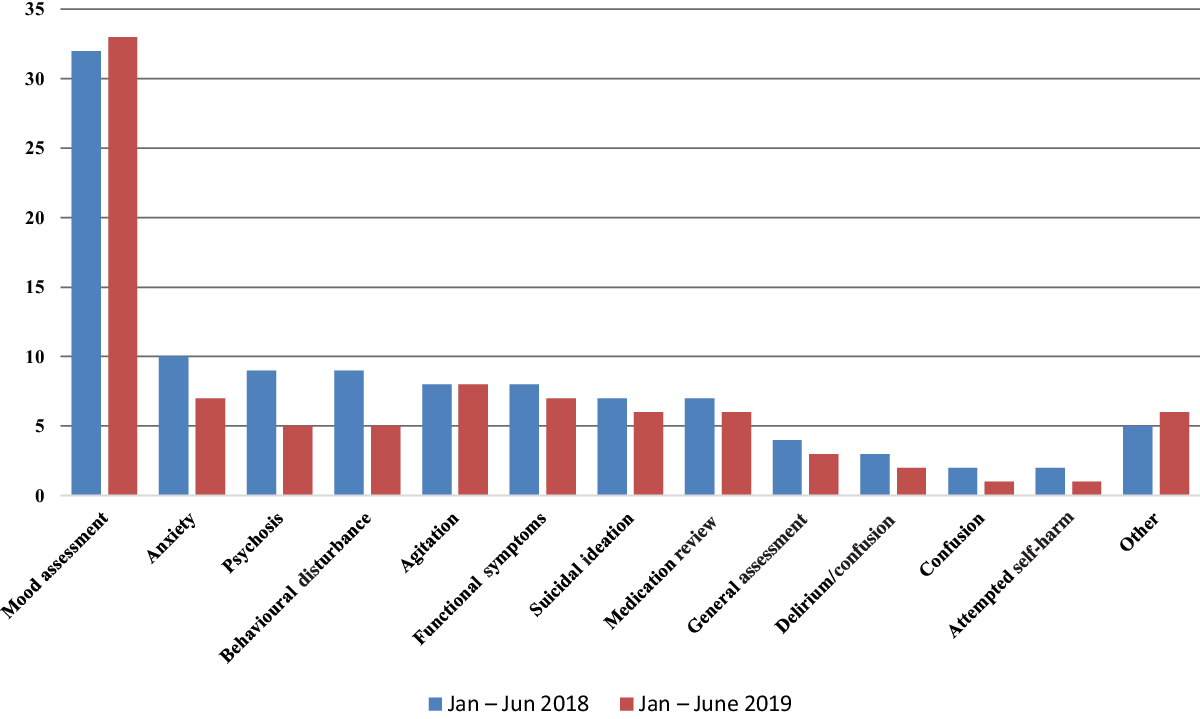
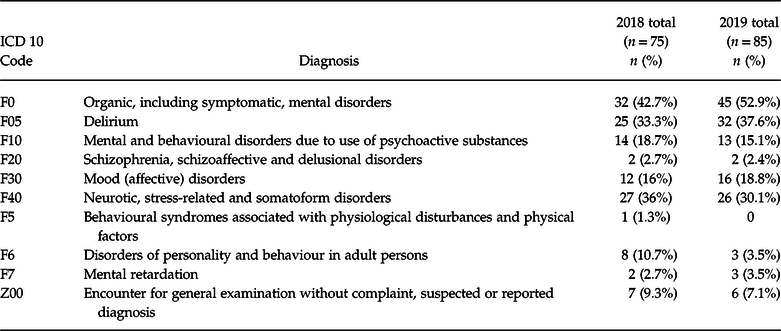
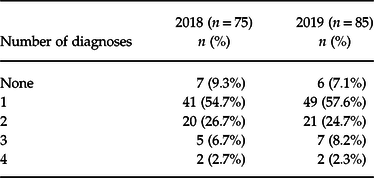
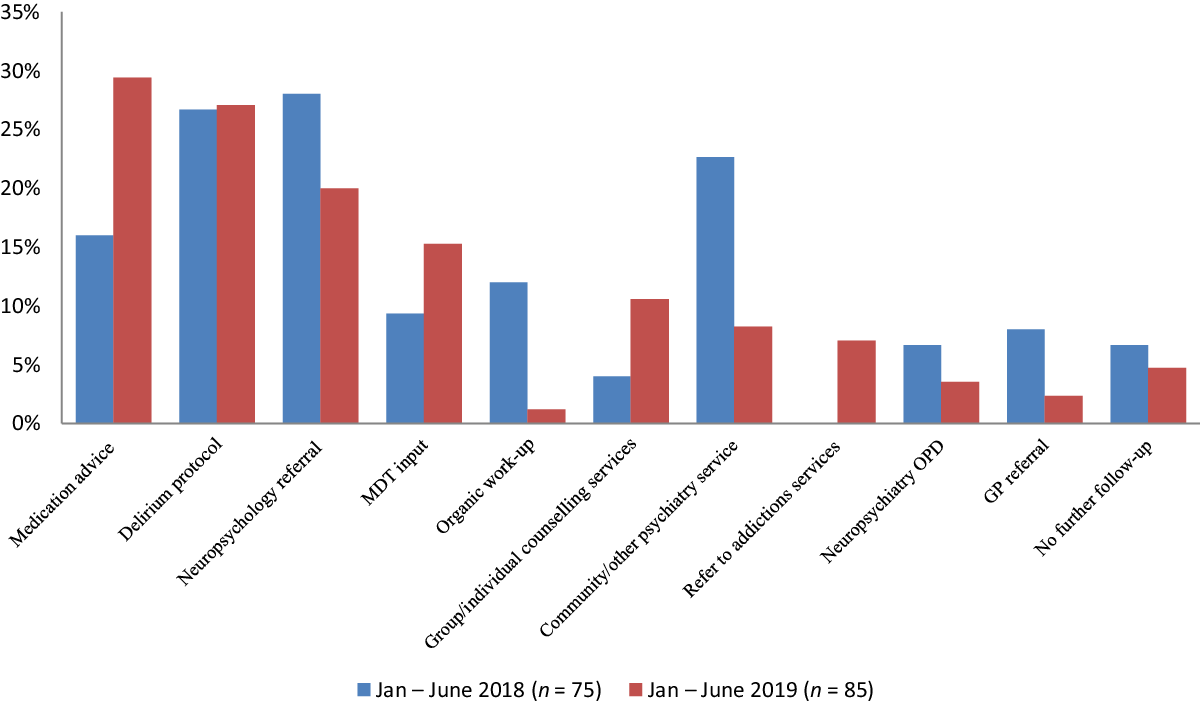
There were 84 referrals to the Neuropsychiatry service in the initial audit between January and June 2018: 43% (n = 36) were male and the mean age was 46 years with a range of 7–79 years; 63% (n = 53) of referrals were from Neurology and 37% (n = 31) were from Neurosurgery. The most common reasons for referral were for assessment of mood (38%; n = 32) and anxiety (11%; n = 10) (Fig. 1). Organic disorders were the most common diagnoses (45%, n = 32) (Table 2). Of the 75 patients assessed, 9.3% (n = 7) had no psychiatric diagnosis (Table 1) and 36% (n = 27) had more than one psychiatric diagnosis (Table 2). Use of the delirium protocol, neuropsychology referral and referral to community psychiatric services were the most common forms of management following assessment by the Neuropsychiatry team in 2018 (Fig. 2). On initial audit, 4% (n = 3) were referred with a specific query of delirium (Fig. 1) and delirium was subsequently diagnosed by Neuropsychiatry in 33% (n = 25) of the patients assessed. The local delirium protocol was utilised prior to referral in 12% (n = 3) of patients who received a diagnosis of delirium from the Neuropsychiatry team (Table 3).
Reason for referral (Please note that multiple terms were used in some referrals and have all been accounted for here).

ICD-10 diagnoses following Neuropsychiatry assessment

Number of psychiatric diagnoses per case

Management plan following review by Neuropsychiatry.

Delirium management prior to referral and subsequent diagnosis by Neuropsychiatry

Re-audit
On re-audit in January–June 2019, there were 86 referrals to the Neuropsychiatry service. Demographically, 52% (n = 45) were male (slightly higher than the previous year but not significant; X 2 (1, n = 170) = 1.5, p = 0.2). The mean age was 48 years with a range of 11–85 years; 44% (n = 38) of referrals were from Neurology, 52% (n = 45) were from Neurosurgery and 3.5% (n = 3) were from the Radiation Oncology, Respiratory and Paediatric teams. Mood assessment remained the most common reason for referral (38%; n = 33). Following assessment by the Neuropsychiatry team, organic disorders remained the most common diagnoses (53%; n = 45). Of the 85 patients assessed, 7.1% (n = 6) had no psychiatric diagnosis (Table 1) and 35% (n = 30) had more than one psychiatric diagnosis (Table 2). Use of the delirium protocol, neuropsychology referral and medication advice were the most common forms of management following assessment by the Neuropsychiatry team in 2019 (Fig. 2). On re-audit, 2% (n = 2) were referred with a specific query for delirium (Fig. 1) and delirium was subsequently diagnosed by Neuropsychiatry in 38% (n = 32) of the patients assessed. The local delirium protocol was utilised prior to referral in 47% (n = 15) of those who received a diagnosis of delirium by the Neuropsychiatry team (Table 3). This reflects a significant increase in use of the delirium protocol (p < 0.01) despite no increase in the number of delirium query referrals.
Discussion
While the proportion of referrals with a subsequent diagnosis of delirium remained the same across both years (approximately one-third of all referrals), we found that a psychoeducational intervention significantly improved the use of the delirium protocol (p < 0.01) by Neurologists and Neurosurgeons in patients with brain disorders prior to referral to a Neuropsychiatry service. On re-audit, the delirium protocol was utilized prior to Neuropsychiatry referral in 47% (n = 15) of those with a subsequent diagnosis of delirium as compared to just 12% (n = 3) in the initial audit.
It is unclear why, despite the significantly increased use of the delirium protocol, there was no increase in the number of delirium query referrals, which were low across both years. It seems that the teams possibly do recognise delirium but are hesitant to name it. This may be due to concern around missing other psychiatric diagnoses, being denied psychiatry review in the past or concerns regarding the implications around increased length of stay. It may also reflect a lack of confidence among Neurology and Neurosurgery teams in making this diagnosis as other terms such as ‘confusion’, ‘behavioural disturbance’ and ‘agitation’ were often used indicating that teams may have implicitly made the diagnosis without using the specific term ‘delirium’.
Recognition of delirium can be poor in clinical settings although psychoeducation and research activity related to delirium has been shown to improve recognition and potentially improve outcomes (Babine et al. Reference Babine, Hyrkas, Hallen, Wierman, Bachand, Chapman and Fuller2018; Welch & Jackson, Reference Welch and Jackson2018). We primarily targeted NCHDs with our intervention. However, nursing staff were included in this intervention and made aware of the delirium protocols that were made available on the ward. The education of nursing staff and more senior members of the team is likely to have the most profound cultural effect on the recognition and management of delirium given the higher turnover of NCHDs.
Our results highlight the wide range of psychiatric co-morbidities in a population of inpatients with neurological disorders and the role of an integrated specialist psychiatry service in their recognition and management. The rate of referral was similar across both audit years. There was a higher proportion of male referrals in the re-audit but not meeting statistical significance (p = 0.2). The mean age did not differ significantly across the two time periods with a broad age range both years. Most referrals were from Neurology and Neurosurgical teams with a small number from other sources.
The proportion of referrals from the Neurosurgery and Neurology teams across these time periods contrasts with a previous study of Neuropsychiatry referrals in Beaumont Hospital in 2002 and 2005 where there was a higher rate of referrals (approximately 115 over a 6-month period in 2002 and 156 over 6 months in 2005) but with 85% of referrals coming from the Neurology team (O’Brien et al. Reference O’Brien, Devitt, Corcoran and Murphy2009). This most likely relates to changes in the referral pathways of patients referred with seizure disorders.
The most common reason for referral in this study was for mood assessment. The most common diagnosis was delirium followed by adjustment disorder in both years and most patients had one diagnosis only. In this study, we also found a low rate of dissociative and somatoform disorders which is consistent with findings in inpatient populations elsewhere (Jefferies et al. Reference Jefferies, Owino, Rickards and Agrawal2007). Most patients with dissociative disorders are seen in our outpatient clinic, similar to other services (Carson et al. Reference Carson, Ringbauer, Stone, McKenzie, Warlow and Sharpe2000). As referral pathways for inpatients with dissociative and somatoform disorders alone generally suggest initial referral to Neuropsychology, these findings likely reflect the growth of the Neuropsychology and outpatient service in managing dissociative disorders.
Use of the delirium protocol and Neuropsychology involvement remained two of the most common management approaches following Neuropsychiatry input across both audit years and this is reflective of the most common diagnoses. There was an increase in medication advice in 2019. This likely relates to pharmacological intervention for delirium and the identification of deliriogenic medications. However, the exact nature of the medication advice was not recorded for the purpose of this audit.
Limitations to this study include the fact that there was a different cohort of Neurology, Neurosurgical and Neuropsychiatry trainees in both audit years. However, the Interns referring and initially managing delirium were in their second 6 months of training both years meaning that they had similar levels of knowledge and experience. We did not use standardised measurement tools as recommended in previous studies (Milisen et al. Reference Milisen, Foreman, Wouters, Driesen, Godderis, Abraham and Broos2002). However, delirium here is diagnosed by an established Neuropsychiatry service. We used the delirium protocol as a proxy measure of appropriate recognition and management by the treating teams prior to referral but did not look at subsequent outcomes such as length of stay.
Interdisciplinary liaison and ongoing psychoeducation are essential in the early detection and management of patients with brain disorders and co-morbid delirium. Raising awareness among patients and their family members may also help in the recognition of this disorder (Teodorczuk et al. Reference Teodorczuk, Reynish and Milisen2012). In this study, we have shown that a targeted psychoeducational staff intervention significantly enhances the use of the delirium protocol in these vulnerable patient groups. Future studies should look at the effect of early use of the delirium protocol on length of stay, explore treating teams’ reticence in diagnosing delirium, examine the use of environmental as compared to pharmacological interventions for delirium and place greater emphasis on the involvement of the multidisciplinary team such as nursing staff and occupational therapy.
Ethical Standards
The authors assert that all procedures contributing to this work comply with the ethical standards of the relevant national and institutional committee on human experimentation with the Helsinki Declaration of 1975, as revised in 2008. The authors assert that ethical approval for publication of this service evaluation has been provided by their local Ethics Committee.
Financial Support
This research received no specific grant from any funding agency, commercial or not-for-profit sectors.
Conflict of Interest
None.
Appendix 1 Beaumont local delirium protocol

Appendix 2 Full diagnostic table