The issue of whether our experience has nonconceptual content (or not) has been vigorously discussed in recent years in relation to Kant’s philosophy.Footnote 1 Curiously enough, in spite of the increasing interest in Hegel’s epistemology and philosophy of cognition,Footnote 2 few contributions explicitly address the question of the conceptual or nonconceptual character of our sensible experience in Hegel.Footnote 3 In this paper I would like to contribute to debate over the conceptual/nonconceptual character of sensible experience in Hegel by suggesting that Hegel’s concept of sensation (Empfindung) can be fruitfully read against the background of the recent distinction between state vs. content nonconceptualism. Moreover, I will argue that Hegel’s position can fruitfully enter into this debate as an interesting alternative.
What I intend to do in this paper is the following: 1) I will use the specific conceptual apparatus of the debate on state vs. content nonconceptualism to read Hegel’s theory of sensation without any distortions. 2) I will show that the result of this interpretation is a consistent position (without committing myself to it); 3) I will show that, in this way, Hegel’s position can enter the contemporary debate as a possible theoretical option, thus broadening its horizons—as a matter of fact, the specific theoretical position I will attribute to him is not currently present in the debate in question.Footnote 4
The paper is divided into three main sections. In the first section, I will provide a brief outline of the distinctions that characterize the debate between state vs. content nonconceptualism. In the second section, I will discuss Hegel’s concept of sensation in light of these distinctions, arguing that Hegel’s concept of sensation is compatible with a certain version of content conceptualism that is combined with a ‘weak’ state nonconceptualism for adult, rational subjects and with a ‘strong’ state nonconceptualism for non-rational animals and infants. I will argue that Hegel’s position is similar to McDowell’s. However, I will further claim that Hegel is committed to a version of content conceptualism which is stronger than McDowell’s. In the third section, I will illustrate some further features of Hegel’s conception of mental content starting from distinctions that characterize the debate on state vs. content nonconceptualism—this analysis will be useful to fully contextualize Hegel’s position in the debate in question.
I. The debate on state vs. content nonconceptualism: some distinctions
The distinction between state vs. content nonconceptualism is usually traced back to Heck’s article ‘Nonconceptual content and the space of reasons’.Footnote 5 In this paper, Heck distinguishes between two ways in which nonconceptualism about perception can be interpreted.
State nonconceptualism:
The first way interprets nonconceptualism as a thesis that applies to mental states. A nonconceptual mental state is a mental state which is not dependent on possession of the concepts that are necessary to give a faithful report of the content of the mental state in question:
SNC: ‘[A] perceiver can be in perceptual states a faithful report of whose content would necessarily employ concepts she did not possess’. (Heck Reference Heck2000: 484)
In this sense, to say that perception is ‘nonconceptual’ means that a subject can be in a determinate perceptual state which presents content she is not able to characterize according to the relevant concepts because she does not possess them. On the contrary, a subject cannot be in an epistemic state such as holding a belief without possessing the relevant concepts that determine the content of that belief: ‘What beliefs a given thinker can have depends upon what concepts she possesses; she cannot have any belief whose content essentially involves a concept she does not possess’ (Heck Reference Heck2000: 484).
However, it is important to notice that state nonconceptualism itself can be interpreted in two different ways: strong and weak.Footnote 6
SNCstrong: [A] mental state is nonconceptual if and only if it is possible to be in the state without possessing or applying any of the concepts that are necessary to specify the content.Footnote 7
SNCweak: [A] mental state is nonconceptual if and only if it is possible to be in the state without possessing or applying all of the relevant concepts that are necessary to specify the content.Footnote 8
What is important to stress is that the distinction between nonconceptual and conceptual states is neutral with respect to the kind of content of perceptual states—that is, distinguishing between the two says nothing with respect to the conceptual or nonconceptual nature of the content of perception.
Content nonconceptualism:
If conceived in the second way, nonconceptualism defines a kind of content which is nonconceptually structured, unlike the content of beliefs and judgements.
In this sense, to say that perception is ‘nonconceptual’ means that it presents the subject with an informational content which is not conceptually constituted. This content must be ‘conceptualized’ in order for it to become the content of a belief or judgement.
CNC: ‘[P]erceptual states have a particular kind of content, nonconceptual content, as opposed to the conceptual content that beliefs are supposed to have’. (Heck Reference Heck2000: 484)
Starting from the distinction between state vs. content nonconconceptualism, Crowther (Reference Crowther2006) discusses the four possibilities in which we can combine conceptualism and nonconceptualism about perception according to the state and content views.Footnote 9
P1: State conceptualism+Content conceptualism: the content of perception is conceived of as conceptually structured, and perceptual states are conceived of as beliefs, hence it is not possible to be in a perceptual state without possessing the concepts which characterize the content in question.
P2: State nonconceptualism+Content nonconceptualism: the content of perception is a nonconceptual content, and perceptual states do not require the subject to possess the concepts that are necessary to specify the content in question.
P3: State conceptualism+Content nonconceptualism: the content of perception is a nonconceptual content, but perceptual states require that the subject possesses the concepts that are necessary to specify the content.
P4: State nonconceptualism+Content conceptualism: the content of perception is a conceptual content, but perceptual states do not require the subject to possess the concepts that characterize the content in question.
II. Hegel’s concept of sensation against the background of the debate on state vs. content nonconceptualism
Against the background of the distinctions discussed in section 1, I believe that it is possible to interpret Hegel’s position according to a particular version of state nonconceptualism+content-conceptualism (P4). This position allows us to interpret some Hegelian statements about sensation in a consistent way and to contextualize them within the broader epistemological and ontological framework within which Hegel’s discussion of sensation takes place.Footnote 10 Although in Hegel’s work there are passages that remain problematic for this reading, I argue that an interpretation which combines (a peculiar form of) state nonconceptualism and content conceptualism (P4) is consistent with the central features of Hegel’s system, and makes the most sense in the framework of his proposal.
IIa. Sensation as nonconceptual ... in which sense?
In Hegel’s discussion of the concept of sensation, there are many assertions that lean towards a characterization of sensation in nonconceptual terms.
IIa.1). Hegel insists on characterizing sensation as an ‘immediate’ cognitive determination:
Sensation is connected with sensitivity; it seems plausible therefore that sensation emphasizes more the aspect of passivity, of finding, i.e. the immediacy of the determinacy in feeling ... . (ES §402R, 84)Footnote 11
Since the determinateness of sensation is still determined as an immediate affection within the soul, spirit itself is still determined as being immediate. (FSS 129)
IIa.2). Hegel makes a distinction between sensation and thought, and, at least in a certain respect,Footnote 12 conceives of sensation as an epistemic form which human beings share with non-rational animals—i.e., with animals that lack conceptual capacities:
It is nowadays necessary to remind ourselves that thinking is what is our very own, is what distinguishes man from animals, and that man has sensibility in common with them. (ES §400R, 70)
This form as such [sensation, FS] is a form common to the animal soul and the human soul. (ES §400A, 70)
IIa.3). Hegel seems therefore to consider the determinations of sensation as excluded from the space of reasons, which seems for him to coincide with the space of conceptually structured thought. As a matter of fact, he writes that in sensation:
[E]very content becomes a contingent content and acquires determinations belonging only to this individual subject. It is thus quite inadmissible to appeal to one’s mere sensations. Whoever does this withdraws from the realm, common to all, of grounds, of thinking, and of objectivity, into his individual subjectivity ... . (ES §400A, 71; translation modified)Footnote 13
And again, he defines sensation and feeling as ‘what cannot be said [das Unsagbare]’ (EL §20R, 50; see also LL 11).
My proposal is to interpret the above-mentioned Hegelian statements—which point towards a definition of sensation in a nonconceptual sense—in terms of a state nonconceptualism and not in terms of a content nonconceptualism.
IIb. The conceptual content of sensation
Although Hegel sometimes seems to explicitly state the contrary (see ES §400, 70; ES §399A, 68; FSS 123–25), I claim here that the content of sensation is,Footnote 14 for Hegel, conceptual content—or, at least, I suggest that it should be conceptual content if the consistency of his system is to be preserved. The interpretation of the content of sensation in nonconceptual terms goes, in my view, against some of Hegel’s central theoretical assumptions.
IIb.1). The content of our epistemic activities is the same
Hegel denies that our epistemic activities have different kinds of content. Instead, he says that the content of our epistemic activities is always the same, even though this content presents itself to the subject according to different epistemic forms—and this makes it appear as though our epistemic capacities have different kinds of content. Although Hegel stresses that ‘... a particular ob-ject’ seems to rise together with the different epistemic forms, he does not actually attribute a different kind of content (‘a diverse content’) to our various epistemic forms.Footnote 15
This is clearly stated in Encyclopaedia §3:
Whatever kind it may be, the content that fills our consciousness is what makes up the determinacy of our feelings, intuitions, images, and representations, of our purposes, duties, etc., and of our thoughts and concepts. Hence feeling, intuition, image etc., are the forms of this content, a content that remains one and the same, whether it be felt, intuited, represented, or willed, and whether it be only felt, or felt, intuited, etc., with an admixture of thought, or whether it is thought quite without any admixture. In any one of these forms or in a mixture of several of them, the content is ob-ject of our consciousness. But in this ob-jectivitiy the determinacies of these forms join themselves onto the content; with the result that each of these forms seems [italics mine] to give rise to a particular ob-ject, and that what is in-itself the same can look like a diverse content. (EL §3, 26; see also EL §24A3, 60)
IIb.2). The content of sensation (and of all our epistemic activities) is conceptual content. Moreover, as I will argue, Hegel is committed to the thesis which claims that the content of our different epistemic activities is conceptual content.Footnote 16
The argument (part one): The conceptual structure of reality
The claim that there is only one kind of content, namely conceptual content, for all epistemic activities follows directly from Hegel’s metaphysics and ontology.
Although I cannot give a detailed motivation of this interpretation, I believe that there are good reasons to adopt a new-metaphysical (not theological) reading of Hegel, according to which, in his system, Hegel aims at developing an account of the ontological structure of the whole of reality, understanding reality to constitute the content of all epistemic activities.Footnote 17 According to this reading, reality is a self-developing and self-referential process (Entwicklung) that is conceived of as manifestation of the Concept. Every determination of reality coincides with an immanent self-determination of the Concept qua universal and holistic ontological horizon, which particularizes itself according to a rational process.
[The Concept, FS] determines itself freely; the process by which it makes itself finite ... is creative power as the absolute negativity which relates itself to its own self. As such, it differentiates itself internally, and this is a determining, because the differentiation is one with the universality. Accordingly, the universal is a process in which it posits the differences themselves as universal and self-related. They thereby become fixed, isolated differences. The isolated subsistence of the finite which earlier was determined as its being-for-self, and also as thinghood, as substance, is, in its truth universality, the form with which the infinite Concept clothes its differences—a form that is, in fact, one of its own differences. Herein consists the creative power of the Concept, a power which is to be comprehended only in this, the Concept’s innermost core. (SL 605; see also SL 591–92, 602–3, 758–59; EL §160A, 378–79)
The Concept, therefore, is the ontological, generative matrix of the totality of reality, and it defines the ontological structure of both the natural and the spiritual world.
[H]ere … the Concept is to be regarded not as the act of the self-conscious understanding, not as the subjective understanding, but as the Concept in its own absolute character which constitutes a stage of nature as well as of spirit. (SL 586)Footnote 18
Therefore, according to Hegel, the conceptual structure of reality is not the result of a projection of subjective conceptual schemes onto the world, nor is it the result of a process of transformation of bare sensible data into conceptual contents. There are no epistemic elements bearing a specific non-conceptual content. More radically, from an ontological point of view as well, there is nothing outside or beyond the conceptual structure of reality. Hegel seems therefore to endorse an ontologically robust conceptual realism, according to which individual beings are manifestations and particularized tokens of the Concept. And their conceptual nature determines their place within the universal order of reality, which Hegel reconstructs within his Encyclopaedia. When we become conscious of the concept of beings or phenomena existing in the world, we comprehend them, and we are able to situate them within the rational order of reality.Footnote 19
The Concept dwells within the things themselves, it is that through which they are what they are, and to comprehend an ob-ject means therefore to become conscious of its concept. If we advance from this to the judging of the ob-ject, the judgment is not our subjective doing, by which this or that predicate is ascribed to the ob-ject; on the contrary, we are considering the ob-ject in the determinacy that is posited by its concept. (EL §166A, 245)Footnote 20
It is interesting to notice that, according to the above quoted passage, Hegel’s conceptualist ontology implies that determinations of reality are not only radically conceptual but also judgementally and syllogistically structured at an ontological level: objects, properties, states of affairs have a conceptual structure.Footnote 21 So, conceptually structured reality is the content of all our epistemic activities.
The argument (part two): The universal natural soul and sensation
How does this (ontologically) conceptually structured content present itself in sensation qua epistemic form?
The (conceptual) content of every epistemic activity is conceived by Hegel as present within the structure of the universal natural soul, and sensation is conceived of as the first concrete form in which this content becomes an epistemic content for us.Footnote 22 But what does this formulation mean?
Let me first say something about Hegel’s concept of ‘universal natural soul’. The universal natural soul is a particularly obscure concept within Hegel’s Encyclopaedia system. It represents the first moment of the section Anthropology, whose ‘regional principle’ is the concept of soul.
The themes which Hegel discusses within this encyclopaedic section are various (for instance: race, sexual differences, sleep and waking, sensation, feeling, folly, habit), and it seems impossible to consider them as part of a specific argument apart from the necessary progression of the concept exposed in the Encyclopaedia (see Corti Reference Corti2016b: Introduction). To accomplish the goals of this paper, it is necessary to focus on some constitutive aspects of Hegel’s notion of universal natural soul and show its link with sensation.Footnote 23
In line with Hegel’s realist tendency, the universal natural soul is defined as ‘unity of thinking and being’ (ES §389A, 30). It is reality conceived of as the totality of (conceptual) contents which can be the object of our epistemic forms (this is what Hegel has in mind when he talks of ‘unconscious thought’ (E §311, 185)—namely thought qua thinkable, not qua act of thought). According to this (abstract) way of conceiving reality, contents are considered in their purity and in their semantic objectivity, in other words they are considered neither in their material existence in nature, nor in their being grasped by a specific cognitive act (by a thought, by a representation, by a sensation, etc.).
These contents, however, are not conceived of as pertaining to a separate realm with respect to the existence of material things (according to a sort of simplified representation of the Fregean third realm). On the contrary—in virtue of Hegel’s thesis of the concrete universal—they also have an embodied existence in nature: natural objects and states of affairs are instatiations of these concepts.
Hegel’s interesting move is to consider he universal natural soul—according to which the conceptual determinations existing in the external world are present in an immaterial and objective form (even though they are also instatiated in nature)—as what constitutes, at the same time, the content of the determinations of human spirit. Still, what does this mean?
If we were to translate this claim into terms more palatable for the contemporary debate, we could say that the universal natural soul justifies the possibility that objective contents (which have their ‘physical’ concretization in nature) are the objects of our epistemic activities.Footnote 24 By relying on the concept of universal natural soul, Hegel aims to justify the fact that the content of our epistemic determinations coincide with the determinations of the natural world which are instantiated in particular objects and states of affairs. This notion is therefore vital in order for Hegel to justify his thesis about ‘objective thought’.
I will now support this reading with textual evidence. Within the Anthropology section of the Encyclopaedia, where specifically human sensation is treated for the first time, Hegel brings two fundamental features together to form the notion of universal natural soul (see E §311, 185 and NG 225). On the one hand, the universal natural soul comprehends in itself the conceptually determined nature of the objects that populate the external natural world.Footnote 25 On the other hand, the universal natural soul constitutes the material, the content, of every epistemic human activity (and of every spiritual determination).Footnote 26
The soul is not only immaterial for itself. It is the universal immateriality of nature, its simple ideal life. Soul is the substance, the absolute foundation [absolute Grundlage] of all the particularizing and individualizing of spirit, so that it is in the soul that spirit finds all the stuff of its determination, and the soul remains the pervading, identical ideality of this determination. (ES §389, 29)Footnote 27
Let me once again expound upon what I take to be the epistemological thesis hidden in Hegel’s cryptic prose: the function of the universal natural soul is to allow us to consider the epistemic content and determinacy existent in the world as originally unified. This is part of Hegel’s realist project and can be seen as the endorsement of a sort of direct (although not immediate!) access to the determinacies of the world.
To put it in other terms, the universal natural soul simultaneously holds in itself:
α) the ontological determinacies of the world (objects, properties, states of affairs), which have an independent existence in nature and are, as we have seen, always already conceptually structured;
β) the universal possibility of thought, its pure potentiality, its capability of being everything and having this or that content.
The universal natural soul is therefore the concept that plays the role of justifying the absence of an ontological gap between content of the world and the content of all epistemic determinations. Moreover, this content is conceptually structured, since the universal natural soul is also identified with the structure of the Concept—‘The soul is the existent concept, the existence of the speculative’ (ES §403R, 88).
Given this background, sensation is thematized as the concretization of the universal natural soul (ES §§399–402) and is defined as β) the epistemic actualization, for the sentient subject, of a determinacy of content that is present in the universal natural soul—universal natural soul being potentially all things (§389). And α) that determinacy coincides with one existing in the external world.
Sensation presents its content in the form of singularity and accidentality, and sensations are private determinations of our subjectivity (ES §400 and A). However, what is important to stress is that sensation does not have a specific kind of content—‘The content of sensation does not pertain to sensation as such’ (NH 52, my translation)—but it presents the single content of all our epistemic activities, which is conceptual and in itself universal, in a particular form. ‘Color or taste has in itself a true [wahrhaft] universal, and it is only as a content of sensation that it has become singular [das Einzelne]’ (NH 52, my translation; see also NG 190–91 and 283–84; LL 51; NS 648–49). Given the fact that content is one and the same for all the forms in which it can present itself (see EL §3 and, above, IIb.1), the peculiar phenomenology of sensation (singularity, peculiarly subjective character) is accounted for at the level of forms—namely, at the level of mental state types—not of content. The various forms (not content!) convey the differences in phenomenological character.Footnote 28
IIc. Combining state nonconceptualism and content-conceptualism
At this point, it is necessary to summarize the results of my analysis and to try to clarify Hegel’s position against the background of the debate between state vs. content nonconceptualism. As previously stated, Hegel’s account of sensation seems to be compatible with a content conceptualism added to a particular version of state nonconceptualism (to be further specified—see below).
Hegel’s endorsement of content-concepualism is determined by his ontology (or metaphysics) of the Concept, exposed in the Science of Logic and in the Encyclopaedia. As observed in IIb, on the one hand, Hegel attributes the same content to all epistemic activities—content which is conceived of as existing in the world and as being a manifestation of the Concept.Footnote 29 On the other hand, Hegel explains in the Anthropology section of the Philosophy of Subjective Spirit how this content presents itself in human sensation. Hegel’s assertions stressing IIa.1) the immediacy of sensation, IIa.2) the fact that sensation is an epistemic form that, at least in a certain respect, we share with non-rational animals, and IIa.3) the difference between sensation and conceptual thought—should, in my view, be interpreted as describing sensation as a specific mental state that an epistemic subject can be in. More specifically, Hegel’s above mentioned claims (IIa.1, IIa.2, IIa.3) should be interpreted as describing a state that is different from the explicit conceptual states that instantiate beliefs, yet do not imply that sensation has a specific kind of content. In sensation, content is presented to the subject in a way that is particular to sensation qua epistemic form.
Therefore, it seems possible to consistently read these assertions defining sensation qua form as compatible with state nonconceptualism, according to which the sentient being is in a state in which content is presented to her without it being necessary that she possesses the relevant concepts which articulate the content in question. Even though Hegel does not explicitly make this claim (in so far as I know), it seems possible to argue for it starting from two passages of the Encyclopaedia:
In Encyclopaedia §3, Hegel writes:
Since the determinacies of feeling, of intuition, of desire, of willing, etc., are generally called representations, inasmuch as we have knowledge of them, it can be said in general that philosophy puts thoughts and categories, but more precisely concepts, in the place of representations. Representations in general ... can be regarded as metaphors of thoughts and concepts. But that we have these does not mean that we are aware of their significance for thinking, i.e., that we have the thoughts and concepts of them. Conversely, it is one thing to have thoughts and concepts and another to know what the representations, intuitions, and feelings are that correspond to them. (EL §3R, 26–27)Footnote 30
I am well aware that, when Hegel says that philosophy puts ‘thoughts’ and ‘categories’ in the place of ‘representations’, he is not expressly addressing the question of the role of concepts in our epistemic life exactly in the same way as in the debate about state vs. content nonconceptualism. As a matter of fact, it seems to me that Hegel has a ‘philosophical’ notion of concept and of thought that exceeds the relevant understandings of these terms within the debate in question (see EL §2)—this implies a difference between Hegel’s framework and the framework of at least some of the participants in the contemporary debate.Footnote 31 Nevertheless, I do believe that it is possible to reconstruct what Hegel’s position with respect to this debate could be, by looking at passages which originally were not primarily meant to give an answer to such a question. These passages can be understood to have at least an indirect relevance for the reconstruction of Hegel’s position within the framework of the contemporary debate.
In the above quoted passage, Hegel seems to claim that the different epistemic forms (feeling, intuition, and, what I believe to be included within the ‘etc.’ Hegel cites, sensation) are forms according to which we represent realityFootnote 32—not in the sense of a classic ‘representationalist’ theory, which is explicitly criticized by Hegel for many reasons,Footnote 33 but in the sense that they are different ways according to which content is presented to the subject.Footnote 34
If we interpret this passage by applying it to the role of concepts in our experience, Hegel asserts that we can have mental states (‘representations’ qua tokens of the epistemic ‘forms’ qua mental state types) such as ‘determinacies of feeling, of intuition, of desire, of willing, etc.,’ but this does not imply ‘that we have the thoughts and concepts of them’. He therefore says that to have (at least some of) such ‘representations’ does not necessarily imply knowing (and therefore possessing) the thoughts and the concepts which articulate and constitute their content.Footnote 35 The possibility that content can be ‘only felt’—without possessing the relevant concepts that articulate it—is contemplated by Hegel shortly before, when he writes (as previously quoted in IIb.1) that:
content ... remains one and the same, whether it be felt, intuited, represented, or willed, and whether it be only felt, or felt, intuited, etc., with an admixture of thought .... (EL §3, 26)
From the quoted passages, it therefore seems that, for a subject to be in a perceptual (or better yet, sensible) state, it is not necessary that this state be accompanied by the concepts which articulate that content—even though each content is ontologically conceptually structured. If my interpretation makes sense, we still must consider what kind of state nonconceptualism is compatible with Hegel’s position.
Even though, in the passage quoted previously, Hegel writes that content can be ‘only felt’, I believe that strong state nonconcepualism (according to which it is possible to be in a perceptual intentional state without possessing any relevant concept for the articulation of the content in question) cannot be attributed to Hegel’s treatment of the sensations of an adult, rational subject. Hegel affirms in crucial places that conceptual thought, qua spontaneous subjective activity, is pervasive with respect to all human epistemic capacities. Conceptual thought, in its ‘subjective’ meaning, is not a mere separable and particular faculty among and ‘beside’ others. According to Hegel, this would be a misleading representation of both mental reality and epistemic activity.Footnote 36 Rather, subjective thought animates all of our epistemic activities: ‘I do not have different activities, of which thinking is one of them. Rather, thinking is the activity itself ... All intuiting, representing, desiring, willing etc. is essentially thinking’ (VLM 1817 5, my translation; see also ES §398A, 66; LL 18 and 6; EL §2).
This seems to commit Hegel to the thesis endorsed by McDowell, according to which sensation (for McDowell: perception) qua epistemic capacity is not separable from thought and from our conceptual capacities (McDowell 19962: Lecture I). The thesis of the pervasiveness of conceptual thought with respect to all our epistemic capacities seems to imply that, for a rational adult subject, at least some concepts must be operative in sensible experience in order for the latter to have epistemic content. For this reason, I believe that Hegel is committed only to a weak state nonconceptualism with regard to the sensation of adult, rational subjects.Footnote 37
On the contrary, like McDowell, Hegel seems to ascribe a strong state nonconcepualism about sensation to infants and non-rational animals. As a matter of fact, Hegel ascribes sensation, characterized by a certain form (not kind) of informational content to non-rational animals and infants as well. Arguments for this claim come from, on the one hand, the fact that Hegel also treats sensation in his Philosophy of Nature (EN §351A, and §§357–58): here he describes sensation as the cognitive element that distinguishes animal life from vegetal life. On the other hand, Hegel seems to claim that sensation is the first epistemic form according to which children relate to the world (ES §396, 142–43). Since non-rational animals and infants lack conceptual thought, their sensations can be treated in line with a strong state nonconceptualism. On this point too, I believe that Hegel would agree with McDowell in not considering these states to be properly states with genuine epistemic significance.
Even though there are important analogies between Hegel’s position and McDowell’s, I would like to suggest that there is a crucial difference between these two authors. My thesis is that both Hegel and McDowell share the same views with respect to the thesis of state nonconceptualism about conscious sensible experience, but have different views with respect to how they conceive of content conceptualism.
McDowell’s position can be described as being committed to a weak form of content conceptualism, in so far as he claims that objects, which figure as conceptually structured senses in perceptual content, are in themselves nonconceptual (McDowell Reference McDowell2008a). As a matter of fact, McDowell considers individuals, for instance ‘pieces of meat’, to be nonconceptual and placed in the Fregean realm of reference—even though he does not consider the distinction between sense and reference as a sort of line that circumscribes and limits the conceptual realm (McDowell Reference McDowell2008b). Hegel’s conceptualism seems to have a stronger ontological and metaphysical import, in so far as Hegel (as we have seen in IIb.2) considers both states of affairs and particular objects in themselves as ontologically conceptually structured. According to Hegel, not only the contents of experiences and beliefs, but the metaphysical structure of the world itself, is radically conceptual.Footnote 38
III. Completing the picture: Hegel’s notion of ‘content’ against the background of the debate on state vs. content nonconceptualism
To complete the picture I have painted here, it is necessary to address a further question, namely how should we further specify Hegel’s notion of content in order for it to fully suit the framework of the debate on state vs. content nonconceptualism. This will allow me, specifically, to achieve two of the goals I put forward in the introduction, namely: 2) to further prove that the view I attribute to Hegel is consistent and, in this way, 3) to make this view fully available for the contemporary debate (in which such a combination of theoretical elements has not yet been put together). At the same time, this will allow me to recap some of the results achieved in the previous analysis.
As shown by Duhau (Reference Duhau2014), the debate on state vs. content nonconceptualism is closely tied to a series of theoretical choices concerning how the content of our mental states should be conceived. The various characterizations of content put substantive constraints on which claims one can defend—therefore a suitable characterization of the notion of content is vital to the consistency of the positions active in this debate.
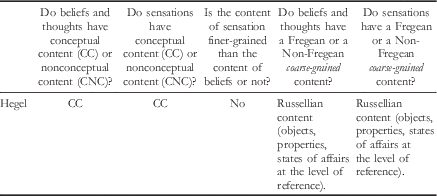
For this reason, the spectrum of positions (more or less explicitly) advanced in the debate is defined by a set of characteristics that qualify them, starting from their attitudes toward a series of alternatives about content.Footnote 39 The relevant alternatives seem to be conveyed by the following questions:
∙ Do beliefs and thoughts have conceptual content (CC) or nonconceptual content (CNC)?
∙ Do perceptions have conceptual content (CC) or nonconceptual content (CNC)?
∙ Is the content of perceptions finer grained than the content of beliefs or not?Footnote 40
∙ Do beliefs and thoughts have a Fregean or a Non-Fregean coarse-grained content?Footnote 41
∙ Do perceptions have a Fregean or a Non-Fregean coarse-grained content?
An exhaustive description of the contemporary positions currently active in the debate on state vs. content nonconceptualismFootnote 42 would show in detail how the various conceptions of content can relate to different stances about state nonconceptualism. However, this endeavor would go beyond the limits of this paper (the same goes for any potential comparison or contrast between Hegel’s position and contemporary theories made for the sake of a critical evaluation of the advantages and limits of the various positions). For this reason I will merely sketch an interpretation of Hegel’s conception of content starting from the above mentioned alternatives, which contribute to substantively shape the positions of the contemporary debate on state vs. content nonconceptualism. This reconstruction of Hegel’s notion of content does not only recap and complete the reading of Hegel I have offered in the two previous parts of the paper; it also gives us a picture which is theoretically coherent with the form of state nonconceptualism I have attributed to Hegel. In this way, I hope to show that Hegel’s position can legitimately enter the contemporary debate on state vs. content nonconceptualism.
So, how should we characterize Hegel’s notion of content starting from the relevant questions that define the positions advanced in the debate on state vs. content nonconceptualism?
For the sake of clarity, it is possible to draw an overall table which I will comment on below:
By summarizing what I have suggested in the second part of the paper, we can say that Hegel explicitly holds that there is only one kind of content for beliefs and sensible experience, and that he conceives of it as ontologically conceptually structured and directly accessible (see IIb.2). This conception of content implies that the distinction between what is ‘conceptual’ and what is ‘nonconceptual’ takes place merely at the level of mental states—in the same spirit, the phenomenological differences between our different mental states are not determined by different kinds of content.
Moreover, because of his ontological content conceptualism, I believe we cannot ascribe to Hegel the thesis of a more fine grained sensible content with respect to the conceptual capacities of the epistemic subject (at least de jure).Footnote 43 In virtue of the isomorphism between the objective and the subjective sides of the Concept,Footnote 44 the conceptual content of our epistemic capacities does not present sides which cannot be adequately grasped by our conceptual capacities (again, at least in principle).Footnote 45
It remains to be determined whether Hegel conceives of the content according to a Fregean model (i.e., content constituted by modes of presentation of objects) or according to a coarsely-grained model (i.e., content constituted by objects themselves and their properties).
Despite the risks inherent in placing a philosopher from the early nineteenth century into current debates and the difficulties of relating Hegel’s thought to a vocabulary which is to a great extent external to it, authors such as McDowell and Brandom seem to interpret Hegel’s conception of mental content starting from a Fregean framework. The crucial difference between these two authors seems to be linked to their thematization of the realm of reference. While for Brandom, reference is a peculiar kind of senseFootnote 46 and is conceived of as radically conceptual, McDowell refuses to incorporate the realm of reference into the realm of sense and maintains that the realm of reference is nonconceptual (though not beyond the reach of the conceptual) (see McDowell Reference McDowell2008b).
However, I believe that the attribution to Hegel of a Fregean kind of content along the lines proposed by McDowell (indirectly) and Brandom (directly) is not only misguided.Footnote 47 It is also inconsistent with my attribution of a weak state nonconceptualism to Hegel’s theory of sensation, since—as authors such as Toríbio and Bermúdez have argued—conceptions of content along Fregean lines are logically inconsistent with the state-nonconceptualist view.
As Duhau (Reference Duhau2014) convincingly shows, the arguments (such as those put forward by Toribio and Bermúdez) for the logical inconsistency of state nonconceptualism presuppose a Fregean notion of content. She also convincingly shows that it is logically possible to make room for the notion of state nonconceptualism once we abandon a Fregean notion of content in favor of a coarse-grained notion of content.
I suggest here to take this different route, namely attributing a notion of coarse-grained content to Hegel. I believe that this route is both interpretively faithful to Hegel’s thought and consistently accommodates the theoretical claims I have attributed to him.Footnote 48
What kind of coarse-grained content does suit Hegel’s position?
By highlighting the strong, realist import of Hegel’s position, it is possible to interpret the content of epistemic capacities in Hegel as a coarse-grained content placed at the level of reference and conceptually structured. This is a view inspired by a ‘Russellian’ conception of semantic content (though this label must be further specified).Footnote 49 In line with the ontological import of Hegel’s conception of Concept, Judgement and Syllogism, content would be constituted by conceptually structured objects and properties, which figure in facts at the level of reference—facts that are rationally articulated and that can be can be explained through inferences.
Moreover, a Russellian and conceptually structured notion of content accounts (at the very least) for the following features of Hegel’s philosophy: 1) Hegel’s realism, 2) the publicity and intersubjective accessibility of content,Footnote 50 3) Hegel’s ‘essentialist’ tendency,Footnote 51 which allows for a peculiar interpretation of the difference between states that are weakly nonconceptual and states that are fully conceptual, 4) the rather scarce interest Hegel sometimes shows to sensible details and the sensible features of experience.Footnote 52
Such a Russellian view of content has to face both theoretical and exegetical difficulties. As a matter of fact, this reading has to confront puzzling problems, such as those constituted by Frege’s casesFootnote 53—but also the problem of the compatibility of Russellian content and internalist reflective access,Footnote 54 problems related to the issue of justification,Footnote 55 and exegetical problems linked to Hegel’s criticism of misleading pictures of content based on the substance/property model and on facts.Footnote 56 For these reasons, a detailed discussion of Hegel’s notion of content deserves its own more adequate treatment in a separate contribution.
However, I suggest that the characterization of the notion of content according to the lines sketched above is perfectly consistent with the combination of state nonconceptualism and content conceptualism and, at the same time, accounts for many core theses to which Hegel seems committed. Moreover, this characterization of content, combined with the peculiar version of state nonconceptualism which I have attributed to Hegel, coincide with a position which—to my knowledge—is not explicitly endorsed by any of the contemporary authors who take part in the current discussion. As surprising as it may seem, Hegel has something to say in this debate.
Conclusion
In this paper I have (I) presented the terms and the logical landscape which define the debate on state vs. content nonconceptualism. I have (IIa) shown that there are many Hegelian assertions that seem to characterize sensation in nonconceptual terms (IIa.1, IIa.2, IIa.3). Since I have demonstrated that, according to Hegel, (IIb.1) all our epistemic activities have the same kind of content and that (IIb.2) this content is constitutively conceptual (CC), I have excluded the possibility that Hegel can defend a content nonconceptualism (CNC). Therefore, I have suggested an interpretation of the aforementioned Hegelian assertions, which lean towards a characterization of sensation in nonconceptual terms (IIa.1, IIa.2, IIa.3), as merely committing him to state nonconconceptualism (SNC), which can be consistently combined with content conceptualism (CC). I then analyzed the version of state nonconceptualism Hegel is committed to (IIc), which is a weak version of state nonconceptualism (SNCweak) for the sensations of adult, rational subjects, and a strong version of state nonconceptualism (SNCstrong) for infants and animals. The combination of these two forms of state nonconceptualism with content conceptualism strongly resembles McDowell’s views on perceptual experience, even though Hegel’s version of content conceptualism is stronger than McDowell’s. Finally, I have shown (III) that, according to the contemporary debate, the combination of state nonconceptualism and content conceptualism is logically consistent only under the assumption of a coarse-grained notion of content—and I have claimed that a Russellian, coarse-grained conception of content perfectly suits Hegel’s position while respecting the aforementioned constraint.
In this way, by means of an internal analysis of Hegel’s philosophy conducted through the lenses of the categorial distinction of the contemporary debate on state vs. content nonconceptualism, my argument depicts Hegel’s position as one possible alternative within this debate.Footnote 57
Hegel’s notion of content against the background of the debate on SNC vs. CNC