Working with technological traditions that remained unchanged during the sixth through fifteenth centuries AD, people living in what is now Arizona manufactured ornaments made primarily from colorful rocks and shells. These materials provided a range of colors and were worked into various shapes, the most numerous being small disk beads. Recent examination of thousands of disk beads from mortuary contexts at three sites in the Tucson Basin found that macroscopic examination was not always enough to distinguish shell, stone, and fired-clay beads (see also Fertelmes and Loendorf Reference Fertelmes and Loendorf2012; Haury Reference Haury1931; Loendorf and Fertelmes Reference Loendorf, Fertelmes, Loendorf, Fertelmes, Garraty and Dybowski2013). Fired-clay beads, in particular, look so similar to stone beads that we hypothesized there was a purposeful masking of the true materials. With that possibility, we wondered if the beads were faked for deceptive reasons concerning wealth or status, or if they were imitated to honor a tradition that could not be otherwise met (Liu Reference Liu2001).
In this article, we describe manufacturing techniques and methods for distinguishing among stone, shell, and fired-clay beads. Using data from Hohokam contexts dating to the Colonial through Classic periods (AD 750–1450) at the Wetlands (AZ AA:12:90 [ASM]), Honey Bee Village (AZ BB:9:189 [ASM]), and the Yuma Wash (AZ AA:12:311 [ASM]) sites, we identify the age groups with whom disk beads were buried and whether the deceased were cremated or inhumed (Figure 1). With these data, we assess evidence for imitative or fakery behaviors reflected in the manufacture of disk beads and explore the social role of disk beads in mortuary ritual.
Location of three sites in the Tucson Basin where disk beads were recovered and analyzed. Map rendered by Catherine Gilman.

Bead Manufacture and Material Identification
Southwestern archaeologists have previously described two disk-bead manufacturing techniques (Haury Reference Haury1931; Jernigan Reference Jernigan1978:202–204; Judd Reference Judd1954:86–87; Vokes Reference Vokes and Wallace2012:541). In one, the artisan holds an individual disk bead in the fingers and grinds it against a flat stone to shape (Haury Reference Haury1931:86). The second is a mass production technique in which flat plates of mudstone are scored into small squares that are drilled, snapped, and strung to be ground en masse against a netherstone for final shaping, or strung tightly and worked in a grooved abrader (Jernigan Reference Jernigan1978:202–204, Figure 95; Judd Reference Judd1954:86, Figure 13). Techniques for manufacturing shell disk beads are the same after the appropriate size pieces are cut or broken from shell valves (Jernigan Reference Jernigan1978:204).
Holes drilled in stone and shell beads with stone drill bits are uniformly circular with distinctively sharp edges and curvilinear abrasions around the inside of the hole (Gwinnett and Gorelick Reference Gwinnett and Gorelick1979:20–21; Vidale Reference Vidale1995:61–64). Hole profile (conical, biconical, or cylindrical) is determined by the shape of the drill bit and whether the bead is drilled in one step or two (Haury Reference Haury1931:85, Figure 1; Haury and Gifford Reference Haury and Gifford1959: 10; Jernigan Reference Jernigan1978:199; Judd Reference Judd1954:86–87). The triangular shape of a flaked stone drill bit leaves a conical hole with a circumference that is wider at the top than at the bottom. If drilled in one step, the hole profile is conical. If the hole is drilled in two steps, with a hole started on each side of the bead, the hole profile is biconical. A cylindrical drill bit, such as a cactus spine, leaves a hole that is uniform in circumference throughout. A biconical hole can be ground to widen it into a cylindrical shape, thereby removing the sharp apex in a biconical hole (Haury Reference Haury1931:87).
In 1931, Haury wrote about disk beads made from stone, shell, and fired clay that were recovered from various sites around the greater US Southwest (Haury Reference Haury1931:80). The identification of fired-clay beads was verified through petrological and chemical analyses (Haury Reference Haury1931:83). This led Haury (Reference Haury1931:84–87) to experiment with how such beads were made and how to distinguish stone beads from fired-clay beads. For stone bead replication, he used the mass production technique described above and cactus needles from saguaro (Carnegiea gigantea) and barrel cactus (Ferocactus wislizeni) in addition to water and sand to drill the holes. This method was chosen based on the cylindrical shapes and sizes of holes he identified on stone beads in his research collection. After speculating that the manufacture of a bead from procurement to finishing would take 15 minutes (Haury Reference Haury1931:82), his experiments showed that just drilling the hole took 15 minutes (Haury Reference Haury1931:86). Since the stone he used was soft, even more time would be needed to drill through harder turquoise nodules or volcanic and metamorphic rocks.
Recent experiments conducted by Curcija (Reference Curcija2016) provide an update to Haury's assessment of the time it takes to drill holes in argillite and shell disk beads. Curcija documented that it was quicker for him to drill holes in argillite beads (average of 13 seconds) than to drill holes in shell beads (average of three minutes), which are thicker than the argillite beads (Curcija Reference Curcija2016:144, 150). He used lithic microdrill bits that created holes like those in the beads evaluated by Haury (Reference Haury1931). Curcija (Reference Curcija2016) also used the mass production technique of stringing beads and rolling them across a flat, abrasive stone surface to shape. Using Curcija's (Reference Curcija2016) study, we estimate one minute per argillite bead and five minutes per shell bead, start to finish.
The manufacturing techniques for fired-clay beads were surmised based partly on microscopic features, such as porosity and circular flow structure, that are consistent with clay rolled around a roughly cylindrical structure (Haury Reference Haury1931:83). Haury (Reference Haury1931:84) concluded that a thin layer of clay rolled around a twig or plant stem created an appropriately thin tube. While still soft, the clay tube was incised to form a row of attached bead blanks. After the incised tube was fired to harden the clay and burn away the stem, the beads were snapped apart along the incised grooves (Haury Reference Haury1931:Plate 10). This left a rough edge around an off-center, irregularly round hole that provided the macroscopic criteria Haury (Reference Haury1931:84) used for distinguishing fired-clay beads from stone beads. However, in examining the beads in his research collections, Haury (Reference Haury1931) noted that post-firing modifications included grinding the fired-clay bead against a flat lapstone to remove distinguishing attributes, such as an opposing lip on one side and a concavity on the other from where beads were snapped off the incised tube.
A recent replication experiment updates observations made by Haury (Reference Haury1931) and adds time estimates for manufacturing fired-clay disk beads. Fired-clay beads were made by replication expert Allen Denoyer, who used clay and grass stems collected along the Santa Cruz River, not far from the Wetlands site (Allen Denoyer, personal communication 2015). Following Haury's (Reference Haury1931) description, thin tubes of clay were rolled around 15–20 cm long grass stems and then incised with a sharp stone flake to mark out 20–25 beads. The dried, incised tubes were placed in the ashes of an open fire and left overnight. After removing the tubes from the fire, the bead blanks were snapped apart, leaving each bead with a distinctive lip around the hole on one side, a concavity on the opposite side, and a rounded perimeter edge from where the clay tube was incised (Figure 2).
Line drawing of fired-clay beads and nomenclature: (a) incised tube, (b) cutaway of interior showing the cylindrical bore with grass stem impressions, (c) individual bead, (d) convex side of a single bead showing irregularly round hole, (e) fired-clay bead after the lip and concave surface have been ground away. Illustrations by Rob Ciaccio.

Using this technique, it would take one hour to make 200 beads. It would take longer to finish these 200 beads, however, if the distinctive lip and concavity were ground away during the finishing stages of manufacture. Such finishing tasks make the fired-clay beads nearly impossible to distinguish macroscopically from stone beads. This simple replication of fired-clay bead manufacture, in conjunction with Haury's (Reference Haury1931) replication of stone bead manufacture, highlights the fact that it was more efficient to make fired-clay beads than to make stone beads, even with added finishing time spent removing the clay lip and concavity.
Raw Material Identification
Because of their small size, it is often difficult to distinguish ancient disk beads made from stone, fired clay, and shell, especially without magnification. Color is not a determining variable as there are multiple sources for colors. Shells typically provided colors of white, gray, and sometimes red. Artisans selected rocks such as argillite, rhyolite, and mudstone for red; mudstone, shale, lignite, and basalt for black; quartz, quartzite, limestone, and granite for white, pink, and tan; sandstone for white and tan; and rocks rich in copper minerals such as chrysocolla, malachite, and turquoise for blue and green. Clay selection and control of firing conditions determined the color of fired-clay beads. Some fired-clay beads were oxidized to a red nearly indistinguishable from red mudstone or argillite, and others were reduced to shades of black and gray similar to mudstone and basalt. The color of other fired-clay beads was controlled by the application of a slip (Adams and Stroud Reference Adams, Stroud and Wallace2012a:337; Vokes and Adams Reference Vokes, Adams and Swartz2016:771).
Shells grow by accreting laminations of calcium carbonate and calcium aragonite that give shell a layered or feathered appearance, especially distinctive when viewed microscopically (Figure 3; Hall Reference Hall, Rosenberg and Runcon1975:Figure 3; Haury Reference Haury1931:84, Plate 9a; Keen Reference Keen1971:14). Elemental composition analysis of shell and stone beads using energy dispersive X-ray fluorescence (EDXRF) concluded that shell was easily distinguished from stone due to high calcium and strontium levels that are lacking in most types of stone (Fertelmes and Loendorf Reference Fertelmes and Loendorf2012:Figure 1; Loendorf and Fertelmes Reference Loendorf, Fertelmes, Loendorf, Fertelmes, Garraty and Dybowski2013). Limestone and dolostone also have high calcium content but lack the feathery, layered appearance of shell. Shell reacts with hydrochloric acid (Haury Reference Haury1931:84), but this is a mildly destructive test not used on mortuary items. Cremation fires, in particular, discolor shell beads, often turning them gray and making them difficult to distinguish from gray stone beads. Sometimes, however, burning separates the lamina, making it easier to recognize shell. Temperatures higher than 800°C cause shell to lose volume and alter the crystal structure of calcium carbonate and aragonite, turning these compounds into a much more friable or powdery white calcite. Because of this, beads or other shell ornaments might not survive a cremation fire (Vokes Reference Vokes and Wallace2012:567).
Feathered appearance of worked shell magnified 40x using a binocular microscope. Photomicrograph by Jenny L. Adams.

Scanning Electron Microscopy of Stone and Fired-Clay Beads
Recognizing that visual cues could distinguish some bead material types, we sought to improve our confidence level in identifying stone and fired-clay beads. Scanning electron microscopy energy dispersive spectrometry (SEM-EDS) adds another dimension to the analysis of beads by providing highly magnified visual and chemical cues to the raw materials and techniques of fired-clay and stone bead manufacture. The 6,427 beads from a child burial at the Wetlands site in Tucson, Arizona, provided an appropriate context for such an analysis (Adams and Stroud Reference Adams, Stroud and Wöcherl2012b). The analysis was nondestructive and proceeded under an agreement with the Tohono O'Odham Nation.
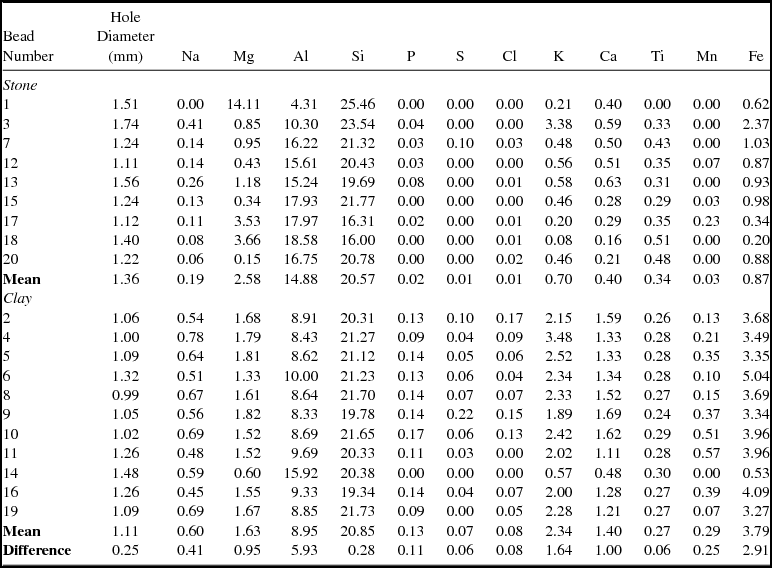
The beads were first examined by Adams using a stereomicroscope and grouped by the features defined by Haury (Reference Haury1931) as characteristic of fired-clay and stone beads. A sample of 20 was selected, representing the range of variation seen among the beads including hole and perimeter edge shapes, color, the presence of inclusions that could be temper, and black around the hole that was perhaps residue left by the grass stem as it burned in an open fire (Table 1; Figure 4).
Results from SEM-EDS Analyses of 20 Sample Beads from the Wetlands Site.

Line drawing of a stone bead and nomenclature identifying the distinctive features. Illustration by Rob Ciaccio.

Backscatter three-dimensional images of both sides of each bead were taken at low power magnification and used to measure the hole diameter. The images also facilitated identification of abrasion marks and a general firing temperature based on clay vitrification (Maniatis and Tite Reference Maniatis and Tite1981:59–68; Tite et al. Reference Tite, Freestone, Meeks, Bimson, Olin and Franklin1982:109–112). Features of the hole were examined through a 200x image taken of the edges around the hole on both sides of the bead. Finally, images were acquired at 1000x of the spots where the EDS was performed, two spots on one side and three spots on the other. This provided information about the chemical variability of the analyzed area.
The elemental data acquired through EDS provided the relative concentrations of elements most likely to vary between clay and the most difficult stone to distinguish from clay, siltstone (Velde Reference Velde1992:42). The raw values for each element were adjusted by combining with oxygen via stoichiometry, because the state of the elements in the samples would be as oxides. The weight percent values were normalized to 100%. Averages and standard deviations for each element in each sample were examined and then compared between the samples.
Results
The combined results from the imaging and chemistry of the 20 samples enabled them to be classified as either fired-clay (n = 10) or stone (n = 10) beads (see Table 1). Only one sample, number 14, had divergent lines of evidence, but the chemistry results are considered correct for reasons discussed below. Knowing the composition of the raw material allows for the documentation of specific technological attributes for fired-clay and stone beads. Among the sampled beads, those identified as stone have a uniform shape with a hole placed almost precisely in the center (Figure 5). The hole and perimeter edges are sharp, and a few stone beads retain abrasions within their holes and on their surfaces. The surfaces of fired-clay beads are often uneven with an off-center hole (see Figure 5). Hole edges and the peripheral edges of fired-clay beads are more rounded than the edges of stone beads, and occasional pits are present along the edges of some fired-clay beads. The attributes of fired-clay beads reflect the malleable clays used in their manufacture. Bead diameters are variable, but as a group, stone beads tend to have larger holes than fired-clay beads (Table 2). The difference in hole configurations reflects the technological difference in hole manufacture with stone beads drilled and fired-clay beads formed around a stalk of grass. Importantly, except hole manufacture, none of these attributes are universal, and stone beads sometimes have attributes thought to belong to fired-clay beads and vice versa.
Photomicrographs (SEM) of (a) stone bead #13 and (b) clay bead #8 taken at 40x magnification by Mary F. Ownby.

Elemental Concentrations and Hole Diameter Measurements for 20 Stone and Fired-Clay Beads Analyzed by SEM-EDS from the Wetlands Site.

Note: All elemental concentrations are reported in weight percent as oxides.
A final technological attribute investigated was the firing temperature of the clay beads. Although analysis of clay mineral sintering from SEM images is a good way to estimate firing temperature, ideally, clay similar to that used for the samples should be fired to various temperatures as control samples and also analyzed by SEM, because the chemical composition of clay will affect the temperature at which vitrification occurs (Tite et al. Reference Tite, Freestone, Meeks, Bimson, Olin and Franklin1982:109). Even without firing a control sample, the overall appearance of the fired-clay beads is consistent with a low firing temperature, causing little vitrification of the clay minerals.
The SEM-EDS chemical data revealed several notable differences in elemental concentrations that are believed to be indicative of clay versus stone composition (Velde Reference Velde1992:42). This was apparent when data from the five spot analyses were averaged for each bead and compared with the other beads (see Table 2). The stone beads typically contained lower levels of elements such as calcium, iron, potassium, and sodium. The fired-clay beads had less aluminum, while the values for silica were similar for both. The differences are likely due to the weathering of parent rock material, the process that creates clay. Stone (in this case probably siltstone) remains in situ with only minor chemical changes; however, the chemistry depends on the parent rock and the type of geologic alteration (Rice Reference Rice1987:35; Velde Reference Velde1992:109–110). Typically, clays are formed from the weathering of feldspars (containing Al, Ca, K, Na, and Si) and micas (containing Al, Ca, Fe, K, Mg, Na, and Si). In the American Southwest, the primary processes are hydration and oxidation, which remove elements in order of their solubility, beginning with sodium, then potassium, calcium, and magnesium (Rice Reference Rice1987:36). These elements become concentrated in the resulting clay. While iron is less soluble, it can be concentrated in oxidizing and acidic conditions (Velde Reference Velde1992:108). Therefore, higher amounts of calcium, iron, potassium, and sodium in some of the beads are considered indicative of the weathering processes that produce clay.
The 20 beads selected for SEM-EDS analysis increased confidence in the use of certain attributes to distinguish stone and fired-clay beads. Most notably: (1) color is not a distinctive attribute, (2) a black hole does not result from firing a tube of clay wrapped around a grass stem, (3) temper is not always added to the clay used to make the beads, and (4) stone can have inclusions that look like temper. As described by Haury (Reference Haury1931), the most useful attributes are hole shape and sharpness of the hole and bead perimeter edges (see Figure 4). Prior to this analysis and the refinement of attributes for accurate identification, Adams correctly identified only 55% of the sample beads using Haury's criteria.
In sum, we have tested visual cues for distinguishing the material type used to manufacture disk beads using nothing more complicated than a binocular microscope. Haury (Reference Haury1931:83) noted the porous texture and circular flow structure of fired-clay beads, the fine-grain texture of stone, and the layered or feathered appearance of shell. We noted the same. The drilled conical or biconical holes of stone and shell beads have sharp edges as well as sharp perimeter edges from being shaped against a netherstone. Fired-clay beads have cylindrical but irregularly round holes from being formed around a grass stem and rounded perimeter edges from being cut from an incised roll of clay (see Figure 2). It is possible that a roll of stone beads could be shaped and incised to create individual beads just like fired-clay beads, but the drilled hole would still be distinctively circular for stone beads. Haury's (Reference Haury1931) observations and analysis techniques from more than 80 years ago still hold value, but modern technology has allowed us to refine the distinctive criteria.
Research with Disk Bead Collections
An opportunity arose to explore the behaviors of imitation and fakery with shell, stone, and fired-clay beads recovered primarily from mortuary contexts at the Wetlands, Honey Bee Village, and Yuma Wash sites (Freeman Reference Freeman1998; Swartz Reference Swartz2016; Wallace Reference Wallace and Wallace2012; Wallace, ed. Reference Wallace and Wallace2012; Wöcherl Reference Wöcherl and Wöcherl2012; Wöcherl, ed. Reference Wöcherl2012). These settlements were long-lived and within 22 km of each other. They were all excavated with the same recovery techniques using small mesh screens, and the beads were all analyzed by the same methods (Adams Reference Adams2014; Adams and Falvey Reference Adams, Falvey and Swartz2016; Adams and Stroud Reference Adams, Stroud and Wallace2012a, Reference Adams, Stroud and Wöcherl2012b).
The earliest settlement at Wetlands dates to the Early Cienega phase (800–400 BC), but later Hohokam burials were found dating to the Late Rincon phase (AD 1100–1150). The child buried with beads at Wetlands was accompanied by 6,427 beads (Adams and Stroud Reference Adams, Stroud and Wallace2012a). Distribution of the disk beads around the child led the excavators to conclude they had been attached to a garment (Wöcherl Reference Wöcherl2012:28–29).
Honey Bee Village and Yuma Wash are large Hohokam villages with complex settlement structures and dedicated cemeteries. Settlement at Yuma Wash began earlier than at Honey Bee Village, with people living at Yuma Wash during the San Pedro phase (1200–800 BC) and continuing sporadically until the Classic period (AD 1150–1450), when there was a large occupation. Honey Bee Village was inhabited beginning in the Tortolita phase, about AD 650, and continuing into the Classic period until about AD 1200. While fired-clay beads were found only in mortuary contexts at these settlements, stone and shell disk beads were found in a few nonmortuary contexts at Yuma Wash and Honey Bee Village. Unfinished beads and beads that broke during manufacture are the best direct evidence for local manufacture of stone and shell disk beads at both sites (Adams and Falvey Reference Adams, Falvey and Swartz2016; Adams and Stroud Reference Adams, Stroud and Wallace2012a; Vokes Reference Vokes and Wallace2012; Vokes and Adams Reference Vokes, Adams and Swartz2016).
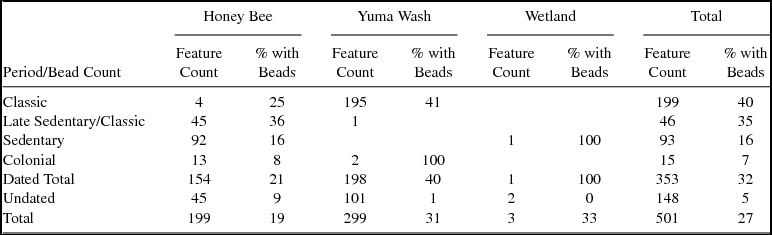
For most of their duration, the Yuma Wash and Honey Bee Village settlements were not contemporary (Table 3). At Honey Bee Village, most of the burials dated to the Sedentary and late Sedentary/early Classic periods, and of these, only 16% and 36%, respectively, had beads. Burials at Yuma Wash dated to the Classic period except for three earlier burials that lacked beads. Beads were included in 41% of Classic period burials, so either burial with beads became more common through time or people at Honey Bee Village and Yuma Wash had different preferences in their burial practices. Hohokam presence at the Wetlands site occurred before people were at Yuma Wash, and too few burials have been recovered to recognize patterns in burial practices there (see Table 3).
Temporal Distribution of Hohokam Burials at Three Sites in the Tucson Basin.

Who Was Buried with Beads
Not everyone was buried with disk beads (Figure 6). Disk beads were included with 31% of the people buried at Yuma Wash and 19% of the people buried at Honey Bee Village (see Table 3). More than 13,000 disk beads were counted from Yuma Wash, including 3,101 of stone, 1,863 of fired clay, and 8,041 of shell. At Honey Bee Village, 777 disk beads included 478 of fired clay, 224 of stone, and 75 of shell (Supplemental Table 1). The count of disk beads included in burial features at Honey Bee Village ranged from 1 to 151 and at Yuma Wash from 1 to 1,749, but for each site the median of all disk beads is less than 10 and the mode is 1. The number of beads placed with burials at both sites does not form a normal distribution. People were buried with beads in various configurations of material type: fired clay only, stone only, shell only, fired clay and stone, fired clay and shell, and fired clay, stone, and shell (Supplemental Figure 2).
Frequency of adults, children, and infants/neonates buried with and without beads at Yuma Wash (YW), Honey Bee (HB), and Wetlands (WL).

The categories used to discuss age-at-death have been defined elsewhere, and here the groups are adults, children, and neonate/infants (Cerezo-Román Reference Cerezo-Román2015:359; Wallace and Swartz Reference Wallace, Swartz and Wallace2012:635, Reference Wallace, Swartz and Swartz2016:862). The few burials with more than one individual in the grave are labeled as mixed burials.
The Wetlands child was approximately one year old when buried with 5,712 fired-clay beads and 715 stone beads (Adams and Stroud Reference Adams, Stroud and Wallace2012a; Wöcherl Reference Wöcherl and Wöcherl2012). The few shell beads buried with the child were not disks but rather whole Nassarius shells (Virden-Lange Reference Virden-Lange and Wöcherl2012:Table 9.5). It is this configuration of disk beads that led us to question the reasons for including fired-clay beads in burial contexts.
At Yuma Wash, more adults and children were buried with disk beads than without them (see Supplemental Table 1). Fired-clay beads were found more often with stone and shell beads than any other combination in burials of adults, children, and neonate/infants (Figure 7). One or two individuals in each of these age groups were buried with less than 10 fired-clay beads and nothing else; the exception was one adult who was buried with 77 fired-clay beads only. At Honey Bee Village, more adults, children, and infants/neonates were buried without disk beads, but those buried with beads were more commonly buried with only stone beads. Burials with only fired-clay beads at Honey Bee Village included one infant and three adults and, as at Yuma Wash, the bead count is less than 10 except for a single adult buried with 86 fired-clay beads. Only six adults and one infant/neonate at Honey Bee Village were buried with mixed media beads that included fired clay. Burials of children included either only stone or stone and shell disk beads. At both settlements, age was apparently not a requirement for burial with beads, and for the most part, fired-clay beads were included without age restriction.
Frequency of adults, children, and infants/neonates buried with beads of various material types at Yuma Wash (YW), Honey Bee (HB), and Wetlands (WL).

Postmortem Treatment and Bead Configurations
Postmortem treatment at both Yuma Wash and Honey Bee Village included inhumation and cremation. Disk beads were found in 32% of the 74 cremations and 29% of the 20 inhumations at Yuma Wash. Among the 177 cremations at Honey Bee Village, 20% had disk beads. Only one of 22 Honey Bee Village inhumations had disk beads. Acknowledging that some ornaments could have been destroyed in cremation fires, we treat the beads recovered from each burial at Honey Bee Village and Yuma Wash as representative of the bead types buried with the deceased.
Whether they were inhumed or cremated, beads of every conceivable material configuration were buried with individuals at Yuma Wash except clay and stone beads, which were not found together in inhumations (see Figure 8). At Honey Bee Village, every material configuration was among cremations except for the combination of clay and shell beads. A token of two fired-clay beads was placed with the inhumation of an infant, which was the only inhumation at Honey Bee Village with beads. Collectively, fired-clay beads are 17% of the disk beads recovered from the sites represented in both cremations and inhumations, albeit sparsely represented among Honey Bee Village inhumations.
Frequency of inhumations and cremations with beads of various material types at Yuma Wash (YW), Honey Bee (HB), and Wetlands (WL).

The number of beads included with an individual probably depended on whether they were added as necklaces, bracelets, attached to a garment, or added as loose beads. Five inhumations and one cremation from Yuma Wash included composite pieces (Hall et al. Reference Hall, Whitney, Copperstone, Whitaker, Margolis, Swartz, Lindeman and Swartz2015). An armband of red fired-clay beads and a necklace of shell and fired-clay beads were buried with one infant. Clusters of fired-clay and stone beads with two infants were probably strung together as necklaces. A concentration of 315 stone beads was probably from a necklace buried with a neonate. More than 300 stone beads, a stone pendant, and 750 shell beads were probably a necklace buried with an adult. A rare burial of a cremated infant included gray stone beads, some of which were formed into wedges that, when strung, create a tight U-shaped line of beads around the bottom of a necklace or bracelet that was with the infant through the cremation fire (Supplemental Figure 1).
These examples of composite pieces are helpful but not for the same reason as for burials with less than 10 beads. The fact that more individuals were buried without beads at Honey Bee Village (81%) and at Yuma Wash (69%) leads us to propose that burial with disk beads was important only to certain people and that the age of the deceased or whether the burial was a cremation or an inhumation did not matter.
Our original interest in the distribution of disk bead types in mortuary contexts was to determine if there were patterns of bead use that indicate how fired-clay beads were incorporated into mortuary ritual. Writing about beads that are made for modern use in the fashion industry or sold to collectors, Liu (Reference Liu2001:24) notes, “The line between imitation and fake is dependent upon both intent to deceive and the degree of knowledge of the observer.” Fakes are fraudulent misrepresentations. Cultural substitutes, replicas, and artist-made representations have more benign intentions, and among ancient jade bead making traditions, substitutes were accepted as “cultural jade” (Liu Reference Liu2001:1).
The patterns we have investigated suggest fired-clay beads were accepted as “cultural stone” that could be interred with the deceased as if they were stone. The previously mentioned experiments that provide time estimates for making disk beads provide perspective about how much more efficient it is to make fired-clay beads that look like stone than it is to make stone beads. Thus, it is not the material of the beads but rather the symbology of the beads that is significant.
Beads as Social Symbols
The creation of an object like a bead, a necklace, a pot, or a tool is personal to the extent that some personal quality is forever a part of that object. As the object moves through a variety of sociocultural engagements, everyone involved contributes their own personal quality to the object, thereby linking the group (Chapman Reference Chapman2000:5–6, 37–47; Chapman and Gaydarska Reference Chapman2007:8; Mills Reference Mills and Crown2000:337, Reference Mills2004, Reference Mills, Mills and Walker2008; Weiner Reference Weiner1992:26, 33). This enchainment extends to fragments of the whole so that each piece of a broken object, each part of a set, and each bead in a necklace stands not only for the whole object but also for the entire group or the entire performance that controls the object and its meaning (Chapman Reference Chapman2000:37–41). Similarly, humans are at once unique individuals and similar parts of large, composite social relationships such as families, social groups, and villages.
Symbology is the art of expression by symbols. The proper application of symbology is the purview of specialists who are knowledgeable and who have the power to create social memories that perpetuate the ritual, any ritual, be it medicinal, procreational, birthing, marital, or postmortem. Parsons's (Reference Parsons1939:299) description of the use of beads to represent a sick woman during a dance for her at Laguna Pueblo demonstrates the enchained nature of beads where the part (loose beads) can represent the whole (person, social group). A nineteenth-century description of the cremation of a Piman warrior in Arizona noted that beads were sacred and were added by mourners to the objects burned with the warrior's body (Kroeber and Fontana Reference Kroeber and Fontana1986:99–100).
Similarly, beads were part of a postburial ritual performed by the Sia (Zia) of New Mexico (White Reference White1962:216–218, Figure 25). The description of the burial, especially the timing, preparation of the body, and burial in a church yard, is infused with postcontact, Christian ritual practices, but the postburial ritual performed by traditional society members over four days is informative.
Right after the body has been taken out for burial, the mother, mother's mother, or eldest sister of the deceased puts a sheep skin on the floor where the deceased had lain and upon this she places an ear of corn, symbolizing “the living breath,” a stick that has been used to poke or stir the fire (opaiyakanyi), which symbolizes the dead body, and a heap of beads (itsatyunyi) of different kinds, the symbolism of which could not be ascertained. . . . The little pile of beads was covered with a sheet. Candles were kept burning day and night. When anyone from the outside the household comes into the room he takes a pinch of prayer meal with his left hand and a pinch of pollen with his right and sprinkles them on the sheet covering the beads [White Reference White1962:216].
The description goes on to relate that the beads were removed from the sheepskin at the end of a four-day ritual by the appropriate society members who took the paraphernalia from the floor of the house and carried it to the edge of the village with the soul of the deceased in tow (White Reference White1962:217). Other rituals involving food and relatives continue for several days, after which the deceased is declared dead. Unfortunately, the account does not say anything about the meaning and final deposition of the beads.
In another social context, the positioning of burials with beads in Chumash cemeteries was used to infer that the deceased had associations with powerful social organizations that owned canoes and controlled trade (Gamble et al. Reference Gamble, Walker and Russell2001:196–197). Gamble and colleagues (Reference Gamble, Walker and Russell2001:200–201) concluded that age-at-death was not a determinant of who received beads, but rather the inclusion of beads was related to “familial relationships.” Through time, both before and after contact with Europeans, a few Chumash children were buried with more beads than anyone else. One child was buried with more than 4,000 beads, which is reminiscent of the child at Wetlands. Consistent with mortuary behavior at Honey Bee Village and Yuma Wash, some California Chumash were buried with hundreds of shell beads, while most people were buried without any beads (Gamble Reference Gamble, Sassaman and Holly2011:241).
The society members described above by White (Reference White1962:217) for Sia (Zia) rituals and by Gamble (Reference Gamble, Sassaman and Holly2011:230) and Hollimon (Reference Hollimon and Chesson2001:43, 47) for the Chumash are specialists with socially specific knowledge about the symbology of beads. They demonstrate that an individual bead can represent something larger than itself and that beads were part of a memorializing process orchestrated by people who knew the proper symbology for bead use.
For some portion of the population at both Honey Bee Village and Yuma Wash, disk beads were an important part of their burial. In our opinion, inclusion of fired-clay beads in burial contexts is consistent with imitation to uphold a standing tradition of a particular social group comprised of all ages and irrespective of beliefs about how the body of a deceased person should be buried. We suggest that making fired-clay beads in imitation of stone beads was an expedient technique for making the required beads to represent individuals comprising the whole of the social group. Bead material type was not as important as bead presence. This connection was maintained even in death and among groups who believed in such distinctly different postmortem treatments of the dead. Whether or not their inclusion was also associated with status or the appearance of wealth remains ambiguous but seems to us less likely than their being associated with a particular social group.
Acknowledgments
We are thankful that permission to conduct special analyses on a small sample of beads from mortuary contexts was given by Peter L. Steere, the Tohono O'Odham Nation Historic Preservation Officer. The SEM-EDS study was conducted at the University of Arizona, Department of Geosciences, using an instrument acquired with funds from the U.S. ARRA Program through the NSF EAR Instrumentation and Facilities Program (NSF EAR-0929777). Assistance with the instrument was provided by Chen Li. Thanks to Rob Ciaccio who drafted the line drawings and to Catherine Gilman for the map. We appreciate the efforts of William Gillespie with research and comments on earlier versions of this paper. Thanks also to Glen Rice and four anonymous reviewers for their comments.
Data Availability Statement
The artifacts examined in this study are curated at the Arizona State Museum. The SEM-EDS images and data are held by M. Ownby and are available upon request. The data on the beads from the Yuma Wash, Honey Bee Village, and Wetlands sites are held by J. Adams and are also available in Adams and Falvey (Reference Adams, Falvey and Swartz2016) and Adams and Stroud (Reference Adams, Stroud and Wallace2012a, Reference Adams, Stroud and Wöcherl2012b).
Supplemental Materials
For supplementary material accompanying this paper, visit https://doi.org/10.1017/aaq.2018.24.
Supplemental Figure 1. Line drawing of wedge beads found with the cremated remains of an infant. Illustration by Rob Ciaccio.
Supplemental Figure 2. Combined frequency of burials at Yuma Wash, Honey Bee Village, and Wetlands with beads of various material types.
Supplemental Table 1. Accounting of Disk Beads by Burial Type and Age Group at Two Tucson Basin Sites.