1. Introduction
Resource-limited, morphologically rich languages pose many challenges to natural language processing (NLP) tasks. The highly inflected surface forms of these languages inflate the vocabulary size and increase sparsity in an already scarce data situation. NLP in general, and machine translation (MT) in particular, can greatly benefit from unsupervised learning approaches to vocabulary reduction, such as unsupervised morphological segmentation. Dialectal Arabic (DA) is an iconic representative of such languages: it has limited parallel and task-specific labeled data, and its large vocabulary is the result of its rich inflectional morphology and unstandardized spontaneous orthography. While these dialects have been historically primarily spoken, they are quite frequently written in social media today. The scarcity of DA parallel and labeled text is more pronounced when considering the large number of dialects and subdialects, the varying levels of dialectness and code switching, the diversity of domains and genres, and the timespan of the collected text. Hence, the need for unsupervised learning solutions to vocabulary reduction that use a more sustainable and continuously fresh source of training data arises, namely monolingual data. In this work, we utilize huge collections of monolingual Arabic text along with limited DA–English parallel data to improve the quality of DA-to-English MT.
We propose an unsupervised learning approach to morphological segmentation consisting of three successive systems. The first system uses word embeddings learned from huge amounts of monolingual Arabic text to extract and extend a list of possible segmentation rules for each vocabulary word and scores these rules with an expectation maximization (EM) algorithm. The second system uses the learned segmentation rules in another EM algorithm to label select DA words in DA–English parallel text with the best segmentation choice based on the English alignments of the word segments. Finally, the third system implements a supervised segmenter by training an averaged structured perceptron (ASP) on the automatically labeled text. The three systems can be used independently for other purposes. We evaluate the performance of our segmenter intrinsically on a portion of the labeled text and extrinsically on MT quality.
2. DA challenges
Contemporary Arabic is a collection of varieties: Modern Standard Arabic (MSA), which has a standard orthography and is used in formal settings, and DAs, which are commonly used informally and with increasing presence on the web, but which do not have standard orthographies. There are several DA varieties which are identified primarily by geography, for example, Gulf Arabic, Levantine Arabic, Egyptian Arabic. (Habash Reference Habash2010). DAs differ from MSA phonologically, morphologically, and to some lesser degree syntactically. The differences between MSA and DAs have often been compared to Latin and the Romance languages (Habash Reference Habash2006).
On Arabic morphology and orthography. In the context of this article, we focus on two challenging areas for modeling Arabic: morphology and orthography. Morphologically, Arabic (MSA and DA) has a rich inflectional system, expressed both templatically and affixationally, and several classes of attachable clitics. For instance, the Levantine Arabic word  w+H+y-ktb-w+hA Footnote a “and they will write it” has two proclitics (+
 w+ “and” and +
 H+ “will”), one prefix
 y- “3rd person,” one suffix
 -w “plural,” and one pronominal enclitic
 + +hA “it/her.” Orthographically, Arabic is written with optional diacritics that specify short vowels, consonantal doubling, and the nunation morpheme (Habash Reference Habash2010). The diacritics are almost never written outside of the domains of religious text, children’s books, and non-native learners’ textbooks. The almost universal absence of these diacritics together with the language’s rich morphology lead to a high degree of ambiguity, for example, the Buckwalter Arabic Morphological Analyzer (Bama) produces an average of 12 analyses per word (Buckwalter Reference Buckwalter2004). Moreover, some Arabic letters are often spelled inconsistently which leads to an increase in both sparsity (multiple forms of the same word) and ambiguity (same form corresponding to multiple words), for example, variants of Hamzated Alif,
 > or,
 are often written without their Hamza
 A; and the Alif-Maqsura (or dotless Ya)
 Y and the regular dotted Ya
 y are often used interchangeably in word final position (El Kholy and Habash Reference Habash2010). Furthermore, in the case of DA, there are no orthographic standards; as such, there is a huge problem with orthographic variants causing model sparsity, for example, Habash et al. (Reference Habash, Eryani, Khalifa, Rambow, Abdulrahim, Erdmann, Faraj, Zaghouani, Bouamor, Zalmout, Hassan, Shargi, Alkhereyf, Abdulkareem, Eskander, Salameh and Saddiki2018) report on a single Egyptian word encountered online in 27 spellings.
NLP challenges. Arabic’s complex morphology and high degree of ambiguity are usually handled through preprocessing using tools for analysis, disambiguation, and tokenization (Habash and Rambow Reference Habash and Rambow2005; Diab et al. Reference Diab, Hacioglu and Jurafsky2007; Pasha et al. Reference Pasha, Al-Badrashiny, Diab, El Kholy, Eskander, Habash, Pooleery, Rambow and Roth2014; Abdelali et al. Reference Abdelali, Darwish, Durrani and Mubarak2016; Khalifa et al. Reference Khalifa, Zalmout and Habash2016; Zalmout and Habash Reference Zalmout and Habash2017a). The lack of standard orthographies for the dialects and their numerous varieties cause new challenges to NLP (Habash et al. Reference Habash, Diab and Rabmow2012c; Eskander et al. Reference Eskander, Habash and Rambow2013; Habash et al. Reference Habash, Eryani, Khalifa, Rambow, Abdulrahim, Erdmann, Faraj, Zaghouani, Bouamor, Zalmout, Hassan, Shargi, Alkhereyf, Abdulkareem, Eskander, Salameh and Saddiki2018). DAs are rather impoverished in terms of available tools and resources compared to MSA, for example, there is very little parallel DA–English corpora and almost no MSA–DA parallel corpora. The number and sophistication of morphological analysis and disambiguation tools in DA is very limited in comparison to MSA (Duh and Kirchhoff Reference Duh and Kirchhoff2005; Habash and Rambow Reference Habash and Rambow2006; Abo Bakr et al. Reference Abo Bakr, Shaalan and Ziedan2008; Habash et al. Reference Habash, Eskander and Hawwari2012a; Khalifa et al. Reference Khalifa, Hassan and Habash2017) MSA tools cannot be effectively used to handle DA: Habash and Rambow (Reference Habash and Rambow2006) report that less than two-thirds of Levantine verbs can be analyzed using an MSA morphological analyzer; and Habash et al. (Reference Habash, Eskander and Hawwari2012a) report that 64% of Egyptian Arabic words are analyzable using an MSA analyzer.
In this article, we present an approach that minimizes the requirement of developing morphological preprocessing tools for DA through exploiting readily available monolingual corpora and (limited but relatively easy to obtain) parallel corpora. Our approach is easily reusable for other languages and dialectal varieties, and it can be applied to a variety of genres and domains that may be relatively poor even for standardized languages.
3. Related work
3.1 Dialectal Arabic natural language processing
Extending MSA resources. Much work has been done in the context of MSA NLP (Habash Reference Habash2010). Specifically for Arabic-to-English statistical machine translation (SMT), the importance of tokenization using morphological analysis has been shown by many researchers (Habash and Sadat Reference Habash and Sadat2006). For the majority of Arabic dialects, dialect-specific NLP resources are nonexistent or in their early stages. Several researchers have explored the idea of exploiting existing MSA-rich resources to build tools for DA NLP, for example, Chiang et al. (Reference Chiang, Diab, Habash, Rambow and Shareef2006) built syntactic parsers for DA trained on MSA treebanks. Such approaches typically expect the presence of tools/resources to relate DA words to their MSA variants or translations. Given that DA and MSA do not have much in terms of parallel corpora, rule-based methods to translate DA to MSA or other methods to collect word pair lists have been explored. For example, Abo Bakr et al. (Reference Abo Bakr, Shaalan and Ziedan2008) introduced a hybrid approach to transfer a sentence from Egyptian Arabic into MSA. This hybrid system consisted of a statistical system for tokenizing and tagging, and a rule-based system for constructing diacritized MSA sentences. Moreover, Al-Sabbagh and Girju (Reference Al-Sabbagh and Girju2010) described an approach of mining the web to build a DA-to-MSA lexicon. In the context of DA-to-English SMT, Riesa and Yarowsky (Reference Riesa and Yarowsky2006) presented a supervised algorithm for online morpheme segmentation on DA that cut the out-of-vocabulary words (OOVs) by half.
DA morphological analysis. By comparison to MSA, only a few efforts have targeted DA morphology (Kilany et al. Reference Kilany, Gadalla, Arram, Yacoub, El-Habashi and McLemore2002; Habash and Rambow Reference Habash and Rambow2006; Abo Bakr et al. Reference Abo Bakr, Shaalan and Ziedan2008; Salloum and Habash Reference Salloum and Habash2011; Mohamed et al. Reference Mohamed, Mohit and Oflazer2012; Habash et al. Reference Habash, Eskander and Hawwari2012a; Hamdi et al. Reference Hamdi, Boujelbane, Habash and Nasr2013; Khalifa et al. Reference Khalifa, Hassan and Habash2017; Samih et al. Reference Samih, Eldesouki, Attia, Darwish, Abdelali, Mubarak and Kallmeyer2017a; Samih et al. Reference Samih, Attia, Eldesouki, Abdelali, Mubarak, Kallmeyer and Darwish2017b; Zalmout and Habash Reference Zalmout and Habash2019). Efforts for modeling DA morphology generally fall into two camps. First are solutions that focus on extending MSA tools to cover DA phenomena. For example, Abo Bakr et al. (Reference Abo Bakr, Shaalan and Ziedan2008) and Salloum and Habash (Reference Salloum and Habash2011) extended the Bama/Sama databases (Buckwalter Reference Buckwalter2004; Graff et al. Reference Graff, Maamouri, Bouziri, Krouna, Kulick and Buckwalter2009) to accept DA prefixes and suffixes. These solutions are fast and cheap to implement but are limited in their modeling of DA linguistic phenomena. The second camp is interested in modeling DA directly. The earliest effort on Egyptian that we know of is the Egyptian Colloquial Arabic Lexicon (Kilany et al. Reference Kilany, Gadalla, Arram, Yacoub, El-Habashi and McLemore2002). This resource was the base for developing the CALIMA Egyptian morphological analyzer (Habash et al. Reference Habash, Eskander and Hawwari2012a). Another effort is the work by Habash and Rambow (Reference Habash and Rambow2006) which focuses on modeling DAs together with MSA using a common multi-tier finite-state machine framework. Eskander et al. (Reference Eskander, Habash and Rambow2013) presented a method for automatically learning inflectional classes and associated lemmas from morphologically annotated corpora. Hamdi et al. (Reference Hamdi, Boujelbane, Habash and Nasr2013) takes advantage of the closeness of MSA and its dialects to build a translation system from Tunisian Arabic verbs to MSA verbs. Eskander et al. (Reference Eskander, Habash, Rambow and Pasha2016) presented an approach to annotating words with a conventional orthography, a segmentation, a lemma, and a set of features. They use these annotations to predict unseen morphological forms, which are used, along with the annotated forms, to create a morphological analyzer for a new dialect. The second approach to modeling Arabic dialect morphology results in better quality morphological analyzers compared to the shallow techniques presented by the first camp. However, they are expensive and need a lot more resources and efforts. Furthermore, they are harder to extend to new dialects since they require annotated training data and/or handwritten rules for each new dialect.
Morphological tokenization for MT. Reducing the size of the vocabulary by tokenizing morphologically complex words proves to be very beneficial for any statistical NLP system in general, and MT in particular. Sadat and Habash (Reference Sadat and Habash2006) explored a number of tokenization schemes for Arabic when translating to English (one scheme at a time). However, Zalmout and Habash (Reference Schone and Jurafsky2017b) experimented with different tokenization schemes for different words in the same Arabic text. Their work showed that these different target languages (English, French, Spanish, Russian, and Chinese) require different Arabic (source) language tokenization schemes. It also showed that combining different tokenization options while training and decoding the SMT system improves the overall performance. The work we present in this article is similar to their work in that the segmentation of a word is influenced by the target language (in our case English) and this can change if the target language changes. We differ from that work in that we do not use predetermined tokenization schemes or combine them; instead, we learn to segment words, and that segmentation is dependent on the word itself and its context.
3.2 MT of dialects
Dialects present many challenges to MT due to their spontaneous, unstandardized nature, and the scarcity of their resources. In this section, we discuss different approaches to handle dialects in the context of MT.
MT for closely related languages. Using closely related languages has been shown to improve MT quality when resources are limited. Hajič et al. (Reference Hajič, Hric and Kubon2000) argued that for very close languages, for example, Czech and Slovak, it is possible to obtain a better translation quality using simple methods, such as morphological disambiguation, transfer-based MT, and word-for-word MT. Zhang (Reference Zhang1998) introduced a Cantonese–Mandarin MT that uses transformational grammar rules. In the context of Arabic dialect translation, Sawaf (Reference Sawaf2010) built a hybrid MT system that uses both statistical and rule-based approaches for DA-to-English MT. In his approach, DA is normalized into MSA using a dialectal morphological analyzer. In this work, we present a rule-based DA–MSA system to improve DA-to-English MT. Our approach used a DA morphological analyzer (Adam) and a list of handwritten morphosyntactic transfer rules. This use of “resource-rich” related languages is a specific variant of the more general approach of using pivot/bridge languages (Kumar et al. Reference Kumar, Och and Macherey2007; Utiyama and Isahara Reference Utiyama and Isahara2007). In the case of MSA and DA variants, it is plausible to consider the MSA variants of a DA phrase as monolingual paraphrases (Callison-Burch et al. Reference Callison-Burch, Koehn and Osborne2006; Du et al. Reference Du, Jiang and Way2010). Also related is the work by Nakov and Ng (Reference Nakov and Ng2011), who use morphological knowledge to generate paraphrases for a morphologically rich language, Malay, to extend the phrase table in a Malay-to-English SMT system.
DA-to-English MT. Two approaches have emerged to alleviate the problem of DA–English parallel data scarcity: using MSA as a bridge language (Sawaf Reference Sawaf2010; Salloum and Habash Reference Salloum and Habash2011; Salloum and Habash Reference Salloum and Habash2013; Sajjad et al. Reference Sajjad, Darwish and Belinkov2013) and using crowdsourcing to acquire parallel data (Zbib et al. Reference Zbib, Malchiodi, Devlin, Stallard, Matsoukas, Schwartz, Makhoul, Zaidan and Callison-Burch2012). Sawaf (Reference Sawaf2010) and Salloum and Habash (Reference Salloum and Habash2013) used hybrid solutions that combine rule-based algorithms and resources such as lexicons and morphological analyzers with statistical models to map DA to MSA before using MSA-to-English MT systems. Sawaf (Reference Sawaf2010) classified words into 15 dialects plus MSA as part of the mapping process to MSA. Sawaf (Reference Sawaf2010) and Salloum and Habash (Reference Salloum and Habash2013) achieve around 1.6% and 1.4% BLEU point increases, respectively, over a baseline that does not map DA to MSA.
Pivoting approaches. Sawaf (Reference Sawaf2010) built a hybrid MT system that uses both statistical and rule-based approaches to translate both DA and MSA to English. In his approach, DA is normalized into MSA using a character-based normalizer, MSA and DA-specific morphological analyzers, and a class-based n-gram language model to classify words into 16 dialects (including MSA). These components produce a lattice annotated with probabilities and morphological features (part-of-speech, stem, gender, etc.), which is then n-best decoded with character-based and word-based, DA and MSA language models. The 1-best sentence is then translated to English with the hybrid MT system. He also showed an improvement of up to 1.6% BLEU by processing the SMT training data with his technique. Salloum and Habash (Reference Salloum and Habash2011; Reference Salloum and Habash2012) and Sajjad et al. (Reference Sajjad, Darwish and Belinkov2013) applied character-level transformation to reduce the gap between DA and MSA. This transformation was applied to Egyptian Arabic to produce EGY data that looks similar to MSA data. They reduced the number of OOV words and spelling variations and improved translation output.
Cheaply obtaining DA–English parallel data. Zbib et al. (Reference Zbib, Malchiodi, Devlin, Stallard, Matsoukas, Schwartz, Makhoul, Zaidan and Callison-Burch2012) demonstrated an approach to cheaply obtain DA–English data via Amazon’s Mechanical Turk (MTurk). They created a DA–English parallel corpus of 1.5M words and used it along with a 150M MSA–English parallel corpus to create the training corpora of their SMT systems. They found that the DA–English system outperforms the DA+MSA–English even though the ratio of DA data size to MSA data size is 1:100. They concluded that simple vocabulary coverage is not sufficient and the domain mismatch is a more important problem. Similar to Zbib et al. (Reference Zbib, Malchiodi, Devlin, Stallard, Matsoukas, Schwartz, Makhoul, Zaidan and Callison-Burch2012), in this work, we add 3.5M words DA–English parallel data to their 1.5M words data and we build three SMT systems such as DA–English, MSA–English, and DA+MSA–English where the ratio of DA data size to MSA data size becomes 1:10.
3.3 Supervised learning approaches to morphological segmentation
Supervised learning techniques, like Mada, Mada-Arz, and Amira (Habash and Rambow Reference Habash and Rambow2005; Diab et al. Reference Diab, Hacioglu and Jurafsky2007; Habash et al. Reference Habash, Roth, Rambow, Eskander and Tomeh2013; Pasha et al., Reference Pasha, Al-Badrashiny, Diab, El Kholy, Eskander, Habash, Pooleery, Rambow and Roth2014), have performed well on the task of morphological tokenization for Arabic MT. They require handcrafted morphological analyzers, such as SAMA (Graff et al. Reference Graff, Maamouri, Bouziri, Krouna, Kulick and Buckwalter2009) or CALIMA (Habash et al. Reference Habash, Eskander and Hawwari2012b) in addition to treebanks to train tokenizers. Using the analyzer, the system turns an input sentence into a lattice of analyses that can be decoded using a context-sensitive model trained on the manually annotated treebank. This is expensive and time-consuming and thus hard to scale to different dialects. Alongside the work on DA morphological tokenization, there has been work on dialectal segmentation. Most recently, some neural models have been achieving good performance without the need to create linguistically motivated analyzers. For example, in Samih et al. (Reference Samih, Eldesouki, Attia, Darwish, Abdelali, Mubarak and Kallmeyer2017a, b), the authors propose a dialectal segmentation model using a deep learning-based, character-level sequence tagger. The model uses character embeddings fed into a bidirectional LSTM layer followed by a CRF layer that computes the probability distribution over the output tags. The model rivals Madamira-Egy on Egyptian and outperforms an SVM ranker on Levantine, Gulf, and Maghribi dialects. Most recently, Zalmout and Habash (Reference Zalmout and Habash2019) presented a joint multi-feature cross-dialectal morphological disambiguation model for MSA and Egyptian Arabic using adversarial training for cross-dialectal morphological knowledge transfer. Their models achieve state-of-the-art results for both Arabic variants.
3.4 Unsupervised learning approaches to morphological segmentation
Given the wealth of unlabeled monolingual text freely available on the Internet, many unsupervised learning algorithms (Creutz and Lagus Reference Creutz and Lagus2002; Stallard et al. Reference Stallard, Devlin, Kayser, Lee and Barzilay2012; Narasimhan et al. Reference Narasimhan, Barzilay and Jaakkola2015) took advantage of it and achieved outstanding results, although not to a degree where they outperform supervised methods, at least on DA to the best of our knowledge. Traditional approaches to unsupervised morphological segmentation, such as Morfessor (Creutz and Lagus Reference Creutz and Lagus2002; Creutz and Lagus Reference Creutz and Lagus2007), use orthographic features of word segments (prefix, stem, and suffix). However, many researchers worked on integrating semantics in the learning of morphology (Schone and Jurafsky Reference Schone and Jurafsky2000; Narasimhan et al. Reference Narasimhan, Barzilay and Jaakkola2015), especially with the advances in neural network-based distributional semantics (Narasimhan et al. Reference Narasimhan, Barzilay and Jaakkola2015). Most recently, Erdmann et al. (Reference Erdmann, Khalifa, Oudah, Habash and Bouamor2019) presented a linguistically motivated alternative to greedy or other unsupervised methods, requiring only minimal language-specific input with large unannotated corpora. In their evaluations, they consistently outperform competitive unsupervised baselines and approach the performance of state-of-the-art models such as MADAMIRA (Pasha et al. Reference Pasha, Al-Badrashiny, Diab, El Kholy, Eskander, Habash, Pooleery, Rambow and Roth2014) and Farasa (Abdelali et al. Reference Abdelali, Darwish, Durrani and Mubarak2016).
In this work, we leverage the use of both approaches. We implement an unsupervised learning approach to automatically create training data which we use to train supervised algorithms for morphological segmentation. Our approach incorporates semantic information from two sources, Arabic (through monolingual data) and English (through parallel data), along with linguistic features of the source word and its target segments to learn a morphological segmenter.
4. Our approach to unsupervised segmentation
Inspired by the supervised tokenization approaches discussed above (Habash and Rambow Reference Habash and Rambow2005; Habash et al. Reference Habash, Roth, Rambow, Eskander and Tomeh2013; Pasha et al. Reference Pasha, Al-Badrashiny, Diab, El Kholy, Eskander, Habash, Pooleery, Rambow and Roth2014), our approach to unsupervised morphological segmentation consists of three components with strong parallels to the supervised methodology:
1. Monolingual identification of segmentation rules. In this component, we build a system that learns Arabic segmentation rules from monolingual text using distributional semantics (Section 5). This component is analogous to a morphological analyzer in that it produces out-of-context segmentation options.
2. Alignment guided segmentation choice. In this component, we build a system that creates synthetic segmentations of Arabic words in a way that optimizes their alignment with English words in a parallel text (Section 6). This component effectively incorporates English semantics in choosing the best in-context segmentation of an Arabic word in a sentence. This is strongly analogous to manual human annotation. However, it is cheaper in that it does require special training to do annotation for the specific NLP task of segmentation. It is also more flexible and tunable, since different approaches to MT or different target languages may require optimizing for different segmentation choices.
3. Supervised segmentation using synthetic data. Starting from the automatically segmented (labeled) data created by the previous component, we train a tagger that learns to score all possible segmentations for a given word in a sentence (Section 7).
One challenge to this approach is that the automatic labeling of words will introduce errors that will affect the quality of the supervised segmenter. To reduce the number of errors in the automatically labeled data, we only label words when the system has a high confidence in its decision. This will result in many unlabeled words in a given sentence that raises another challenge to the supervised segmenter which we solve by modifying the training algorithm.
The underlying assumption of this approach is that if the unsupervised labeling process does not cover all words in the vocabulary, the supervised segmenter will learn to generalize to the missed words and OOVs. We evaluate this approach on two Arabic dialects: Egyptian and Levantine. The next three sections discuss the three systems used in this approach and present the experimental setup, examples, and discussion.
5. Monolingual identification of segmentation rules
Given a word out of context, we would like to generate a ranked list of possible segmentations of it. For example, the word  mAtjwzt “I-did-not-marry” should be ideally segmentable into
 mA tjwzt,
 or mA tjwz t but not
 mAtj wzt (a nonsensical segmentation). Our approach to learn segmentation rules from monolingual data consists of three steps: word clustering, rule learning, and rule scoring.
5.1 Word clustering based on word embeddings
We learn word vector representations (word embeddings) from huge amounts of monolingual Arabic untokenized text using Word2Vec (Mikolov et al., Reference Mikolov and Chen2013). For every Arabic word x, we then compute the closest N words using cosine distance (with cosine distance above threshold  $D_a$). We consider these N words to be x’s semantic cluster. Every cluster has a source word. It is important to mention that a word x might appear in y’s cluster but not vice versa.
After a manual error analysis of the data, we picked a high cosine distance threshold  $D_a=0.35$, since we need only words that we have high confidence in their belonging to a cluster in order to produce high-quality segmentation rules. This high threshold results in many words having small or even empty clusters. In small clusters, the main word will not have enough segmentation rules, limiting the possibility of identifying the optimal segmentation in the next step. For example, the word
 mAtjwzt “I-did-not-marry” might have
 mAtjwz “did-not-marry” but not
 Atjwz “married,” which is the desired stem. We attempt to solve this problem with a rule expansion algorithm discussed in Section 5.2. The empty clusters happen when the closest word to the cluster’s main word is beyond the distance threshold. This means that we will not have any labeled examples for this word; hence, it will be an OOV word for the supervised segmenter. We address this issue later on by designing the segmenter so that it generalizes to unseen words.
Even with this high threshold, many words end up with very large clusters due to Word2Vec putting thousands of certain types of words very close in the vector space (e.g., proper names, words that appeared only few times in the training data). This adds noise to the rule scoring training data discussed later. We solve this problem by deciding on a maximum cluster size  $N = 200$.
5.2 Rule learning
Rule extraction. We extract segmentation rules from the clusters learned previously. For every word x, for every word y in x’s cluster where y is a substring of x, we generate a segmentation rule  $x \rightarrow p+ y -q$ where y is the stem, p+ is the prefix (the substring of x before y starts), and
 $-q$ is the suffix (the substring of x after y ends). A rule might have an empty prefix or suffix denoted as P+ and -Q, respectively. If y happens to appear at different indices inside x, we generate multiple rules (e.g., x is “hzhzt” and y is “hz” we produce “hzhzt
 $\rightarrow$ P+ hz -hzt” and “hzhzt
 $\rightarrow$ hz+ hz -t”). We define a function
 $dist(x \rightarrow y)$ as the cosine distance between words x and y if there is a rule from x to y, equal to 1 if
 $x=y$, and 0 otherwise:
 \begin{equation}\begin{aligned}dist(x \rightarrow y) = \begin{cases} cosineDistance(x, y), & \text{if } \exists \text{ } x \rightarrow p \text{+ } y \text{ -}q \\ 1, & \text{if } x = y \\ 0, & \text{otherwise} \\ \end{cases}\end{aligned}\end{equation}
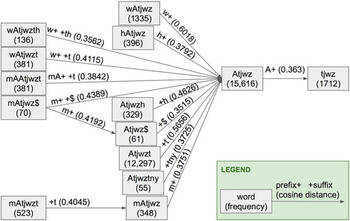
Rule expansion. Given the high cluster admission threshold, we consider expanding the rule set by adding further segmentations. We build an acyclic directed graph from all the extracted rules where words are nodes and rules are edges. Since a rule is always directed from a longer word to a shorter one, the graph will not have cycles and will not have very long paths. Figure 1 shows a partial segmentation graph built from some rules that lead to the word  Atjwz “I marry/he married.” We then expand the rules by generating a rule
 $x \rightarrow y$ for every node x that has a path to node y in the graph. To do so, we recursively scan the graph starting from leaves (words that cannot be segmented) all the way back to the beginning of the graph and add a rule
 $x \rightarrow y$ to the graph if there are two rules
 $x \rightarrow w$ and
 $w \rightarrow y$ where w is a word. The recursive scan insures that we fully expand w and add its outgoing edges to the graph before we expand x. It also allows us to compute a confidence score
 $conf(x \rightarrow y)$ that starts with the cosine distance between x and y and will increase the more paths we find between them:
Example of a segmentation graph that leads to the word Atjwz “I marry/he married.” The frequencies of the words are enclosed in parenthesis inside the nodes. The cosine distance and split affixes are on the arcs.

 \begin{equation}conf(x \rightarrow y) = dist(x \rightarrow y) + \sum_{w} conf(x \rightarrow w) \times conf(w \rightarrow y)\end{equation}
Projected frequency. The main reason for segmentation is to reduce the vocabulary size and thus increase word frequencies which improves the quality of any subsequent statistical system. However, chopping affixes off a word (as opposed to clitics) may affect the integrity of the word, for example, it may slightly change the meaning of the word or may cause it to align to more general words (e.g., segmenting “parking” to “park -ing” in English may negatively affect alignment depending on the foreign language). Additionally, every time we make a segmentation decision, we may introduce errors. Therefore, it is important to know at what point we do not need to segment a word anymore. To do so, we consider word frequencies as part of scoring the rules because frequent words are likely to be aligned and translated correctly to their inflected English translations without the need for segmentations. For example, in Figure 1, we might not want to segment “Atjwz” to “tjwz” considering its high frequency and the number and frequencies of words that lead to it. We define a projected frequency score of a word as:
 \begin{equation}pf(y)=\sum_{x \in V} conf(x \rightarrow y) \times log(freq(x))\end{equation}
where x is any word in the vocabulary V and log(freq(x)) is the logarithm of x’s frequency. We use logarithms to smooth the effect of frequent words on the final score to better represent y as a hub for many words. Note that  $conf(y \rightarrow y)=1$ and thus we include log(freq(y)) in the score.
Word-to-stem score. Given the projected frequency scores, we compute the ratio  $pf(y)/pf(x)$ that represents the gain we get from segmenting x to y. For example, if x is frequent and has many words that lead to it, and y gets most of its projected frequency from x, then the ratio will be small. But if x is infrequent (i.e., not a hub) and y has a high pf score through other sources, then the ratio will be high. Now, we can compute the final word-to-stem (a2s) score, which we will be using next, as follows:
 \begin{equation}\begin{aligned} a2s(a \rightarrow s) = conf(a \rightarrow s) \times pf(s)/pf(a)\end{aligned}\end{equation}
Fully reduced words. All the rules extracted so far will segment a word to a shorter word with at least one affix. The automatic annotations need to have some examples where words do not get segmented in order for the segmenter to learn such cases. Therefore, we need to identify a list of words that cannot be segmented and thus produce rules that transform a word to itself with no affixes. Such rules will be of the form  $x \rightarrow$ P + x -Q. The list does not have to be complete; it just needs to be of high confidence. To generate the list, we consider words that appear on the target side of rules but never on the source side. We then reduce the list to only frequent stems (with over 3000 occurrences) that have at least three words that can be segmented to them, which gives us enough confidence as we have seen them in various contexts and they have appeared in at least three clusters but yet do not have any substrings in their own clusters. These thresholds are determined empirically. We compute the word-to-stem score for these fully reduced rules using this equation:
 \begin{equation}\begin{aligned} a2s(a \rightarrow a) = \sum_{x} conf(x \rightarrow a)\end{aligned}\end{equation}
5.3 Rule scoring
Since a rule  $a \rightarrow psq$ produces three segments: a stem s, a prefix p, and a suffix q, we define its score as the product of the word-to-stem score
 $a2s(a \rightarrow s)$, the joint probability of the prefix and the stem v(p, s), and the joint probability of the suffix and the stem u(q, s):
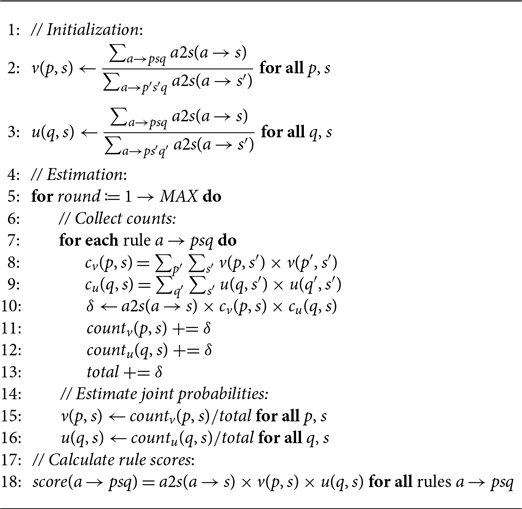
 \begin{equation}score(a \rightarrow psq) = a2s(a \rightarrow s) \times v(p, s) \times u(q, s)\end{equation}
Affix correlation. To estimate the correlation between a prefix p and a prefix p  $^{\prime}$, we iterate over all stems s
 $^{\prime}$ and compute
 \begin{equation} corr_{pref}(p^{\prime}, p) = \sum_{s^{\prime}} v(p, s^{\prime}) \times v(p^{\prime}, s^{\prime})\end{equation}
This score indicates the similarity in morphosyntactic behavior of these two prefixes. For example, the Egyptian prefix +  h+ “will” and the MSA prefix +
 ws+ “and will” attach to present tense verbs; therefore, we would expect them to share many of the stems in the rules they appear in, which leads to a high correlation score.Footnote b
We similarly define suffix correlation as:
 \begin{equation}corr_{suff}(q^{\prime}, q) = \sum_{s^{\prime}} u(q, s^{\prime}) \times u(q^{\prime}, s^{\prime})\end{equation}
Affix–stem correlation. Using these affix correlation scores, we can estimate the correlation between a prefix p and a stem s by iterating over all prefixes p  $^{\prime}$ that we have seen with s in a rule and summing their correlation scores with p:
 \begin{equation}\begin{aligned}c_v(p, s)&=\sum_{p^{\prime}} corr_{pref}(p^{\prime}, p)=\sum_{p^{\prime}} \sum_{s^{\prime}} v(p, s^{\prime}) \times v(p^{\prime}, s^{\prime})\end{aligned}\end{equation}
We similarly define suffix–stem correlation as:
 \begin{equation}\begin{aligned}c_u(q, s)&=\sum_{q^{\prime}} corr_{suff}(q^{\prime}, q)=\sum_{q^{\prime}} \sum_{s^{\prime}} u(q, s^{\prime}) \times u(q^{\prime}, s^{\prime})\end{aligned}\end{equation}
Affix–stem joint probabilities. Given affix–stem correlation scores, we can define the prefix–stem joint probability, v(p, s), and the suffix–stem joint probability, u(q, s), as follows:
 \begin{equation}\begin{aligned}v(p, s) = \dfrac{c_v(p, s)}{\sum_{p^{\prime},\ s^{\prime}} c_v(p^{\prime}, s^{\prime}) }, \qquad u(q, s) = \dfrac{c_u(q, s)}{\sum_{q^{\prime},\ s^{\prime}} c_u(q^{\prime}, s^{\prime})}\end{aligned}\end{equation}
To estimate the parameters in these recursive equations, we implement the EM algorithm shown in Algorithm 1 The initialization step uses only word-to-stem scores computed earlier, that is, it is equivalent to the first round rin the following EM loop with the exception that  $\delta \gets a2s(a \rightarrow s)$. We found that running the EM algorithm for 50 rounds provides good results.
Affix–stem joint probability estimation.

5.4 Experimental data
We use two sets of monolingual Arabic text: about 2B tokens from Arabic GigaWord Fourth Edition which is mainly MSA (Parker et al. Reference Parker, Graff, Chen, Kong and Maeda2009) and about 392M tokens of Egyptian text,Footnote c resulting in about 2.4B tokens of monolingual Arabic text used to train Word2Vec (Mikolov et al. Reference Mikolov and Chen2013) to build word vectors. In this work, we did not have access to a sizable amount of Levantine text to add to the monolingual data. Access to Levantine text would help this task learn Levantine segmentation rules and thus hopefully improve the final system. We did not want to use the Levantine side of the parallel data to keep this system separate from the second system to avoid any resulting biases.
6. Alignment guided segmentation choice
In the previous section, we learned and scored segmentation rules for words out of context. In this section, we use these rules and their scores to learn in-context segmentations of words guided by their English alignments in parallel text. The premise of this approach is that if we find enough Arabic words where we are confident in their segmentation choices in-context given the English translation, then we can use those segmentation choices as labeled data to train a supervised segmenter.
6.1 Approach
Unsupervised learning of word alignments from a parallel corpus is pretty much established. A ltool like Giza++ (Och and Ney Reference Och and Ney2003b) can be run on the Arabic–English parallel data to obtain many-to-many word alignments. That means, each Arabic word aligns to multiple English words and each English word aligns to multiple Arabic words. However, these algorithms look at the surface form without considering morphological inflections.
Our alignment algorithm concerns with aligning the internal structure of Arabic words (the rule segments) to their English translations. We start by running Giza++ on our Arabic–English parallel corpora to obtain initial, surface form alignments. We use Giza++ with default symmetrization (grow-diag-final-and) as part of the Moses toolkit pipeline for statistical MT (Koehn et al. Reference Koehn, Hoang, Birch, Callison-Burch, Federico, Bertoldi, Cowan, Shen, Moran, Zens, Dyer, Bojar, Constantin and Herbst2007). Then, we consider one-to-many aligned pairs  $\langle a_i, E_{a_i} \rangle$, where
 $a_i$ is an Arabic word at position i and
 $E_{a_i} = (e_1, e_2, ..., e_{|E_{a_i}|})$ is the sequence of English words aligned to
 $a_i$ ordered by their position in the English sentence. Since the Arabic side of the parallel data is unsegmented, the plethora of inflected words will dramatically extend the vocabulary size and the Zipfian tail of infrequent words, which will negatively affect parameter estimation in Giza++ resulting in many inaccurate alignments. To reduce the effect of this problem on our algorithm, we expand the definition of
 $E_{a_i}$ to also include surrounding words of the words aligned to
 $a_i$ by Giza++. The order of the English words is preserved. We model dropping words from
 $E_{a_i}$ in our alignment model.
Given an aligned pair  $\langle a_i, E_{a_i} \rangle$ where
 $a_i$ has a set of segmentation rules
 $R = \{r\,{:}\,r = a_i \rightarrow g_1g_2g_3\}$, we estimate an alignment probability for every rule r based on aligning its segments to words in
 $E_{a_i}$. We, then, pick the rule with the highest probability,
 $r^*$, as the segmentation choice for
 $a_i$ in that context. It is important to note that the context here is determined by the English translation instead of the surrounding Arabic words. Note that the rule itself has a score derived from the Arabic context of the word through word embedding. Therefore, if we incorporate the rule score in the alignment probability model, we can combine Arabic semantics and English semantics in determining the segmentation choice in context.
6.2 The alignment model
In order to compute an alignment probability for every pair  $(r, E_{a_i})$, we need to estimate how r’s segments translate to
 $E_{a_i}$’s tokens. To translate a source text sequence to a sequence in a target language, two questions must be asked:
-
1. What target words/phrases should we produce?
-
2. Where should we place them?
The IBM models as motivation.
We provide a quick introduction to the IBM models to give a general motivation to our proposed alignment model. Details that do not relate to our model are not discussed. For detailed discussion of the IBM models, refer to Brown et al. (1993). IBM Model 1 answers only the first question by introducing a lexical translation model,  $t(e_i | f_j)$, that estimates how well a source token
 $e_i$ translates to a target token
 $f_j$. IBM Model 1 does not model word alignments explicitly which means once the target words are generated, they can be put in any order in the target sentence. To answer the second question, IBM Model 2 adds an absolute alignment model,
 $a(i | j, m, n)$, that measures the probability of a target token at position j in a target sentence of length m to be aligned to a source word at position i in a source sentence of length n. This independent modeling of translation and alignment makes the problem easier to solve. IBM Model 3 takes the first question a step further by modeling fertility which allows source words to produce multiple target words or even get dropped from translation and allows target words to be inserted without a source word generating them. Fertility gets handled by two separate models: (a) The fertility model,
 $y(n_{slots} | f)$, handles source word fertility by estimating the probability of a source word f to produce zero or more slots to be filled with target words. If
 $n_{slots}=0$, source word f will be dropped from translation. If
 $n_{slots}>0$, one or more target words will be generated. And (b) NULL insertion models the introduction of new target words without a source translation. While IBM Model 3 keeps the regular lexical translation model as is
 $t(e_i | f_j)$, it reverses the direction of Model 2’s absolute alignment model to become
 $d(j | i, m, n)$, which they call an absolute distortion model. IBM Model 4 further improves Model 3 by introducing a relative distortion model which allows target words to move around based on surrounding words instead of the length of source and target sentences. Finally, IBM Model 5 fixes the deficiency in Model 3 and 4 that allows multiple target words to be placed in the same position.
Our alignment probability model.
The IBM models were originally proposed as MT systems, but now they are widely used as part of word alignments since more advanced MT approaches were introduced. While our alignment model is inspired by the IBM models, we have no intention to use it as an MT system; therefore, we are not bound to design an alignment model that generates fluent translations. In other words, the placement of English words in their exact positions (the second question) is not essential. Our model should measure how well a certain segmentation of an Arabic word  $a_i$, produced by rule
 $r = a_i \rightarrow g_1g_2g_3$, aligns to English words in the target sequence
 $E_{a_i}$.
The English sequence could contain words that do not align to any segment of the source Arabic word. This is a result of erroneous alignments by Giza++ or due to our inclusion of surrounding words. To handle this, we model dropping words from  $E_{a_i}$ by introducing a NULL token on the Arabic side (with index 4) that misaligned English words can align to. This makes the Arabic sequence of length 4 indexed: 1 for prefix, 2 for stem, 3 for suffix, and 4 for the NULL token. We use the variable j to refer to this index. The English sequence can be of any length, denoted as m. As mentioned above, the original order of English words is preserved in the sequence
 $E_{a_i}$ but re-indexed from 1 to m. We use the variable k to refer to this index.
Definition: Alignment vector. An alignment vector is a vector of m elements denoted as  $L = (l_1, l_2, ..., l_m)$, where
 $l_k$ is position in the Arabic segment that
 $e_k$ aligns to. This allows multiple English words can align to the same token in the Arabic sequence, for example, “and” and “will” can align to +
 wH+ “and will.” However, an English word, in our model, cannot align to multiple Arabic tokens, which forces the English word to pick its best aligned Arabic token. We define
 $L_{(r, E_{a_i})}$ as the set of all possible alignment vectors that align
 $E_{a_i}$’s words to r’s segments and the NULL token.
Definitions: Center and direction. We define the center of the English sequence as the English word that best aligns to the Arabic stem. We denote its index as  $k_{stem}$. Given
 $k_{stem}$, we define a direction vector
 $D = \{d_k \,{:}\, d_k= $ sgn
 $(k-k_{stem}) \}$
Footnote d, where every English word
 $e_k$ has a direction
 $d_k$ relative to the center
 $e_{k_{stem}}$. This means that the center
 $e_{k_{stem}}$ has a direction of 0, words that appear before the center have a direction of –1, and words that appear after center have a direction of +1,
It is intuitive to assume that the direction of an English word relative to the center could have an impact on the decision of whether to align it to a prefix, a stem, a suffix, or even NULL to drop it from alignment as it might align to a previous or subsequent word in the Arabic sentence. To motivate this intuition, let us observe closed-class and open-class English words and their relations to the types of Arabic segments based on their directions from the center.
In our approach to segmentation, an Arabic affix is split from the stem as one unit without further splitting its internal components which could contain pronouns, prepositions, or particles such as conjunction, negation, and future particles. These affixes tend to align to closed-class English words. For example, the Arabic definite article, +  Al+ “the,” appears only in prefixes (e.g., in +
 wAl+ “and the”); similarly, the English word “the” appears only before the center when it aligns to a prefix. If “the” appears after the center, it probably should be aligned to a subsequent Arabic word in the source sentence. Moreover, the Arabic conjunction particle, +
 w+ “and,” appears in prefixes (e.g., in +
 wH+ “and will”) or as a separate word
 w; therefore, when “and” appears before or at the center it tends to align to a prefix or a stem, respectively. If “and” appears after the center, it probably should be dropped. Furthermore, the English word “to” could align to any token of the source sequence at any position in the target sequence; however, its direction relative to the center correlates with the position of the Arabic token it aligns to. Here are the four cases:
-
1. “to” could align to the prefix particle +
 l+ “to” (as in this example attaching to a verb and a noun: “ ”
lybEt lrfyqh “to send to his friend”).Footnote e In such cases, the English word “to” has a direction of –1.
-
2. “to” could align to a stem such as
$<$lY “to,” a separate preposition in Arabic. In these cases, “to” has a direction of 0. -
3. “to” could align to a suffix containing the indirect object preposition
- -l “to” (as in the suffix- --wlk “they, to you” in “ ” ybEtwlk “they send to you”). In such cases, “to” has a direction of +1. -
4. “to” could align to NULL if misaligned which could occur at any value for
$d_k$.
 l+ “to” (as in this example attaching to a verb and a noun: “
 ”
lybEt lrfyqh “to send to his friend”).


 - -l “to” (as in the suffix-
 --wlk “they, to you” in “
 ” ybEtwlk “they send to you”). In such cases, “to” has a direction of +1.

Similar to closed-class words, open-class words tend to either align to the stem or to NULL. For example, there is no prefix or suffix that aligns to the word “send”; therefore, if it appears on either side of the center, it probably belongs to a surrounding word of the current Arabic word  $a_i$. This motivates the design of a probability distribution that capitalize on this correlation.
Our model answers the two questions introduced earlier with two separate probability distributions:
-
1. Lexical translation model:
$t(e_k|g_{l_k})$. This model is identical to IBM Model 1. It estimates the probability of translating an Arabic segment to an English word. For example, t(“and”$ | $“wH+”) represents the probability of producing the word “and” from the prefix wH+ “and will.” -
2. Lexical direction model:
$z(l_k | e_k, d_k)$. This model estimates the probability of aligning an English word $e_k$ with direction $d_k$ to position $l_k$ in the Arabic sequence. For example, $z(1 | $“and”$, -1)$ is the probability of the word “and” aligning to a prefix knowing that it appeared before the center.


 wH+ “and will.”


In this model, the exact position of the generated English word is not important; instead, the direction relative to center is what matters.
To compute  $k_{stem}$, we find the English word with the highest
 $t \times z$ score as in the following equation:
 \begin{equation*}k_{stem} = \arg\max_k t(e_k | g_2) \times z(2 | e_k, 0)\end{equation*}
This might seem like a circular dependency: z depends on  $d_k$ which is computed from
 $k_{stem}$ that depends on z. In other words, using the direction from the center while trying to find the center. In fact, we do not need the direction from the center to compute
 $k_{stem}$. Instead, we set
 $d_k = 0$ in
 $z(2 | e_k, 0)$, which, when multiplied with
 $t(e_k | g_2)$, basically asks the question: if word
 $e_k$ were to be selected as the center, how well will it align to position 2 (the stem) in the source sequence? This breaks the circular dependency.
Example
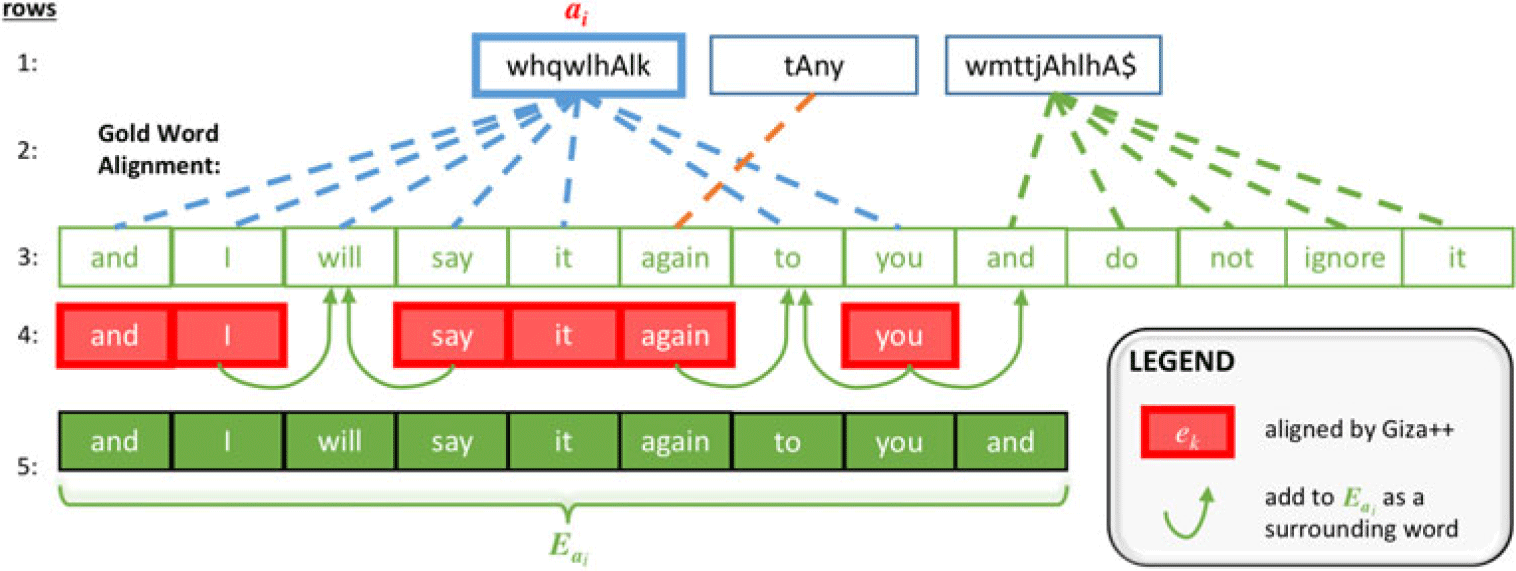
Consider the Egyptian Arabic sentence  whqwlhAlk tAny wmttjAhlhA$ translated to English as “And I will say it again to you and do not ignore it.” Figure 2 presents the Arabic and English sentences in rows 1 and 3 (index is in the left margin), as well as their perfect word-level alignment (Row 2). For our example, we consider the first word, whqwlhAlk, as
 $a_i$ and we construct
 $E_{a_i}$ in Row 4 by first including words aligned by Giza++ (in red rectangles) and then adding surrounding words (identified by the green arrows). Row 5 shows the resulting
 $E_{a_i}$. Due to the infrequency of such highly inflected words, Giza++ tends to make errors aligning them. In this case, it erroneously aligns “again” to
 $a_i$ and misses “will” and “to” which should have been aligned. Our inclusion of surrounding words results in adding the missed words but also includes the trailing “and” erroneously. This approach increases recall while compromising precision since it depends on the probabilistic model to maximize English alignment to
 $a_i$’s internal structure while dropping the misaligned English words.
Example of sentence alignment that shows how we extract the English sequence  $E_{a_i}$ that aligns to a source word
 $a_i$. The figure is organized as rows indexed from 1 to 5 as shown on the left margin. Row 1 and 3 show the source Arabic sentence and its English translation. Row 2 shows the perfect word-level alignment between the two sentences. Row 4 shows the automatic process of extracting
 $E_{a_i}$ by first adding words aligned by Giza++ (in red rectangles) and then adding surrounding words (identified by the green arrows). Row 5 shows the resulting
 $E_{a_i}$.

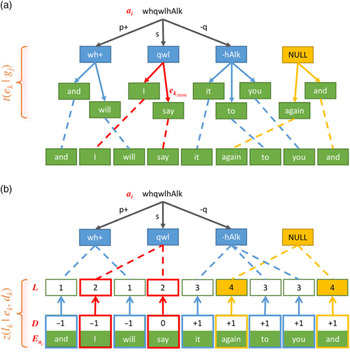
Example of alignment model parameters t and z for an Arabic word aligned to an English phrase.

Figure 3 shows the alignment of the Arabic word  whqwlhAlk from Figure 2 with its aligned English sequence
 $E_{a_i} = ($and, I, will, say, it, again, to, you, and). This example shows how our model would score an alignment vector
 $L = (1, 2, 1, 2, 3, 4, 3, 3, 4)$ linking
 $E_{a_i}$ tokens one-to-many to the four Arabic tokens. L, shown in Part
 $(\textit{b})$ of the figure (index is in the left margin), is actually the gold alignment vector. Part
 $(\textit{a})$ shows the lexical translation model,
 $t(e_k|g_{l_k})$, generating English words from Arabic tokens under alignment vector L. The English word “say” is picked as the center over “I” because t(say
 $|$qwl
 $) > t(\textit{I}|$qwl). Part
 $(\textit{b})$ shows how the lexical direction model,
 $z(l_k | e_k, d_k)$, predicts the position an English word
 $e_k$ with direction
 $d_k$ aligns to.
Decoding with the model: finding the best segmentation choice
The probability of an alignment vector L that aligns the words of an English sequence,  $E_{a_i}$, to the four Arabic tokens produced by a rule r and the NULL token is denoted as
 $p_{align}(E_{a_i}, L | r)$ and is given by this equation:
 \begin{equation}p_{align}(E_{a_i}, L | r) = \prod_{k=1}^{m} t(e_k | g_{l_k}) \times z(l_k | e_k, d_k)\end{equation}
To find the best segmentation choice for an Arabic word  $a_i$ with a set of rules
 $R_{a_i}$, we pick the rule,
 $r^*$, that has the highest score when aligned to the English sequence
 $E_{a_i}$. To evaluate how well a rule r aligns to
 $E_{a_i}$, we scan all possible alignment vectors generated from r and
 $E_{a_i}$ to find the one with the highest probability
 $p_{align}(E_{a_i}, L | r)$. Therefore, the best segmentation choice for
 $a_i$ is generated by the rule
 $r^*$ that has the best alignment to
 $E_{a_i}$’s words among all other rules in
 $R_{a_i}$, as shown in the following equation:
 \begin{equation}r^* = \arg\max_{r \in R_{a_i}} \max_{L \in L_{(r, E_{a_i})}} p_{align}(E_{a_i}, L | r)\end{equation}
It is important to note that the rule score computed in Section 5, score(r), is not used directly in these equations; however, it is used in estimating the model’s parameters t and z.
6.3 Parameter estimation with EM
In this subsection, we present our EM algorithm to estimate our model’s parameters. First, we start with initializing our parameters and then we explain the EM algorithm used for parameter estimation.
Initialization. Our initialization step starts by running Giza++ (Och and Ney Reference Och and Ney2003b) on the untokenized Arabic–English parallel data to produce many-to-many word-level alignments. Using these alignments, we estimate two word translation probability distributions for each Arabic word a and English word e:
-
1. The word translation probability:
$p_1(e|a) = count_{aligned}(a, e) / count(a)$. -
2. The reverse word translation probability:
$p_2(a|e)=count_{aligned}(a, e) / count(e)$.


where  $count_{aligned}(a, e)$ is the number of times we saw Arabic word a aligned to English word e in Giza++ output, while count(x) is the frequency of word x in the parallel corpora. The word translation probability distribution is used to initialize the
 $t(e_k|g_h)$ parameter of our model as shown in Algorithm 2 in Equation (14). Since the stems are actual Arabic words in our definition, we will have
 $p_1(e_k | g_2)$ probabilities for stems; however, this is not possible for affixes. Therefore, we compute the count
 $c(e_k, g_h)$ by summing over all
 $\langle a_i, e_k \rangle$ pairs where
 $p_1(e_k | a_i)>0$ and
 $a_i$ has one or more rules,
 $r = a_i \rightarrow G$, that generate the segment
 $g_h$, and computing the score
 $p_1(e_k | a_i) \times score(a_i \rightarrow G)$ that is then added to
 $p_1(e_k | g_h)$ if nonzero. The
 $z(l_k | e_k, d_k)$ parameters are uniformly distributed as shown in Algorithm 2, Equation (15).
Affix–stem joint probability estimation.

Parameter estimation. Algorithm 2 presents an EM algorithm where every epoch iterates over every aligned Arabic–English pair  $\langle a_i, E_{a_i} \rangle$ in the parallel text and computes counts from every possible segmentation of
 $a_i$ that aligns to
 $E_{a_i}$’s tokens. In Line 5, we compute the confidence in this aligned pair, conf, that will be used in computing
 $\delta$. In Line 8, we compute
 $k_{stem}$ which gives us the English token,
 $e_{k_{stem}}$, with the highest alignment to the stem in the current segmentation of
 $a_i$. If the alignment score of this word,
 $t(e_{k_{stem}} | g_2) \times z(2 | e_{k_{stem}})$ is lower than a threshold, we ignore the rule that produced this segmentation. The threshold can be manipulated to trade off quality and number of labeled segmentation choices. Once
 $k_{stem}$ is found, the direction vector, D, can be computed (Line 11). Then, every possible combination of
 $E_{a_i}$ tokens and
 $a_i$ segments are considered to compute
 $\delta_{tz}$, using the last iteration t and z parameters (Line 16), which is combined with the rule score and the aligned pair confidence score to compute
 $\delta$.
 $\delta$ is then used to compute the counts. Finally, the model’s probabilities are calculated (Lines 23–24) to be used in the next epoch.
Experiments. We use three parallel corpora obtained from several LDC corpora including GALE and BOLT data and preprocessed by separating punctuation marks and Alif/Yah normalization. The corpora are Egyptian–English (Egy–En) corpus of  $\sim$2.4M tokens, Levantine–English (Lev–En) corpus of
 $\sim$1.5M tokens, and MSA–English (MSA–En) corpus of
 $\sim$49.5M tokens. The combined corpus, which amounts to
 $\sim$53.5M tokens, is word-aligned using GIZA++ (Och and Ney Reference Och and Ney2003a) and used as training data to this step.
We trained the EM algorithm for 50 rounds on this data and we labeled 11.9M words with acceptable confidence.Footnote f
7. Supervised segmentation using synthetic data
We train a supervised segmenter to learn how to segment Arabic words in a given sentence. For every word in the sentence, the segmenter considers a list of rules to transform that word and scores them using an ASP. The transformation rules are segmentation rules that produce a stem and affixes. This setup allows for more advanced transformation rules where the stem is not a partial string of the source word. Examples are spelling variation normalization, templatic morphology segmentation, and even infrequent-to-frequent word translation; although, new features should be introduced to capture those advanced transformations. The empty affixes “P+” and “-Q” are not generated in the segmented output. We train and evaluate our segmenter on train/test split sets of our automatically labeled data.
7.1 Challenges of automatically labeled data
Two challenges for training and decoding arise from the nature of our automatically labeled data: frequent OOVs and unlabeled words in a training sentence.
Frequent words as OOVs. The general case in manually annotated training data for NLP tasks is that the data are selected randomly from the text expected to be handled by the NLP tool (sometimes with a bias toward more frequent cases in the target area, such as domain, dialect, and genre). The frequent words in the vocabulary, as a result, will generally be labeled in the training data. This means that OOVs in a given test set are usually infrequent words and, thus, rare in those sets. In our setup, we label words with their segmentation choice only when we have high confidence in our decision. This leaves our partially labeled training data with many unlabeled frequent words. These words are naturally frequent in a given test set, which means they will be OOVs for a system trained on our partially labeled training data. This problem requires us, as we design the segmenter, to give special attention to its ability to learn how to generalize to unseen words, since those unseen words are now a frequent phenomena. To do so, we use the following strategies:
-
1. We introduce features that deliberately try not to memorize specific segmentations in order to allow them to generalize to OOVs.
-
2. We drop all segmentation rules learned in Section 5 since they do not extend to a large portion of the vocabulary. To generate a list of rules for a given word in a sentence, the decoder, now, considers all possible segmentations of that word that produce stems that have been seen in the parallel data. This will introduce new, unseen affixes, which is intended to generalize to unseen dialectal morphology.
-
3. Some of our best features use distance scores from the Arabic and English clusters of the word being processed (discussed later). Since these clusters were used in creating our labeled data, all labeled words have both clusters. This results in a generalizability issue as many other words may have one or no clusters. To solve this issue, we deliberately drop either or both clusters for some labeled words in a random manner in order to allow other general features to be trained for such cases.
-
4. To evaluate our segmenter’s ability to generalize to OOVs, we randomly drop some test set words from the training data to generate OOVs that we can evaluate on. This allows us to pick a system with high generalizability.
Unlabeled words in a training sentence. Unlike manually labeled data where all words in a training sentence are labeled, our data may have many unlabeled words in a given training sentence. This means that features of a rule cannot depend on the segmentation decision made for the previous word since we cannot guarantee knowing that decision during training. Therefore, the decoder cannot use the Viterbi algorithm; instead, it picks the segmentation rule with the highest score for every word independently. We do, however, use features that look at the possible segmentation rules of surrounding words which are inspired by the gender/number agreement of Arabic.
7.2 Features
Global linear models allow us to use millions of features to score the different rules of a given word in context.
A feature is 1 if a certain condition is satisfied by the rule and 0 otherwise. For example, the feature below fires up when a rule is trying to segment the prefix  wh+ “and will” from a stem with four letters (which could be a present verb in Arabic):
 \begin{equation*} \phi_{1000}({a \rightarrow psq})= \begin{cases} 1, & \text{if length of stem } s = 4 \\ & \text{ and prefix } p = \text{ "wh+"} \\ 0, & otherwise \\ \end{cases} \end{equation*}
Salloum (Reference Salloum2018) includes a detailed description of the features we used, such as features based on the main word and its segments, surrounding words, tokens’ length and frequency, affixes, English and Arabic clusters, and affix correlation. We use the structured perceptron algorithm with averaging (for regularization) to learn the weights of those features.
7.3 Experiments and evaluation
Experimental setup. We implement our own ASP trainer and decoder.We split the automatically labeled examples from the previous step into train ( $\sim$9.9M labeled tokens) and dev and test sets (1M labeled tokens each).
Evaluation. We ran hundreds of experiments in a linguistically motivated greedy approach to engineer good feature types for our segmenter. The systems learned from the top-performing feature type combinations were then evaluated by the MT experiments to pick the best segmenter.
We empirically determined the number of epochs to be 14. In development and test, we automatically generate OOVs by randomly omitting Arabic and English clusters as discussed earlier. This makes the non-cluster features fully responsible for segmenting those words without the reliance on cluster features, which allows the segmenter to tune their weights and thus generalize to actual MT sets’ OOVs.
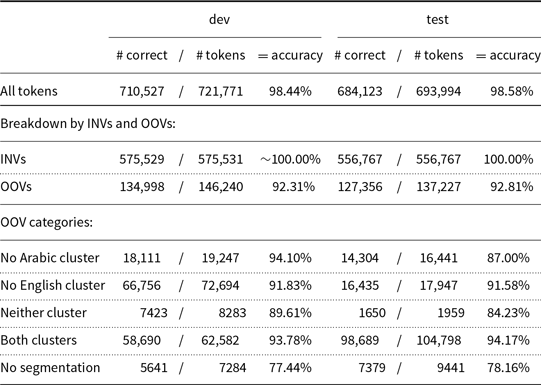
Table 1 presents the performance of the best segmenter system in terms of accuracy on both dev and test sets (the last two columns across all sections). The sections of the table represent the breakdown of tokens into categories for in-depth evaluation. The accuracy scores for each of these categories were used to engineer our feature types to ensure that they generalize to frequent OOVs belonging to those categories. We also make sure, while automatically generating OOVs in dev/test sets, that we have enough tokens in each category to guarantee a representative evaluation.
The segmentation decoder results in terms of accuracy (number of correct segmentations/total number of tokens) on both the dev and blind test sets. The first section shows the results on all tokens, while the following sections break the tokens down into categories

Since the segmenter’s job is to pick a segmentation rule out of a generated list of rules, we evaluate only on words with more than one rule (multi-choice) which constitute 721,771 tokens of the 1M-token dev set and 693,994 tokens of the 1M-token blind test set. The rest of the tokens have only one segmentation rule: no segmentation. The first section of Table shows the accuracy of the segmenter on multi-choice tokens. In the second section, we break down the evaluation to in-vocabulary words (INVs) and OOVs.
Since we might not have Arabic or English clusters for many words in test sets, we define four categories representing the absence of either cluster, both, or neither. These categories are mutually exclusive. We also evaluate on OOVs that should not be segmented, yet have multiple rules, to reduce our decoder’s over-segmentation. The third section of Table presents evaluation on multi-choice OOV categories. The results on the dev set carry on to the blind test set.
8. Evaluation on MT
8.1 MT experimental setup
MT train/tune/test data. We combine the training, dev, and test sets we used to train and evaluate our segmenter into one parallel corpus and we use it to train our MT systems. The MT tune, dev, and test sets, however, are selected from several standard MT test sets. We use three Egyptian sets from LDC BOLT data with two references (EgyDevV2, EgyDevV3, and EgyTestV2), and one Levantine set from BBN (Zbib et al. Reference Zbib, Malchiodi, Devlin, Stallard, Matsoukas, Schwartz, Makhoul, Zaidan and Callison-Burch2012) with one reference which we split into LevDev and LevTest. We use EgyDevV3 to tune our SMT systems. We use the remaining sets for development and test on both Egyptian and Levantine. For dev, we use EgyDevV2 and LevDev and for test we use EgyTestV2 and LevTest. It is important to note that the segmenter has never seen these tune/dev/test sets. The segmenter was only trained on the MT training data.
MT tools and settings. We use the open-source Moses toolkit (Koehn et al. Reference Koehn, Hoang, Birch, Callison-Burch, Federico, Bertoldi, Cowan, Shen, Moran, Zens, Dyer, Bojar, Constantin and Herbst2007) to build our Arabic–English phrase-based SMT systems.Footnote g Our systems use a standard phrase-based architecture. The language model for our systems is trained on English Gigaword (Graff and Cieri Reference Graff and Cieri2003). We use SRILM Toolkit (Stolcke Reference Stolcke2002) to build a 5-gram language model with modified Kneser–Ney smoothing. Feature weights are tuned to maximize BLEU on the tuning set using minimum error rate training (Och Reference Och2003). Results are presented in terms of BLEU (Papineni et al. Reference Papineni, Roukos, Ward and Zhu2002) and METEOR (Banerjee and Lavie Reference Banerjee and Lavie2005). All evaluation results are case- insensitive. The English data are tokenized using simple punctuation-based rules. The Arabic text is also Alif/Ya normalized. For more details on processing Arabic, see (Habash Reference Habash2010).
8.2 MT experiments
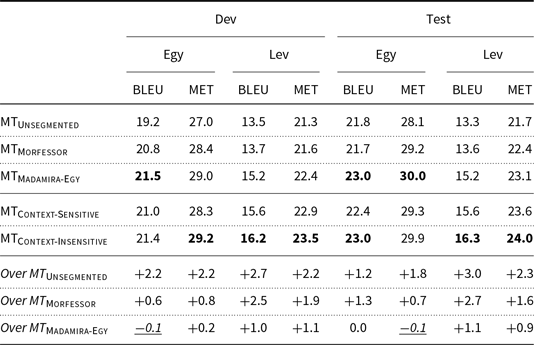
We use the same parallel data to train all of our MT systems and the same dev and test sets to evaluate. The only difference is the preprocessing of the Arabic side of training, dev, and test data. Table shows MT experiment results in terms of BLEU and METEOR on dev (first set of columns) and blind test (second set of columns).
Evaluation in terms of BLEU and METEOR (MET) of our two MT systems, MT Context-Sensitive and MT Context-Insensitive , on a dev test (first set of columns) and a blind test set (second set of columns), in comparison with three baselines, MT Unsegmented , MT Morfessor , and MT Madamira-Egy . Results in bold show the highest performing system in the column.

Baseline systems. We build three baseline MT systems to compare our systems against. In the first baseline system, we Alif/Ya normalize the Arabic side but we leave it unsegmented. We call this baseline MT Unsegmented . The other two baseline systems are based on two previous research efforts representing two approaches to morphological segmentation. The first is a tool for language-independent, unsupervised learning of morphology: Morfessor (Creutz and Lagus Reference Creutz and Lagus2002) to segment the Arabic side, and the second is a dialect-specific tool that requires handcrafted resources and is trained on hand-labeled data: Madamira-Egy, the version of Madamira (Pasha et al. Reference Pasha, Al-Badrashiny, Diab, El Kholy, Eskander, Habash, Pooleery, Rambow and Roth2014) that handles Egyptian as well as MSA. We use these two tools to preprocess Arabic and we name the resulting two MT systems after them: MT Morfessor and MT Madamira-Egy , respectively. All Arabic textual data (parallel and monolingual) were used to train Morfessor.
The first section of Table 2 presents results on these baselines. On the dev set, MTMorfessor
performs significantly better than MTUnsegmented
on Egyptian (1.6% BLEU, 1.4% METEOR) and slightly better on Levantine (0.2% BLEU, 0.3% METEOR). This could be due to the limited Levantine text in Morfessor’s segmentation training data compared to Egyptian and MSA. MTMadamira-Egy
outperforms the other baselines on both dialects on both metrics. An interesting case is MTMadamira-Egy
results on Levantine dev: it improves over MTUnsegmented
by 2.3% BLEU, 2.0% METEOR, and over MTMorfessor
by 1.5% BLEU, 0.8% METEOR. MTMadamira-Egy
’s good performance on Levantine can be explained by the fact that these two dialects share many of their dialectal affixes and clitics (e.g., +  H+ “will,” b+ “simple present,”
 - -lk “to you”) as well as many lemmas. Moreover, most of the phonological differences between Levantine and Egyptian do not show up in the orthographic form since Arabic writers tend to drop short vowels and spell some sounds etymologically, thus normalizing them, for example, the words for “leather” (Egyptian /ɡeld/, Levantine /ʒeled/, and MSA /ʤild/) are all written
 jld. This leads to many Levantine words looking identical to their Egyptian equivalents although they are pronounced differently.
Our MT systems. We present two MT systems to evaluate two of our segmentation models. The first model is trained using the best-performing combination of context-sensitive and insensitive features, while the second model uses the best-performing combination of context-insensitive features only presented in Table 1. We call the resulting MT systems: MTContext-Sensitive and MTContext-Insensitive , respectively. We present MT results on our systems in the second section of Table. MTContext-Insensitive outperforms MTContext-Sensitive across dialects and metrics. Investigating the output of both systems shows that the inconsistencies generated by context-based segmentation outweighs the benefits of disambiguation, especially that phrase-based SMT is robust toward infrequent systematic segmentation errors across training, tuning, and test sets.
The third section of Table 2 reports the differences between our best system’s results and those of the three baselines. MTContext-Insensitive improves over both resource-free baselines (MTUnsegmented and MTMorfessor ) across dev sets and metrics ranging from 2.2% BLEU on Egyptian and 2.7% BLEU on Levantine over MTUnsegmented to 0.6% BLEU on Egyptian and 2.5% BLEU on Levantine over MTMorfessor . These results demonstrate the usefulness of such approach where resources are unavailable.
When compared to MTMadamira-Egy , however, performance on Egyptian differs from Levantine. The results on Egyptian are inconclusive: in terms of BLEU, MTMadamira-Egy leads by 0.1%, while in terms of METEOR, MTContext-Insensitive leads by 0.2%. These results mean that our best MT system is on par with MTMadamira-Egy on Egyptian, which we consider a good result since Madamira-Egy has been optimized for years with a wealth of dialect and task-specific resources. On Levantine, however, our system outperforms MTMadamira-Egy by 1.0% BLEU, 1.1% METEOR. The results on blind test sets, presented in the second set of columns of Table 2 (Test), agree with the results on the dev sets and confirm their conclusions.
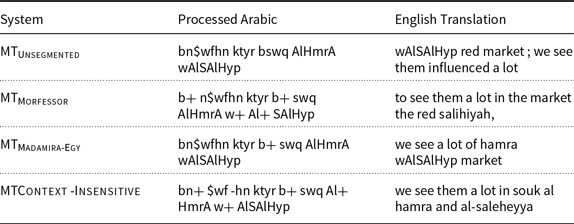
An Arabic sentence  “We see them a lot in the Hamra and Salehieh markets.” translated by the three baselines and our best system

8.3 Example and discussion
Table 3 presents an example Levantine sentence translated by the three baselines and our best system. While each baseline has its own errors, our system produces a perfect translation although the reference does not match it word-for-word due to the several acceptable transliterations of the mentioned proper names found in our MT training data.Footnote h This results in penalties by BLEU and, in this example, METEOR; nevertheless, the translation is sound. The example contains words with different characteristics that are handled differently and sometimes similarly by the four systems:
-
1. The word
bn$wfhn “we see them” has rich Levantine morphology. Unlike MTMorfessor
and MTMadamira-Egy
, our system segments this word to three tokens that map directly to the three English words of the correct translation. -
2. The word
bswq “in market” has MSA morphology and is segmented correctly by all systems (except MTUnsegmented
) which results in correct translations (MTContext-Insensitive
translates swq to “Souk,” a correct transliteration found in our MT training data since it is frequently part of a proper noun). -
3. The word
AlHmrA “Al Hamra” (“Al” is the definite article in Arabic) is a proper noun although the word literally means “red” which led to the mistakes by MTUnsegmented
and MTMorfessor
. Both MTContext-Insensitive
and MTMadamira-Egy
produce an acceptable transliteration. -
4. The word
wAlSAlHyp “and Al Salehieh” is the name of the second market with the conjunction particle w “and” attached to it. Both MTContext-Insensitive
and MTMorfessor
succeed in segmenting this word to produce an acceptable translation and transliteration, although MTMorfessor
fails to produce “and.” This word shows an advantage that our segmenter and Morfessor have over Madamira-Egy. Since they learn their morphemes and stems from data, they can better handle morphologically inflected proper nouns and dialectal/infrequent lemmas that do not appear in Madamira-Egy’s internal morphological analyzer database.
 bn$wfhn “we see them” has rich Levantine morphology. Unlike
 bswq “in market” has MSA morphology and is segmented correctly by all systems (except
 AlHmrA “Al Hamra” (“Al” is the definite article in Arabic) is a proper noun although the word literally means “red” which led to the mistakes by
 wAlSAlHyp “and Al Salehieh” is the name of the second market with the conjunction particle
 w “and” attached to it. Both
9. Conclusion and future directions
In this work, we presented an approach to cheaply scale morphological segmentation to many dialects without the need for DA preprocessing tools. This approach attempts at learning an underlying Arabic preprocessing models for all Arabic varieties, including MSA. The approach expects a small amount of DA–English parallel data along with a sizable amount of MSA–English data.
Our approach learns out-of-context preprocessing rules for DA from unlabeled monolingual data. We use an unsupervised approach applied on large quantities of unlabeled Arabic text to extract a list of out-of-context preprocessing rules with weights estimated with EM. We use these rules in another unsupervised learning approach to automatically label words in the dialectal side of a DA–English parallel corpus. In a given DA sentence, a word is labeled in context with its best preprocessing rule which generates tokens that maximize alignment and translation to English words in the English translation of the corresponding sentence. This synthetic labeled corpus is used to train a supervised segmenter with features designed to capture general orthographic, morphological, and morphosyntactic behavior in Arabic words in order to generalize to unseen words.
We evaluated our approach on morphological segmentation and showed significant improvements on Egyptian and Levantine compared to other unsupervised segmentation systems. We also showed that our system is on par with the state-of-the-art morphological tokenizer for Egyptian Arabic built with supervised learning approaches that require manually labeled data, a large budget, and years to build. This shows that our approach can cheaply and quickly scale to more dialects while still performing on par with the best supervised learning algorithm. Furthermore, our evaluation on Levantine Arabic showed an improvement of 3% over an unsegmented baseline, 2.7% over the unsupervised segmentation system, and 1.1% over the supervised tokenization system, in terms of BLEU. This is especially important given that our system was not trained on monolingual Levantine text, which means that Levantine preprocessing rules were not learned; yet, our segmenter was able to generalize to Levantine.
In the future, we plan to evaluate our work on more dialects and subdialects where DA–English may or may not be available. We also plan to apply our approach to tasks other than morphological segmentation.
Acknowledgements
This research was supported in part by the Defense Advanced Research Projects Agency (DARPA) GALE program, contract HR0011-06-C-0022, and the DARPA BOLT program, contract No. HR0011-12-C-0014. Any opinions, findings, conclusions, or recommendations expressed in this work are those of the authors and do not necessarily reflect the view of DARPA.

 w+ “and,” attach to tens of thousands of stems and that unnecessarily slows the algorithm. We found