

INTRODUCTION
Drawing on data generated from ethnographic observations, semi-structured interviews, and archival documents, I examine the work of the Committee for Professional Policing (CfPP), a grassroots group founded in 2013 to call for police accountability in Minneapolis, Minnesota. Specifically, I analyze the group’s three-year campaign to place a police insurance amendment on the city’s November 2016 election ballot. The failed ballot effort would have created a new private insurance market by making Minneapolis the first US city to require police to carry their own professional liability insurance, like mandatory automobile insurance for drivers.Footnote 1 In attempting to pass this police misconduct insuranceFootnote 2 amendment, I argue that the CfPP has turned the logic of Malcolm M. Feeley and Jonathan Simon’s (Reference Feeley and Simon1992) “new penology” paradigm onto police.
Feeley and Simon (Reference Feeley and Simon1992) argue that a systemic shift in penal managerialism occurred in late twentieth-century US crime control and crime policy. This shift in penal practices is largely driven by criminal justice administrators in institutions like policing and corrections and in the criminological research community. The emergence of this new penology framework consists of three distinct features: (1) the development of new discourses (for example, the language of actuarial risk and probability) in place of older discourses (for example, clinical diagnosis, retributivism); (2) new objectives such as the efficient control of institutional processes with an emphasis on managing subpopulations based on levels of dangerousness, the spatial sorting of penal bodies, and selective incapacitation over traditional objectives (for example, rehabilitation, crime control, specific and general deterrence; recidivism rates as a metric for the success or failure of correctional programs); and (3) employing new techniques (for example, probability models, actuarial risk assessments) in place of traditional techniques such as individualization to manage aggregate criminal categories. In this article, I extend Feeley and Simon’s thesis beyond the scope of penal managerialism to analyze how social movement organizations, like the CfPP, are inverting this paradigm onto state actors in the criminal justice system.
By applying the new penology, the CfPP sought to punish officers who have a documented history of engaging in police misconduct, while deterring officers without a history from engaging in such behavior.Footnote 3 Though the amendment did not pass, in the CfPP’s effort to pragmatically reform policing, the group has sought to carve out a strategic discursive space in the policing arena by adopting an actuarial and scientific risk management logic. It also sought to put a novel insurance-based reform on the policy radar. This strategic move should not be surprising since risk technologies intended for specific law and criminal justice contexts in the penal field are quite malleable and “constantly being reinvented, retrofitted, and reassembled in response to institutional agendas” (Maurutto and Hannah-Moffat Reference Maurutto and Kelly2006, 440). In the case of penal governance, risk entails a “heterogeneous array of practices with diverse effects and implications … [and] may take a wide diversity of forms that reflect the purposes to which it is put and the assumptions on which it based” (O’Malley Reference O’Malley2008, 453). For example, “experiments in risk” unfolding within marginal sites of resistance may serve to advance social justice projects in the penal field. In the broader penal field, policing operates alongside other subfields such as imprisonment, probation, parole, and each operates according to its own set of rules and logic (Page Reference Page, Simon and Sparks2013). That said, I contend that the fluidity of risk and the heterogeneous practices, diverse effects, and implications that it may embody also applies to the subfield of policing and police accountability governance, including the CfPP’s social justice-oriented “experiment in risk.”
Since Feeley and Simon (Reference Feeley and Simon1992) delineated their thesis, a number of scholars have theorized and applied the new penology in the context of punishing criminal offenders from the community (for example, Feeley and Simon Reference Feeley, Simon and Nelken1994; Lynch Reference Lynch1998; Simon and Feeley Reference Simon, Feeley, Thomas and Cohen2003; Cheliotis Reference Cheliotis2006). Some policing scholars have started to examine how private insurance (Otu Reference Otu2006; Epp Reference Epp2009; McCoy Reference McCoy and McCoy2010; Rappaport Reference Rappaport2016, Reference Rappaport2017; Schwartz Reference Schwartz2016; D. Ramirez et al. Reference Ramirez, Marcus, Lauren and Carly2019), modern risk assessment instruments, and risk management practices (Archbold Reference Archbold2004, Reference Archbold2005; Ross and Bodapati Reference Ross and Bodapati2006; Worden, Harris, and McLean Reference Worden, Christopher and McLean2014; Walker and Archbold Reference Walker and Archbold2019) currently are, or could be, used to regulate police. One could argue that the logic of the new penology flows from any adoption of predictive algorithms, insurance, and risk management practices. Yet scholars have neither explicitly theorized and applied the new penology in the context of regulating police or other criminal justice personnel nor examined how grassroots activists are trying to apply the new penology to punish dangerous criminal justice personnel—both of which are the central goals of this article.
Though the new penology critique foresaw the subsequent significance of actuarial-based criminal justice, its implementation has lacked a focused plan and been more unsystematic than initially expected. Considerable barriers hindered its adoption during and after the 1990s. However, in the past decade, the actuarial paradigm has firmly taken hold. Today, actuarial techniques and logics appear ascendant in nearly all criminal justice sectors, including policing (Rothschild-Elyassi, Koehler, and Simon Reference Rothschild-Elyassi, Johann, Jonathan and Deflem2019). With the advent of big data analytics superseding more traditional and social science-informed actuarialism, scholars are beginning to call attention to the broader phenomenon of how the criminal justice system, social justice organizations, and individuals are influencing, contesting, and reconceiving traditional risk logics (Hannah-Moffat Reference Hannah-Moffat2019). Criminologist Kelly Hannah-Moffat (Reference Hannah-Moffat2019, 4) argues that “[b]ig data can … support powerful racialized social justice critiques of traditional police, court and penal practices” and, thus, challenge conventional definitions of “risk.” Scant research though has examined how traditional understandings of risk are being redefined and expanded to create “alternative risk narrative[s]” that seek to reconfigure “power and knowledge assemblages” (1–4, 12). With the insurance industry increasingly relying on big data-informed algorithmic risk techniques (Elliott Reference Elliott2017), examining the CfPP’s failed insurance campaign to apply the new penology to punish dangerous police officers can offer insight into this broader phenomenon.
That said, how are grassroots activists trying to apply the new penology in contemporary police reform efforts to punish police who commit misconduct? And how are grassroots groups using the discourses, objectives, and techniques of the new penology to challenge conventional understandings of risk in order to create alternative risk narratives? I examine these questions through an empirical case study of the CfPP’s failed insurance campaign.
LITERATURE REVIEW
Police Liability in an Era of Legalized Accountability
In the current Black Lives Matter (BLM) era, public discussion has centered on the adoption of existing accountability mechanisms and reforms to address police misconduct, like the use of body cameras by officers or demilitarizing police (Weitzer Reference Weitzer2015). Following the recent murder by police of George Floyd in Minneapolis, which sparked worldwide protests, some US activists and community members have also called for defunding and/or abolishing police (Coleman Reference Coleman2020). Meanwhile, policing scholars have identified new accountability mechanisms (for example, critical incident reporting) to address the weaknesses of past reforms (Walker and Archbold Reference Walker and Archbold2019). And some legal scholars have begun to examine the role that public and private insurers can play in reforming police and increasing accountability in jurisdictions that carry municipal liability insurance—a type of insurance that many small municipalities and some larger ones rely on to some degree (McCoy Reference McCoy and McCoy2010; Schwartz Reference Schwartz2016; Rappaport Reference Rappaport2017). Because individual officers in jurisdictions covered by municipal liability insurance are nearly always financially protected and almost never contribute anything toward financial settlements and judgments stemming from misconduct, they have little financial incentive to change their behavior (Schwartz Reference Schwartz2014). However, one potential accountability mechanism and alternative means of reducing legal liability that has been largely overlooked by the public and policing scholars is mandatory professional liability insurance for officers (but see Otu Reference Otu2006; D. Ramirez et al. Reference Ramirez, Marcus, Lauren and Carly2019).
The lack of attention on personal financial liability of police and the role that professional liability insurance might play to reform police is a surprising oversight considering that police liability has increased significantly in recent decades, and insurance practices such as risk management have been found to increase accountability and reduce liability-related costs (Archbold Reference Archbold2004, Reference Archbold2005; Walker and Archbold Reference Walker and Archbold2019). Risk management involves a routine process of evaluation that can help reduce financial risk stemming from insurance claims and liability lawsuits, lower the risk of possible harm to officers and the communities they serve, and strengthen the accountability of individual officers and departments (Walker and Archbold Reference Walker and Archbold2019).
One sign of increased police liability is the rising number of civil lawsuits involving police (Archbold Reference Archbold2004). In Monell v. New York City Department of Social Services (1978), the Supreme Court of the United States ruled that victims’ families and survivors of police misconduct can file federal civil rights lawsuits against individual officers and departments under Section 1983 of Title 42 of the US Code (Rushin Reference Rushin2017a).Footnote 4 This ruling eliminated governmental immunity and made municipalities liable for plaintiffs’ injuries resulting from their police departments’ unconstitutional “custom, policy, or practice” (McCoy Reference McCoy and McCoy2010, 113). Political scientist Charles R. Epp (Reference Epp2009, 2–3) has argued that following Monell a “legalized accountability” policy framework began to significantly influence the field of policing, which he defines as “a law-styled attempt to bring bureaucratic practice into line with emerging legal norms.” Early legalized accountability reforms proposed in the 1960s, like imposing constitutional limits on police and establishing civilian review boards, at first had little influence, and the movement for legalized reform lay dormant for most of the 1970s. By the 1980s, activists and police professionals pushed for such legalized accountability reforms, which gained traction and transformed policing in the 1980s and 1990s. By the 1990s, legalized accountability became the dominant police reform model and remains so today.
Due to activist efforts, media coverage of lawsuits, and professional police managers’ desires to maintain public legitimacy, the “threat of liability” became the central driver of police reform in the legalized accountability movement. In contrast to the prevailing belief among scholars that concerns over financial costs primarily drive administrative police reforms, Epp (Reference Epp2009) found that professional practitioners were primarily concerned about the threat of liability due to fears of being perceived as condoning police misconduct and, therefore, jeopardizing professional reputation and public legitimacy. In light of the current public legitimacy crisis facing policing (Weitzer Reference Weitzer2015), the threat of liability remains a pressing reality for police leaders today.
Since Monell, departments have faced increased civilian complaints and legal challenges in failing to adapt policies and procedures that adhere to changes in the law (Archbold Reference Archbold2004; McCoy Reference McCoy and McCoy2010). Non-sanctioned use of force by officers during arrest and failure to ensure due process are two areas in which citizens typically receive settlements and damages are most commonly sought (Archbold Reference Archbold2004). From 1980 to 2005, the number of federal court decisions in Section 1983 lawsuits filed against police almost tripled (Kappeler Reference Kappeler2006). This dramatic increase may be attributable to the advantages of filing such suits, including the ability to file class actions, recover attorney fees if one wins one’s case, and win large settlements from the deep pockets of municipalities—all of which became possible after Monell (Cheh Reference Cheh, William and Toch1996; McCoy Reference McCoy and McCoy2010).
The research is mixed on whether Section 1983 suits reduce misconduct (Walker and Archbold Reference Walker and Archbold2019). Some legal experts argue that civil rights lawsuits do not deter misconduct, including successful suits, since the same officers tend to engage in repeated misconduct (Patton Reference Patton1993). Legal scholar Barbara E. Armacost (Reference Armacost2004, 457) contends that current legal remedies for addressing police misconduct are limited because they privilege an “individual-specific and incident-specific approach,” thus overlooking systemic and organizational structures that lie at the root of misconduct. Criminal justice scholar Candace McCoy (Reference McCoy and McCoy2010), on the other hand, finds that since Monell such litigation has led several departments to reform, often/sometimes under pressure from insurance companies. Yet the Section 1983 lawsuits that cost the government a substantial amount financially do not inevitably, or consistently, lead to negative repercussions for the individual officers who have committed the misconduct. Many police agencies appear to view litigation-related payouts as merely a “cost of doing business” (Armacost Reference Armacost2004; D. Ramirez et al. Reference Ramirez, Marcus, Lauren and Carly2019).
Another federal statute that addresses police misconduct is Section 242 of Title 18 of the US Code, which protects individuals against the deprivation of federal civil rights by anyone acting “under color of law.” The US Department of Justice (DOJ) has used Section 242 to prosecute the most flagrant cases of police misconduct (Rushin Reference Rushin2017a). For example, in the early 1990s, after the officers involved in the Rodney King beating were acquitted at the state level, the DOJ prosecuted them under Section 242, which resulted in the acquittal of two officers and the conviction of two officers, including the supervising officer who permitted the beating (Levenson Reference Levenson1993). However, it is very difficult to win such cases due to the high legal standards required, and the DOJ has only prosecuted a small number and rarely sought criminal charges (Rushin Reference Rushin2017a).
For years, civil rights groups have pressured Congress to expand structural reform litigation. The King beating spurred Congress to pass Section 14141 of the 1994 Violent Crime Control and Law Enforcement Act, authorizing the DOJ to “investigate and overhaul local police departments engaged in a ‘pattern or practice’ of unconstitutional misconduct” (Rushin Reference Rushin2017a, 3).Footnote 5 Police agencies in many of the biggest cities have been subject to federal oversight under Section 14141. Legal scholar Stephen Rushin (Reference Rushin2017a) finds that, as a result, policing in these departments has improved in some measure, but he and other policing scholars argue that Congress did not invest enough financial resources in the Act’s enforcement (Walker and Archbold Reference Walker and Archbold2019). By investing more and expanding federal oversight, they believe Section 14141 could be an effective mechanism. During the Trump administration though, the DOJ, under the direction of Attorney General Jeff Sessions, limited the use of Section 14141, and only one Section 14141 investigation of a police department was launched during Trump’s time in office. By contrast, the Biden administration plans to expand the use of Section 14141 investigations and reverse limitations enforced by Trump’s DOJ and has already begun to do so (Norwood and Bush Reference Norwood and Daniel2020). For example, immediately following the conviction of Derek Chauvin, the white police officer who murdered George Floyd, Attorney General Merrick Garland launched a “pattern or practice” investigation of the Minneapolis Police Department (MPD). Shortly thereafter, Garland then launched a “pattern or practice” investigation of the Louisville Police Department in response to the police-perpetrated killing of Breonna Taylor last year, which, along with Floyd’s murder, ignited nationwide BLM protests (BBC News 2021).
Another sign of increased police liability is evidenced in the large financial settlements awarded citizens that successfully sue police, their departments, and municipalities (Archbold Reference Archbold2004). In recent years, the cost of settling police misconduct cases has increased dramatically in large US cities. In 2014, the ten cities with the biggest police departments paid $248.7 million in police misconduct-related settlements and judgments, which was a 48 percent increase from the $168.3 million paid in 2010. Over that five-year period, those cities combined paid $1.02 billion in these cases (Elinson and Frosch Reference Elinson and Dan2015). An array of funding arrangements are used to cover liability lawsuits, and the amount (if any) that police agencies and individual officers contribute toward payouts varies by jurisdiction. Large, mid-sized, and small municipalities use three central approaches to satisfy payouts: (1) self-insurance, meaning payouts come from public funds; (2) private insurance, which cities and departments buy from insurance companies; and (3) intergovernmental insurance risk pools, which spread risk across multiple cities that pay into a membership cooperative (Schwartz Reference Schwartz2016). Irrespective of the approach used, payouts represent a miniscule portion of these cities’ budgets. In the first empirical study of how US jurisdictions with large, mid-sized, and small police agencies pay for liability lawsuits, legal scholar Joanna C. Schwartz (Reference Schwartz2016, 1164–65) found that these payments constituted “significantly less than one percent of most jurisdictions’ expenditures.” Despite this fact, some cities are still struggling to pay for liability-related costs (Goodwin, Shepard, and Sloan Reference Goodwin, Whitney and Carrie2020).
To cover the increasing costs of misconduct, some small, mid-sized, and large US cities and counties are issuing or selling to Wall Street what researchers Alyxandra Goodwin, Whitney Shepard, and Carrie Sloan (Reference Goodwin, Whitney and Carrie2020) refer to as “police brutality bonds” and, consequently, entering into long-term debt cycles. In some instances, this is a response to revenue shortfalls following the Great Recession of 2008. From 2008 to 2017, Chicago, Los Angeles, Cleveland, Milwaukee, and Lake County, Indiana, borrowed nearly $838 million in bonds. Banks, firms, and investors that purchased these bonds made a $891 million profit in interest and fees. Consequently, taxpayers in these cities and county will be obligated to pay a combined total of $1.73 billion.
Up until the current COVID-19 pandemic and worldwide economic recession, the economy as a whole had recuperated from the 2008 financial crisis, but many governments still struggle with budget problems, and some cities and counties routinely do not budget enough for police liability. They regularly shift money from budgets earmarked for education, social services, and infrastructure to cover payouts, bond borrow, or both. To pay off debts owed to bondholders, some cities use funds from public services, raise taxes, and/or continually issue new bonds, which perpetuates debt cycles (Goodwin, Shepard, and Sloan Reference Goodwin, Whitney and Carrie2020). In extreme instances, municipalities that carry private insurance to cover payouts have had to close their police departments when insurers stopped providing coverage (Rappaport Reference Rappaport2017). Most large cities self-insure and, therefore, pay settlements from city budgets, so their police conduct policies and practices are not affected by private insurers (Balko Reference Balko2016). To address sources of police liability and reduce associated costs, administrative reforms by police departments have included legal counseling and risk management strategies (Archbold Reference Archbold2004, Reference Archbold2005; Ross and Bodapati Reference Ross and Bodapati2006; Walker and Archbold Reference Walker and Archbold2019). The high costs of payouts, increased police liability, and revenue shortfalls still facing many cities suggest the need to test different budgetary arrangements, including holding departments and individual officers more financially accountable, which some cities, like New York and Cleveland (Schwartz Reference Schwartz2016), and states, like Coloardo (Berman Reference Berman2020), are starting to do.
As this section has highlighted, two signs of increased police liability in recent years include the rise in the number of lawsuits and large financial settlements. Scholars have examined efforts by the federal government to bring about institutional change through Sections 1983, 242, and 14141 (Cheh Reference Cheh, William and Toch1996; McCoy Reference McCoy and McCoy2010; Rushin Reference Rushin2017a; Walker and Archbold Reference Walker and Archbold2019) and the role that private municipal liability insurers play in reforming police (Epp Reference Epp2009; McCoy Reference McCoy and McCoy2010; Rappaport Reference Rappaport2017). Furthermore, researchers have started to consider the effects that different insurance arrangements, city, county, and state budgetary practices, and financial borrowing schemes have on police behavior at the agency and individual level (Schwartz Reference Schwartz2014, Reference Schwartz2016; Goodwin, Shepard, and Sloan Reference Goodwin, Whitney and Carrie2020). Scholars and think tanks are also starting to recognize the potential role that mandatory professional liability insurance could play to address increased police liability and reduce misconduct (Otu Reference Otu2006; Schwartz Reference Schwartz2014, Reference Schwartz2016; Neily Reference Neily2018; D. Ramirez et al. Reference Ramirez, Marcus, Lauren and Carly2019). However, no prior study has examined how police accountability activists perceive the way individual-level insurance could be used to reform police or the strategy and language that grassroots groups are using to try to require officers to carry such insurance. I seek to address this gap in the literature through a case study of the CfPP’s insurance campaign.
Financial Immunization of Police via Indemnification
A potential barrier to reducing misconduct stems from the fact that officers rarely face financial liability for their actions. Police departments indemnify officers by providing them with legal representation and assuming the costs of judgments and settlements stemming from actions they engage in during their employment. Indemnifying officers introduces the problem of grave moral hazard, which can be defined as the greater probability that the insured will behave less cautiously and not act in ways that avert or mitigate risks when negative consequences are completely covered (D. Ramirez et al. Reference Ramirez, Marcus, Lauren and Carly2019). In the first national study of police indemnification in small, mid-sized, and large police departments, Schwartz (Reference Schwartz2014) found that officers are nearly always indemnified when facing Section 1983 suits. Under the legal doctrine of qualified immunity, they are protected from facing personal liability as long as they have not violated any clearly established laws. Between 2006 and 2011, in forty-four of the seventy biggest police departments nationwide, officers involved in misconduct-related lawsuits only paid 0.02 percent of the money in settlements and judgments awarded to plaintiffs. In thirty-seven small and mid-sized departments, officers paid no money. In only around forty cases were officers required to help pay. Schwartz (Reference Schwartz2014, 936–37) also found that officers were almost always indemnified even in cases where they were “disciplined, terminated, or criminally prosecuted as a result of their conduct.” Thus, lawsuits and civil monetary awards typically imply “no real punishment and offer no real deterrence” for individual officers (Cheh Reference Cheh, William and Toch1996, 268), which undermines the primary goal of punitive damages in Section 1983 lawsuits: “punishing and deterring malfeasance” (D. Ramirez et al. Reference Ramirez, Marcus, Lauren and Carly2019, 436).
Many legal scholars contend that, when cities pay settlements and judgments stemming from their officers’ misconduct, they will be incentivized to discipline, supervise, and better train them. Instead, municipal governments are just “absorbing the costs of individual officer liability” (Schwartz Reference Schwartz2014, 955). While the costs of governmental payouts for misconduct cases continues to increase, Schwartz (Reference Schwartz2014) argues that most governments are not taking enough proactive steps to investigate and discipline officers or successfully managing their departments. Police union contracts contribute to this problem by constraining police managers’ abilities to investigate or discipline officers who engage in misconduct, including those involved in costly lawsuits (Rushin Reference Rushin2017b).
Police misconduct settlements and judgments tend to be paid out from a city’s general budget or insurer, and departments are rarely financially impacted or obligated to help pay for lawsuits. Thus, there is “double indemnification”: officers and police agencies are indemnified by the city (Schwartz Reference Schwartz2014), which produces a “double-layer” of moral hazard insofar as they both have less of an incentive to avert or mitigate risks (D. Ramirez et al. Reference Ramirez, Marcus, Lauren and Carly2019). In the first comprehensive study examining the financial sources that cities, counties, and states draw from to cover payouts, Schwartz (Reference Schwartz2016, 1193) found that budgeting practices immunized at least “80 percent of city law enforcement agencies from any financial effects.” Even in municipalities that hold departments financially liable, such monetary pressures alone will not curb misconduct. Therefore, Schwartz (Reference Schwartz2016, 1209) argues that other pressures are needed, including one that is rarely used but potentially powerful—namely, “to financially sanction individual officers who have violated department policies or the law.”Footnote 6
In order to make individual officers financially liable for their misconduct, criminologist Noel Otu (Reference Otu2006) was the first academic to propose that municipal-level police be required to carry professional liability insurance.Footnote 7 Otu grounds his proposal in rational choice and deterrence theory and argues that the threat of financial liability via higher insurance premiums would deter officers from misconduct. Recently, legal scholars Deborah Ramirez et al. (Reference Ramirez, Marcus, Lauren and Carly2019) have grounded their proposal for such insurance in economics and insurance theory. They contend that mandating it would mitigate extreme moral hazard by holding officers financially responsible for misconduct, thus incentivizing them to reduce and prevent risky behavior. I expand on the work of Otu (Reference Otu2006) and Ramirez et al. (Reference Ramirez, Marcus, Lauren and Carly2019) by elucidating how the CfPP has adopted new penological objectives, discourses, and technologies in its insurance campaign.
Governing Police through Insurance and Risk
In their foundational work in the sociology of insurance and risk, Tom Baker and Jonathan Simon (Reference Baker, Jonathan, Baker and Simon2002) identify a transformation in how societies approach risk and responsibility, which they term “embracing risk.” Embracing risk is a “strategy of government—a governmental rationality—that applies to many levels of society” (17) and reflects two cultural trends: (1) efforts to conceive and deal with social problems in terms of risk and (2) a reaction against the twentieth-century practice of “spreading risk” by seeking instead to make people more individually responsible for risk.
Insurance is the central institution of spreading risk across populations, and “visions of insurance” and risk are important windows into understanding social change. Insurance is also a vital form of delegated state power (Baker and Simon Reference Baker, Jonathan, Baker and Simon2002) and a form of what Foucauldian scholars deem “discipline” insofar as it is a system of inculcating and imposing norms and regulating behavior (Stone Reference Stone, Baker and Simon2002). With the downsizing of the state in recent decades, some argue that insurance has become the primary institution of governance outside the state and serves to govern based on local knowledge of risk (Ericson, Doyle, and Barry Reference Ericson, Aaron and Dean2003). Several studies have demonstrated the governing role that private insurers can play in reforming police. Epp (Reference Epp2009) notes that, as police leaders braced for increased litigation following Monell, insurance companies compelled police agencies to reduce legal liability when they began pulling out of the market due to increasing liability. McCoy (Reference McCoy and McCoy2010) has found that the significant improvements in policing since Monell (for example, internal discipline, addressing domestic violence, use of force) are primarily attributable to the insurance industry, coupled with constitutional tort lawsuits. Recently, John Rappaport (Reference Rappaport2016, Reference Rappaport2017) has developed an insurance-based typology of misconduct and has mapped the police liability insurance terrain by detailing the different ways that insurers compel departments to adopt policies and practices that reduce risk and liability (for example, amending use-of-force policies). Reducing risk and liability enables insurers to lower the cost of payouts and increase profits. A cost-effective loss-prevention program can lower a municipality’s premiums; however, if departments fail to comply with required loss-prevention initiatives, insurers can increase premiums or deny coverage altogether (Rappaport Reference Rappaport2017).
In addition to examining how private insurers reform police via municipal liability insurance (Epp Reference Epp2009; McCoy Reference McCoy and McCoy2010), scholars have analyzed how police agencies adopt the insurance template to manage and communicate risks to various external institutions (for example, those dealing with health, education, welfare) (Ericson and Haggerty Reference Ericson and Haggerty1997). Few studies though have examined the application or effect of risk management tools as a police accountability approach (Walker and Archbold Reference Walker and Archbold2019). In the first national study on the use of risk management by US police departments, policing scholar Carol A. Archbold (Reference Archbold2005) found that, in interviews with 354 departments, only fourteen employ risk management to reduce liability, a striking finding considering the increase in payouts stemming from liability and litigation claims in the last few decades. In their longitudinal study of Michigan police agencies, Darrell L. Ross and Madhava R. Bodapati (Reference Ross and Bodapati2006) studied risk exposure and claims, liability, and losses at the organizational level, while Walker and Archbold (Reference Walker and Archbold2019) discuss police risk management tools (for example, early intervention systems) and tools in other professions (for example, medical checklists) that departments can adopt to reduce liability. Acknowledging the dearth of research on the use of risk management in US policing, Walker and Archbold encourage more studies on the financial affect it can have on police liability.
In contrast to the aforementioned empirical studies, which examine how private insurers and risk management practices reduce police liability at the agency level, the present study centers attention on individual insurance for officers. With the exception of Otu (Reference Otu2006) and Ramirez et al. (Reference Ramirez, Marcus, Lauren and Carly2019), no prior studies have interpreted how individual officers would become the subjects of insurance and risk management. Exploring the social construction of risk and responsibility from the perspective of the CfPP offers a window into the development of “insurance visions” at the grassroots level, as activists seek to move a population—in this case, police officers—from being “beyond insurable” to being treated as “insurable risks” (Baker and Simon Reference Baker, Jonathan, Baker and Simon2002).
SETTING AND METHODS
I employ a multi-method qualitative case study design by drawing on ethnographic observations, interviews, and archival data. Unlike most ethnographic studies, I use the real name of the organization and committee. I do so because the president of the organization granted permission and because the organization’s campaign was the first of its kind and has received national news coverage, making de-identifying it unrealistic. In December 2014, following the non-indictment of Darren Wilson, the Ferguson, Missouri, officer who killed Michael Brown, I attended a presentation by Communities United against Police Brutality (CUAPB), a twenty-year-old Twin Cities-based organization. CUAPB provides support to victims of police misconduct and their families, as it works to foster a “climate of resistance to abuse of authority by police organizations” through advocacy, political action, and educational outreach (CUAPB 2021), including on issues like racial disparities in policing. With national attention centered on BLM, which emerged in 2013 and became a national social movement following Brown’s death, I wanted to understand how police accountability organizations that emerged before BLM were operating in this current era. In spring of 2015, I began observing CUAPB’s weekly meetings where it discussed the work of the CfPP, a committee that unofficially formed out of CUAPB in 2010. The CfPP allowed me to observe its campaign, interview volunteers and board members, and analyze its archival materials.
For ten months, I observed the CfPP’s board meetings, petitioning events, ad hoc strategic planning sessions, volunteer orientations, and city council and court hearings. I observed a combined total of twenty meetings and events where issues related to risk management–based reform were salient and recurring. For the interview portion, I recruited subjects by attending board meetings, volunteer orientations, and local police accountability forums. Interviews were necessary to reconstruct the committee’s history, tap into the worldviews motivating the CfPP’s action, and put the committee in dialogue with oppositional groups, like the Police Officers Federation of Minneapolis (also referred to as the Minneapolis Police Federation [MPF]). With the exception of respondents who permitted me to use their real names, I use pseudonyms for study subjects to protect their confidentiality. I conducted ten semi-structured tape-recorded interviews, including with the originator of the individual insurance concept that inspired the CfPP’s campaign, CfPP board members and volunteers, an independent police accountability activist, a former police chief, and the sitting president of the MPF during the CfPP’s campaign. I selected interview subjects based on either their involvement in developing and advancing this insurance vision or their expertise on policing and reform-related issues. The interviews ranged from one to two hours with the average interview lasting ninety minutes. I asked the CfPP interviewees why they decided to pursue this accountability mechanism, how individual insurance would reduce misconduct, and what type of grassroots effort is required to pass the amendment. I asked the active and retired police leaders their views on the proposed amendment and issues related to police liability and risk management.
After the campaign ended, the CfPP made its archival materials available for me to analyze. The materials date back to 2010 and comprise twenty-one folders, including background research on the amendment, legal briefs, campaign literature, board recruitment materials, endorsements from politicians and organizations, CfPP press releases, MPF press releases, and campaign updates/fundraising emails. For this article, I analyzed a subset of internal strategy documents, campaign materials, and legal briefs to understand how the CfPP framed its campaign and how board members and volunteers interpreted their efforts to reform police using individual-level insurance. Data generated from these methods was coded and analyzed in ATLAS.ti (version 7.5), and new penological discourses, objectives, and techniques were emergent themes.
FINDINGS
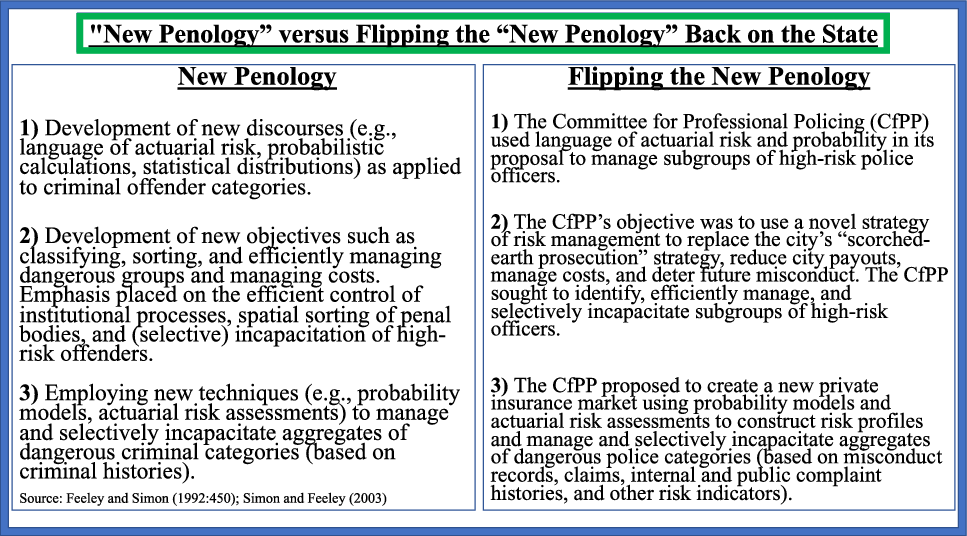
As shown in Figure 1, the case of police misconduct insurance flips the new penology script in three ways. First, instead of developing new discourses around actuarial risk and probability as applied to criminal offender categories, grassroots activists are developing similar discourses and applying them to criminal justice personnel. Second, instead of developing new objectives such as applying the logic of risk management to identify and efficiently manage dangerous groups of criminal offenders, grassroots activists are developing new objectives, including using risk management strategies to hold offending officers financially accountable, while reducing city payouts. Third, instead of employing new techniques such as probability models and actuarial risk assessments to manage aggregates of dangerous criminal categories based on criminal histories, grassroots activists are seeking to create a new private insurance market using similar techniques to manage aggregates of dangerous police categories based on police misconduct histories.
Flipping the “new penology” script. Courtesy of the author.

Flipping the “New Penology”: Developing Discourses of Risk Management and Actuarial Science to Address Police Misconduct
The Origins of the Police Insurance Concept
The idea of requiring police to carry their own professional liability insurance has been a ten-year effort in the making. CUAPB president and CfPP board member, Michelle Gross, says that in 2006 Michael Friedman talked with Gross about some ideas he was developing to increase police accountability. Friedman served as a board member and chair of the now defunct Civilian Review Authority (CRA) from 2003 to 2005.Footnote 8 Through his involvement, he gained an inside view of the ineffectiveness of civilian oversight and felt that the board lacked the authority to hold police accountable. He wanted to shift away from punitive, reactive approaches to dealing with police violence and develop a way to incentivize officers not to engage in misconduct:
I didn’t value civilian review as a scold and punish system. And so, part of my vision … is … sort of believing in positive cooperation or positive incentivizing. … A long time ago, I wrote … a document … suggesting … creating … a point system relating to CRA complaints and having it be that if lawsuit money went down, the city payouts went down, [and] what the city saved would be partly shared with officers based on having the fewest points from civilian complaints. … So somewhere along there that morphed into the idea of the liability insurance.Footnote 9
In explaining sections of a March 2002 document that he wrote entitled “Guiding Principles for Police Oversight Reform” (CRA 2002), Friedman noted: “The Guiding Principles begins work on the benefit of differentiating officer risk and compares it to the professional liability of doctors…but did not [propose] individual insurance policies. Instead it created its own internal risk assessment mechanism and tied it to bonuses.”Footnote 10
The document was written at a time in Minneapolis when police and community relations had reached a boiling point following high-profile incidents of misconduct. Minneapolis residents called for federal mediation, but grassroots groups, like CUAPB, argued that the city was undermining such efforts by handpicking a “community” team to broker an ineffectual mediation agreement. Before this agreement was reached, community members had elected their own team to draft a list of community demands and broker a substantive agreement. In January 2003, Friedman helped draft this list of demands. Although it remained an internal document due to the city’s refusal to negotiate with the community elected team, Friedman proposed in it the “concept to possibly requiring officers to carry their own insurance product.” He noted that “[a]doption of improvements in policy, training and oversight should reduce civil liability exposure,” before making three insurance-related demands:
(1) Privatize work-related liability coverage. Paid coverage will be at the lowest risk rating for the job description. Officers whose risk rating is higher will be required to cover the extra cost out-of-pocket [privatization should be phased in over a three-year period]; (2) Pass an ordinance that would require $1,000,000 liability coverage [the amount of coverage should be automatically adjusted for inflation annually] for all police officers … working in Minneapolis; [and] (3) Any reduction in cost to the City realized as a result of lowered premium costs will be distributed as bonuses to police who have no discipline points. (Federal Mediation Now 2003)
In 2006, when Friedman proposed the concept of mandatory professional liability insurance for police to Gross, she says that she liked his idea, but CUAPB was busy with other projects. Then, several years later, at CUAPB’s annual strategic planning meeting, one board member suggested that they get this idea off the ground, which they all agreed to do.Footnote 11
Moving from a Concept to a Grassroots Campaign
In 2010, CUAPB leaders started drafting the wording for a police insurance charter amendment. In 2013, after two false starts, the group crafted an amendment that adhered to the city’s plain language charter. Around this time, the group formed the CfPP to follow campaign laws and began a three-year ballot petition campaign. The proposed amendment read as follows:
Section 7.3(a)(2) Police Officers. Each peace officer appointed in the police department must be licensed as required by law. Each such licensed officer may exercise any lawful power that a peace officer enjoys at common law or by general or special law, and may execute a warrant anywhere in the county. Each appointed police officer must provide proof of professional liability insurance coverage in the amount consistent with current limits under the statutory immunity provision of state law and must maintain continuous coverage throughout the course of employment as a police officer with the city. Such insurance must be the primary insurance for the officer and must include coverage for willful or malicious acts and acts outside the scope of the officer’s employment by the city. If the City Council desires, the city may reimburse officers for the base rate of this coverage but officers must be responsible for any additional costs due to personal or claims history. The city may not indemnify police officers against liability in any amount greater than required by State Statute unless the officer’s insurance is exhausted. Footnote 12 This amendment shall take effect one year after passage. (CfPP 2014; emphasis in the original)
The amendment language was informed by Friedman’s initial proposal to have private insurance companies determine risk ratings of officers based on their misconduct histories. As the amendment language illustrates—with its implicit focus on factoring in “personal or claims history” to determine insurance premiums—the CfPP worked to develop a discourse around risk management and actuarial science to reduce misconduct and the financial costs stemming from it.
The campaign strategy of developing a discourse around risk management and actuarial science was evident in all aspects of the CfPP’s efforts to pass this novel accountability mechanism. In a CfPP internal media training document, the group noted the importance of accurately communicating this discourse to the public: “Our language is important! We need to consistently and clearly explain the mechanics of the amendment while addressing concerns of the public.” The document included bullet-pointed instructions for discussing the amendment with the media:
-
Read and be familiar with the wording of our amendment before participating in any interviews.
-
Refer to it as the police insurance amendment.
-
The police insurance amendment will require police officers to carry their own professional liability insurance. DO NOT refer to it as individual insurance as this raises the specter that officers will have to pay for it themselves.
-
If asked about the cost of coverage, say “the city could pay the base rate of the premium but any overage due to misconduct would come from the pocket of the officer who caused it.”
-
When questions of cost are raised: “Minneapolis currently spends about $3000 per officer per year for police misconduct—for every officer, including the officers who don’t engage in misconduct. We believe professional liability insurance will be less expensive over time as officers engage in less misconduct.”
-
Refer to payouts for police misconduct as “BAILOUTS for bad policing.” (CfPP 2016b; emphasis in the original)
As the bullet-pointed instructions highlight, the CfPP stressed the importance of carefully noting how the proposal balances municipal liability insurance (by encouraging the city to cover the base rate) with individual liability insurance (by having officers personally cover any overage due to misconduct) in order to encourage accountability at both the municipal and individual levels.
Though similarities exist between the old penology of penal governance and old penology of police misconduct with respect to discourses, objectives, and techniques, these two strategic formations have unfolded historically in unique ways and over distinct time periods. While the roots of US modern punishment date back to early penal reform efforts of the eighteenth, nineteenth, and early twentieth centuries (Simon and Feeley Reference Simon, Feeley, Thomas and Cohen2003), modern US policing has a much shorter history. A watershed moment was the 1931 publication of the Wickersham Commission report under President Herbert Hoover, which was the first report to recognize police misconduct as a national social problem (Rushin Reference Rushin2017a; Walker and Archbold Reference Walker and Archbold2019). The Wickersham Commission report is the starting point of what, I argue, may be thought of as the old penology of police misconduct. One objective that both the old penology of penal governance and police misconduct share is meting out punishment to have a specific and general deterrent effect: the former regarding individual offenders from the community (Feeley and Simon Reference Feeley and Simon1992) and the latter regarding individual police officers.
Critics of the new penology thesis have noted that contemporary crime control operates as a hybrid model consisting of both old and new penological features (Lynch Reference Lynch1998; Coleman and Sim Reference Coleman, Joe, Pratt, Brown, Brown, Hallsworth and Morrison2005; Cheliotis Reference Cheliotis2006), a critique that Simon and Feeley (Reference Simon, Feeley, Thomas and Cohen2003) acknowledge as valid and address in later work by clarifying their original thesis. Such hybridity was also evidenced in the CfPP’s campaign, especially in its emphasis on the old penological objective of specific and general deterrence. While the CfPP embraced new penological features such as selective incapacitation, the CfPP’s overall insurance model was aimed at general deterrence since it sought to reduce misconduct by increasing the likelihood or severity of punishment for officers. Furthermore, as the CfPP’s bullet-pointed instructions reveal, its proposal was aimed at specific deterrence insofar as the punished officer would theoretically avoid engaging in future misconduct for fear of, again, suffering the punishment she faced for committing the first offense (that is, having to pay “any overage due to misconduct”).
Throughout the campaign, the CfPP tended to avoid the explicit use of deterrence discourse, instead using seemingly more strategic and politically palatable language. One way the group did so was by analogizing to other professions. In its campaign literature, the CfPP analogized to professional liability or malpractice insurance in other occupations (for example, accountants, doctors, general contractors, and lawyers) (CfPP 2013c), and this idea was encapsulated in a “Get Out the Vote” meme that the CfPP campaign chair and board member, Dave Bicking, presented at a CfPP board meeting in August 2016: “How come the doctor who fixes my broken arm has to carry insurance, but the police officer who broke it doesn’t …?”Footnote 13 By analogizing to other professions, the CfPP emphasized how insurance would enhance police professionalism, as its name the Committee for “Professional” Policing conveyed.
The CfPP also tended to avoid the explicit use of deterrence discourse by framing the proposal in terms of positive and negative incentives. In a widely distributed campaign leaflet, the CfPP cited its primary analogy of auto insurance to explain how mandatory insurance would work in practice. The group highlighted positive incentives of requiring individual insurance such as: “All officers would see that good conduct is rewarded, in the same way that safe drivers pay lower insurance premiums than bad drivers” (CfPP 2013b). In line with Friedman’s earlier recommendations to offer positive incentives such as higher pay and bonuses to well-behaved officers, the CfPP envisioned that officers with long records of spotless behavior would be enticed by “good officer discounts” on their insurance rates similar to “safe driver discounts.”Footnote 14 At the same time, the CfPP’s campaign literature highlighted how requiring insurance would incentivize officers by offering negative consequences for bad behavior: “Just as bad drivers pay more for their insurance, police officers who harm the community will pay more for their insurance and some will become uninsurable. … [O]fficers will have an incentive not to brutalize people—because it will cost them money” (CfPP 2016m). The group’s tendency to avoid the language of deterrence was, arguably, more conducive to the CfPP’s objective of normalizing and depoliticizing its insurance proposal that centered on tools of risk management and actuarial science. Because material consequences such as losing one’s job could be perceived by some constituencies as “anti-cop”—and, in fact, were by the Police Officers Federation of Minneapolis (2016)—relying on deterrence discourse would have been a hard sell politically.
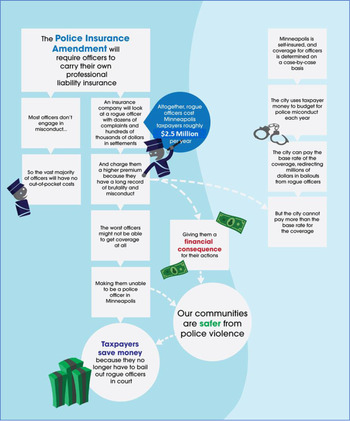
When deploying these newly developed discourses, the CfPP’s effort to stay on message was evident in its PowerPoint presentation before the city’s Police Conduct Oversight Commission (PCOC) in June 2016.Footnote 15 In the presentation, Gross first explained to the PCOC how the amendment would work in practice by going over the following campaign infographic (Figure 2). Gross then proceeded to highlight “a number of benefits to this approach,” including:
-
An officer who engages in misconduct that results in a premium increase will have a personal consequence for the conduct. This incentivizes the officer not to engage in this behavior in the future, applying a risk management strategy to policing that is not currently present. It also removes the element of politics in terms of who is disciplined and who isn’t.
-
Officers who don’t learn the lesson, and continue to engage in misconduct will find that their rates increase to the point of being unaffordable. The worst offenders may become uninsurable and thus, no longer employable by the Minneapolis Police Department.
-
As the worst offenders leave, good officers will have a better working environment. …
-
Police leadership will have a powerful new tool for managing their staff.
-
Decreases in police misconduct will increase the safety of the community and improve police-community relations. (CfPP 2016h; emphasis added)
How the police insurance amendment would work. Credit: CfPP 2016h.

These talking points further illustrate the development of this new penology of police misconduct discourse, including by highlighting how if punished officers recidivate by failing to “learn the lesson,” they are then identified and managed as an unruly group by having their insurance rates increased to the point of being “unaffordable.”
The CfPP portrayed officers as rational actors and, arguably, over-determined their rationality, while presuming a close link between misconduct, litigation, liability, and financial exposure.Footnote 16 In much the same way as the new penology does (Feeley and Simon Reference Feeley and Simon1992), the CfPP’s proposal placed a strong emphasis on the rationality of the managerial processes of police departments and insurance companies that would help to create a “better working environment” and provide police leadership with a “powerful new tool for managing their staff.” Critics of the new penology argue that it paints a pessimistic view of penal agents as lacking agency and ensnarled in “the ‘iron cage’ of an over-rationalized criminal justice system,” thus, overlooking positive features of penal managerialism, including its potential to “facilitate the ‘delivery’ of justice” (Cheliotis Reference Cheliotis2006, 314, 330). By only applying and theorizing the new penology in the context of criminal offenders from the community, scholars have also overlooked its potential to “facilitate the ‘delivery’ of justice” in the case of managing dangerous categories of criminal justice personnel, as the CfPP sought to do by developing discourses of risk management and actuarial science to address police misconduct. On its face, while the CfPP was discursively making an amoral case by adopting risk management logics, the group’s proposal assigned insurance companies the role of providing a normalizing assessment of risk levels in a dispassionate, apolitical fashion.
Flipping the “New Penology”: Developing a New Objective of Improved Risk Management to Reduce City Payouts and Misconduct
The Taxpayers Are the City’s Insurance Policy
In an April 2016 Minneapolis City Pages newspaper article describing the CfPP’s campaign, the then presiding but now former MPF president, Lieutenant Bob Kroll, criticized the campaign’s effort to insure police: “‘This group is so naïve. Our labor contract provides that the city will insure us. … They can get all the signatures they need to get on the ballot … and it’s not going to change our labor agreement’” (qtd. in Du Reference Du2016). Kroll further explained the current self-insurance terrain and voluntary professional liability insurance available to Minneapolis police:
[M]ost of us … have our [own liability insurance]. There’s two organizations [that provide officers liability coverage]: Minnesota Police and Peace Officers Association, and the Fraternal Order of Police. And most of us have one legal protection plan or another…. In addition with my home[owner’s insurance], I’ve got an umbrella. So I basically have three forms of coverage … just on my own choosing. But the department—by our labor agreement—has to provide us that coverage. … If [officers are] acting under the color of law and the enforcement of their duties, they’re going to be covered. … By and large, the city indemnifies. But you have situations where … it may have to be tried in court to say, “Is the officer acting within the scope of his duties or went beyond?” … But those are very, very rare. More than not, if the cop has got his uniform on, and they’re trying to do any effort at police work, they’re going to be covered under the city’s liability, … under just city policy and labor agreement.Footnote 17
In defense of the CfPP’s proposed amendment, Gross challenged Kroll’s assertions:
The reason this [amendment] is … needed … in Minneapolis is that the city does not indemnify officers automatically…. [A]ll funding for judgments and settlements related to [misconduct] incidents comes directly from the taxpayers. And that’s because a city literally budgets for police brutality. … [S]o there’s nothing in the police contract that could require the city to carry insurance because this city doesn’t have insurance. They … self-insure for these things … Mr. Kroll … seems to have it backwards. The federation contract has to follow the law. The law doesn’t have to follow the federation contract. … [One year after the measure is passed], the changes would take effect … to allow time to adjust the contract, accordingly.Footnote 18
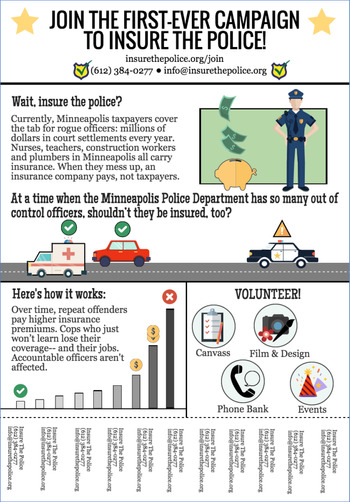
Thus, the CfPP viewed its insurance proposal as a necessary revision to the city’s existing indemnification practices. Under the group’s proposal, officers would have “guaranteed coverage,” which they did not have at the time since Minneapolis determined coverage on a case-by-case basis (CfPP 2016h). Further, the CfPP argued that the proposed amendment was needed because the taxpayers were the city’s insurance policy since they paid for the costs of misconduct. This was made clear in the campaign literature that the CfPP disseminated, including in one of its volunteer recruitment flyers (Figure 3).
CfPP volunteer recruitment flyer. Credit: CfPP 2016n.

Applying risk management as an accountability strategy is not new to policing (Walker and Archbold Reference Walker and Archbold2019). What was novel about the CfPP’s proposal was its attempt to develop a new objective of risk management through mandatory individual insurance to reduce misconduct and payouts. The CfPP leaders viewed existing accountability mechanisms as considerably weak and largely ineffective—a claim validated by a recent nationwide study that finds “every major mechanism of police accountability to be substantially flawed or generally ineffective” (D. Ramirez et al. Reference Ramirez, Marcus, Lauren and Carly2019, 458). But they still generally supported educating and training officers in anti-racism, de-escalation, community policing, and interventions to rehabilitate and correct officers’ performance problems.Footnote 19 Moreover, they supported individual insurance as one among myriad reforms necessary to end police violence that CUAPB had been fighting for years to implement—many of which faced resistance from Minnesota public officials at every level of government (Forliti and Imbrahim Reference Forliti and Mohamed2020). The CfPP believed that individual insurance was necessary because not enough was being done to hold rogue officers accountable. That said, the volunteer recruitment flyer highlights what Epp (Reference Epp2009) refers to as “liability’s benefits” insofar as responsibilizing pressures via individual insurance would presumably safeguard public safety by weeding out repeat offenders, while placing the financial onus on rogue officers instead of taxpayers.
The CfPP’s flyer also emphasized how professionals in other occupations in both the private and public sectors carry individual liability insurance. Police officers are one class of public sector employees that have been able to avoid becoming responsibilized worker subjects. This rare exception seems puzzling in an era in which neoliberal governmentality is the dominant governing rationality, and almost all spheres of human life are economized and privatized (Brown Reference Brown2015). However, it is less surprising when considered in the broader context of carceral state buildup.
As neoliberal governmentality gained prominence in the 1970s and subsequent decades, carceral state buildup, which began in the mid-1960s, coincided with structural transformations, like economic deregulation and welfare retrenchment. Paradoxically, in response to these state policies, the state increased spending on prisons, courts, and policing as its solution to managing economic and social insecurities. Police play an integral role in criminalizing social insecurity and managing dispossessed urban populations through a neoliberal state strategy of “punitive containment” that relies on panoptic surveillance and aggressive, militarized policing (Wacquant Reference Wacquant2009). During the course of carceral state buildup, I argue that legal mechanisms to hold police accountable have emerged (for example, Sections 242, 1983, and 14141) but are effectively neutralized by a legalized impunity infrastructure (for example, indemnification laws, qualified immunity doctrine, police union contracts) that also emerged over this period. Transforming police into market actors by mandating individual insurance would radically challenge elements of this legalized impunity infrastructure that financially immunizes officers who commit misconduct.
The CfPP understood the radical potential of its amendment, as CfPP campaign manager and board member, Cole Yates, explained:
How is it radical to propose that a dance teacher has to carry liability insurance, but someone that … harasses people in the community with a gun doesn’t? … But, at the same time, it directly undermines the system that’s in place that ensures that there’s not going to be accountability for police officers. So … it is extremely radical.Footnote 20
The CfPP’s novel application of risk management techniques was evident in the “[h]ere’s how it works” section of the flyer insofar as “repeat offenders” would be placed in higher risk categories by facing increased premiums. If they failed to refrain from further misconduct, they would lose their insurance coverage altogether. Meanwhile, the premiums of low risk or “[a]countable officers” would remain stable if they refrained from committing misconduct, so as not to punish ethical officers (CfPP 2016n).
When Police Misconduct Occurs, the City Pays Out
While the cost side of actuarial risk assessment is one aspect of penal managerialism that Feeley and Simon (Reference Feeley and Simon1992) left mostly unexplored (Aviram Reference Aviram2015), both sides of the cost/risk equation featured prominently throughout the CfPP’s campaign. The CfPP promoted a new objective of risk management to reduce misconduct-related costs, and, on its initial campaign website, “$20 Million Dollars” appeared in big, bold letters with the following explanation: “That’s the cost of police brutality to Minneapolis taxpayers over the past seven years. … Despite clear incentives for the city to use risk management to reduce these costs, this has yet to occur, demonstrated by the lack of accountability of officers … and … continuing brutality” (CfPP 2018).
The CfPP’s strategic framing in terms of cost savings is part of a new, broader discourse in criminal justice policy that punishment scholar Hadar Aviram (Reference Aviram2015) refers to as “humonetarianism,” which first rose to prominence in response to the 2008 financial crisis. Humonetarianism is the increasing propensity of penal actors to consider criminal justice and punitive policies mainly on the basis of cost, including “criminal propensity, risk, deterrence, and rehabilitation” (Aviram Reference Aviram2010, 3). Humonetarianism can be viewed as a “direct continuation of the actuarial-managerial practices of New Penology,” but, rather than focusing primarily on the risk levels of criminal offender categories, humonetarianism focuses on the costs that aggregated offender classes impose on the penal system (16–17).
The CfPP employed humonetarianism and inverted this new penological discourse by focusing on the costs that aggregated policing categories impose on taxpayers. Since its ultimate objective was to drive out rogue officers, the CfPP sought to make visible policing categories that are both high cost and high risk: high cost due to officers’ involvement in misconduct-related payouts and high risk due to their likelihood of committing future misconduct. Just as risk and cost are seen as “two parts of a calculus of ‘worthiness of incarceration’” (Aviram Reference Aviram2015, 57), the CfPP considered risk and cost as two parts of a calculus of worthiness of employment as an officer.
The CfPP also viewed its campaign as a “win for taxpayers” because taxpayers would no longer have to subsidize police violence by “bail[ing] out rogue officers” (CfPP 2016c) and paying a monetary sanction in the form of what essentially amounts to a police violence tax. In the punishment literature, the conventional definition of “monetary sanctions” is all the costs imposed by the criminal justice and court system on individuals from the community convicted and/or accused of committing a criminal offense. Such costs include fines, fees, interest, surcharges, collection charges, court processing fees, and defense attorney fees, which generate and reproduce inequality by trapping individuals in legal debt cycles (see Harris Reference Harris2016). For example, in the lead up to the death of Michael Brown, Ferguson budgeted annually for significant increases in municipal fines and fees to finance the city budget and to compensate for tax revenue shortfalls (US DOJ 2015). Instead of focusing on how cities budget for revenue generated from monetary sanctions and the micro-level predatory effects on individuals convicted and/or accused of a criminal offense, the CfPP sought to illuminate: (1) how police misconduct-related settlements and judgments (along with the hidden costs of legal fees, court testimonies, depositions, and so on) contribute to tax revenue shortfalls and (2) how financially immunizing individual officers and departments has meso-level predatory effects on self-insured cities by diverting tax revenue from the public sector—in areas like education, social services, and infrastructure—to cover payouts.
The CfPP strategically chose to frame its campaign using humonetarianism and with these meso-level effects in mind, as Yates explained: “Part of our messaging is going to be explaining to voters how that twenty million dollars could have been spent. For instance, you could say twenty million dollars could hire this many teachers, … or … help this many homeless people, or … do this for roads.”Footnote 21 This dynamic of misconduct-related costs contributing to tax revenue shortfalls, and local government officials raiding city funds budgeted for other purposes, as the CfPP claimed, is not isolated to Minneapolis but part of a national pattern. Furthermore, in some US cities, it only takes one or two big payouts to create a budgetary emergency (Goodwin, Shepard, and Sloan Reference Goodwin, Whitney and Carrie2020).Footnote 22
The City’s Lack of Transparency and Misuse of Taxpayer Dollars to Cover Payouts
While Yates estimated that police misconduct had cost the city twenty million dollars in recent years, determining the precise cost was a more challenging task. During an August 2016 CfPP board meeting, Gross attributed the difficulty of getting “exact figures” to the city’s lack of transparency and told the board she needs a researcher to go through all the city council meetings to determine how many payouts have been made and the amount it paid out. She said that some of the payouts are being hidden and not reported by the Minneapolis City Council’s Ways and Means Committee, after it approves them. The lack of transparency in how cities pay for misconduct is not a problem unique to Minneapolis. In her empirical study of how cities, counties, and states budget and pay for misconduct, Joanna C. Schwartz (Reference Schwartz2016, 1210) found a lack of transparency nationwide. Alyxandra Goodwin, Whitney Shepard, and Carrie Sloan (Reference Goodwin, Whitney and Carrie2020) also found a lack of transparency by cities that engage in bond borrowing. The majority of cities they examined “were unable, or unwilling, to provide a full accounting” (6), and many disregarded sections of their data requests or sent incomplete responses to their questions. The CfPP had a similar experience when trying to hold the city accountable for misusing taxpayer dollars.
In August 2016, Gross filed a formal complaint to the Minnesota Office of the State Auditor against Minneapolis for refusing to indemnify Blayne Lehner—an on-duty MPD officer who acted outside the scope of his employment during a 2013 incident—but still paying out $360,000 to the victim. She noted that in the past several years the city has frequently used taxpayer dollars on payouts to cover incidents that the city recognized as involving “willful or malicious acts and acts outside the scope of the officer’s employment.” Gross requested that the state auditor open an investigation into “this misuse of taxpayer funds,” but the office did not accept her complaint and, therefore, would not investigate the matter (CfPP 2016f). Gross contends that this lack of transparency is part of a larger pattern in Minneapolis. On several occasions, local newspapers have reported on a misconduct-related lawsuit that the city paid out, but the payout will not appear in the city’s itemized list of payouts when Gross makes a formal public data request. She says: “The city itself doesn’t even know when, to whom, and how much it’s paying out.”Footnote 23
City’s Number One Risk Management Strategy: “Scorched-Earth Prosecution”
As the CfPP sought to develop a new objective of risk management through professional liability insurance, Kroll argued that the city ought to adopt a tougher legal strategy. He claimed that compared to other cities Minneapolis is not tough enough in fighting frivolous lawsuits that result in lucrative settlements for plaintiffs:
I’m very opposed to settlements. … In Minneapolis, they’re known as “go away money,” meaning … you file suit against the police department for excessive force. Your claims may be … very weak, but they go, “Well, how much is it going to cost to try the case as opposed to just pay them to go away?”Footnote 24 … The more you do that the more people come forth with frivolous lawsuits…. [T]here’s other cities that have a zero-tolerance level, and they don’t get sued because they’ve told … these lawyers that represent clients in these cases, … “We’re not gonna give you quote ‘go away money.’ … We fight!” So, guess what? They don’t come back anymore.Footnote 25
Gross challenged Kroll’s claims that the city is just giving away money to those who file supposedly frivolous lawsuits:
These large settlements, … like when they rolled … a live flashbang grenade into a woman’s house, … and it was a wrong address raid and [almost] incinerated the back of her leg off. … There is no way in hell the city is not going to settle a case like that … [W]hen you make mistakes, you have to pay for those mistakes. That’s nonsensical [that is, Kroll’s argument]. The city is not … pushovers…. The city’s primary risk management strategy … is to prosecute the hell out of the person that’s the victim. They put phony charges on people. They drag them to court many … times, trying to get the person to just take a deal. … We call it “scorched-earth prosecution” of people who have been victimized by police.Footnote 26
Thus, Kroll and the CfPP leaders perceived the issue of misconduct and the city’s litigation response in fundamentally different ways. The CfPP viewed large financial settlements as an inevitable outcome of legitimate lawsuits filed due to the human costs of misconduct. To develop a new objective of improved risk management, the CfPP sought to replace the city’s “scorched-earth prosecution” strategy with police misconduct insurance to reduce city payouts and misconduct. In contrast, Kroll, who was elected MPF president by police to represent the force’s nearly 880 sworn officers, wanted to adopt an aggressive zero-tolerance approach. Kroll advocated this position by appearing to minimize and deflect attention away from the legitimate human costs and financial risk that police who commit misconduct pose to the community while, at the same time, claiming that community members filing “weak” excessive use-of-force claims pose the real financial risk.Footnote 27 These contrasting viewpoints illustrate the uphill challenge that the CfPP faced in trying to reconceptualize problem officersFootnote 28 as a financial risk category that needs to be responsibilized.
Building a Bipartisan Coalition to Support Police Misconduct Insurance
Since the 2008 financial crisis, humonetarian discourse has started to dominate political and public discussions about criminal justice and correctional policies (Aviram Reference Aviram2015). In the case of penal reform, conservatives are increasingly motivated, at least in part, by a cost savings approach involving bipartisan efforts to curb the war on drugs and reduce mass incarceration, prison overcrowding, and sentencing (Dagan and Teles Reference Dagan and Teles2016). Hadar Aviram (Reference Aviram2015, 6) contends that bipartisanship is a defining feature of humonetarianism: “Humonetarian discourse is characterized by turning to former enemies—libertarians, old-school free market economists, and financially prudent politicians of all stripes—as new allies to create initiatives and alternatives that roll back years of punitive legislation.” To influence police accountability governance, the CfPP also deployed humonetarian discourse that emphasized bipartisanship.
In 2012, before the CfPP officially formed, CUAPB spent a year crafting the insurance amendment and had a bipartisan coalition vet the wording, which comprised insurance professionals, labor attorneys, retired police officers, and community stakeholders from across the political spectrum. Gross says that they all thought the insurance amendment was a “brilliant idea” for addressing misconduct and fighting government corruption.Footnote 29 During the campaign, Bicking remarked: “I think we have as much support among Republicans as we do among Democrats. The libertarians … definitely support us.”Footnote 30 At a CfPP board meeting in August 2016, a board member named Kim sought to increase bipartisan support by brainstorming cost-centered campaign slogans:
Kim … shared her messaging and framing with the board. … Her draft read, “We shouldn’t have to pay for someone else’s misconduct. Save tons of our tax dollars: vote to require police insurance November 8th.” … Kim then told the board that it needs to emphasize how taxpayers should be in support of this insurance effort to attract more Republicans. Gross agreed and observed that some white conservatives just don’t give a damn if you try to make the argument based on the wrongfulness of the brutality itself. (Emphasis in original)
Thus, in the CfPP’s effort to influence police accountability governance, it deployed humonetarianism to increase bipartisan support by illuminating how taxpayers could save money currently being spent on misconduct, if they supported the insurance amendment.
Flipping the “New Penology”: Deploying Techniques of Risk Management and Actuarial Science to Manage Police as Aggregates in a New Insurance Market
Creating a New Insurance Market
John Rappaport (Reference Rappaport2016, Reference Rappaport2017) and Joanna C. Schwartz (Reference Schwartz2016), preeminent legal scholars on police misconduct, payouts, and liability insurance, have noted the honest brokerage role that insurers can play to force cities to reform their police departments. Bringing in insurance companies is a solution to the problem that Gross also supported: “Right now, we have people working in the city of Minneapolis who have cost us multiple million-dollar lawsuits. … An insurance company isn’t gonna put up with that. … They’re gonna say, ‘You pay more for your premiums just like a bad driver, … repeat drunk drivers, … or … eventually become uninsurable.’”Footnote 31 In the new penology, the government employs novel techniques, like actuarial risk assessments, to manage aggregates of dangerous criminal categories based on criminal histories. In flipping the new penology, the CfPP sought to use similar techniques, while creating a new insurance market, to manage aggregates of dangerous police categories based on misconduct histories and other risk indicators (for example, settlements, judgments, complaints, claims) (CfPP 2013a). Just as aggregates of offender classes are surveilled in prisons and on parole and probation in the new penology of corrections (Feeley and Simon Reference Feeley and Simon1992), officers would be surveilled by risk management and insurance experts under the CfPP’s proposal, incorporating various risk indicators to construct risk profiles. Creating a new insurance market to regulate police behavior though remains unchartered territory, especially in this emerging “algorithmic age,” to which the insurance industry is quickly adapting (Elliott Reference Elliott2017; Hannah-Moffat Reference Hannah-Moffat2019; Rothschild-Elyassi, Koehler, and Simon Reference Rothschild-Elyassi, Johann, Jonathan and Deflem2019). The novelty of adopting such insurance was made clear during the CfPP’s board meetings and volunteer orientations as well as during the CfPP’s legal challenges with the city over placing the proposed amendment on the ballot.
During a CfPP question-and-answer session at an orientation for new volunteers in July 2016, a thirty-something-year-old Black female volunteer asked Gross who would pay for the insurance. Gross said that the city would cover the base rate and that if the officer acted outside the scope of his duties, the city and officer could be sued. Bicking added that this insurance idea worked a lot like car insurance: the officers would have a lawyer from the insurance companies working on their behalf, and the insurance company would defend them against the plaintiff. A white volunteer in her late thirties then asked if they had an insurance company in mind. Before answering the question, Gross acknowledged that she personally could not stand insurance companies but that they played an important risk management role. She then said that Wright USAFootnote 32 and Travelers are the biggest players in insurance, implying that such insurance companies would provide coverage and that in fifteen years she thinks people will look back and say: “What? They didn’t have insurance back then?” She envisioned that creating this new insurance market would later be viewed as common sense.
Building on Otu (Reference Otu2006) and the CfPP’s campaign efforts, Ramirez et al. (Reference Ramirez, Marcus, Lauren and Carly2019) have similarly advocated mandatory professional liability insurance for officers. Like the CfPP, the central analogy they employ is automobile insurance. Though they acknowledge that other professions, like law and medicine, encounter risks that are often insured, they contend that automobile insurance is a more appropriate analogy to policing than professional liability insurance in other professions. For instance, medical malpractice insurance employs “broad risk classes” (for example, by specialty) and rarely adjusts premiums based on a doctor’s behavior or disciplinary record in like manner as a motorist who experiences increased premiums due to a bad driving record. Consequently, low-risk doctors end up subsidizing the legal liability of high-risk ones since doctors who share a specialty generally pay the equivalent amount. Because premiums remain unaffected, prior claims history appears not to affect the quality of care provided by doctors. Furthermore, while automobile insurance is compulsory nationwide, individual-level insurance in other professions is not. Up until 2017, Oregon was the only state that required all lawyers to carry professional liability insurance. In the medical profession, only seven states currently require doctors to carry medical malpractice insurance. In contrast to using broad risk classes, which offer no economic incentive for improving one’s behavior, raising drivers’ insurance premiums and/or deductibles based on their bad driving histories have both been shown to decrease the number of auto accidents.
In August 2016, Tracey N. Fussy, a Minneapolis assistant city attorney, submitted an affidavit to the county district court during the city’s court battle with the CfPP over the legality of placing the insurance amendment on the ballot. In the city’s attempt to challenge the practicality of the proposed amendment, the affidavit included a letter from John M. Ratelle, the city’s insurance broker and risk advisor. Ratelle raised a number of potential insurance and risk-related issues if Minneapolis were to mandate individual insurance. He explained that there would not likely be different base rates for officers based on one’s risk level and position within the force (for example, SWAT team members versus traffic officers), as the CfPP envisioned, because an insurance company would employ broad risk classes:
The requirement that each Police Officer have their own policy will likely result in each policy being considered “first dollar coverage” meaning that the policies will [financially cover] defense and any actual claims [paid out] to claimants without any contribution from the Officer or City. The cost to the city of issuing [policies] to each Officer will increase the overall expense to the city, as a result of multiple policies being issued and multiple sets of limits being insured. … [F]or example instead of a $100 [million] limit for 800 officers the Insurance Company may issue 800 policies of $1 [million] each for a total risk insured of $800 [million]. … [E]ssentially the insurance company is insuring … on an individual basis versus a group policy. … Underwriting this kind of program will cause every officer to be charged a premium and that carries the highest risk Policing activity. … [S]o an administrative office[r] would likely pay the same premium as an officer on street patrol because they could be assigned street duty.Footnote 33
In an internal legal strategy memo circulated among board members, the CfPP leaders sought to refute Ratelle’s claim that broad risk classes would be employed. They believed that an administrative officer would have a lower base rate than a patrol officer and “if a desk officer is reassigned to patrol during the year, the rate [will] get … adjusted.” The CfPP further argued that setting the base rate for officers would be dependent upon different individual risk factors and considerations “just as the base rate for auto insurance differs based on the location, the type of car, the miles driven” (CfPP 2016a).
Ratelle further claimed that, if several claims were filed against officers, then the insurer would likely raise premiums of both individual officers and the entire force. Consequently, low-risk officers would end up subsidizing the legal liability of high-risk ones since the whole force would be affected by increased premiums regardless of an officer’s involvement in the claims. Ratelle then noted that a similar scenario would likely play out if a lawsuit were filed. Regardless of the merit of the suit, if the insurer decided it was more cost effective to settle out of court than to go to trial, the insurer would then “recoup the costs by raising the rates of the insured officer and potentially the group.”Footnote 34 Thus, Ratelle’s claims appeared to undermine one of the CfPP’s central arguments that the premiums of ethical and low-risk officers would remain stable and incentivize them to continue to refrain from misconduct (CfPP 2013a, 2016m). However, Bicking contended that it would not be logical for insurance companies to recoup costs by raising rates on the group. But if they did, he argued, then ethical and low-risk officers would be incentivized in a different way: to intervene and prevent officers, particularly high-risk ones, from committing misconduct to ensure that their premiums do not increase.Footnote 35
At an August 2016 board meeting, the board discussed how it believed base rates would be determined and the cost of them. Bicking explained that, if officers are on the beat in different neighborhoods, their base rate would still be the same as officers patrolling other neighborhoods. So even if they work in high-crime areas and, therefore, have higher incidents of use of force than officers in lower-crime areas, they should not have higher rates of police misconduct that would increase their insurance premiums since they would still be acting within the scope of their employment. Gross then presented her research, finding that the base rate per federal officer was three thousand dollars. Bicking estimated that it would cost between one thousand to one thousand five hundred dollars per year for the base rate for officers with no risks or low risks to be insured. He then reminded the board that, since this is a new proposal, insurance companies have not yet figured out the details.
In her presentation before the PCOC in June 2016, Gross made clear the CfPP’s uncertainty over insurance costs:
Because this kind of insurance has not been available in Minneapolis before, we don’t know with certainty about the costs. However, our research indicates that these policies will be available for well less than $3000 per year.Footnote 36 Even if the initial costs are higher, over time these costs will decrease as risk management strategies are applied that reduce the number of incidents and as problem officers self-select to leave the department or become uninsurable and are forced to leave. (CfPP 2016h)
Thus, even if the projected costs seem high, Gross contended that they will eventually go down after insurers employ “risk management strategies” to weed out the aggregated risk category of “problem officers.” This would have been a likely outcome since insurance opens up a population to indefinite scrutiny as subclasses of risk are finely specified, and risks that undermine the integrity of the risk pool are unpooled (Ericson, Doyle, and Barry Reference Ericson, Aaron and Dean2003). Though Rappaport remains skeptical (qtd. in Balko Reference Balko2016), the CfPP believed that the logic of loss prevention and the current use of risk management techniques applied in the case of municipal-level police insurance (Rappaport Reference Rappaport2017) would extend to individual-level insurance, which Ramirez et al. (Reference Ramirez, Marcus, Lauren and Carly2019) have also recently suggested and on which they have elaborated.
At an earlier board meeting in June 2016, Gross said that insurance companies are starting to discuss this individual insurance concept because they see police as an untapped insurance market. She noted how Insurance Business Magazine had published an article earlier that spring about the role that insurance companies could play in addressing police misconduct.Footnote 37 In what appeared to be more of an observation than a serious strategy proposal, Gross pondered whether insurance companies should be funding the CfPP’s effort since the amendment was in their economic interest. Kim said that the CfPP did not want to accept the insurance industry’s money because it would take away from the campaign’s message of police accountability.
In late August 2016, after the city council and district court blocked the CfPP’s ballot measure, the city argued to the Minnesota Supreme Court that state law and the police union contract require that the city indemnify officers. The CfPP rebutted, arguing that the proposed amendment “addressed an area not covered by state law: insurance for claims of misconduct involving willful and malicious acts outside of the scope of the officer’s employment, where the City is not required under law to indemnify.”Footnote 38 In early August 2016, the CfPP argued before the city council that, in such cases, “the City is under no obligation to defend … or pay damages resulting from legal actions and … sometimes … has chosen not to” (CfPP 2016g). Ratelle challenged the practicality of the CfPP’s proposal: “I have never seen an Insurance Company issue a policy that only covers ‘Malfeasance’. … [T]he Insurance Company could deny the claim if they were only brought in when ‘Malfeasance’ was established for prejudice.”Footnote 39 In its internal legal strategy memo, the CfPP countered his argument: “If coverage is allowed by law, it is safe to presume that insurance companies will offer it—the beauty of the free market.” The CfPP then refuted another concern of Ratelle’s that its proposal overlapped with the city’s duty to indemnify:
[M]any officers already have some form of professional liability insurance. … [T]hese policies are more likely to overlap with the city’s duty to … indemnify. … Somehow the city manages to deal with that without breaking state law. … If the city claims that our amendment would make it impossible for the city to continue in its lawful responsibility, … then the city must now prohibit officers from purchasing any policies of their own! (CfPP 2016a; emphasis in original)
Thus, in underscoring the city’s inconsistent indemnification practices, the CfPP challenged what it perceived as a “law on the books” versus “law in action” discrepancy. By addressing an area of indemnification not covered by state law and the police union contract,Footnote 40 the CfPP strategically crafted its proposal to allow insurers to weed out problem officers. Achieving this reform through a grassroots referendum would have enabled the community to influence the future collective bargaining process and police union contract, thus circumventing labor protections against officers being fired. Since police union contracts often “contain provisions that can insulate frontline officers from accountability,” and many state labor laws exclude community input in the collective bargaining process (Rushin Reference Rushin2017b, 1222), this action would have been a radical departure from the status quo.
Engaging the Public Safety Debate: Police Misconduct Insurance versus the “Ferguson Effect”
Rappaport worries that requiring police to carry their own liability insurance would impose too much financial burden on officers and that they may start quitting once their premiums are too high (qtd. in Balko Reference Balko2016). But upending the status quo of police impunity by driving out rogue officers whose repeated misconduct makes them unable to pay higher premiums or uninsurable was precisely the CfPP’s goal. The CfPP implicitly sought to apply the new penological strategy of selective incapacitation, which Simon and Feeley (Reference Simon, Feeley, Thomas and Cohen2003, 102) view as “the exemplar of the new penology.” Thus, the CfPP’s primary aim was not to rehabilitate or retrain problem officers but, rather, to bring about substantial aggregate effects in the reduction of misconduct by driving them out of the department to create a more professional and safer working environment for ethical and low-risk officers and to increase public safety.
Bicking claimed that, instead of firing some rogue officers, the city promotes them to internal desk jobs just to get them off the street, so that they have minimal, if any, direct contact with the public. If insurers applied broad risk classes and charged every officer a base rate covering the highest risk of policing activity, as Ratelle anticipated, insurers would still have discretion not to insure high-risk officers, including those who have escaped accountability by being reassigned to internal desk jobs. This is because private insurers are able to exert pressure on departments to terminate problem officers and sometimes succeed in doing so (Rappaport Reference Rappaport2017). If the base rates varied depending on one’s misconduct history and position within the force, as the CfPP envisioned, insurers would have discretion to offer a base rate covering the highest risk of policing activity for low- and moderate-risk officers, while either terminating high-risk officers or reassigning them to low-risk positions to reduce police liability and increase public safety.
Lieutenant Kroll, on the other hand, advocated the “Ferguson effect,” arguing that violent crime in US cities is rising due to increased scrutiny of officers following the widely publicized 2014 fatal shooting by police of Michael Brown, which has inhibited officers from proactive policing (Mac Donald Reference Mac Donald2016).Footnote 41 Kroll viewed proactive policing as synonymous with aggressive policing:
In police work, it’s a lot like basketball. If you’re not getting a lot of fouls, you’re probably not playing hard enough. … I’ve been complained against forty-eight times, but … what’s thicker than that is my commendation file. … [T]he officers that are aggressive, that engage, have a lot of complaints. … [T]hey offset that with a lot of awards. … [E]xcessive force and police misconduct, it’s subjective. Just because a person has a lot of accusations doesn’t mean that they’re guilty of doing anything wrong. … The ones that do nothing, … they … have no complaints and … don’t have any awards…. If you’re a taxpayer, which cop do you want working your neighborhood, your business?Footnote 42
In contrast to Kroll, the CfPP’s ideal conception of proactive policing de-emphasized aggressive policing. The CfPP believed that insuring officers would challenge and reshape the current organizational culture that rewards such policing. In a July 2016 letter to the city council, Yates explained that by passing the insurance amendment “[o]fficers would be incentivized to engage in quality policing that increases community safety and improves police-community relations.” Failing to adopt an effective accountability mechanism like this, Yates said, will perpetuate not only financial costs but also human costs: “[O]ne must … consider the nonmonetary costs to people harmed by police misconduct and the cost to the community of distrust and poor police-community relations” (CfPP 2016d). Thus, the CfPP believed its campaign would promote a form of proactive policing predicated on community policing and de-escalation efforts that increase public safety and police-community trust.
During the campaign, in a National Public Radio interview, Kroll applied the Ferguson effect logic to argue against the insurance amendment. He stated that requiring such insurance would make officers overly cautious and prevent them from looking into suspicious activities. He further argued that “[i]f you don’t do that proactive police work, your likelihood of being sued is a lot less” (Kaste Reference Kaste2016). However, he did so without acknowledging that police who refrain from carrying out their duties—whether proactive or reactive—might still be held liable in a civil lawsuit (Otu Reference Otu2006) and that “[j]ustified use-of-force incidents should not raise the premium” (D. Ramirez et al. Reference Ramirez, Marcus, Lauren and Carly2019, 452). Moreover, researchers have previously found that “[o]fficer initiated aggressive behaviors … do not seem to be deterred to any substantial extent by concerns about liability” (Novak, Smith, and Frank Reference Novak, Smith and James2003, 363). Around the same time, in an interview with the Chicago Reporter, Kroll further argued against the amendment by trying to rebut the CfPP’s attempt to analogize police officers to professionals in other occupations who carry insurance: “Doctors, with the exception of those in the ER, have the luxury of analysis before, during and after their decisions. Lawyers have the opportunity to research, review and consult before they decide. … Comparing them to police officers who make split-second decisions is like a whole other realm” (Murphy Reference Murphy2016).
During the campaign, the CfPP board members struggled to rebut Kroll’s Ferguson effect argument, and, at a June 2016 board meeting, discussed ways to challenge it:
Yates suggested they say something like, “This insurance amendment should make officers think twice before engaging in police misconduct.” Kim said that we don’t want to frame it like that because the best argument police have is that policing is different than other professions, and that they have to make split-second decisions, and an insurance requirement would inhibit proactive policing and their ability to carry out their jobs effectively. Kim said that she has been trying to think of a strong counterargument, and that we need it to be simple enough for the general public to understand.
The group thus grappled with how to frame a response to accusations that its insurance proposal would undermine public safety by inhibiting officers from making split-second decisions and investigating suspicious activities.
Why the CfPP’s Insurance Campaign Failed and Efforts Moving Forward in Minnesota and Beyond
Despite the CfPP collecting enough valid signatures, the city council voted against placing the insurance amendment on the November ballot (CfPP 2016k). In late July 2016, just days before the council’s vote, Minneapolis City Attorney Susan L. Segal and her office issued a legal opinion. The opinion echoed central arguments made by the MPF’s attorney in a letter addressed to Segal in June 2016 (Michels Reference Michels2016)—namely, that the proposed amendment was “preempted by state law and conflict[ed] with state public policy” (Segal et al. Reference Segal, Susan, Trina and Burt2016, 2). Segal and her office asserted that the measure was expressly preempted by, and inconsistent with, the city’s statutory duty to indemnify officers and conflicted with the state law granting police union and collective bargaining rights. Thus, they advised the city council to vote against placing it on the ballot (Segal et al. Reference Segal, Susan, Trina and Burt2016), which the vast majority of council members did (CfPP 2016i).
Throughout the process of validating signatures, the CfPP felt that city officials “engaged in illegal stalling and disenfranchisement.” The group believed Segal and her office’s “specious opinion” (CfPP 2016l) and the city council’s vote were a continuation of such attempts to undermine the “democratic process” (CfPP 2016k). The CfPP responded by filing a lawsuit in district court to reverse the city council’s decision on the basis that it “illegally” voted against placing the amendment on the ballot (CfPP 2016j). In the district court’s ruling dismissing the CfPP’s petition, Judge Susan M. Robiner argued in favor of the city and police federation that the proposed amendment conflicted with state law.Footnote 43 The CfPP then filed an expedited appeal to the Minnesota Supreme Court, which affirmed the lower court’s ruling.Footnote 44
In its legal brief to the Minnesota Supreme Court, the CfPP alleged that the city and the district court “mischaracterize[d]” its proposal as conflicting with existing state statutes, including the statute on indemnification. The CfPP contended that its proposal dealt with a new matter not covered by state law: “[T]he rising number of payouts to victims of police actions that are taken outside of the scope of duty or that show an abuse of an officer’s discretion.”Footnote 45 The CfPP further argued that existing state statutes concerning municipal tort liability do not appear to rule out the possibility of mandatory individual-level insurance for officers.
In March 2017, the Minnesota Supreme Court issued its formal written opinion. In the sole dissenting opinion, former associate justice of the Supreme Court, David Stras, stated that he agreed with the district court’s decision to dismiss the CfPP’s proposal but not with its reason for doing so. In contrast to the district court, which addressed the merits of the proposal, Judge Stras found the case to be “nonjusticiable,” meaning that the state Supreme Court did not have the authority to adjudicate the dispute. Judge Stras noted that the set of case law that the court’s majority drew on to justify its ruling required demonstrating that the proposed amendment was manifestly unconstitutional, a condition that was clearly lacking. Consequently, the court was playing “the unfamiliar role of gatekeeper of local citizen initiatives and referenda.”Footnote 46 In the end, the CfPP leaders thought that in siding with the city and district court, the Supreme Court determined that “politics are more important than the law” (CfPP 2016e).
Following the CfPP’s failed 2016 ballot campaign in Minneapolis,Footnote 47 CUAPB—along with other major police accountability groups in Minnesota, including two BLM chapters—have proposed in the wake of George Floyd’s murder over forty reforms to end police violence, including a renewed effort to mandate individual-level insurance (Forliti and Imbrahim Reference Forliti and Mohamed2020), which some insurance industry professionals view as a central Minneapolis reform recommendation (Live Insurance News 2020). Beyond Minnesota, a bill requiring this insurance was recently introduced by a New York state lawmaker, and several insurance brokerage companies throughout the United States are starting to either explore the possibility of developing such coverage or writing policies in anticipation of this new world of mandatory individual-level insurance (Barlyn and Scott Reference Barlyn and Alwyn2020). Since Colorado recently passed a police reform bill that can make individual officers personally responsible for up to $25,000 in a police misconduct-related lawsuit (Berman Reference Berman2020), Colorado insurance companies have sought CUAPB’s advice on mandating such insurance.Footnote 48 Shortly after Floyd’s murder, CUAPB was in talks with Minnesota lawmakers to pass a bill mandating this insurance at the state levelFootnote 49 ; however, the Minnesota Legislature, specifically State Senate Republicans, blocked the billFootnote 50 from even having a hearing.Footnote 51 Despite this most recent setback, as part of its long-term vision, CUAPB plans to continue working to build a nationwide movement to insure police.Footnote 52
DISCUSSION AND CONCLUSION
Feeley and Simon (Reference Feeley and Simon1992) have distilled key dimensions of contemporary trends in penal managerialism through their new penology thesis. In this article, I have extended their thesis in a new direction by examining how social movement organizations are flipping the new penology back onto state actors in the criminal justice system. In the contemporary policing era, as BLM mass protests capture national attention, some long-standing grassroots groups have been working for years to introduce innovative accountability mechanisms, like individual insurance, to curb incidents of police misconduct. Building on the work of criminologists and legal scholars who have analyzed and theorized policing at the intersections of government payouts, indemnification, and reform via private insurers (Otu Reference Otu2006; McCoy Reference McCoy and McCoy2010; Schwartz Reference Schwartz2014, Reference Schwartz2016; Rappaport Reference Rappaport2016, Reference Rappaport2017; D. Ramirez et al. Reference Ramirez, Marcus, Lauren and Carly2019), I have presented a case study of the CfPP’s failed ballot campaign to require police to carry professional liability insurance.
Employing risk management as an accountability strategy is not new to policing (Walker and Archbold Reference Walker and Archbold2019), nor is applying actuarial logic, which is standard practice in many other areas of insurance risk management. Yet the CfPP’s application of actuarial logic in this case is novel. The CfPP tried to work within the system and change the “rules of the game” that govern the US policing field by adopting the three defining features of the new penology: (1) the CfPP used language of actuarial risk and probability in an effort to manage police, especially “rogue” officers; (2) the CfPP proposed using the logic of risk management to reduce city payouts of police misconduct cases and hold police accountable; and (3) the CfPP sought to create a new insurance market using risk assessments to manage aggregates of dangerous police categories based on misconduct histories and other evidence of risk.
By only considering how the new penology has been applied by penal administrators and mid-level criminal justice personnel, researchers have assumed that its application is unidirectional and usually top down. With the dawn of big data analytics supplanting more traditional and social science-based actuarialism, scholars are starting to focus attention on the wider phenomenon of how traditional risk logics are being challenged, reconfigured, and expanded upon by various entities, including from the bottom up by social justice organizations—an area of research that has received limited attention (Hannah-Moffat Reference Hannah-Moffat2019). In addition to the CfPP’s bottom-up campaign to insure police, academic activists and researchers have started to implicitly propose inverting the new penology. Some policing scholars suggest reconfiguring correctional strategies, like actuarial risk assessment tools, to manage problem officers (Worden, Harris, and McLean Reference Worden, Christopher and McLean2014). Legal scholar Darrell D. Jackson (Reference Jackson2017) suggests that marginalized communities flip the script on US Supreme Court-sanctioned practices that allow police to profile racial minorities in order to profile the police, develop offender profiles based on risk, and predict future misconduct of high-risk officers.
Future research should further consider how penal logics and political technologies of social control may manifest in a bidirectional and bottom-up fashion, as grassroots groups seek to reinvent, retrofit, and reassemble penal logics to promote social justice and advance broader social movement agendas (Maurutto and Hannah-Moffat Reference Maurutto and Kelly2006). For example, adopting new penological discourses and logics could be seen as related to recent police reform efforts to invert the panopticon onto police through the use of body cameras that can discipline officers until they have been reconstituted to refrain from deviant behavior and normalized to achieve the means of correct training to carry out their intended role (Foucault Reference Foucault and Sheridan1977). Or grassroots efforts to pressure police departments to adopt disciplinary matrices containing different “offense classes” to represent the seriousness of offenses (Stephens Reference Stephens2011) could be interpreted as another way to use police misconduct histories to mete out punishments parallel to sentencing guideline states that factor in criminal histories at sentencing.
To understand not just the growing role of grassroots groups in governing police (Mastrofski and Willis Reference Mastrofski and Willis2010), but other grassroots efforts to reform the criminal justice system (for example, re-enfranchising people with felony records), future research should draw from social movement scholarship to understand the strategies, framings, and repertories of contention that activists may be using to advance their agendas. Bridging punishment and social movement scholarship may reveal that script flipping, in general, and “flipping the ‘new penology’ script,” in particular, are occurring in other criminal justice settings too. Policing scholar Christopher J. Harris (Reference Harris2010) suggests that the phenomenon of high-rate offenders may not only be limited to traditional criminal offenders or police officers but also evident in other criminal justice occupations (for example, probation, corrections). Thus, perhaps contemporary grassroots campaigns, like the CfPP’s, are proposing to manage high-risk personnel in other criminal justice occupations. Examining various grassroots campaigns from this analytic standpoint could contribute to recent efforts to foreground mid-level struggles around penal development (Goodman, Page, and Phelps Reference Goodman, Joshua and Michelle2017).
In addition to contributing to punishment scholarship and adding to the literatures in both the sociology of insurance and risk and risk management approaches in policing, I have sought in this article to make a public policy intervention by calling attention to a novel accountability mechanism that has been largely left off the post-Ferguson policy agenda on police reform at virtually all levels of policy making, including at the executive level (see, for example, President’s Task Force on 21st Century Policing 2015). While Epp (Reference Epp2009) has examined the role of insurance companies operating within the traditional model in the context of the legalized accountability movement, the push for professional liability insurance can be seen as an attempt by activists to further extend the model and the reform movement itself. The innovation of police misconduct insurance by contemporary police reformers seems well timed, as over-punishing is falling out of favor and the violent crime rate continues to decline (Clear and Frost Reference Clear and Natasha2015). In light of these recent trends, high law enforcement expenditures are becoming more difficult to justify to the public (M. Ramirez Reference Ramirez2013), as are misconduct-related payouts, which have increased dramatically in recent years (Elinson and Frosch Reference Elinson and Dan2015). Although the CfPP’s campaign failed, the group helped put this alternative accountability mechanism on the policy radar, thus possibly foreshadowing future police reforms in other cities, especially in the wake of George Floyd’s murder—an accountability mechanism whose potential legal scholars have started to recognize and elaborate on (D. Ramirez et al. Reference Ramirez, Marcus, Lauren and Carly2019). Since the CfPP’s campaign, this accountability mechanism continues to gain traction across the ideological spectrum with libertarian think tanks, like the Cato Institute, supporting it (Neily Reference Neily2018). Before backing the “defund the police” movement as a necessary course of action toward abolishing police in the aftermath of Floyd’s murder (Goodwin, Shepard, and Sloan Reference Goodwin, Whitney and Carrie2020), some racial justice research centers also recommended mandatory professional liability insurance as an imperfect, but provisional, reform mechanism (Goodwin, Shepard, and Sloan Reference Goodwin, Whitney and Carrie2018).
In contrast to Feeley and Simon (Reference Feeley and Simon1992), who left mostly unexamined the cost side of the risk/cost calculus of new penology managerialism, the CfPP emphasized both sides of the risk/cost equation by flipping the new penology script. The group strategically employed humonetarianism, a novel criminal justice policy discourse that foregrounds cost savings and has gained prominence in political and public debates around criminal justice and penal reform policies, especially since the 2008 financial crisis (Aviram Reference Aviram2015). While humonetarianism focuses on the costs that aggregated high-risk offender classes impose on the penal system, the CfPP’s campaign highlighted the costs that aggregated classes of high-risk officers impose on taxpayers, particularly those living in self-insured cities. The CfPP considered risk and cost as two sides in a calculus of worthiness of employment—a new penological perspective that legal scholars have begun to implicitly adopt in their empirically driven risk/cost calculus for weeding out problem officers (Rozema and Schanzenbach Reference Rozema and Max2019).
Through employing humonetarianism, the CfPP’s campaign has implicitly helped broaden scholars’ conceptual understanding of monetary sanctions in the punishment literature. Existing research on monetary sanctions focuses on all the costs imposed by the criminal justice system on traditional offenders accused and/or convicted of a crime, which can trap them in legal debt cycles (Harris Reference Harris2016). The CfPP’s campaign illuminated how indemnifying officers accused and/or found responsible for misconduct imposes monetary sanctions on taxpayers through payouts and hidden costs (for example, legal fees, court testimonies, depositions). By making officers financially responsible for misconduct that the city is not legally obligated to indemnify, the CfPP sought to reduce grave moral hazard stemming from near blanket indemnification,Footnote 53 which contributes to tax revenue shortfalls and reductions in the public sector and, in some cases, locks cities and counties into long-term debt cycles via the issuing or selling of police brutality bonds. This, in turn, obligates taxpayers to cover all bond borrowing-related costs owed to Wall Street (Goodwin, Shepard, and Sloan Reference Goodwin, Whitney and Carrie2020). All misconduct-related costs essentially amount to what I refer to as a police violence tax. To build on recent research examining how governments cover payouts (Schwartz Reference Schwartz2016; Goodwin, Shepard, and Sloan Reference Goodwin, Whitney and Carrie2020), future research should examine all the costs that misconduct committed by criminal justice personnel imposes on taxpayers as well as the adverse effects that these monetary sanctions have on impacted communities and neighborhoods.
Ultimately, the barriers to passing the amendment (for example, existing state law, the police labor agreement, the power of the MPF)—whether real or imagined—seemed to matter when city council members decided to vote against placing it on the 2016 ballot. The campaign arguably failed due, in large part, to the MPF’s ability to successfully mobilize state law and the union contract against the CfPP’s campaign, a claim supported by recent findings that police union contracts stymie community participation and police accountability efforts (Rushin Reference Rushin2017b). The failure of the campaign speaks to the asymmetry of the new penology: it has been successfully implemented when applied to criminal offenders from the community, but the script has not been flipped in terms of law, policy change, and implementation due to entrenched state and police federation power and control over community. It remains to be seen if the script will successfully flip, as communities and activists continue to seek police accountability following George Floyd’s murder.
Finally, a central feature of humonetarianism is bipartisanship (Aviram Reference Aviram2015), which the CfPP appealed to by foregrounding cost-benefit considerations. While the CfPP recognized the existence of racial disparities in policing, its leaders struggled in contention for years alongside state actors within a constrained political opportunity structure. Thus, they strategically adopted a pragmatic approach to police reform through police insurance that would have broader, bipartisan appeal and help them gain access to city government. The CfPP’s emphasis on cost savings was analogous to efforts by anti-death penalty activists to appeal to conservative lawmakers by emphasizing cost-effectiveness rather than human rights and deterrence (Aviram and Newby Reference Aviram and Ryan2013). Just as Hadar Aviram and Ryan Newby (Reference Aviram and Ryan2013) question the long-term viability of adopting such a strategy, it is important to consider what the CfPP missed in terms of larger reform possibilities by embracing this pragmatic approach. In settling excessive use-of-force cases for large amounts of money, self-insured cities, like Minneapolis, are essentially assigning a price tag to bodily harm and the loss of human life, which disproportionately affects racial minorities (Muhammad Reference Muhammad2018).
Under the CfPP’s proposal, instead of the state assigning monetary value, insurers would be responsible for determining the price of bodily harm and human life and the threshold for taking on the financial risk of officers. But how does shifting the discretionary role from the state to private insurance companies in assigning monetary value to human life not continue to inherently devalue human life itself, especially in a society in which deep-seated racist beliefs have long held that Black bodies possess little or no value to begin with (Muhammad Reference Muhammad2018)? And can racialized police violence be effectively challenged and ameliorated through an accountability mechanism of professional liability insurance predicated on depoliticized and deracialized instruments of risk and actuarial science? To fully understand this novel accountability mechanism, future research should examine how racial justice concerns manifest or do not manifest in this reform effort. This inquiry involves consideration of what is gained and lost from foregrounding an ostensibly amoral, apolitical, and actuarial approach to police reform, while backgrounding emotions and racial justice appeals that other grassroots groups, like BLM, center in their social movement efforts.