INTRODUCTION
This study focuses on physicians' ways of communicating about bodily changes with gastrointestinal cancer patients. It is part of a research program with the long-term goal of enabling person-centered communication over time for people with gastrointestinal cancer: from diagnosis, initial treatment, through recovery, rehabilitation, and the palliative phase.
Communication in cancer care is a field of growing interest, from both the practice and research perspectives. Due to improvements in surgical and chemotherapy regimens, many patients with a cancer diagnosis live longer than before, and their treatment periods are more extended (Cersosimo, Reference Cersosimo2013; Renehan et al., Reference Renehan, Egger and Saunders2002). As health professionals, physicians have primary responsibility for enabling their patients to learn about the disease, prognosis, and treatment, and to handle changed bodily functions in the future. A dialogue with patients is needed to accomplish this (Jones et al., Reference Jones, Hampshire and Tweddle2001). Medical consultations thus form one of the cornerstones of cancer care, and as such they are complex communicative practices that require going beyond one-directional transfer of information to patients (Stewart, Reference Stewart1995).
Studies have revealed that most patients and their significant others want to be fully informed and knowledgeable about their situation (Gaston & Mitchell, Reference Gaston and Mitchell2005; Parker et al., Reference Parker, Clayton and Hancock2007), although it is well known that, in general, many patients do not get the information they need (Jones, Reference Jones2000; Rainbird et al., Reference Rainbird, Perkins and Sanson-Fisher2009). Linked to this, there is evidence that cancer patients' understanding is often not optimal, that is, they are unaware of or unclear about the diagnosis, prognosis, and treatment (Barnes et al., Reference Barnes, Barlow and Harrington2011). Physicians may assume that patients have wider understanding about the body and biomedical matters than they actually do.
Misunderstandings that depart from patients' and physicians' different perspectives are common, and in cancer care consultations it has been reported that the medical terminology or wording often has another meaning in nonmedical settings—for example, the meaning of the terms “positive” and “negative” often confuse patients (Jones, Reference Jones2000; Rainbird et al., Reference Rainbird, Perkins and Sanson-Fisher2009). It has also been shown that, often when physicians think they have used everyday language, patients disagree (Fallowfield et al., Reference Fallowfield, Jenkins and Beveridge2002; Yardley et al., Reference Yardley, Davis and Sheldon2001). Chapman et al. (Reference Chapman, Abraham and Jenkins2003) found that, among healthy persons in general, levels of understanding of terms used to describe cancer diagnosis; prognosis, and treatment tend to vary. Accordingly, patients may have limited knowledge of location of organs and their basic physiological functions. Moreover, patients may not understand medical language used to describe things like tumor location, prognosis, spreading and screening procedures. The use of medical language alongside cultural-, age-, or sociodemographic-related factors thus poses an obvious risk in hampering patients' understanding in cancer care consultations (Chapman et al., Reference Chapman, Abraham and Jenkins2003).
In a study by Taylor et al. (Reference Taylor, Richardson and Cowley2010), patients undergoing surgery for colorectal cancer expressed a strong desire to regain confidence and certainty about body functions after surgery. They also perceived it to be a major challenge to understand and control the “new” body. Further, patients with colorectal cancer, especially those with poorer preoperative health status, such as patients with other cancer diagnoses (Taylor et al., Reference Taylor, Richardson and Cowley2010), perceived their information and support needs to be greater than the actual information and support being received (Jones, Reference Jones2000; Rainbird et al., Reference Rainbird, Perkins and Sanson-Fisher2009). Studies have also been performed to test and develop instruments and methods aimed at investigating patients' worries (Heyn et al., Reference Heyn, Ruland and Finset2012), perceptions of problems, understanding of their disease and beliefs, and expectations about prognosis and outcomes of treatment (Main et al., Reference Main, Buchbinder and Porcheret2010), as well as views about involvement in decision-making (Beaver et al., Reference Beaver, Campbell and Craven2009).
In a systematic review (Fine et al., Reference Fine, Reid and Shengelia2010) of observational studies of patient–physician conversations, a number of communicative challenges in person-centered communication were revealed. Physicians in conversation with patients often focus on medical or technical issues and tend to avoid emotional and quality-of-life issues. In another study examining outpatient consultations and the process of communication between oncologists and patients with cancer about symptoms, similar findings were revealed, that is, a dialogue with the patient was missing, as the oncologist predominantly initiated the topics (focusing narrowly on limited physical aspects of pain) and directed further discussion (Rogers & Todd, Reference Rogers and Todd2010).
Research on physician/patient-oriented communication processes related to gastrointestinal cancer seems to be somewhat sparse. Among notable exceptions, however, are some studies on the content of communication and its expression in oncology consultations, which have revealed the dominance of disease and treatment issues and a toning down of patient-initiated talk about emotional matters (Lithner, Reference Lithner, Johansson and Andersson2012). Barriers to psychosocial issues in oncology consultations have also been identified (Fagerlind et al., Reference Fagerlind, Lindblad and Bergström2008; Lidén et al., Reference Liden, Öhlen and Hyden2010; Öhlén et al., Reference Öhlen, Carling-Elofsson and Hydén2008). From other contexts, it is known that misunderstandings of patients' information needs and levels of disease-related understanding are likely to affect their ability to participate in decisions about care and treatment. From a longitudinal perspective, lack of or insufficient communication among patients with gastrointestinal cancer has been shown to negatively affect patient satisfaction, compliance, health outcomes, and quality of life (Fagerlind et al., Reference Fagerlind, Kettis and Bergstrom2012).
In summary, medical consultations involve rich opportunities to promote the knowledgeable patient. Disease-related knowledge is of significance for patients to make informed decisions in connection with cancer treatment, and to handle life with illness as a whole. To understand the prerequisites for gastrointestinal cancer patients' knowledge enhancement, we need to know more about how physicians communicatively enable patients to understand bodily changes and matters related to disease, prognosis, treatments, and outcomes. The aim of our study, therefore, was to explore how physicians communicatively enable patients' understanding of bodily changes in gastrointestinal cancer care consultations.
METHODS
Participants and Data
The data for our study were collected with the aim of studying physicians' communicative patterns in gastrointestinal cancer care consultations. Data were derived from palliative care consultations (PCC) and from diagnostic consultations (DIC).
The PCC data consisted of transcriptions from audio recordings of outpatient consultations collected during 2007 at a university hospital oncology unit in southern Sweden specializing in palliative care. Three oncologists (all men, aged 55–60) and six patients (three men and three women aged 54–70) who had been diagnosed with advanced gastrointestinal cancer and were receiving chemotherapy treatment participated in the consultations. Four of the patients had a primary colorectal cancer diagnosis, one patient had liver metastases secondary to breast cancer, and another had pancreatic cancer with liver metastases (Öhlén et al., Reference Öhlen, Carling-Elofsson and Hydén2008).
The DIC data consisted of transcriptions from audio recordings of diagnostic consultations with surgeons (one woman and five men aged 40–66) carried out between December of 2010 and January of 2011. The setting was an outpatient clinic in a large surgical department specialized in colorectal surgery at a university hospital. Five surgeons were specialized in colorectal surgery and one with another surgical specialty but with several years of experience with colorectal surgery. Seven patients (four men and three women aged 44–88) all diagnosed with colorectal cancer participated and provided DIC data.
Analytical Perspective
The analytical approach in this study is founded in social constructionism (Berger & Luckman, Reference Berger and Luckman1966), claiming the view that language and communication are situated and developed in various contexts. Language use thus represents specific contextualized perspectives and is constitutive, with implications for how people develop understanding, knowledge, and opinions in and about the world. Analyses of interactional data can therefore be used as a means for investigating how phenomena in the social world are created communicatively (Öhlén et al., Reference Öhlen, Carling-Elofsson and Hydén2008). Accordingly, the focus of our study was how an understanding of bodily changes evolves within the patient–physician interaction.
Analysis
The analysis was inductively driven and iterative (Wetherell et al., Reference Wetherell, Taylor and Yates2001). It started with a description of the parts of the data (PCC and DIC data) related to participants' talk about bodily changes, focusing both on the content—the “what”—and the language use—the “how.” Linguistic markers—that is, intonation, choice of words, and use of similes and metaphors—were employed as tools in the description of the content and form of the interaction. Significant sequences and words were marked and compared in order to find similarities and differences in communication.
The second step involved an interpretation and started with the PCC data, the notion of framing (Potter & Wetherell, Reference Potter, Wetherell and Wetherell2001) guiding the process. Two tentative, overarching communicative strategies and variations thereof were identified. These two strategies were then used in an abductive approach, meaning that the analysis combined a deductive search for the tentative visualizing and contrasting strategies with an inductive search for other strategies within the DIC data. No additional overarching strategies were identified, but the specific strategies were developed and specified.
RESULTS
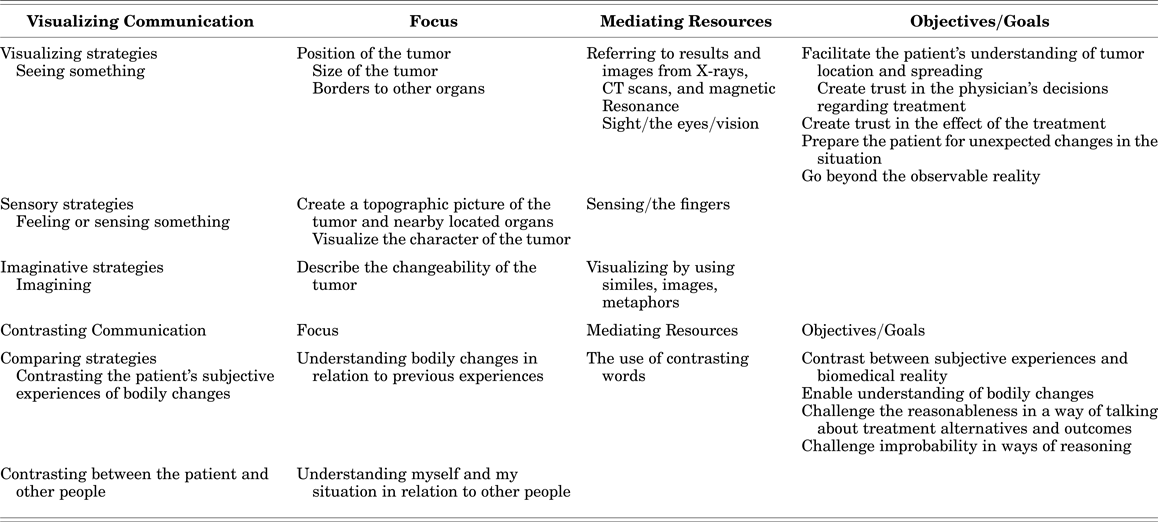
Two overarching communicative strategies (see Table 1) were found—visualizing and contrasting strategies—that communicate the disease as object (medical expressions of the disease) and the disease as subject (bodily changes experienced by patients or by physicians). The visualizing and contrasting communication strategies were sometimes used separately, but more often in interplay, depending on the situation and what message had to be communicated.
Presentation of physicians' communication strategies

Within the two different series of PCC and DIC consultations, the visualizing and contrasting strategies were used similarly, even though the standpoints and purposes of the consultations differed. For this reason, they will not be described separately in the findings unless there is a marked difference. One such significant difference was noted in regard to the physicians' use of disease-related terms and expressions about bodily changes in order to frame the consultations. The findings start with framing the consultations followed by the different communicative strategies.
Framing the Gastrointestinal Cancer Care Consultations
The communicative purpose of the preoperative consultations appeared to be to ensure that patients were initiated into accepting that they had a potentially life-threatening disease. A patient's knowledge seemed to be an important starting point for further communication, and the consultations most commonly started with the physician asking carefully formulated questions, shaped by a vague and gentle vocabulary in probing the patient's understanding of the situation—for example, “What have you been told about the abnormality in your bowel?” Once the patient's understanding was defined, the physicians changed their vocabulary, and terms like malignancy, cancer, and tumor were used to clarify and emphasize the severity of a patient's condition:
Ph: Yes. But this concerns the tumor in your bowel being a malignant tumor.
P: Hmm.
Ph: It's something you have to know.
P: Yes.
Ph: Before having this treatment.
P: Yes.
Ph: And I'm presuming you've been told this.
P: Yes.
Ph: Hmm. And they've used the word “cancer” too, have they?
In all of the preoperative consultations, the patients received “positive news,” which meant that there was no spreading of the tumor, and the disease was considered to be curable. By communicating these positive messages early in the preoperative consultations, the physicians framed the communication in a way that enabled the patient to relax and concentrate on the main topics that followed: information about the surgical procedure and other treatments, the anatomical and physiological changes that would follow surgery, and the process of recovery.
In the PCC consultations, the uncertainty of the situation was framed by assuring control of the development of the disease and of the medical treatment. Communication thus revolved around balancing the risk of an increase in tumor size with assurance of the best available medical treatment.
The most common term used to define the severity of a patient's situation was spreading, which referred to other concretized organs (e.g., liver or lungs). The terms cancer, tumor, and malignancy were not primarily used as markers of severity, but rather in a distancing way. Metastasis was seldom used, although the alternative terms secondary tumors or distant metastasis were. Reference to “glands” or “spots” informed the patients about the characteristics and progression of tumor growth. Additionally, terms that explain the process characteristics of the disease—e.g., new changes, spreading, and activity—were used to clarify a prognosis to the patient. To some extent, the communicative framings thus seemed to aim at limiting the burden of reality for the patient.
Visualizing Communication
The visualizing communication strategies that were found in this study involved three dimensions: visible strategies—visualizing with what you actually or potentially can see; sensory strategies—visualizing with what is possible to feel; and imaginative strategies—visualizing by using images and metaphors. Visualizing communication often departed from a topic that was introduced either by the physician or the patient, one that the physician elaborated upon further by utilizing those visualizing strategies.
Within the visualizing communication, various expressions were employed to guide a patient's understanding of the position, size, spreading, and bordering of the tumor to surrounding organs. Another purpose was to visualize the effects of treatments: for example, cytostatic or surgery. Describing surgical procedures, or rather the results of a surgical procedure (especially in DIC consultations), was one instance where the visualizing communication strategy was efficient and commonly used. The patient was guided stepwise through the description of the tumor's appearance and positioning, and of what it felt like for the surgeon to touch, and so on. In this way, the patient gained a topographic apprehension of the position of the tumor, and of the organ from which the tumor derived. The patient was invited to “see” what the physician had seen. Visualizing strategies offered the ability to emphasize messages within the consultations, and to facilitate the patient's participation and ability to take control of the situation, counterbalancing the power asymmetry between physician and patient.
In some ways, visualizing strategies seemed to be helpful in communicating that the situation was under control and could thus be described as verifying strategies, often used to create trust and make the patient feel safe.
Visible Visualization
The word see was employed both literally and metaphorically in conversations. The physicians communicated what is, or was, possible to detect with the assistance of images using various methods, especially CT scan and X-ray, and what was possible to see during the operation, thereby visualizing for the patient what the body looks like on the inside:
So, some new information can be gained once we operate this rectal tumor and get an idea of how it has spread. You can see much better what the surface looks like when you're inside operating, compared to the X-ray. Of course, X-ray is good for looking at it from the inside.
The fact that the physicians literally saw something enhanced the trustworthiness of their information, and this enhanced a patient's understanding of the tumor as a physical object. At the same time, a reservation was made about what could not be directly observed, which implied that the tumor “lives a life of its own,” and so the future is always more or less uncertain:
We can only see what we see. We can't see anything so small it doesn't show up on the X-ray exam. So that's an aspect of uncertainty you have to live with for the first few years. Then once four, five, six, seven years have passed and nothing's happened, you're on the safe side.
During preoperative care consultations, the physicians claimed “good reasons” to believe that the patient would be cured after surgery, because no spreading activity had been detected.
Enabling patients to become knowledgeable about the objective body and how the disease and treatment change bodily premises seemed to be one of a physician's major goals, which also presented a challenge to communication during consultations. In order to visualize where the tumor was positioned and how the anatomy and physiology of the bowel was going to change after the operation, an anatomic sketch was employed to guide a patient:
Here are the small intestines. They move about quite a bit, relatively freely inside the abdominal cavity. They can move quite a bit. The first part we call the large intestine, and there's the appendix, too. Then the large intestine goes round like a horseshoe in the abdomen that, on the other hand, sits quite securely, you could say. And in your case the abnormality, the tumor is there (…) in the very first part of the large intestine.
Visualizing the tumor by actually looking at both the tumor itself and its position, for example, via a rectoscope, was described as vital for making decisions about the surgical procedure, and for being able to predict the outcome. When a rectoscopy was performed, the physician informed the patient about what he or she saw through the rectoscope, and often linked this information to the anatomical sketch.
Mediating tools were said to be helpful in monitoring and visualizing differences in the results, often via images from CT scan, X-ray, or magnetic resonance imaging (MRI), between checkups from time to time. Balance in and control of the progression or deterioration of the disease were desirable. The (disease) process was described by physicians as being “stopped,” “slowed down,” or “advancing,” while the unpredictability of the disease was alluded to using terms like “monitor” or “check” to ensure constant preparedness. The activity of the disease required monitoring to control the process:
So if you're going to see as much as possible, then MRI is a little better. The thing about the liver, there has been such different verdicts. “What this MRI shows is that it has spread in the liver.” We can't escape that.
In this example, a physician in one of the palliative care consultations talked to a patient about his liver metastasis. The purpose of the conversation seemed to be to outline the benefits of MRI compared to other mediating tools, and thereby explain why previous methods of detecting the metastasis had failed.
Sensory Visualization
In this type of communication, the physicians guided the patient by communicating the possibility of sensing the physiological changes and abnormalities that were related to the disease. Mostly, sensory communication was used to inform about the position and spreading of the tumor, but also as part of the objective assessment of the patient's previous medical and surgical history and signs related to the present condition, for example, by palpating the abdomen.
To guide the patient's understanding of the deviation in amount of fluid, the physician says, “I'm going to squeeze the abdomen to see if there's a lot of liquid. You can feel that with your fingers.” He helps the patient to understand the variations by saying that normally there is a small amount of fluid, not sensible. There are normal variations and there are abnormal ones. In this way, he prepares the patient for the possibility of bad news. The physician also helps the patient to discern the bodily change by saying that something abnormal has been seen on the X-ray.
During consultations, the physicians also employed sensory visualization to co-create a clear picture of the tumor's size or position in the body and its relation to subjective well-being. This was done by encouraging patients to verify what was objectively known from X-rays or surgery by relating their subjective experiences: “You've felt that yourself (…) since it's pressing, as you say.”
Imaginative Visualization
During consultations the disease was communicated as a process and as a changeable and erratic activity, which on the one hand was possible to position and to delimit, but on the other was something that might transfer to or between different locations in the body. Describing changeability thereby explicated the uncertainty of the process. Especially in the palliative cancer care consultations, physicians talked about the tumor as “active” and its size as something that might decrease or increase over time, though periods of stability were also possible. To communicate the disease as a process, the physicians sometimes used images, similes, or metaphors. These images and metaphors often related to situations, activities, or phenomena in the social world about which the patients were assumed to have a current understanding. In the following example, one physician explained the growing mechanisms of the tumor by using a simile:
I don't know if I likened it to breast cancer last time; the day the woman feels she has a tumor in her breast, and then it's often been there for several years, right, and it's because a tiny little cell divides into two, then four and eight, and so on. It's only towards the end there's this exponential growth then.
In other consultations, a narrative approach was adopted using metaphors to communicate changeability, for example, by likening a situation to “a large building with several stories,” with the possible activities going on inside the building, as observed by a person standing outside. Amplifying adjectives such as “insidious” and “difficult” were utilized to describe the various traits attributed to the tumor. The process characteristics of the disease could also be presented as part of a body, a “mechanical system” whereby the process had thrown some “grit into the machinery”:
But now that there's a lot on, in that you experienced these troubles, you can expect your body to be a little out of order for a certain period of time before it finds its way back to functioning normally again.
The nature of the progression of the tumor was communicated to patients in preoperative consultations using terms like “slow growing” to describe a gradual and slow course. In these conversations, physicians communicated the risk of spreading with expressions like “might move over to other organs” and mostly emphasized terms like cancer or malign to make sure that patients recognized the importance of undergoing surgery, while also clarifying the minimal risk of spreading during the waiting period.
Contrasting Communication
Contrasting communication was frequently used in all consultations. Those strategies seemed to be directed toward enabling patients to understand bodily changes by establishing differences and similarities, most often linked to past and present time and related to subjective experiences or through comparisons with other people.
Both physicians and patients built contrasts into the conversations, although these could be of different kinds. Physicians employed contrasts to enhance the patient's understanding, and the patient agreeing, and thereby acknowledging that the contrasting had successfully delivered the underlying message, usually followed these sequences. Contrasting communication invited patients to reflect and free themselves from the order of the conversation and introduce a new topic.
Contrasting Subjective Experiences
Quite often, communication in the consultations departed from topics initiated by the patient. Specificity about the contrasting strategies seemed to center on their potential to involve the patient in an explanation of matters related to disease trajectory (progression or recovery). The patient and the physician co-created such a trajectory, which over time illustrated the contrasts in subjective experiences at different points in time. To assess changes in well-being, the physicians frequently sought to visualize contrasts between the patient's previous everyday life and the present time. In the following example, the physician asked questions about the patient's physical activity in relation to the process of recovery after treatment:
Ph: How much can you normally do, when you're out walking?
P: Well, so I haven't done it for ages because of the snow.
Ph: Before the snow came, how far could you walk then?
P: Well, I walk down to the square, so that's about 500 meters or something like that. But I used to get a lot of cramps in my legs, but I think it's got better.
The above example also outlines that contrasting communication not only enabled patients to understand their bodily changes but also allowed physicians to get a clearer picture of the patients' present condition.
Quite often, contrasting communication appeared to be aimed at enabling patients' ability to understand the reasonability of a situation and/or understand treatment alternatives and their outcomes. Sometimes the patient's experience of illness did not harmonize with the biomedical reality. In the following example, the physician emphasized a discrepancy between the patient's experience of illness and what was detected in the results from blood samples:
P: But I only had [a value of] 67 when they discovered it.
Ph: But then you should have been pale and tired.
P: No, I stayed inside (…)
Ph: You didn't notice it?
P: No.
Ph: Wow (…)
By contrasting discrepancies between experiences and the biomedical reality of bodily changes, the difference between being ill and feeling ill became more obvious. In consultations, this was sometimes helpful for the physicians, not only in motivating the patients but also in making well-grounded decisions about treatment.
Contrasting strategies were also utilized to inform the patient about their probable future condition after surgery. In the example below, the physician informed the patient about the surgical procedure and the consequences of removing the bowel, making contrasting comparisons with the patient's previous healthy life and the changes they would soon be facing in their new everyday life:
You'll have stools the normal way, of course, but you won't have the same motions. You won't feel the need to go in the same way, and you'll kind of have to miss it a bit to get your stomach in order afterwards. We usually tell patients that they'll never be how they were before.
In this example, the physician's factual and experience-based knowledge about objective bodily changes and the troubles that will usually follow surgery served as a predictor of the patient's expected subjective well-being in the near future.
Contrasting Between the Patient and Other People
Sometimes patients expected themselves, or conversely were expected by others (i.e., the physicians), to be more affected by the disease than the experience of illness revealed. In these situations, the physicians employed comparisons with other healthy people to visualize and challenge the reasonableness or improbability of patients' reasoning about their own condition, thus creating a contrast. In the following example, comparison with older people was utilized:
There are some seventy year olds running in the Gothenburg half marathon this Saturday. You always say that—it's a comfort. Why should you suddenly get more tired after just a couple of weeks? Because if we take a look at the tests, the liver, and the blood tests, there's nothing strange about them.
Occasionally, the patient and next of kin used contrasting strategies to enable physicians to better understand their situation and difficulty in grasping the message. In the following sequence, the patient and his wife made comparisons between themselves and other people in their social context to explain to the physician why some things were difficult to fully understand when they were “in their shoes”:
W: We know so little about this. We have no experience of it, neither of us. Neither of us have any relatives who have had any cancer.
Ph: And this thing that happens with this kind of tumorous disease; it doesn't happen as often with the other types, so, it's very special, this one.
W: You mean it spreads?
In this conversation, the physician continued by contrasting with a new, different content to enable the patient's wife to interpret the situation using the new information she had received.
DISCUSSION
Our study aimed to explore how physicians communicatively enable patients' understanding of bodily changes during gastrointestinal cancer care consultations. Visualizing and contrasting strategies form parts of a physician's experience- or practice-based knowledge. According to Polanyi (Reference Polanyi2009), practice-based knowledge can function tacitly. However, if verbalized and reflected, tacit knowledge becomes focal and possible to share with others and thereby possible to examine and value critically. As a consequence, visualizing and contrasting strategies can function as forceful dialogical tools and become a more deliberate part of consultation practice.
The identified visualizing and contrasting strategies and variations thereof revealed clear pedagogical potentials and, as we interpret them, arenas for patient learning. To deepen the understanding of the two communicative strategies, we now turn to the variation theory of learning (Marton & Booth, Reference Marton and Booth1997), according to which the discerning, varying, and comparing aspects of what is to be learned are core concepts in learning. The physicians in our study employed all these concepts. Following Marton & Booth (Reference Marton and Booth1997), to enable learning, the characteristics of the learning object (the “what” aspect) have to be discerned in addition to the ways the learning object varies (the “how” aspect). Thus, the pedagogical task for the physician is to identify critical aspects in the learning patient's way of thinking or reasoning. In the above example, a critical aspect may be when the patient suddenly understands the location and size of the tumor in relation to the function of the bowels. Identification of these aspects and reflective dialogical exploration thereof are critical for the patient's understanding.
The excerpt in the results section regarding a physician's abdominal examination to check fluid level exemplifies something that could develop into a critical point in a patient's way of understanding. If the physician's examination of the abdomen reveals more fluid than normal, the patient will presumably link that information to an increase in tumor size. Consequently, the patient finds out something he or she did not know before. According to Marton & Booth (Reference Marton and Booth1997), change in knowing always indicates a change in perception. Reflected awareness of the connection between different levels of fluid and the underlying cancer situation could thus signal a turning point in the patient's way of understanding.
Research on physicians' communication skills and strategies often describes a medically driven agenda (Fine et al., Reference Fine, Reid and Shengelia2010). Our study points to interesting details that give a more nuanced view. In fact, in our study, we see that finely graded and multilayered communication strategies were employed to enable patients' understanding of bodily changes. Even if the physicians often steered and framed the communication (Rogers & Todd, Reference Rogers and Todd2010; Öhlen et al., Reference Öhlen, Carling-Elofsson and Hydén2008), the results of our study reveal clear efforts to guide patients toward an understanding of their bodily changes. The fact that the physicians literally had seen or sensed something presumably enhanced the trustworthiness of their information. It is likely that it also enhanced patient understanding of the tumor as a physical object (Fine et al., Reference Fine, Reid and Shengelia2010). Bodily changes may therefore be easier to understand if a physician who has seen it with his own eyes or sensed it with his fingers describes the localization and topography of a tumor.
The strategies used by physicians can be regarded as ways of checking a patient's level of knowledge (their beliefs and perceptions) and also as a way to prepare for bad or good news. The use of metaphors and euphemisms indicate alternatives to a more cognitively directed language. Accordingly, we assume that the bodily and cognitively framed pedagogical strategies prepare the patient to understand the status of the cancer disease following a bodily change. Here we would like to draw a parallel to the term “sense making” (Chapman et al., Reference Chapman, Abraham and Jenkins2003; Taylor et al., Reference Taylor, Richardson and Cowley2010). Öhlén et al. (Reference Öhlen, Wallengren Gustafsson and Friberg2013) described sense making of receiving palliative treatment as a process of human learning characterized by an ongoing search for knowledge and understanding. According to Kenne Sarenmalm et al. (Reference Kenne Sarenmalm, Thoren-Jonsson and Gaston-Johansson2009), sense making is a personal transition process while adjusting to impending death in three phases: confronting shifting expectations and awareness, easing distress, and transcending with the creation of wellness. Consequently, professionals must go beyond provision of pure information to enable patients' sense making.
Visualizing and contrasting strategies are examples of such sense-making activities. Expressed another way, the sense-making process makes the transformation of information to personal knowledge possible. Hence, sense making as indicated in this study is process directed and situational, in comparison to information transference, which is a more linear way of thinking. Indeed, sense making as a pedagogical approach (Öhlén et al., Reference Öhlen, Wallengren Gustafsson and Friberg2013) presupposes a view of a patient as a person capable of understanding bodily changes. The results also indicate that the physicians were dependent on patients' knowledge as a basis for decision making. This dual and shared knowledge can be described as a kind of partnership and is one of the core concepts of person-centered care (Tullis, Reference Tullis2012). Another cornerstone in person-centered care is to take the patient's narrative into account (Ekman et al., Reference Ekman, Swedberg and Taft2011; McCormack & McCance, Reference McCormack and McCance2006). The physicians in our study used notes from the patients' illness stories (palliative cancer patients) or what they had read in a medical journal (surgical cancer patients) as mediating communicative tools in the conversation.
As indicated in our study, it is a pedagogical challenge to make information available in a person-centered manner. The results clearly disclose that the physicians went beyond transferring factual medical information, and the statements they used were not primarily cognitive in terms of conceptualized explanations. Instead, we assume that the physicians' communicative and pedagogical strategies were bodily and experientially grounded in encounters with former patients, and employed because they had previously been valued as successful or convenient. As shown in a study by van de Wiej et al. (Reference van de Wiej, van den Bossche and Janssen2011), physicians' workplace learning was to a large degree based in experience. Here, interactive moments (such as in consultations) were shown to contribute to development of expertise. Our study clearly revealed pedagogical skills mirroring physicians' expertise. Teaching pedagogical theories for the development of reflected expertise in complex learning practices can thus play a major role in medical and continuing education. However, in order to become formalized parts of medical education and consultation practice, the presented strategies need to be further implemented and tested.
We chose one theory of learning as an appropriate frame of interpretation. We found the parallels between the physicians' strategies and the variation theory of learning (Marton & Booth, Reference Marton and Booth1997; Polanyi, Reference Polanyi2009) interesting and significant in problematizing consultation practice, which was largely taken for granted and not reflected upon. The variation theory derives from phenomenography (Marton & Booth, Reference Marton and Booth1997; Marton, Reference Marton1981), which is a learning approach inspired by phenomenology and Gestalt theory. Key concepts in phenomenography are phenomena and learning objects, human experience and intentionality (Marton, Reference Marton1981). In our study, we were inspired by the fact that the physicians directed their awareness (intentionality) toward patients' words and gestures (human experiences) and toward that which had to be learned (phenomenon or learning object). We utilized two datasets. The results from the first dataset were validated by analysis of the second dataset, which we see as a methodological strength. Further studies are needed to more fully understand learning practices from the perspectives of both patients and physicians. Visualizing and contrasting communicative strategies as parts of physicians' tacit and experience-based knowledge, as revealed in this study of gastrointestinal cancer consultations, need to be verbalized. Of significance is explication of the unreflected use of learning theory. By means of increased awareness, physicians can more easily identify turning points in patients' levels of understanding, thereby enriching ordinary medical consultations with reflected pedagogical strategies and skills in how to dialogue in a person-centered manner. In addition, continuous interdisciplinary and crossdisciplinary workshops are suggested for collegial sharing and critical discussion of experience-based pedagogical knowledge.
ACKNOWLEDGMENTS
Our sincere thanks to the patients and physicians who took part in the interviews. The study was supported by grants from the University of Gothenburg Center for Person-Centred Care (GPCC).